

ORGANIZATIONAL COMMUNICATIONPRESENTED BY:ABHILASH NAIRHARSHIDA CPRIYA PSHISHIR V RATHOREVIVEK SRIVASTAVA
FORMAL SMALL-GROUP NETWORKS
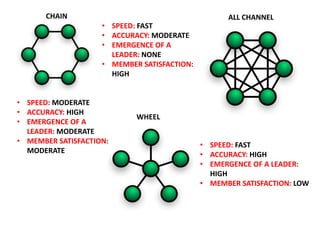
CHAINALL CHANNELSPEED: FAST
ACCURACY: MODERATE
EMERGENCE OF A LEADER: NONE
MEMBER SATISFACTION: HIGH
SPEED: MODERATE
ACCURACY: HIGH
EMERGENCE OF A LEADER: MODERATE
MEMBER SATISFACTION:MODERATEWHEELSPEED: FAST
ACCURACY: HIGH
EMERGENCE OF A LEADER: HIGH
MEMBER SATISFACTION: LOWGRAPEVINE COMMUNICATIONInformal communication group.Important source of information. Statistics say 75% of the employees hear about the matters through rumors.General practice involves tracing a piece of information back to its source
GRAPEVINE COMMUNICATIONNot controlled by managementConsidered more believable and reliable than formal communication techniques.To serve the self interests of people within the organization.
RUMORS !!They emerge as response to:Important IssuesAmbiguityAnxiety
IS GRAPEVINE NECESSARY ?About 75% of information carried is true.Gives managers a feel for moral in their organization.Help identify what is important or not.Creates a sense of closeness and friendship among whom they share.
Management must work….HOW?To avoid negative consequences of rumorsAnnouncing timetables for decisionsExplaining decisions and behaviors that may appear secretive and unclear.Emphasizing on downside and upside of decisions and future plans.Openly discuss worst case possibilities.
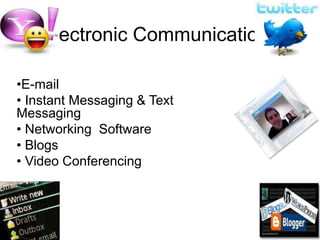
Electronic CommunicationsE-mail
 Instant Messaging & Text                          Messaging
 Networking  Software
 Blogs
 Video ConferencingE-mailE-mail uses the internet to transmit and receive computer generated text and documents.
BenefitsManaging E-mail is EasyFastInexpensiveTransmission Secure and Reliable Easy to PrioritizeAutomated E-mails
LimitationsMisinterpreting the Message Communicating Negative Messages Overuse of E-mail E-mail Emotions Privacy Concerns
        Instant messagingDefinition :IM falls under the umbrella term online chat communication done in real-time, between specified known users
               OverviewIt is real timeAllows Text, voice call, Video CallsOffline Messages are also allowedAllowing immediate receipt of acknowledgment or reply
                   History   Instant messaging predates the InternetFirst appearing on multi-user operating systems like Compatible Time-Sharing System (CTSS) and Multiplexed Information and Computing Service (Multics ) [1] in the mid-1960s. Initially, some of these systems were used as notification systems for services like printing
            InteroperabilityTransfer file , contact list, the ability to hold several simultaneous conversations.Enterprise application integrationXMPP, Lotus  Sametime , Microsoft Office Communicator
Mobile instant messagingServices to be accessed from a portable deviceAndroid, Blackberry OS, iOS  , Symbian OS, Windows MobileEmbedded clients - tailored IM client for every specific device.a)  Clientless platform –  not need to download any            software to the handsetb)  Enables all users and all devices from any network to connect
            In web browserGtalkyahoo! MessengerWindow Live Messenger
       Business applicationEnterprise Instant MessagingMicrosoft ExchangeIBM Lotus Sametime , Microsoft Office Communications Server, Jabber XCP and Cisco Unified Presence
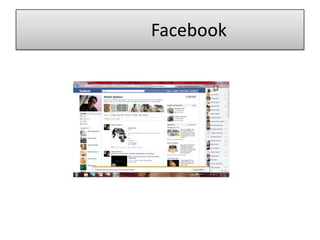
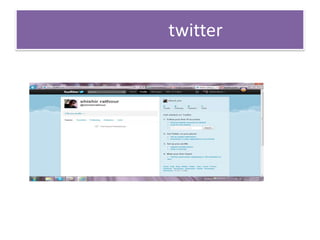
   Social Networking SitesFacebookTwitterMyspaceOrkut
             Facebook
                twitter
Web Logs (Blogs)
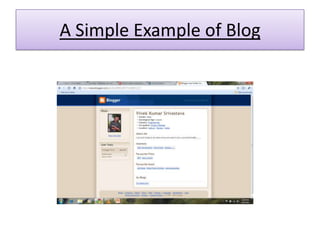
INTRODUCTIONA blog (a blend of the term web log) is a type of website or part of a website. Blogs are usually maintained by an individual with regular entries of commentary, descriptions of events, or other material such as graphics or video.Most blogs are interactive, allowing visitors to leave comments and even message each other via widgets on the blogs and it is this interactivity that distinguishes them from other static websites.
A Simple Example of Blog
Types Of BlogsThere are many different types of blogs, differing not only in the type of content, but also in the way that content is delivered or written.Personal blogs                     -- TwitterCorporate and organizational blogs                      -- Business BlogsBy media type-                        -- vlog ,LinklogBy device                    ---   moblog
Reasons Your Business Needs a BlogBuild relationshipsBuild your reputationBuild customer loyalty Build authority Build traffic

Organizational communication

  • 1.
    ORGANIZATIONAL COMMUNICATIONPRESENTED BY:ABHILASHNAIRHARSHIDA CPRIYA PSHISHIR V RATHOREVIVEK SRIVASTAVA
  • 2.
  • 3.
  • 4.
  • 5.
    EMERGENCE OF ALEADER: NONE
  • 6.
  • 7.
  • 8.
  • 9.
    EMERGENCE OF ALEADER: MODERATE
  • 10.
  • 11.
  • 12.
    EMERGENCE OF ALEADER: HIGH
  • 13.
    MEMBER SATISFACTION: LOWGRAPEVINECOMMUNICATIONInformal communication group.Important source of information. Statistics say 75% of the employees hear about the matters through rumors.General practice involves tracing a piece of information back to its source
  • 14.
    GRAPEVINE COMMUNICATIONNot controlledby managementConsidered more believable and reliable than formal communication techniques.To serve the self interests of people within the organization.
  • 15.
    RUMORS !!They emergeas response to:Important IssuesAmbiguityAnxiety
  • 16.
    IS GRAPEVINE NECESSARY?About 75% of information carried is true.Gives managers a feel for moral in their organization.Help identify what is important or not.Creates a sense of closeness and friendship among whom they share.
  • 17.
    Management must work….HOW?Toavoid negative consequences of rumorsAnnouncing timetables for decisionsExplaining decisions and behaviors that may appear secretive and unclear.Emphasizing on downside and upside of decisions and future plans.Openly discuss worst case possibilities.
  • 18.
  • 19.
    Instant Messaging& Text Messaging
  • 20.
    Networking Software
  • 21.
  • 22.
    Video ConferencingE-mailE-mailuses the internet to transmit and receive computer generated text and documents.
  • 23.
    BenefitsManaging E-mail isEasyFastInexpensiveTransmission Secure and Reliable Easy to PrioritizeAutomated E-mails
  • 24.
    LimitationsMisinterpreting the MessageCommunicating Negative Messages Overuse of E-mail E-mail Emotions Privacy Concerns
  • 25.
    Instant messagingDefinition :IM falls under the umbrella term online chat communication done in real-time, between specified known users
  • 26.
    OverviewIt is real timeAllows Text, voice call, Video CallsOffline Messages are also allowedAllowing immediate receipt of acknowledgment or reply
  • 27.
    History Instant messaging predates the InternetFirst appearing on multi-user operating systems like Compatible Time-Sharing System (CTSS) and Multiplexed Information and Computing Service (Multics ) [1] in the mid-1960s. Initially, some of these systems were used as notification systems for services like printing
  • 28.
    InteroperabilityTransfer file , contact list, the ability to hold several simultaneous conversations.Enterprise application integrationXMPP, Lotus Sametime , Microsoft Office Communicator
  • 29.
    Mobile instant messagingServicesto be accessed from a portable deviceAndroid, Blackberry OS, iOS , Symbian OS, Windows MobileEmbedded clients - tailored IM client for every specific device.a) Clientless platform – not need to download any software to the handsetb) Enables all users and all devices from any network to connect
  • 30.
    In web browserGtalkyahoo! MessengerWindow Live Messenger
  • 31.
    Business applicationEnterprise Instant MessagingMicrosoft ExchangeIBM Lotus Sametime , Microsoft Office Communications Server, Jabber XCP and Cisco Unified Presence
  • 32.
    Social Networking SitesFacebookTwitterMyspaceOrkut
  • 33.
    Facebook
  • 34.
    twitter
  • 35.
  • 36.
    INTRODUCTIONA blog (a blend of the term weblog) is a type of website or part of a website. Blogs are usually maintained by an individual with regular entries of commentary, descriptions of events, or other material such as graphics or video.Most blogs are interactive, allowing visitors to leave comments and even message each other via widgets on the blogs and it is this interactivity that distinguishes them from other static websites.
  • 37.
  • 38.
    Types Of BlogsThereare many different types of blogs, differing not only in the type of content, but also in the way that content is delivered or written.Personal blogs -- TwitterCorporate and organizational blogs -- Business BlogsBy media type- -- vlog ,LinklogBy device --- moblog
  • 39.
    Reasons Your BusinessNeeds a BlogBuild relationshipsBuild your reputationBuild customer loyalty Build authority Build traffic