Amity Business School
1
Amity Business School
MBA
Dr. Anshu Yadav
Amity Business School
Perception
Why Study Perception
Human behaviour is a function of
 the way in which we perceive the world around
us, and
 how we perceive other people and events in
that world
It is our perception of reality which shapes and
directs our behaviour, not some objective
understanding of it
3
When you change
the way you look
at things, the
things you look
at change.
Which of these lines is longer.
Which of the center circles are larger in size.
Gestalt
Approach
Figure
Ground
A process by which individuals select, organize and
interpret their sensory impressions in order to give
meaning to their environment.
People’s behavior is based on their perception of what
reality is, not on reality itself.
The world as it is perceived is the world that is
behaviorally important.
Organization
Selection Interpretation
Input
Outputs
Factors Influencing
Perception
Amity Business School
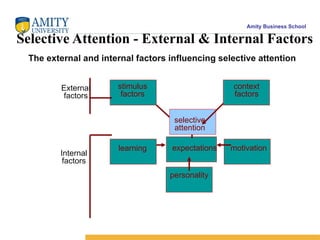
Selective Attention - External & Internal Factors
The external and internal factors influencing selective attention
expectations motivation
selective
attention
stimulus
factors
context
factors
learning
personality
External
factors
Internal
factors
Amity Business School
External factors: Our attention is drawn to stimuli that are:
Our attention is drawn more readily to external stimuli
that are:
large rather than small
bright dull
loud quiet
strong weak
unfamiliar familiar
stand out from surroundings blend with
surroundings
moving stationary
repeated (but not repetitive) one-off
Amity Business School
Internal factors affecting perception
Perceptual Process
The dynamic psychological process
responsible for attending to, organizing and
interpreting sensory data
–The perceptual process consists of the
following elements:
1. Environmental stimuli
2. Observation
3. Perceptual selection
4. Perceptual organization
5. Interpretation
6. response
13
Perception
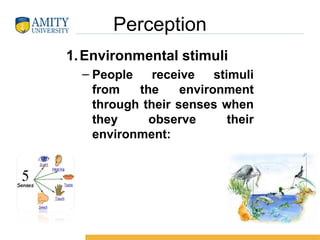
1.Environmental stimuli
– People receive stimuli
from the environment
through their senses when
they observe their
environment:
Perception
2.Perceptual Selection
• When the stimuli are received a person might pay attention to some
of the aspects in the environment and ignore others. This filtering
out of most information to deal with the most important matter is
referred to as selective screening.The influencing factors are due
mainly to external and internal factors.
• External factors are:
»Size
»Intensity
»Contrast
»Motion
»Repetition
»Novelty and familiarity
• A combination of the above may be operating at any time to affect
perception.
Perception
• Internal factors
 Personality – personality is a strong influencing
factor in determining how an individual perceive
other people.
 Learning affects perception by the development
of perceptual sets. A perceptual set is an
expectation of a particular interpretation based on
past experience with the same or similar objects.
 Motivation – the urgent needs and desires at any
particular time can influence perception.
How would you describe these
potato chips?
3.Perceptual organization
• The process by which
people group environmental
stimuli into recognizable
patterns
• Perceptual grouping is the
tendency to form perceive
objects as a continuous
pattern.
Perception
• Closure is
the tendency
to complete
an object
and perceive
it as a
constant.
Good fit, closure, simplicity
Law of Proximity
Personal perception
• Personal perception is the process by which
individuals attribute characteristics or traits to other
people. One imagines that in the workplace personal
perception plays an important role in shaping our
behaviour in context of our work relationships with our
colleagues. The factors that influence personal
perception are:
Characteristics of the perceived
Characteristics of the perceiver, and
The situation or context within which the perception takes
place.
Person perception
• The perceived
– The person being perceived gives us information
relative to:
Facial expression
General appearance
Skin colour
Posture
Age
Gender
Voice quality
Personality traits
behaviours
Person perception
• The situation
 Situation does not only mean a place. Situation is inclusive of
an event or an occasion when people interact. A situation may
be important in understanding first impressions.
Attribution theory
Attribution theory aids in perceptual
interpretation by focusing on how people
attempt to :
 Understand the causes of a certain event.
 Assess responsibility for the outcomes of the
event.
 Evaluate the personal qualities of the people
involved in the event.
Attribution Theory: Judging
Others
When individuals observe behavior, they attempt to
determine whether it is internally or externally caused.
Causes of Behavior
Internal causes are under that person’s control
 Internal factors – Personal characteristics that cause
behavior (e.g., ability, effort)
External causes are not controllable, person forced to act
in that way
 External factors – Environmental characteristics that
cause behavior (e.g., task difficulty, good/bad luck)
Rules for determining
Attribution
Distinctiveness -A behavioural rule that asks
whether an individual acts similarly across a variety
of situations.
Consensus - A behavioural rule that asks if
everyone faced with a similar situation responds in
the same way.
Consistency - A behavioural rule that asks whether
the individual has been acting in the same way over
time.
Elements of Attribution
Theory
Errors and Biases in Attributions
Fundamental Attribution Error
 The tendency to underestimate the influence of
external factors and overestimate the influence of
internal factors when making judgments about the
behavior of others
 We blame people first, not the situation
Self-Serving Bias
 The tendency for individuals to attribute their own
successes to internal factors while putting the blame
for failures on external factors
 It is “our” success but “their” failure
Frequently Used Shortcuts in Judging
Others
 Selective Perception - People selectively interpret
what they see on the basis of their interests,
background, experience, and attitudes
 Halo Effect- Drawing a general impression about
an individual on the basis of a single characteristic
 Contrast Effects- Evaluation of a person’s
characteristics that are affected by comparisons
with other people recently encountered who rank
higher or lower on the same characteristics
 Projection: The tendency to attribute one’s own
characteristics to other people.
 Stereotyping - Judging someone on the basis of
one’s perception of the group to which that person
belongs – a prevalent and often useful, if not
always accurate, generalization
 Prejudice - An unfounded dislike of a person or
group based on their belonging to a particular
stereotyped group.
Frequently Used Shortcuts in Judging
Others
Specific Shortcut Applications in
Organizations
 Employment Interview- Perceptual biases of raters
affect the accuracy of interviewers’ judgments of
applicants. Formed in a single glance – 1/10 of a
second!
 Performance Evaluations- Appraisals are often the
subjective (judgmental) perceptions of appraisers of
another employee’s job performance
 Building Relationship- Positive perception helps to
build effective communication and trust, leading to
high performing relationship within managerial
group, within employees, and between managers
and junior employees.
Managerial uses of perception
 Advertising
 Maintaining Safety
 Managing Impression
 Building Corporate Image
 Self-Assessment and Development
 Judging Employees’ Loyalty
Self-Fulfilling Prophecy
The terms self-fulfilling prophecy or Pygmalion effect
have evolved to characterize the fact that people’s
expectations determine their behaviour.
It is a concept that a person will behave in ways
consistent with how he or she is perceived by others.
Illustration: 105 soldiers in the Israeli Defense Forces
Organizational Behavior
34
Test Your Knowledge
Nadia’s performance is declining. Her peers
performance hasn’t changed, it is occurring on
several tasks, and has occurred for the past six
months.
 This represents:
1. consensus : High (A) or Low (B)
2. distinctiveness : High (A) or Low (B)
3. consistency : High (A) or Low (B)
 The attribution her supervisor is likely to make is…
a. Internal
b. External
Thank You
36
How do we “organize” (i.e., cluster, group, give meaning, prioritize) our
sensations into perception?
How do we “organize” (i.e., cluster, group, give meaning, prioritize) our
sensations into perception?

Module 2 Perception dfbb ghnh tgng nbvf gh

  • 1.
    Amity Business School 1 AmityBusiness School MBA Dr. Anshu Yadav
  • 2.
  • 3.
    Why Study Perception Humanbehaviour is a function of  the way in which we perceive the world around us, and  how we perceive other people and events in that world It is our perception of reality which shapes and directs our behaviour, not some objective understanding of it 3
  • 4.
    When you change theway you look at things, the things you look at change.
  • 5.
    Which of theselines is longer. Which of the center circles are larger in size.
  • 6.
  • 7.
    A process bywhich individuals select, organize and interpret their sensory impressions in order to give meaning to their environment. People’s behavior is based on their perception of what reality is, not on reality itself. The world as it is perceived is the world that is behaviorally important.
  • 8.
  • 9.
  • 10.
    Amity Business School SelectiveAttention - External & Internal Factors The external and internal factors influencing selective attention expectations motivation selective attention stimulus factors context factors learning personality External factors Internal factors
  • 11.
    Amity Business School Externalfactors: Our attention is drawn to stimuli that are: Our attention is drawn more readily to external stimuli that are: large rather than small bright dull loud quiet strong weak unfamiliar familiar stand out from surroundings blend with surroundings moving stationary repeated (but not repetitive) one-off
  • 12.
    Amity Business School Internalfactors affecting perception
  • 13.
    Perceptual Process The dynamicpsychological process responsible for attending to, organizing and interpreting sensory data –The perceptual process consists of the following elements: 1. Environmental stimuli 2. Observation 3. Perceptual selection 4. Perceptual organization 5. Interpretation 6. response 13
  • 14.
    Perception 1.Environmental stimuli – Peoplereceive stimuli from the environment through their senses when they observe their environment:
  • 15.
    Perception 2.Perceptual Selection • Whenthe stimuli are received a person might pay attention to some of the aspects in the environment and ignore others. This filtering out of most information to deal with the most important matter is referred to as selective screening.The influencing factors are due mainly to external and internal factors. • External factors are: »Size »Intensity »Contrast »Motion »Repetition »Novelty and familiarity • A combination of the above may be operating at any time to affect perception.
  • 16.
    Perception • Internal factors Personality – personality is a strong influencing factor in determining how an individual perceive other people.  Learning affects perception by the development of perceptual sets. A perceptual set is an expectation of a particular interpretation based on past experience with the same or similar objects.  Motivation – the urgent needs and desires at any particular time can influence perception. How would you describe these potato chips?
  • 17.
    3.Perceptual organization • Theprocess by which people group environmental stimuli into recognizable patterns • Perceptual grouping is the tendency to form perceive objects as a continuous pattern.
  • 18.
    Perception • Closure is thetendency to complete an object and perceive it as a constant.
  • 19.
  • 20.
  • 21.
    Personal perception • Personalperception is the process by which individuals attribute characteristics or traits to other people. One imagines that in the workplace personal perception plays an important role in shaping our behaviour in context of our work relationships with our colleagues. The factors that influence personal perception are: Characteristics of the perceived Characteristics of the perceiver, and The situation or context within which the perception takes place.
  • 22.
    Person perception • Theperceived – The person being perceived gives us information relative to: Facial expression General appearance Skin colour Posture Age Gender Voice quality Personality traits behaviours
  • 23.
    Person perception • Thesituation  Situation does not only mean a place. Situation is inclusive of an event or an occasion when people interact. A situation may be important in understanding first impressions.
  • 24.
    Attribution theory Attribution theoryaids in perceptual interpretation by focusing on how people attempt to :  Understand the causes of a certain event.  Assess responsibility for the outcomes of the event.  Evaluate the personal qualities of the people involved in the event.
  • 25.
    Attribution Theory: Judging Others Whenindividuals observe behavior, they attempt to determine whether it is internally or externally caused. Causes of Behavior Internal causes are under that person’s control  Internal factors – Personal characteristics that cause behavior (e.g., ability, effort) External causes are not controllable, person forced to act in that way  External factors – Environmental characteristics that cause behavior (e.g., task difficulty, good/bad luck)
  • 26.
    Rules for determining Attribution Distinctiveness-A behavioural rule that asks whether an individual acts similarly across a variety of situations. Consensus - A behavioural rule that asks if everyone faced with a similar situation responds in the same way. Consistency - A behavioural rule that asks whether the individual has been acting in the same way over time.
  • 27.
  • 28.
    Errors and Biasesin Attributions Fundamental Attribution Error  The tendency to underestimate the influence of external factors and overestimate the influence of internal factors when making judgments about the behavior of others  We blame people first, not the situation Self-Serving Bias  The tendency for individuals to attribute their own successes to internal factors while putting the blame for failures on external factors  It is “our” success but “their” failure
  • 29.
    Frequently Used Shortcutsin Judging Others  Selective Perception - People selectively interpret what they see on the basis of their interests, background, experience, and attitudes  Halo Effect- Drawing a general impression about an individual on the basis of a single characteristic  Contrast Effects- Evaluation of a person’s characteristics that are affected by comparisons with other people recently encountered who rank higher or lower on the same characteristics
  • 30.
     Projection: Thetendency to attribute one’s own characteristics to other people.  Stereotyping - Judging someone on the basis of one’s perception of the group to which that person belongs – a prevalent and often useful, if not always accurate, generalization  Prejudice - An unfounded dislike of a person or group based on their belonging to a particular stereotyped group. Frequently Used Shortcuts in Judging Others
  • 31.
    Specific Shortcut Applicationsin Organizations  Employment Interview- Perceptual biases of raters affect the accuracy of interviewers’ judgments of applicants. Formed in a single glance – 1/10 of a second!  Performance Evaluations- Appraisals are often the subjective (judgmental) perceptions of appraisers of another employee’s job performance  Building Relationship- Positive perception helps to build effective communication and trust, leading to high performing relationship within managerial group, within employees, and between managers and junior employees.
  • 32.
    Managerial uses ofperception  Advertising  Maintaining Safety  Managing Impression  Building Corporate Image  Self-Assessment and Development  Judging Employees’ Loyalty
  • 33.
    Self-Fulfilling Prophecy The termsself-fulfilling prophecy or Pygmalion effect have evolved to characterize the fact that people’s expectations determine their behaviour. It is a concept that a person will behave in ways consistent with how he or she is perceived by others. Illustration: 105 soldiers in the Israeli Defense Forces
  • 34.
    Organizational Behavior 34 Test YourKnowledge Nadia’s performance is declining. Her peers performance hasn’t changed, it is occurring on several tasks, and has occurred for the past six months.  This represents: 1. consensus : High (A) or Low (B) 2. distinctiveness : High (A) or Low (B) 3. consistency : High (A) or Low (B)  The attribution her supervisor is likely to make is… a. Internal b. External
  • 35.
  • 36.
  • 37.
    How do we“organize” (i.e., cluster, group, give meaning, prioritize) our sensations into perception?
  • 38.
    How do we“organize” (i.e., cluster, group, give meaning, prioritize) our sensations into perception?