组织行为学:导论 Organizational Behavior:Introduction 金杨华 博士、副教授 Dr. JIN Yang-hua 浙江工商大学工商管理学院 School of Management, Zhejiang Gongshang University E-mail: jinyanghua@163.com
组织行为学是探讨个体、群体及结构对组织内部个体行为的影响,以便应用这些知识去改善组织效能的研究领域,是综合性、基础性学科。 ( OrganizationalBehavior is a field of study that investigates the impact that individuals, groups, and structure on behavior within organizations for the purpose of applying such knowledge toward improving an organization’s effectiveness. ) 组织行为学是综合运用各种与人的行为有关的知识,研究各类工作组织中人的工作行为规律的科学。 组织行为学
MBTI ( Myers-BriggsType Indicator ) 的个性分类 心理类型测验 从四个维度考察个人的个性及偏好: 1 能量获取 : E xtraversion (E) v s. I ntroversion (I) 外倾 / 内倾 2 接受信息 : S ensing (S) vs. i N tuition (N) 感觉 / 直觉 3 处理信息 : T hinking (T) vs. F eeling (F) 思考 / 情感 4 生活方式 : J udging (J) vs. P erceiving (P) 判断 / 知觉 Energizing / Attending / Deciding / Living
The importance ofbig five personality traits Conscientiousness: key factor to career success CEO of Southwest Airline Herb Kellerher worked 80-90 hours a week and less than 6 hours sleeping time. Emotional stability and extroversion are important to sales or management, agreeableness are imperative to team work……
28.
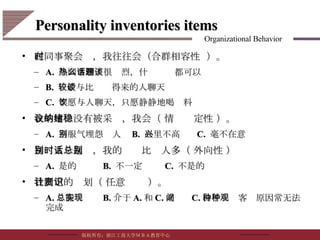
Personality inventories items在同事聚会时,我往往会(合群相容性 )。 A. 与同事聊天很热烈,什么话题都可以谈 B. 一般与比较谈得来的人聊天 C. 不愿与人聊天,只愿静静地喝饮料 我的建议没有被采纳,我会( 情绪稳定性 )。 A. 不服气埋怨别人 B. 心里不高兴 C. 毫不在意 和别人一起时,我的话总比别人多( 外向性 ) A. 是的 B. 不一定 C. 不是的 我制定的计划( 责任意识 )。 A. 总能实现 B. 介于 A. 和 C. 之间 C. 由于种种客观原因常无法完成
29.
其他个性特质 Locus ofControl (控制源):内控型 外控型 自尊( Self esteem ):人们喜欢或不喜欢自己的程度 自我监控( Self-monitoring ):根据情境调整行为的能力 冒险性( risk-taking ):冒险意愿上的差异 马基雅维里主义 (Mach ):实效、任务结果导向、控制 A 型人格( Type A Personality )
不同文化下的价值观 Greet Hofstede(霍夫斯塔德)的文化研究: 个体主义-集体主义( Individualism vs. Collectivism) 权利距离( Power Distance) 不确定性回避 (Uncertainty Avoidance) 长期导向与短期导向 (Long-term vs. Short-term Orientation) 生活质量与生活数量 ( Lift of Quality vs. Quantity)


![组织行为学( Organizational Behavior ) 主要教材: [ 美 ] 斯蒂芬 • P • 罗宾斯( Stephen P. Robbins ) 《组织行为学》(第十版)中国人民大学出版社 2005 相关中文期刊 管理世界 人力资源开发与管理 中国人力资源开发 心理学报](https://image.slidesharecdn.com/organizational-behavior-introduction-1196172862186103-2/85/Organizational-Behavior-Introduction-7-320.jpg)








![能力研究进展-胜任能力建模 1 、胜任能力( Competence )的起源 McClelland(1973) 年回顾以往研究发现:智力测验和学业成绩不能预测职业成功,应该用胜任能力( Competence )代替传统智力测验。 McClelland D C. Testing for competence rather than for “intelligence” [J]. American Psychologist , 1973, 28: 1-14. 2 、胜任能力( Competence )的概念 ( 1 ) 胜任能力指动机、特质、自我概念、态度 / 价值观、知识或技能,是指能够被可靠测量的,并能把高绩效员工与一般员工区分出来的任何个体特征( Spencer , McClelland & Spencer , 1994 ); ( 2 ) 胜任能力指知识、技能、能力、动机、信念、价值观和兴趣的综合( Fleishman , et al. , 1995 ); ( 3 ) 胜任能力指与高工作绩效相关的知识、技能、能力或特征( Mirabile , 1997 ); 此外, Zwell 和 Russell 等直接把胜任能力定义为决定工作绩效的持久的品质和特征( Zwell , 2000 ;金杨华、陈卫旗、王重鸣 , 2004 )。](https://image.slidesharecdn.com/organizational-behavior-introduction-1196172862186103-2/85/Organizational-Behavior-Introduction-48-320.jpg)


