Su-Laine Yeo Vancouver User Experience Group November, 2007 Dynamics of Wikipedia This presentation is licensed under Creative Commons Attribution Share-Alike 3.0 http://creativecommons.org/licenses/by-sa/3.0/
Overview How does it all work? Who writes for Wikipedia, and why? How does the site keep vandalism and spam away? What happens when contributors disagree?  How does the site keep articles consistent and organized?
Agenda What is Wikipedia? Contributing: Part I Vandalism and spam Conflict and culture Contributing: Part II Please ask questions along the way!
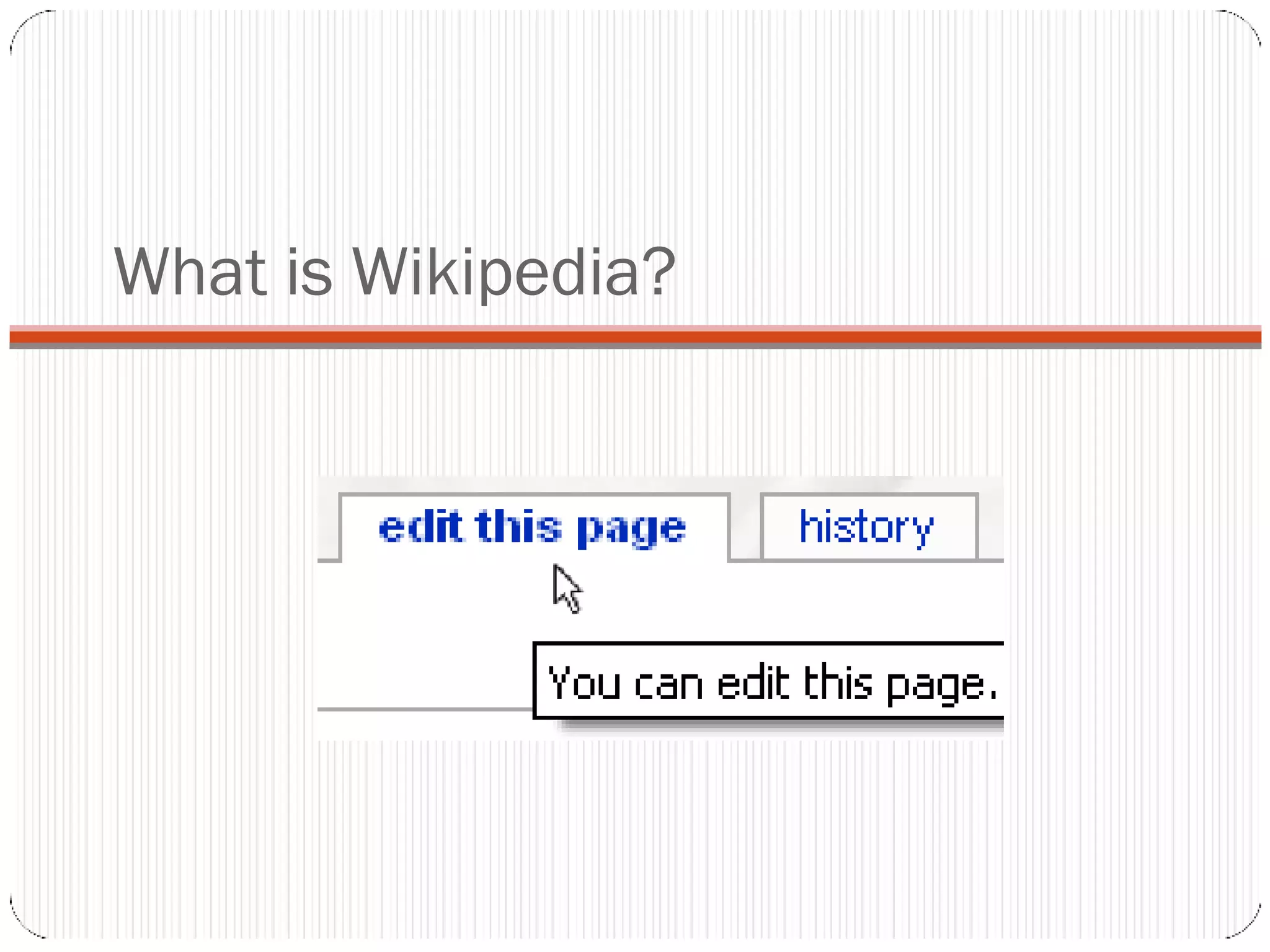
What is Wikipedia?
Vision A free, neutral encyclopedia that anyone can edit “ Imagine a world in which every single person on the planet is given free access to the sum of all human knowledge. That's what we're doing.”  –  Wikipedia founder Jimbo Wales
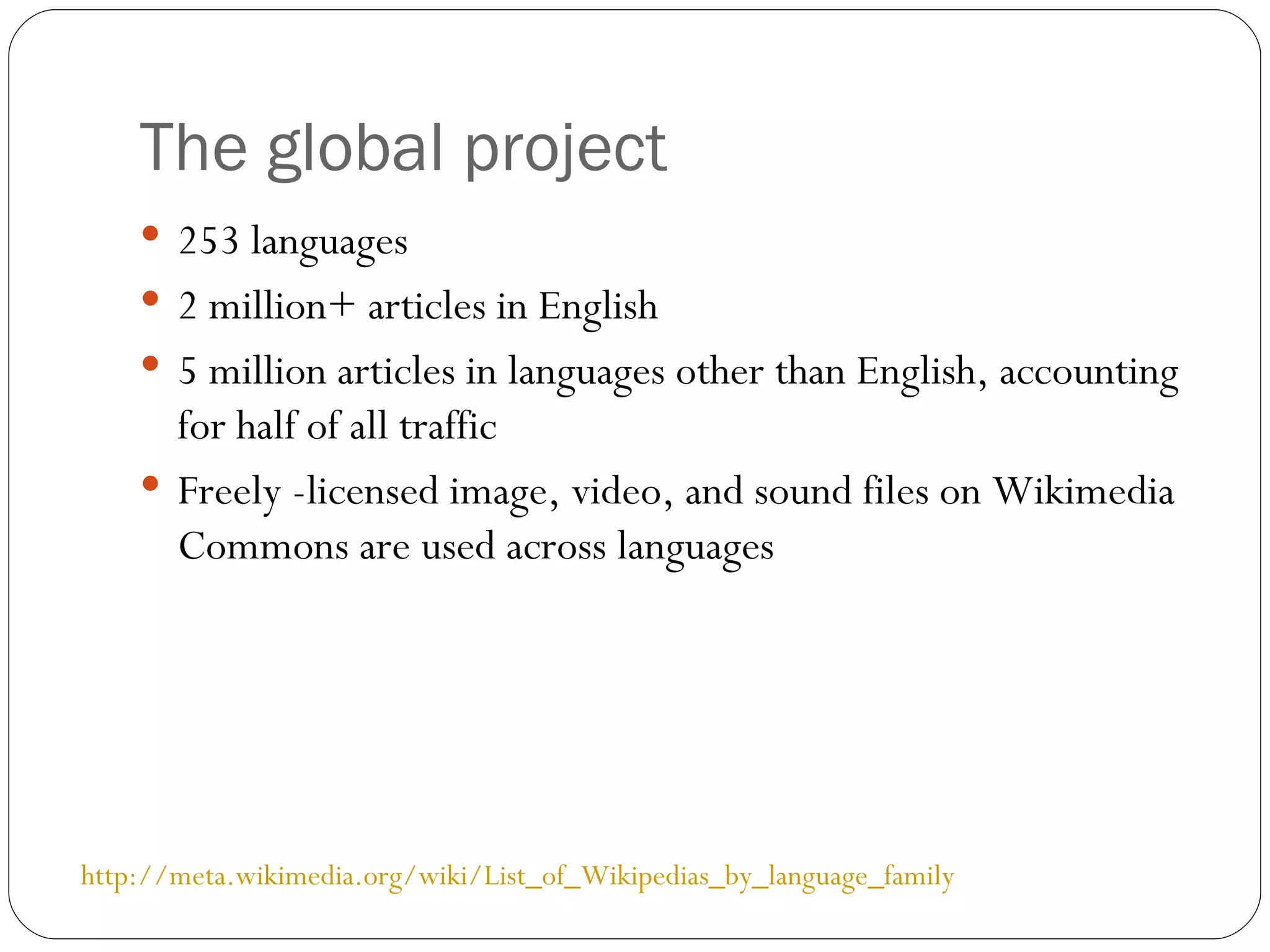
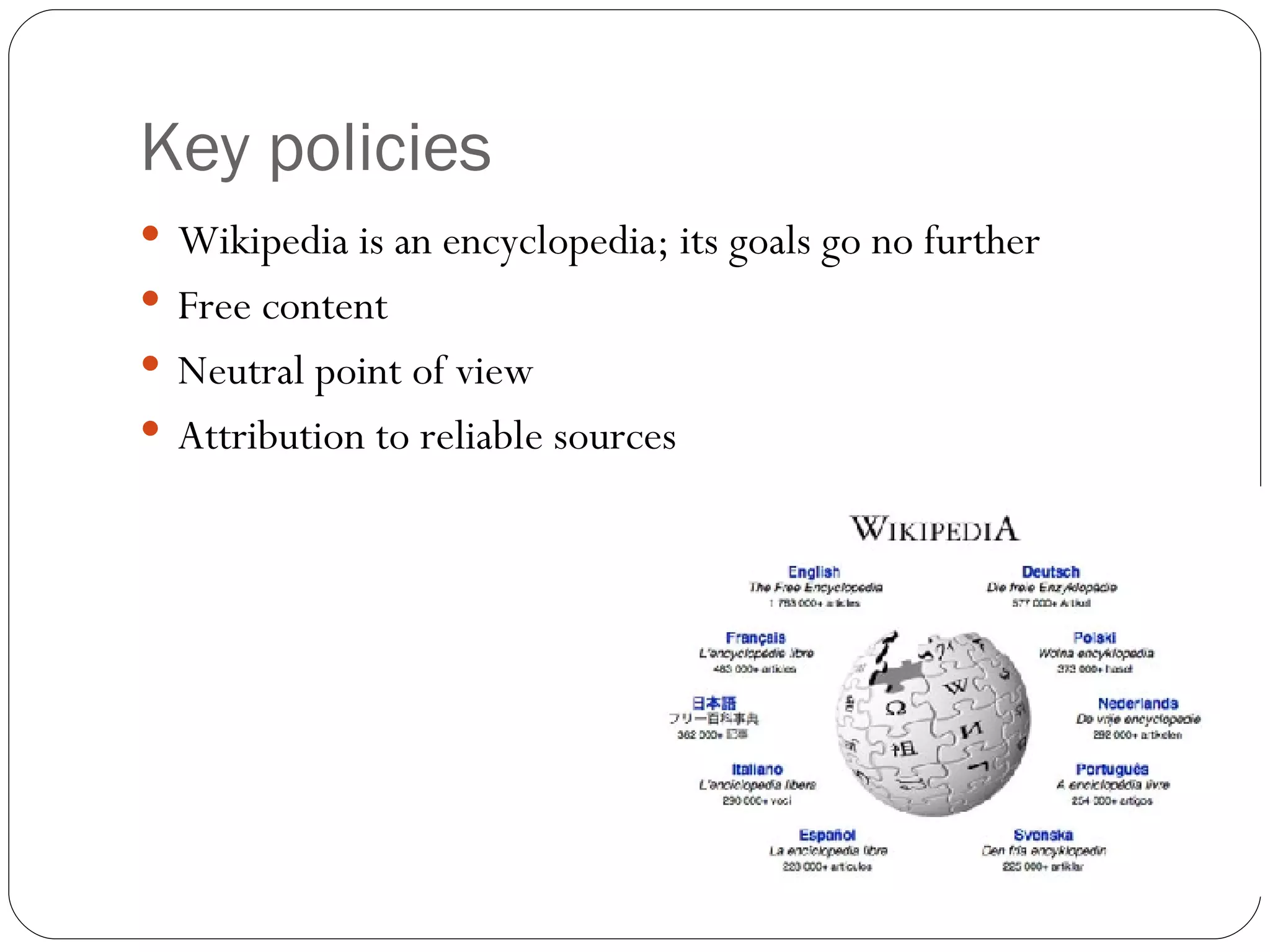
The global project 253 languages 2 million+ articles in English 5 million articles in languages other than English, accounting for half of all traffic Freely -licensed image, video, and sound files on Wikimedia Commons are used across languages http://meta.wikimedia.org/wiki/List_of_Wikipedias_by_language_family
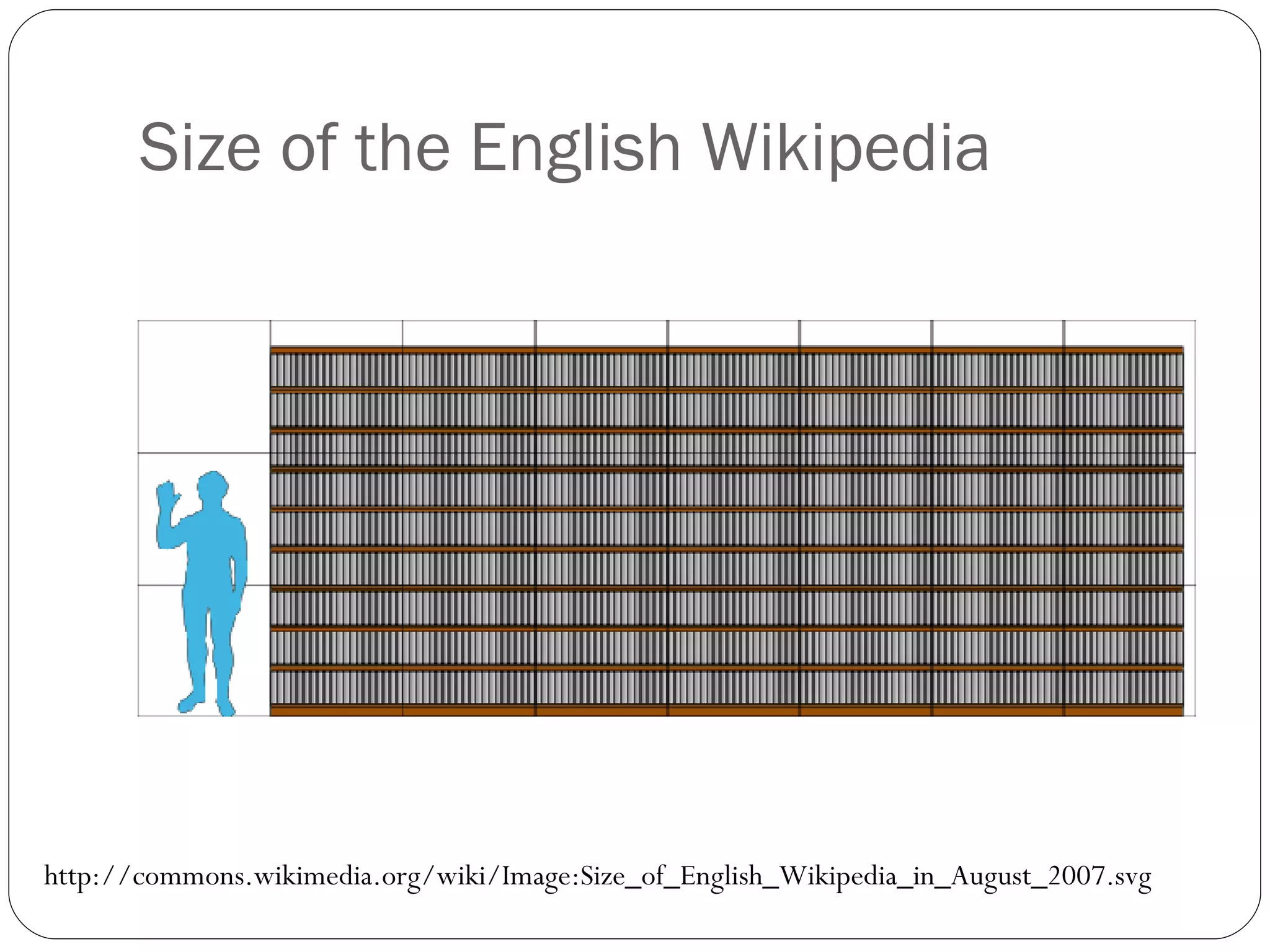
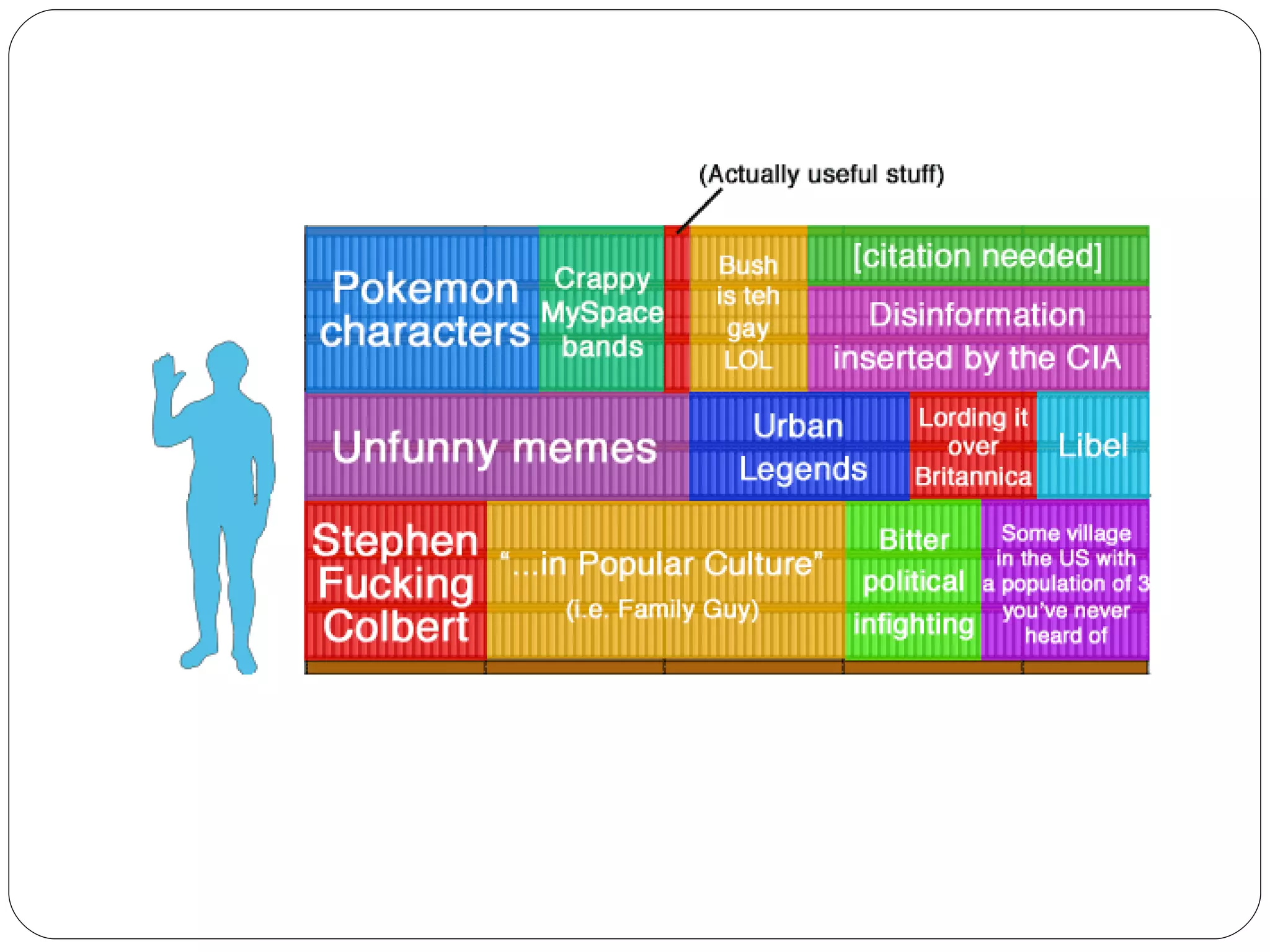
Size of the English Wikipedia http://commons.wikimedia.org/wiki/Image:Size_of_English_Wikipedia_in_August_2007.svg
 
Who’s who MediaWiki software Wikimedia Foundation Jimmy (Jimbo)  Wales, founder, leader, and benevolent dictator  5.8 million registered accounts for volunteer contributors Lots of edits by unregistered users
Wikimedia Foundation Runs the servers; hardware costs are 60% of its budget No ads or paid subscribers Annual revenues $1.5 million (June 2006)  Fewer than 10 full-time employees Sister projects to Wikipedia: Wiktionary,  Wikispecies, Wikiversity, Wikinews…
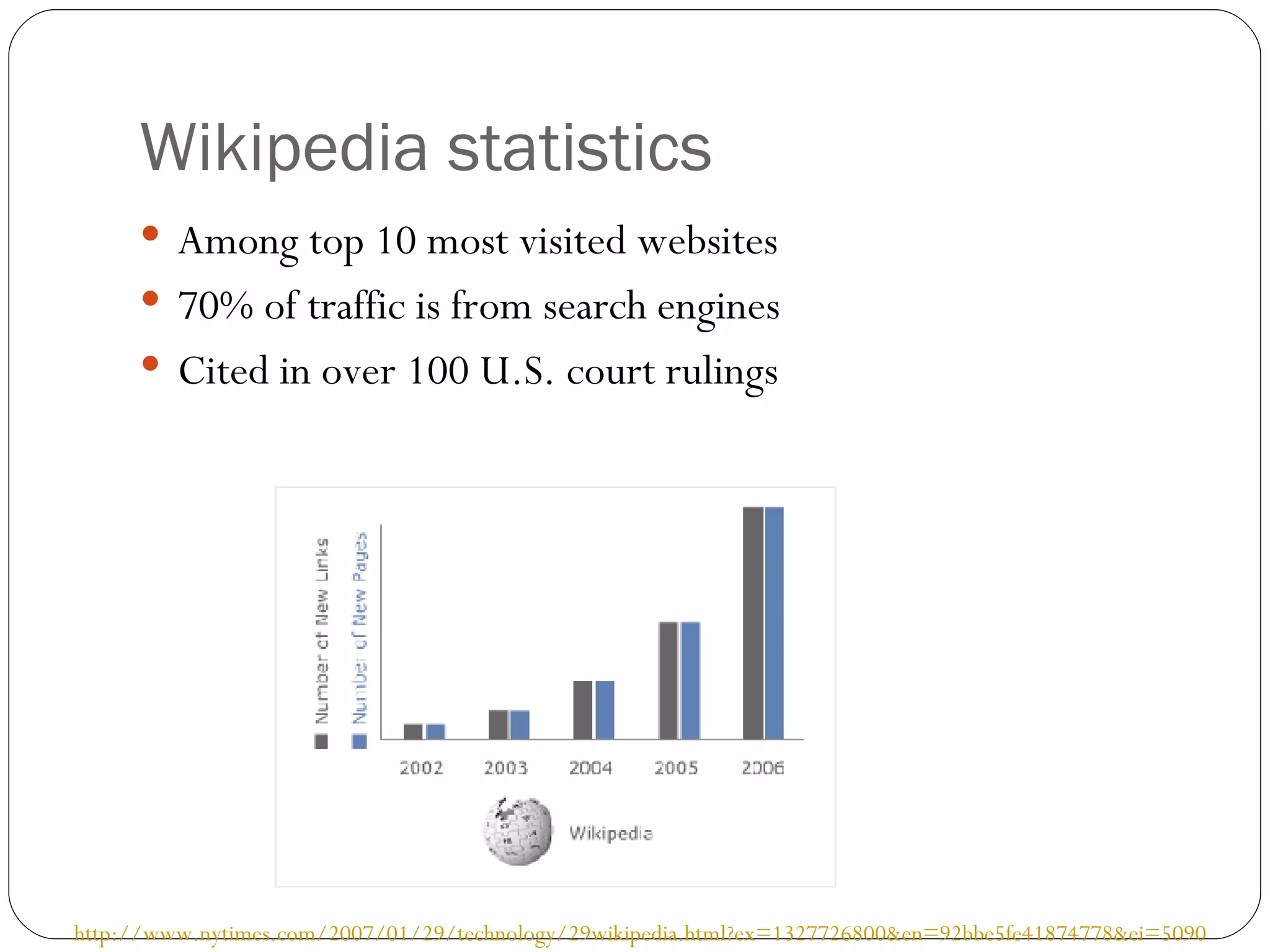
Wikipedia statistics  Among top 10 most visited websites 70% of traffic is from search engines Cited in over 100 U.S. court rulings http://www.nytimes.com/2007/01/29/technology/29wikipedia.html?ex=1327726800&en=92bbe5fe41874778&ei=5090
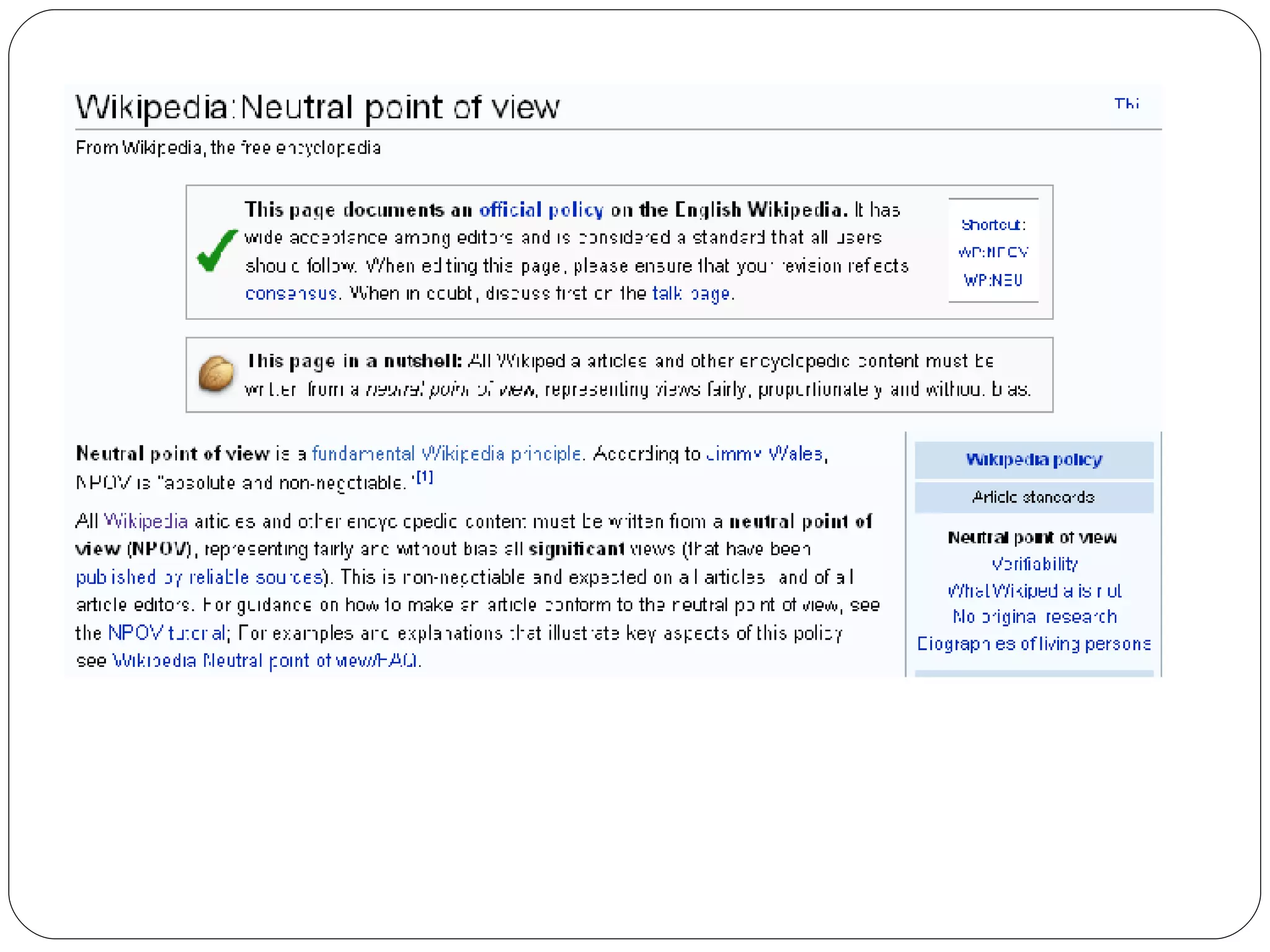
Key policies Wikipedia is an encyclopedia; its goals go no further Free content Neutral point of view Attribution to reliable sources
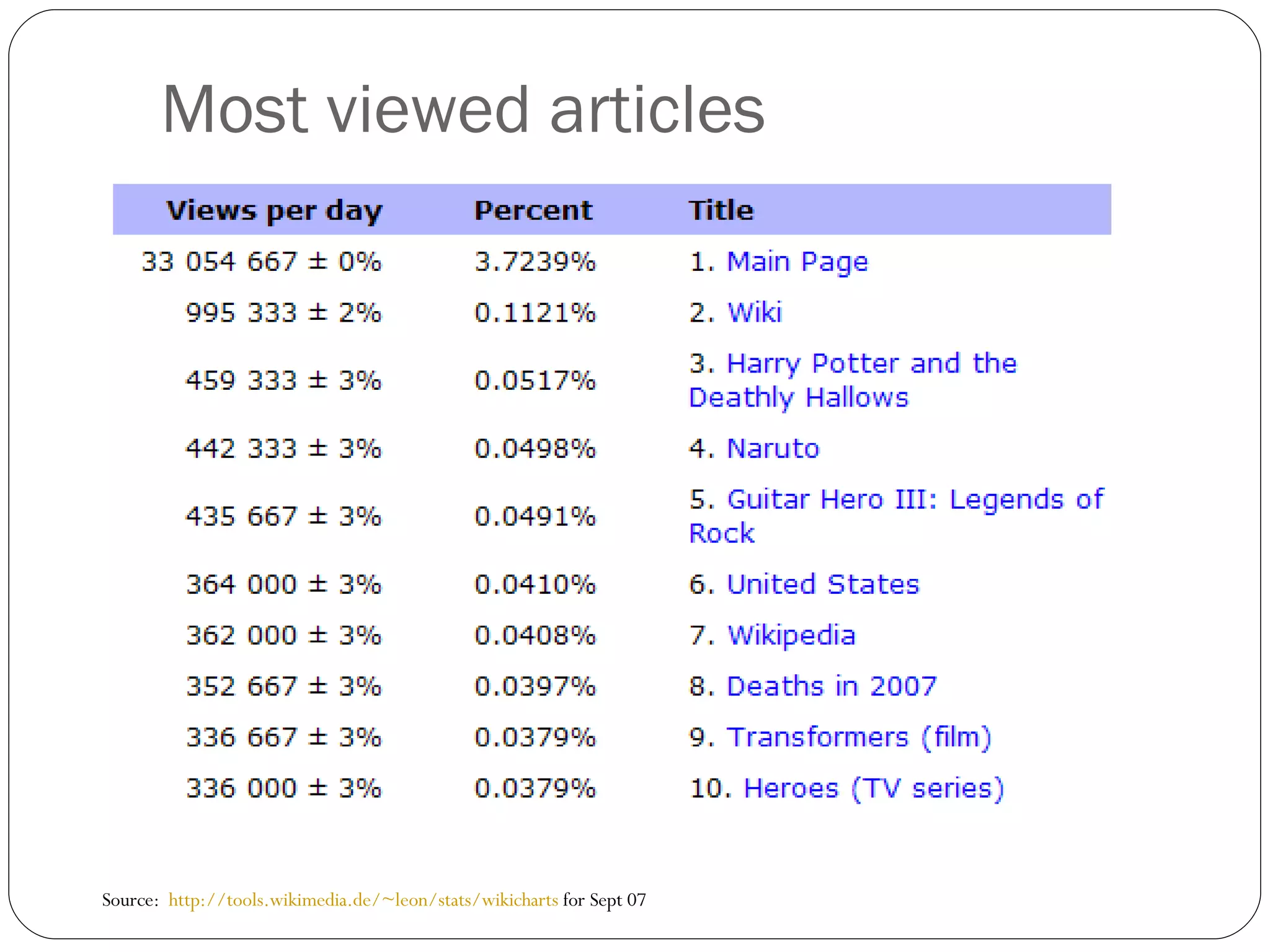
Most viewed articles  Source:  http://tools.wikimedia.de/~leon/stats/wikicharts  for Sept 07
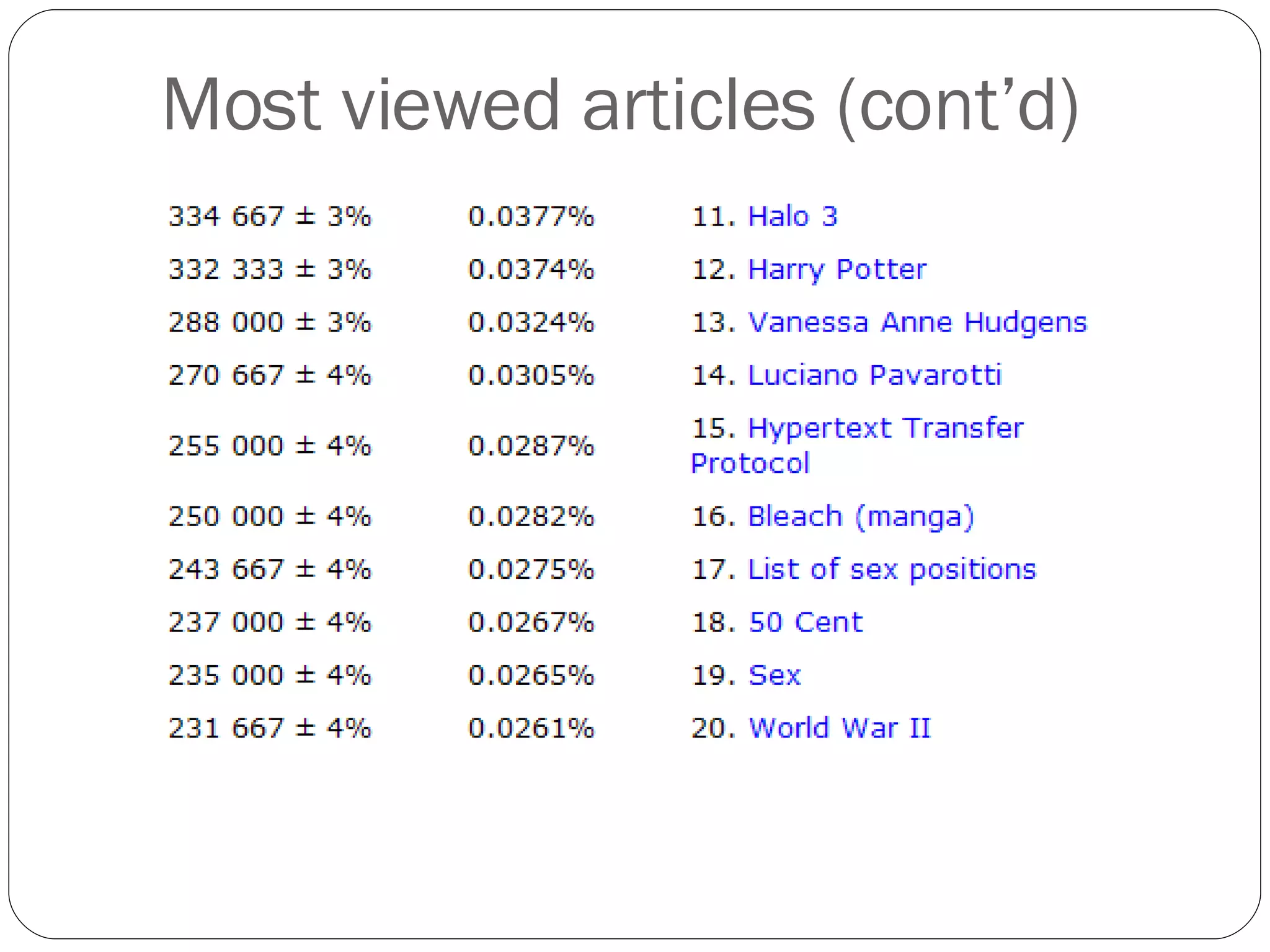
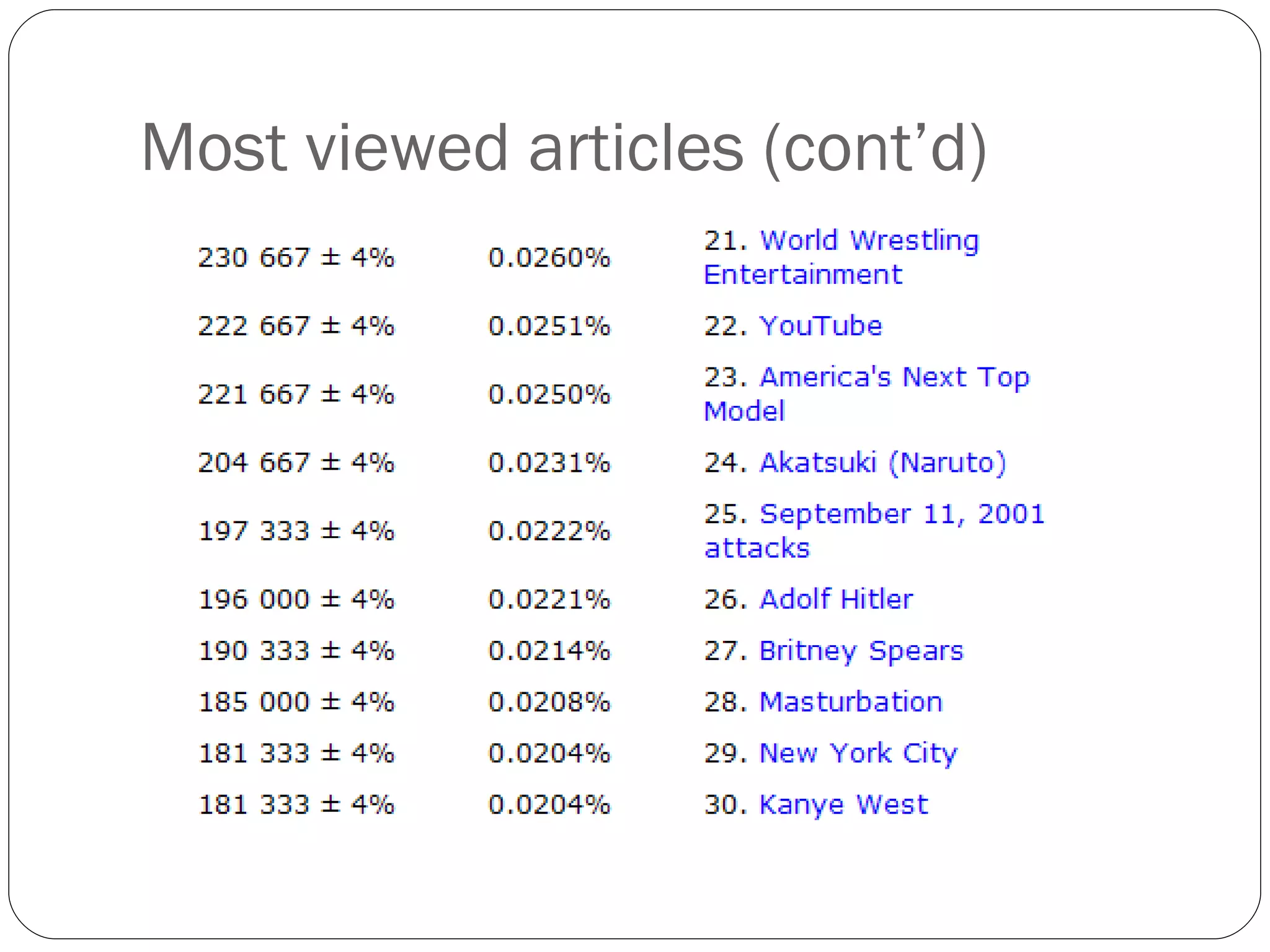
Most viewed articles (cont’d)
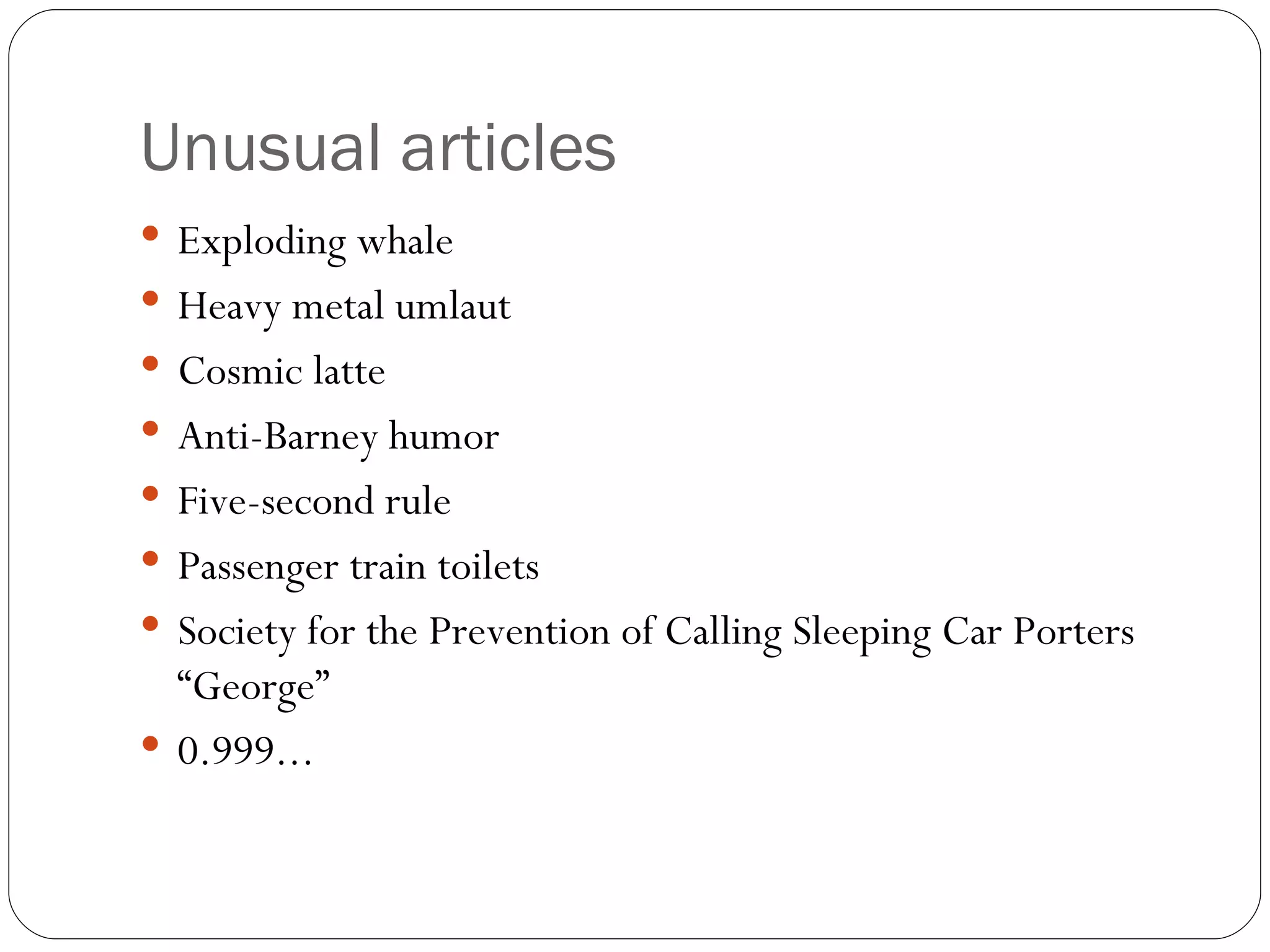
Unusual articles Exploding whale Heavy metal umlaut Cosmic latte Anti-Barney humor Five-second rule Passenger train toilets Society for the Prevention of Calling Sleeping Car Porters “George” 0.999...
Contributing: Part I “ So fix it.”  - A Wikipedia saying
Contributing: Overview Editing a sentence Wikitext Headings Links Bulleted lists Templates Signatures Accounts and privacy
Get an account Editing with an account is MORE private than editing without one Don’t use your real name You can change your username later You can identify yourself in less permanent ways
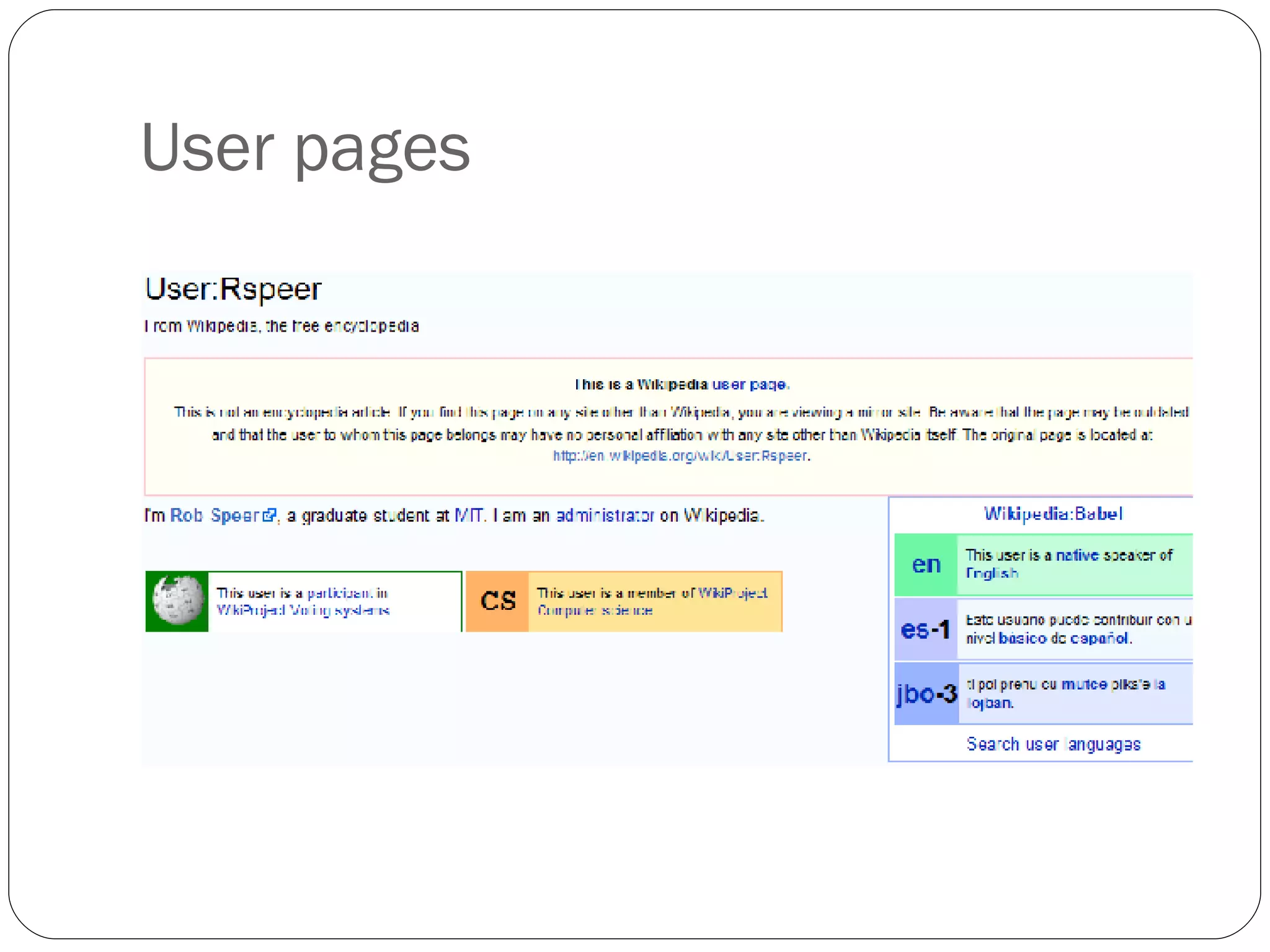
User pages
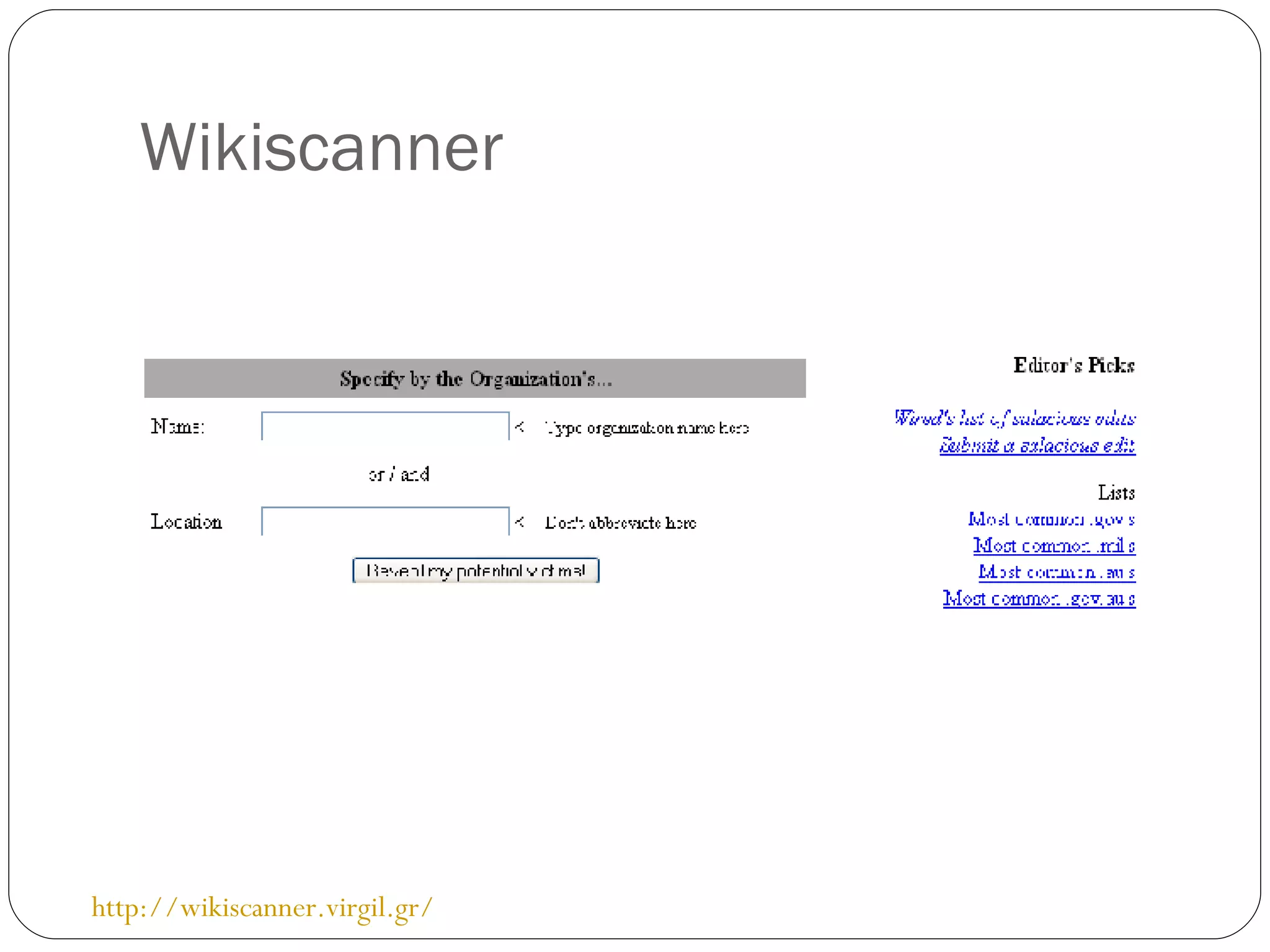
Wikiscanner http://wikiscanner.virgil.gr/
Vandals and spammers
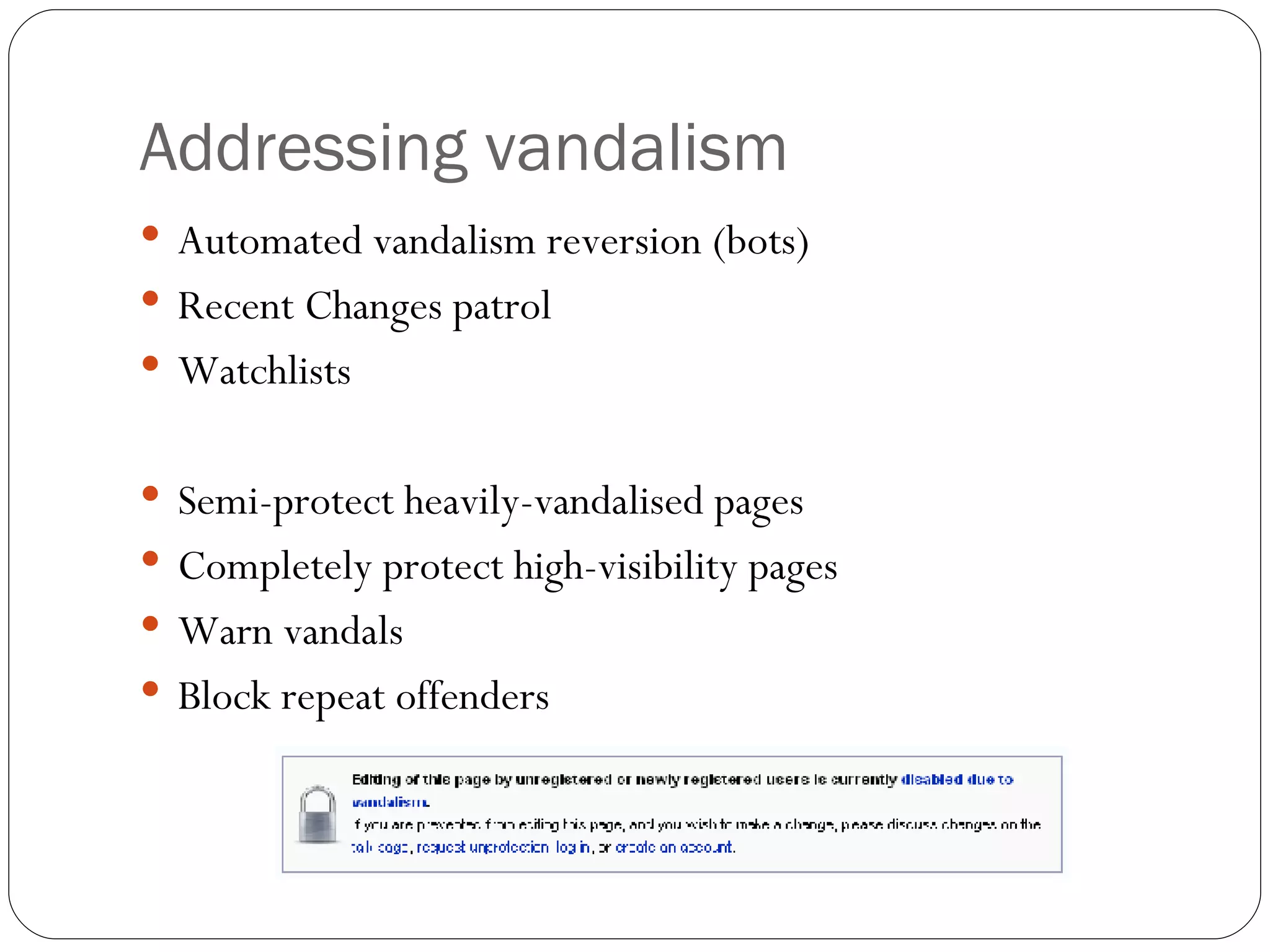
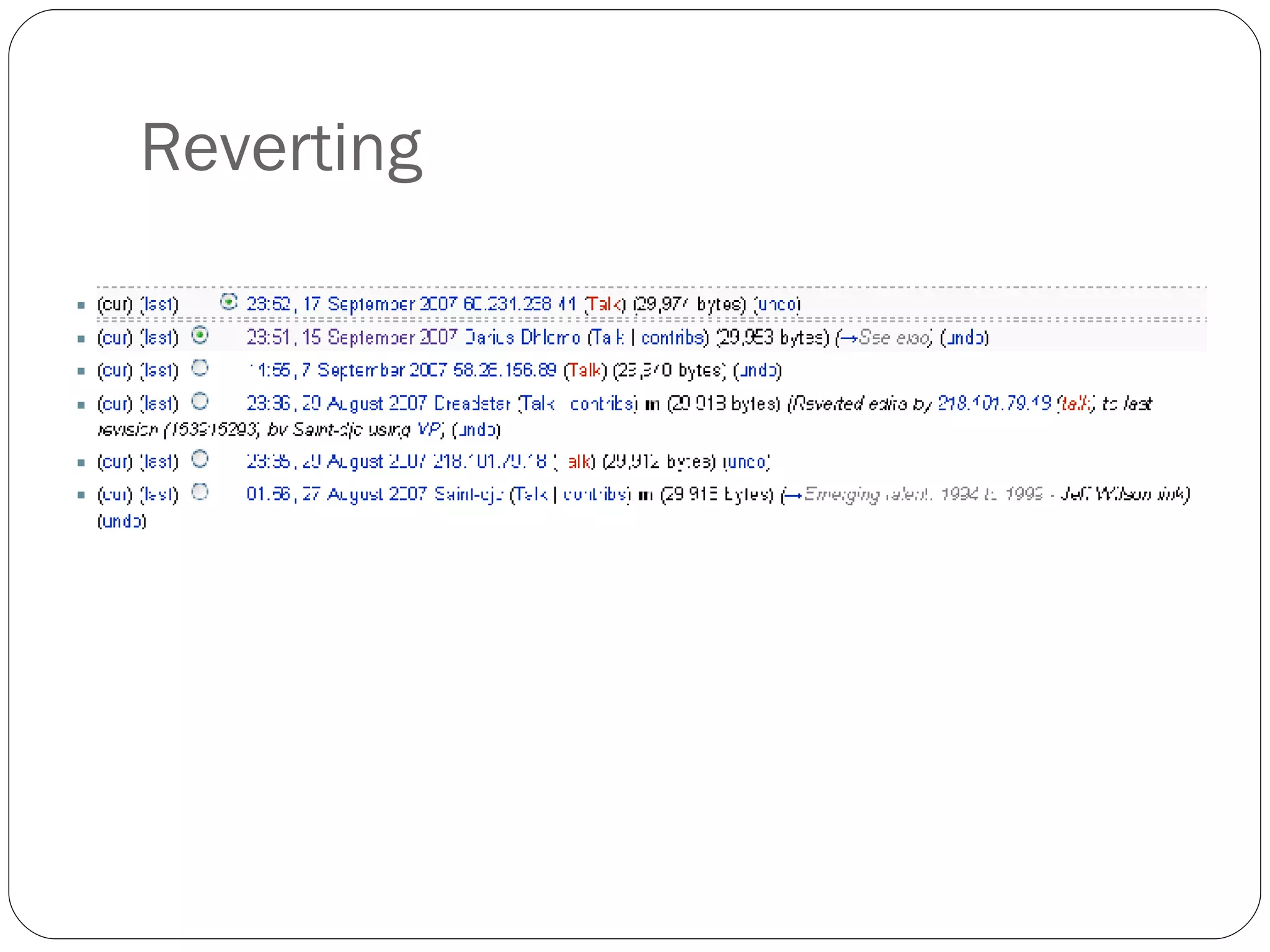
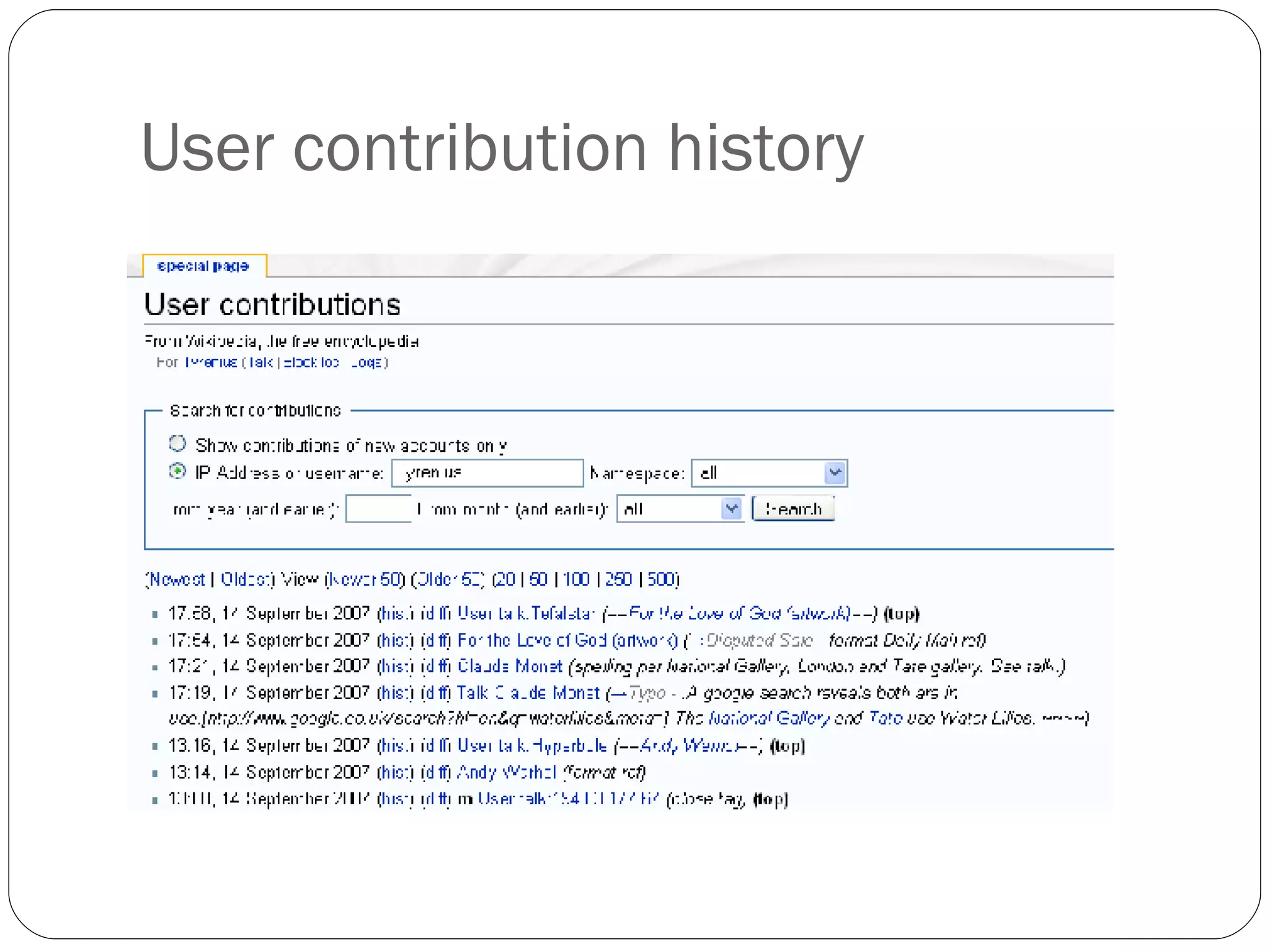
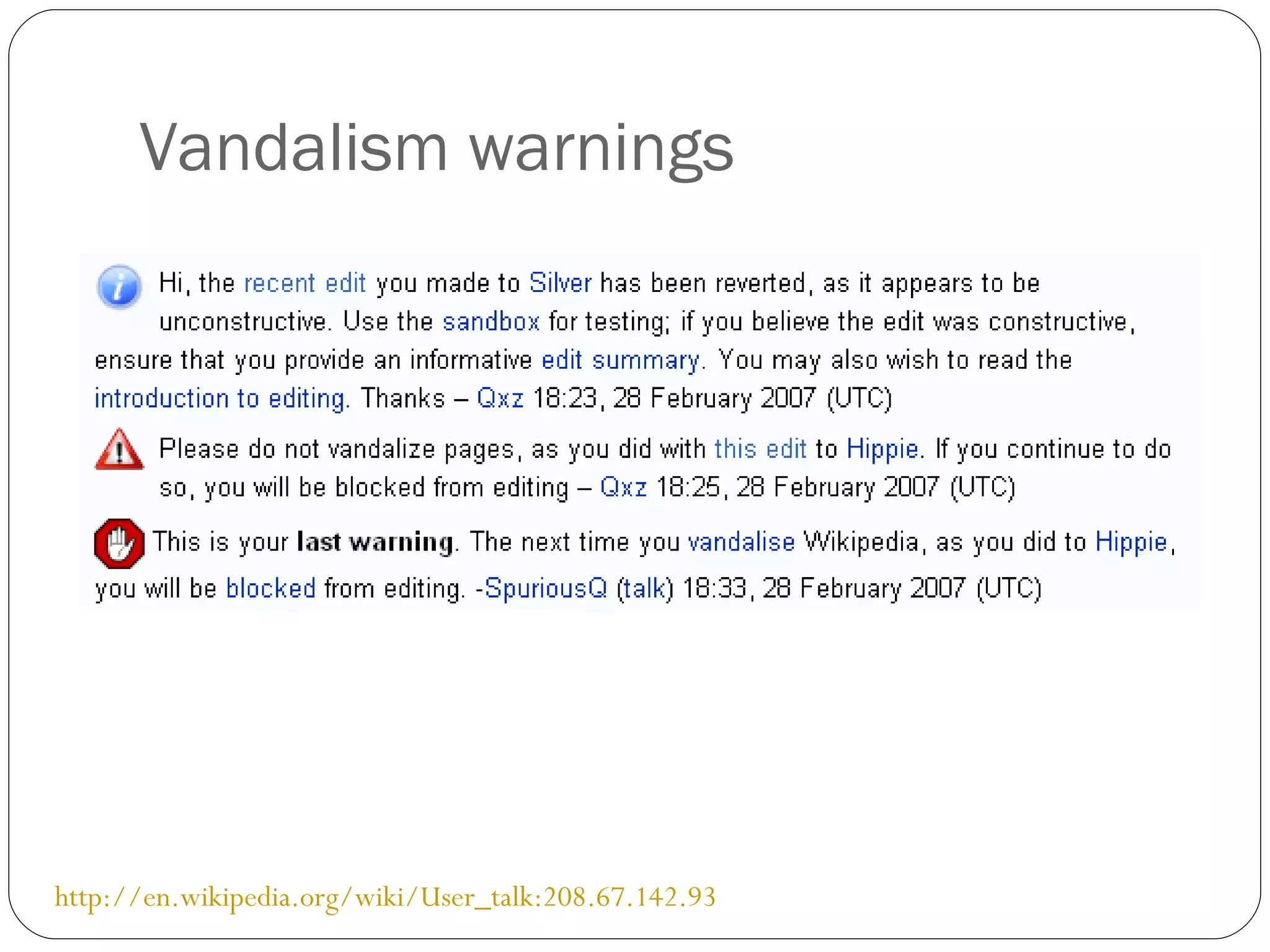
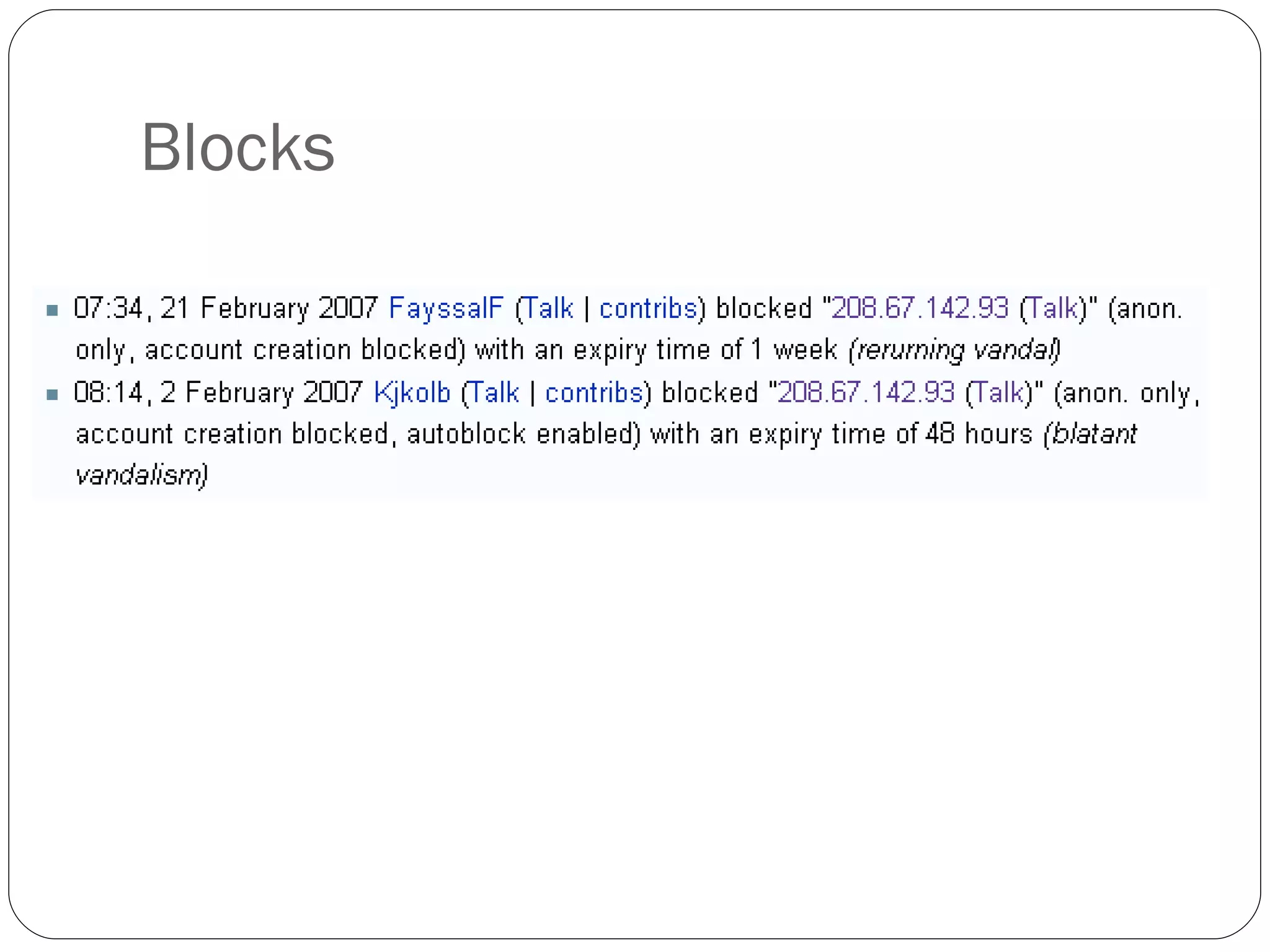
Addressing vandalism Automated vandalism reversion (bots) Recent Changes patrol Watchlists Semi-protect heavily-vandalised pages Completely protect high-visibility pages Warn vandals Block repeat offenders
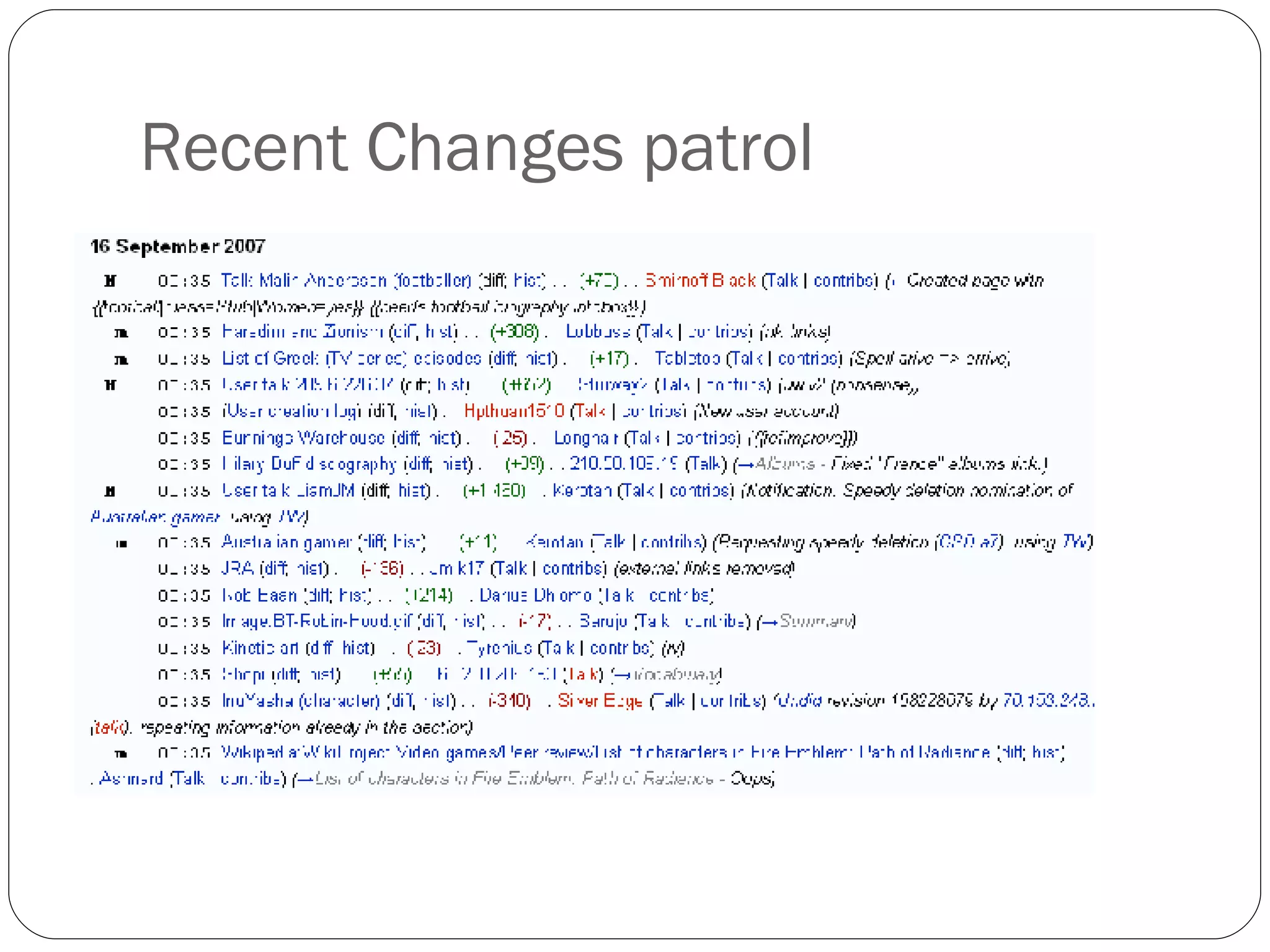
Recent Changes patrol
Reverting
User contribution history
Vandalism warnings http://en.wikipedia.org/wiki/User_talk:208.67.142.93
Blocks
Administrators ~1400 administrators in English Block and unblock users Semi-protect pages (lock pages from being edited by unregistered and new users)  Protect pages (lock pages from being edited) Edit protected pages Delete and undelete page histories
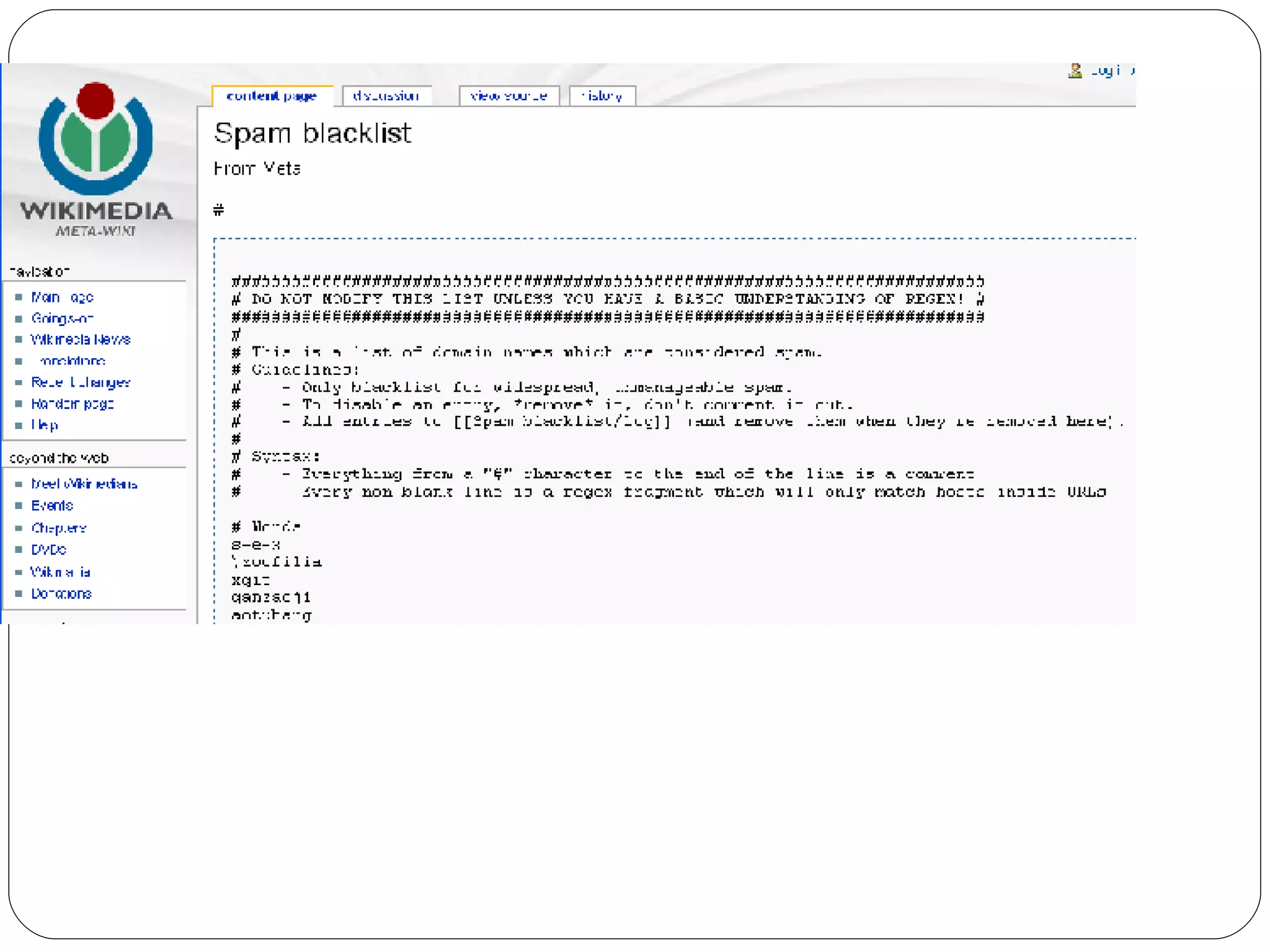
Addressing spam “ No-follow” on external links Spam blacklist As with vandalism: revert, warn user, block persistent offenders
 
Other obviously-bad edits Blatant advertising Copyright violation Libel Hoax Complete bullocks
Conflict and Culture “ When someone just writes 'f**k, f**k, f**k', we just fix it, laugh and move on. But the difficult social issues are the borderline cases — people who do some good work, but who are also a pain in the neck.”  –  Jimbo Wales
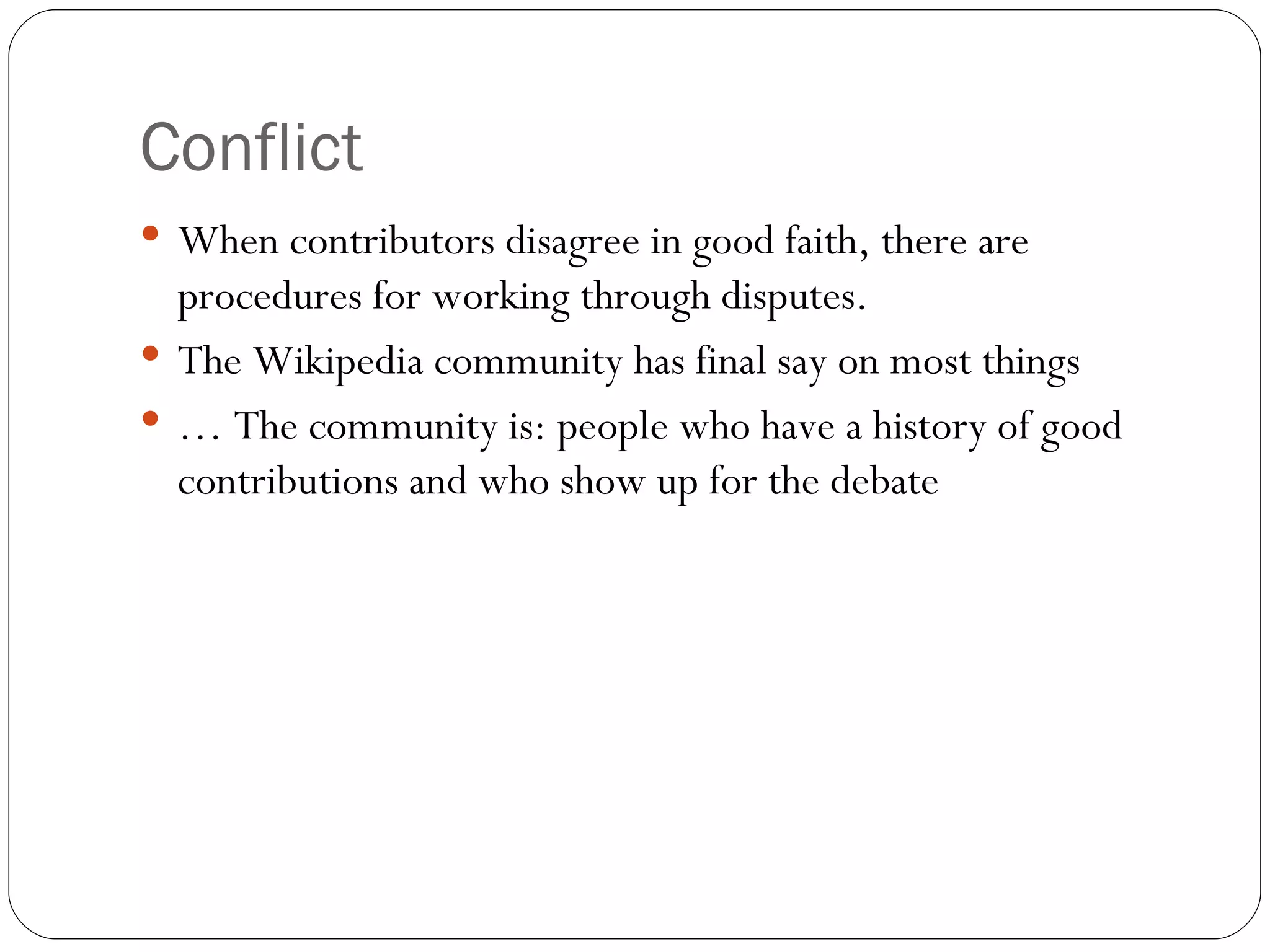
Conflict When contributors disagree in good faith, there are procedures for working through disputes. The Wikipedia community has final say on most things …  The community is: people who have a history of good contributions and who show up for the debate
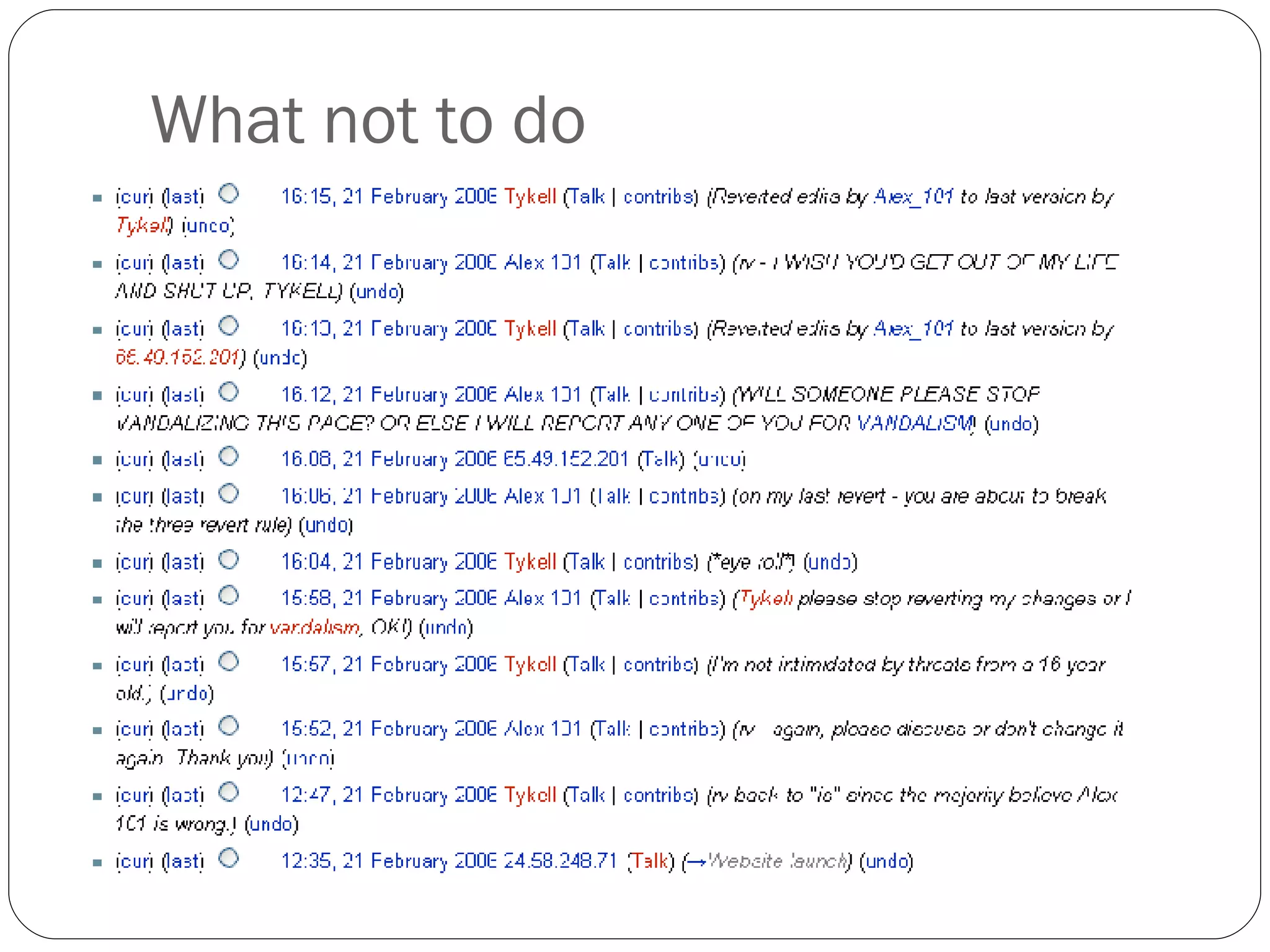
What not to do
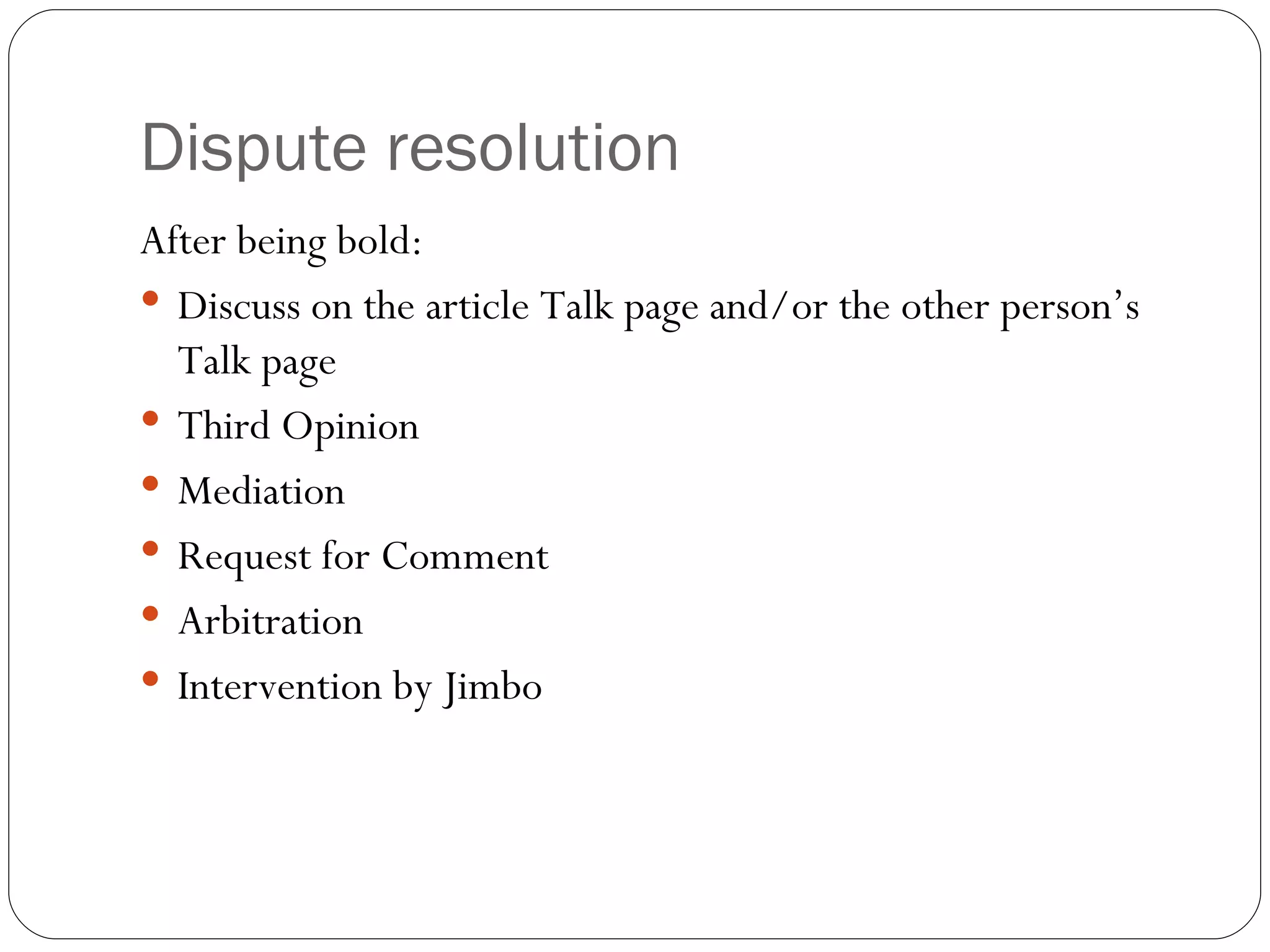
Dispute resolution After being bold: Discuss on the article Talk page and/or the other person’s Talk page Third Opinion Mediation Request for Comment Arbitration Intervention by Jimbo
Content policies and guidelines What are reliable sources? What is an acceptable External Link? Is company XYZ notable enough for an article? Should the article title be “Giraffe” or “Giraffes”? Is it “program” or “programme”?


Conduct policies and guidelines Be civil Assume good faith Don’t edit war Write for the enemy Ignore all rules Don’t use Wikipedia for self-promotion
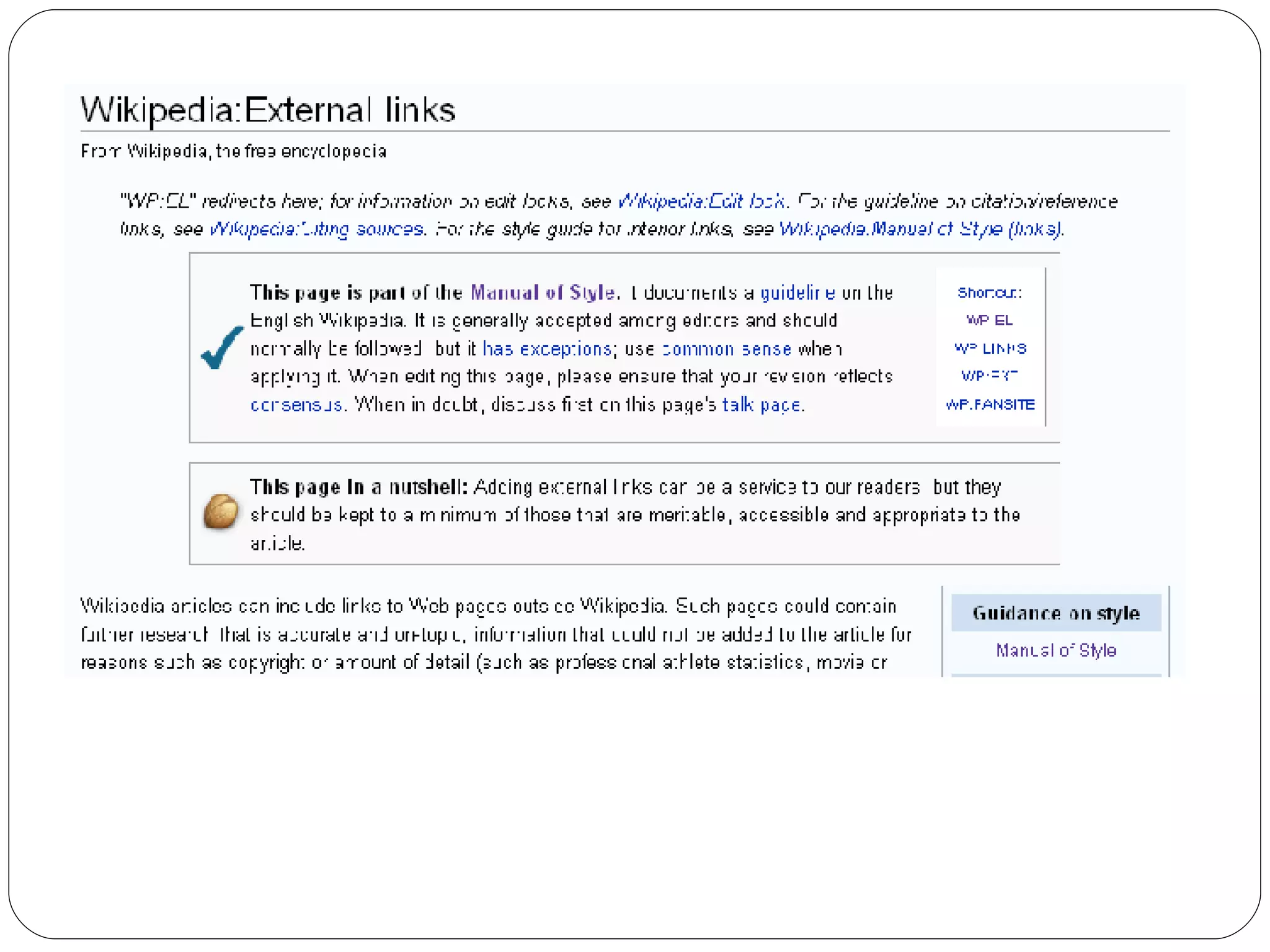
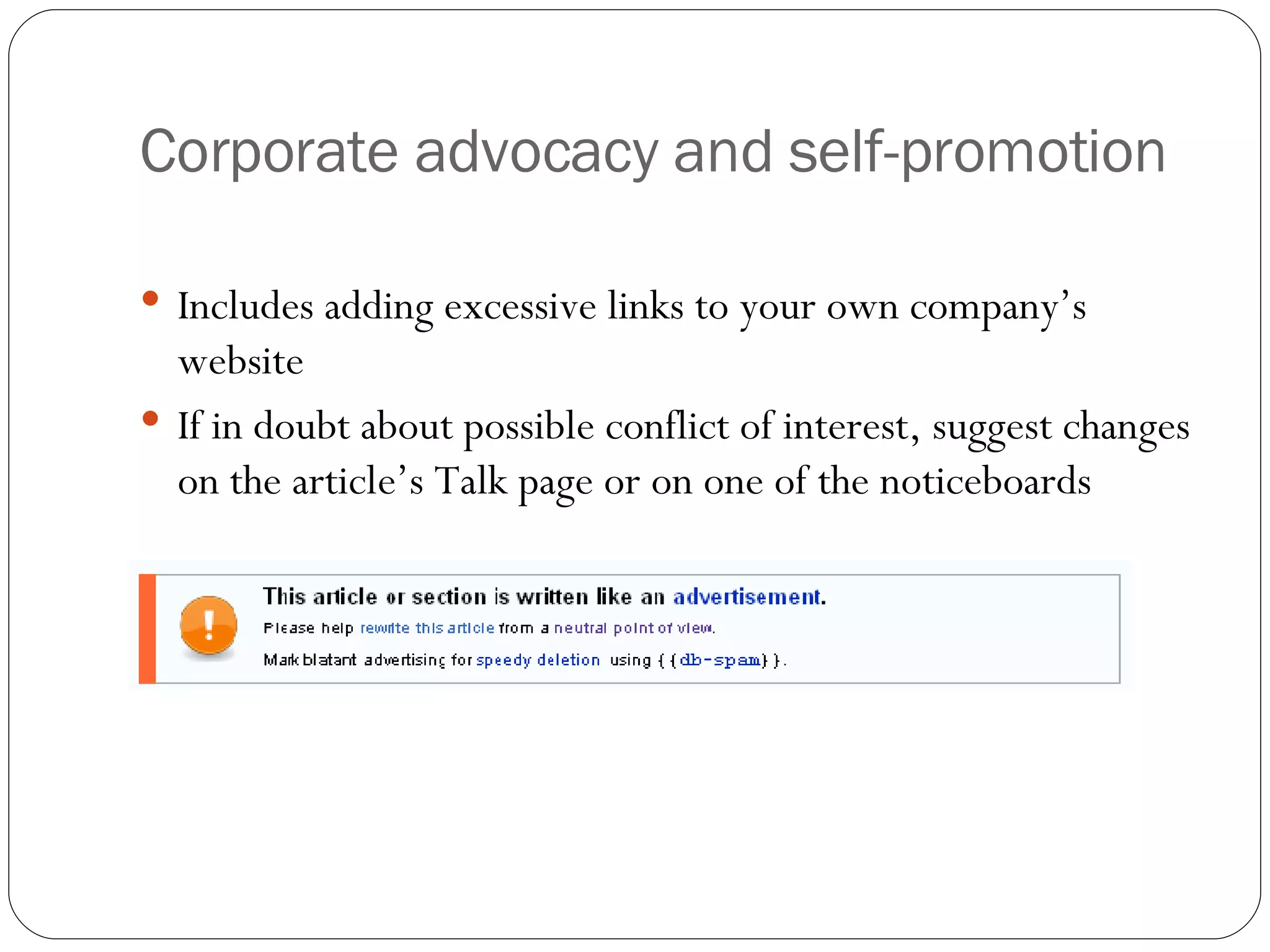
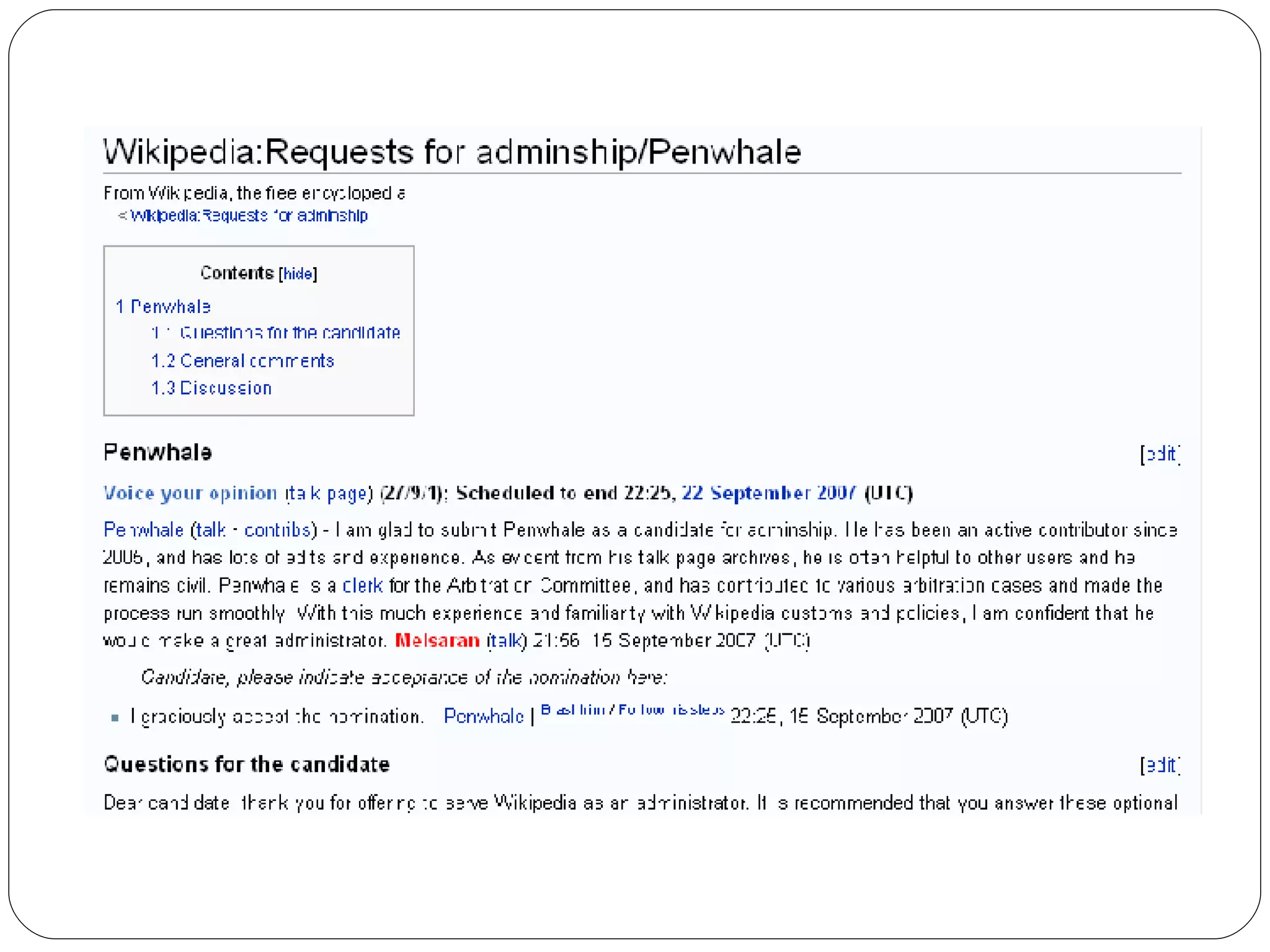
Corporate advocacy and self-promotion Includes adding excessive links to your own company’s website If in doubt about possible conflict of interest, suggest changes on the article’s Talk page or on one of the noticeboards
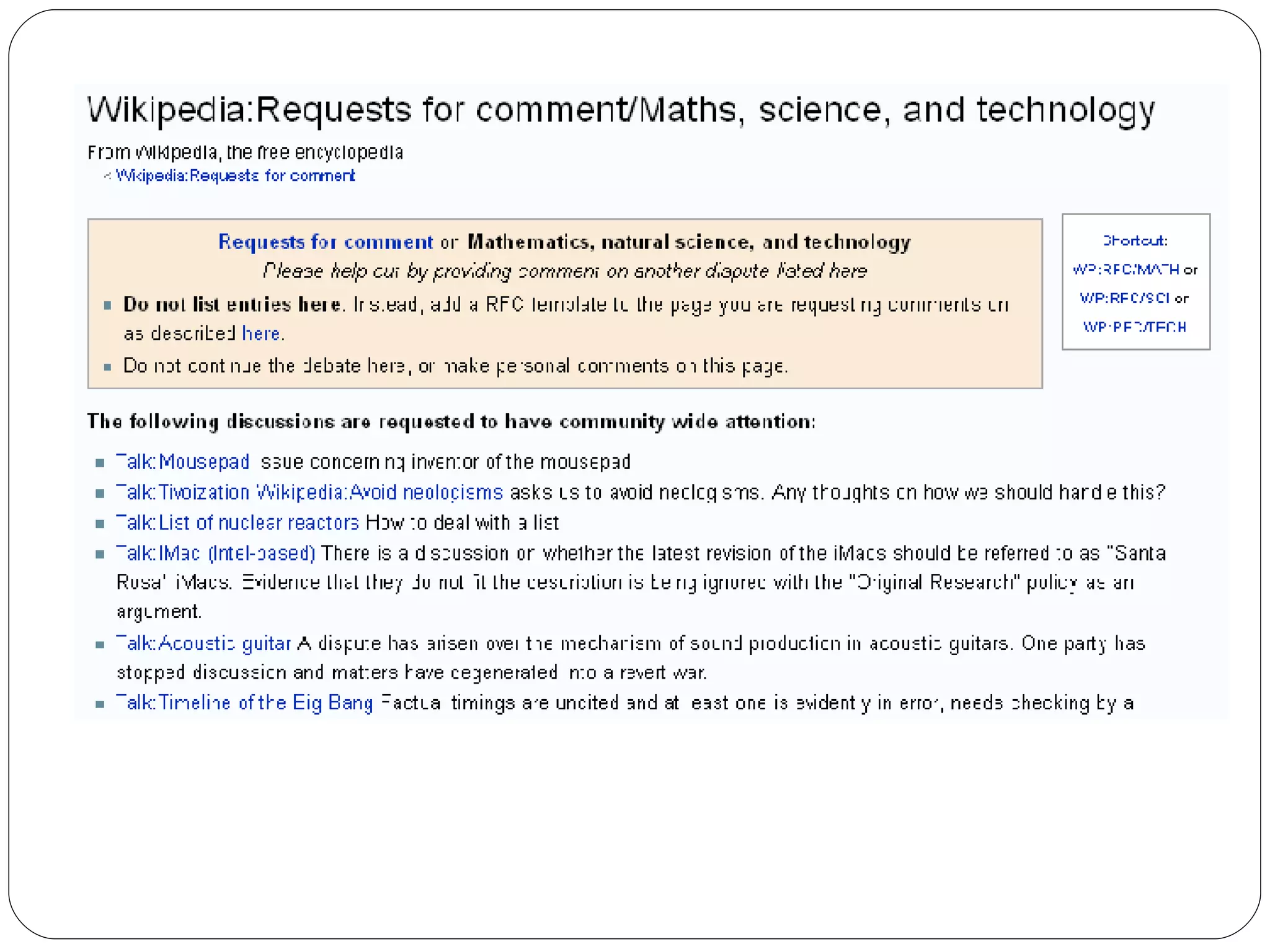
Talk pages
 
Dispute resolution principles Focus on how to improve the articles Widen the conflict; ask for third-party viewpoints Don’t wikilawyer Discuss rather than vote
 
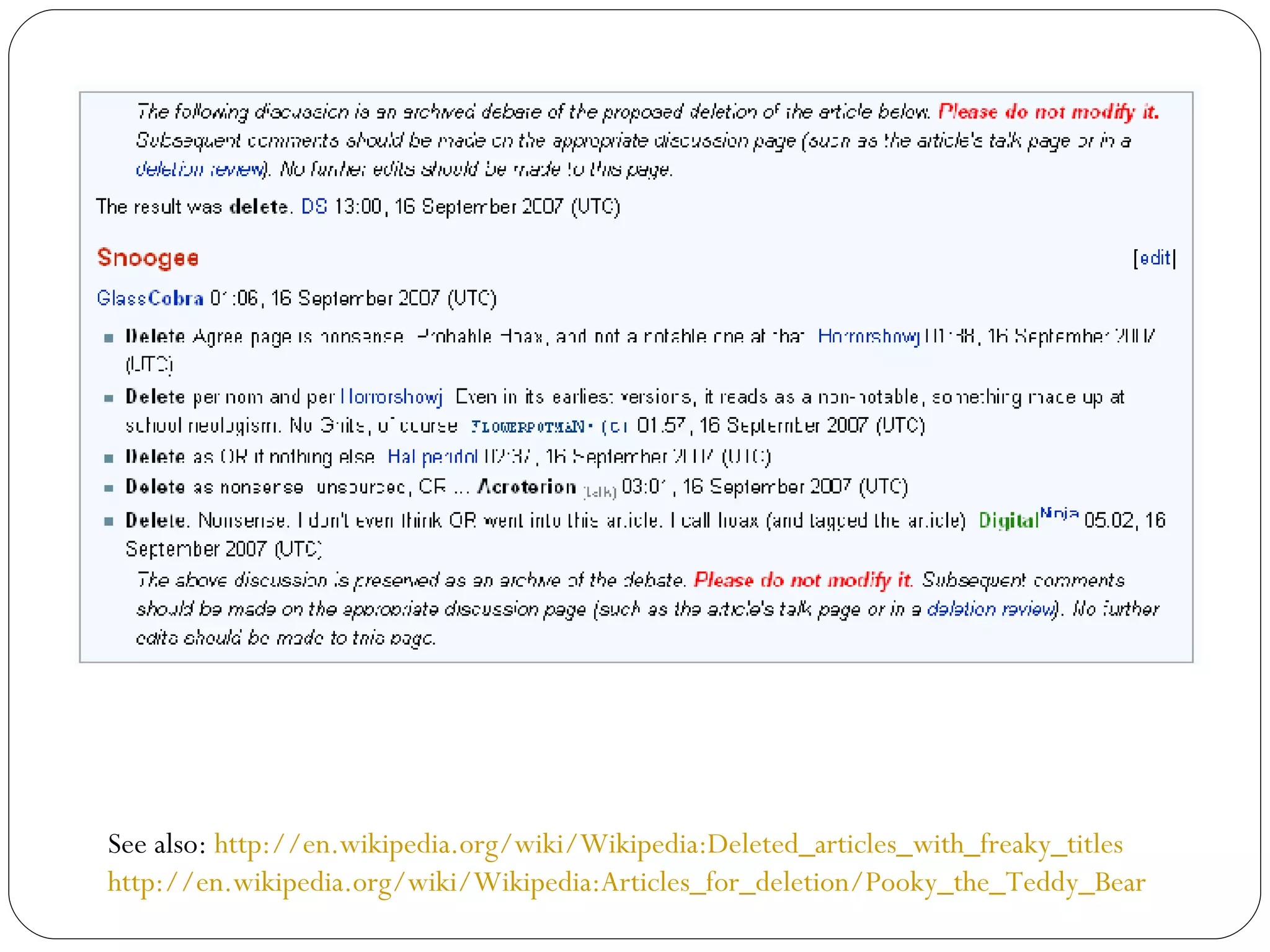
See also:  http://en.wikipedia.org/wiki/Wikipedia:Deleted_articles_with_freaky_titles http://en.wikipedia.org/wiki/Wikipedia:Articles_for_deletion/Pooky_the_Teddy_Bear
 
 
Controversy is often good Motivates people to improve articles Raises awareness of the need for quality sourcing Leads to inclusion of multiple viewpoints and nuances in articles Builds community
Problem behaviour Point-of-view pushing; political and nationalist block voting Edit warring Persistent corporate advocacy Fraudulent use of multiple accounts (sockpuppetry)
Problem behaviour (cont’d) Problem users can be banned from a topic or from all of Wikipedia Bans are difficult to enforce Short supply of neutral people who are patient enough to deal with problematic behaviour “ The takeaway message I'm getting here is ‘only an admin with a hole in his head willingly gets involved in Israel-Palestine articles.’ ”  - a Wikipedia administrator
Controversial Issues Wikipedia’s  list of controversial issues Articles involving “biographies of living persons” Children in the news Victims of crime People notable for having medical conditions Overwhelmingly negative biographies
Biographies of Living Persons rules Consider privacy Negative material has more rigorous inclusion requirements Immediately remove unsourced or poorly sourced negative or controversial material Avoid discussion
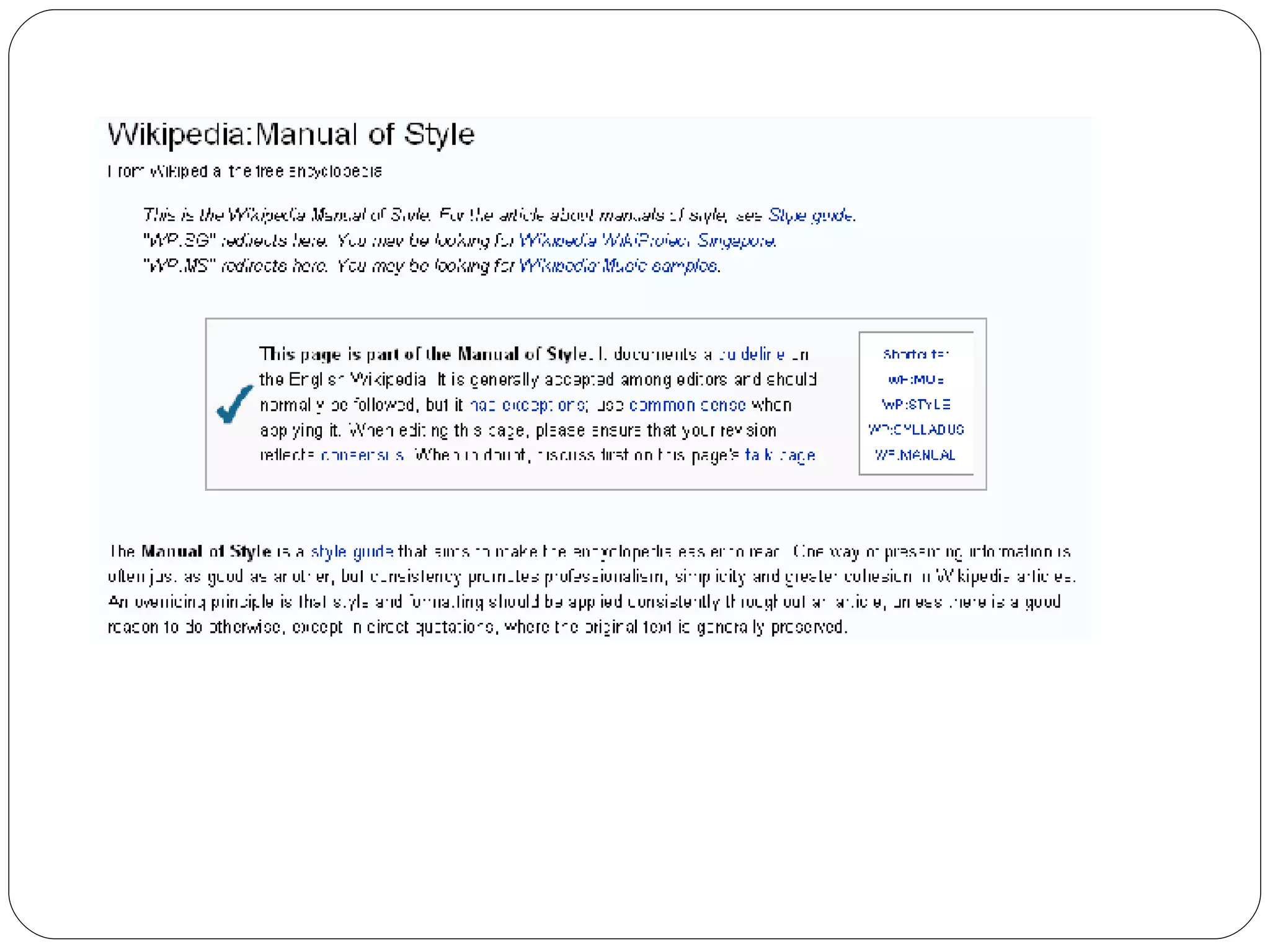
IA for two million articles Few  information types : encyclopedia articles, lists, disambiguation pages No essays or how-to articles No point-of-view forking of articles Extensive  guidelines  on: naming conventions refactoring long articles, merging similar articles use of categories
IA for two million articles (cont’d) Relatively  simple markup   Extensive use of  templates Constant  refactoring
Templates
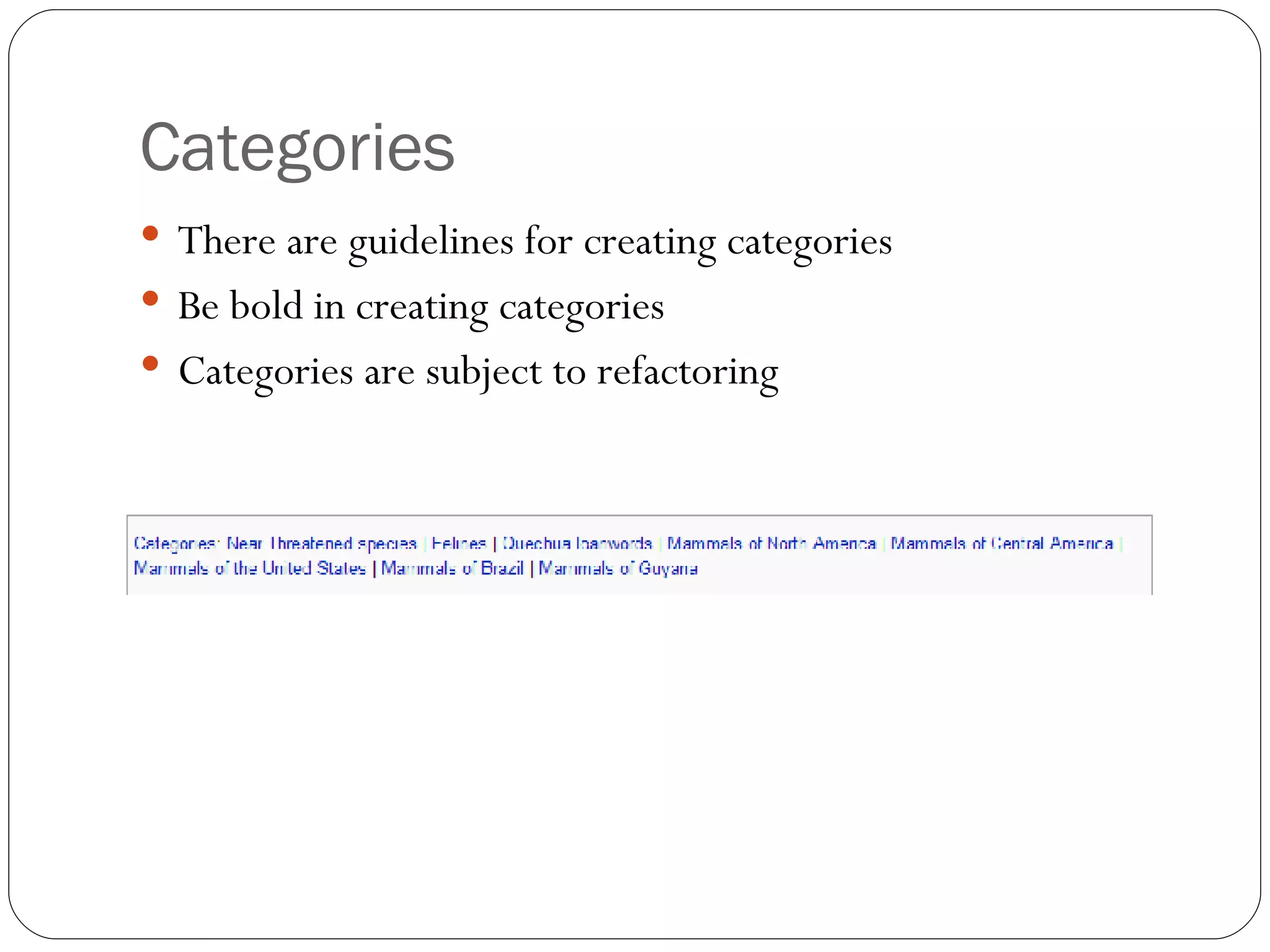
Categories There are guidelines for creating categories Be bold in creating categories Categories are subject to refactoring
Adding and using categories
Summary: Conflict and culture Policies and guidelines Culture is oriented towards trust, discussion, and generating consensus Conflict can build community and often leads to better articles Most articles are not controversial. Usually, good-faith edits stick Decentralized management of information architecture
Contributing: Part II “ I have found working with a bunch of like minded folks on an article or wikiproject when it kicks into top gear one of the most inspiring things, the rapid-fire editing of an article gunning toward FA status as writer's blocks are sequentially blasted out of the way is just amazing to witness via the diffs/hists.”  – Wikipedia editor  “Casliber”
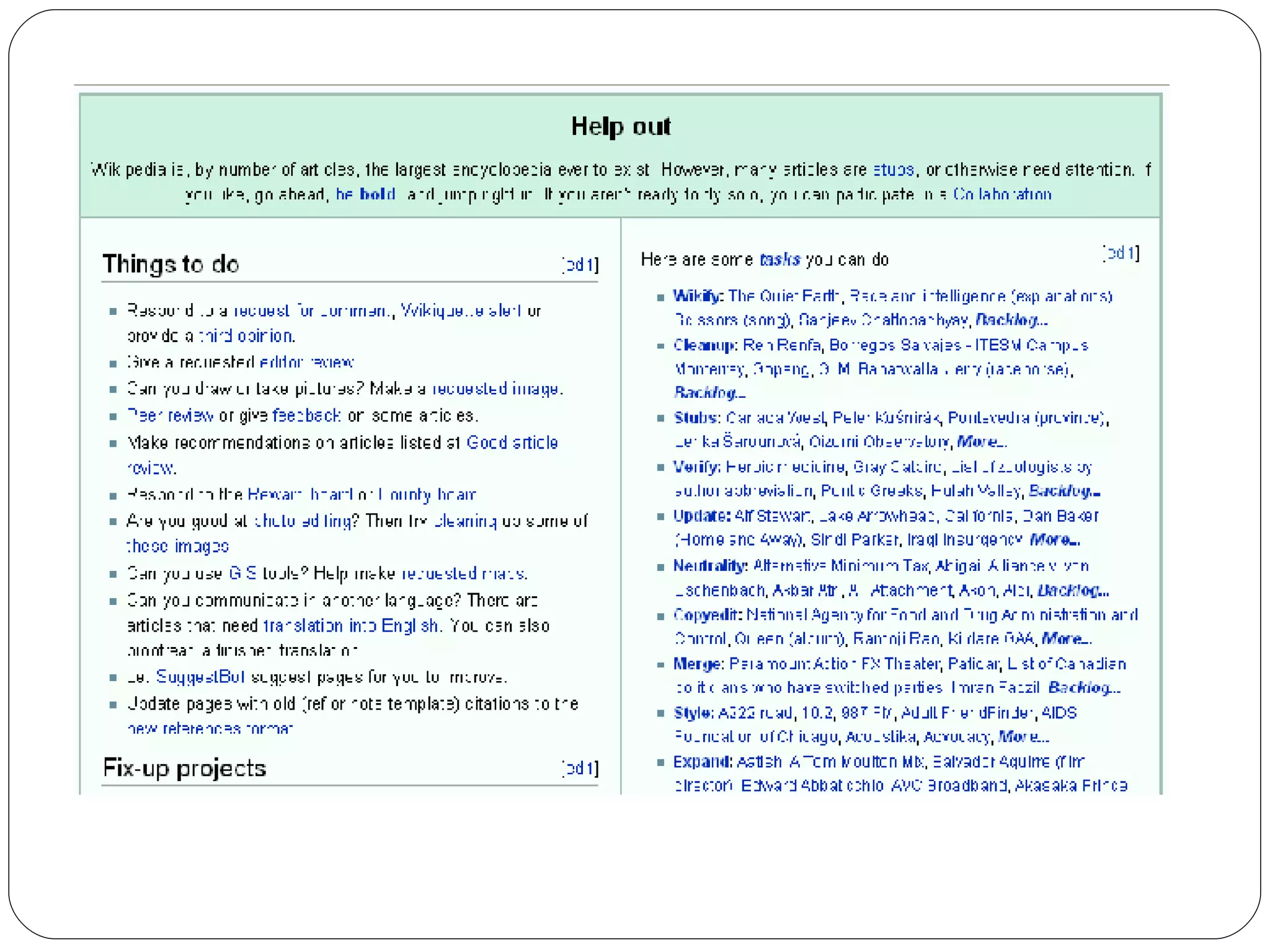
Contribute by… Writing about what you’re interested in Improving the writing of others Citing sources Categorizing and organizing articles  Translating articles Contributing photographs and artwork Reviewing and commenting on articles Maintenance: removing vandalism, spam, and trivia Helping to resolve disputes
"We can no longer feel satisfied and happy when we see these (article) numbers going up.... We should continue to turn our attention away from growth and towards quality.“ - Jimbo Wales
 
 
Why contribute? Improve your skills in: Writing Editing Having your work edited Conflict resolution and group dynamics Understanding copyright Wiki technology
Summary Free encyclopedia written by volunteers Be bold Get an account with a fake name; don’t promote commercial interests Revert, warn, and block vandals and spammers Policies, guidelines, and dispute resolution systems exist for controversial issues Distributed decision-making scales well for information architecture
The radical project Almost no co-ordination of effort 2% of users (1400 people) make 73.4% of edits 0.7% of users (524 people) make 50% of edits But… people who make very, very few edits  write   most of Wikipedia’s content …  Your earliest edits will probably be your most valuable ones http://www.aaronsw.com/weblog/whowriteswikipedia
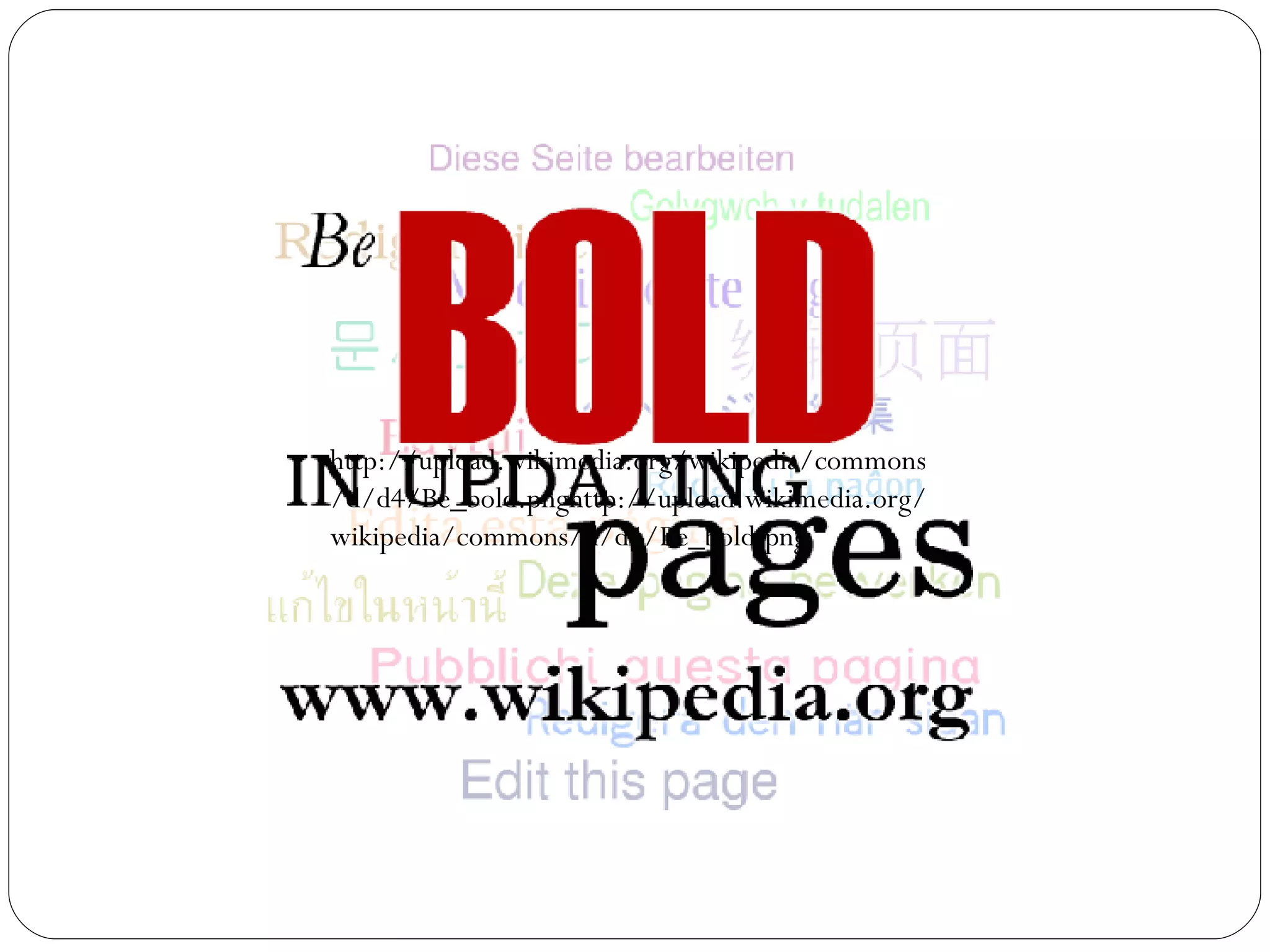
http://upload.wikimedia.org/wikipedia/commons/d/d4/Be_bold.pnghttp://upload.wikimedia.org/wikipedia/commons/d/d4/Be_bold.png

dynamics-of-wikipedia-1196670708664566-3

  • 1.
    Su-Laine Yeo VancouverUser Experience Group November, 2007 Dynamics of Wikipedia This presentation is licensed under Creative Commons Attribution Share-Alike 3.0 http://creativecommons.org/licenses/by-sa/3.0/
  • 2.
    Overview How doesit all work? Who writes for Wikipedia, and why? How does the site keep vandalism and spam away? What happens when contributors disagree? How does the site keep articles consistent and organized?
  • 3.
    Agenda What isWikipedia? Contributing: Part I Vandalism and spam Conflict and culture Contributing: Part II Please ask questions along the way!
  • 4.
  • 5.
    Vision A free,neutral encyclopedia that anyone can edit “ Imagine a world in which every single person on the planet is given free access to the sum of all human knowledge. That's what we're doing.” – Wikipedia founder Jimbo Wales
  • 6.
    The global project253 languages 2 million+ articles in English 5 million articles in languages other than English, accounting for half of all traffic Freely -licensed image, video, and sound files on Wikimedia Commons are used across languages http://meta.wikimedia.org/wiki/List_of_Wikipedias_by_language_family
  • 7.
    Size of theEnglish Wikipedia http://commons.wikimedia.org/wiki/Image:Size_of_English_Wikipedia_in_August_2007.svg
  • 8.
  • 9.
    Who’s who MediaWikisoftware Wikimedia Foundation Jimmy (Jimbo) Wales, founder, leader, and benevolent dictator 5.8 million registered accounts for volunteer contributors Lots of edits by unregistered users
  • 10.
    Wikimedia Foundation Runsthe servers; hardware costs are 60% of its budget No ads or paid subscribers Annual revenues $1.5 million (June 2006) Fewer than 10 full-time employees Sister projects to Wikipedia: Wiktionary, Wikispecies, Wikiversity, Wikinews…
  • 11.
    Wikipedia statistics Among top 10 most visited websites 70% of traffic is from search engines Cited in over 100 U.S. court rulings http://www.nytimes.com/2007/01/29/technology/29wikipedia.html?ex=1327726800&en=92bbe5fe41874778&ei=5090
  • 12.
    Key policies Wikipediais an encyclopedia; its goals go no further Free content Neutral point of view Attribution to reliable sources
  • 13.
    Most viewed articles Source: http://tools.wikimedia.de/~leon/stats/wikicharts for Sept 07
  • 14.
  • 15.
  • 16.
    Unusual articles Explodingwhale Heavy metal umlaut Cosmic latte Anti-Barney humor Five-second rule Passenger train toilets Society for the Prevention of Calling Sleeping Car Porters “George” 0.999...
  • 17.
    Contributing: Part I“ So fix it.” - A Wikipedia saying
  • 18.
    Contributing: Overview Editinga sentence Wikitext Headings Links Bulleted lists Templates Signatures Accounts and privacy
  • 19.
    Get an accountEditing with an account is MORE private than editing without one Don’t use your real name You can change your username later You can identify yourself in less permanent ways
  • 20.
  • 21.
  • 22.
  • 23.
    Addressing vandalism Automatedvandalism reversion (bots) Recent Changes patrol Watchlists Semi-protect heavily-vandalised pages Completely protect high-visibility pages Warn vandals Block repeat offenders
  • 24.
  • 25.
  • 26.
  • 27.
  • 28.
  • 29.
    Administrators ~1400 administratorsin English Block and unblock users Semi-protect pages (lock pages from being edited by unregistered and new users) Protect pages (lock pages from being edited) Edit protected pages Delete and undelete page histories
  • 30.
    Addressing spam “No-follow” on external links Spam blacklist As with vandalism: revert, warn user, block persistent offenders
  • 31.
  • 32.
    Other obviously-bad editsBlatant advertising Copyright violation Libel Hoax Complete bullocks
  • 33.
    Conflict and Culture“ When someone just writes 'f**k, f**k, f**k', we just fix it, laugh and move on. But the difficult social issues are the borderline cases — people who do some good work, but who are also a pain in the neck.” – Jimbo Wales
  • 34.
    Conflict When contributorsdisagree in good faith, there are procedures for working through disputes. The Wikipedia community has final say on most things … The community is: people who have a history of good contributions and who show up for the debate
  • 35.
  • 36.
    Dispute resolution Afterbeing bold: Discuss on the article Talk page and/or the other person’s Talk page Third Opinion Mediation Request for Comment Arbitration Intervention by Jimbo
  • 37.
    Content policies andguidelines What are reliable sources? What is an acceptable External Link? Is company XYZ notable enough for an article? Should the article title be “Giraffe” or “Giraffes”? Is it “program” or “programme”?
  • 38.
  • 39.
  • 40.
  • 41.
    Conduct policies andguidelines Be civil Assume good faith Don’t edit war Write for the enemy Ignore all rules Don’t use Wikipedia for self-promotion
  • 42.
    Corporate advocacy andself-promotion Includes adding excessive links to your own company’s website If in doubt about possible conflict of interest, suggest changes on the article’s Talk page or on one of the noticeboards
  • 43.
  • 44.
  • 45.
    Dispute resolution principlesFocus on how to improve the articles Widen the conflict; ask for third-party viewpoints Don’t wikilawyer Discuss rather than vote
  • 46.
  • 47.
    See also: http://en.wikipedia.org/wiki/Wikipedia:Deleted_articles_with_freaky_titles http://en.wikipedia.org/wiki/Wikipedia:Articles_for_deletion/Pooky_the_Teddy_Bear
  • 48.
  • 49.
  • 50.
    Controversy is oftengood Motivates people to improve articles Raises awareness of the need for quality sourcing Leads to inclusion of multiple viewpoints and nuances in articles Builds community
  • 51.
    Problem behaviour Point-of-viewpushing; political and nationalist block voting Edit warring Persistent corporate advocacy Fraudulent use of multiple accounts (sockpuppetry)
  • 52.
    Problem behaviour (cont’d)Problem users can be banned from a topic or from all of Wikipedia Bans are difficult to enforce Short supply of neutral people who are patient enough to deal with problematic behaviour “ The takeaway message I'm getting here is ‘only an admin with a hole in his head willingly gets involved in Israel-Palestine articles.’ ” - a Wikipedia administrator
  • 53.
    Controversial Issues Wikipedia’s list of controversial issues Articles involving “biographies of living persons” Children in the news Victims of crime People notable for having medical conditions Overwhelmingly negative biographies
  • 54.
    Biographies of LivingPersons rules Consider privacy Negative material has more rigorous inclusion requirements Immediately remove unsourced or poorly sourced negative or controversial material Avoid discussion
  • 55.
    IA for twomillion articles Few information types : encyclopedia articles, lists, disambiguation pages No essays or how-to articles No point-of-view forking of articles Extensive guidelines on: naming conventions refactoring long articles, merging similar articles use of categories
  • 56.
    IA for twomillion articles (cont’d) Relatively simple markup Extensive use of templates Constant refactoring
  • 57.
  • 58.
    Categories There areguidelines for creating categories Be bold in creating categories Categories are subject to refactoring
  • 59.
    Adding and usingcategories
  • 60.
    Summary: Conflict andculture Policies and guidelines Culture is oriented towards trust, discussion, and generating consensus Conflict can build community and often leads to better articles Most articles are not controversial. Usually, good-faith edits stick Decentralized management of information architecture
  • 61.
    Contributing: Part II“ I have found working with a bunch of like minded folks on an article or wikiproject when it kicks into top gear one of the most inspiring things, the rapid-fire editing of an article gunning toward FA status as writer's blocks are sequentially blasted out of the way is just amazing to witness via the diffs/hists.” – Wikipedia editor “Casliber”
  • 62.
    Contribute by… Writingabout what you’re interested in Improving the writing of others Citing sources Categorizing and organizing articles Translating articles Contributing photographs and artwork Reviewing and commenting on articles Maintenance: removing vandalism, spam, and trivia Helping to resolve disputes
  • 63.
    "We can nolonger feel satisfied and happy when we see these (article) numbers going up.... We should continue to turn our attention away from growth and towards quality.“ - Jimbo Wales
  • 64.
  • 65.
  • 66.
    Why contribute? Improveyour skills in: Writing Editing Having your work edited Conflict resolution and group dynamics Understanding copyright Wiki technology
  • 67.
    Summary Free encyclopediawritten by volunteers Be bold Get an account with a fake name; don’t promote commercial interests Revert, warn, and block vandals and spammers Policies, guidelines, and dispute resolution systems exist for controversial issues Distributed decision-making scales well for information architecture
  • 68.
    The radical projectAlmost no co-ordination of effort 2% of users (1400 people) make 73.4% of edits 0.7% of users (524 people) make 50% of edits But… people who make very, very few edits write most of Wikipedia’s content … Your earliest edits will probably be your most valuable ones http://www.aaronsw.com/weblog/whowriteswikipedia
  • 69.