Organizational Behavior &
Development
Queens College
School of Postgraduate Studies
MBA Program
Welcome to
Self Introduction
Instructor: Abdulnasir Abdulmelike Mohammed
Education: BA in Management, MBA
Academic rank: Assistant Professor of Management
Experience: more than 12 years in higher education,
published more than 10 articles & presented at national &
international conferences (for more search about me at
researchgate)
Course Description
Course code: MBA 625
Course title: Organizational Behavior & Development
Course level: Advanced
Course type: Major
Course Description
The course is divided into four basic chapters.
The first chapter discusses introductory concepts.
The second chapter describes foundations of
individual behavior - biographical characteristics,
ability, and learning. It also discusses perception,
attitudes, values and motivation.
Course Description
The third chapter deals with foundations of group
behavior with emphasis on formal and informal
teams. Here students will also learn about Conflict
and its dynamics.
Finally, students will acquire knowledge about
organization dynamics. Topics such as organizational
structure, change & leadership.
Course Objectives
At the end of this course you should be able to:
• Explain the impact that individuals, groups and organization
dynamics have on behavior within organizations
• Explain the foundations of individual behavior in
organizations
• Explain the foundations of group behavior in organizations
• Explain the foundations of organization behavior in
organizations
• Apply the knowledge of behavior within organizations to
improve productivity and job satisfaction
Course Outline
Chapter 1: Introduction
Chapter 2: Individual behavior
Chapter 3: Group behavior
Chapter 4: Organization dynamics
Course Delivery
•Lecture
•Discussions
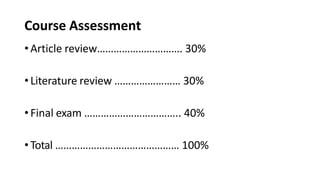
Course Assessment
•Article review…………………………. 30%
•Literature review …………………… 30%
•Final exam …………………………….. 40%
•Total ……………………………………… 100%
Recommended Readings
Text book
Robbins & Judge 2013, organizational behavior 15th
edition.
Chapter 1
Introduction
Chapter Objectives
At the end of this chapter you should be able to:
• Demonstrate the importance of interpersonal skills in the
workplace.
• Describe the manager’s functions, roles, and skills.
• Define organizational behavior (OB).
• Show the value of OB for systematic study.
• Identify the major behavioral science disciplines that contribute to
OB.
• Demonstrate why there are few absolutes in OB.
• Identify the challenges and opportunities managers face in
applying OB concepts.
Management
• Management is the process of getting things done effectively and
efficiently through the efforts of others to achieve organizational goal.
• Until the late 1980s, business school curricula emphasized the technical
aspects of management, focusing on economics, accounting, finance, and
quantitative techniques. Course work in human behavior and people skills
received relatively less attention.
• Over the past three decades, however, business faculty have come to
realize the role that understanding human behavior plays in determining a
manager’s effectiveness, and required courses on people skills have been
added to many curricula.
What Managers Do
• They get things done through other people.
• Management Activities:
– Make decisions
– Allocate resources
– Direct activities of others to attain goals
• Work in an organization
– A consciously coordinated social unit composed of two or more people that
functions on a relatively continuous basis to achieve a common goal or set of
goals.
Four Management Functions
• PLAN
• A process that includes defining goals, establishing strategy, and developing
plans to coordinate activities.
• ORGANIZE
• Determining what tasks are to be done, who is to do them, how the tasks are
to be grouped, who reports to whom, and where decisions are to be made.
Four Management Functions
• LEAD
• A function that includes motivating employees, directing others, selecting the
most effective communication channels, and resolving conflicts.
• CONTROL
• Monitoring performance, comparing actual performance with previously set
goals, and correcting any deviation.
Mintzberg’s Managerial Roles
• Ten roles in three groups
• Interpersonal
• Figurehead, Leader, and Liaison
• Informational
• Monitor, Disseminator, Spokesperson
• Decisional
• Entrepreneur, Disturbance Handler, Resource Allocator, and Negotiator.
The Importance of Interpersonal Skills
• Developing managers’ interpersonal skills help organizations
attract and keep high-performing employees.
• Organizational benefits of skilled managers include;
–Lower turnover of quality employees
–Higher quality applications for recruitment
–Better financial performance
Katz’s Essential Management Skills
• Technical Skills
– The ability to apply specialized knowledge or expertise
• Human Skills
– The ability to work with, understand, and motivate other people, both
individually and in groups
• Conceptual Skills
– The mental ability to analyze and diagnose complex situations
Organizational Behavior
A field of study that investigates the impact that individuals, groups,
and structure have on behavior within organizations, for the purpose of
applying such knowledge toward improving an organization’s
effectiveness.
Intuition and Systematic Study
• Intuition
• Gut feelings
• Individual observation
• Common sense
• Systematic Study
• Looks at relationships
• Scientific evidence
• Predicts behaviors
• The two are complementary means of predicting behavior.
An Outgrowth of Systematic Study…
Evidence-Based Management (EBM)
– Basing managerial decisions on the best available scientific evidence.
– Must think like scientists:
• Pose a managerial question
• Search for best available evidence
• Apply relevant information to case
Managers Should Use All Three Approaches
The trick is to know when to go with your gut.
– Jack Welsh
• Intuition is often based on inaccurate information
• Systematic study can be time-consuming
Use evidence as much as possible to inform your intuition and
experience. That is the promise of OB.
Four Contributing Disciplines
• Psychology
The science that seeks to measure, explain, and sometimes change
the behavior of humans and other animals.
• Unit of Analysis:
• Individual
• Contributions to OB:
• Learning, motivation, personality, emotions, perception
• Training, leadership effectiveness, job satisfaction
• Individual decision making, performance appraisal, attitude measurement
• Employee selection, work design, and work stress
Four Contributing Disciplines
– Organizational System
–Contributions to OB:
• Group dynamics
• Work teams
• Communication
• Power
• Conflict
• Intergroup behavior
• Sociology
The study of people in relation to their fellow
human beings.
– Unit of Analysis:
– Group
• Formal organization theory
• Organizational technology
• Organizational change
• Organizational culture
Four Contributing Disciplines
• Social Psychology
An area within psychology that blends concepts from psychology and
sociology and that focuses on the influence of people on one another.
– Unit of Analysis:
• Group
– Contributions to OB:
• Behavioral change
• Attitude change
• Communication
• Group processes
• Group decision making
Four Contributing Disciplines
– Unit of Analysis:
-- Organizational System
–Contributions to OB:
• Organizational culture
• Organizational
environment
-- Group
• Comparative values
• Comparative attitudes
• Cross-cultural analysis
• Anthropology
The study of societies to learn about human
beings and their activities.
Challenges and Opportunities for OB
• Responding to Globalization
• Managing Workforce Diversity
• Improving Quality and Productivity
• Improving Customer Service
• Improving People Skills
• Stimulating Innovation and Change
• Coping with “Temporariness”
• Working in Networked Organizations
• Helping Employees Balance Work-Life Conflicts
• Creating a Positive Work Environment
• Improving Ethical Behavior
Challenges and Opportunities for OB
• Responding to Globalization
– Increased foreign assignments
– Working with people from different cultures
– Coping with anti-capitalism backlash
– Overseeing movement of jobs to countries with low-cost labor
– Managing people during the war on terror
• Managing Workforce Diversity
– The people in organizations are becoming more heterogeneous demographically
(disability, gender, age, national origin, race, and domestic partners)
– Embracing diversity
– Changing demographics
– Management philosophy changes
– Recognizing and responding to differences
Developing an OB Model
• A model is an abstraction of reality: a simplified representation of
some real-world phenomenon.
• Our OB model has three levels of analysis:
• Each level is constructed on the prior level
• Individual
• Group
• Organizational Systems
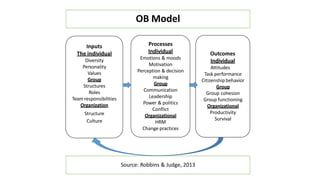
OB Model
Source: Robbins & Judge, 2013
Inputs
The individual
Diversity
Personality
Values
Group
Structures
Roles
Team responsibilities
Organization
Structure
Culture
Processes
Individual
Emotions & moods
Motivation
Perception & decision
making
Group
Communication
Leadership
Power & politics
Conflict
Organizational
HRM
Change practices
Outcomes
Individual
Attitudes
Task performance
Citizenshipbehavior
Group
Group cohesion
Group functioning
Organizational
Productivity
Survival
Summary and Managerial Implications
• Managers need to develop their interpersonal skills to be effective.
• OB focuses on how to improve factors that make organizations more
effective.
• The best predictions of behavior are made from a combination of
systematic study and intuition.
• Situational variables moderate cause-and-effect relationships – which
is why OB theories are contingent.
• There are many OB challenges and opportunities for managers today.
End of Chapter 1
Chapter 2
Individual Behavior
Lesson 1
Ability and Learning
Chapter Objectives
At the end of this chapter you should be able to:
• Contrast the two types of ability.
• Define intellectual ability and demonstrate its relevance to OB.
• Identify the key biographical characteristics and describe how they
are relevant to OB.
• Define learning and outline the principles of the three major
theories of learning.
• Describe how behavior can be shaped.
Ability
Ability refers to an individual’s capacity to perform the various tasks
in a job.
⚫Made up of two sets of factors:
⚫Intellectual Abilities
⚫The abilities needed to perform mental activities.
⚫General Mental Ability (GMA) is a measure of overall intelligence.
⚫Wonderlic Personnel Test: a quick measure of intelligence for recruitment screening.
⚫Physical Abilities
⚫The capacity to do tasks demanding stamina, dexterity, strength, and similar characteristics.
Dimensions of Intellectual Ability
• Number Aptitude
• Verbal Comprehension
• Perceptual Speed
• Inductive Reasoning
• Deductive Reasoning
• Spatial Visualization
• Memory
Dimensions of Intellectual Ability
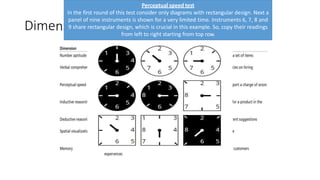
Perceptual speed test
In the first round of this test consider only diagrams with rectangular design. Next a
panel of nine instruments is shown for a very limited time. Instruments 6, 7, 8 and
9 share rectangular design, which is crucial in this example. So, copy their readings
from left to right starting from top row.
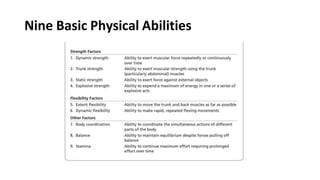
Nine Basic Physical Abilities
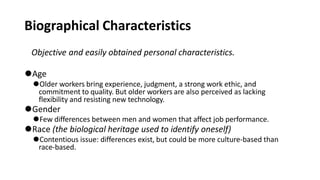
Biographical Characteristics
Objective and easily obtained personal characteristics.
⚫Age
⚫Older workers bring experience, judgment, a strong work ethic, and
commitment to quality. But older workers are also perceived as lacking
flexibility and resisting new technology.
⚫Gender
⚫Few differences between men and women that affect job performance.
⚫Race (the biological heritage used to identify oneself)
⚫Contentious issue: differences exist, but could be more culture-based than
race-based.
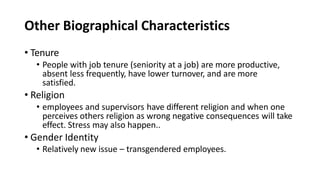
Other Biographical Characteristics
• Tenure
• People with job tenure (seniority at a job) are more productive,
absent less frequently, have lower turnover, and are more
satisfied.
• Religion
• employees and supervisors have different religion and when one
perceives others religion as wrong negative consequences will take
effect. Stress may also happen..
• Gender Identity
• Relatively new issue – transgendered employees.
Learning
Any relatively permanent change in behavior
that occurs as a result of experience
• Learning components:
• Involves Change
• Is Relatively Permanent
• Is Acquired Through Experience
Theories of Learning
• Classical Conditioning
• A type of conditioning in which an individual responds to some stimulus that
would not ordinarily produce such a response.
• Operant Conditioning
• A type of conditioning in which desired voluntary behavior leads to a reward
or prevents a punishment.
• Social-Learning Theory
• People can learn through observation and direct experience.
Classical Conditioning
⚫Pavlov’s Dog Drool
⚫Key Concepts:
⚫Unconditioned stimulus
⚫A naturally occurring phenomenon.
⚫Unconditioned response
⚫The naturally occurring response to a natural stimulus.
⚫Conditioned stimulus
⚫An artificial stimulus introduced into the situation.
⚫Conditioned response
⚫The response to the artificial stimulus.
This is a passive form of learning. It is reflexive and not voluntary – not the
best theory for OB learning.
Operant Conditioning
⚫B. F. Skinner’s concept of Behaviorism: behavior follows stimuli in a
relatively unthinking manner.
⚫Key Concepts:
⚫Conditioned behavior: voluntary behavior that is learned, not reflexive.
⚫Reinforcement: the consequences of behavior which can increase or decrease
the likelihood of behavior repetition.
⚫Pleasing consequences increase likelihood of repetition.
⚫Rewards are most effective immediately after performance.
⚫Unrewarded/punished behavior is unlikely to be repeated.
Social-Learning Theory
⚫Based on the idea that people can also learn indirectly: by observation,
reading, or just hearing about someone else’s – a model’s – experiences.
⚫Key Concepts:
⚫Attentional processes
⚫Must recognize and pay attention to critical features to learn.
⚫Retention processes
⚫Model’s actions must be remembered to be learned.
⚫Motor reproduction processes
⚫Watching the model’s behavior must be converted to doing.
⚫Reinforcement processes
⚫Positive incentives motivate learners.
Behavior Modification (OB Mod)
The application of reinforcement concepts to individuals in the work
setting.
• Follows the Five-Step Problem-Solving Model:
• Identify critical behaviors
• Develop baseline data
• Identify behavioral consequences
• Develop and apply intervention
• Evaluate performance improvement
Shaping: A Managerial Tool
Systematically reinforcing each successive step that moves an
individual closer to the desired response.
⚫Four Methods of Shaping Behavior:
⚫Positive reinforcement
⚫Providing a reward for a desired behavior (learning)
⚫Negative reinforcement
⚫Removing an unpleasant consequence when the desired behavior occurs (learning)
⚫Punishment
⚫Applying an undesirable condition to eliminate an undesirable behavior (“unlearning”)
⚫Extinction
⚫Withholding reinforcement of a behavior to cause its cessation (“unlearning”)
⚫Removing of all reinforcement that might be associated with a behavior.
Summary and Managerial Implications
• Three Individual Variables:
• Ability
• Directly influences employee’s level of performance
• Managers need to focus on ability in selection, promotion, and transfer.
• Fine-tune job to fit incumbent’s abilities.
• Biographical Characteristics
• Should not be used in management decisions: possible source of bias.
• Learning
• Observable change in behavior = learning.
• Reinforcement works better than punishment.
Lesson 2
Attitude
Chapter Objectives
At the end of this chapter you should be able to:
• Contrast the three components of an attitude.
• Summarize the relationship between attitudes and behavior.
• Compare and contrast the major job attitudes.
• Define job satisfaction and show how it can be measured.
• Summarize the main causes of job satisfaction.
• Identify four employee responses to dissatisfaction
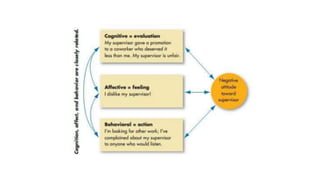
Attitudes
Evaluative statements or judgments concerning
objects, people, or events.
Three components of an attitude:
• Affective – The emotional or feeling segment of an
attitude
• Cognitive – The opinion or belief segment of an attitude
• Behavioral – An intention to behave in a certain way
toward someone or something
Does Behavior Always Follow from Attitudes?
• People watch television programs they like, or that
employees try to avoid assignments they find distasteful
(behavior follows attitude)
• A friend of yours has consistently argued that the quality of
cars assembled in Ethiopia isn’t up to that of imports and
that he’d never own anything but a Japanese car. But his dad
gives him a Lifan 630 automobile, and suddenly he says
Ethiopian cars aren’t so bad.
Does Behavior Always Follow from Attitudes?
• Leon Festinger – No, the reverse is sometimes true!
• Cognitive Dissonance: Any incompatibility between two or more
attitudes or between behavior and attitudes
– Individuals seek to reduce this uncomfortable gap, or dissonance, to reach
stability and consistency
– Consistency is achieved by changing the attitudes, modifying the behaviors, or
through rationalization
– Desire to reduce dissonance depends on:
• Importance of elements
• Degree of individual influence
• Rewards involved in dissonance
What Are the Major Job Attitudes?
• Job Satisfaction
• A positive feeling about the job resulting from an evaluation of its
characteristics.
• Job Involvement
• Degree of psychological identification with the job where perceived
performance is important to self-worth.
• Psychological Empowerment
• Belief in the degree of influence over the job, competence, job
meaningfulness, and autonomy.
Another Major Job Attitude
• Organizational Commitment
• Identifying with a particular organization and its goals, while wishing to
maintain membership in the organization.
• Three dimensions:
• Affective – emotional attachment to organization
• Continuance Commitment – economic value of staying
• Normative – moral or ethical obligations
• Has some relation to performance, especially for new employees.
• Less important now than in past – now perhaps more of occupational
commitment, loyalty to profession rather than to a given employer.
And Yet More Major Job Attitudes…
• Perceived Organizational Support (POS)
• Degree to which employees believe the organization values their contribution
and cares about their well-being.
• Higher when rewards are fair, employees are involved in decision-making, and
supervisors are seen as supportive.
• High POS is related to higher OCBs and performance.
• Employee Engagement
• The degree of involvement, satisfaction with, and enthusiasm for the job.
• Engaged employees are passionate about their work and company.
Job Satisfaction
•One of the primary job attitudes measured.
–Broad term involving a complex individual
summation of a number of discrete job elements.
•How to measure?
–Single global rating (one question/one answer) -
Best
–Summation score (many questions/one average) -
OK
Causes of Job Satisfaction
• Pay influences job satisfaction only to a point.
– After about $40,000 a year (in the U. S.), there is no relationship between
amount of pay and job satisfaction.
– Money may bring happiness, but not necessarily job satisfaction.
• Personality can influence job satisfaction.
– Negative people are usually not satisfied with their jobs.
– Those with positive core self-evaluation are more satisfied with their jobs.
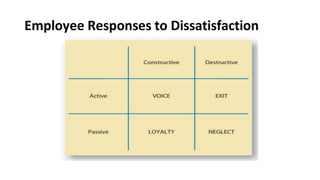
Employee Responses to Dissatisfaction
• Exit
– Behavior directed toward leaving the organization
• Voice
– Active and constructive attempts to improve conditions
• Neglect
– Allowing conditions to worsen
• Loyalty
– Passively waiting for conditions to improve
Employee Responses to Dissatisfaction
Outcomes of Job Satisfaction
• Job Performance
– Satisfied workers are more productive AND more
productive workers are more satisfied!
– The causality may run both ways.
• Organizational Citizenship Behaviors
– Satisfaction influences OCB through perceptions of
fairness.
• Customer Satisfaction
– Satisfied frontline employees increase customer
satisfaction and loyalty.
• Absenteeism
– Satisfied employees are moderately less likely to miss work.
More Outcomes of Job Satisfaction
• Turnover
• Satisfied employees are less likely to quit.
• Many moderating variables in this relationship.
• Economic environment and tenure.
• Organizational actions taken to retain high performers and to
weed out lower performers.
• Workplace Deviance
• Dissatisfied workers are more likely to unionize, abuse
substances, steal, be tardy, and withdraw.
Despite the overwhelming evidence of the impact of job
satisfaction on the bottom line, most managers are
either unconcerned about or overestimate worker
satisfaction.
Summary and Managerial Implications
• Managers should watch employee attitudes
• They give warnings of potential problems
• They influence behavior
• Managers should try to increase job satisfaction and generate
positive job attitudes
• Reduces costs by lowering turnover, absenteeism, tardiness, and theft,
and increasing OCB
• Focus on the intrinsic parts of the job: make work challenging
and interesting
• Pay is not enough
Lesson 3
Personality and Values
Lesson Objectives
At the end of this lesson you should be able to:
⚫Define personality, describe how it is measured, and explain the factors
that determine an individual’s personality.
⚫Describe the Myers-Briggs Type Indicator personality framework and
assess its strengths and weaknesses.
⚫Identify the key traits in the Big Five personality model.
⚫Demonstrate how the Big Five traits predict behavior at work.
⚫Identify other personality traits relevant to OB.
⚫Define values, demonstrate their importance, and contrast terminal and
instrumental values.
⚫Compare generational differences in values, and identify the dominant
values in today’s workforce.
⚫Identify Hofstede’s five value dimensions of national culture.
What is Personality?
The dynamic organization within the individual of those psychophysical
systems that determine his unique adjustments to his environment. -
Gordon Allport
• The sum total of ways in which an individual reacts and interacts with others,
the measurable traits a person exhibits
•Measuring Personality
• Helpful in hiring decisions
• Most common method: self-reporting surveys
• Observer-ratings surveys provide an independent assessment of personality
– often better predictors
Personality Determinants
• Heredity
• Factors determined at conception: physical stature, facial
attractiveness, gender, temperament, muscle composition and reflexes,
energy level, and bio-rhythms
• This “Heredity Approach” argues that genes are the source of
personality
• Twin studies: raised apart but very similar personalities support the
heredity approach.
• Parents don’t add much to personality development
• There is some personality change over long time periods (eg.
Dependability increase when young adults take on roles)
Personality Traits
Enduring characteristics that describe an individual’s
behavior
• The more consistent the characteristic and the more frequently it
occurs in diverse situations, the more important the trait.
• Two dominant frameworks used to describe personality:
• Myers-Briggs Type Indicator (MBTI®)
• Big Five Model
The Myers-Briggs Type Indicator
• Most widely-used instrument in the world.
• Participants are classified on four axes to determine one of
16 possible personality types, such as ENTJ.
• Extroverted (E) vs. Introverted (I)
• Sensing (S) vs. Intuitive (N)
• Thinking (T) vs. Feeling (F)
• Judging (J) vs. Perceiving (P)
The Types and Their Uses
▣ Each of the sixteen possible combinations has a name, for instance:
◾Visionaries (INTJ) – are original, stubborn and driven.
◾Organizers (ESTJ) – realistic, logical, analytical and businesslike.
◾Conceptualizer (ENTP) – entrepreneurial, innovative,
individualistic and resourceful.
▣ Research results on validity mixed.
◾MBTI® is a good tool for self-awareness and counseling.
◾Should not be used as a selection test for job candidates.
The Big Five Model of Personality Dimensions
• Extroversion
• Sociable, gregarious, and assertive
• Agreeableness
• Good-natured, cooperative, and trusting
• Conscientiousness
• Responsible, dependable, persistent, and organized
• Emotional Stability
• Calm, self-confident, secure under stress (positive), versus
nervous, depressed, and insecure under stress (negative)
• Openness to Experience
• Curious, imaginative, artistic, and sensitive
How Do the Big Five Traits Predict Behavior?
▣ Research has shown this to be a better framework.
▣Certain traits have been shown to strongly relate to higher job
performance:
◾Highly conscientious people develop more job knowledge, exert
greater effort, and have better performance.
◾Other Big Five Traits also have implications for work.
 Emotional stability is related to job satisfaction.
 Extroverts tend to be happier in their jobs and have good social skills.
 Open people are more creative and can be good leaders.
 Agreeable people are good in social settings.
Other Personality Traits Relevant to OB
• Core Self-Evaluation
• The degree to which people like or dislike themselves
• Positive self-evaluation leads to higher job performance
• Machiavellianism
• A pragmatic, emotionally distant power-player who believes that ends justify
the means
• High Machs are manipulative, win more often, and persuade more than they
are persuaded. Flourish when:
• Have direct interaction
• Work with minimal rules and regulations
• Emotions distract others
• Narcissism
• An arrogant, entitled, self-important person who needs excessive admiration
• Less effective in their jobs
More Relevant Personality Traits
• Self-Monitoring
• The ability to adjust behavior to meet external, situational factors.
• High monitors conform more and are more likely to become
leaders.
• Risk Taking
• The willingness to take chances.
• May be best to align propensities with job requirements.
• Risk takers make faster decisions with less information.
Even More Relevant Personality Traits
• Type A Personality
• Aggressively involved in a chronic, incessant struggle to achieve more in less
time
• Impatient: always moving, walking, and eating rapidly
• Strive to think or do two or more things at once
• Cannot cope with leisure time
• Obsessed with achievement numbers
• Type B people are the complete opposite
• Proactive Personality
• Identifies opportunities, shows initiative, takes action, and perseveres to
completion
• Creates positive change in the environment
Values
Basic convictions on how to conduct yourself or how to live your life
that is personally or socially preferable – “How to” live life properly.
Importance of values
• Provide understanding of the attitudes, motivation, and behaviors
• Influence our perception of the world around us
• Represent interpretations of “right” and “wrong”
• Imply that some behaviors or outcomes are preferred over others
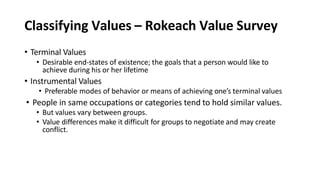
Classifying Values – Rokeach Value Survey
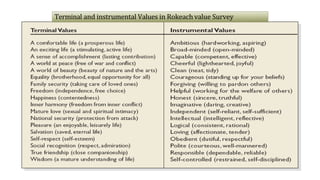
• Terminal Values
• Desirable end-states of existence; the goals that a person would like to
achieve during his or her lifetime
• Instrumental Values
• Preferable modes of behavior or means of achieving one’s terminal values
• People in same occupations or categories tend to hold similar values.
• But values vary between groups.
• Value differences make it difficult for groups to negotiate and may create
conflict.
Terminal and instrumental Values in Rokeach value Survey
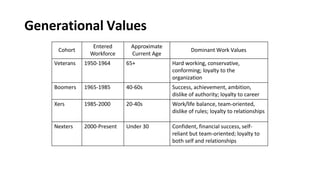
Generational Values
Cohort
Entered
Workforce
Approximate
Current Age
Dominant Work Values
Veterans 1950-1964 65+ Hard working, conservative,
conforming; loyalty to the
organization
Boomers 1965-1985 40-60s Success, achievement, ambition,
dislike of authority; loyalty to career
Xers 1985-2000 20-40s Work/life balance, team-oriented,
dislike of rules; loyalty to relationships
Nexters 2000-Present Under 30 Confident, financial success, self-
reliant but team-oriented; loyalty to
both self and relationships
Linking Personality and Values to the
Workplace
Managers are less interested in someone’s ability to do a
specific job than in that person’s flexibility.
▣Person-Job Fit:
◾John Holland’s Personality-Job Fit Theory
 Six personality types
 Vocational Preference Inventory (VPI)
◾Key Points of the Model:
 There appear to be intrinsic differences in personality between people.
 There are different types of jobs.
 People in jobs congruent with their personality should be more satisfied and have lower
turnover.
Holland’s Personality Types
• Six types:
• Realistic
• Investigative
• Artistic
• Social
• Enterprising
• Conventional
• Need to match personality type with occupation
Still Linking Personality to the Workplace
In addition to matching the individual’s personality to the job, managers
are also concerned with:
•Person-Organization Fit:
• The employee’s personality must fit with the organizational culture.
• People are attracted to organizations that match their values.
• Those who match are most likely to be selected.
• Mismatches will result in turnover.
• Can use the Big Five personality types to match to the organizational culture.
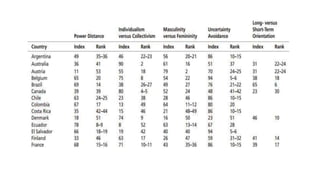
Hofstede’s Framework: Power Distance
The extent to which a society accepts that power in institutions and
organizations is distributed unequally.
• Low distance
• Relatively equal power between those with status/wealth and those without status/wealth
• High distance
• Extremely unequal power distribution between those with status/wealth and those without
status/wealth
Hofstede’s Framework: Individualism
• Individualism
• The degree to which people prefer to act as individuals rather than as
members of groups
• Collectivism
• A tight social framework in which people expect others in groups of which
they are a part to look after them and protect them
Hofstede’s Framework: Masculinity
• Masculinity
• The extent to which the society values work roles of achievement, power, and
control, and where assertiveness and materialism are also valued
• Femininity
• The extent to which there is little differentiation between roles for men and
women
Hofstede’s Framework: Uncertainty
Avoidance
The extent to which a society feels threatened by uncertain and
ambiguous situations and tries to avoid them
• High Uncertainty Avoidance:
• Society does not like ambiguous situations and tries to avoid them.
• Low Uncertainty Avoidance:
• Society does not mind ambiguous situations and embraces them.
Hofstede’s Framework: Time Orientation
• Long-term Orientation
• A national culture attribute that emphasizes the future, thrift, and persistence
• Short-term Orientation
• A national culture attribute that emphasizes the present and the here-and-
now
Hofstede’s Framework: An Assessment
⚫There are regional differences within countries
⚫The original data is old and based on only one company
⚫Hofstede had to make many judgment calls while doing the research
⚫Some results don’t match what is believed to be true about given
countries
⚫Despite these problems it remains a very popular framework
GLOBE Framework for Assessing Cultures
⚫Global Leadership and Organizational Behavior Effectiveness (GLOBE)
research program.
⚫Nine dimensions of national culture
⚫Similar to Hofstede’s framework with these additional dimensions:
⚫Humane Orientation: how much society rewards people for being altruistic,
generous, and kind.
⚫Performance Orientation: how much society encourages and rewards
performance improvement and excellence.
Summary and Managerial Implications
▣Personality
◾Screen for the Big Five trait of conscientiousness
◾Take into account the situational factors as well
◾MBTI® can help with training and development
▣Values
◾Often explain attitudes, behaviors and perceptions
◾Higher performance and satisfaction achieved when the individual’s
values match those of the organization
Lesson 4
Perception and Individual Decision
Making
Lesson Objectives
At the end of this lesson you should be able to:
⚫Define perception.
⚫Describe the individual decision making process.
What is Perception?
• A process by which individuals organize and interpret their sensory
impressions in order to give meaning to their environment.
• People’s behavior is based on their perception of what reality is, not
on reality itself.
• The world as it is perceived is the world that is behaviorally
important.
Factors affecting Perception
• Target/perceived: Characteristics of the target affect what we perceive.
• Eg. Loud people are more likely to be noticed in a group than quiet ones. So, too, are extremely
attractive or unattractive individuals.
• The perceiver: your interpretation is heavily influenced by your personal
characteristics—your attitudes, personality, motives, interests, past
experiences, and expectations.
• For instance, if you expect police officers to be authoritative or young people to be
lazy, you may perceive them as such, regardless of their actual traits.
• The context: The time at which we see an object or event can influence our
attention, as can location, light, heat, or any number of situational factors.
• Eg. At a night time, you may not notice a young guest “dressed to the well.” Yet that
same person so attired for your Monday morning management class would certainly
catch your attention (and that of the rest of the class).
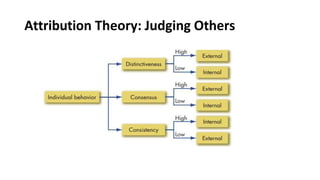
Attribution Theory: Judging Others
• Attribution theory tries to explain the ways in which we judge people
differently, depending on the meaning we attribute to a given behavior.
• When individuals observe behavior, they attempt to determine whether it is internally or
externally caused.
• Internal causes are under that person’s control.
• External causes are not – person forced to act in that way.
• Causation judged through:
• Distinctiveness
• Shows different behaviors in different situations (Is the employee who arrives late today also
one who regularly “blows off” commitments?)
• Consensus
• If everyone who faces a similar situation responds in the same way
• Consistency
• Responds in the same way over time (Coming in 10 minutes late for work once in a month…)
Attribution Theory: Judging Others
Errors and Biases in Attributions
• Fundamental Attribution Error
• The tendency to underestimate the influence of external factors and
overestimate the influence of internal factors when making judgments about
the behavior of others
• We blame people first, not the situation
• Self-Serving Bias
• The tendency for individuals to attribute their own successes to internal
factors while putting the blame for failures on external factors
• It is “our” success but “their” failure
Frequently Used Shortcuts in Judging Others
▣ Selective Perception
◾People selectively interpret what they see on the basis of their interests,
background, experience, and attitudes.
▣ Halo Effect
◾Drawing a general impression about an individual on the basis of a single
characteristic
▣ Contrast Effects
◾Evaluation of a person’s characteristics that are affected by comparisons
with other people recently encountered who rank higher or lower on the
same characteristics
Another Shortcut: Stereotyping
Judging someone on the basis of one’s perception of the group to
which that person belongs – a prevalent and often useful, if not
always accurate, generalization
•Profiling
• A form of stereotyping in which members of a group are singled out for
intense scrutiny based on a single, often racial, trait.
Perceptions and Individual Decision Making
▣ Problem
◾A perceived discrepancy between the current state of affairs and a desired
state
▣ Decisions
◾Choices made from among alternatives developed from data
▣ Perception Linkage:
◾All elements of problem identification and the decision making process are
influenced by perception.
 Problems must be recognized
 Data must be selected and evaluated
Decision-Making Models in Organizations
• Rational Decision-Making
• The “perfect world” model: assumes complete information, all options known, and
maximum payoff
• Six-step decision-making process
1. Define the problem.
2. Identify the decision criteria.
3. Allocate weights to the criteria.
4. Develop the alternatives.
5. Evaluate the alternatives.
6. Select the best alternative.
Decision-Making Models in Organizations
• Bounded Reality
• The “real world” model: seeks satisfactory and sufficient solutions from limited data
and alternatives
• Intuition
• A non-conscious process created from distilled experience that results in quick
decisions
• Relies on holistic associations
• Affectively charged – engaging the emotions
Common Biases and Errors in Decision-
Making
▣ Overconfidence Bias
◾ Believing too much in our own ability to make good decisions – especially when
outside of own expertise
▣ Anchoring Bias
◾ Using early, first received information as the basis for making subsequent
judgments
▣ Confirmation Bias
◾ Selecting and using only facts that support our decision
▣ Availability Bias
◾ Emphasizing information that is most readily at hand
 Recent
 Vivid
More Common Decision-Making Errors
▣ Escalation of Commitment
◾Increasing commitment to a decision in spite of evidence that it is wrong –
especially if responsible for the decision!
▣ Randomness Error
◾Creating meaning out of random events - superstitions
▣ Winner’s Curse
◾Highest bidder pays too much due to value overestimation
◾Likelihood increases with the number of people in auction
▣ Hindsight Bias
◾After an outcome is already known, believing it could have been accurately
predicted beforehand
Individual Differences in Decision-Making
▣Personality
◾Conscientiousness may effect escalation of commitment
 Achievement strivers are likely to increase commitment
 Dutiful people are less likely to have this bias
◾Self-Esteem
 High self-esteem people are susceptible to self-serving bias
 Gender
▣ Women analyze decisions more than men – rumination
▣ Women are twice as likely to develop depression
▣ Differences develop early (eg. Girls at 11 are more ruminating than boys)
Summary and Managerial Implications
▣ Perception:
◾People act based on how they view their world
◾What exists is not as important as what is believed
◾Managers must also manage perception
▣ Individual Decision Making
◾Most use bounded rationality: they satisfice
◾Combine traditional methods with intuition and creativity for better
decisions
 Analyze the situation and adjust to culture and organizational reward criteria
 Be aware of, and minimize, biases
Lesson 5
Motivation Concepts
Lesson Objectives
At the end of this lesson you should be able to:
⚫Describe the three elements of motivation.
⚫Identify four early theories of motivation and evaluate their applicability
today.
⚫Apply the predictions of Cognitive Evaluation theory to intrinsic and
extrinsic rewards.
⚫Compare and contrast goal-setting theory and Management by
Objectives.
⚫Contrast reinforcement theory and goal-setting theory.
⚫Demonstrate how organizational justice is a refinement of equity theory.
⚫Apply the key tenets of expectancy theory to motivating employees.
⚫Compare contemporary theories of motivation.
⚫Explain to what degree motivation theories are culture-bound.
Defining Motivation
The result of the interaction between the individual and the situation.
•The processes that account for an individual’s intensity, direction, and
persistence of effort toward attaining a goal – specifically, an
organizational goal.
•Three key elements:
• Intensity – how hard a person tries.
• Direction – effort that is channeled toward, and consistent with,
organizational goals.
• Persistence – how long a person can maintain effort.
Early Theories of Motivation
These early theories may not be valid, but they do form the basis
for contemporary theories and are still used by practicing
managers.
•Maslow’s Hierarchy of Needs Theory
• Alderfer’s ERG (Existence, Relatedness, and Growth)
•McGregor’s Theory X and Theory Y
•Herzberg’s Two-Factor Theory
•McClelland’s Theory of Needs
Maslow’s Hierarchy of Needs
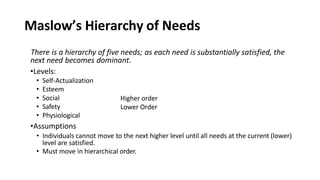
There is a hierarchy of five needs; as each need is substantially satisfied, the
next need becomes dominant.
•Levels:
• Self-Actualization
• Esteem
Higher order
Lower Order
• Social
• Safety
• Physiological
•Assumptions
• Individuals cannot move to the next higher level until all needs at the current (lower)
level are satisfied.
• Must move in hierarchical order.
Alderfer’s ERG Theory
A reworking of Maslow to fit empirical research
•Three groups of core needs:
• Existence (Maslow: physiological and safety)
• Relatedness (Maslow: social and status)
• Growth (Maslow: esteem and self-actualization)
•Removed the hierarchical assumption
• Can be motivated by all three at once
•Popular, but not accurate, theory
McGregor’s Theory X and Theory Y
▣Two distinct views of human beings: Theory X (basically negative) and
Theory Y (positive).
◾Managers used a set of assumptions based on their view
◾The assumptions molded their behavior toward employees
 Theory X
🢝Workers have little ambition
🢝Dislike work
🢝Avoid responsibility
 Theory Y
🢝Workers are self-directed
🢝Enjoy work
🢝Accept responsibility
▣ No empirical evidence to support this theory
Herzberg’s Two-Factor Theory
• Key Point: Satisfaction and dissatisfaction are not opposites but separate
constructs
• Hygiene Factors - Extrinsic and Related to Dissatisfaction
• Work Conditions
• Salary
• Company Policies
• Motivators - Intrinsic and Related to Satisfaction
• Achievement
• Responsibility
• Growth
Criticisms of Two-Factor Theory
Herzberg says that hygiene factors must be met to remove
dissatisfaction. If motivators are given, then satisfaction can occur.
•Herzberg is limited by his procedure
• Participants had self-serving bias
•Reliability of raters questioned
• Bias or errors of observation
•No overall measure of satisfaction was used
•Herzberg assumed, but didn’t research, a strong relationship between
satisfaction and productivity
McClelland’s Three Needs Theory
▣ Need for Achievement (nAch)
◾The drive to excel, to achieve in relation to a set of standards, to strive to
succeed
▣ Need for Power (nPow)
◾The need to make others behave in a way that they would not have behaved
otherwise
▣ Need for Affiliation (nAff)
◾The desire for friendly and close interpersonal relationships
▣ People have varying levels of each of the three needs
◾Hard to measure
McClelland’s Three Needs Theory
▣ Target A sits almost within arm’s reach. If you hit it, you get $2.
▣ Target B is a bit farther out, but about 80 percent of the people who try can hit
it. It pays $4.
▣ Target C pays $8, and about half the people who try can hit it.
▣ Very few people can hit Target D, but the payoff is $16 for those who do.
▣ Finally, Target E pays $32, but it’s almost impossible to achieve. Which would
you try for?
Performance Predictions for High nAch
▣ People with a high need for achievement are likely to:
◾Prefer to undertake activities with a 50/50 chance of success – avoiding very
low or high risk situations
◾Be motivated in jobs that offer high degree of personal responsibility,
feedback, and moderate risk
◾Don’t necessarily make good managers – too personal a focus
◾Most good general managers do NOT have a high nAch
◾Need high level of nPow and low nAff for managerial success
▣ Good research support but it is not a very practical theory
Contemporary Theories of Motivation
• Cognitive Evaluation Theory
• Goal-Setting Theory
• Management By Objectives (MBO)
• Self-Efficacy Theory
• Also known as Social Cognitive Theory or Social Learning Theory
• Reinforcement Theory
• Equity Theory
• Expectancy Theory
Cognitive Evaluation Theory
Providing an extrinsic reward for behavior that had been previously only intrinsically rewarding
tends to decrease the overall level of motivation
•Major Implications for Work Rewards
• Intrinsic and extrinsic rewards are not independent
• Extrinsic rewards can undermine motivation if they are seen as coercive. They can increase motivation if
they provide information about competence and relatedness.
• Pay should be non-contingent on performance
• Verbal rewards increase intrinsic motivation, tangible rewards reduce it
•Self-concordance
• When the personal reasons for pursuing goals are consistent with personal interests and core values
(intrinsic motivation), people are happier and more successful.
Locke’s Goal-Setting Theory
• Basic Premise:
• That specific and difficult goals, with self-generated feedback, lead to higher
performance.
• Difficult Goals:
• Focus and direct attention
• Energize the person to work harder
• Difficulty increases persistence
• Force people to be more effective and efficient
• Relationship between goals and performance depends on:
• Goal commitment (the more public the better!)
• Task characteristics (simple, well-learned)
• Culture
Implementation: Management By
Objectives
• MBO is a systematic way to utilize goal-setting.
• Goals must be:
• Tangible
• Verifiable
• Measurable
• Corporate goals are broken down into smaller, more specific goals at each
level of organization.
• Four common ingredients to MBO programs:
• Goal Specificity
• Participative decision making
• Explicit time period
• Performance feedback
Bandura’s Self-Efficacy Theory
• An individual’s belief that he or she is capable of performing a task
• Higher efficacy is related to:
• Greater confidence
• Greater persistence in the face of difficulties
• Better response to negative feedback (work harder)
• Self-Efficacy complements Goal-Setting Theory
Increasing Self-Efficacy
• Albert Bandura, proposes four ways self-efficacy can be increased:
1. Enactive mastery
• Most important source of efficacy
• Gaining relevant experience with task or job
• “Practice makes Perfect”
2. Vicarious modeling
• Increasing confidence by watching others perform the task
• Most effective when observer sees the model to be similar to him- or herself
3. Verbal persuasion
• Motivation through verbal conviction
• Pygmalion and Galatea effects - self-fulfilling prophecies
4. Arousal
• Getting “psyched up” – emotionally aroused – to complete task
• Can hurt performance if emotion is not a component of the task
Reinforcement Theory
▣Similar to Goal-Setting Theory, but focused on a behavioral
approach rather than a cognitive one
◾Behavior is environmentally caused
◾Behavior is controlled by its consequences – reinforcers
◾Not a motivational theory but a means of analysis of behavior
◾Reinforcement strongly influences behavior but not likely to be the
sole cause
Adams’ Equity Theory
• Employees compare their ratios of outcomes-to-inputs of
relevant others
• When ratios are equal: state of equity exists – no tension as the
situation is considered fair
• When ratios are unequal: tension exists due to unfairness
• Underrewarded states cause anger
• Overrewarded states cause guilt
• Tension motivates people to act to bring their situation into equity
Equity Theory’s “Relevant Others”
• Can be four different situations:
• Self-Inside
• The person’s experience in a different job in the same organization
• Self-Outside
• The person’s experience in a different job in a different organization
• Other-Inside
• Another individual or group within the organization
• Other-Outside
• Another individual or group outside of the organization
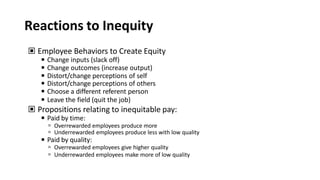
Reactions to Inequity
▣ Employee Behaviors to Create Equity
◾ Change inputs (slack off)
◾ Change outcomes (increase output)
◾ Distort/change perceptions of self
◾ Distort/change perceptions of others
◾ Choose a different referent person
◾ Leave the field (quit the job)
▣ Propositions relating to inequitable pay:
◾ Paid by time:
 Overrewarded employees produce more
 Underrewarded employees produce less with low quality
◾ Paid by quality:
 Overrewarded employees give higher quality
 Underrewarded employees make more of low quality
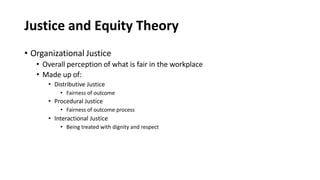
Justice and Equity Theory
• Organizational Justice
• Overall perception of what is fair in the workplace
• Made up of:
• Distributive Justice
• Fairness of outcome
• Procedural Justice
• Fairness of outcome process
• Interactional Justice
• Being treated with dignity and respect
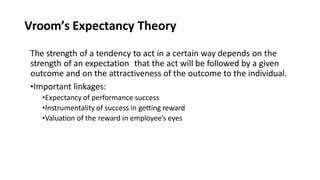
Vroom’s Expectancy Theory
The strength of a tendency to act in a certain way depends on the
strength of an expectation that the act will be followed by a given
outcome and on the attractiveness of the outcome to the individual.
•Important linkages:
•Expectancy of performance success
•Instrumentality of success in getting reward
•Valuation of the reward in employee’s eyes
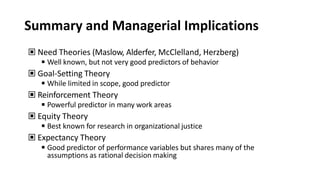
Summary and Managerial Implications
▣ Need Theories (Maslow, Alderfer, McClelland, Herzberg)
◾Well known, but not very good predictors of behavior
▣ Goal-Setting Theory
◾While limited in scope, good predictor
▣ Reinforcement Theory
◾Powerful predictor in many work areas
▣ Equity Theory
◾Best known for research in organizational justice
▣ Expectancy Theory
◾Good predictor of performance variables but shares many of the
assumptions as rational decision making
Lesson 6
Emotion and Mood
Lesson Objectives
At the end of this lesson you should be able to:
⚫Differentiate emotions from moods, and list the basic emotions and
moods.
⚫Discuss whether emotions are rational and what functions they
serve.
⚫Identify the sources of emotions and moods.
⚫Describe Affective Events Theory and identify its applications.
⚫Contrast the evidence for and against the existence of emotional
intelligence.
⚫Apply concepts about emotions and moods to specific OB issues.
⚫Contrast the experience, interpretation, and expression of
emotions across cultures.
Why Were Emotions Ignored in OB?
⚫The “Myth of Rationality”
⚫Emotions were seen as irrational
⚫Managers worked to make emotion-free environments
⚫View of Emotionality
⚫Emotions were believed to be disruptive
⚫Emotions interfered with productivity
⚫Only negative emotions were observed
⚫Now we know emotions can’t be separated from the workplace
What are Emotions and Moods?
⚫Affect
⚫A broad range of feelings that people experience
⚫Made up of:
⚫Emotions
⚫Intense feelings that are directed at someone or something
⚫Moods
⚫Feelings that tend to be less intense than emotions and that lack
a contextual stimulus
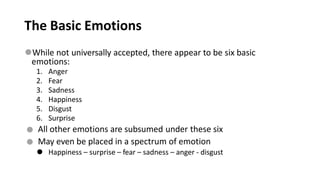
The Basic Emotions
⚫While not universally accepted, there appear to be six basic
emotions:
1. Anger
2. Fear
3. Sadness
4. Happiness
5. Disgust
6. Surprise
⚫
⚫
All other emotions are subsumed under these six
May even be placed in a spectrum of emotion
⚫ Happiness – surprise – fear – sadness – anger - disgust
Do Emotions Make Us Irrational?
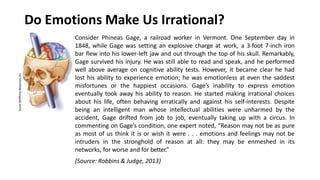
Consider Phineas Gage, a railroad worker in Vermont. One September day in
1848, while Gage was setting an explosive charge at work, a 3-foot 7-inch iron
bar flew into his lower-left jaw and out through the top of his skull. Remarkably,
Gage survived his injury. He was still able to read and speak, and he performed
well above average on cognitive ability tests. However, it became clear he had
lost his ability to experience emotion; he was emotionless at even the saddest
misfortunes or the happiest occasions. Gage’s inability to express emotion
eventually took away his ability to reason. He started making irrational choices
about his life, often behaving erratically and against his self-interests. Despite
being an intelligent man whose intellectual abilities were unharmed by the
accident, Gage drifted from job to job, eventually taking up with a circus. In
commenting on Gage’s condition, one expert noted, “Reason may not be as pure
as most of us think it is or wish it were . . . emotions and feelings may not be
intruders in the stronghold of reason at all: they may be enmeshed in its
networks, for worse and for better.”
(Source: Robbins & Judge, 2013)
What is the Function of Emotion?
⚫Do Emotions Make Us Irrational?
⚫Expressing emotions publicly may be damaging to social status
⚫Emotions are critical to rational decision-making
⚫Emotions help us understand the world around us
⚫What Functions Do Emotions Serve?
⚫Darwin argued they help in survival problem-solving
⚫Evolutionary psychology: people must experience emotions as there is a
purpose behind them
⚫Not all researchers agree with this assessment
Sources of Emotion and Mood
⚫Personality
⚫There is a trait component – affect intensity
⚫Day and Time of the Week
⚫There is a common pattern for all of us:
⚫ Happier in the midpoint of the daily awake period
⚫ Happier toward the end of the week
⚫Weather
⚫Illusory correlation – no effect
⚫Stress
⚫Even low levels of constant stress can worsen moods
⚫Social Activities
⚫Physical, informal, and dining activities increase positive moods
More Sources of Emotion and Mood
• Sleep
• Poor sleep quality increases negative affect
• Exercise
• Does somewhat improve mood, especially for depressed people
• Age
• Older folks experience fewer negative emotions
• Gender
• Women tend to be more emotionally expressive, feel emotions more
intensely, have longer lasting moods, and express emotions more frequently
than do men
• Due more to socialization than to biology
Emotional Labor
An employee’s expression of organizationally desired emotions during
interpersonal transactions at work
⚫Emotional Dissonance:
⚫Employees have to project one emotion while simultaneously feeling another
⚫Can be very damaging and lead to burnout
⚫Types of Emotions:
⚫Felt: the individual’s actual emotions
⚫Displayed: required or appropriate emotions
⚫ Surface Acting: displaying appropriately but not feeling those emotions internally
⚫ Deep Acting: changing internal feelings to match display rules - very stressful
Emotional Intelligence (EI)
⚫A person’s ability to:
⚫Be self-aware
⚫Recognizing own emotions when experienced
⚫Detect emotions in others
⚫Manage emotional signs and information
⚫EI plays an important role in job performance
⚫EI is controversial and not wholly accepted
⚫Case for EI:
⚫Intuitive appeal; predicts criteria that matter; is biologically-based
⚫Case against EI:
⚫Too vague a concept; can’t be measured; its validity is suspect
Summary and Managerial Implications
• Moods are more general than emotions and less contextual
• Emotions and moods impact all areas of OB
• Managers cannot and should not attempt to completely control
the emotions of their employees
• Managers must not ignore the emotions of their co-workers and
employees
• Behavior predictions will be less accurate if emotions are not
taken into account
End of Chapter 2
Chapter 3
Group Behavior
Lesson 1
Groups and Teams
Chapter Objectives
At the end of this chapter you should be able to:
• Define groups and differentiate between different types of groups.
• Identify the five stages of group development.
• Show how role requirements change in different situations.
• Demonstrate how norms and status exert influence on an individual’s
behavior.
• Show how group size affects group performance.
• Contrast the benefits and disadvantages of cohesive groups.
• Contrast the strengths and weaknesses of group decision making.
• Compare the effectiveness of interacting, brainstorming, nominal, and
electronic meeting groups.
• Evaluate evidence for cultural differences in group status and social
loafing, and the effects of diversity in groups.
• Discuss about teams in organizations
Defining and Classifying Groups
• Group:
• Two or more individuals interacting and interdependent, who have come
together to achieve particular objectives
• Formal Group:
• Defined by the organization’s structure with designated work assignments
establishing tasks
• Informal Group:
• Alliances that are neither formally structured nor organizationally determined
• Appear naturally in response to the need for social contact
• Deeply affect behavior and performance
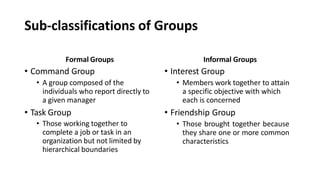
Sub-classifications of Groups
Formal Groups
• Command Group
• A group composed of the
individuals who report directly to
a given manager
• Task Group
• Those working together to
complete a job or task in an
organization but not limited by
hierarchical boundaries
Informal Groups
• Interest Group
• Members work together to attain
a specific objective with which
each is concerned
• Friendship Group
• Those brought together because
they share one or more common
characteristics
Why People Join Groups
• Security
• Status
• Self-esteem
• Affiliation
• Power
• Goal Achievement
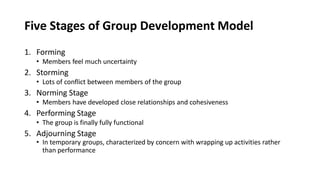
Five Stages of Group Development Model
1. Forming
• Members feel much uncertainty
2. Storming
• Lots of conflict between members of the group
3. Norming Stage
• Members have developed close relationships and cohesiveness
4. Performing Stage
• The group is finally fully functional
5. Adjourning Stage
• In temporary groups, characterized by concern with wrapping up activities rather
than performance
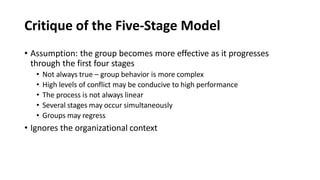
Critique of the Five-Stage Model
• Assumption: the group becomes more effective as it progresses
through the first four stages
• Not always true – group behavior is more complex
• High levels of conflict may be conducive to high performance
• The process is not always linear
• Several stages may occur simultaneously
• Groups may regress
• Ignores the organizational context
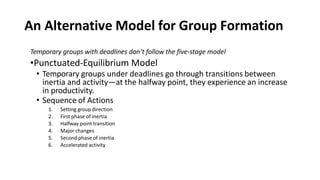
An Alternative Model for Group Formation
Temporary groups with deadlines don’t follow the five-stage model
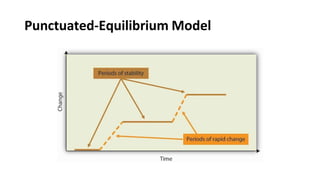
•Punctuated-Equilibrium Model
• Temporary groups under deadlines go through transitions between
inertia and activity—at the halfway point, they experience an increase
in productivity.
• Sequence of Actions
1. Setting group direction
2. First phase of inertia
3. Halfway point transition
4. Major changes
5. Second phase of inertia
6. Accelerated activity
Punctuated-Equilibrium Model
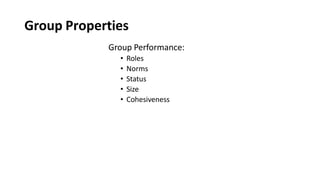
Group Properties
Group Performance:
• Roles
• Norms
• Status
• Size
• Cohesiveness
Group Property 1: Roles
• Role
• A set of expected behavior patterns attributed to someone occupying a given position in a
social unit
• Role Identity
• Certain attitudes and behaviors consistent with a role
• Role Perception
• An individual’s view of how he or she is supposed to act in a given situation – received by
external stimuli
• Role Expectations
• How others believe a person should act in a given situation
• Psychological Contract: an unwritten agreement that sets out mutual expectations of
management and employees
• Role Conflict
• A situation in which an individual is confronted by divergent role expectations
Zimbardo’s Prison Experiment (Stanford University)
• Faked a prison using student volunteers
• Randomly assigned to guard and prisoner roles
• Within six days the experiment was halted due to concerns:
• Guards had dehumanized the prisoners
• Prisoners were subservient
• Fell into the roles as they understood them
• No real resistance felt
• Conclusion: the Stanford Prison Experiment revealed how people will readily
conform to the social roles they are expected to play, especially if the roles are as
strongly stereotyped as those of the prison guards.
Group Property 2: Norms
• Norms
• Acceptable standards of behavior within a group that are shared by the
group’s members
• Classes of Norms
• Performance norms - level of acceptable work
• Appearance norms - what to wear
• Social arrangement norms - friendships and the like
• Allocation of resources norms - distribution and assignments of jobs and
material
Group Norms and the Hawthorne Studies
A series of studies undertaken by Elton Mayo at Western Electric Company’s Hawthorne
Works in Chicago between 1924 and 1932
• Research Conclusions
• Worker behavior and sentiments were closely related.
• Group influences (norms) were significant in affecting individual behavior.
• Group standards (norms) were highly effective in establishing individual worker
output.
• Money was less a factor in determining worker output than were group standards,
sentiments, and security.
Norms and Behavior
• Conformity
• Gaining acceptance by adjusting one’s behavior to align with the norms of the
group
• Reference Groups
• Important groups to which individuals belong or hope to belong and with
whose norms individuals are likely to conform
Defying Norms: Deviant Workplace Behavior
• Deviant Workplace Behavior
• Also called antisocial behavior or workplace incivility
• Voluntary behavior that violates significant organizational norms and, in
doing so, threatens the well-being of the organization
• Typology:
• Production – working speed
• Property – damage and stealing
• Political – favoritism and gossip
• Personal Aggression – sexual harassment
Group Influence on Deviant Behavior
• Group norms can influence the presence of deviant
behavior
• Simply belonging to a group increases the likelihood of
deviance
• Being in a group allows individuals to hide – creates a
false sense of confidence that they won’t be caught
Group Property 3: Status
A socially defined position or rank given to groups or group members
by others – it differentiates group members
• Important factor in understanding behavior
• Significant motivator
• Status Characteristics Theory
• Status derived from one of three sources:
• Power a person has over others
• Ability to contribute to group goals
• Personal characteristics
Status Effects
• On Norms and Conformity
• High-status members are less restrained by norms and pressure to conform
• Some level of deviance is allowed to high-status members so long as it
doesn’t affect group goal achievement
• On Group Interaction
• High-status members are more assertive
• Large status differences limit diversity of ideas and creativity
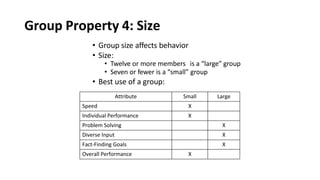
Group Property 4: Size
• Group size affects behavior
• Size:
• Twelve or more members is a “large” group
• Seven or fewer is a “small” group
• Best use of a group:
Attribute Small Large
Speed X
Individual Performance X
Problem Solving X
Diverse Input X
Fact-Finding Goals X
Overall Performance X
Issues with Group Size
• Social Loafing
• The tendency for individuals to expend less effort when working collectively than
when working individually
• Ringelmann’s Rope Pull: greater levels of productivity but with diminishing returns as
group size increases
• Caused by either equity concerns or a diffusion of responsibility (free riders)
• Managerial Implications
• Build in individual accountability
• Prevent social loafing by:
• Set group goals
• Increase intergroup competition
• Use peer evaluation
• Distribute group rewards based on individual effort
Group Property 5: Cohesiveness
Degree to which group members are attracted to each other and
are motivated to stay in the group
•Managerial Implication
• To increase cohesiveness:
• Make the group smaller.
• Encourage agreement with group goals.
• Increase time members spend together.
• Increase group status and admission difficulty.
• Stimulate competition with other groups.
• Give rewards to the group, not to individuals.
• Physically isolate the group.
Group Decision Making Phenomena
• Groupthink
• Situations where group pressures for conformity deter the group from
critically appraising unusual, minority, or unpopular views
• Hinders performance
• Groupshift
• When discussing a given set of alternatives and arriving at a solution, group
members tend to exaggerate the initial positions that they hold. This causes a
shift to more conservative or more risky behavior.
Groupthink
• Symptoms:
• Group members rationalize any resistance to the assumptions
they have made.
• Members apply direct pressure on those who express doubts
about shared views or who question the alternative favored by
the majority.
• Members who have doubts or differing points of view keep silent
about misgivings.
• There appears to be an illusion of unanimity.
• Minimize Groupthink By:
• Reduce the size of the group to 10 or less
• Encourage group leaders to be impartial
• Appoint a “devil’s advocate”
• Use exercises on diversity
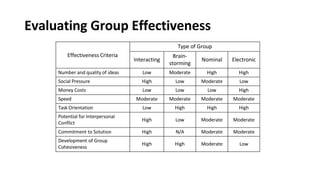
Evaluating Group Effectiveness
Effectiveness Criteria
Type of Group
Interacting
Brain-
storming
Nominal Electronic
Number and quality of ideas Low Moderate High High
Social Pressure High Low Moderate Low
Money Costs Low Low Low High
Speed Moderate Moderate Moderate Moderate
Task Orientation Low High High High
Potential for Interpersonal
Conflict
High Low Moderate Moderate
Commitment to Solution High N/A Moderate Moderate
Development of Group
Cohesiveness
High High Moderate Low
Groups and Teams
• A group interacts primarily to share information and to make
decisions to help each group member perform within his or her area
of responsibility (no joint effort required)
• Work teams generate positive synergy through coordinated effort.
The individual efforts result in a performance that is greater than the
sum of the individual inputs
Types of Teams
• Problem-solving Teams
• Groups of 5 to 12 employees from the same department who meet for a few
hours each week to discuss ways of improving quality, efficiency, and the work
environment
• Self-Managed Work Teams
• Groups of 10 to 15 people who take on the responsibilities of their former
supervisors
Types of Teams
• Cross-Functional Teams
• Employees from about the same hierarchical level, but from different work
areas, who come together to accomplish a task
• Task forces
• Committees
Types of Teams
▣ Virtual Teams
◾Teams that use computer technology to tie together physically dispersed
members in order to achieve a common goal
▣Characteristics
◾Limited socializing
◾The ability to overcome time and space constraints
▣To be effective, needs:
◾Trust among members
◾Close monitoring
◾To be publicized
Summary and Managerial Implications
• Performance
• Typically, clear role perception, appropriate norms, low status
differences, and smaller, more cohesive groups lead to higher
performance
• Satisfaction
• Increases with:
• High congruence between boss’s and employees’ perceptions about the job
• Not being forced to communicate with lower-status employees
• Smaller group size
Lesson 2
Communication
Chapter Objectives
At the end of this chapter you should be able to:
• Identify the main functions of communication.
• Describe the communication process and distinguish between formal
and informal communication.
• Contrast downward, upward, and lateral communication with
examples.
• Contrast oral, written, and nonverbal communication.
• Compare and contrast formal communication networks and the
grapevine.
• Analyze the advantages and challenges of electronic communication.
• Show how channel richness underlies the choice of communication
channel.
• Identify common barriers to effective communication.
• Show how to overcome the potential problems in cross-cultural
communication.
Communication & its Functions
• Communication
• The transference and the understanding of meaning
• Communication Functions:
• Control member behavior
• Foster motivation for what is to be done
• Provide a release for emotional expression
• Provide information needed to make decisions
The Communication Process
• The steps between a source and a receiver that result in the transference and
understanding of meaning
◾ The Sender – initiates message
◾ Encoding – translating thought to message
◾ The Message – what is communicated
◾ The Channel – the medium the message travels through
◾ Decoding – the receiver’s action in making sense of the message
◾ The Receiver – person who gets the message
◾ Noise – things that interfere with the message
◾ Feedback – a return message regarding the initial communication
Communication Direction
• Communication can flow vertically or horizontally.
• Vertical flow consists upward & downward whereas horizontal flow
involves lateral flow
• Communication that flows from one level of a group or organization
to a lower level is downward communication.
• Upward communication flows to a higher level in the group or
organization.
• When communication takes place among members of the same work
group, members of work groups at the same level, managers at the
same level, or any other horizontally equivalent workers, we describe
it as lateral communication.
Interpersonal Communication
▣ Oral Communication
◾Advantages: Speed and feedback
◾Disadvantage: Distortion of the message
▣ Written Communication
◾Advantages: Tangible and verifiable
◾Disadvantages: Time-consuming and lacks feedback
▣ Nonverbal Communication
◾Advantages: Supports other communications and provides observable
expression of emotions and feelings
◾Disadvantage: Misperception of body language or gestures can influence
receiver’s interpretation of message
Nonverbal Communication
• Body Movement
• Unconscious motions that provide meaning
• Shows extent of interest in another and relative perceived status differences
• Intonations and Voice Emphasis
• The way something is said can change meaning
• Facial Expressions
• Show emotion
• Physical Distance between Sender and Receiver
• Depends on cultural norms
• Can express interest or status
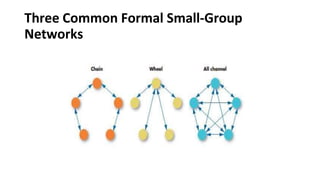
Exhibit 11-2
Three Common Formal Small-Group
Networks
• Chain:
• Rigidly follows the chain of command
• Wheel:
• Relies on a central figure to act as the conduit for all communication
• Team with a strong leader
• All Channel:
• All group members communicate actively with each other
• Self-managed teams
Three Common Formal Small-Group
Networks
Small Group Network Effectiveness
• Small group effectiveness depends on the desired outcome variable
Criteria Chain
TYPES OF NETWORKS
Wheel All Channel
Speed Moderate Fast Fast
Accuracy High High Moderate
Emergence of a leader Moderate High None
Member satisfaction Moderate Low High
The Grapevine
• Three Main Grapevine Characteristics:
1. Informal, not controlled by management
2. Perceived by most employees as being more believable and reliable than formal
communications
3. Largely used to serve the self-interests of those who use it
• Results from:
• Desire for information about important situations
• Ambiguous conditions
• Conditions that cause anxiety
• Insightful to managers
• Serves employee’s social needs
Barriers to Effective Communication
▣ Filtering
◾ A sender’s manipulation of information so that it will be seen more favorably by
the receiver
▣ Selective Perception
◾ People selectively interpret what they see on the basis of their interests,
background, experience, and attitudes
▣ Information Overload
◾ A condition in which information inflow exceeds an individual’s processing capacity
▣ Emotions
◾ How a receiver feels at the time a message is received will influence how the
message is interpreted.
More Barriers to Effective Communication
• Language
• Words have different meanings to different people.
• Communication Apprehension
• Undue tension and anxiety about oral communication, written
communication, or both
Summary and Managerial Implications
▣The less employees are uncertain, the greater their satisfaction; good
communication reduces uncertainty!
▣ Communication is improved by:
◾Choosing the correct channel
◾Being a good listener
◾Using feedback
▣Potential for misunderstanding in electronic communication is higher
than for traditional modes
▣ There are many barriers to communication that must be overcome
Lesson 3
Leadership
Chapter Objectives
At the end of this chapter you should be able to:
• Define leadership and contrast leadership and management.
• Summarize the conclusions of trait theories.
• Identify the central tenets and main limitations of behavioral
theories.
• Assess contingency theories of leadership by their level of
support.
• Contrast the interactive theories (path-goal and leader-
member exchange).
• Identify the situational variables in the leader-participation
model.
• Show how U.S. managers might need to adjust their
leadership approaches in Brazil, France, Egypt, and China.
What Is Leadership?
• Leadership
• The ability to influence a group toward the achievement of goals
• Management
• Use of authority inherent in designated formal rank to obtain compliance
from organizational members
• Both are necessary for organizational success
Trait Theories of Leadership
• Theories that consider personality, social, physical, or intellectual traits
to differentiate leaders from nonleaders
• Not very useful until matched with the Big Five Personality Framework
• Leadership Traits
• Extroversion
• Conscientiousness
• Openness
• Emotional Intelligence (Qualified)
• Traits can predict leadership, but they are better at predicting leader
emergence than effectiveness
Behavioral Theories of Leadership
• Theories proposing that specific behaviors differentiate leaders from
non-leaders
• Differences between theories of leadership:
• Trait theory: leadership is inborn, so we must identify the leader based on his
or her traits
• Behavioral theory: leadership is a skill set and can be taught to anyone, so we
must identify the proper behaviors to teach potential leaders
Important Behavioral Studies
• Ohio State University
• Found two key dimensions of leader behavior:
• Initiating structure – the defining and structuring of roles
• Consideration – job relationships that reflect trust and respect
• Both are important
• University of Michigan
• Also found two key dimensions of leader behavior:
• Employee-oriented – emphasize interpersonal relationships and is the most powerful
dimension
• Production-oriented – emphasize the technical aspects of the job
• The dimensions of the two studies are very similar
Blake and Mouton’s Managerial Grid®
• Draws on both studies to assess leadership style
• “Concern for People” is Consideration and Employee-Orientation
• “Concern for Production” is Initiating Structure and Production-Orientation
Contingency Theories
• While trait and behavior theories do help us understand
leadership, an important component is missing: the environment
in which the leader exists.
• Contingency Theory deals with this additional aspect of
leadership effectiveness studies.
• Three key theories:
• Fielder’s Model
• Hersey and Blanchard’s Situational Leadership Theory
• Path-Goal Theory
Fiedler Model
• Effective group performance depends on the proper match between
leadership style and the situation
• Assumes that leadership style (based on orientation revealed in LPC questionnaire) is
fixed
• Considers Three Situational Factors:
• Leader-member relations: degree of confidence and trust in the leader
• Task structure: degree of structure in the jobs
• Position power: leader’s ability to hire, fire, and reward
• For effective leadership: must change to a leader who fits the situation or
change the situational variables to fit the current leader
Fiedler Model
Assessment of Fiedler’s Model
• Positives:
• Considerable evidence supports the model, especially if the original eight
situations are grouped into three
• Problems:
• The logic behind the LPC scale is not well understood
• LPC scores are not stable
• Contingency variables are complex and hard to determine
Fiedler’s Cognitive Resource Theory
• A refinement of Fielder’s original model:
• Focuses on stress as the enemy of rationality and creator of unfavorable
conditions
• A leader’s intelligence and experience influence his or her reaction to that
stress
• Stress Levels:
• Low Stress: Intellectual abilities are effective
• High Stress: Leader experiences are effective
• Research is supporting the theory
Hersey & Blanchard’s Situational Leadership
• A model that focuses on follower “readiness”
• Followers can accept or reject the leader
• Effectiveness depends on the followers’ response to the leader’s actions
• “Readiness” is the extent to which people have the ability and willingness to
accomplish a specific task
• A paternal model:
• As the child matures, the adult releases more and more control over the situation
• As the workers become more ready, the leader becomes more laissez-faire
• An intuitive model that does not get much support from the research findings
House’s Path-Goal Theory
• Builds from the Ohio State studies and the expectancy theory of motivation
• The Theory:
– Leaders provide followers with information, support, and resources to help them
achieve their goals
– Leaders help clarify the “path” to the worker’s goals
– Leaders can display multiple leadership types
• Four types of leaders:
– Directive: focuses on the work to be done
– Supportive: focuses on the well-being of the worker
– Participative: consults with employees in decision-making
– Achievement-Oriented: sets challenging goals
Path-Goal Model
• Two classes of contingency variables:
• Environmental are outside of employee control
• Subordinate factors are internal to employee
• Mixed support in the research findings
Leader-Member Exchange (LMX) Theory
• A response to the failing of contingency theories to account for
followers and heterogeneous leadership approaches to individual
workers
• LMX Premise:
– Because of time pressures, leaders form a special relationship with a small
group of followers: the “in-group”
– This in-group is trusted and gets more time and attention from the leader
(more “exchanges”)
– All other followers are in the “out-group” and get less of the leader’s
attention and tend to have formal relationships with the leader (fewer
“exchanges”)
– Leaders pick group members early in the relationship
LMX Model
• How groups are assigned is unclear
• Follower characteristics determine group membership
• Leaders control by keeping favorites close
• Research has been generally supportive
Vroom & Yetton’s Leader-Participation Model
• How a leader makes decisions is as important as what is decided
• Premise:
• Leader behaviors must adjust to reflect task structure
• “Normative” model: tells leaders how participative to be in their decision-
making of a decision tree
• Five leadership styles
• Twelve contingency variables
• Research testing for both original and modified models has not been
encouraging
• Model is overly complex
Summary and Managerial Implications
• Leadership is central to understanding group behavior as the
leader provides the direction
• Extroversion, conscientiousness, and openness all show
consistent relationships to leadership
• Behavioral approaches have narrowed leadership down into two
usable dimensions
• Need to take into account the situational variables, especially the
impact of followers
Lesson 4
Conflict and Negotiation
Chapter Objectives
At the end of this chapter you should be able to:
• Define conflict.
• Differentiate between the traditional, human relations,
and interactionist views of conflict.
• Outline the conflict process.
• Define negotiation.
• Contrast distributive and integrative bargaining.
• Apply the five steps in the negotiation process.
• Show how individual differences influence negotiations.
• Assess the roles and functions of third-party negotiations.
• Describe cultural differences in negotiations.
Conflict Defined
• A process that begins when one party perceives that another party
has negatively affected, or is about to negatively affect, something
that the first party cares about
– That point in an ongoing activity when an interaction “crosses over” to
become an interparty conflict
• Encompasses a wide range of conflicts that people experience in
organizations
– Incompatibility of goals
– Differences over interpretations of facts
– Disagreements based on behavioral expectations
Transitions in Conflict Thought
• Traditional View of Conflict
– The belief that all conflict is harmful and must be avoided
– Prevalent view in the 1930s-1940s
• Conflict resulted from:
– Poor communication
– Lack of openness
– Failure to respond to employee needs
Continued Transitions in Conflict Thought
• Human Relations View of Conflict
• The belief that conflict is a natural and inevitable outcome in any group
• Prevalent from the late 1940s through mid-1970s
• Interactionist View of Conflict
• The belief that conflict is not only a positive force in a group but that it is
absolutely necessary for a group to perform effectively
• Current view
Forms of Interactionist Conflict
• Functional Conflict
• Conflict that supports the goals of the group and improves its performance
• Dysfunctional Conflict
• Conflict that hinders group performance
Types of Interactionist Conflict
▣Task Conflict
◾Conflicts over content and goals of the work
◾Low-to-moderate levels of this type are FUNCTIONAL
▣Relationship Conflict
◾Conflict based on interpersonal relationships
◾Almost always DYSFUNCTIONAL
▣Process Conflict
◾Conflict over how work gets done
◾Low levels of this type are FUNCTIONAL
The Conflict Process
• Stage I: Potential Opposition or Incompatibility
– Communication
• Semantic difficulties, misunderstandings, and “noise”
– Structure
• Size and specialization of jobs
• Jurisdictional clarity/ambiguity
• Member/goal incompatibility
• Leadership styles (close or participative)
• Reward systems (win-lose)
• Dependence/interdependence of groups
– Personal Variables
• Differing individual value systems
• Personality types
Stage II: Cognition and Personalization
• Important stage for two reasons:
1. Conflict is defined
• Perceived Conflict
• Awareness by one or more parties of the existence of conditions that create
opportunities for conflict to arise
2. Emotions are expressed that have a strong impact on the
eventual outcome
• Felt Conflict
• Emotional involvement in a conflict creating anxiety, tenseness, frustration, or
hostility
Stage III: Intentions
• Intentions
– Decisions to act in a given way
– Note: behavior does not always accurate reflect intent
• Dimensions of conflict-handling intentions:
– Cooperativeness
• Attempting to satisfy
the other party’s
concerns
– Assertiveness
• Attempting to satisfy
one’s own concerns
Stage IV: Behavior
• Conflict Management
• The use of resolution and stimulation techniques to achieve the desired level
of conflict
• Conflict-Intensity Continuum
Conflict Resolution Techniques
– Problem solving
– Superordinate goals
– Expansion of resources
– Avoidance
– Smoothing
– Compromise
– Authoritative command
– Altering the human variable
– Altering the structural variables
– Communication
◾Bringing in outsiders
◾Restructuring the organization
◾Appointing a devil’s advocate
Stage V: Outcomes
• Functional
– Increased group performance
– Improved quality of decisions
– Stimulation of creativity and
innovation
– Encouragement of interest and
curiosity
– Provision of a medium for problem-
solving
– Creation of an environment for self-
evaluation and change
• Dysfunctional
– Development of discontent
– Reduced group effectiveness
– Retarded communication
– Reduced group cohesiveness
– Infighting among group members
overcomes group goals
• Creating Functional Conflict
– Reward opposition and punish
conflict avoiders
Negotiation
• Negotiation (Bargaining)
• A process in which two or more parties exchange goods or services and
attempt to agree on the exchange rate for them
• Two General Approaches:
• Distributive Bargaining
• Negotiation that seeks to divide up a fixed amount of resources; a win-lose situation
• Integrative Bargaining
• Negotiation that seeks one or more settlements that can create a win-win solution
Third-Party Negotiations
• Four Basic Third-Party Roles
• Mediator
• A neutral third party who facilitates a negotiated solution by using reasoning,
persuasion, and suggestions for alternatives
• Arbitrator
• A third party to a negotiation who has the authority to dictate an agreement.
• Conciliator
• A trusted third party who provides an informal communication link between the
negotiator and the opponent
• Consultant
• An impartial third party, skilled in conflict management, who attempts to facilitate
creative problem solving through communication and analysis
Summary and Managerial Implications
• Conflict can be constructive or destructive
• Reduce excessive conflict by using:
– Competition
– Collaboration
– Avoidance
– Accommodation
– Compromise
• Integrative negotiation is a better long-term method
End of Chapter 3
Chapter 4
Organization Dynamics
Lesson 1
Organizational Structure and Culture
Chapter Objectives
At the end of this chapter you should be able to:
• Identify the six elements of an organization’s structure.
• Identify the characteristics of a bureaucracy.
• Describe a matrix organization.
• Identify the characteristics of a virtual organization.
• Show why managers want to create boundaryless organizations.
• Demonstrate how organizational structures differ, and contrast
mechanistic and organic structural models.
• Analyze the behavioral implications of different organizational
designs.
• Show how globalization affects organizational structure.
What Is Organizational Structure?
• Organizational Structure
– How job tasks are formally divided, grouped, and coordinated
– Key Elements:
1. Work specialization
2. Departmentalization
3. Chain of command
4. Span of control
5. Centralization and decentralization
6. Formalization
1. Work Specialization
• The degree to which tasks in the organization are subdivided into
separate jobs
• Division of Labor
– Makes efficient use of employee skills
– Increases employee skills through repetition
– Less between-job downtime increases productivity
– Specialized training is more efficient
– Allows use of specialized equipment
• Can create greater economies and efficiencies – but not always…
Work Specialization Economies and
Diseconomies
• Specialization can reach a point of diminishing returns
• Then job enlargement gives greater efficiencies than does
specialization
2. Departmentalization
• The basis by which jobs are grouped together
• Grouping Activities by:
• Function
• Product
• Geography
• Process
• Customer
3. Chain of Command
• Authority
– The rights inherent in a managerial position to give orders and to expect the
orders to be obeyed
• Chain of Command
– The unbroken line of authority that extends from the top of the organization
to the lowest echelon and clarifies who reports to whom
• Unity of Command
– A subordinate should have only one superior to whom he or she is directly
responsible
4. Span of Control
• The number of subordinates a manager can efficiently and effectively
direct
• Wider spans of management increase organizational efficiency
• Narrow span drawbacks:
• Expense of additional layers of management
• Increased complexity of vertical communication
• Encouragement of overly tight supervision and discouragement of employee autonomy
5. Centralization and Decentralization
• Centralization
• The degree to which decision making is concentrated at a single point in the
organization.
• Decentralization
• The degree to which decision making is spread throughout the organization.
6. Formalization
• The degree to which jobs within the organization are standardized.
• High formalization
• Minimum worker discretion in how to get the job done
• Many rules and procedures to follow
• Low formalization
• Job behaviors are nonprogrammed
• Employees have maximum discretion
Common Organization Designs: Simple
Structure
• Simple Structure
• A structure characterized by a low degree of departmentalization, wide spans
of control, authority centralized in a single person, and little formalization
Common Organizational Designs: Bureaucracy
• Bureaucracy
• A structure of highly operating routine tasks achieved through specialization,
very formalized rules and regulations, tasks that are grouped into functional
departments, centralized authority, narrow spans of control, and decision
making that follows the chain of command
An Assessment of Bureaucracies
Strengths
• Functional economies of scale
• Minimum duplication of personnel
and equipment
• Enhanced communication
• Centralized decision making
Weaknesses
• Subunit conflicts with organizational
goals
• Obsessive concern with rules and
regulations
• Lack of employee discretion to deal
with problems
Common Organizational Designs: Matrix
• Matrix Structure
– A structure that creates dual lines of authority and combines functional and
product departmentalization
• Key Elements
– Gains the advantages of functional and product departmentalization while
avoiding their weaknesses
– Facilitates coordination of complex and interdependent activities
– Breaks down unity-of-command concept
New Design Options: Virtual Organization
• A small, core organization that outsources its major business functions
• Highly centralized with little or no departmentalization
• Provides maximum flexibility while concentrating on what the organization does best
• Reduced control over key parts of the business
New Design Options: Boundaryless
Organization
• An organization that seeks to eliminate the chain of command, have limitless
spans of control, and replace departments with empowered teams
• T-form Concepts
• Eliminate vertical (hierarchical) and horizontal (departmental) internal boundaries
• Break down external barriers to customers and suppliers
Four Reasons Structures Differ
1. Strategy
– Innovation Strategy
• A strategy that emphasizes the introduction of major new products and services
• Organic structure best
– Cost-minimization Strategy
• A strategy that emphasizes tight cost controls, avoidance of unnecessary innovation or
marketing expenses, and price cutting
• Mechanistic model best
– Imitation Strategy
• A strategy that seeks to move into new products or new markets only after their viability
has already been proven
• Mixture of the two types of structure
Why Structures Differ
2. Organizational Size
◾ As organizations grow, they become more mechanistic, more specialized,
with more rules and regulations
3. Technology
◾ How an organization transfers its inputs into outputs
 The more routine the activities, the more mechanistic the structure with greater
formalization
 Custom activities need an organic structure
4. Environment
◾ Institutions or forces outside the organization that potentially affect the
organization’s performance
◾ Three key dimensions: capacity, volatility, and complexity
Organizational Designs and Employee
Behavior
• Impossible to generalize due to individual differences in the employees
• Research Findings
– Work specialization contributes to higher employee productivity, but it reduces job
satisfaction.
– The benefits of specialization have decreased rapidly as employees seek more
intrinsically rewarding jobs.
– The effect of span of control on employee performance is contingent upon
individual differences and abilities, task structures, and other organizational factors.
– Participative decision making in decentralized organizations is positively related to
job satisfaction.
• People seek and stay at organizations that match their needs.
Organizational Culture
• Institutionalization: A forerunner of culture
– When an organization takes on a life of its own, apart from any of its members,
becomes valued for itself, and acquires immortality
• Organizational Culture
– A common perception held by the organization’s members; a system of shared
meaning
– Seven primary characteristics
1. Innovation and risk taking
2. Attention to detail
3. Outcome orientation
4. People orientation
5. Team orientation
6. Aggressiveness
7. Stability
Do Organizations Have Uniform Cultures?
• Culture is a descriptive term: it may act as a substitute for formalization
• Dominant Culture
– Expresses the core values that are shared by a majority of the organization’s
members
• Subcultures
– Minicultures within an organization, typically defined by department designations
and geographical separation
• Core Values
– The primary or dominant values that are accepted throughout the organization
• Strong Culture
– A culture in which the core values are intensely held and widely shared
What Do Cultures Do?
• Culture’s Functions
1. Defines the boundary between one organization and others
2. Conveys a sense of identity for its members
3. Facilitates the generation of commitment to something larger than self-
interest
4. Enhances the stability of the social system
5. Serves as a sense-making and control mechanism for fitting employees in
the organization
Culture as a Liability
• Barrier to change
– Occurs when culture’s values are not aligned with the values necessary for
rapid change
• Barrier to diversity
– Strong cultures put considerable pressure on employees to conform, which
may lead to institutionalized bias
• Barrier to acquisitions and mergers
– Incompatible cultures can destroy an otherwise successful merger
How Culture Begins
• Stems from the actions of the founders:
• Founders hire and keep only employees who think and feel the same way
they do.
• Founders indoctrinate and socialize these employees to their way of thinking
and feeling.
• The founders’ own behavior acts as a role model that encourages employees
to identify with them and thereby internalize their beliefs, values, and
assumptions.
Keeping Culture Alive
• Selection
– Concerned with how well the candidates will fit into the organization
– Provides information to candidates about the organization
• Top Management
– Senior executives help establish behavioral norms that are adopted by the
organization
• Socialization
– The process that helps new employees adapt to the organization’s culture
How Employees Learn Culture
• Stories
• Anchor the present into the past and provide explanations and legitimacy for current
practices
• Rituals
• Repetitive sequences of activities that express and reinforce the key values of the
organization
• Material Symbols
• Acceptable attire, office size, opulence of the office furnishings, and executive perks
that convey to employees who is important in the organization
• Language
• Jargon and special ways of expressing one’s self to indicate membership in the
organization
Summary and Managerial Implications
• Structure impacts both the attitudes and behaviors of the people
within it.
• Culture can have an effect on behavior within the organization.
Lesson 2
Organizational Change and Development
Chapter Objectives
At the end of this chapter you should be able to:
• Identify forces that act as stimulants to change, and contrast
planned and unplanned change.
• List the forces for resistance to change.
• Compare the four main approaches to managing organizational
change.
• Demonstrate two ways of creating a culture for change.
• Define stress and identify its potential sources.
• Identify the consequences of stress.
• Contrast the individual and organizational approaches to managing
stress.
• Explain global differences in organizational change and work
stress.
Change
•Everything changes but change itself.
(Heraclitus)
•Change refers to any alteration from the
existing situation.
Forces for Change
•Nature of the Workforce
–Almost every organization must adjust to a
multicultural environment, demographic changes,
immigration, and outsourcing.
•Technology
–Faster, cheaper, more mobile technologies are
changing jobs & organizations.
•Economic Shocks
–Result in downsizing, bankruptcy, restructuring
• Competition
• Global marketplace ignited competition
• Mergers and consolidations
• Growth of e-commerce
•Social trends
• Increased environmental awareness
• World politics
• Collapse of soviet union
• Black rule of south Africa
Types of Change
• Planned Change
– Activities that are proactive and purposeful: an intentional, goal-oriented
activity
– Goals of Planned Change
• Improving the ability of the organization to adapt to changes in its environment
• Changing employee behavior
• First order change-linear and continuous change
• Second order change-multi dimensional, multilevel, dissentious and radical change
• Unplanned Change
– Organizational changes that are not foreseen prior to the need to change,
often made necessary by shifts in the organizational environment.
Resistance to Change
•Resistance to change appears to be a natural and positive state
Forms of Resistance to Change:
• Overt and Immediate
• Voicing complaints, engaging in job actions
• Implicit and Deferred
• Loss of employee loyalty and motivation, increased errors or mistakes, increased
absenteeism
• Deferred resistance clouds the link between source and reaction
Sources of Resistance to Change
• Individual
• Habit, security, economic factors, fear of the unknown, and selective
information processing
• Organizational
• Structural inertia, limited focus of change, group inertia, threat to expertise,
threat to established power relationships and resource allocations
Overcoming Resistance to Change
• Education and Communication
• Show those affected the logic behind the change
• Participation
• Participation in the decision process lessens resistance
• Support and Commitment
• Counseling, therapy, or new-skills training
• Manipulation and Cooptation
• “Spinning” the message to gain cooperation
• Selecting people who accept change
• Hire people who enjoy change in the first place
• Coercion
• Direct threats and force
Lewin's Three-Step Change Model
• Unfreezing
• Change efforts to overcome the pressures of both individual
resistance and group conformity (basically there are driving forces
that direct behavior away from status quo and restraining forces
that hinder movement from the existing equilibrium)
• Movement
• Make the changes
• Refreezing
• Stabilizing a change intervention by balancing driving and
restraining forces
Kotter's Eight-Step Plan
• Builds from Lewin’s Model
• To implement change:
1. Establish a sense of urgency
2. Form a coalition
3. Create a new vision
4. Communicate the vision
5. Empower others by removing barriers
6. Create and reward short-term “wins”
7. Consolidate, reassess, and adjust
8. Reinforce the changes
Unfreezing
Movement
Refreezing
Organizational Development
• Organizational Development (OD)
– A collection of planned interventions, built on humanistic-democratic values,
that seeks to improve organizational effectiveness and employee well-being
• OD Values
– Respect for people
– Trust and support
– Power equalization
– Confrontation
– Participation
Six OD Techniques
1. Sensitivity Training
• Training groups (T-groups) that seek to change behavior through unstructured group
interaction
• Provides increased awareness of others and self
• Increases empathy with others, listening skills, openness, and tolerance for others
1. Survey Feedback Approach
• The use of questionnaires to identify discrepancies among member perceptions;
discussion follows and remedies are suggested
3. Process Consultation (PC)
• A consultant gives a client insights into what is going on around the client, within the
client, and between the client and other people; identifies processes that need
improvement.
Six OD Techniques (Continued)
4. Team Building
– High interaction among team members to increase trust and openness
5. Intergroup Development
– OD efforts to change the attitudes, stereotypes, and perceptions that groups have of
each other
6. Appreciative Inquiry
– Seeks to identify the unique qualities and special strengths of an organization, which
can then be built on to improve performance
• Discovery: Recalling the strengths of the organization
• Dreaming: Speculation on the future of the organization
• Design: Finding a common vision
• Destiny: Deciding how to fulfill the dream
Creating a Culture for Change: Innovation
1. Stimulating a Culture of Innovation
– Innovation: a new idea applied to initiating or improving a product, process,
or service
– Sources of Innovation:
• Structural variables: organic structures
• Long-tenured management
• Slack resources
• Interunit communication
– Idea Champions: Individuals who actively promote the innovation
Creating a Culture for Change: Learning
2. Creating a learning organization
– An organization that has developed the continuous capacity to adapt and
change
– Learning Types
• Single-Loop: errors are corrected using past routines
• Double-Loop: errors are corrected by modifying routines
– Characteristics
• Holds a shared vision
• Discards old ways of thinking
• Views organization as system of relationships
• Communicates openly
• Works together to achieve shared vision
Summary and Managerial Implications
• Organizations and the individuals within them must undergo dynamic
change
• Managers are change agents and modifiers of organizational culture
• Stress can be good or bad for employees
• Despite possible improvements in job performance caused by stress,
such improvements come at the cost of increased job dissatisfaction
End of Chapter 4

Org Behaviour.pptx

  • 1.
    Organizational Behavior & Development QueensCollege School of Postgraduate Studies MBA Program Welcome to
  • 2.
    Self Introduction Instructor: AbdulnasirAbdulmelike Mohammed Education: BA in Management, MBA Academic rank: Assistant Professor of Management Experience: more than 12 years in higher education, published more than 10 articles & presented at national & international conferences (for more search about me at researchgate)
  • 3.
    Course Description Course code:MBA 625 Course title: Organizational Behavior & Development Course level: Advanced Course type: Major
  • 4.
    Course Description The courseis divided into four basic chapters. The first chapter discusses introductory concepts. The second chapter describes foundations of individual behavior - biographical characteristics, ability, and learning. It also discusses perception, attitudes, values and motivation.
  • 5.
    Course Description The thirdchapter deals with foundations of group behavior with emphasis on formal and informal teams. Here students will also learn about Conflict and its dynamics. Finally, students will acquire knowledge about organization dynamics. Topics such as organizational structure, change & leadership.
  • 6.
    Course Objectives At theend of this course you should be able to: • Explain the impact that individuals, groups and organization dynamics have on behavior within organizations • Explain the foundations of individual behavior in organizations • Explain the foundations of group behavior in organizations • Explain the foundations of organization behavior in organizations • Apply the knowledge of behavior within organizations to improve productivity and job satisfaction
  • 7.
    Course Outline Chapter 1:Introduction Chapter 2: Individual behavior Chapter 3: Group behavior Chapter 4: Organization dynamics
  • 8.
  • 9.
    Course Assessment •Article review………………………….30% •Literature review …………………… 30% •Final exam …………………………….. 40% •Total ……………………………………… 100%
  • 10.
    Recommended Readings Text book Robbins& Judge 2013, organizational behavior 15th edition.
  • 11.
  • 12.
    Chapter Objectives At theend of this chapter you should be able to: • Demonstrate the importance of interpersonal skills in the workplace. • Describe the manager’s functions, roles, and skills. • Define organizational behavior (OB). • Show the value of OB for systematic study. • Identify the major behavioral science disciplines that contribute to OB. • Demonstrate why there are few absolutes in OB. • Identify the challenges and opportunities managers face in applying OB concepts.
  • 13.
    Management • Management isthe process of getting things done effectively and efficiently through the efforts of others to achieve organizational goal. • Until the late 1980s, business school curricula emphasized the technical aspects of management, focusing on economics, accounting, finance, and quantitative techniques. Course work in human behavior and people skills received relatively less attention. • Over the past three decades, however, business faculty have come to realize the role that understanding human behavior plays in determining a manager’s effectiveness, and required courses on people skills have been added to many curricula.
  • 14.
    What Managers Do •They get things done through other people. • Management Activities: – Make decisions – Allocate resources – Direct activities of others to attain goals • Work in an organization – A consciously coordinated social unit composed of two or more people that functions on a relatively continuous basis to achieve a common goal or set of goals.
  • 15.
    Four Management Functions •PLAN • A process that includes defining goals, establishing strategy, and developing plans to coordinate activities. • ORGANIZE • Determining what tasks are to be done, who is to do them, how the tasks are to be grouped, who reports to whom, and where decisions are to be made.
  • 16.
    Four Management Functions •LEAD • A function that includes motivating employees, directing others, selecting the most effective communication channels, and resolving conflicts. • CONTROL • Monitoring performance, comparing actual performance with previously set goals, and correcting any deviation.
  • 17.
    Mintzberg’s Managerial Roles •Ten roles in three groups • Interpersonal • Figurehead, Leader, and Liaison • Informational • Monitor, Disseminator, Spokesperson • Decisional • Entrepreneur, Disturbance Handler, Resource Allocator, and Negotiator.
  • 18.
    The Importance ofInterpersonal Skills • Developing managers’ interpersonal skills help organizations attract and keep high-performing employees. • Organizational benefits of skilled managers include; –Lower turnover of quality employees –Higher quality applications for recruitment –Better financial performance
  • 19.
    Katz’s Essential ManagementSkills • Technical Skills – The ability to apply specialized knowledge or expertise • Human Skills – The ability to work with, understand, and motivate other people, both individually and in groups • Conceptual Skills – The mental ability to analyze and diagnose complex situations
  • 20.
    Organizational Behavior A fieldof study that investigates the impact that individuals, groups, and structure have on behavior within organizations, for the purpose of applying such knowledge toward improving an organization’s effectiveness.
  • 21.
    Intuition and SystematicStudy • Intuition • Gut feelings • Individual observation • Common sense • Systematic Study • Looks at relationships • Scientific evidence • Predicts behaviors • The two are complementary means of predicting behavior.
  • 22.
    An Outgrowth ofSystematic Study… Evidence-Based Management (EBM) – Basing managerial decisions on the best available scientific evidence. – Must think like scientists: • Pose a managerial question • Search for best available evidence • Apply relevant information to case
  • 23.
    Managers Should UseAll Three Approaches The trick is to know when to go with your gut. – Jack Welsh • Intuition is often based on inaccurate information • Systematic study can be time-consuming Use evidence as much as possible to inform your intuition and experience. That is the promise of OB.
  • 24.
    Four Contributing Disciplines •Psychology The science that seeks to measure, explain, and sometimes change the behavior of humans and other animals. • Unit of Analysis: • Individual • Contributions to OB: • Learning, motivation, personality, emotions, perception • Training, leadership effectiveness, job satisfaction • Individual decision making, performance appraisal, attitude measurement • Employee selection, work design, and work stress
  • 25.
    Four Contributing Disciplines –Organizational System –Contributions to OB: • Group dynamics • Work teams • Communication • Power • Conflict • Intergroup behavior • Sociology The study of people in relation to their fellow human beings. – Unit of Analysis: – Group • Formal organization theory • Organizational technology • Organizational change • Organizational culture
  • 26.
    Four Contributing Disciplines •Social Psychology An area within psychology that blends concepts from psychology and sociology and that focuses on the influence of people on one another. – Unit of Analysis: • Group – Contributions to OB: • Behavioral change • Attitude change • Communication • Group processes • Group decision making
  • 27.
    Four Contributing Disciplines –Unit of Analysis: -- Organizational System –Contributions to OB: • Organizational culture • Organizational environment -- Group • Comparative values • Comparative attitudes • Cross-cultural analysis • Anthropology The study of societies to learn about human beings and their activities.
  • 28.
    Challenges and Opportunitiesfor OB • Responding to Globalization • Managing Workforce Diversity • Improving Quality and Productivity • Improving Customer Service • Improving People Skills • Stimulating Innovation and Change • Coping with “Temporariness” • Working in Networked Organizations • Helping Employees Balance Work-Life Conflicts • Creating a Positive Work Environment • Improving Ethical Behavior
  • 29.
    Challenges and Opportunitiesfor OB • Responding to Globalization – Increased foreign assignments – Working with people from different cultures – Coping with anti-capitalism backlash – Overseeing movement of jobs to countries with low-cost labor – Managing people during the war on terror • Managing Workforce Diversity – The people in organizations are becoming more heterogeneous demographically (disability, gender, age, national origin, race, and domestic partners) – Embracing diversity – Changing demographics – Management philosophy changes – Recognizing and responding to differences
  • 30.
    Developing an OBModel • A model is an abstraction of reality: a simplified representation of some real-world phenomenon. • Our OB model has three levels of analysis: • Each level is constructed on the prior level • Individual • Group • Organizational Systems
  • 31.
    OB Model Source: Robbins& Judge, 2013 Inputs The individual Diversity Personality Values Group Structures Roles Team responsibilities Organization Structure Culture Processes Individual Emotions & moods Motivation Perception & decision making Group Communication Leadership Power & politics Conflict Organizational HRM Change practices Outcomes Individual Attitudes Task performance Citizenshipbehavior Group Group cohesion Group functioning Organizational Productivity Survival
  • 32.
    Summary and ManagerialImplications • Managers need to develop their interpersonal skills to be effective. • OB focuses on how to improve factors that make organizations more effective. • The best predictions of behavior are made from a combination of systematic study and intuition. • Situational variables moderate cause-and-effect relationships – which is why OB theories are contingent. • There are many OB challenges and opportunities for managers today.
  • 33.
  • 34.
  • 35.
  • 36.
    Chapter Objectives At theend of this chapter you should be able to: • Contrast the two types of ability. • Define intellectual ability and demonstrate its relevance to OB. • Identify the key biographical characteristics and describe how they are relevant to OB. • Define learning and outline the principles of the three major theories of learning. • Describe how behavior can be shaped.
  • 37.
    Ability Ability refers toan individual’s capacity to perform the various tasks in a job. ⚫Made up of two sets of factors: ⚫Intellectual Abilities ⚫The abilities needed to perform mental activities. ⚫General Mental Ability (GMA) is a measure of overall intelligence. ⚫Wonderlic Personnel Test: a quick measure of intelligence for recruitment screening. ⚫Physical Abilities ⚫The capacity to do tasks demanding stamina, dexterity, strength, and similar characteristics.
  • 38.
    Dimensions of IntellectualAbility • Number Aptitude • Verbal Comprehension • Perceptual Speed • Inductive Reasoning • Deductive Reasoning • Spatial Visualization • Memory
  • 39.
    Dimensions of IntellectualAbility Perceptual speed test In the first round of this test consider only diagrams with rectangular design. Next a panel of nine instruments is shown for a very limited time. Instruments 6, 7, 8 and 9 share rectangular design, which is crucial in this example. So, copy their readings from left to right starting from top row.
  • 40.
  • 41.
    Biographical Characteristics Objective andeasily obtained personal characteristics. ⚫Age ⚫Older workers bring experience, judgment, a strong work ethic, and commitment to quality. But older workers are also perceived as lacking flexibility and resisting new technology. ⚫Gender ⚫Few differences between men and women that affect job performance. ⚫Race (the biological heritage used to identify oneself) ⚫Contentious issue: differences exist, but could be more culture-based than race-based.
  • 42.
    Other Biographical Characteristics •Tenure • People with job tenure (seniority at a job) are more productive, absent less frequently, have lower turnover, and are more satisfied. • Religion • employees and supervisors have different religion and when one perceives others religion as wrong negative consequences will take effect. Stress may also happen.. • Gender Identity • Relatively new issue – transgendered employees.
  • 43.
    Learning Any relatively permanentchange in behavior that occurs as a result of experience • Learning components: • Involves Change • Is Relatively Permanent • Is Acquired Through Experience
  • 44.
    Theories of Learning •Classical Conditioning • A type of conditioning in which an individual responds to some stimulus that would not ordinarily produce such a response. • Operant Conditioning • A type of conditioning in which desired voluntary behavior leads to a reward or prevents a punishment. • Social-Learning Theory • People can learn through observation and direct experience.
  • 45.
    Classical Conditioning ⚫Pavlov’s DogDrool ⚫Key Concepts: ⚫Unconditioned stimulus ⚫A naturally occurring phenomenon. ⚫Unconditioned response ⚫The naturally occurring response to a natural stimulus. ⚫Conditioned stimulus ⚫An artificial stimulus introduced into the situation. ⚫Conditioned response ⚫The response to the artificial stimulus. This is a passive form of learning. It is reflexive and not voluntary – not the best theory for OB learning.
  • 46.
    Operant Conditioning ⚫B. F.Skinner’s concept of Behaviorism: behavior follows stimuli in a relatively unthinking manner. ⚫Key Concepts: ⚫Conditioned behavior: voluntary behavior that is learned, not reflexive. ⚫Reinforcement: the consequences of behavior which can increase or decrease the likelihood of behavior repetition. ⚫Pleasing consequences increase likelihood of repetition. ⚫Rewards are most effective immediately after performance. ⚫Unrewarded/punished behavior is unlikely to be repeated.
  • 47.
    Social-Learning Theory ⚫Based onthe idea that people can also learn indirectly: by observation, reading, or just hearing about someone else’s – a model’s – experiences. ⚫Key Concepts: ⚫Attentional processes ⚫Must recognize and pay attention to critical features to learn. ⚫Retention processes ⚫Model’s actions must be remembered to be learned. ⚫Motor reproduction processes ⚫Watching the model’s behavior must be converted to doing. ⚫Reinforcement processes ⚫Positive incentives motivate learners.
  • 48.
    Behavior Modification (OBMod) The application of reinforcement concepts to individuals in the work setting. • Follows the Five-Step Problem-Solving Model: • Identify critical behaviors • Develop baseline data • Identify behavioral consequences • Develop and apply intervention • Evaluate performance improvement
  • 49.
    Shaping: A ManagerialTool Systematically reinforcing each successive step that moves an individual closer to the desired response. ⚫Four Methods of Shaping Behavior: ⚫Positive reinforcement ⚫Providing a reward for a desired behavior (learning) ⚫Negative reinforcement ⚫Removing an unpleasant consequence when the desired behavior occurs (learning) ⚫Punishment ⚫Applying an undesirable condition to eliminate an undesirable behavior (“unlearning”) ⚫Extinction ⚫Withholding reinforcement of a behavior to cause its cessation (“unlearning”) ⚫Removing of all reinforcement that might be associated with a behavior.
  • 50.
    Summary and ManagerialImplications • Three Individual Variables: • Ability • Directly influences employee’s level of performance • Managers need to focus on ability in selection, promotion, and transfer. • Fine-tune job to fit incumbent’s abilities. • Biographical Characteristics • Should not be used in management decisions: possible source of bias. • Learning • Observable change in behavior = learning. • Reinforcement works better than punishment.
  • 51.
  • 52.
    Chapter Objectives At theend of this chapter you should be able to: • Contrast the three components of an attitude. • Summarize the relationship between attitudes and behavior. • Compare and contrast the major job attitudes. • Define job satisfaction and show how it can be measured. • Summarize the main causes of job satisfaction. • Identify four employee responses to dissatisfaction
  • 53.
    Attitudes Evaluative statements orjudgments concerning objects, people, or events. Three components of an attitude: • Affective – The emotional or feeling segment of an attitude • Cognitive – The opinion or belief segment of an attitude • Behavioral – An intention to behave in a certain way toward someone or something
  • 55.
    Does Behavior AlwaysFollow from Attitudes? • People watch television programs they like, or that employees try to avoid assignments they find distasteful (behavior follows attitude) • A friend of yours has consistently argued that the quality of cars assembled in Ethiopia isn’t up to that of imports and that he’d never own anything but a Japanese car. But his dad gives him a Lifan 630 automobile, and suddenly he says Ethiopian cars aren’t so bad.
  • 56.
    Does Behavior AlwaysFollow from Attitudes? • Leon Festinger – No, the reverse is sometimes true! • Cognitive Dissonance: Any incompatibility between two or more attitudes or between behavior and attitudes – Individuals seek to reduce this uncomfortable gap, or dissonance, to reach stability and consistency – Consistency is achieved by changing the attitudes, modifying the behaviors, or through rationalization – Desire to reduce dissonance depends on: • Importance of elements • Degree of individual influence • Rewards involved in dissonance
  • 57.
    What Are theMajor Job Attitudes? • Job Satisfaction • A positive feeling about the job resulting from an evaluation of its characteristics. • Job Involvement • Degree of psychological identification with the job where perceived performance is important to self-worth. • Psychological Empowerment • Belief in the degree of influence over the job, competence, job meaningfulness, and autonomy.
  • 58.
    Another Major JobAttitude • Organizational Commitment • Identifying with a particular organization and its goals, while wishing to maintain membership in the organization. • Three dimensions: • Affective – emotional attachment to organization • Continuance Commitment – economic value of staying • Normative – moral or ethical obligations • Has some relation to performance, especially for new employees. • Less important now than in past – now perhaps more of occupational commitment, loyalty to profession rather than to a given employer.
  • 59.
    And Yet MoreMajor Job Attitudes… • Perceived Organizational Support (POS) • Degree to which employees believe the organization values their contribution and cares about their well-being. • Higher when rewards are fair, employees are involved in decision-making, and supervisors are seen as supportive. • High POS is related to higher OCBs and performance. • Employee Engagement • The degree of involvement, satisfaction with, and enthusiasm for the job. • Engaged employees are passionate about their work and company.
  • 60.
    Job Satisfaction •One ofthe primary job attitudes measured. –Broad term involving a complex individual summation of a number of discrete job elements. •How to measure? –Single global rating (one question/one answer) - Best –Summation score (many questions/one average) - OK
  • 61.
    Causes of JobSatisfaction • Pay influences job satisfaction only to a point. – After about $40,000 a year (in the U. S.), there is no relationship between amount of pay and job satisfaction. – Money may bring happiness, but not necessarily job satisfaction. • Personality can influence job satisfaction. – Negative people are usually not satisfied with their jobs. – Those with positive core self-evaluation are more satisfied with their jobs.
  • 62.
    Employee Responses toDissatisfaction • Exit – Behavior directed toward leaving the organization • Voice – Active and constructive attempts to improve conditions • Neglect – Allowing conditions to worsen • Loyalty – Passively waiting for conditions to improve
  • 63.
    Employee Responses toDissatisfaction
  • 64.
    Outcomes of JobSatisfaction • Job Performance – Satisfied workers are more productive AND more productive workers are more satisfied! – The causality may run both ways. • Organizational Citizenship Behaviors – Satisfaction influences OCB through perceptions of fairness. • Customer Satisfaction – Satisfied frontline employees increase customer satisfaction and loyalty. • Absenteeism – Satisfied employees are moderately less likely to miss work.
  • 65.
    More Outcomes ofJob Satisfaction • Turnover • Satisfied employees are less likely to quit. • Many moderating variables in this relationship. • Economic environment and tenure. • Organizational actions taken to retain high performers and to weed out lower performers. • Workplace Deviance • Dissatisfied workers are more likely to unionize, abuse substances, steal, be tardy, and withdraw. Despite the overwhelming evidence of the impact of job satisfaction on the bottom line, most managers are either unconcerned about or overestimate worker satisfaction.
  • 66.
    Summary and ManagerialImplications • Managers should watch employee attitudes • They give warnings of potential problems • They influence behavior • Managers should try to increase job satisfaction and generate positive job attitudes • Reduces costs by lowering turnover, absenteeism, tardiness, and theft, and increasing OCB • Focus on the intrinsic parts of the job: make work challenging and interesting • Pay is not enough
  • 67.
  • 68.
    Lesson Objectives At theend of this lesson you should be able to: ⚫Define personality, describe how it is measured, and explain the factors that determine an individual’s personality. ⚫Describe the Myers-Briggs Type Indicator personality framework and assess its strengths and weaknesses. ⚫Identify the key traits in the Big Five personality model. ⚫Demonstrate how the Big Five traits predict behavior at work. ⚫Identify other personality traits relevant to OB. ⚫Define values, demonstrate their importance, and contrast terminal and instrumental values. ⚫Compare generational differences in values, and identify the dominant values in today’s workforce. ⚫Identify Hofstede’s five value dimensions of national culture.
  • 69.
    What is Personality? Thedynamic organization within the individual of those psychophysical systems that determine his unique adjustments to his environment. - Gordon Allport • The sum total of ways in which an individual reacts and interacts with others, the measurable traits a person exhibits •Measuring Personality • Helpful in hiring decisions • Most common method: self-reporting surveys • Observer-ratings surveys provide an independent assessment of personality – often better predictors
  • 70.
    Personality Determinants • Heredity •Factors determined at conception: physical stature, facial attractiveness, gender, temperament, muscle composition and reflexes, energy level, and bio-rhythms • This “Heredity Approach” argues that genes are the source of personality • Twin studies: raised apart but very similar personalities support the heredity approach. • Parents don’t add much to personality development • There is some personality change over long time periods (eg. Dependability increase when young adults take on roles)
  • 71.
    Personality Traits Enduring characteristicsthat describe an individual’s behavior • The more consistent the characteristic and the more frequently it occurs in diverse situations, the more important the trait. • Two dominant frameworks used to describe personality: • Myers-Briggs Type Indicator (MBTI®) • Big Five Model
  • 72.
    The Myers-Briggs TypeIndicator • Most widely-used instrument in the world. • Participants are classified on four axes to determine one of 16 possible personality types, such as ENTJ. • Extroverted (E) vs. Introverted (I) • Sensing (S) vs. Intuitive (N) • Thinking (T) vs. Feeling (F) • Judging (J) vs. Perceiving (P)
  • 73.
    The Types andTheir Uses ▣ Each of the sixteen possible combinations has a name, for instance: ◾Visionaries (INTJ) – are original, stubborn and driven. ◾Organizers (ESTJ) – realistic, logical, analytical and businesslike. ◾Conceptualizer (ENTP) – entrepreneurial, innovative, individualistic and resourceful. ▣ Research results on validity mixed. ◾MBTI® is a good tool for self-awareness and counseling. ◾Should not be used as a selection test for job candidates.
  • 74.
    The Big FiveModel of Personality Dimensions • Extroversion • Sociable, gregarious, and assertive • Agreeableness • Good-natured, cooperative, and trusting • Conscientiousness • Responsible, dependable, persistent, and organized • Emotional Stability • Calm, self-confident, secure under stress (positive), versus nervous, depressed, and insecure under stress (negative) • Openness to Experience • Curious, imaginative, artistic, and sensitive
  • 75.
    How Do theBig Five Traits Predict Behavior? ▣ Research has shown this to be a better framework. ▣Certain traits have been shown to strongly relate to higher job performance: ◾Highly conscientious people develop more job knowledge, exert greater effort, and have better performance. ◾Other Big Five Traits also have implications for work.  Emotional stability is related to job satisfaction.  Extroverts tend to be happier in their jobs and have good social skills.  Open people are more creative and can be good leaders.  Agreeable people are good in social settings.
  • 76.
    Other Personality TraitsRelevant to OB • Core Self-Evaluation • The degree to which people like or dislike themselves • Positive self-evaluation leads to higher job performance • Machiavellianism • A pragmatic, emotionally distant power-player who believes that ends justify the means • High Machs are manipulative, win more often, and persuade more than they are persuaded. Flourish when: • Have direct interaction • Work with minimal rules and regulations • Emotions distract others • Narcissism • An arrogant, entitled, self-important person who needs excessive admiration • Less effective in their jobs
  • 78.
    More Relevant PersonalityTraits • Self-Monitoring • The ability to adjust behavior to meet external, situational factors. • High monitors conform more and are more likely to become leaders. • Risk Taking • The willingness to take chances. • May be best to align propensities with job requirements. • Risk takers make faster decisions with less information.
  • 79.
    Even More RelevantPersonality Traits • Type A Personality • Aggressively involved in a chronic, incessant struggle to achieve more in less time • Impatient: always moving, walking, and eating rapidly • Strive to think or do two or more things at once • Cannot cope with leisure time • Obsessed with achievement numbers • Type B people are the complete opposite • Proactive Personality • Identifies opportunities, shows initiative, takes action, and perseveres to completion • Creates positive change in the environment
  • 80.
    Values Basic convictions onhow to conduct yourself or how to live your life that is personally or socially preferable – “How to” live life properly. Importance of values • Provide understanding of the attitudes, motivation, and behaviors • Influence our perception of the world around us • Represent interpretations of “right” and “wrong” • Imply that some behaviors or outcomes are preferred over others
  • 81.
    Classifying Values –Rokeach Value Survey • Terminal Values • Desirable end-states of existence; the goals that a person would like to achieve during his or her lifetime • Instrumental Values • Preferable modes of behavior or means of achieving one’s terminal values • People in same occupations or categories tend to hold similar values. • But values vary between groups. • Value differences make it difficult for groups to negotiate and may create conflict.
  • 82.
    Terminal and instrumentalValues in Rokeach value Survey
  • 83.
    Generational Values Cohort Entered Workforce Approximate Current Age DominantWork Values Veterans 1950-1964 65+ Hard working, conservative, conforming; loyalty to the organization Boomers 1965-1985 40-60s Success, achievement, ambition, dislike of authority; loyalty to career Xers 1985-2000 20-40s Work/life balance, team-oriented, dislike of rules; loyalty to relationships Nexters 2000-Present Under 30 Confident, financial success, self- reliant but team-oriented; loyalty to both self and relationships
  • 84.
    Linking Personality andValues to the Workplace Managers are less interested in someone’s ability to do a specific job than in that person’s flexibility. ▣Person-Job Fit: ◾John Holland’s Personality-Job Fit Theory  Six personality types  Vocational Preference Inventory (VPI) ◾Key Points of the Model:  There appear to be intrinsic differences in personality between people.  There are different types of jobs.  People in jobs congruent with their personality should be more satisfied and have lower turnover.
  • 85.
    Holland’s Personality Types •Six types: • Realistic • Investigative • Artistic • Social • Enterprising • Conventional • Need to match personality type with occupation
  • 86.
    Still Linking Personalityto the Workplace In addition to matching the individual’s personality to the job, managers are also concerned with: •Person-Organization Fit: • The employee’s personality must fit with the organizational culture. • People are attracted to organizations that match their values. • Those who match are most likely to be selected. • Mismatches will result in turnover. • Can use the Big Five personality types to match to the organizational culture.
  • 87.
    Hofstede’s Framework: PowerDistance The extent to which a society accepts that power in institutions and organizations is distributed unequally. • Low distance • Relatively equal power between those with status/wealth and those without status/wealth • High distance • Extremely unequal power distribution between those with status/wealth and those without status/wealth
  • 88.
    Hofstede’s Framework: Individualism •Individualism • The degree to which people prefer to act as individuals rather than as members of groups • Collectivism • A tight social framework in which people expect others in groups of which they are a part to look after them and protect them
  • 89.
    Hofstede’s Framework: Masculinity •Masculinity • The extent to which the society values work roles of achievement, power, and control, and where assertiveness and materialism are also valued • Femininity • The extent to which there is little differentiation between roles for men and women
  • 90.
    Hofstede’s Framework: Uncertainty Avoidance Theextent to which a society feels threatened by uncertain and ambiguous situations and tries to avoid them • High Uncertainty Avoidance: • Society does not like ambiguous situations and tries to avoid them. • Low Uncertainty Avoidance: • Society does not mind ambiguous situations and embraces them.
  • 91.
    Hofstede’s Framework: TimeOrientation • Long-term Orientation • A national culture attribute that emphasizes the future, thrift, and persistence • Short-term Orientation • A national culture attribute that emphasizes the present and the here-and- now
  • 92.
    Hofstede’s Framework: AnAssessment ⚫There are regional differences within countries ⚫The original data is old and based on only one company ⚫Hofstede had to make many judgment calls while doing the research ⚫Some results don’t match what is believed to be true about given countries ⚫Despite these problems it remains a very popular framework
  • 94.
    GLOBE Framework forAssessing Cultures ⚫Global Leadership and Organizational Behavior Effectiveness (GLOBE) research program. ⚫Nine dimensions of national culture ⚫Similar to Hofstede’s framework with these additional dimensions: ⚫Humane Orientation: how much society rewards people for being altruistic, generous, and kind. ⚫Performance Orientation: how much society encourages and rewards performance improvement and excellence.
  • 95.
    Summary and ManagerialImplications ▣Personality ◾Screen for the Big Five trait of conscientiousness ◾Take into account the situational factors as well ◾MBTI® can help with training and development ▣Values ◾Often explain attitudes, behaviors and perceptions ◾Higher performance and satisfaction achieved when the individual’s values match those of the organization
  • 96.
    Lesson 4 Perception andIndividual Decision Making
  • 97.
    Lesson Objectives At theend of this lesson you should be able to: ⚫Define perception. ⚫Describe the individual decision making process.
  • 98.
    What is Perception? •A process by which individuals organize and interpret their sensory impressions in order to give meaning to their environment. • People’s behavior is based on their perception of what reality is, not on reality itself. • The world as it is perceived is the world that is behaviorally important.
  • 99.
    Factors affecting Perception •Target/perceived: Characteristics of the target affect what we perceive. • Eg. Loud people are more likely to be noticed in a group than quiet ones. So, too, are extremely attractive or unattractive individuals. • The perceiver: your interpretation is heavily influenced by your personal characteristics—your attitudes, personality, motives, interests, past experiences, and expectations. • For instance, if you expect police officers to be authoritative or young people to be lazy, you may perceive them as such, regardless of their actual traits. • The context: The time at which we see an object or event can influence our attention, as can location, light, heat, or any number of situational factors. • Eg. At a night time, you may not notice a young guest “dressed to the well.” Yet that same person so attired for your Monday morning management class would certainly catch your attention (and that of the rest of the class).
  • 100.
    Attribution Theory: JudgingOthers • Attribution theory tries to explain the ways in which we judge people differently, depending on the meaning we attribute to a given behavior. • When individuals observe behavior, they attempt to determine whether it is internally or externally caused. • Internal causes are under that person’s control. • External causes are not – person forced to act in that way. • Causation judged through: • Distinctiveness • Shows different behaviors in different situations (Is the employee who arrives late today also one who regularly “blows off” commitments?) • Consensus • If everyone who faces a similar situation responds in the same way • Consistency • Responds in the same way over time (Coming in 10 minutes late for work once in a month…)
  • 101.
  • 102.
    Errors and Biasesin Attributions • Fundamental Attribution Error • The tendency to underestimate the influence of external factors and overestimate the influence of internal factors when making judgments about the behavior of others • We blame people first, not the situation • Self-Serving Bias • The tendency for individuals to attribute their own successes to internal factors while putting the blame for failures on external factors • It is “our” success but “their” failure
  • 103.
    Frequently Used Shortcutsin Judging Others ▣ Selective Perception ◾People selectively interpret what they see on the basis of their interests, background, experience, and attitudes. ▣ Halo Effect ◾Drawing a general impression about an individual on the basis of a single characteristic ▣ Contrast Effects ◾Evaluation of a person’s characteristics that are affected by comparisons with other people recently encountered who rank higher or lower on the same characteristics
  • 104.
    Another Shortcut: Stereotyping Judgingsomeone on the basis of one’s perception of the group to which that person belongs – a prevalent and often useful, if not always accurate, generalization •Profiling • A form of stereotyping in which members of a group are singled out for intense scrutiny based on a single, often racial, trait.
  • 105.
    Perceptions and IndividualDecision Making ▣ Problem ◾A perceived discrepancy between the current state of affairs and a desired state ▣ Decisions ◾Choices made from among alternatives developed from data ▣ Perception Linkage: ◾All elements of problem identification and the decision making process are influenced by perception.  Problems must be recognized  Data must be selected and evaluated
  • 106.
    Decision-Making Models inOrganizations • Rational Decision-Making • The “perfect world” model: assumes complete information, all options known, and maximum payoff • Six-step decision-making process 1. Define the problem. 2. Identify the decision criteria. 3. Allocate weights to the criteria. 4. Develop the alternatives. 5. Evaluate the alternatives. 6. Select the best alternative.
  • 107.
    Decision-Making Models inOrganizations • Bounded Reality • The “real world” model: seeks satisfactory and sufficient solutions from limited data and alternatives • Intuition • A non-conscious process created from distilled experience that results in quick decisions • Relies on holistic associations • Affectively charged – engaging the emotions
  • 108.
    Common Biases andErrors in Decision- Making ▣ Overconfidence Bias ◾ Believing too much in our own ability to make good decisions – especially when outside of own expertise ▣ Anchoring Bias ◾ Using early, first received information as the basis for making subsequent judgments ▣ Confirmation Bias ◾ Selecting and using only facts that support our decision ▣ Availability Bias ◾ Emphasizing information that is most readily at hand  Recent  Vivid
  • 109.
    More Common Decision-MakingErrors ▣ Escalation of Commitment ◾Increasing commitment to a decision in spite of evidence that it is wrong – especially if responsible for the decision! ▣ Randomness Error ◾Creating meaning out of random events - superstitions ▣ Winner’s Curse ◾Highest bidder pays too much due to value overestimation ◾Likelihood increases with the number of people in auction ▣ Hindsight Bias ◾After an outcome is already known, believing it could have been accurately predicted beforehand
  • 110.
    Individual Differences inDecision-Making ▣Personality ◾Conscientiousness may effect escalation of commitment  Achievement strivers are likely to increase commitment  Dutiful people are less likely to have this bias ◾Self-Esteem  High self-esteem people are susceptible to self-serving bias  Gender ▣ Women analyze decisions more than men – rumination ▣ Women are twice as likely to develop depression ▣ Differences develop early (eg. Girls at 11 are more ruminating than boys)
  • 111.
    Summary and ManagerialImplications ▣ Perception: ◾People act based on how they view their world ◾What exists is not as important as what is believed ◾Managers must also manage perception ▣ Individual Decision Making ◾Most use bounded rationality: they satisfice ◾Combine traditional methods with intuition and creativity for better decisions  Analyze the situation and adjust to culture and organizational reward criteria  Be aware of, and minimize, biases
  • 112.
  • 113.
    Lesson Objectives At theend of this lesson you should be able to: ⚫Describe the three elements of motivation. ⚫Identify four early theories of motivation and evaluate their applicability today. ⚫Apply the predictions of Cognitive Evaluation theory to intrinsic and extrinsic rewards. ⚫Compare and contrast goal-setting theory and Management by Objectives. ⚫Contrast reinforcement theory and goal-setting theory. ⚫Demonstrate how organizational justice is a refinement of equity theory. ⚫Apply the key tenets of expectancy theory to motivating employees. ⚫Compare contemporary theories of motivation. ⚫Explain to what degree motivation theories are culture-bound.
  • 114.
    Defining Motivation The resultof the interaction between the individual and the situation. •The processes that account for an individual’s intensity, direction, and persistence of effort toward attaining a goal – specifically, an organizational goal. •Three key elements: • Intensity – how hard a person tries. • Direction – effort that is channeled toward, and consistent with, organizational goals. • Persistence – how long a person can maintain effort.
  • 115.
    Early Theories ofMotivation These early theories may not be valid, but they do form the basis for contemporary theories and are still used by practicing managers. •Maslow’s Hierarchy of Needs Theory • Alderfer’s ERG (Existence, Relatedness, and Growth) •McGregor’s Theory X and Theory Y •Herzberg’s Two-Factor Theory •McClelland’s Theory of Needs
  • 116.
    Maslow’s Hierarchy ofNeeds There is a hierarchy of five needs; as each need is substantially satisfied, the next need becomes dominant. •Levels: • Self-Actualization • Esteem Higher order Lower Order • Social • Safety • Physiological •Assumptions • Individuals cannot move to the next higher level until all needs at the current (lower) level are satisfied. • Must move in hierarchical order.
  • 117.
    Alderfer’s ERG Theory Areworking of Maslow to fit empirical research •Three groups of core needs: • Existence (Maslow: physiological and safety) • Relatedness (Maslow: social and status) • Growth (Maslow: esteem and self-actualization) •Removed the hierarchical assumption • Can be motivated by all three at once •Popular, but not accurate, theory
  • 118.
    McGregor’s Theory Xand Theory Y ▣Two distinct views of human beings: Theory X (basically negative) and Theory Y (positive). ◾Managers used a set of assumptions based on their view ◾The assumptions molded their behavior toward employees  Theory X 🢝Workers have little ambition 🢝Dislike work 🢝Avoid responsibility  Theory Y 🢝Workers are self-directed 🢝Enjoy work 🢝Accept responsibility ▣ No empirical evidence to support this theory
  • 119.
    Herzberg’s Two-Factor Theory •Key Point: Satisfaction and dissatisfaction are not opposites but separate constructs • Hygiene Factors - Extrinsic and Related to Dissatisfaction • Work Conditions • Salary • Company Policies • Motivators - Intrinsic and Related to Satisfaction • Achievement • Responsibility • Growth
  • 120.
    Criticisms of Two-FactorTheory Herzberg says that hygiene factors must be met to remove dissatisfaction. If motivators are given, then satisfaction can occur. •Herzberg is limited by his procedure • Participants had self-serving bias •Reliability of raters questioned • Bias or errors of observation •No overall measure of satisfaction was used •Herzberg assumed, but didn’t research, a strong relationship between satisfaction and productivity
  • 121.
    McClelland’s Three NeedsTheory ▣ Need for Achievement (nAch) ◾The drive to excel, to achieve in relation to a set of standards, to strive to succeed ▣ Need for Power (nPow) ◾The need to make others behave in a way that they would not have behaved otherwise ▣ Need for Affiliation (nAff) ◾The desire for friendly and close interpersonal relationships ▣ People have varying levels of each of the three needs ◾Hard to measure
  • 122.
    McClelland’s Three NeedsTheory ▣ Target A sits almost within arm’s reach. If you hit it, you get $2. ▣ Target B is a bit farther out, but about 80 percent of the people who try can hit it. It pays $4. ▣ Target C pays $8, and about half the people who try can hit it. ▣ Very few people can hit Target D, but the payoff is $16 for those who do. ▣ Finally, Target E pays $32, but it’s almost impossible to achieve. Which would you try for?
  • 123.
    Performance Predictions forHigh nAch ▣ People with a high need for achievement are likely to: ◾Prefer to undertake activities with a 50/50 chance of success – avoiding very low or high risk situations ◾Be motivated in jobs that offer high degree of personal responsibility, feedback, and moderate risk ◾Don’t necessarily make good managers – too personal a focus ◾Most good general managers do NOT have a high nAch ◾Need high level of nPow and low nAff for managerial success ▣ Good research support but it is not a very practical theory
  • 124.
    Contemporary Theories ofMotivation • Cognitive Evaluation Theory • Goal-Setting Theory • Management By Objectives (MBO) • Self-Efficacy Theory • Also known as Social Cognitive Theory or Social Learning Theory • Reinforcement Theory • Equity Theory • Expectancy Theory
  • 125.
    Cognitive Evaluation Theory Providingan extrinsic reward for behavior that had been previously only intrinsically rewarding tends to decrease the overall level of motivation •Major Implications for Work Rewards • Intrinsic and extrinsic rewards are not independent • Extrinsic rewards can undermine motivation if they are seen as coercive. They can increase motivation if they provide information about competence and relatedness. • Pay should be non-contingent on performance • Verbal rewards increase intrinsic motivation, tangible rewards reduce it •Self-concordance • When the personal reasons for pursuing goals are consistent with personal interests and core values (intrinsic motivation), people are happier and more successful.
  • 126.
    Locke’s Goal-Setting Theory •Basic Premise: • That specific and difficult goals, with self-generated feedback, lead to higher performance. • Difficult Goals: • Focus and direct attention • Energize the person to work harder • Difficulty increases persistence • Force people to be more effective and efficient • Relationship between goals and performance depends on: • Goal commitment (the more public the better!) • Task characteristics (simple, well-learned) • Culture
  • 127.
    Implementation: Management By Objectives •MBO is a systematic way to utilize goal-setting. • Goals must be: • Tangible • Verifiable • Measurable • Corporate goals are broken down into smaller, more specific goals at each level of organization. • Four common ingredients to MBO programs: • Goal Specificity • Participative decision making • Explicit time period • Performance feedback
  • 128.
    Bandura’s Self-Efficacy Theory •An individual’s belief that he or she is capable of performing a task • Higher efficacy is related to: • Greater confidence • Greater persistence in the face of difficulties • Better response to negative feedback (work harder) • Self-Efficacy complements Goal-Setting Theory
  • 129.
    Increasing Self-Efficacy • AlbertBandura, proposes four ways self-efficacy can be increased: 1. Enactive mastery • Most important source of efficacy • Gaining relevant experience with task or job • “Practice makes Perfect” 2. Vicarious modeling • Increasing confidence by watching others perform the task • Most effective when observer sees the model to be similar to him- or herself 3. Verbal persuasion • Motivation through verbal conviction • Pygmalion and Galatea effects - self-fulfilling prophecies 4. Arousal • Getting “psyched up” – emotionally aroused – to complete task • Can hurt performance if emotion is not a component of the task
  • 130.
    Reinforcement Theory ▣Similar toGoal-Setting Theory, but focused on a behavioral approach rather than a cognitive one ◾Behavior is environmentally caused ◾Behavior is controlled by its consequences – reinforcers ◾Not a motivational theory but a means of analysis of behavior ◾Reinforcement strongly influences behavior but not likely to be the sole cause
  • 131.
    Adams’ Equity Theory •Employees compare their ratios of outcomes-to-inputs of relevant others • When ratios are equal: state of equity exists – no tension as the situation is considered fair • When ratios are unequal: tension exists due to unfairness • Underrewarded states cause anger • Overrewarded states cause guilt • Tension motivates people to act to bring their situation into equity
  • 132.
    Equity Theory’s “RelevantOthers” • Can be four different situations: • Self-Inside • The person’s experience in a different job in the same organization • Self-Outside • The person’s experience in a different job in a different organization • Other-Inside • Another individual or group within the organization • Other-Outside • Another individual or group outside of the organization
  • 133.
    Reactions to Inequity ▣Employee Behaviors to Create Equity ◾ Change inputs (slack off) ◾ Change outcomes (increase output) ◾ Distort/change perceptions of self ◾ Distort/change perceptions of others ◾ Choose a different referent person ◾ Leave the field (quit the job) ▣ Propositions relating to inequitable pay: ◾ Paid by time:  Overrewarded employees produce more  Underrewarded employees produce less with low quality ◾ Paid by quality:  Overrewarded employees give higher quality  Underrewarded employees make more of low quality
  • 134.
    Justice and EquityTheory • Organizational Justice • Overall perception of what is fair in the workplace • Made up of: • Distributive Justice • Fairness of outcome • Procedural Justice • Fairness of outcome process • Interactional Justice • Being treated with dignity and respect
  • 135.
    Vroom’s Expectancy Theory Thestrength of a tendency to act in a certain way depends on the strength of an expectation that the act will be followed by a given outcome and on the attractiveness of the outcome to the individual. •Important linkages: •Expectancy of performance success •Instrumentality of success in getting reward •Valuation of the reward in employee’s eyes
  • 136.
    Summary and ManagerialImplications ▣ Need Theories (Maslow, Alderfer, McClelland, Herzberg) ◾Well known, but not very good predictors of behavior ▣ Goal-Setting Theory ◾While limited in scope, good predictor ▣ Reinforcement Theory ◾Powerful predictor in many work areas ▣ Equity Theory ◾Best known for research in organizational justice ▣ Expectancy Theory ◾Good predictor of performance variables but shares many of the assumptions as rational decision making
  • 137.
  • 138.
    Lesson Objectives At theend of this lesson you should be able to: ⚫Differentiate emotions from moods, and list the basic emotions and moods. ⚫Discuss whether emotions are rational and what functions they serve. ⚫Identify the sources of emotions and moods. ⚫Describe Affective Events Theory and identify its applications. ⚫Contrast the evidence for and against the existence of emotional intelligence. ⚫Apply concepts about emotions and moods to specific OB issues. ⚫Contrast the experience, interpretation, and expression of emotions across cultures.
  • 139.
    Why Were EmotionsIgnored in OB? ⚫The “Myth of Rationality” ⚫Emotions were seen as irrational ⚫Managers worked to make emotion-free environments ⚫View of Emotionality ⚫Emotions were believed to be disruptive ⚫Emotions interfered with productivity ⚫Only negative emotions were observed ⚫Now we know emotions can’t be separated from the workplace
  • 140.
    What are Emotionsand Moods? ⚫Affect ⚫A broad range of feelings that people experience ⚫Made up of: ⚫Emotions ⚫Intense feelings that are directed at someone or something ⚫Moods ⚫Feelings that tend to be less intense than emotions and that lack a contextual stimulus
  • 141.
    The Basic Emotions ⚫Whilenot universally accepted, there appear to be six basic emotions: 1. Anger 2. Fear 3. Sadness 4. Happiness 5. Disgust 6. Surprise ⚫ ⚫ All other emotions are subsumed under these six May even be placed in a spectrum of emotion ⚫ Happiness – surprise – fear – sadness – anger - disgust
  • 142.
    Do Emotions MakeUs Irrational? Consider Phineas Gage, a railroad worker in Vermont. One September day in 1848, while Gage was setting an explosive charge at work, a 3-foot 7-inch iron bar flew into his lower-left jaw and out through the top of his skull. Remarkably, Gage survived his injury. He was still able to read and speak, and he performed well above average on cognitive ability tests. However, it became clear he had lost his ability to experience emotion; he was emotionless at even the saddest misfortunes or the happiest occasions. Gage’s inability to express emotion eventually took away his ability to reason. He started making irrational choices about his life, often behaving erratically and against his self-interests. Despite being an intelligent man whose intellectual abilities were unharmed by the accident, Gage drifted from job to job, eventually taking up with a circus. In commenting on Gage’s condition, one expert noted, “Reason may not be as pure as most of us think it is or wish it were . . . emotions and feelings may not be intruders in the stronghold of reason at all: they may be enmeshed in its networks, for worse and for better.” (Source: Robbins & Judge, 2013)
  • 143.
    What is theFunction of Emotion? ⚫Do Emotions Make Us Irrational? ⚫Expressing emotions publicly may be damaging to social status ⚫Emotions are critical to rational decision-making ⚫Emotions help us understand the world around us ⚫What Functions Do Emotions Serve? ⚫Darwin argued they help in survival problem-solving ⚫Evolutionary psychology: people must experience emotions as there is a purpose behind them ⚫Not all researchers agree with this assessment
  • 144.
    Sources of Emotionand Mood ⚫Personality ⚫There is a trait component – affect intensity ⚫Day and Time of the Week ⚫There is a common pattern for all of us: ⚫ Happier in the midpoint of the daily awake period ⚫ Happier toward the end of the week ⚫Weather ⚫Illusory correlation – no effect ⚫Stress ⚫Even low levels of constant stress can worsen moods ⚫Social Activities ⚫Physical, informal, and dining activities increase positive moods
  • 145.
    More Sources ofEmotion and Mood • Sleep • Poor sleep quality increases negative affect • Exercise • Does somewhat improve mood, especially for depressed people • Age • Older folks experience fewer negative emotions • Gender • Women tend to be more emotionally expressive, feel emotions more intensely, have longer lasting moods, and express emotions more frequently than do men • Due more to socialization than to biology
  • 146.
    Emotional Labor An employee’sexpression of organizationally desired emotions during interpersonal transactions at work ⚫Emotional Dissonance: ⚫Employees have to project one emotion while simultaneously feeling another ⚫Can be very damaging and lead to burnout ⚫Types of Emotions: ⚫Felt: the individual’s actual emotions ⚫Displayed: required or appropriate emotions ⚫ Surface Acting: displaying appropriately but not feeling those emotions internally ⚫ Deep Acting: changing internal feelings to match display rules - very stressful
  • 147.
    Emotional Intelligence (EI) ⚫Aperson’s ability to: ⚫Be self-aware ⚫Recognizing own emotions when experienced ⚫Detect emotions in others ⚫Manage emotional signs and information ⚫EI plays an important role in job performance ⚫EI is controversial and not wholly accepted ⚫Case for EI: ⚫Intuitive appeal; predicts criteria that matter; is biologically-based ⚫Case against EI: ⚫Too vague a concept; can’t be measured; its validity is suspect
  • 148.
    Summary and ManagerialImplications • Moods are more general than emotions and less contextual • Emotions and moods impact all areas of OB • Managers cannot and should not attempt to completely control the emotions of their employees • Managers must not ignore the emotions of their co-workers and employees • Behavior predictions will be less accurate if emotions are not taken into account
  • 149.
  • 150.
  • 151.
  • 152.
    Chapter Objectives At theend of this chapter you should be able to: • Define groups and differentiate between different types of groups. • Identify the five stages of group development. • Show how role requirements change in different situations. • Demonstrate how norms and status exert influence on an individual’s behavior. • Show how group size affects group performance. • Contrast the benefits and disadvantages of cohesive groups. • Contrast the strengths and weaknesses of group decision making. • Compare the effectiveness of interacting, brainstorming, nominal, and electronic meeting groups. • Evaluate evidence for cultural differences in group status and social loafing, and the effects of diversity in groups. • Discuss about teams in organizations
  • 153.
    Defining and ClassifyingGroups • Group: • Two or more individuals interacting and interdependent, who have come together to achieve particular objectives • Formal Group: • Defined by the organization’s structure with designated work assignments establishing tasks • Informal Group: • Alliances that are neither formally structured nor organizationally determined • Appear naturally in response to the need for social contact • Deeply affect behavior and performance
  • 154.
    Sub-classifications of Groups FormalGroups • Command Group • A group composed of the individuals who report directly to a given manager • Task Group • Those working together to complete a job or task in an organization but not limited by hierarchical boundaries Informal Groups • Interest Group • Members work together to attain a specific objective with which each is concerned • Friendship Group • Those brought together because they share one or more common characteristics
  • 155.
    Why People JoinGroups • Security • Status • Self-esteem • Affiliation • Power • Goal Achievement
  • 156.
    Five Stages ofGroup Development Model 1. Forming • Members feel much uncertainty 2. Storming • Lots of conflict between members of the group 3. Norming Stage • Members have developed close relationships and cohesiveness 4. Performing Stage • The group is finally fully functional 5. Adjourning Stage • In temporary groups, characterized by concern with wrapping up activities rather than performance
  • 157.
    Critique of theFive-Stage Model • Assumption: the group becomes more effective as it progresses through the first four stages • Not always true – group behavior is more complex • High levels of conflict may be conducive to high performance • The process is not always linear • Several stages may occur simultaneously • Groups may regress • Ignores the organizational context
  • 158.
    An Alternative Modelfor Group Formation Temporary groups with deadlines don’t follow the five-stage model •Punctuated-Equilibrium Model • Temporary groups under deadlines go through transitions between inertia and activity—at the halfway point, they experience an increase in productivity. • Sequence of Actions 1. Setting group direction 2. First phase of inertia 3. Halfway point transition 4. Major changes 5. Second phase of inertia 6. Accelerated activity
  • 159.
  • 160.
    Group Properties Group Performance: •Roles • Norms • Status • Size • Cohesiveness
  • 161.
    Group Property 1:Roles • Role • A set of expected behavior patterns attributed to someone occupying a given position in a social unit • Role Identity • Certain attitudes and behaviors consistent with a role • Role Perception • An individual’s view of how he or she is supposed to act in a given situation – received by external stimuli • Role Expectations • How others believe a person should act in a given situation • Psychological Contract: an unwritten agreement that sets out mutual expectations of management and employees • Role Conflict • A situation in which an individual is confronted by divergent role expectations
  • 162.
    Zimbardo’s Prison Experiment(Stanford University) • Faked a prison using student volunteers • Randomly assigned to guard and prisoner roles • Within six days the experiment was halted due to concerns: • Guards had dehumanized the prisoners • Prisoners were subservient • Fell into the roles as they understood them • No real resistance felt • Conclusion: the Stanford Prison Experiment revealed how people will readily conform to the social roles they are expected to play, especially if the roles are as strongly stereotyped as those of the prison guards.
  • 163.
    Group Property 2:Norms • Norms • Acceptable standards of behavior within a group that are shared by the group’s members • Classes of Norms • Performance norms - level of acceptable work • Appearance norms - what to wear • Social arrangement norms - friendships and the like • Allocation of resources norms - distribution and assignments of jobs and material
  • 164.
    Group Norms andthe Hawthorne Studies A series of studies undertaken by Elton Mayo at Western Electric Company’s Hawthorne Works in Chicago between 1924 and 1932 • Research Conclusions • Worker behavior and sentiments were closely related. • Group influences (norms) were significant in affecting individual behavior. • Group standards (norms) were highly effective in establishing individual worker output. • Money was less a factor in determining worker output than were group standards, sentiments, and security.
  • 165.
    Norms and Behavior •Conformity • Gaining acceptance by adjusting one’s behavior to align with the norms of the group • Reference Groups • Important groups to which individuals belong or hope to belong and with whose norms individuals are likely to conform
  • 166.
    Defying Norms: DeviantWorkplace Behavior • Deviant Workplace Behavior • Also called antisocial behavior or workplace incivility • Voluntary behavior that violates significant organizational norms and, in doing so, threatens the well-being of the organization • Typology: • Production – working speed • Property – damage and stealing • Political – favoritism and gossip • Personal Aggression – sexual harassment
  • 167.
    Group Influence onDeviant Behavior • Group norms can influence the presence of deviant behavior • Simply belonging to a group increases the likelihood of deviance • Being in a group allows individuals to hide – creates a false sense of confidence that they won’t be caught
  • 168.
    Group Property 3:Status A socially defined position or rank given to groups or group members by others – it differentiates group members • Important factor in understanding behavior • Significant motivator • Status Characteristics Theory • Status derived from one of three sources: • Power a person has over others • Ability to contribute to group goals • Personal characteristics
  • 169.
    Status Effects • OnNorms and Conformity • High-status members are less restrained by norms and pressure to conform • Some level of deviance is allowed to high-status members so long as it doesn’t affect group goal achievement • On Group Interaction • High-status members are more assertive • Large status differences limit diversity of ideas and creativity
  • 170.
    Group Property 4:Size • Group size affects behavior • Size: • Twelve or more members is a “large” group • Seven or fewer is a “small” group • Best use of a group: Attribute Small Large Speed X Individual Performance X Problem Solving X Diverse Input X Fact-Finding Goals X Overall Performance X
  • 171.
    Issues with GroupSize • Social Loafing • The tendency for individuals to expend less effort when working collectively than when working individually • Ringelmann’s Rope Pull: greater levels of productivity but with diminishing returns as group size increases • Caused by either equity concerns or a diffusion of responsibility (free riders) • Managerial Implications • Build in individual accountability • Prevent social loafing by: • Set group goals • Increase intergroup competition • Use peer evaluation • Distribute group rewards based on individual effort
  • 172.
    Group Property 5:Cohesiveness Degree to which group members are attracted to each other and are motivated to stay in the group •Managerial Implication • To increase cohesiveness: • Make the group smaller. • Encourage agreement with group goals. • Increase time members spend together. • Increase group status and admission difficulty. • Stimulate competition with other groups. • Give rewards to the group, not to individuals. • Physically isolate the group.
  • 173.
    Group Decision MakingPhenomena • Groupthink • Situations where group pressures for conformity deter the group from critically appraising unusual, minority, or unpopular views • Hinders performance • Groupshift • When discussing a given set of alternatives and arriving at a solution, group members tend to exaggerate the initial positions that they hold. This causes a shift to more conservative or more risky behavior.
  • 174.
    Groupthink • Symptoms: • Groupmembers rationalize any resistance to the assumptions they have made. • Members apply direct pressure on those who express doubts about shared views or who question the alternative favored by the majority. • Members who have doubts or differing points of view keep silent about misgivings. • There appears to be an illusion of unanimity. • Minimize Groupthink By: • Reduce the size of the group to 10 or less • Encourage group leaders to be impartial • Appoint a “devil’s advocate” • Use exercises on diversity
  • 175.
    Evaluating Group Effectiveness EffectivenessCriteria Type of Group Interacting Brain- storming Nominal Electronic Number and quality of ideas Low Moderate High High Social Pressure High Low Moderate Low Money Costs Low Low Low High Speed Moderate Moderate Moderate Moderate Task Orientation Low High High High Potential for Interpersonal Conflict High Low Moderate Moderate Commitment to Solution High N/A Moderate Moderate Development of Group Cohesiveness High High Moderate Low
  • 176.
    Groups and Teams •A group interacts primarily to share information and to make decisions to help each group member perform within his or her area of responsibility (no joint effort required) • Work teams generate positive synergy through coordinated effort. The individual efforts result in a performance that is greater than the sum of the individual inputs
  • 177.
    Types of Teams •Problem-solving Teams • Groups of 5 to 12 employees from the same department who meet for a few hours each week to discuss ways of improving quality, efficiency, and the work environment • Self-Managed Work Teams • Groups of 10 to 15 people who take on the responsibilities of their former supervisors
  • 178.
    Types of Teams •Cross-Functional Teams • Employees from about the same hierarchical level, but from different work areas, who come together to accomplish a task • Task forces • Committees
  • 179.
    Types of Teams ▣Virtual Teams ◾Teams that use computer technology to tie together physically dispersed members in order to achieve a common goal ▣Characteristics ◾Limited socializing ◾The ability to overcome time and space constraints ▣To be effective, needs: ◾Trust among members ◾Close monitoring ◾To be publicized
  • 180.
    Summary and ManagerialImplications • Performance • Typically, clear role perception, appropriate norms, low status differences, and smaller, more cohesive groups lead to higher performance • Satisfaction • Increases with: • High congruence between boss’s and employees’ perceptions about the job • Not being forced to communicate with lower-status employees • Smaller group size
  • 181.
  • 182.
    Chapter Objectives At theend of this chapter you should be able to: • Identify the main functions of communication. • Describe the communication process and distinguish between formal and informal communication. • Contrast downward, upward, and lateral communication with examples. • Contrast oral, written, and nonverbal communication. • Compare and contrast formal communication networks and the grapevine. • Analyze the advantages and challenges of electronic communication. • Show how channel richness underlies the choice of communication channel. • Identify common barriers to effective communication. • Show how to overcome the potential problems in cross-cultural communication.
  • 183.
    Communication & itsFunctions • Communication • The transference and the understanding of meaning • Communication Functions: • Control member behavior • Foster motivation for what is to be done • Provide a release for emotional expression • Provide information needed to make decisions
  • 184.
    The Communication Process •The steps between a source and a receiver that result in the transference and understanding of meaning ◾ The Sender – initiates message ◾ Encoding – translating thought to message ◾ The Message – what is communicated ◾ The Channel – the medium the message travels through ◾ Decoding – the receiver’s action in making sense of the message ◾ The Receiver – person who gets the message ◾ Noise – things that interfere with the message ◾ Feedback – a return message regarding the initial communication
  • 185.
    Communication Direction • Communicationcan flow vertically or horizontally. • Vertical flow consists upward & downward whereas horizontal flow involves lateral flow • Communication that flows from one level of a group or organization to a lower level is downward communication. • Upward communication flows to a higher level in the group or organization. • When communication takes place among members of the same work group, members of work groups at the same level, managers at the same level, or any other horizontally equivalent workers, we describe it as lateral communication.
  • 186.
    Interpersonal Communication ▣ OralCommunication ◾Advantages: Speed and feedback ◾Disadvantage: Distortion of the message ▣ Written Communication ◾Advantages: Tangible and verifiable ◾Disadvantages: Time-consuming and lacks feedback ▣ Nonverbal Communication ◾Advantages: Supports other communications and provides observable expression of emotions and feelings ◾Disadvantage: Misperception of body language or gestures can influence receiver’s interpretation of message
  • 187.
    Nonverbal Communication • BodyMovement • Unconscious motions that provide meaning • Shows extent of interest in another and relative perceived status differences • Intonations and Voice Emphasis • The way something is said can change meaning • Facial Expressions • Show emotion • Physical Distance between Sender and Receiver • Depends on cultural norms • Can express interest or status Exhibit 11-2
  • 188.
    Three Common FormalSmall-Group Networks • Chain: • Rigidly follows the chain of command • Wheel: • Relies on a central figure to act as the conduit for all communication • Team with a strong leader • All Channel: • All group members communicate actively with each other • Self-managed teams
  • 189.
    Three Common FormalSmall-Group Networks
  • 190.
    Small Group NetworkEffectiveness • Small group effectiveness depends on the desired outcome variable Criteria Chain TYPES OF NETWORKS Wheel All Channel Speed Moderate Fast Fast Accuracy High High Moderate Emergence of a leader Moderate High None Member satisfaction Moderate Low High
  • 191.
    The Grapevine • ThreeMain Grapevine Characteristics: 1. Informal, not controlled by management 2. Perceived by most employees as being more believable and reliable than formal communications 3. Largely used to serve the self-interests of those who use it • Results from: • Desire for information about important situations • Ambiguous conditions • Conditions that cause anxiety • Insightful to managers • Serves employee’s social needs
  • 192.
    Barriers to EffectiveCommunication ▣ Filtering ◾ A sender’s manipulation of information so that it will be seen more favorably by the receiver ▣ Selective Perception ◾ People selectively interpret what they see on the basis of their interests, background, experience, and attitudes ▣ Information Overload ◾ A condition in which information inflow exceeds an individual’s processing capacity ▣ Emotions ◾ How a receiver feels at the time a message is received will influence how the message is interpreted.
  • 193.
    More Barriers toEffective Communication • Language • Words have different meanings to different people. • Communication Apprehension • Undue tension and anxiety about oral communication, written communication, or both
  • 194.
    Summary and ManagerialImplications ▣The less employees are uncertain, the greater their satisfaction; good communication reduces uncertainty! ▣ Communication is improved by: ◾Choosing the correct channel ◾Being a good listener ◾Using feedback ▣Potential for misunderstanding in electronic communication is higher than for traditional modes ▣ There are many barriers to communication that must be overcome
  • 195.
  • 196.
    Chapter Objectives At theend of this chapter you should be able to: • Define leadership and contrast leadership and management. • Summarize the conclusions of trait theories. • Identify the central tenets and main limitations of behavioral theories. • Assess contingency theories of leadership by their level of support. • Contrast the interactive theories (path-goal and leader- member exchange). • Identify the situational variables in the leader-participation model. • Show how U.S. managers might need to adjust their leadership approaches in Brazil, France, Egypt, and China.
  • 197.
    What Is Leadership? •Leadership • The ability to influence a group toward the achievement of goals • Management • Use of authority inherent in designated formal rank to obtain compliance from organizational members • Both are necessary for organizational success
  • 198.
    Trait Theories ofLeadership • Theories that consider personality, social, physical, or intellectual traits to differentiate leaders from nonleaders • Not very useful until matched with the Big Five Personality Framework • Leadership Traits • Extroversion • Conscientiousness • Openness • Emotional Intelligence (Qualified) • Traits can predict leadership, but they are better at predicting leader emergence than effectiveness
  • 199.
    Behavioral Theories ofLeadership • Theories proposing that specific behaviors differentiate leaders from non-leaders • Differences between theories of leadership: • Trait theory: leadership is inborn, so we must identify the leader based on his or her traits • Behavioral theory: leadership is a skill set and can be taught to anyone, so we must identify the proper behaviors to teach potential leaders
  • 200.
    Important Behavioral Studies •Ohio State University • Found two key dimensions of leader behavior: • Initiating structure – the defining and structuring of roles • Consideration – job relationships that reflect trust and respect • Both are important • University of Michigan • Also found two key dimensions of leader behavior: • Employee-oriented – emphasize interpersonal relationships and is the most powerful dimension • Production-oriented – emphasize the technical aspects of the job • The dimensions of the two studies are very similar
  • 201.
    Blake and Mouton’sManagerial Grid® • Draws on both studies to assess leadership style • “Concern for People” is Consideration and Employee-Orientation • “Concern for Production” is Initiating Structure and Production-Orientation
  • 202.
    Contingency Theories • Whiletrait and behavior theories do help us understand leadership, an important component is missing: the environment in which the leader exists. • Contingency Theory deals with this additional aspect of leadership effectiveness studies. • Three key theories: • Fielder’s Model • Hersey and Blanchard’s Situational Leadership Theory • Path-Goal Theory
  • 203.
    Fiedler Model • Effectivegroup performance depends on the proper match between leadership style and the situation • Assumes that leadership style (based on orientation revealed in LPC questionnaire) is fixed • Considers Three Situational Factors: • Leader-member relations: degree of confidence and trust in the leader • Task structure: degree of structure in the jobs • Position power: leader’s ability to hire, fire, and reward • For effective leadership: must change to a leader who fits the situation or change the situational variables to fit the current leader
  • 204.
  • 205.
    Assessment of Fiedler’sModel • Positives: • Considerable evidence supports the model, especially if the original eight situations are grouped into three • Problems: • The logic behind the LPC scale is not well understood • LPC scores are not stable • Contingency variables are complex and hard to determine
  • 206.
    Fiedler’s Cognitive ResourceTheory • A refinement of Fielder’s original model: • Focuses on stress as the enemy of rationality and creator of unfavorable conditions • A leader’s intelligence and experience influence his or her reaction to that stress • Stress Levels: • Low Stress: Intellectual abilities are effective • High Stress: Leader experiences are effective • Research is supporting the theory
  • 207.
    Hersey & Blanchard’sSituational Leadership • A model that focuses on follower “readiness” • Followers can accept or reject the leader • Effectiveness depends on the followers’ response to the leader’s actions • “Readiness” is the extent to which people have the ability and willingness to accomplish a specific task • A paternal model: • As the child matures, the adult releases more and more control over the situation • As the workers become more ready, the leader becomes more laissez-faire • An intuitive model that does not get much support from the research findings
  • 208.
    House’s Path-Goal Theory •Builds from the Ohio State studies and the expectancy theory of motivation • The Theory: – Leaders provide followers with information, support, and resources to help them achieve their goals – Leaders help clarify the “path” to the worker’s goals – Leaders can display multiple leadership types • Four types of leaders: – Directive: focuses on the work to be done – Supportive: focuses on the well-being of the worker – Participative: consults with employees in decision-making – Achievement-Oriented: sets challenging goals
  • 209.
    Path-Goal Model • Twoclasses of contingency variables: • Environmental are outside of employee control • Subordinate factors are internal to employee • Mixed support in the research findings
  • 210.
    Leader-Member Exchange (LMX)Theory • A response to the failing of contingency theories to account for followers and heterogeneous leadership approaches to individual workers • LMX Premise: – Because of time pressures, leaders form a special relationship with a small group of followers: the “in-group” – This in-group is trusted and gets more time and attention from the leader (more “exchanges”) – All other followers are in the “out-group” and get less of the leader’s attention and tend to have formal relationships with the leader (fewer “exchanges”) – Leaders pick group members early in the relationship
  • 211.
    LMX Model • Howgroups are assigned is unclear • Follower characteristics determine group membership • Leaders control by keeping favorites close • Research has been generally supportive
  • 212.
    Vroom & Yetton’sLeader-Participation Model • How a leader makes decisions is as important as what is decided • Premise: • Leader behaviors must adjust to reflect task structure • “Normative” model: tells leaders how participative to be in their decision- making of a decision tree • Five leadership styles • Twelve contingency variables • Research testing for both original and modified models has not been encouraging • Model is overly complex
  • 213.
    Summary and ManagerialImplications • Leadership is central to understanding group behavior as the leader provides the direction • Extroversion, conscientiousness, and openness all show consistent relationships to leadership • Behavioral approaches have narrowed leadership down into two usable dimensions • Need to take into account the situational variables, especially the impact of followers
  • 214.
  • 215.
    Chapter Objectives At theend of this chapter you should be able to: • Define conflict. • Differentiate between the traditional, human relations, and interactionist views of conflict. • Outline the conflict process. • Define negotiation. • Contrast distributive and integrative bargaining. • Apply the five steps in the negotiation process. • Show how individual differences influence negotiations. • Assess the roles and functions of third-party negotiations. • Describe cultural differences in negotiations.
  • 216.
    Conflict Defined • Aprocess that begins when one party perceives that another party has negatively affected, or is about to negatively affect, something that the first party cares about – That point in an ongoing activity when an interaction “crosses over” to become an interparty conflict • Encompasses a wide range of conflicts that people experience in organizations – Incompatibility of goals – Differences over interpretations of facts – Disagreements based on behavioral expectations
  • 217.
    Transitions in ConflictThought • Traditional View of Conflict – The belief that all conflict is harmful and must be avoided – Prevalent view in the 1930s-1940s • Conflict resulted from: – Poor communication – Lack of openness – Failure to respond to employee needs
  • 218.
    Continued Transitions inConflict Thought • Human Relations View of Conflict • The belief that conflict is a natural and inevitable outcome in any group • Prevalent from the late 1940s through mid-1970s • Interactionist View of Conflict • The belief that conflict is not only a positive force in a group but that it is absolutely necessary for a group to perform effectively • Current view
  • 219.
    Forms of InteractionistConflict • Functional Conflict • Conflict that supports the goals of the group and improves its performance • Dysfunctional Conflict • Conflict that hinders group performance
  • 220.
    Types of InteractionistConflict ▣Task Conflict ◾Conflicts over content and goals of the work ◾Low-to-moderate levels of this type are FUNCTIONAL ▣Relationship Conflict ◾Conflict based on interpersonal relationships ◾Almost always DYSFUNCTIONAL ▣Process Conflict ◾Conflict over how work gets done ◾Low levels of this type are FUNCTIONAL
  • 221.
    The Conflict Process •Stage I: Potential Opposition or Incompatibility – Communication • Semantic difficulties, misunderstandings, and “noise” – Structure • Size and specialization of jobs • Jurisdictional clarity/ambiguity • Member/goal incompatibility • Leadership styles (close or participative) • Reward systems (win-lose) • Dependence/interdependence of groups – Personal Variables • Differing individual value systems • Personality types
  • 222.
    Stage II: Cognitionand Personalization • Important stage for two reasons: 1. Conflict is defined • Perceived Conflict • Awareness by one or more parties of the existence of conditions that create opportunities for conflict to arise 2. Emotions are expressed that have a strong impact on the eventual outcome • Felt Conflict • Emotional involvement in a conflict creating anxiety, tenseness, frustration, or hostility
  • 223.
    Stage III: Intentions •Intentions – Decisions to act in a given way – Note: behavior does not always accurate reflect intent • Dimensions of conflict-handling intentions: – Cooperativeness • Attempting to satisfy the other party’s concerns – Assertiveness • Attempting to satisfy one’s own concerns
  • 224.
    Stage IV: Behavior •Conflict Management • The use of resolution and stimulation techniques to achieve the desired level of conflict • Conflict-Intensity Continuum
  • 225.
    Conflict Resolution Techniques –Problem solving – Superordinate goals – Expansion of resources – Avoidance – Smoothing – Compromise – Authoritative command – Altering the human variable – Altering the structural variables – Communication ◾Bringing in outsiders ◾Restructuring the organization ◾Appointing a devil’s advocate
  • 226.
    Stage V: Outcomes •Functional – Increased group performance – Improved quality of decisions – Stimulation of creativity and innovation – Encouragement of interest and curiosity – Provision of a medium for problem- solving – Creation of an environment for self- evaluation and change • Dysfunctional – Development of discontent – Reduced group effectiveness – Retarded communication – Reduced group cohesiveness – Infighting among group members overcomes group goals • Creating Functional Conflict – Reward opposition and punish conflict avoiders
  • 227.
    Negotiation • Negotiation (Bargaining) •A process in which two or more parties exchange goods or services and attempt to agree on the exchange rate for them • Two General Approaches: • Distributive Bargaining • Negotiation that seeks to divide up a fixed amount of resources; a win-lose situation • Integrative Bargaining • Negotiation that seeks one or more settlements that can create a win-win solution
  • 228.
    Third-Party Negotiations • FourBasic Third-Party Roles • Mediator • A neutral third party who facilitates a negotiated solution by using reasoning, persuasion, and suggestions for alternatives • Arbitrator • A third party to a negotiation who has the authority to dictate an agreement. • Conciliator • A trusted third party who provides an informal communication link between the negotiator and the opponent • Consultant • An impartial third party, skilled in conflict management, who attempts to facilitate creative problem solving through communication and analysis
  • 229.
    Summary and ManagerialImplications • Conflict can be constructive or destructive • Reduce excessive conflict by using: – Competition – Collaboration – Avoidance – Accommodation – Compromise • Integrative negotiation is a better long-term method
  • 230.
  • 231.
  • 232.
  • 233.
    Chapter Objectives At theend of this chapter you should be able to: • Identify the six elements of an organization’s structure. • Identify the characteristics of a bureaucracy. • Describe a matrix organization. • Identify the characteristics of a virtual organization. • Show why managers want to create boundaryless organizations. • Demonstrate how organizational structures differ, and contrast mechanistic and organic structural models. • Analyze the behavioral implications of different organizational designs. • Show how globalization affects organizational structure.
  • 234.
    What Is OrganizationalStructure? • Organizational Structure – How job tasks are formally divided, grouped, and coordinated – Key Elements: 1. Work specialization 2. Departmentalization 3. Chain of command 4. Span of control 5. Centralization and decentralization 6. Formalization
  • 235.
    1. Work Specialization •The degree to which tasks in the organization are subdivided into separate jobs • Division of Labor – Makes efficient use of employee skills – Increases employee skills through repetition – Less between-job downtime increases productivity – Specialized training is more efficient – Allows use of specialized equipment • Can create greater economies and efficiencies – but not always…
  • 236.
    Work Specialization Economiesand Diseconomies • Specialization can reach a point of diminishing returns • Then job enlargement gives greater efficiencies than does specialization
  • 237.
    2. Departmentalization • Thebasis by which jobs are grouped together • Grouping Activities by: • Function • Product • Geography • Process • Customer
  • 238.
    3. Chain ofCommand • Authority – The rights inherent in a managerial position to give orders and to expect the orders to be obeyed • Chain of Command – The unbroken line of authority that extends from the top of the organization to the lowest echelon and clarifies who reports to whom • Unity of Command – A subordinate should have only one superior to whom he or she is directly responsible
  • 239.
    4. Span ofControl • The number of subordinates a manager can efficiently and effectively direct • Wider spans of management increase organizational efficiency • Narrow span drawbacks: • Expense of additional layers of management • Increased complexity of vertical communication • Encouragement of overly tight supervision and discouragement of employee autonomy
  • 240.
    5. Centralization andDecentralization • Centralization • The degree to which decision making is concentrated at a single point in the organization. • Decentralization • The degree to which decision making is spread throughout the organization.
  • 241.
    6. Formalization • Thedegree to which jobs within the organization are standardized. • High formalization • Minimum worker discretion in how to get the job done • Many rules and procedures to follow • Low formalization • Job behaviors are nonprogrammed • Employees have maximum discretion
  • 242.
    Common Organization Designs:Simple Structure • Simple Structure • A structure characterized by a low degree of departmentalization, wide spans of control, authority centralized in a single person, and little formalization
  • 243.
    Common Organizational Designs:Bureaucracy • Bureaucracy • A structure of highly operating routine tasks achieved through specialization, very formalized rules and regulations, tasks that are grouped into functional departments, centralized authority, narrow spans of control, and decision making that follows the chain of command
  • 244.
    An Assessment ofBureaucracies Strengths • Functional economies of scale • Minimum duplication of personnel and equipment • Enhanced communication • Centralized decision making Weaknesses • Subunit conflicts with organizational goals • Obsessive concern with rules and regulations • Lack of employee discretion to deal with problems
  • 245.
    Common Organizational Designs:Matrix • Matrix Structure – A structure that creates dual lines of authority and combines functional and product departmentalization • Key Elements – Gains the advantages of functional and product departmentalization while avoiding their weaknesses – Facilitates coordination of complex and interdependent activities – Breaks down unity-of-command concept
  • 246.
    New Design Options:Virtual Organization • A small, core organization that outsources its major business functions • Highly centralized with little or no departmentalization • Provides maximum flexibility while concentrating on what the organization does best • Reduced control over key parts of the business
  • 247.
    New Design Options:Boundaryless Organization • An organization that seeks to eliminate the chain of command, have limitless spans of control, and replace departments with empowered teams • T-form Concepts • Eliminate vertical (hierarchical) and horizontal (departmental) internal boundaries • Break down external barriers to customers and suppliers
  • 248.
    Four Reasons StructuresDiffer 1. Strategy – Innovation Strategy • A strategy that emphasizes the introduction of major new products and services • Organic structure best – Cost-minimization Strategy • A strategy that emphasizes tight cost controls, avoidance of unnecessary innovation or marketing expenses, and price cutting • Mechanistic model best – Imitation Strategy • A strategy that seeks to move into new products or new markets only after their viability has already been proven • Mixture of the two types of structure
  • 249.
    Why Structures Differ 2.Organizational Size ◾ As organizations grow, they become more mechanistic, more specialized, with more rules and regulations 3. Technology ◾ How an organization transfers its inputs into outputs  The more routine the activities, the more mechanistic the structure with greater formalization  Custom activities need an organic structure 4. Environment ◾ Institutions or forces outside the organization that potentially affect the organization’s performance ◾ Three key dimensions: capacity, volatility, and complexity
  • 250.
    Organizational Designs andEmployee Behavior • Impossible to generalize due to individual differences in the employees • Research Findings – Work specialization contributes to higher employee productivity, but it reduces job satisfaction. – The benefits of specialization have decreased rapidly as employees seek more intrinsically rewarding jobs. – The effect of span of control on employee performance is contingent upon individual differences and abilities, task structures, and other organizational factors. – Participative decision making in decentralized organizations is positively related to job satisfaction. • People seek and stay at organizations that match their needs.
  • 251.
    Organizational Culture • Institutionalization:A forerunner of culture – When an organization takes on a life of its own, apart from any of its members, becomes valued for itself, and acquires immortality • Organizational Culture – A common perception held by the organization’s members; a system of shared meaning – Seven primary characteristics 1. Innovation and risk taking 2. Attention to detail 3. Outcome orientation 4. People orientation 5. Team orientation 6. Aggressiveness 7. Stability
  • 252.
    Do Organizations HaveUniform Cultures? • Culture is a descriptive term: it may act as a substitute for formalization • Dominant Culture – Expresses the core values that are shared by a majority of the organization’s members • Subcultures – Minicultures within an organization, typically defined by department designations and geographical separation • Core Values – The primary or dominant values that are accepted throughout the organization • Strong Culture – A culture in which the core values are intensely held and widely shared
  • 253.
    What Do CulturesDo? • Culture’s Functions 1. Defines the boundary between one organization and others 2. Conveys a sense of identity for its members 3. Facilitates the generation of commitment to something larger than self- interest 4. Enhances the stability of the social system 5. Serves as a sense-making and control mechanism for fitting employees in the organization
  • 254.
    Culture as aLiability • Barrier to change – Occurs when culture’s values are not aligned with the values necessary for rapid change • Barrier to diversity – Strong cultures put considerable pressure on employees to conform, which may lead to institutionalized bias • Barrier to acquisitions and mergers – Incompatible cultures can destroy an otherwise successful merger
  • 255.
    How Culture Begins •Stems from the actions of the founders: • Founders hire and keep only employees who think and feel the same way they do. • Founders indoctrinate and socialize these employees to their way of thinking and feeling. • The founders’ own behavior acts as a role model that encourages employees to identify with them and thereby internalize their beliefs, values, and assumptions.
  • 256.
    Keeping Culture Alive •Selection – Concerned with how well the candidates will fit into the organization – Provides information to candidates about the organization • Top Management – Senior executives help establish behavioral norms that are adopted by the organization • Socialization – The process that helps new employees adapt to the organization’s culture
  • 257.
    How Employees LearnCulture • Stories • Anchor the present into the past and provide explanations and legitimacy for current practices • Rituals • Repetitive sequences of activities that express and reinforce the key values of the organization • Material Symbols • Acceptable attire, office size, opulence of the office furnishings, and executive perks that convey to employees who is important in the organization • Language • Jargon and special ways of expressing one’s self to indicate membership in the organization
  • 258.
    Summary and ManagerialImplications • Structure impacts both the attitudes and behaviors of the people within it. • Culture can have an effect on behavior within the organization.
  • 259.
  • 260.
    Chapter Objectives At theend of this chapter you should be able to: • Identify forces that act as stimulants to change, and contrast planned and unplanned change. • List the forces for resistance to change. • Compare the four main approaches to managing organizational change. • Demonstrate two ways of creating a culture for change. • Define stress and identify its potential sources. • Identify the consequences of stress. • Contrast the individual and organizational approaches to managing stress. • Explain global differences in organizational change and work stress.
  • 261.
    Change •Everything changes butchange itself. (Heraclitus) •Change refers to any alteration from the existing situation.
  • 262.
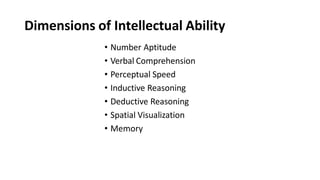
    Forces for Change •Natureof the Workforce –Almost every organization must adjust to a multicultural environment, demographic changes, immigration, and outsourcing. •Technology –Faster, cheaper, more mobile technologies are changing jobs & organizations. •Economic Shocks –Result in downsizing, bankruptcy, restructuring
  • 263.
    • Competition • Globalmarketplace ignited competition • Mergers and consolidations • Growth of e-commerce •Social trends • Increased environmental awareness • World politics • Collapse of soviet union • Black rule of south Africa
  • 264.
    Types of Change •Planned Change – Activities that are proactive and purposeful: an intentional, goal-oriented activity – Goals of Planned Change • Improving the ability of the organization to adapt to changes in its environment • Changing employee behavior • First order change-linear and continuous change • Second order change-multi dimensional, multilevel, dissentious and radical change • Unplanned Change – Organizational changes that are not foreseen prior to the need to change, often made necessary by shifts in the organizational environment.
  • 265.
    Resistance to Change •Resistanceto change appears to be a natural and positive state Forms of Resistance to Change: • Overt and Immediate • Voicing complaints, engaging in job actions • Implicit and Deferred • Loss of employee loyalty and motivation, increased errors or mistakes, increased absenteeism • Deferred resistance clouds the link between source and reaction
  • 266.
    Sources of Resistanceto Change • Individual • Habit, security, economic factors, fear of the unknown, and selective information processing • Organizational • Structural inertia, limited focus of change, group inertia, threat to expertise, threat to established power relationships and resource allocations
  • 267.
    Overcoming Resistance toChange • Education and Communication • Show those affected the logic behind the change • Participation • Participation in the decision process lessens resistance • Support and Commitment • Counseling, therapy, or new-skills training • Manipulation and Cooptation • “Spinning” the message to gain cooperation • Selecting people who accept change • Hire people who enjoy change in the first place • Coercion • Direct threats and force
  • 268.
    Lewin's Three-Step ChangeModel • Unfreezing • Change efforts to overcome the pressures of both individual resistance and group conformity (basically there are driving forces that direct behavior away from status quo and restraining forces that hinder movement from the existing equilibrium) • Movement • Make the changes • Refreezing • Stabilizing a change intervention by balancing driving and restraining forces
  • 269.
    Kotter's Eight-Step Plan •Builds from Lewin’s Model • To implement change: 1. Establish a sense of urgency 2. Form a coalition 3. Create a new vision 4. Communicate the vision 5. Empower others by removing barriers 6. Create and reward short-term “wins” 7. Consolidate, reassess, and adjust 8. Reinforce the changes Unfreezing Movement Refreezing
  • 270.
    Organizational Development • OrganizationalDevelopment (OD) – A collection of planned interventions, built on humanistic-democratic values, that seeks to improve organizational effectiveness and employee well-being • OD Values – Respect for people – Trust and support – Power equalization – Confrontation – Participation
  • 271.
    Six OD Techniques 1.Sensitivity Training • Training groups (T-groups) that seek to change behavior through unstructured group interaction • Provides increased awareness of others and self • Increases empathy with others, listening skills, openness, and tolerance for others 1. Survey Feedback Approach • The use of questionnaires to identify discrepancies among member perceptions; discussion follows and remedies are suggested 3. Process Consultation (PC) • A consultant gives a client insights into what is going on around the client, within the client, and between the client and other people; identifies processes that need improvement.
  • 272.
    Six OD Techniques(Continued) 4. Team Building – High interaction among team members to increase trust and openness 5. Intergroup Development – OD efforts to change the attitudes, stereotypes, and perceptions that groups have of each other 6. Appreciative Inquiry – Seeks to identify the unique qualities and special strengths of an organization, which can then be built on to improve performance • Discovery: Recalling the strengths of the organization • Dreaming: Speculation on the future of the organization • Design: Finding a common vision • Destiny: Deciding how to fulfill the dream
  • 273.
    Creating a Culturefor Change: Innovation 1. Stimulating a Culture of Innovation – Innovation: a new idea applied to initiating or improving a product, process, or service – Sources of Innovation: • Structural variables: organic structures • Long-tenured management • Slack resources • Interunit communication – Idea Champions: Individuals who actively promote the innovation
  • 274.
    Creating a Culturefor Change: Learning 2. Creating a learning organization – An organization that has developed the continuous capacity to adapt and change – Learning Types • Single-Loop: errors are corrected using past routines • Double-Loop: errors are corrected by modifying routines – Characteristics • Holds a shared vision • Discards old ways of thinking • Views organization as system of relationships • Communicates openly • Works together to achieve shared vision
  • 275.
    Summary and ManagerialImplications • Organizations and the individuals within them must undergo dynamic change • Managers are change agents and modifiers of organizational culture • Stress can be good or bad for employees • Despite possible improvements in job performance caused by stress, such improvements come at the cost of increased job dissatisfaction
  • 276.