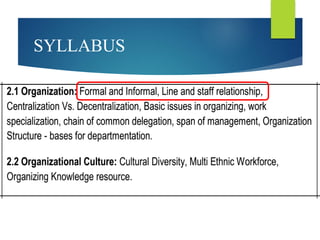
SYLLABUS
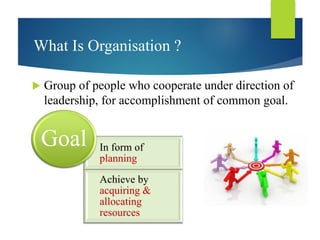
What Is Organisation ?
 Group of people who cooperate under direction of
leadership, for accomplishment of common goal.
In form of
planning
Achieve by
acquiring &
allocating
resources
Goal
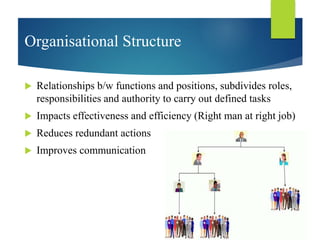
Organisational Structure
 Relationships b/w functions and positions, subdivides roles,
responsibilities and authority to carry out defined tasks
 Impacts effectiveness and efficiency (Right man at right job)
 Reduces redundant actions
 Improves communication
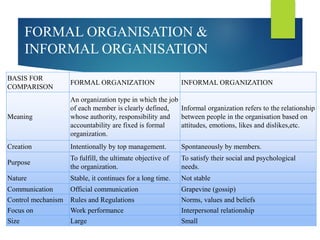
FORMAL ORGANISATION &
INFORMAL ORGANISATION
BASIS FOR
COMPARISON
FORMAL ORGANIZATION INFORMAL ORGANIZATION
Meaning
An organization type in which the job
of each member is clearly defined,
whose authority, responsibility and
accountability are fixed is formal
organization.
Informal organization refers to the relationship
between people in the organisation based on
attitudes, emotions, likes and dislikes,etc.
Creation Intentionally by top management. Spontaneously by members.
Purpose
To fulfill, the ultimate objective of
the organization.
To satisfy their social and psychological
needs.
Nature Stable, it continues for a long time. Not stable
Communication Official communication Grapevine (gossip)
Control mechanism Rules and Regulations Norms, values and beliefs
Focus on Work performance Interpersonal relationship
Size Large Small
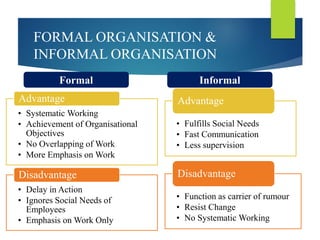
FORMAL ORGANISATION &
INFORMAL ORGANISATION
• Systematic Working
• Achievement of Organisational
Objectives
• No Overlapping of Work
• More Emphasis on Work
Advantage
• Delay in Action
• Ignores Social Needs of
Employees
• Emphasis on Work Only
Disadvantage
• Fulfills Social Needs
• Fast Communication
• Less supervision
Advantage
• Function as carrier of rumour
• Resist Change
• No Systematic Working
Disadvantage
Formal Informal
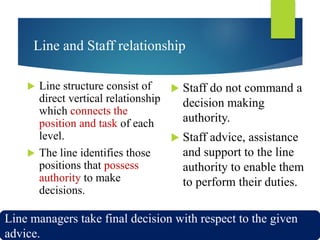
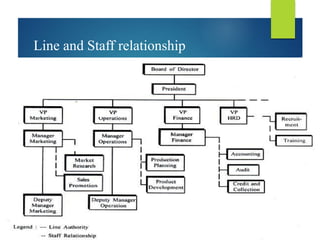
Line and Staff relationship
 Line structure consist of
direct vertical relationship
which connects the
position and task of each
level.
 The line identifies those
positions that possess
authority to make
decisions.
 Staff do not command a
decision making
authority.
 Staff advice, assistance
and support to the line
authority to enable them
to perform their duties.
Line managers take final decision with respect to the given
advice.
Line and Staff relationship
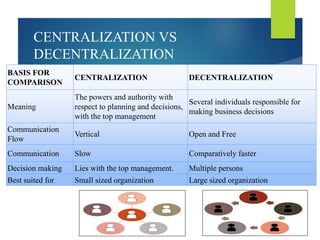
CENTRALIZATION VS
DECENTRALIZATION
BASIS FOR
COMPARISON
CENTRALIZATION DECENTRALIZATION
Meaning
The powers and authority with
respect to planning and decisions,
with the top management
Several individuals responsible for
making business decisions
Communication
Flow
Vertical Open and Free
Communication Slow Comparatively faster
Decision making Lies with the top management. Multiple persons
Best suited for Small sized organization Large sized organization
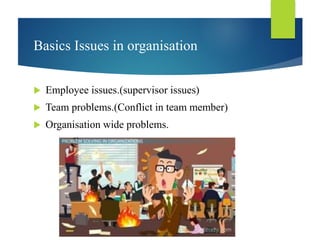
Basics Issues in organisation
 Employee issues.(supervisor issues)
 Team problems.(Conflict in team member)
 Organisation wide problems.
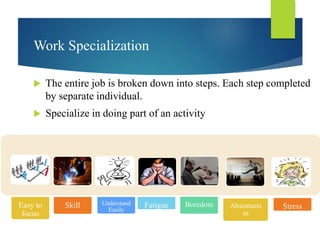
Work Specialization
 The entire job is broken down into steps. Each step completed
by separate individual.
 Specialize in doing part of an activity
Easy to
focus
Skill Understand
Easily
Fatigue Boredom Absenteeis
m
Stress
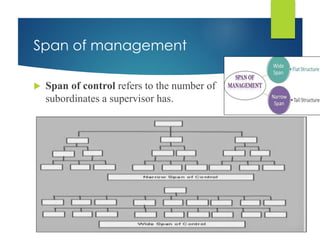
Span of management
 Span of control refers to the number of
subordinates a supervisor has.
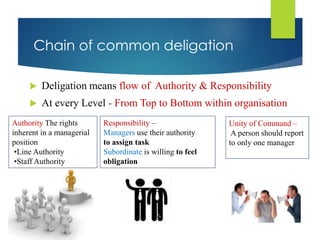
Chain of common deligation
 Deligation means flow of Authority & Responsibility
 At every Level - From Top to Bottom within organisation
Authority The rights
inherent in a managerial
position
•Line Authority
•Staff Authority
Responsibility –
Managers use their authority
to assign task
Subordinate is willing to feel
obligation
Unity of Command –
A person should report
to only one manager
Departmentation:
 The process of grouping of activities into units for the purpose
of administration is called departmentation.
 Departmentation provides scope for organisation’s growth and
expansion
 A) Departmentation by Functional
– Grouping jobs by functions performed
Departmentation:
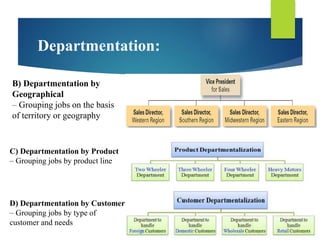
B) Departmentation by
Geographical
– Grouping jobs on the basis
of territory or geography
C) Departmentation by Product
– Grouping jobs by product line
D) Departmentation by Customer
– Grouping jobs by type of
customer and needs
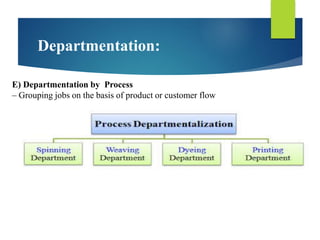
E) Departmentation by Process
– Grouping jobs on the basis of product or customer flow
Departmentation:
Organization

Organization

  • 2.
  • 3.
    What Is Organisation?  Group of people who cooperate under direction of leadership, for accomplishment of common goal. In form of planning Achieve by acquiring & allocating resources Goal
  • 4.
    Organisational Structure  Relationshipsb/w functions and positions, subdivides roles, responsibilities and authority to carry out defined tasks  Impacts effectiveness and efficiency (Right man at right job)  Reduces redundant actions  Improves communication
  • 5.
    FORMAL ORGANISATION & INFORMALORGANISATION BASIS FOR COMPARISON FORMAL ORGANIZATION INFORMAL ORGANIZATION Meaning An organization type in which the job of each member is clearly defined, whose authority, responsibility and accountability are fixed is formal organization. Informal organization refers to the relationship between people in the organisation based on attitudes, emotions, likes and dislikes,etc. Creation Intentionally by top management. Spontaneously by members. Purpose To fulfill, the ultimate objective of the organization. To satisfy their social and psychological needs. Nature Stable, it continues for a long time. Not stable Communication Official communication Grapevine (gossip) Control mechanism Rules and Regulations Norms, values and beliefs Focus on Work performance Interpersonal relationship Size Large Small
  • 6.
    FORMAL ORGANISATION & INFORMALORGANISATION • Systematic Working • Achievement of Organisational Objectives • No Overlapping of Work • More Emphasis on Work Advantage • Delay in Action • Ignores Social Needs of Employees • Emphasis on Work Only Disadvantage • Fulfills Social Needs • Fast Communication • Less supervision Advantage • Function as carrier of rumour • Resist Change • No Systematic Working Disadvantage Formal Informal
  • 7.
    Line and Staffrelationship  Line structure consist of direct vertical relationship which connects the position and task of each level.  The line identifies those positions that possess authority to make decisions.  Staff do not command a decision making authority.  Staff advice, assistance and support to the line authority to enable them to perform their duties. Line managers take final decision with respect to the given advice.
  • 8.
    Line and Staffrelationship
  • 9.
    CENTRALIZATION VS DECENTRALIZATION BASIS FOR COMPARISON CENTRALIZATIONDECENTRALIZATION Meaning The powers and authority with respect to planning and decisions, with the top management Several individuals responsible for making business decisions Communication Flow Vertical Open and Free Communication Slow Comparatively faster Decision making Lies with the top management. Multiple persons Best suited for Small sized organization Large sized organization
  • 10.
    Basics Issues inorganisation  Employee issues.(supervisor issues)  Team problems.(Conflict in team member)  Organisation wide problems.
  • 11.
    Work Specialization  Theentire job is broken down into steps. Each step completed by separate individual.  Specialize in doing part of an activity Easy to focus Skill Understand Easily Fatigue Boredom Absenteeis m Stress
  • 12.
    Span of management Span of control refers to the number of subordinates a supervisor has.
  • 13.
    Chain of commondeligation  Deligation means flow of Authority & Responsibility  At every Level - From Top to Bottom within organisation Authority The rights inherent in a managerial position •Line Authority •Staff Authority Responsibility – Managers use their authority to assign task Subordinate is willing to feel obligation Unity of Command – A person should report to only one manager
  • 14.
    Departmentation:  The processof grouping of activities into units for the purpose of administration is called departmentation.  Departmentation provides scope for organisation’s growth and expansion  A) Departmentation by Functional – Grouping jobs by functions performed
  • 15.
    Departmentation: B) Departmentation by Geographical –Grouping jobs on the basis of territory or geography C) Departmentation by Product – Grouping jobs by product line D) Departmentation by Customer – Grouping jobs by type of customer and needs
  • 16.
    E) Departmentation byProcess – Grouping jobs on the basis of product or customer flow Departmentation: