1
Short-Term Incentives
Those additions to base pay
provided to employees
within the current year.
2
Short-Term Incentives
 In reviewing opportunities for granting
short-term incentives, employees must
be viewed from four different
perspectives:
• Individual contributors
• Team members
• Work units
• Organization members
3
Premiums & Differentials
Wage and Hour Laws
Pay Policy and Procedures
Union Contracts
Industry Practices
Defined and Proscribed By:
4
Premiums & Differentials
 Overtime Pay
 Shift Differential
 Weekend
 Holiday Work
 Call-back
 Reporting
 Standby
 Cleanup Time
 Burdensome
 Distasteful
 Hazardous Work
5
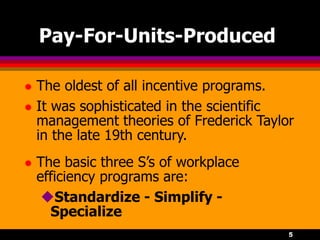
Pay-For-Units-Produced
 The oldest of all incentive programs.
 It was sophisticated in the scientific
management theories of Frederick Taylor
in the late 19th century.
 The basic three S’s of workplace
efficiency programs are:
Standardize - Simplify -
Specialize
6
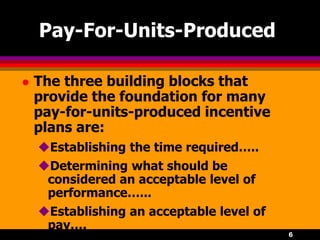
Pay-For-Units-Produced
 The three building blocks that
provide the foundation for many
pay-for-units-produced incentive
plans are:
Establishing the time required…..
Determining what should be
considered an acceptable level of
performance…...
Establishing an acceptable level of
pay….
7
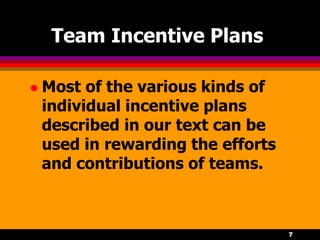
Team Incentive Plans
 Most of the various kinds of
individual incentive plans
described in our text can be
used in rewarding the efforts
and contributions of teams.
8
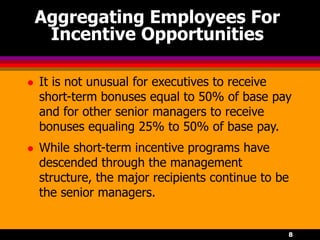
Aggregating Employees For
Incentive Opportunities
 It is not unusual for executives to receive
short-term bonuses equal to 50% of base pay
and for other senior managers to receive
bonuses equaling 25% to 50% of base pay.
 While short-term incentive programs have
descended through the management
structure, the major recipients continue to be
the senior managers.
9
Aggregating Employees For
Incentive Opportunities
The size of the
bonus pool from
which management
short-term
incentives are taken
is normally
determined by some
form of profit
measurement.
10
The measures
used will vary by
organization and
they are
normally formula
driven plans with
one or more of
the following
characteristics:
 Profit Before Taxes
 Profit After Taxes
 Return On Equity
 Return On Invested
Capital
Aggregating Employees For
Incentive Opportunities
11
Aggregating Employees For
Incentive Opportunities
 The amount of the bonus
is normally established as
a percentage of base pay.
12
Organization-Wide
Short-Term Incentives
 Productivity Gain Sharing Plans
This is basically a sharing by the
organization with employees of "bottom-
line" improvements obtained through
increased productivity.
A first requirement for a gain sharing
plan is determination of a standard
measure of performance.
13
Scanlon Plan
 Scanlon's philosophy was that if the
company would foster and use
employee ideas and suggestions
and, in turn, reward employees for
their constructive efforts, the
company would improve profitability
and workers would gain through
steady employment and increased
pay.
14
Scanlon Plan
 The Basic Elements of the Scanlon
Plan are:
The Ratio
Total labor cost / sales value
of production .
The Bonus
Depends on the reduction in costs
below the preset ratio.
15
Scanlon Plan
 The Production Committee
Formed in each major
department and is used to
tap into the imagination and
ingenuity of the workers.
16
Scanlon Plan
 The Screening Committee
Consists of top members of the plant
management and workers
representatives, usually eight to
twelve members.
It reviews the monthly bonus,
discusses current production
problems, and considers all
suggestions for organizational
improvement.
17
Profit Sharing
 Any procedure under which an
employer pays or makes available
to regular employees, (subject to
reasonable eligibility rules) in
addition to prevailing rates of pay,
special current or deferred sums
based on the profits of business.
18
Profit Sharing
 There are essentially three
different types of profit sharing
plans in existence today
Cash or current payment plan
Deferred plan (pension support)
Combined plan
19
Lincoln's Incentive System
 The company guarantees 30 hours
of work 50 weeks a year to each
employee who has a least 3 years
of service.
 Standard job evaluation
procedures set the base wage,
using six compensable factors to
determine the importance of each
job.
20
Lincoln's Incentive System
 The majority of workers are on a
piecework incentive plan.
 All employees may participate in
the suggestion program with the
exception of department heads
and members of the engineering
and time-study departments.
21
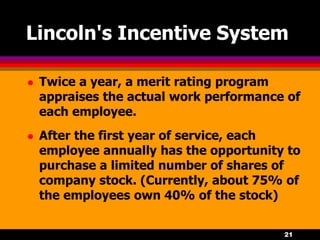
Lincoln's Incentive System
 Twice a year, a merit rating program
appraises the actual work performance of
each employee.
 After the first year of service, each
employee annually has the opportunity to
purchase a limited number of shares of
company stock. (Currently, about 75% of
the employees own 40% of the stock)
22
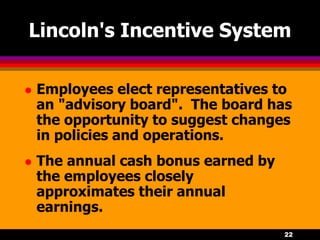
Lincoln's Incentive System
 Employees elect representatives to
an "advisory board". The board has
the opportunity to suggest changes
in policies and operations.
 The annual cash bonus earned by
the employees closely
approximates their annual
earnings.
23
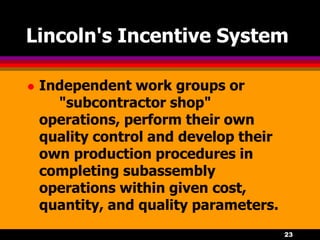
Lincoln's Incentive System
 Independent work groups or
"subcontractor shop"
operations, perform their own
quality control and develop their
own production procedures in
completing subassembly
operations within given cost,
quantity, and quality parameters.
24
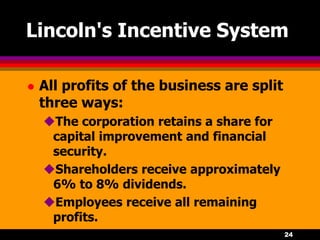
Lincoln's Incentive System
 All profits of the business are split
three ways:
The corporation retains a share for
capital improvement and financial
security.
Shareholders receive approximately
6% to 8% dividends.
Employees receive all remaining
profits.
25
Timing Of Bonus Payments
 Christmas Bonus
 Vacation Bonus
 Annual Lump-sum Bonuses

Presentation on Short Term Incentives for Management

  • 1.
    1 Short-Term Incentives Those additionsto base pay provided to employees within the current year.
  • 2.
    2 Short-Term Incentives  Inreviewing opportunities for granting short-term incentives, employees must be viewed from four different perspectives: • Individual contributors • Team members • Work units • Organization members
  • 3.
    3 Premiums & Differentials Wageand Hour Laws Pay Policy and Procedures Union Contracts Industry Practices Defined and Proscribed By:
  • 4.
    4 Premiums & Differentials Overtime Pay  Shift Differential  Weekend  Holiday Work  Call-back  Reporting  Standby  Cleanup Time  Burdensome  Distasteful  Hazardous Work
  • 5.
    5 Pay-For-Units-Produced  The oldestof all incentive programs.  It was sophisticated in the scientific management theories of Frederick Taylor in the late 19th century.  The basic three S’s of workplace efficiency programs are: Standardize - Simplify - Specialize
  • 6.
    6 Pay-For-Units-Produced  The threebuilding blocks that provide the foundation for many pay-for-units-produced incentive plans are: Establishing the time required….. Determining what should be considered an acceptable level of performance…... Establishing an acceptable level of pay….
  • 7.
    7 Team Incentive Plans Most of the various kinds of individual incentive plans described in our text can be used in rewarding the efforts and contributions of teams.
  • 8.
    8 Aggregating Employees For IncentiveOpportunities  It is not unusual for executives to receive short-term bonuses equal to 50% of base pay and for other senior managers to receive bonuses equaling 25% to 50% of base pay.  While short-term incentive programs have descended through the management structure, the major recipients continue to be the senior managers.
  • 9.
    9 Aggregating Employees For IncentiveOpportunities The size of the bonus pool from which management short-term incentives are taken is normally determined by some form of profit measurement.
  • 10.
    10 The measures used willvary by organization and they are normally formula driven plans with one or more of the following characteristics:  Profit Before Taxes  Profit After Taxes  Return On Equity  Return On Invested Capital Aggregating Employees For Incentive Opportunities
  • 11.
    11 Aggregating Employees For IncentiveOpportunities  The amount of the bonus is normally established as a percentage of base pay.
  • 12.
    12 Organization-Wide Short-Term Incentives  ProductivityGain Sharing Plans This is basically a sharing by the organization with employees of "bottom- line" improvements obtained through increased productivity. A first requirement for a gain sharing plan is determination of a standard measure of performance.
  • 13.
    13 Scanlon Plan  Scanlon'sphilosophy was that if the company would foster and use employee ideas and suggestions and, in turn, reward employees for their constructive efforts, the company would improve profitability and workers would gain through steady employment and increased pay.
  • 14.
    14 Scanlon Plan  TheBasic Elements of the Scanlon Plan are: The Ratio Total labor cost / sales value of production . The Bonus Depends on the reduction in costs below the preset ratio.
  • 15.
    15 Scanlon Plan  TheProduction Committee Formed in each major department and is used to tap into the imagination and ingenuity of the workers.
  • 16.
    16 Scanlon Plan  TheScreening Committee Consists of top members of the plant management and workers representatives, usually eight to twelve members. It reviews the monthly bonus, discusses current production problems, and considers all suggestions for organizational improvement.
  • 17.
    17 Profit Sharing  Anyprocedure under which an employer pays or makes available to regular employees, (subject to reasonable eligibility rules) in addition to prevailing rates of pay, special current or deferred sums based on the profits of business.
  • 18.
    18 Profit Sharing  Thereare essentially three different types of profit sharing plans in existence today Cash or current payment plan Deferred plan (pension support) Combined plan
  • 19.
    19 Lincoln's Incentive System The company guarantees 30 hours of work 50 weeks a year to each employee who has a least 3 years of service.  Standard job evaluation procedures set the base wage, using six compensable factors to determine the importance of each job.
  • 20.
    20 Lincoln's Incentive System The majority of workers are on a piecework incentive plan.  All employees may participate in the suggestion program with the exception of department heads and members of the engineering and time-study departments.
  • 21.
    21 Lincoln's Incentive System Twice a year, a merit rating program appraises the actual work performance of each employee.  After the first year of service, each employee annually has the opportunity to purchase a limited number of shares of company stock. (Currently, about 75% of the employees own 40% of the stock)
  • 22.
    22 Lincoln's Incentive System Employees elect representatives to an "advisory board". The board has the opportunity to suggest changes in policies and operations.  The annual cash bonus earned by the employees closely approximates their annual earnings.
  • 23.
    23 Lincoln's Incentive System Independent work groups or "subcontractor shop" operations, perform their own quality control and develop their own production procedures in completing subassembly operations within given cost, quantity, and quality parameters.
  • 24.
    24 Lincoln's Incentive System All profits of the business are split three ways: The corporation retains a share for capital improvement and financial security. Shareholders receive approximately 6% to 8% dividends. Employees receive all remaining profits.
  • 25.
    25 Timing Of BonusPayments  Christmas Bonus  Vacation Bonus  Annual Lump-sum Bonuses