Presented by
Nagesha k
M.Com
Presented to
Ast pro .Raghu sir
Manasa gangotri
Mysoru
Meaning
The term Incentives mean something which
encourge a person to do something or the extra
financial reward or motivation.
Incentive is the performance link reward to
improve motivation and productivity of the
employee
Incentive includes all that provide extra pay for
the extra performance in addition to regular
wages for the job.
 Incentive are considered beneficial to both employees
as well as employees in following ways .
 Workers are likely to work at their best when they are
offered monetatory rewards for good performance .
 Provide opportunity for hard working and amditive
employee to earn more.
 To improve work flow, work method and man
machine relationship .
 To bring employee involvent to make employee
innovative.
 Incentive are the sound techinque of improving
productivety.
 Help to improve discipline and industrial
relation
 The cost of supervision are reduced
 To obtain desired result.
 What makes an Incentives plan effective
 In the absence of mutual trust between
management and workers , an incentives may be
viewed as an attempte to improve production or
profit only.
 Incentive plan should be installed in consulation
with
 Worker and union .
 Payment of incentives should be free from base
and established through scientific or proper work
study
 To implement incentives plane effectively
minimum wages should be guaranteed to every
earning .
 It should provide equal opportunity to all workers
to earn incentive pay.
 Plan should be filexable to adpot any changes later
on.
 Plan should not be very costly in operation.
 Payment of incentive should be prompt I,e as early
as possible .
 It should be adequence to motivate each employee.
 Every plan should be reviewed periodically.
 The basic form of incentives are as follow
 Bonuses :It is an incentive payment that is given to
an employee beyond his normal standard wages. It
is generally given at the end of the year and does
not become part of the basic pay.
 The payment of bonus act 1965 is applicable to
every factory or establishment in which 20 or more
person are employed in an according year.
 Merit pay : It a reward based pay on law an
employee done the assigned job. Hoigher the
performance greater will be the reward.
 The payment is depend on individual employees
performance .
 Commission for sales people: is paid on the
basis of sales made by the employee through
different plan such as
 Salary plan : where new salesman is appointed
is unable to generate new.
 Commission plan : where organization is
totally based on sales of their product.
 Combination of both: is the most frequently
used method.
Incentives plans
Organization –wideIndividual
Time –based
Output -based
Group
Time –based• profit sharing
•co-partnership
•Gain –sharing
•ESOPs
Time based incentive plan:
 under time based plan per hour wage rate is
determined and incentives paid on the based of
time saved.
 Time based incentives plans is divided in four
different ways.
 Hasley plan Emerson plan Bedeuax plan
 This all plan more or less follow same method I,e
(pay bonus on the basis of timed saved by
employee ) but with different formulae.
 under output based plan per price wages rate
is determined and incentive paid on the based
of output produced I,e more output in
standard time or standard output in less time.
 For output based incentive following 3
methods can be used.
 Taylor plan merrick plan Gnatt plan.
Fringe benefit may be defined as
 Compensation in addition to direct wages or
salaries such as company car house allowence
medical insurance paid holidays.Pension
,schemes, subsided, meals. some fringe benefits
are regarded part of a taxable income.
In simple words
 Any nonwage payment or benefit granted to
employee by employeer
Employee payment for fringe benefits are include in
employee compension costs and therefore are not
usually taxed .It the cost of fringes benefit were
paid directly as wages the worker would pay taxes
on this amount and therefore have less to spend
when purchasing equivalent benefits
independently.
Objectives of Fringe Benefits
 Employee point of view is that fringe benefits from
an important part of employee incentives to obtain
their loyalty and retaining them .The important
objectives of Fringe Benefits are
 To create and improve sound industrial relation .
 To best up employee by identifying and satisfying
their unsatisfied needs.
 To provide qualitative work environment and
work life.
 To provide security to the employees against social
risks like old age benefits and maternity benefits .
 To protect the health of the employee and
providing welfare measures like recreation
facilities.
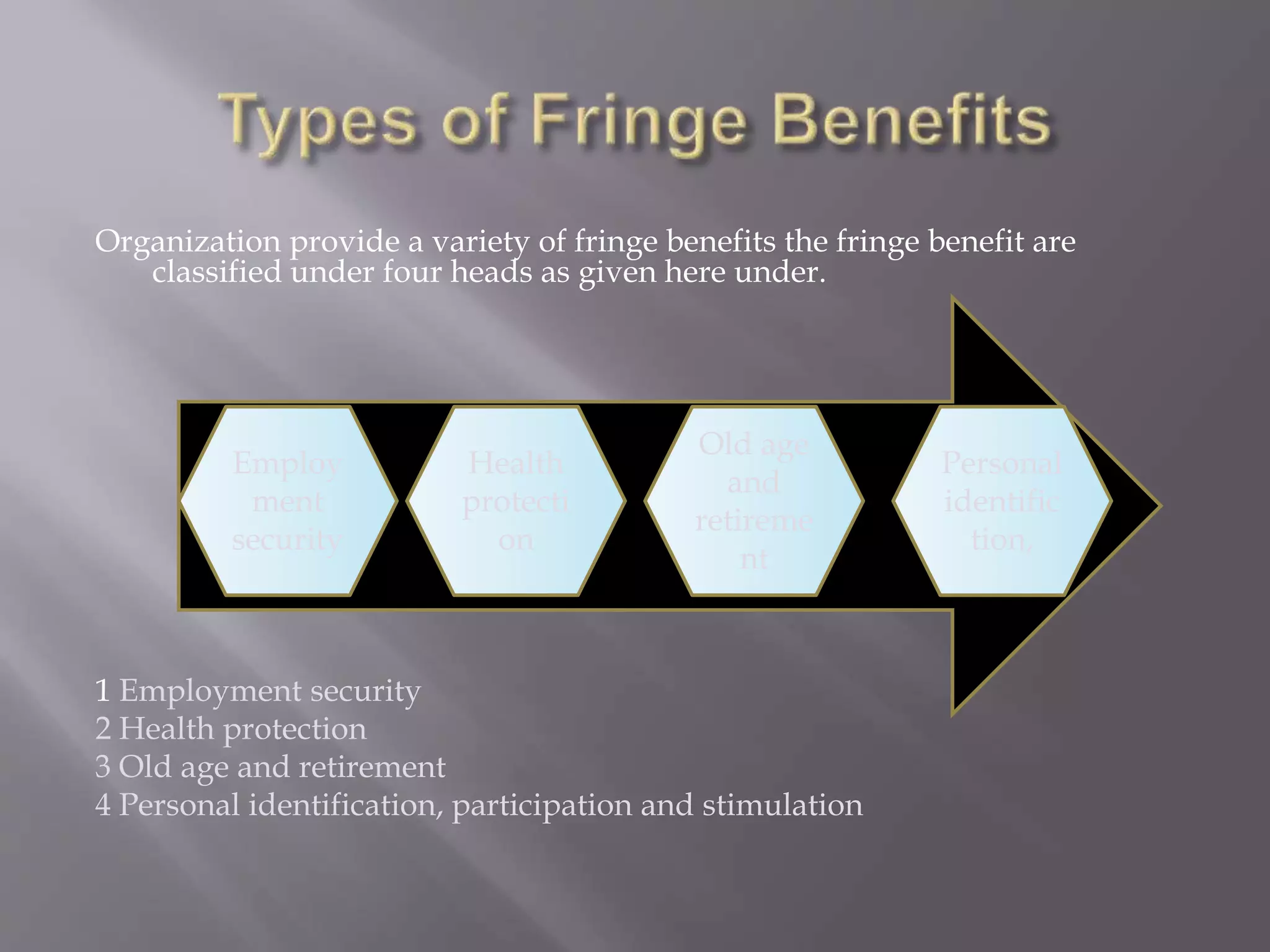
Organization provide a variety of fringe benefits the fringe benefit are
classified under four heads as given here under.
1 Employment security
2 Health protection
3 Old age and retirement
4 Personal identification, participation and stimulation
Employ
ment
security
Health
protecti
on
Old age
and
retireme
nt
Personal
identific
tion,
1 Emplacement security: Benefit under this head
include unemployment insurance
,technological adjustment pay leave for pay
,over time pay, level for negotiation, leave for
maternity ,leave for grievances, holidays, cost
of living bonus, layoff retiring rooms , jobs to
the sons /daughter of the employee and the
like.
safety health protection :
benefits under this head
include accident insurance
disability insurance ,health
insurance ,hospitalization
life insurance ,medical care
,sick benefits sick leave ets.
3 old age and retirement: benefits under this category
include deferred income plans pensions, gratuity,
provident fund, old age assistance, old age
counseling ,medical benefits for retired employees
travelling concession to retired employee, jobs to
son or daughter of the decided employee and like.
 4 personnel identification participate and
stimulations : this category covers the following
benefits : anniversary awards ,atendance bonus
,canteen corerative credit societs educational
facilities housing income tax aid , conuselling,
quality bonues receational programs strees
conuseling safety measures ets.
Presentation1 incentives nagesh

Presentation1 incentives nagesh

  • 1.
    Presented by Nagesha k M.Com Presentedto Ast pro .Raghu sir Manasa gangotri Mysoru
  • 2.
    Meaning The term Incentivesmean something which encourge a person to do something or the extra financial reward or motivation. Incentive is the performance link reward to improve motivation and productivity of the employee Incentive includes all that provide extra pay for the extra performance in addition to regular wages for the job.
  • 3.
     Incentive areconsidered beneficial to both employees as well as employees in following ways .  Workers are likely to work at their best when they are offered monetatory rewards for good performance .  Provide opportunity for hard working and amditive employee to earn more.  To improve work flow, work method and man machine relationship .  To bring employee involvent to make employee innovative.  Incentive are the sound techinque of improving productivety.
  • 4.
     Help toimprove discipline and industrial relation  The cost of supervision are reduced  To obtain desired result.
  • 5.
     What makesan Incentives plan effective  In the absence of mutual trust between management and workers , an incentives may be viewed as an attempte to improve production or profit only.  Incentive plan should be installed in consulation with  Worker and union .  Payment of incentives should be free from base and established through scientific or proper work study
  • 6.
     To implementincentives plane effectively minimum wages should be guaranteed to every earning .  It should provide equal opportunity to all workers to earn incentive pay.  Plan should be filexable to adpot any changes later on.  Plan should not be very costly in operation.  Payment of incentive should be prompt I,e as early as possible .  It should be adequence to motivate each employee.  Every plan should be reviewed periodically.
  • 7.
     The basicform of incentives are as follow  Bonuses :It is an incentive payment that is given to an employee beyond his normal standard wages. It is generally given at the end of the year and does not become part of the basic pay.  The payment of bonus act 1965 is applicable to every factory or establishment in which 20 or more person are employed in an according year.  Merit pay : It a reward based pay on law an employee done the assigned job. Hoigher the performance greater will be the reward.  The payment is depend on individual employees performance .
  • 8.
     Commission forsales people: is paid on the basis of sales made by the employee through different plan such as  Salary plan : where new salesman is appointed is unable to generate new.  Commission plan : where organization is totally based on sales of their product.  Combination of both: is the most frequently used method.
  • 9.
    Incentives plans Organization –wideIndividual Time–based Output -based Group Time –based• profit sharing •co-partnership •Gain –sharing •ESOPs
  • 10.
    Time based incentiveplan:  under time based plan per hour wage rate is determined and incentives paid on the based of time saved.  Time based incentives plans is divided in four different ways.  Hasley plan Emerson plan Bedeuax plan  This all plan more or less follow same method I,e (pay bonus on the basis of timed saved by employee ) but with different formulae.
  • 11.
     under outputbased plan per price wages rate is determined and incentive paid on the based of output produced I,e more output in standard time or standard output in less time.  For output based incentive following 3 methods can be used.  Taylor plan merrick plan Gnatt plan.
  • 12.
    Fringe benefit maybe defined as  Compensation in addition to direct wages or salaries such as company car house allowence medical insurance paid holidays.Pension ,schemes, subsided, meals. some fringe benefits are regarded part of a taxable income. In simple words  Any nonwage payment or benefit granted to employee by employeer
  • 13.
    Employee payment forfringe benefits are include in employee compension costs and therefore are not usually taxed .It the cost of fringes benefit were paid directly as wages the worker would pay taxes on this amount and therefore have less to spend when purchasing equivalent benefits independently. Objectives of Fringe Benefits  Employee point of view is that fringe benefits from an important part of employee incentives to obtain their loyalty and retaining them .The important objectives of Fringe Benefits are
  • 14.
     To createand improve sound industrial relation .  To best up employee by identifying and satisfying their unsatisfied needs.  To provide qualitative work environment and work life.  To provide security to the employees against social risks like old age benefits and maternity benefits .  To protect the health of the employee and providing welfare measures like recreation facilities.
  • 15.
    Organization provide avariety of fringe benefits the fringe benefit are classified under four heads as given here under. 1 Employment security 2 Health protection 3 Old age and retirement 4 Personal identification, participation and stimulation Employ ment security Health protecti on Old age and retireme nt Personal identific tion,
  • 16.
    1 Emplacement security:Benefit under this head include unemployment insurance ,technological adjustment pay leave for pay ,over time pay, level for negotiation, leave for maternity ,leave for grievances, holidays, cost of living bonus, layoff retiring rooms , jobs to the sons /daughter of the employee and the like.
  • 17.
    safety health protection: benefits under this head include accident insurance disability insurance ,health insurance ,hospitalization life insurance ,medical care ,sick benefits sick leave ets.
  • 18.
    3 old ageand retirement: benefits under this category include deferred income plans pensions, gratuity, provident fund, old age assistance, old age counseling ,medical benefits for retired employees travelling concession to retired employee, jobs to son or daughter of the decided employee and like.
  • 19.
     4 personnelidentification participate and stimulations : this category covers the following benefits : anniversary awards ,atendance bonus ,canteen corerative credit societs educational facilities housing income tax aid , conuselling, quality bonues receational programs strees conuseling safety measures ets.