Organic Compounds
Organic Compounds Definition
• Organic compounds are a type chemical compounds where one or
more than one carbon covalently bonded with each other and with
other atom like nitrogen, oxygen, halogen etc. Such as, methane
(CH4), ethane (C2H6), benzene (C6H6) etc.
•
• Exceptions
• Few carbon containing chemical compounds like metal cyanides (CN),
oxides of carbon (CO2, CO), metal carbonates (CO3) and metal
carbides are inorganic compounds. Such as, sodium cyanide (NaCN),
sodium carbonate (Na2CO3), calcium carbide (CaC2) etc.
Properties
Organic compounds have unique chemical and physical
properties what can differ them from inorganic compounds.
Such as,
• Low boiling point
• Low melting point
• Low solubility in water
• High solubility in organic solvent
• Non conductor of electricity
• Isomerism possible
• Mostly covalent bonding
• Flammable
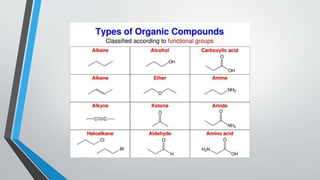
• Classification
• Organic compounds can be classified in various ways. Such as,
depending on sources, sizes and presence of heteroatom in organic
compounds.
,
•Carbohydrates- cellulose, sugar, starches etc.
•Proteins- silk, wool, casein, in different food etc.
•Alkaloid- quinine, morphine etc.
•Fats and oils- cottonseed, soyabean oil, butter etc.
•Hormones, vitamins etc.
•Natural gas,
•Petroleum- solvent, rubber, explosives etc.
•Coal- drug, dyes etc.
Natural compounds
Organic compounds are found in large number in nature and
they are well known for their uses. Such as,
Synthetic compounds
Organic compounds can also be made synthetically in
different industries. These compounds some time exist
naturally and some time they can only make synthetically.
These molecules can be small or large polymer like
plastics, rubber etc.
Biotechnology
Recently biotechnology engineered molecule are
synthesized in lab. Such as, insulin. These compounds
are manufactured using organisms like yeast and
bacteria.
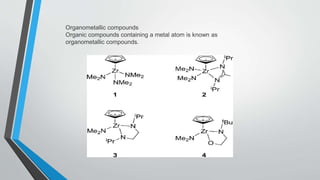
Organometallic compounds
Organic compounds containing a metal atom is known as
organometallic compounds.
Structure of organic compounds
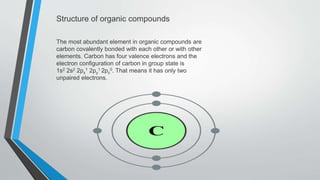
The most abundant element in organic compounds are
carbon covalently bonded with each other or with other
elements. Carbon has four valence electrons and the
electron configuration of carbon in group state is
1s2 2s2 2px
1 2py
1 2pz
0. That means it has only two
unpaired electrons.
And the electron configuration of carbon in excited state is
1s2 2s1 2px
1 2py
1 2pz
1. That means it has now four
unpaired electrons. Thus carbon undergoes
sp3 hybridization to attach convalently with four other
elements. Carbon usually attached with another carbon or
hydrogen atoms, like:
Carbon can share more than one electrons with same
element to form double or triple bond. Such as:
Carbon undergoes sp2 or sp hybridization to form double
or triple bond leaving one or two p-orbitals to participate in
double or triple bonding.
Thus the rotation around the C=C is restricted and
isomerism is possible.
organic compounds

organic compounds

  • 1.
  • 2.
    Organic Compounds Definition •Organic compounds are a type chemical compounds where one or more than one carbon covalently bonded with each other and with other atom like nitrogen, oxygen, halogen etc. Such as, methane (CH4), ethane (C2H6), benzene (C6H6) etc. •
  • 3.
    • Exceptions • Fewcarbon containing chemical compounds like metal cyanides (CN), oxides of carbon (CO2, CO), metal carbonates (CO3) and metal carbides are inorganic compounds. Such as, sodium cyanide (NaCN), sodium carbonate (Na2CO3), calcium carbide (CaC2) etc.
  • 4.
    Properties Organic compounds haveunique chemical and physical properties what can differ them from inorganic compounds. Such as, • Low boiling point • Low melting point • Low solubility in water • High solubility in organic solvent • Non conductor of electricity • Isomerism possible • Mostly covalent bonding • Flammable
  • 5.
    • Classification • Organiccompounds can be classified in various ways. Such as, depending on sources, sizes and presence of heteroatom in organic compounds.
  • 6.
    , •Carbohydrates- cellulose, sugar,starches etc. •Proteins- silk, wool, casein, in different food etc. •Alkaloid- quinine, morphine etc. •Fats and oils- cottonseed, soyabean oil, butter etc. •Hormones, vitamins etc. •Natural gas, •Petroleum- solvent, rubber, explosives etc. •Coal- drug, dyes etc. Natural compounds Organic compounds are found in large number in nature and they are well known for their uses. Such as,
  • 7.
    Synthetic compounds Organic compoundscan also be made synthetically in different industries. These compounds some time exist naturally and some time they can only make synthetically. These molecules can be small or large polymer like plastics, rubber etc. Biotechnology Recently biotechnology engineered molecule are synthesized in lab. Such as, insulin. These compounds are manufactured using organisms like yeast and bacteria.
  • 8.
    Organometallic compounds Organic compoundscontaining a metal atom is known as organometallic compounds.
  • 9.
    Structure of organiccompounds The most abundant element in organic compounds are carbon covalently bonded with each other or with other elements. Carbon has four valence electrons and the electron configuration of carbon in group state is 1s2 2s2 2px 1 2py 1 2pz 0. That means it has only two unpaired electrons.
  • 10.
    And the electronconfiguration of carbon in excited state is 1s2 2s1 2px 1 2py 1 2pz 1. That means it has now four unpaired electrons. Thus carbon undergoes sp3 hybridization to attach convalently with four other elements. Carbon usually attached with another carbon or hydrogen atoms, like:
  • 11.
    Carbon can sharemore than one electrons with same element to form double or triple bond. Such as: Carbon undergoes sp2 or sp hybridization to form double or triple bond leaving one or two p-orbitals to participate in double or triple bonding.
  • 12.
    Thus the rotationaround the C=C is restricted and isomerism is possible.