Activation Energy and
Catalyst
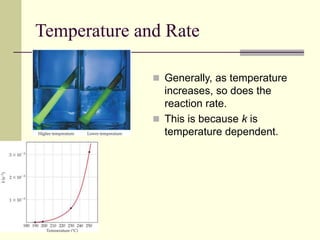
Temperature and Rate
 Generally, as temperature
increases, so does the
reaction rate.
 This is because k is
temperature dependent.
The Collision Model
 In a chemical reaction, bonds are broken and
new bonds are formed.
 Molecules can only react if they collide with
each other.
The Collision Model
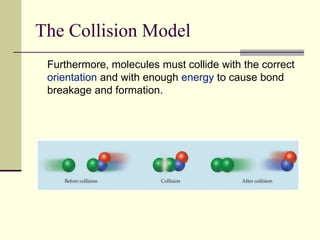
Furthermore, molecules must collide with the correct
orientation and with enough energy to cause bond
breakage and formation.
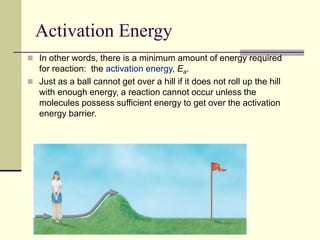
Activation Energy
 In other words, there is a minimum amount of energy required
for reaction: the activation energy, Ea.
 Just as a ball cannot get over a hill if it does not roll up the hill
with enough energy, a reaction cannot occur unless the
molecules possess sufficient energy to get over the activation
energy barrier.
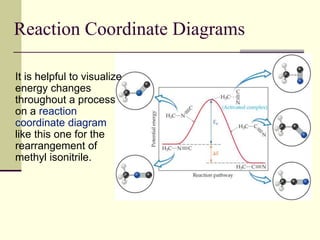
Reaction Coordinate Diagrams
It is helpful to visualize
energy changes
throughout a process
on a reaction
coordinate diagram
like this one for the
rearrangement of
methyl isonitrile.
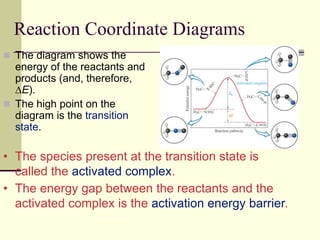
Reaction Coordinate Diagrams
 The diagram shows the
energy of the reactants and
products (and, therefore,
E).
 The high point on the
diagram is the transition
state.
• The species present at the transition state is
called the activated complex.
• The energy gap between the reactants and the
activated complex is the activation energy barrier.
Maxwell–Boltzmann Distributions
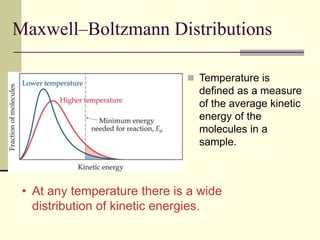
 Temperature is
defined as a measure
of the average kinetic
energy of the
molecules in a
sample.
• At any temperature there is a wide
distribution of kinetic energies.
Maxwell–Boltzmann Distributions
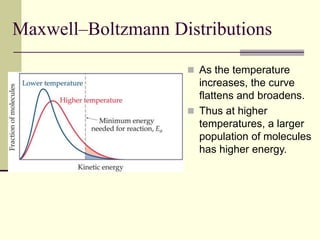
 As the temperature
increases, the curve
flattens and broadens.
 Thus at higher
temperatures, a larger
population of molecules
has higher energy.
Maxwell–Boltzmann Distributions
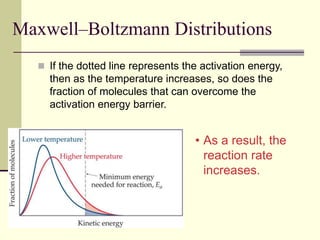
 If the dotted line represents the activation energy,
then as the temperature increases, so does the
fraction of molecules that can overcome the
activation energy barrier.
• As a result, the
reaction rate
increases.
Maxwell–Boltzmann Distributions
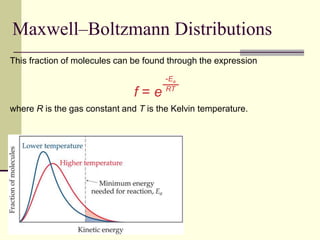
This fraction of molecules can be found through the expression
where R is the gas constant and T is the Kelvin temperature.
f = e
-Ea
RT
Arrhenius Equation
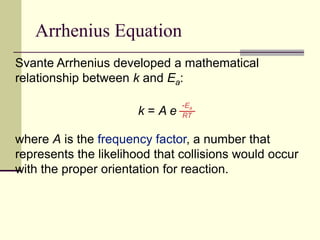
Svante Arrhenius developed a mathematical
relationship between k and Ea:
k = A e
where A is the frequency factor, a number that
represents the likelihood that collisions would occur
with the proper orientation for reaction.
-Ea
RT
Arrhenius Equation
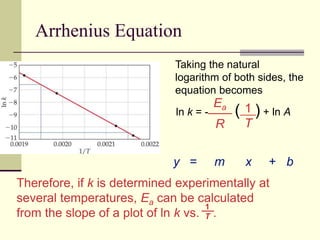
Taking the natural
logarithm of both sides, the
equation becomes
ln k = - ( ) + ln A
1
T
y = m x + b
Therefore, if k is determined experimentally at
several temperatures, Ea can be calculated
from the slope of a plot of ln k vs. .
Ea
R
1
T
Catalysts
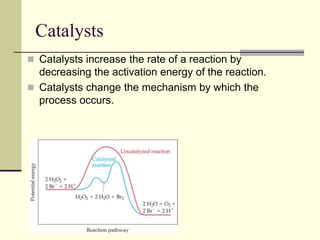
 Catalysts increase the rate of a reaction by
decreasing the activation energy of the reaction.
 Catalysts change the mechanism by which the
process occurs.
Catalysts
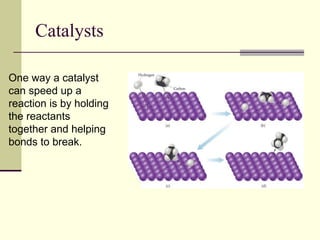
One way a catalyst
can speed up a
reaction is by holding
the reactants
together and helping
bonds to break.
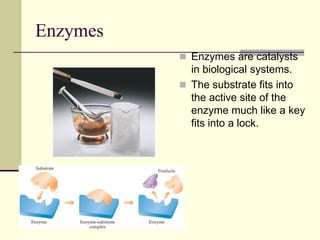
Enzymes
 Enzymes are catalysts
in biological systems.
 The substrate fits into
the active site of the
enzyme much like a key
fits into a lock.

Activation_Energy_and_Catalyst.ppt

  • 1.
  • 2.
    Temperature and Rate Generally, as temperature increases, so does the reaction rate.  This is because k is temperature dependent.
  • 3.
    The Collision Model In a chemical reaction, bonds are broken and new bonds are formed.  Molecules can only react if they collide with each other.
  • 4.
    The Collision Model Furthermore,molecules must collide with the correct orientation and with enough energy to cause bond breakage and formation.
  • 5.
    Activation Energy  Inother words, there is a minimum amount of energy required for reaction: the activation energy, Ea.  Just as a ball cannot get over a hill if it does not roll up the hill with enough energy, a reaction cannot occur unless the molecules possess sufficient energy to get over the activation energy barrier.
  • 6.
    Reaction Coordinate Diagrams Itis helpful to visualize energy changes throughout a process on a reaction coordinate diagram like this one for the rearrangement of methyl isonitrile.
  • 7.
    Reaction Coordinate Diagrams The diagram shows the energy of the reactants and products (and, therefore, E).  The high point on the diagram is the transition state. • The species present at the transition state is called the activated complex. • The energy gap between the reactants and the activated complex is the activation energy barrier.
  • 8.
    Maxwell–Boltzmann Distributions  Temperatureis defined as a measure of the average kinetic energy of the molecules in a sample. • At any temperature there is a wide distribution of kinetic energies.
  • 9.
    Maxwell–Boltzmann Distributions  Asthe temperature increases, the curve flattens and broadens.  Thus at higher temperatures, a larger population of molecules has higher energy.
  • 10.
    Maxwell–Boltzmann Distributions  Ifthe dotted line represents the activation energy, then as the temperature increases, so does the fraction of molecules that can overcome the activation energy barrier. • As a result, the reaction rate increases.
  • 11.
    Maxwell–Boltzmann Distributions This fractionof molecules can be found through the expression where R is the gas constant and T is the Kelvin temperature. f = e -Ea RT
  • 12.
    Arrhenius Equation Svante Arrheniusdeveloped a mathematical relationship between k and Ea: k = A e where A is the frequency factor, a number that represents the likelihood that collisions would occur with the proper orientation for reaction. -Ea RT
  • 13.
    Arrhenius Equation Taking thenatural logarithm of both sides, the equation becomes ln k = - ( ) + ln A 1 T y = m x + b Therefore, if k is determined experimentally at several temperatures, Ea can be calculated from the slope of a plot of ln k vs. . Ea R 1 T
  • 14.
    Catalysts  Catalysts increasethe rate of a reaction by decreasing the activation energy of the reaction.  Catalysts change the mechanism by which the process occurs.
  • 15.
    Catalysts One way acatalyst can speed up a reaction is by holding the reactants together and helping bonds to break.
  • 16.
    Enzymes  Enzymes arecatalysts in biological systems.  The substrate fits into the active site of the enzyme much like a key fits into a lock.