MALIGNANT EYELID TUMOURS 1.  Basal cell carcinoma 2.  Squamous cell carcinoma 3.  Meibomian gland carcinoma 4.  Melanoma 5.  Kaposi sarcoma 6.  Merkel cell carcinoma 7.  Treatment
Basal Cell Carcinoma - Important Facts 1.  Most common human malignancy 2.  Usually affects the elderly 3.  Slow-growing, locally invasive 5.  90% occur on head and neck 6.  Of these 10% involve eyelids 7.  Accounts for 90% of eyelid malignancies 4.  Does not metastasize
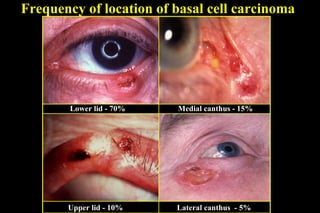
Frequency of location of basal cell carcinoma Lower lid - 70% Medial canthus - 15% Upper lid - 10% Lateral canthus  - 5%
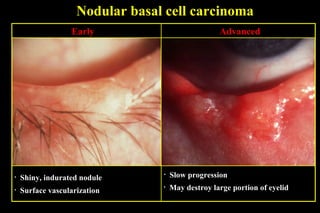
Nodular basal cell carcinoma Early Shiny, indurated nodule Surface vascularization Slow progression Advanced May destroy large portion of eyelid
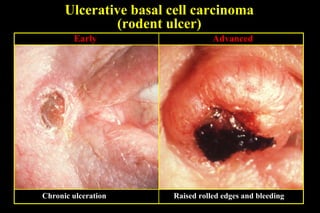
Ulcerative basal cell carcinoma (rodent ulcer) Early Chronic ulceration Advanced Raised rolled edges and bleeding
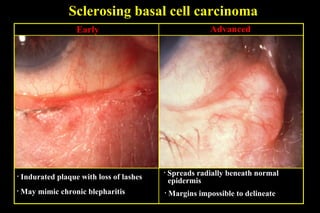
Sclerosing basal cell carcinoma Indurated plaque with loss of lashes Advanced  Spreads radially beneath normal  epidermis Early May mimic chronic blepharitis Margins impossible to delineate
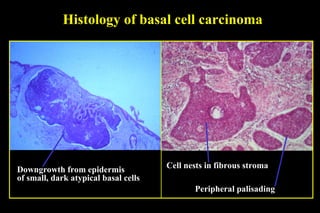
Histology of basal cell carcinoma Downgrowth from epidermis of small, dark atypical basal cells Peripheral palisading Cell nests in fibrous stroma
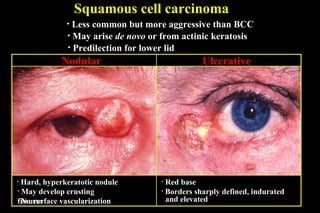
Squamous cell carcinoma Predilection for lower lid Hard, hyperkeratotic nodule Less common but more aggressive than BCC May develop crusting fissures May arise  de novo  or from actinic keratosis Ulcerative No surface vascularization Red base Borders sharply defined, indurated  and elevated Nodular
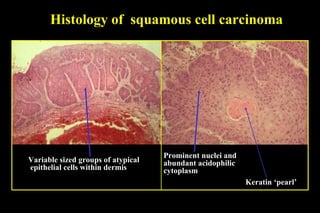
Prominent nuclei and abundant acidophilic  cytoplasm Variable sized groups of atypical epithelial cells within dermis Histology of  squamous cell carcinoma Keratin ‘pearl’
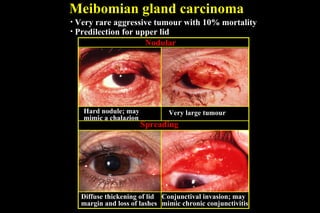
Meibomian gland carcinoma Spreading Nodular Very rare aggressive tumour with 10% mortality Predilection for upper lid Hard nodule; may mimic a chalazion Very large tumour Diffuse thickening of lid  margin and loss of lashes Conjunctival invasion; may mimic chronic conjunctivitis
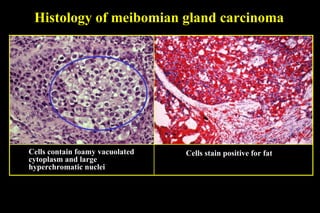
Histology of meibomian gland carcinoma Cells stain positive for fat Cells contain foamy vacuolated cytoplasm and large  hyperchromatic nuclei
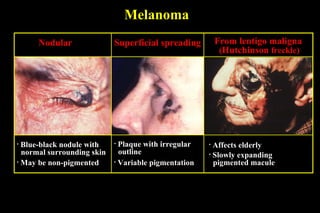
Melanoma From lentigo maligna ( Hutchinson  freckle) Nodular Blue-black nodule with normal surrounding skin Plaque with irregular outline Variable pigmentation Affects elderly Slowly expanding  pigmented macule May be non-pigmented Superficial spreading
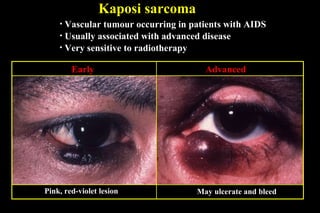
Kaposi sarcoma Advanced  Early Pink, red-violet lesion Vascular tumour occurring in patients with AIDS Usually associated with advanced disease Very sensitive to radiotherapy May ulcerate and bleed
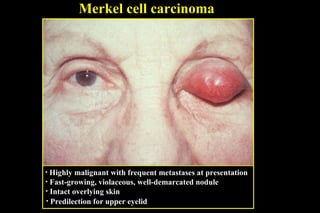
Merkel cell carcinoma Highly malignant with frequent metastases at presentation Fast-growing, violaceous, well-demarcated nodule Intact overlying skin Predilection for upper eyelid
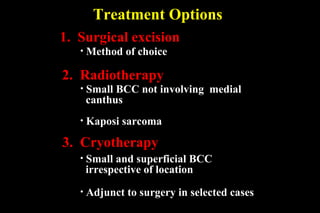
Treatment Options 3.  Cryotherapy 2.  Radiotherapy Small BCC not involving  medial  canthus 1.  Surgical excision Method of choice Small and superficial BCC irrespective of location Adjunct to surgery in selected cases Kaposi sarcoma
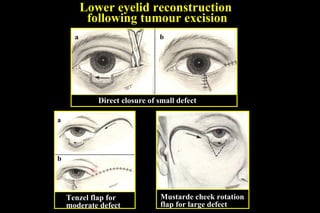
Lower eyelid reconstruction following tumour excision Mustarde cheek rotation  flap for large defect Tenzel flap for  moderate defect Direct closure of small defect a b a b b
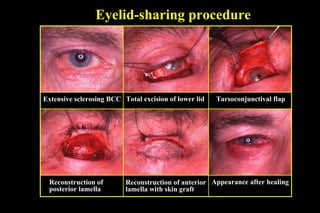
Eyelid-sharing procedure Reconstruction of posterior lamella Extensive sclerosing BCC Total excision of lower lid Tarsoconjunctival flap Reconstruction of anterior lamella with skin graft Appearance after healing

05 malignant eyelid tumours

  • 1.
    MALIGNANT EYELID TUMOURS1. Basal cell carcinoma 2. Squamous cell carcinoma 3. Meibomian gland carcinoma 4. Melanoma 5. Kaposi sarcoma 6. Merkel cell carcinoma 7. Treatment
  • 2.
    Basal Cell Carcinoma- Important Facts 1. Most common human malignancy 2. Usually affects the elderly 3. Slow-growing, locally invasive 5. 90% occur on head and neck 6. Of these 10% involve eyelids 7. Accounts for 90% of eyelid malignancies 4. Does not metastasize
  • 3.
    Frequency of locationof basal cell carcinoma Lower lid - 70% Medial canthus - 15% Upper lid - 10% Lateral canthus - 5%
  • 4.
    Nodular basal cellcarcinoma Early Shiny, indurated nodule Surface vascularization Slow progression Advanced May destroy large portion of eyelid
  • 5.
    Ulcerative basal cellcarcinoma (rodent ulcer) Early Chronic ulceration Advanced Raised rolled edges and bleeding
  • 6.
    Sclerosing basal cellcarcinoma Indurated plaque with loss of lashes Advanced Spreads radially beneath normal epidermis Early May mimic chronic blepharitis Margins impossible to delineate
  • 7.
    Histology of basalcell carcinoma Downgrowth from epidermis of small, dark atypical basal cells Peripheral palisading Cell nests in fibrous stroma
  • 8.
    Squamous cell carcinomaPredilection for lower lid Hard, hyperkeratotic nodule Less common but more aggressive than BCC May develop crusting fissures May arise de novo or from actinic keratosis Ulcerative No surface vascularization Red base Borders sharply defined, indurated and elevated Nodular
  • 9.
    Prominent nuclei andabundant acidophilic cytoplasm Variable sized groups of atypical epithelial cells within dermis Histology of squamous cell carcinoma Keratin ‘pearl’
  • 10.
    Meibomian gland carcinomaSpreading Nodular Very rare aggressive tumour with 10% mortality Predilection for upper lid Hard nodule; may mimic a chalazion Very large tumour Diffuse thickening of lid margin and loss of lashes Conjunctival invasion; may mimic chronic conjunctivitis
  • 11.
    Histology of meibomiangland carcinoma Cells stain positive for fat Cells contain foamy vacuolated cytoplasm and large hyperchromatic nuclei
  • 12.
    Melanoma From lentigomaligna ( Hutchinson freckle) Nodular Blue-black nodule with normal surrounding skin Plaque with irregular outline Variable pigmentation Affects elderly Slowly expanding pigmented macule May be non-pigmented Superficial spreading
  • 13.
    Kaposi sarcoma Advanced Early Pink, red-violet lesion Vascular tumour occurring in patients with AIDS Usually associated with advanced disease Very sensitive to radiotherapy May ulcerate and bleed
  • 14.
    Merkel cell carcinomaHighly malignant with frequent metastases at presentation Fast-growing, violaceous, well-demarcated nodule Intact overlying skin Predilection for upper eyelid
  • 15.
    Treatment Options 3. Cryotherapy 2. Radiotherapy Small BCC not involving medial canthus 1. Surgical excision Method of choice Small and superficial BCC irrespective of location Adjunct to surgery in selected cases Kaposi sarcoma
  • 16.
    Lower eyelid reconstructionfollowing tumour excision Mustarde cheek rotation flap for large defect Tenzel flap for moderate defect Direct closure of small defect a b a b b
  • 17.
    Eyelid-sharing procedure Reconstructionof posterior lamella Extensive sclerosing BCC Total excision of lower lid Tarsoconjunctival flap Reconstruction of anterior lamella with skin graft Appearance after healing