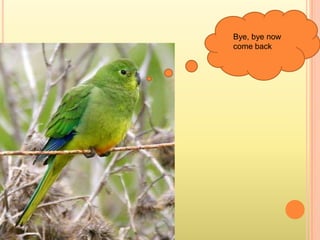
Orange bellied parrotNeophemachrysogasterBy Cara
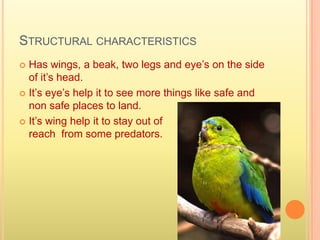
Structural characteristicsHas wings, a beak, two legs and eye’s on the side of it’s head.It’s eye’s help it to see more things like safe and non safe places to land.It’s wing help it to stay out of                               reach  from some predators.
Behaveral characteristicsThey nest, they can fly away from pray, extra sight vision and can blend in to their colour.
Functional characteristics They live in nests, there awake from dawn to dusk. They fly from Victoria to south west Tasmania to breed in summer, they teach them there young to fly back to Victoria for the winter.
classification Kingdom: AnimaliaPhylum: ChordataClass: AvesOrder: PsittaciformesFamily: Psittacidae
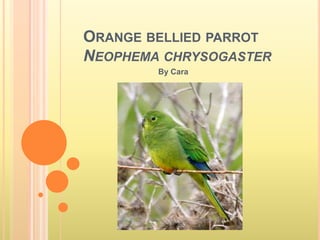
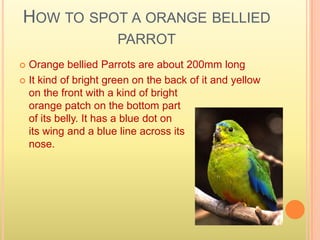
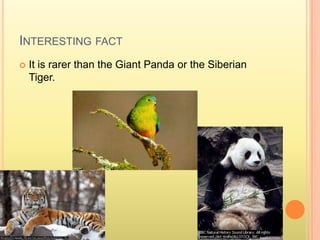
How to spot a orange bellied parrotOrange bellied Parrots are about 200mm long It kind of bright green on the back of it and yellow on the front with a kind of bright                                                    orange patch on the bottom part                                                      of its belly. It has a blue dot on                                                      its wing and a blue line across its                                         nose.
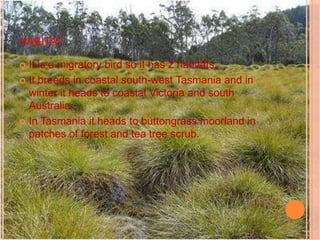
habitatIt is a migratory bird so it has 2 habitats.It breeds in coastal south-west Tasmania and in winter it heads to coastal Victoria and south Australia.In Tasmania it heads to buttongrass moorland in patches of forest and tea tree scrub.
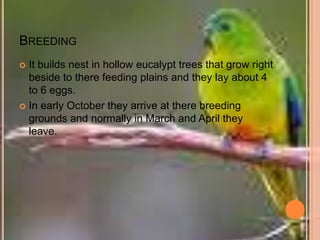
BreedingIt builds nest in hollow eucalypt trees that grow right beside to there feeding plains and they lay about 4 to 6 eggs.In early October they arrive at there breeding grounds and normally in March and April they leave.
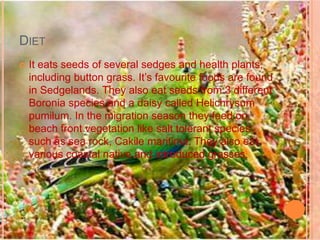
DietIt eats seeds of several sedges and health plants, including button grass.It’s favourite foods are found in Sedgelands. They also eat seeds from 3 different Boronia species and a daisy called Helichrysum pumilum. In the migration season they feed on beach front vegetation like salt tolerant species such as sea rock, Cakile maritima. They also eat various coastal native and introduced grasses.
ThreatsThey bread in Tasmania but over winter they fly back to Victoria and their home land there is being destroyed there destroyed by rabbits and stock.Housing developments are going up near or on the grounds the salt marsh habitats and a lot of new predators  are hunting them like domestic or feral cats and some others. There is also a lot of wind farms going und that leaves les flying space.
Interesting factIt is rarer than the Giant Panda or the Siberian Tiger.
bibliographyhttp://www.birdsaustralia.com.au/our-projects/orange-bellied-parrot.htmlhttp://www.parks.tas.gov.au/file.aspx?id=6783http://www.parks.tas.gov.au/index.aspx?base=5136http://www.environment.gov.au/biodiversity/threatened/publications/orange-bellied-parrot-recovery.htmlhttp://www.dpiw.tas.gov.au/internnsf/WebPages/BHAN-54G3C5?openThe Encyclopaedia of mammals-birdsMicrosoft Encarta premium-Giant Panda, Siberian Tiger and Sheep.http://kimbofo.smugmug.com/Travel/Australia/Cradle-Mountain-Tasmania/buttongrass/20895880_cYzTX-S.jpg
Bye, bye now come back

Orange bellied parrot