AEN 301 PESTS OF FIELD CROPS AND THEIR
MANAGEMENT (2+1)
Lec. No. Title
32 BIRD PESTS AND THEIR MANAGEMENT
Dr. N. MUTHUKRISHNAN, Ph.D.
Professor (Entomology)
Department of Agricultural Entomology
Tamil Nadu Agricultural University
Coimbatore 641 003
94862 57548
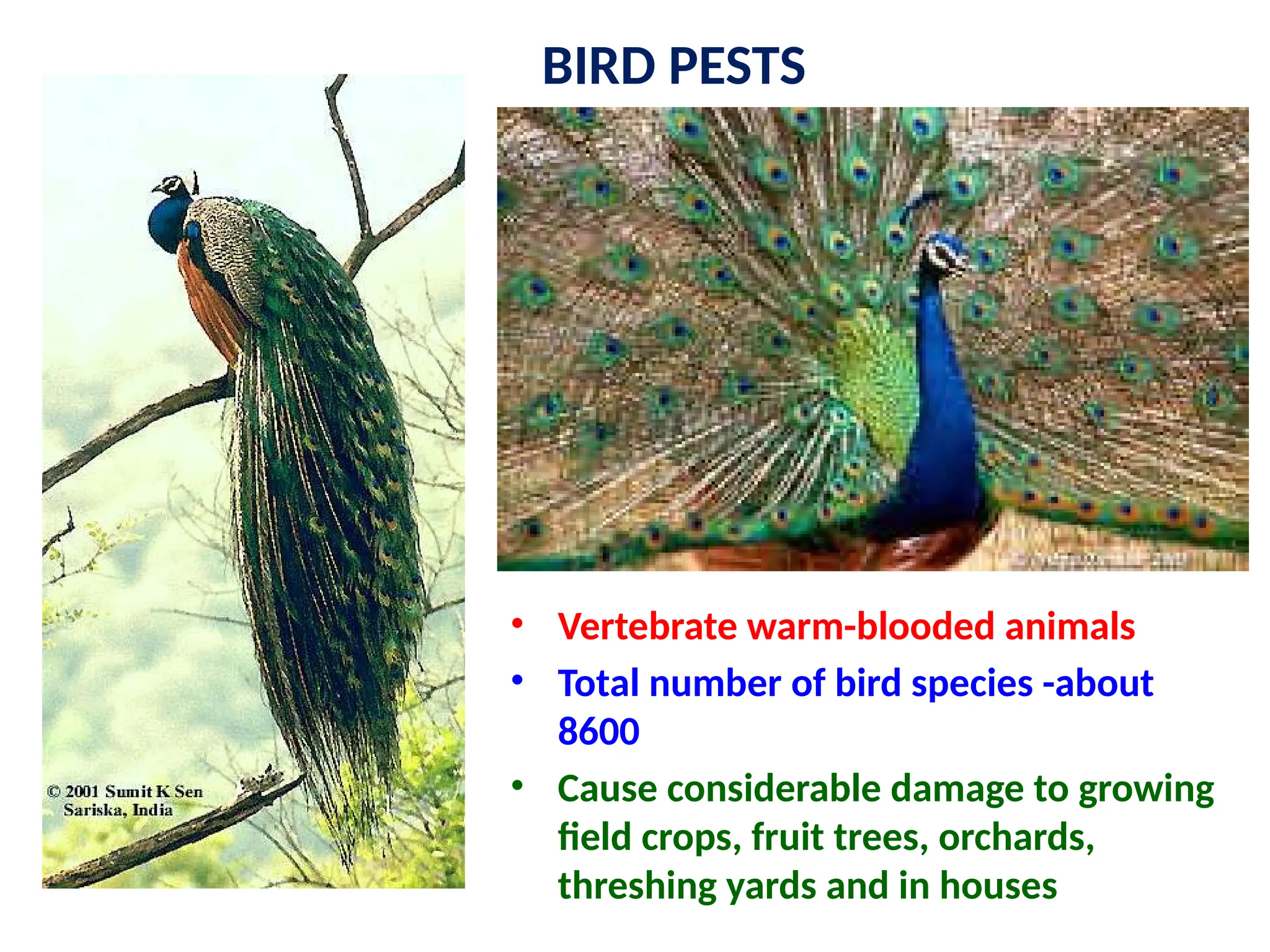
BIRD PESTS
• Vertebrate warm-blooded animals
• Total number of bird species -about
8600
• Cause considerable damage to growing
field crops, fruit trees, orchards,
threshing yards and in houses
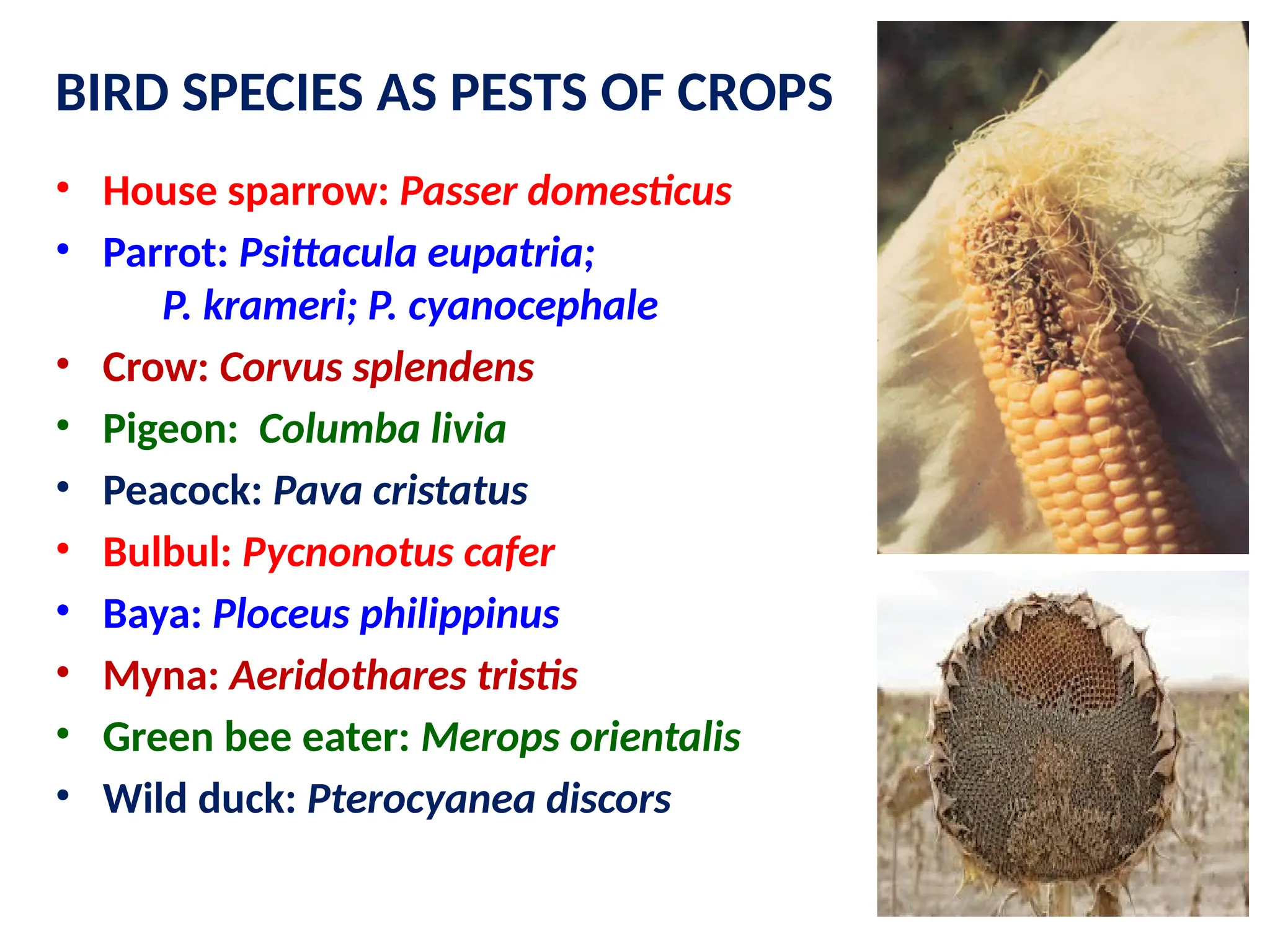
BIRD SPECIES AS PESTS OF CROPS
• House sparrow: Passer domesticus
• Parrot: Psittacula eupatria;
P. krameri; P. cyanocephale
• Crow: Corvus splendens
• Pigeon: Columba livia
• Peacock: Pava cristatus
• Bulbul: Pycnonotus cafer
• Baya: Ploceus philippinus
• Myna: Aeridothares tristis
• Green bee eater: Merops orientalis
• Wild duck: Pterocyanea discors
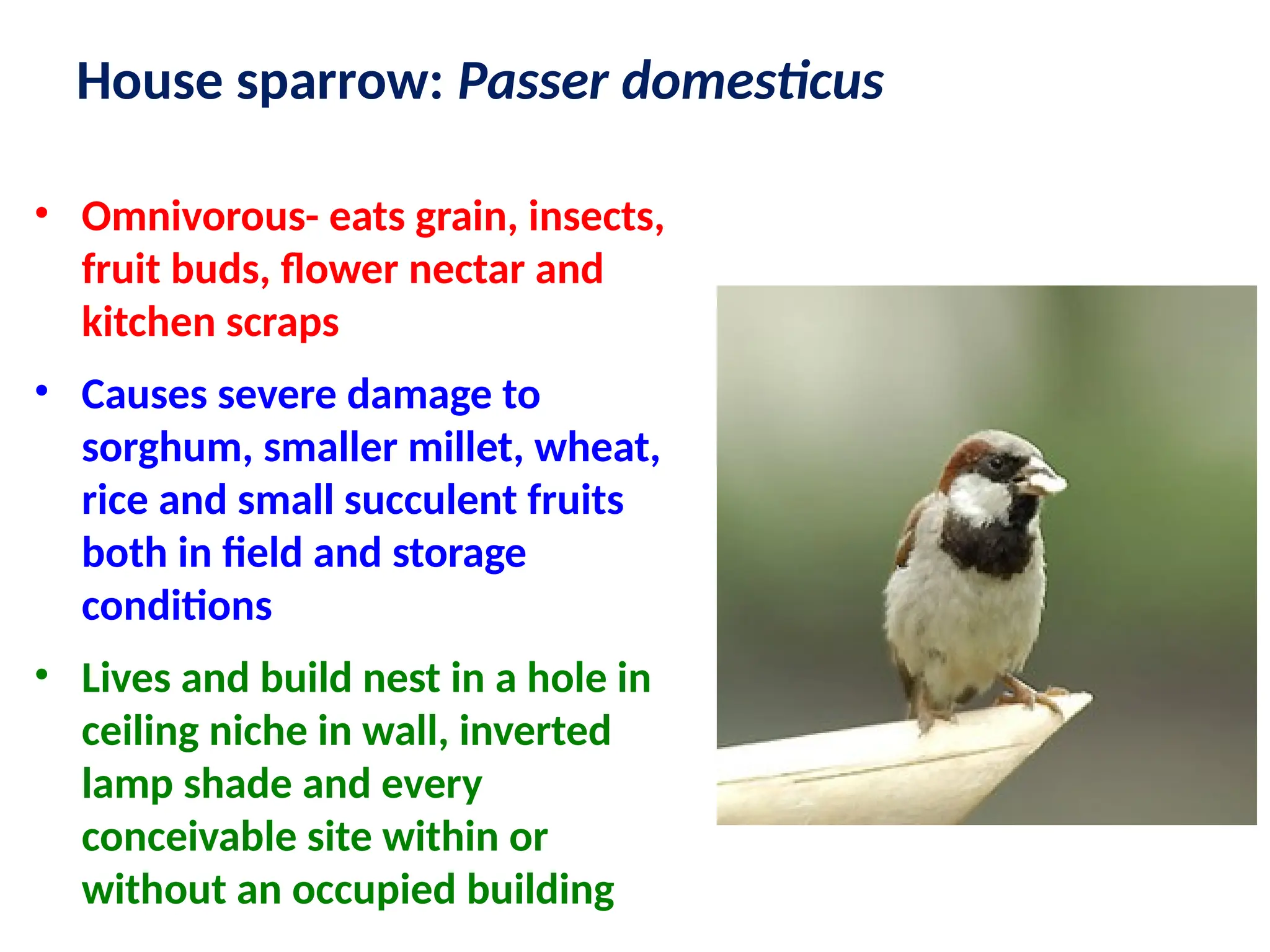
House sparrow: Passer domesticus
• Omnivorous- eats grain, insects,
fruit buds, flower nectar and
kitchen scraps
• Causes severe damage to
sorghum, smaller millet, wheat,
rice and small succulent fruits
both in field and storage
conditions
• Lives and build nest in a hole in
ceiling niche in wall, inverted
lamp shade and every
conceivable site within or
without an occupied building
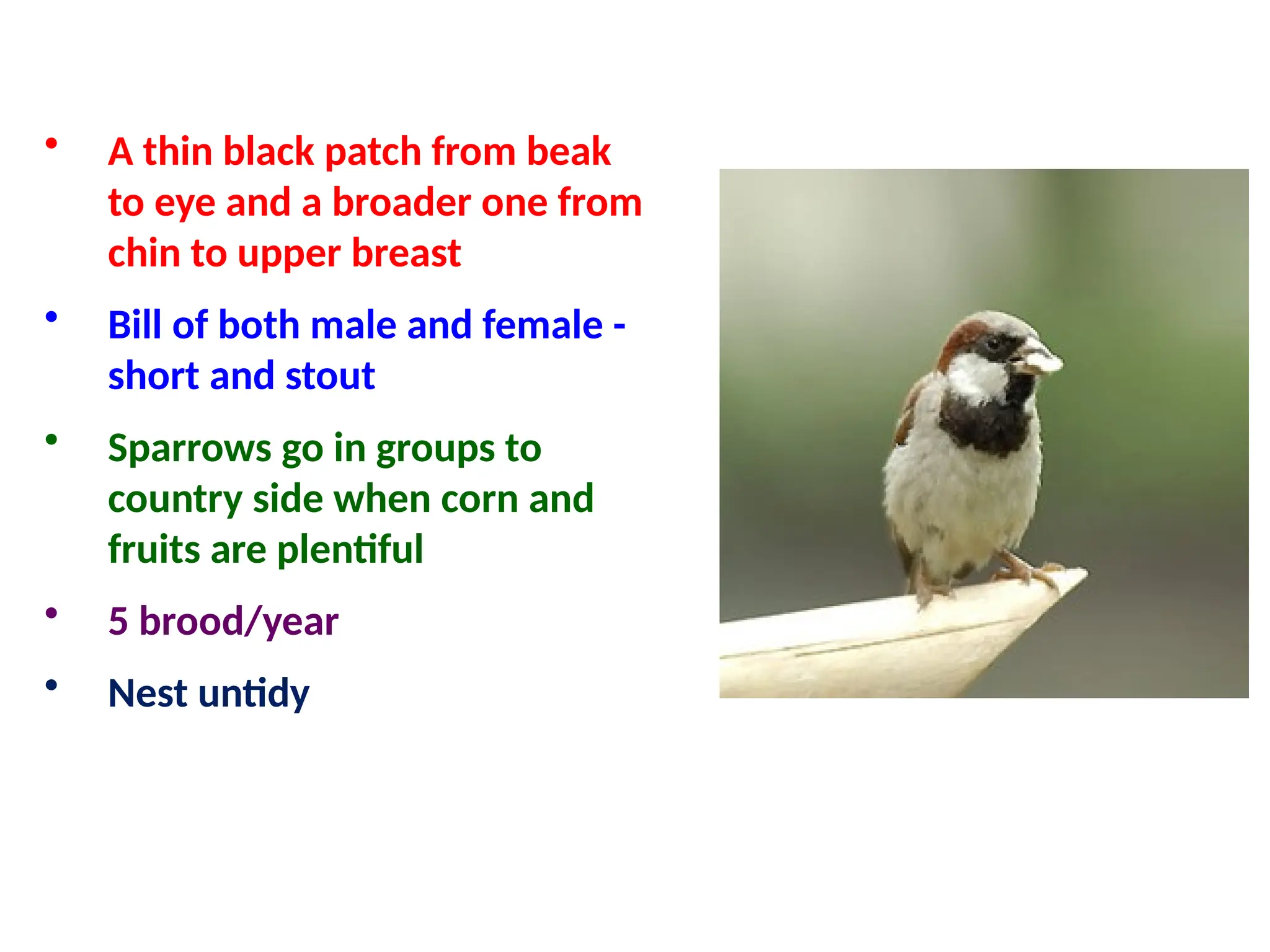
• A thin black patch from beak
to eye and a broader one from
chin to upper breast
• Bill of both male and female -
short and stout
• Sparrows go in groups to
country side when corn and
fruits are plentiful
• 5 brood/year
• Nest untidy
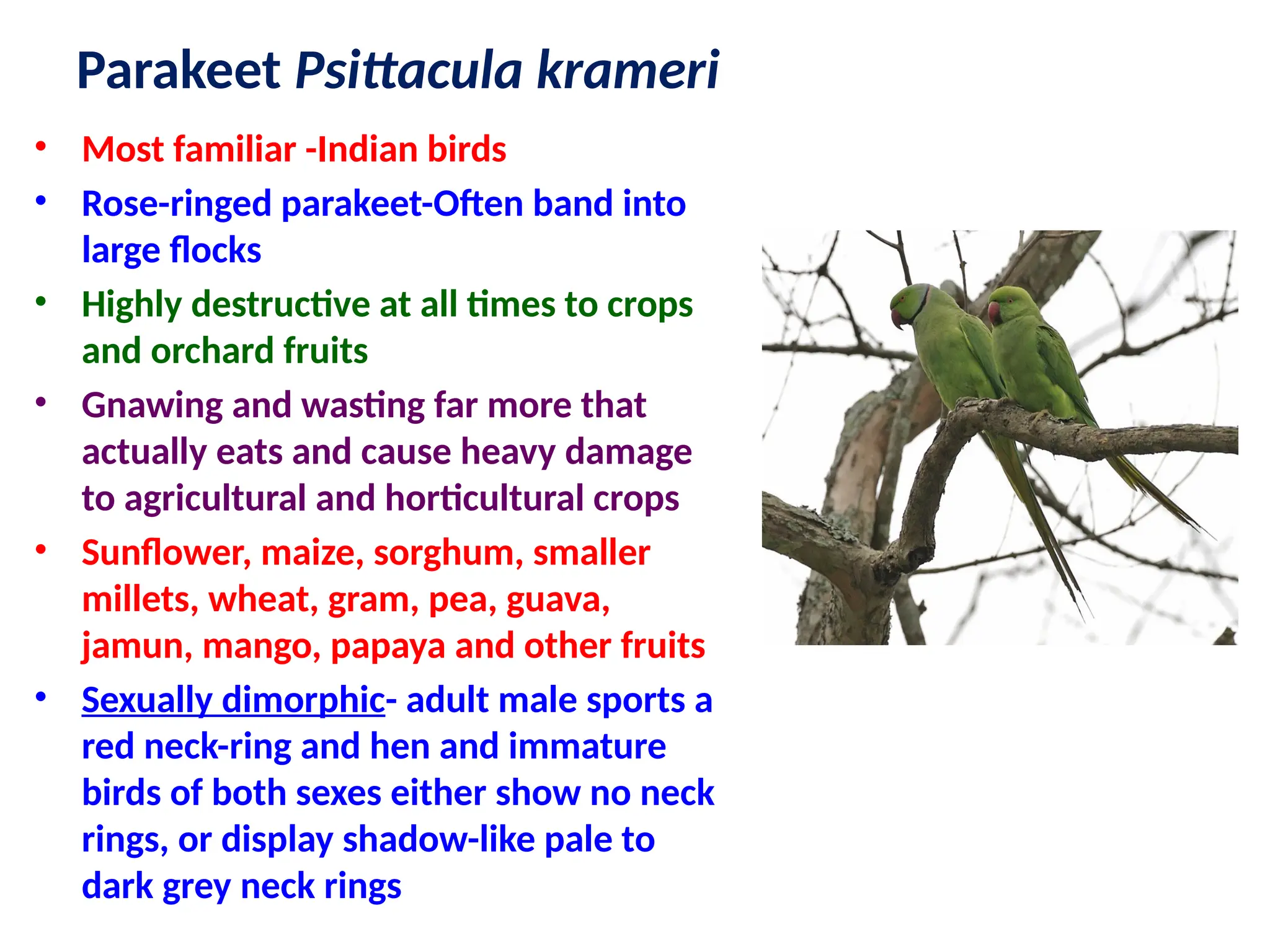
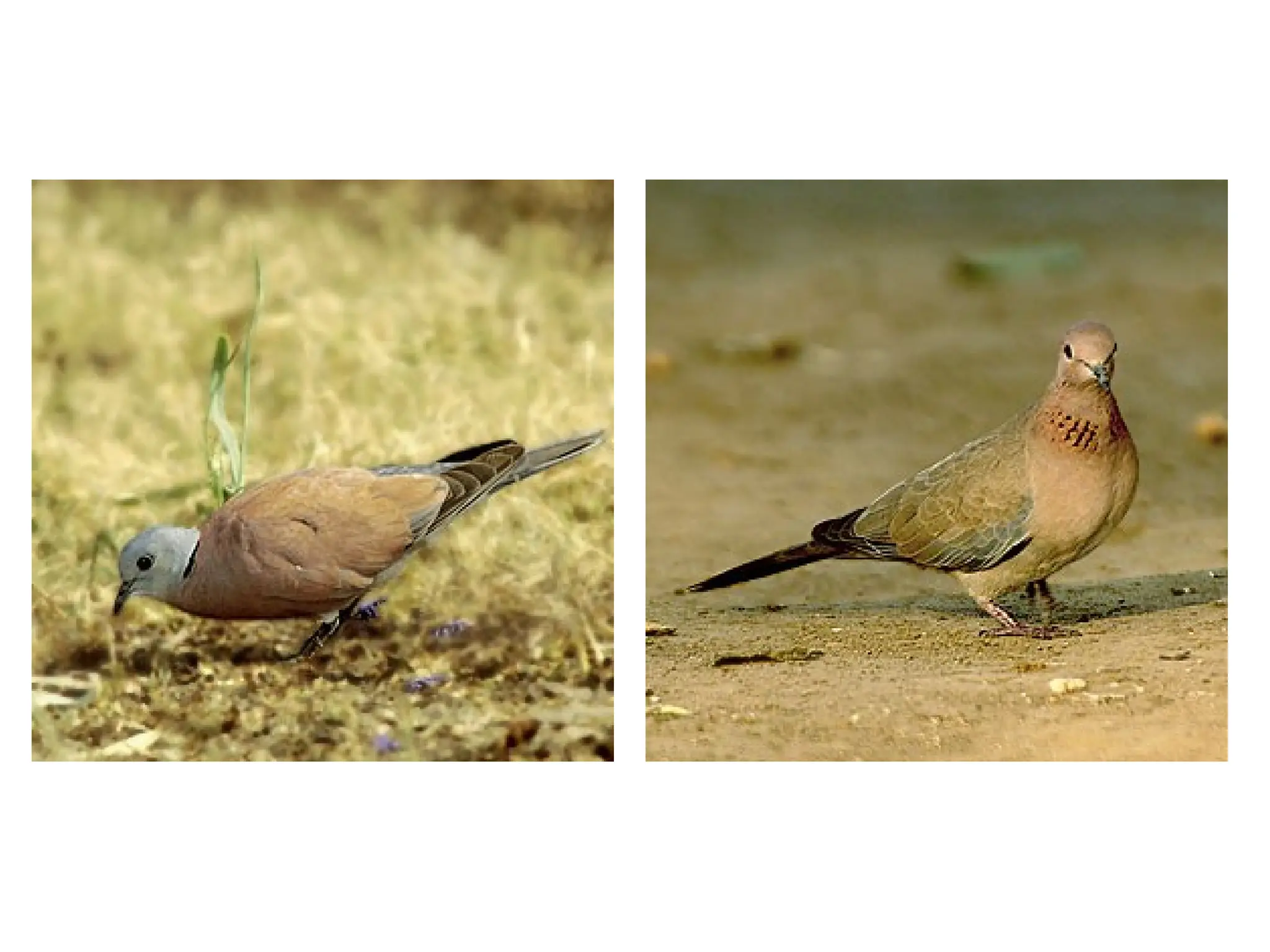
Parakeet Psittacula krameri
• Most familiar -Indian birds
• Rose-ringed parakeet-Often band into
large flocks
• Highly destructive at all times to crops
and orchard fruits
• Gnawing and wasting far more that
actually eats and cause heavy damage
to agricultural and horticultural crops
• Sunflower, maize, sorghum, smaller
millets, wheat, gram, pea, guava,
jamun, mango, papaya and other fruits
• Sexually dimorphic- adult male sports a
red neck-ring and hen and immature
birds of both sexes either show no neck
rings, or display shadow-like pale to
dark grey neck rings
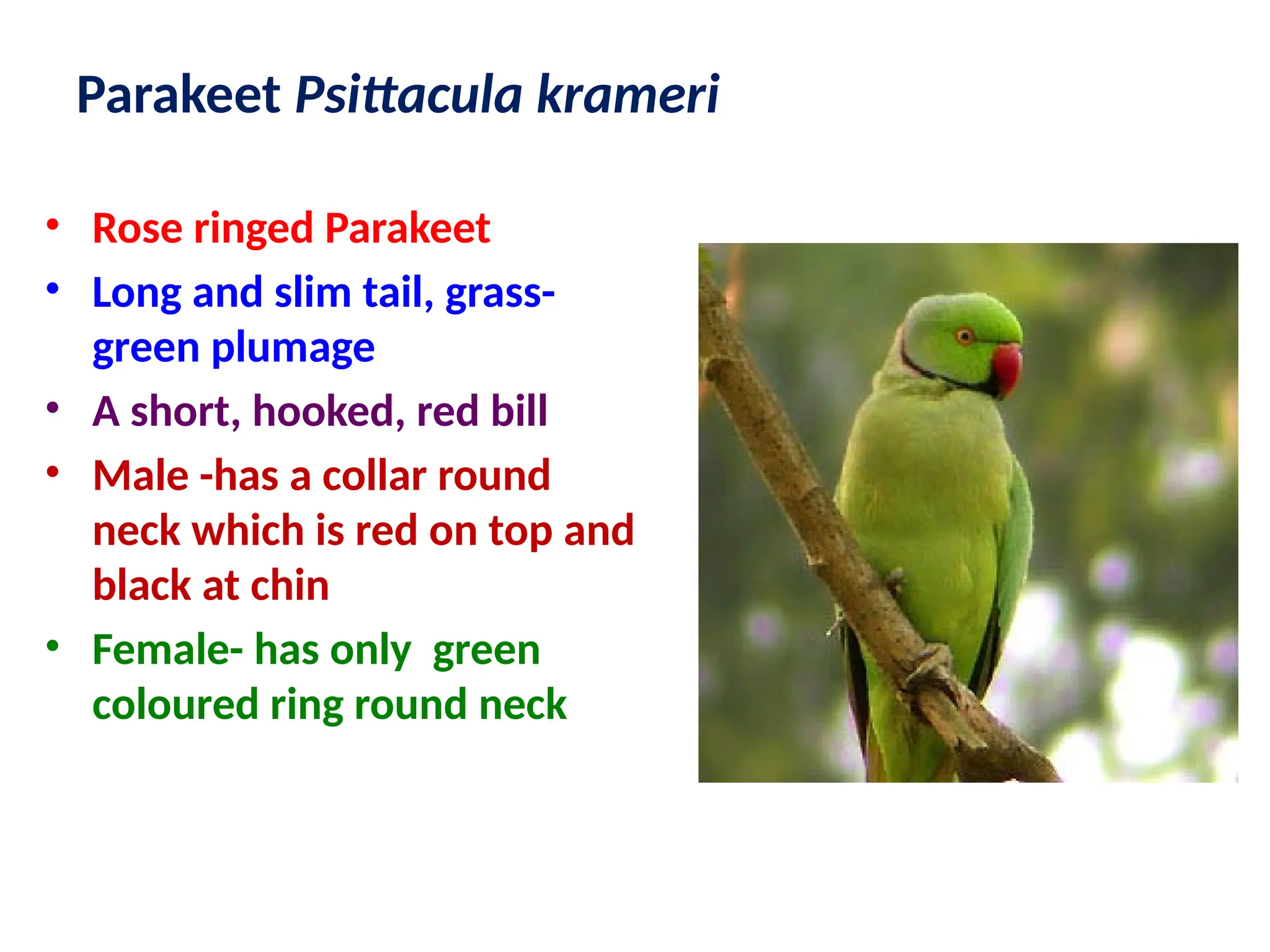
Parakeet Psittacula krameri
• Rose ringed Parakeet
• Long and slim tail, grass-
green plumage
• A short, hooked, red bill
• Male -has a collar round
neck which is red on top and
black at chin
• Female- has only green
coloured ring round neck
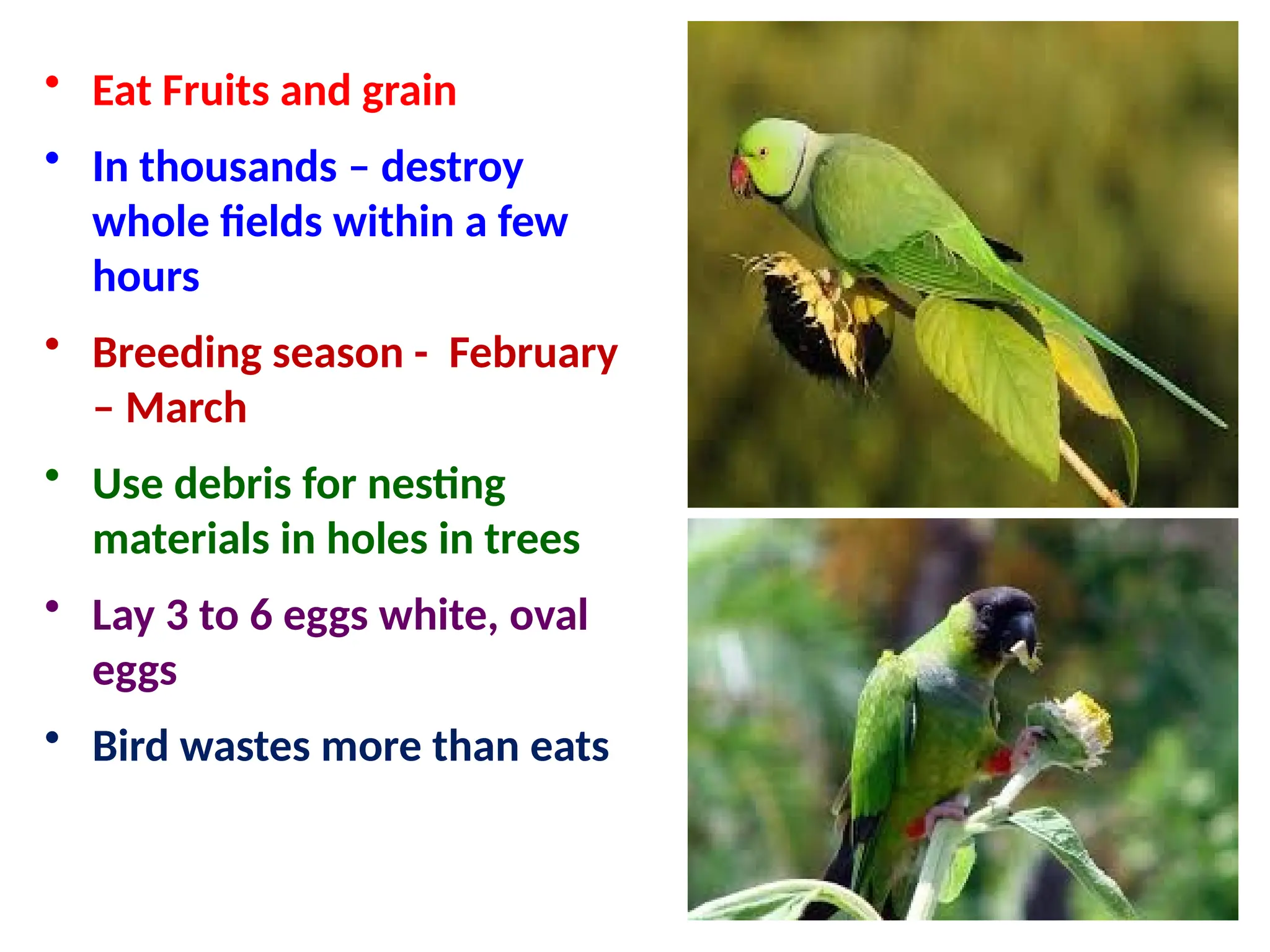
• Eat Fruits and grain
• In thousands – destroy
whole fields within a few
hours
• Breeding season - February
– March
• Use debris for nesting
materials in holes in trees
• Lay 3 to 6 eggs white, oval
eggs
• Bird wastes more than eats
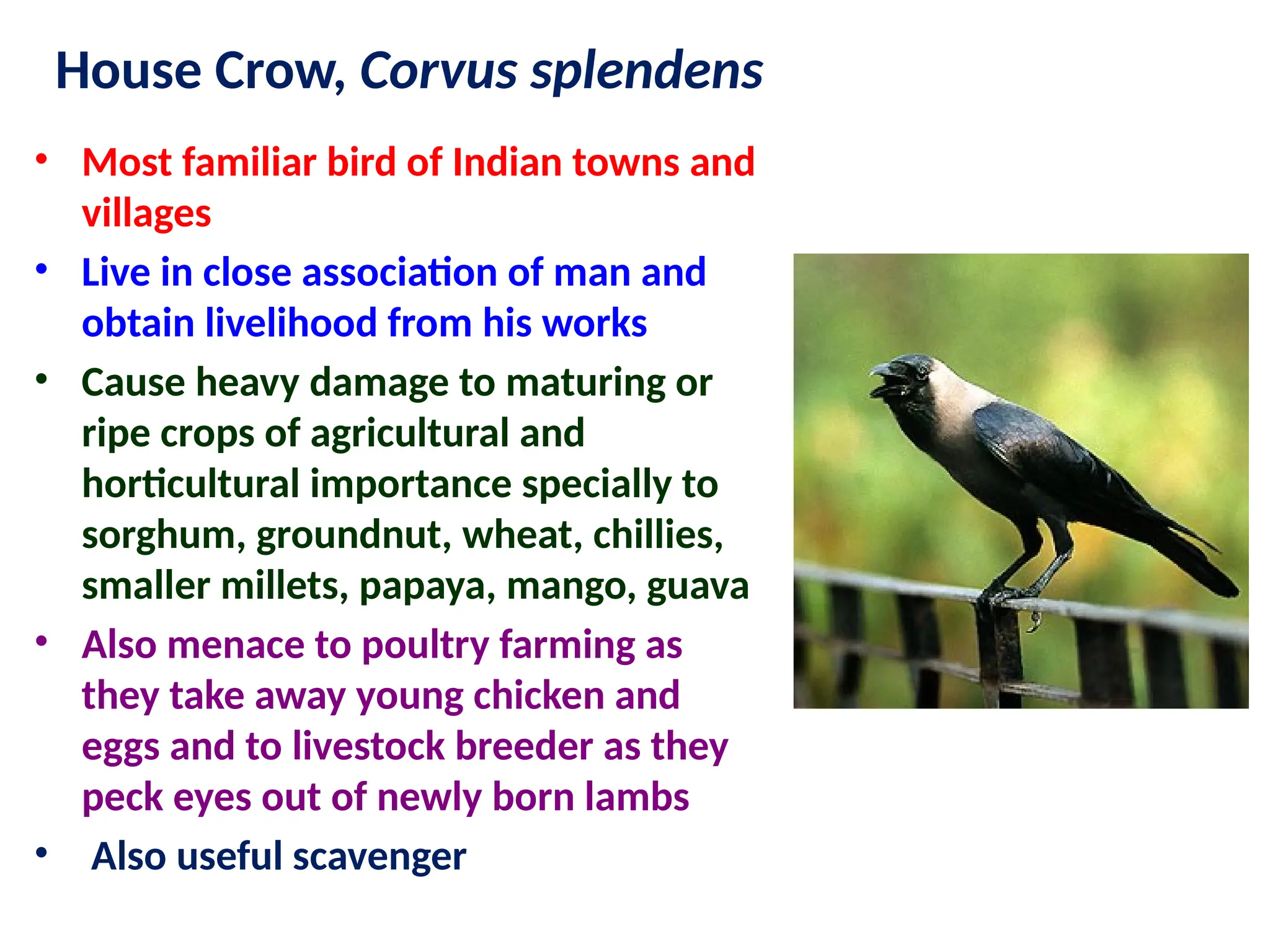
House Crow, Corvus splendens
• Most familiar bird of Indian towns and
villages
• Live in close association of man and
obtain livelihood from his works
• Cause heavy damage to maturing or
ripe crops of agricultural and
horticultural importance specially to
sorghum, groundnut, wheat, chillies,
smaller millets, papaya, mango, guava
• Also menace to poultry farming as
they take away young chicken and
eggs and to livestock breeder as they
peck eyes out of newly born lambs
• Also useful scavenger
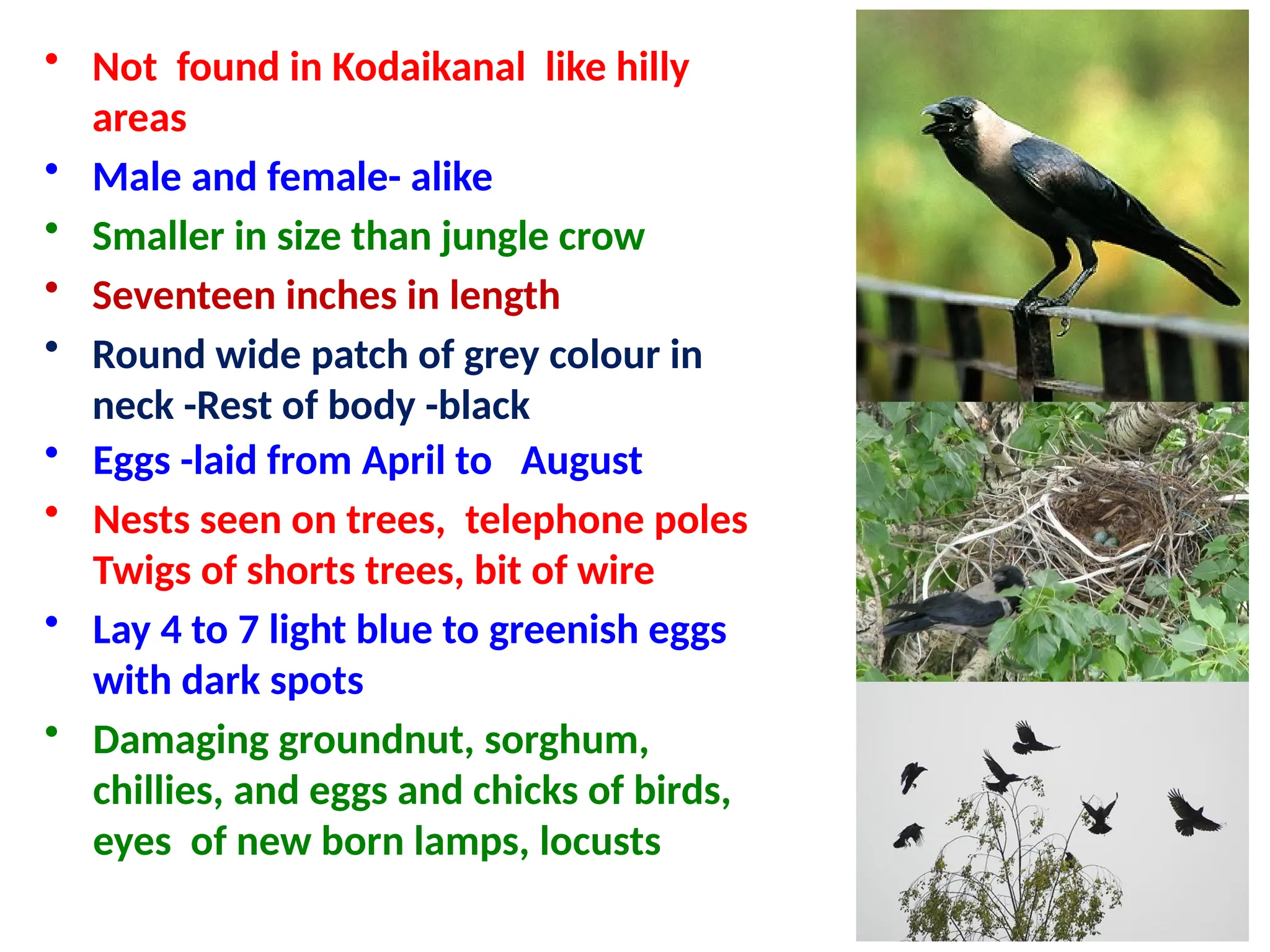
• Not found in Kodaikanal like hilly
areas
• Male and female- alike
• Smaller in size than jungle crow
• Seventeen inches in length
• Round wide patch of grey colour in
neck -Rest of body -black
• Eggs -laid from April to August
• Nests seen on trees, telephone poles
Twigs of shorts trees, bit of wire
• Lay 4 to 7 light blue to greenish eggs
with dark spots
• Damaging groundnut, sorghum,
chillies, and eggs and chicks of birds,
eyes of new born lamps, locusts
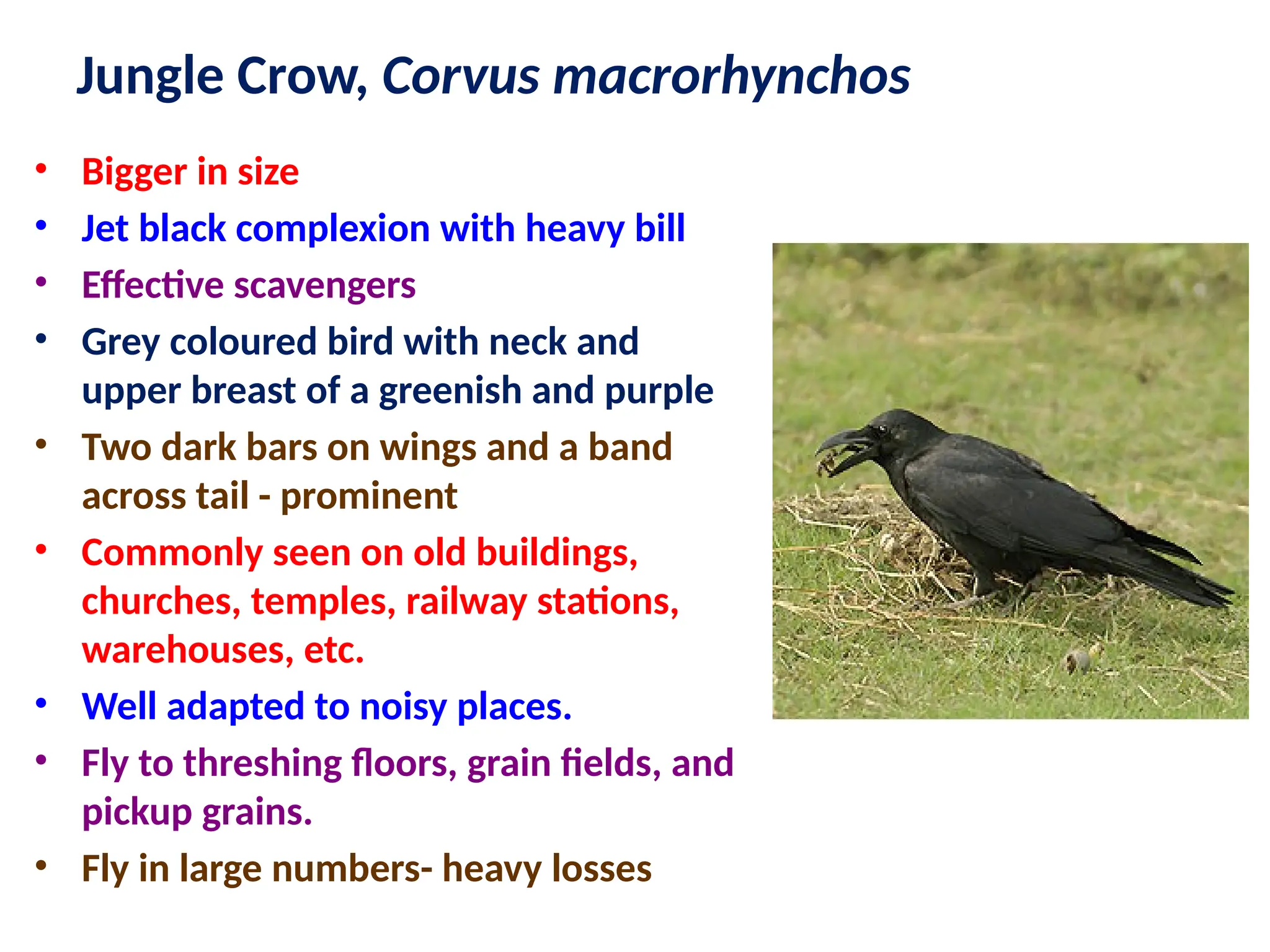
Jungle Crow, Corvus macrorhynchos
• Bigger in size
• Jet black complexion with heavy bill
• Effective scavengers
• Grey coloured bird with neck and
upper breast of a greenish and purple
• Two dark bars on wings and a band
across tail - prominent
• Commonly seen on old buildings,
churches, temples, railway stations,
warehouses, etc.
• Well adapted to noisy places.
• Fly to threshing floors, grain fields, and
pickup grains.
• Fly in large numbers- heavy losses
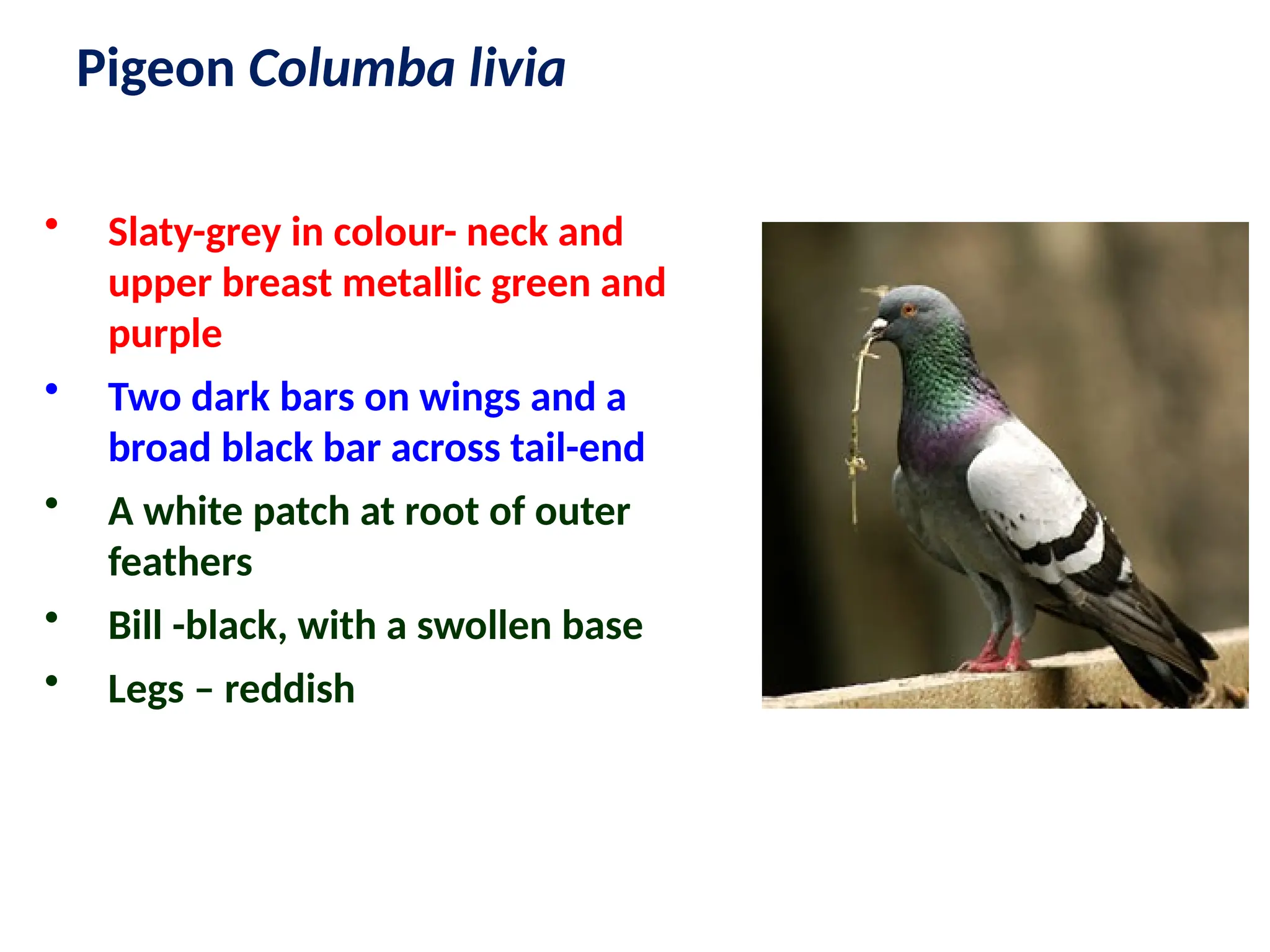
Pigeon Columba livia
• Slaty-grey in colour- neck and
upper breast metallic green and
purple
• Two dark bars on wings and a
broad black bar across tail-end
• A white patch at root of outer
feathers
• Bill -black, with a swollen base
• Legs – reddish
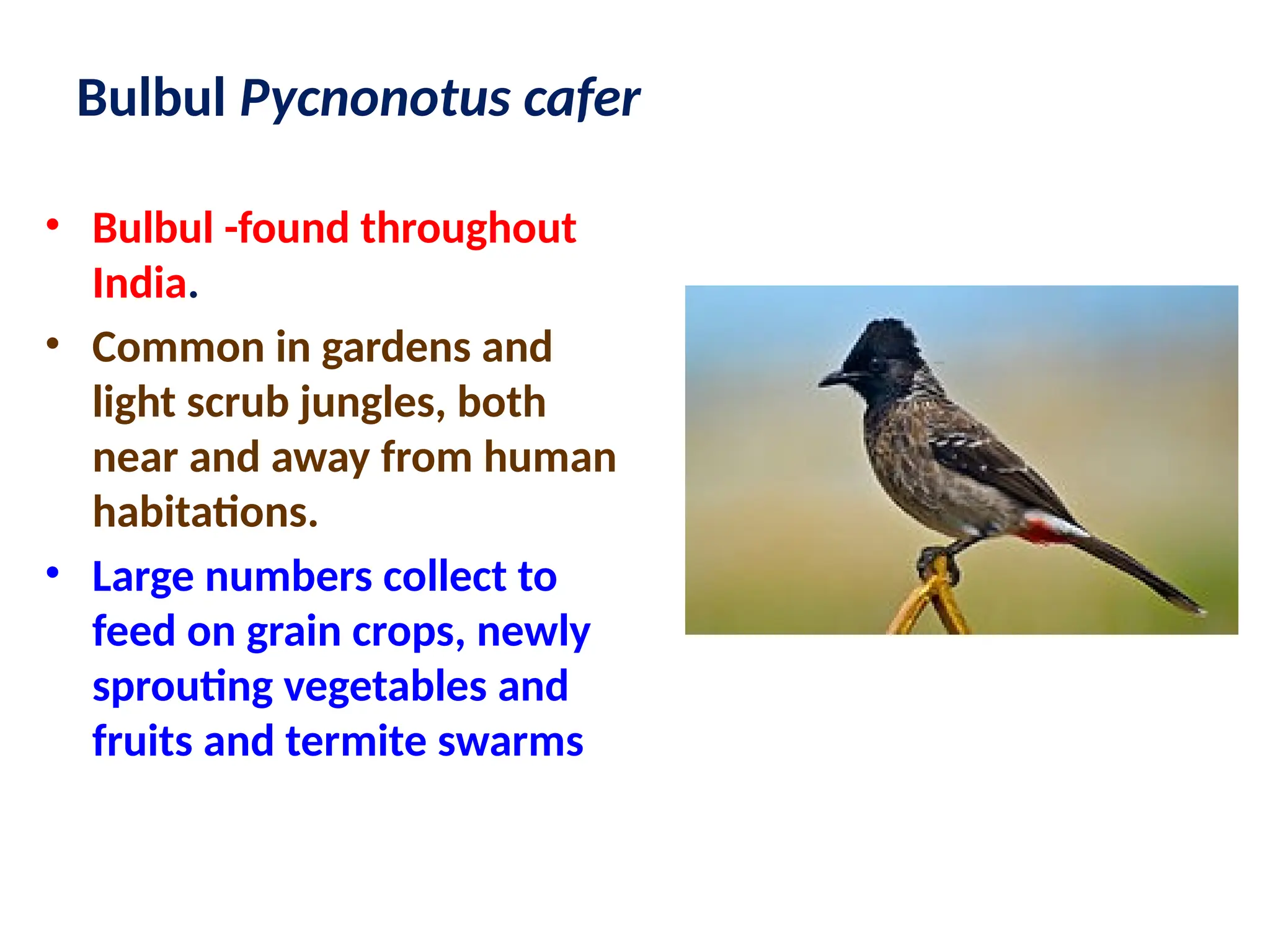
Bulbul Pycnonotus cafer
• Bulbul -found throughout
India.
• Common in gardens and
light scrub jungles, both
near and away from human
habitations.
• Large numbers collect to
feed on grain crops, newly
sprouting vegetables and
fruits and termite swarms
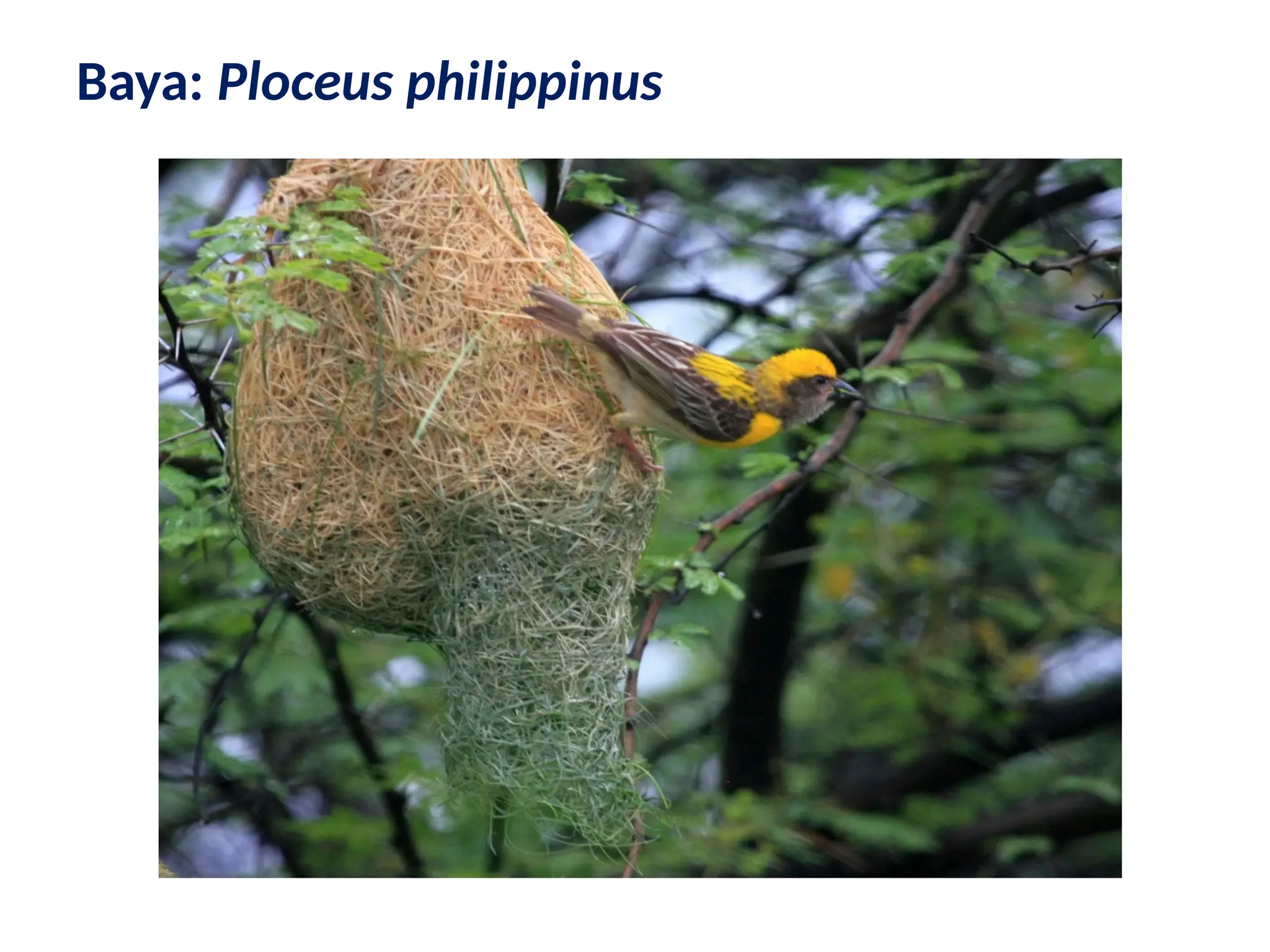
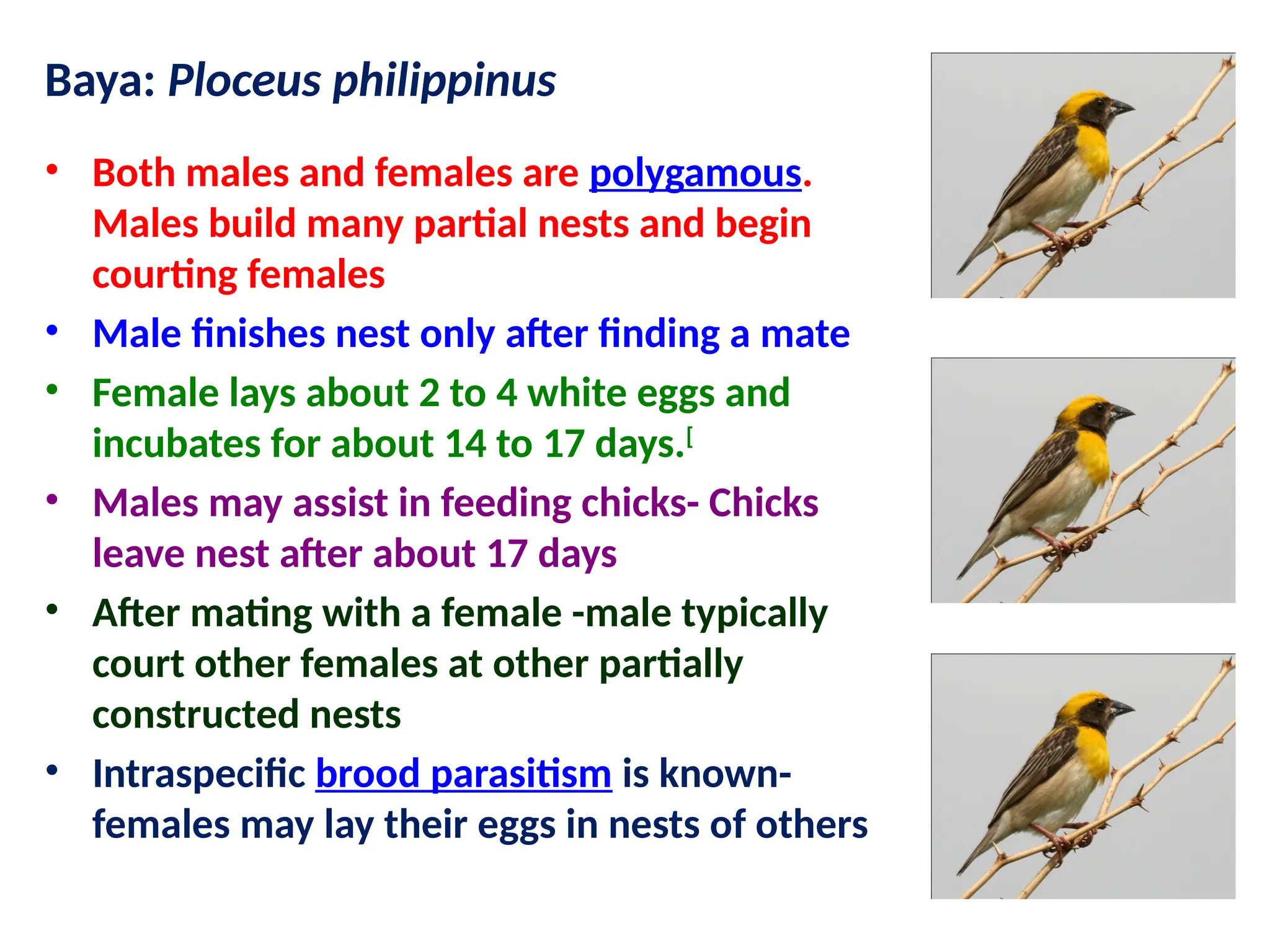
Baya: Ploceus philippinus
• Both males and females are polygamous.
Males build many partial nests and begin
courting females
• Male finishes nest only after finding a mate
• Female lays about 2 to 4 white eggs and
incubates for about 14 to 17 days.[
• Males may assist in feeding chicks- Chicks
leave nest after about 17 days
• After mating with a female -male typically
court other females at other partially
constructed nests
• Intraspecific brood parasitism is known-
females may lay their eggs in nests of others
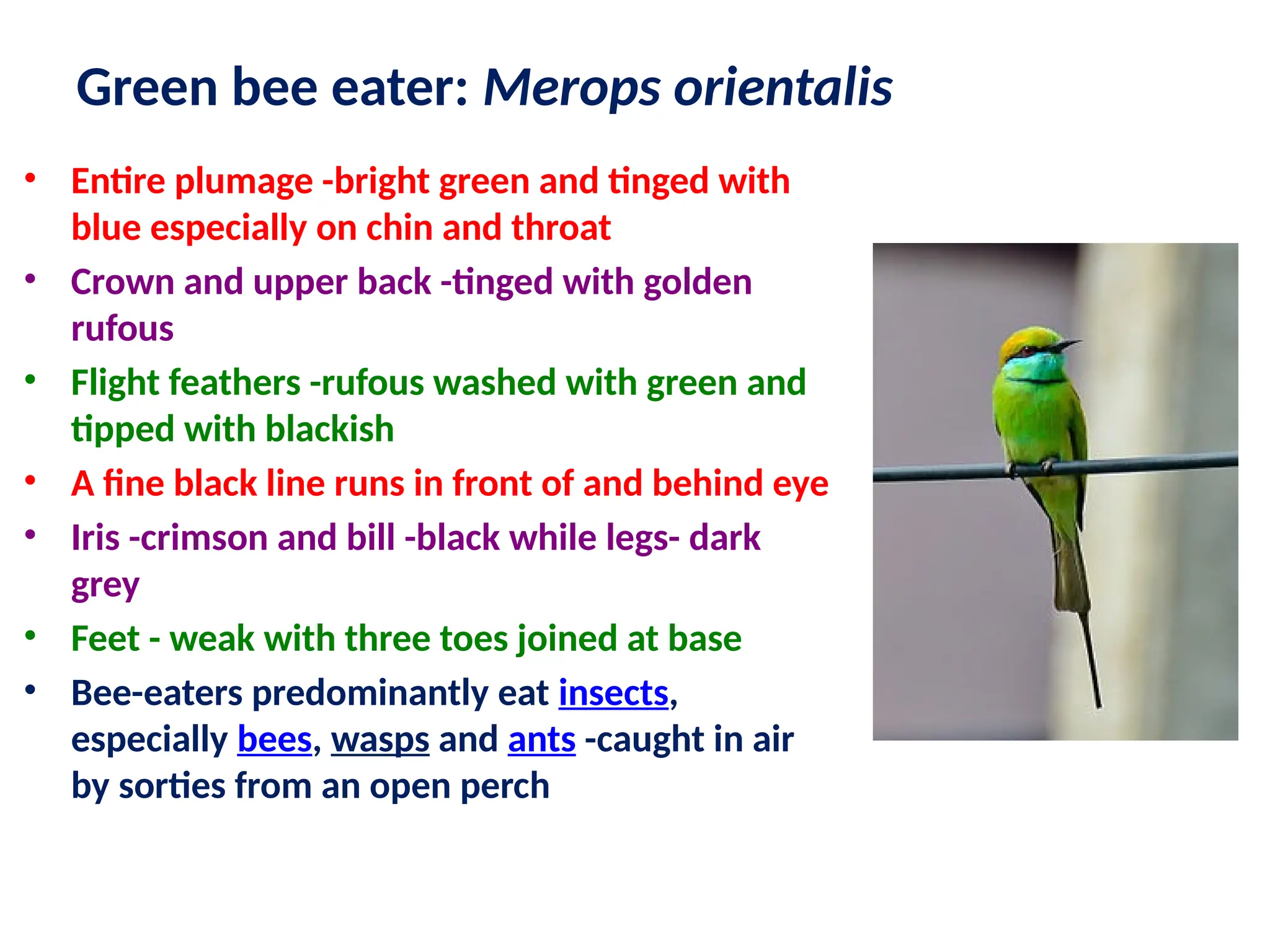
Green bee eater: Merops orientalis
• Entire plumage -bright green and tinged with
blue especially on chin and throat
• Crown and upper back -tinged with golden
rufous
• Flight feathers -rufous washed with green and
tipped with blackish
• A fine black line runs in front of and behind eye
• Iris -crimson and bill -black while legs- dark
grey
• Feet - weak with three toes joined at base
• Bee-eaters predominantly eat insects,
especially bees, wasps and ants -caught in air
by sorties from an open perch
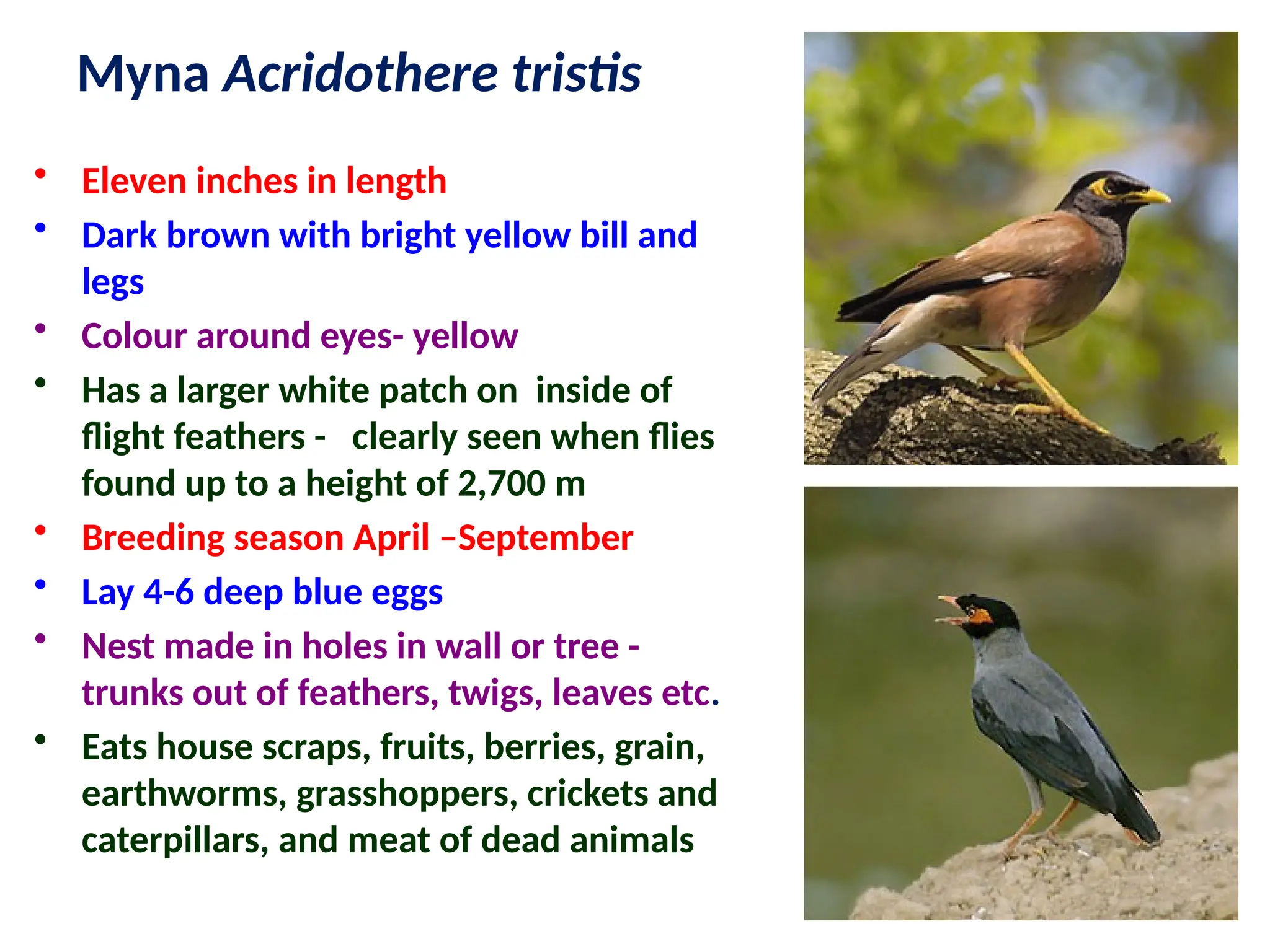
Myna Acridothere tristis
• Eleven inches in length
• Dark brown with bright yellow bill and
legs
• Colour around eyes- yellow
• Has a larger white patch on inside of
flight feathers - clearly seen when flies
found up to a height of 2,700 m
• Breeding season April –September
• Lay 4-6 deep blue eggs
• Nest made in holes in wall or tree -
trunks out of feathers, twigs, leaves etc.
• Eats house scraps, fruits, berries, grain,
earthworms, grasshoppers, crickets and
caterpillars, and meat of dead animals
• 5 - 6 broods/ year; peak
in January to May
• Nest on natural rock
cliffs
• Lays 2 elongate white
oval egg
• It feeds on grains
• Transmits - Ornithosis,
Salmonella food poising
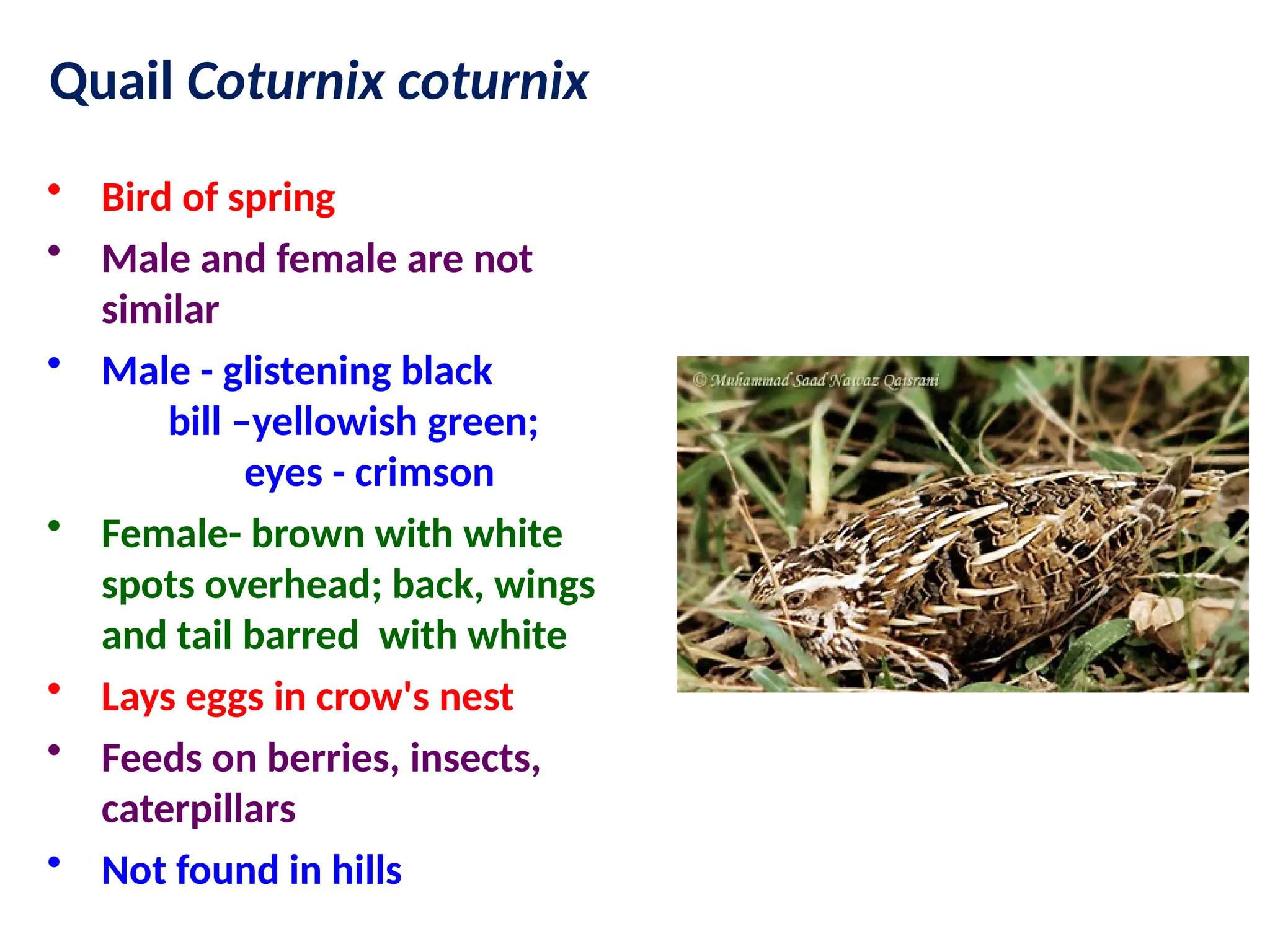
• Bird of spring
• Male and female are not
similar
• Male - glistening black
bill –yellowish green;
eyes - crimson
• Female- brown with white
spots overhead; back, wings
and tail barred with white
• Lays eggs in crow's nest
• Feeds on berries, insects,
caterpillars
• Not found in hills
Quail Coturnix coturnix
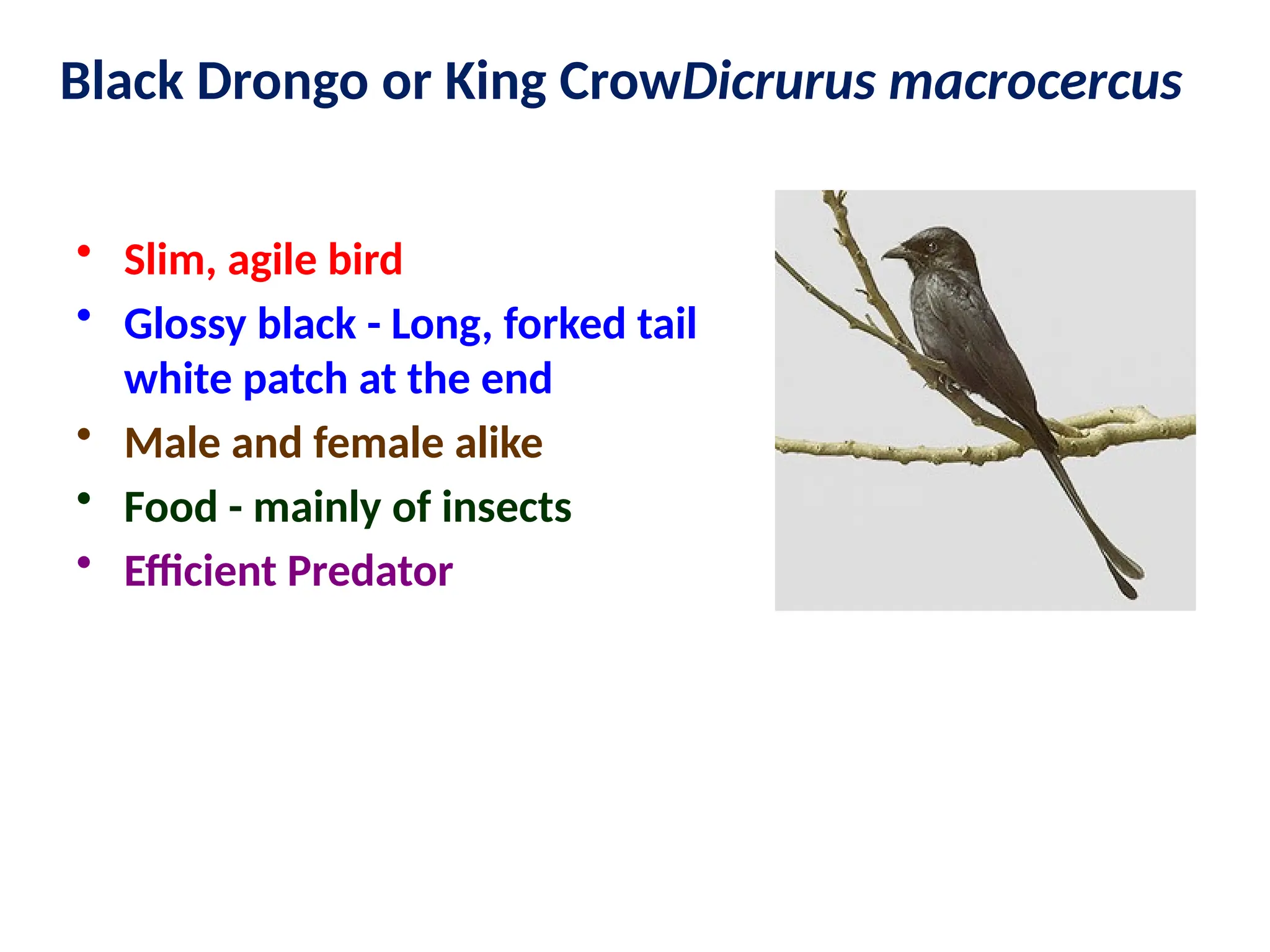
Black Drongo or King CrowDicrurus macrocercus
• Slim, agile bird
• Glossy black - Long, forked tail
white patch at the end
• Male and female alike
• Food - mainly of insects
• Efficient Predator
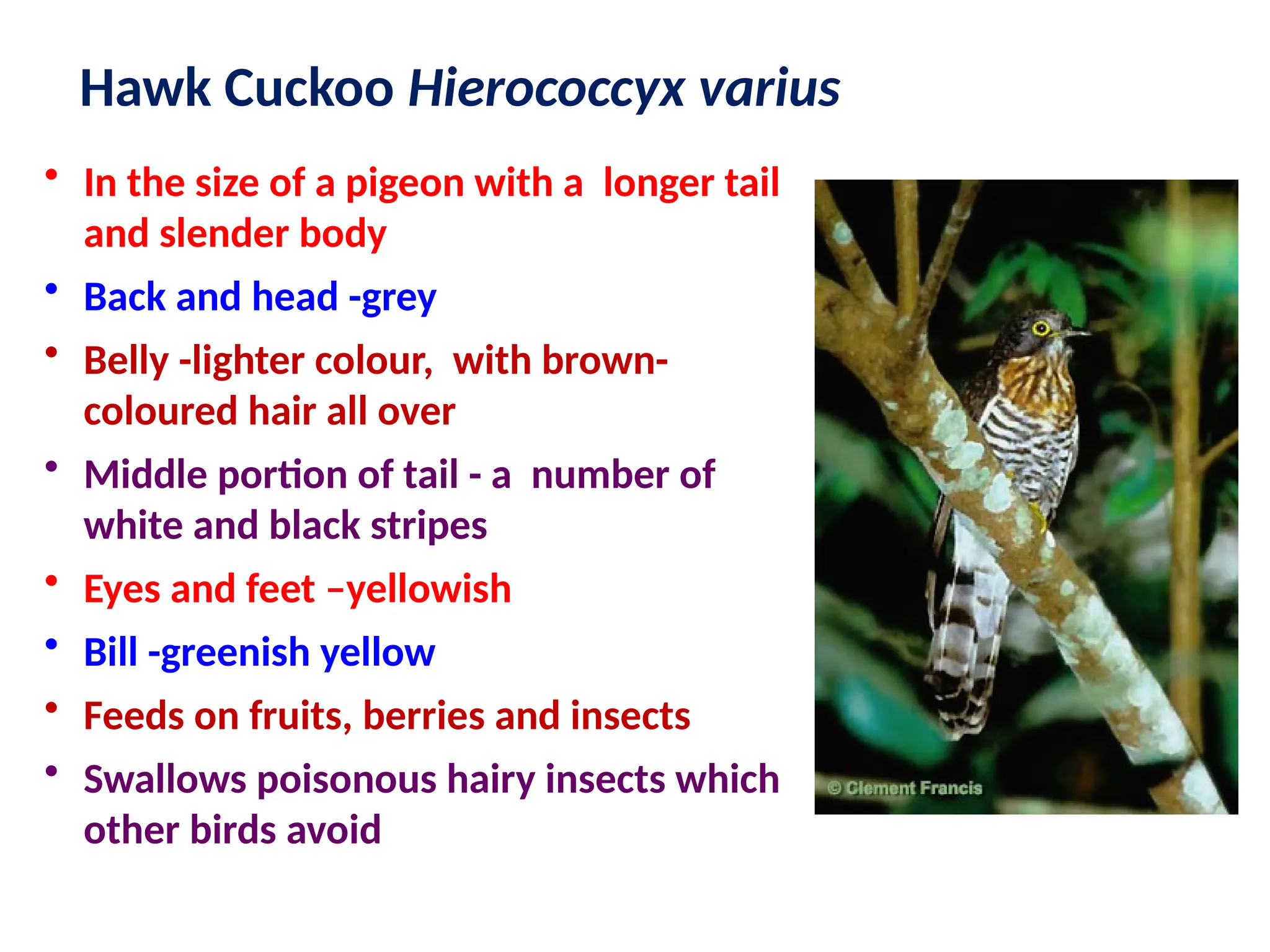
• In the size of a pigeon with a longer tail
and slender body
• Back and head -grey
• Belly -lighter colour, with brown-
coloured hair all over
• Middle portion of tail - a number of
white and black stripes
• Eyes and feet –yellowish
• Bill -greenish yellow
• Feeds on fruits, berries and insects
• Swallows poisonous hairy insects which
other birds avoid
Hawk Cuckoo Hierococcyx varius
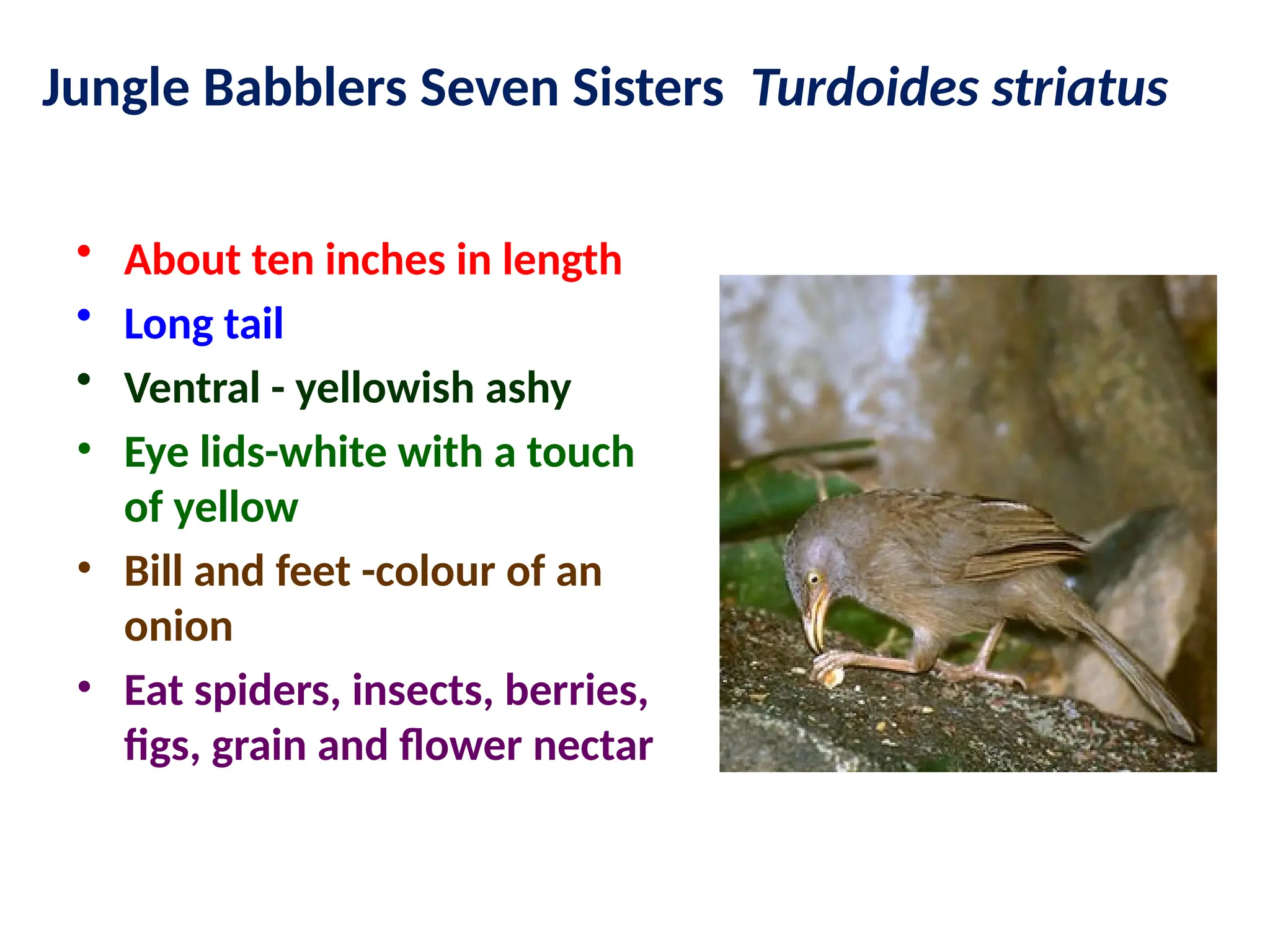
Jungle Babblers Seven Sisters Turdoides striatus
• About ten inches in length
• Long tail
• Ventral - yellowish ashy
• Eye lids-white with a touch
of yellow
• Bill and feet -colour of an
onion
• Eat spiders, insects, berries,
figs, grain and flower nectar
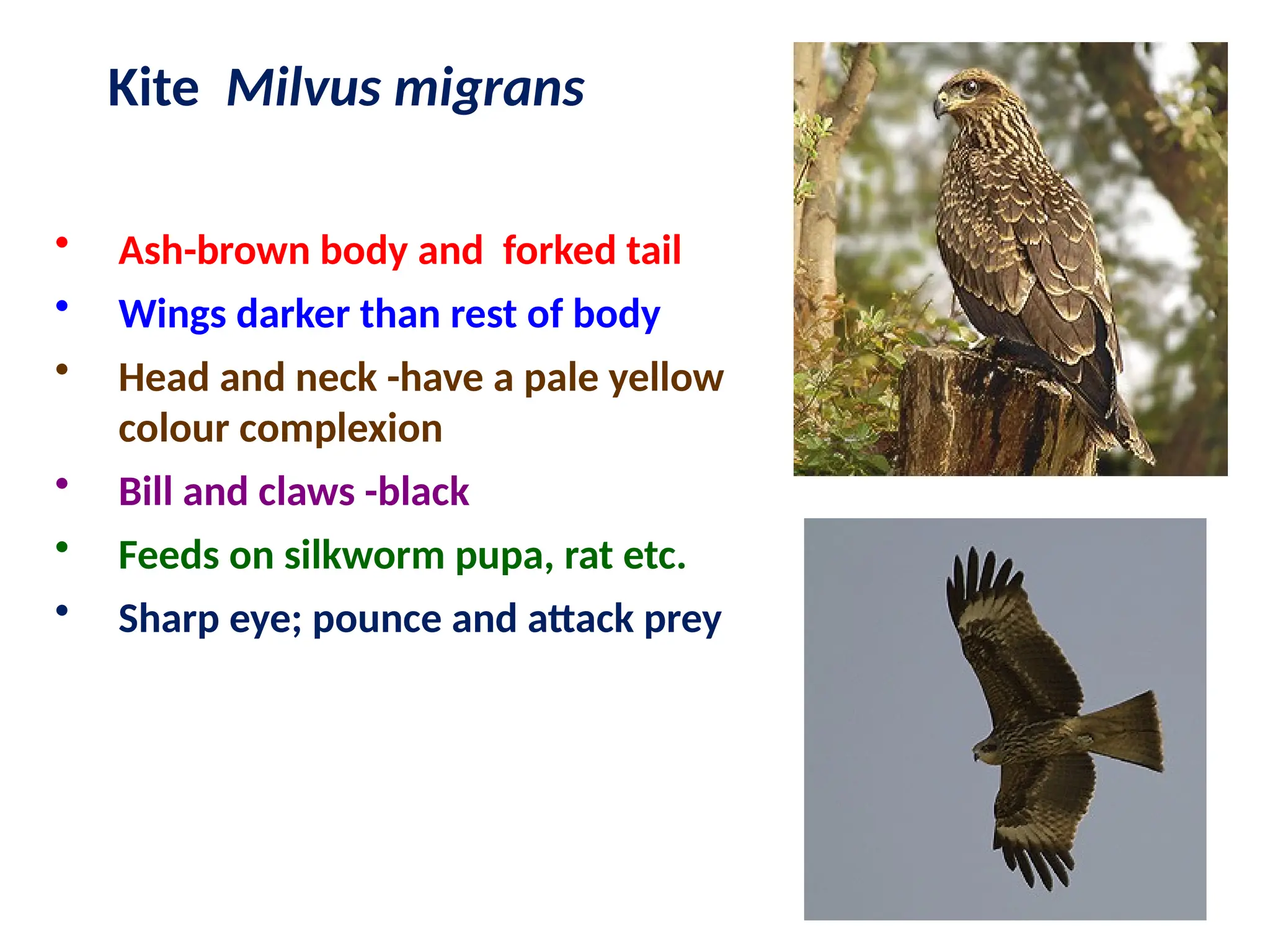
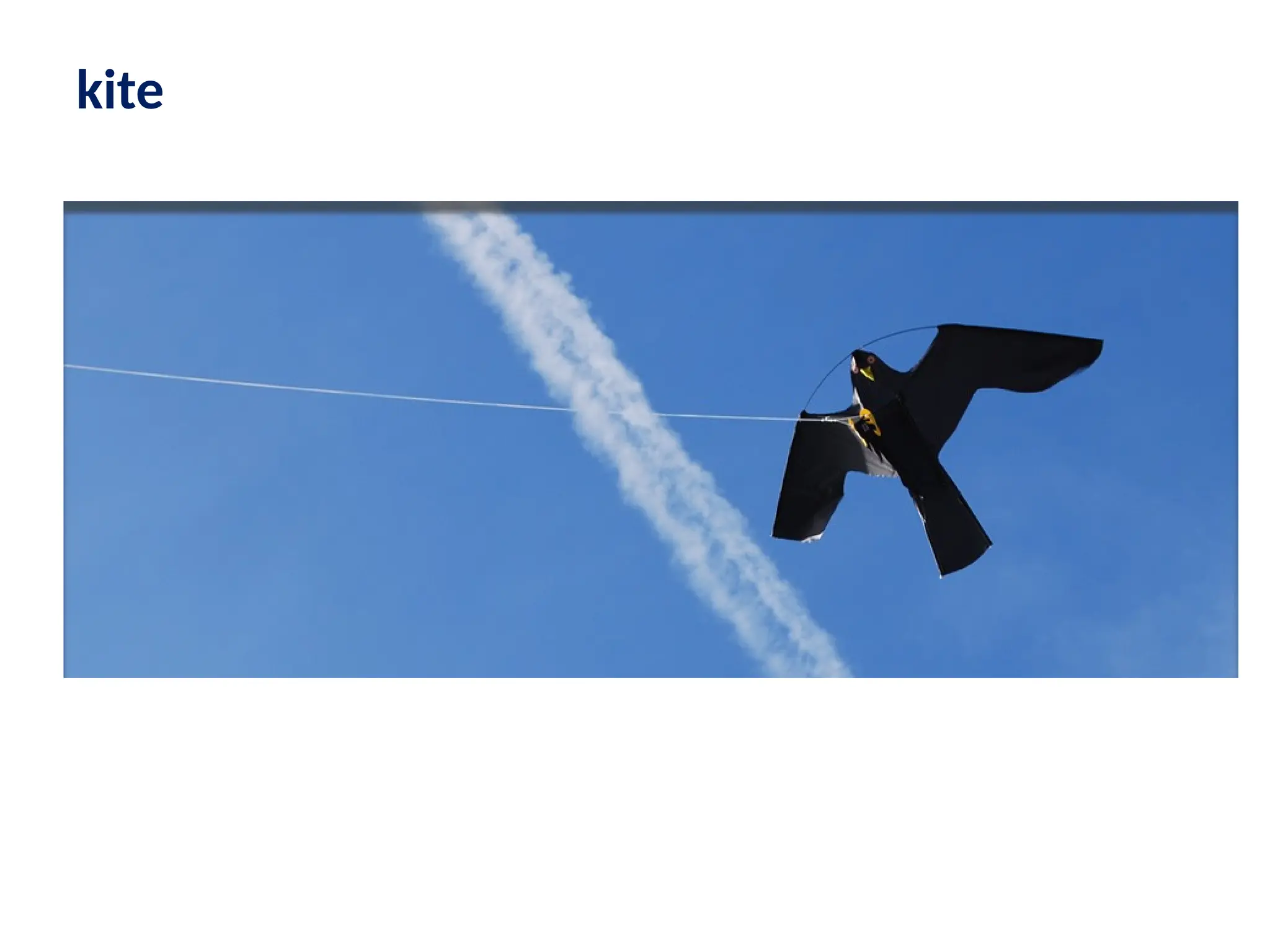
Kite Milvus migrans
• Ash-brown body and forked tail
• Wings darker than rest of body
• Head and neck -have a pale yellow
colour complexion
• Bill and claws -black
• Feeds on silkworm pupa, rat etc.
• Sharp eye; pounce and attack prey
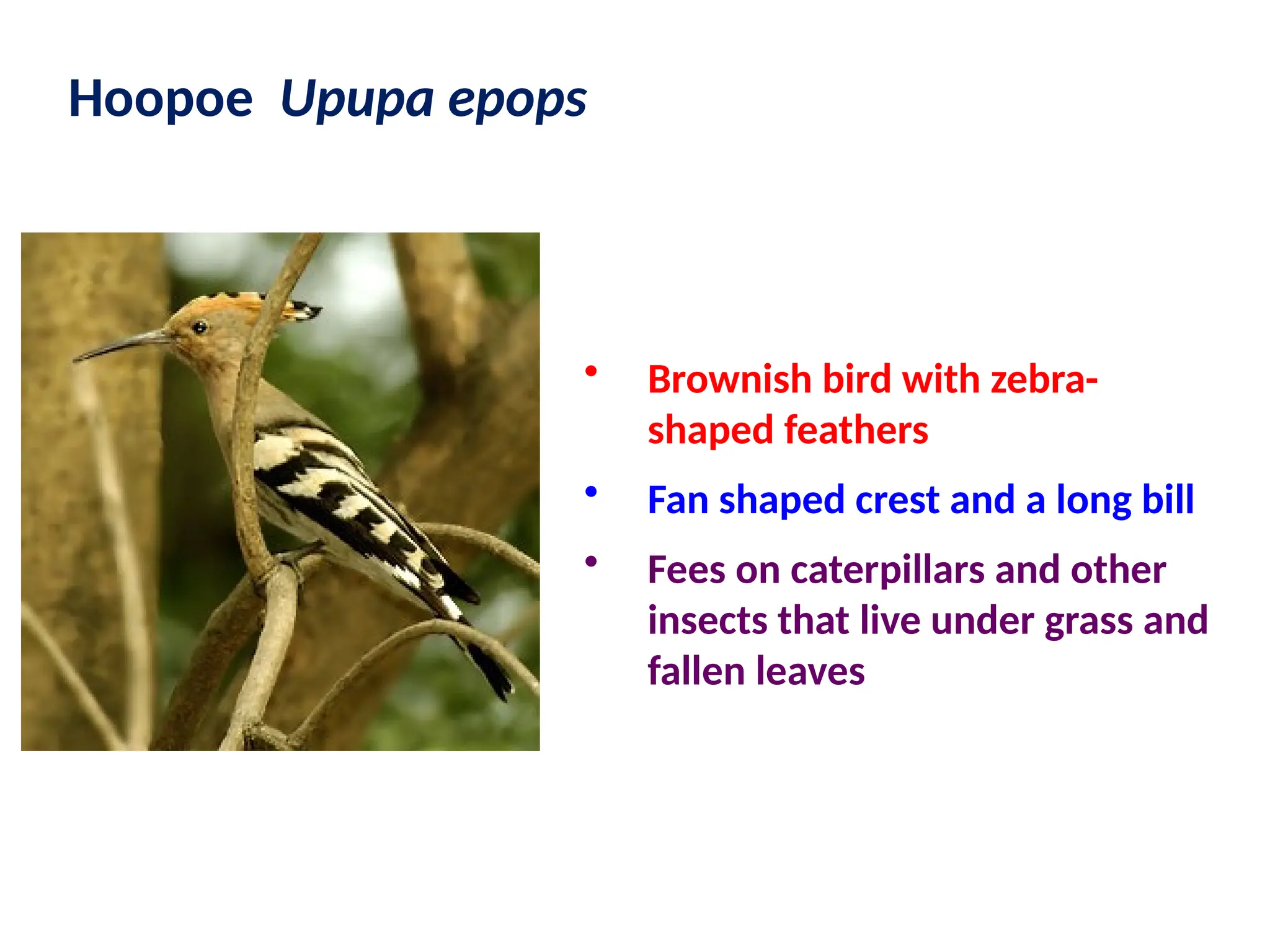
Hoopoe Upupa epops
• Brownish bird with zebra-
shaped feathers
• Fan shaped crest and a long bill
• Fees on caterpillars and other
insects that live under grass and
fallen leaves
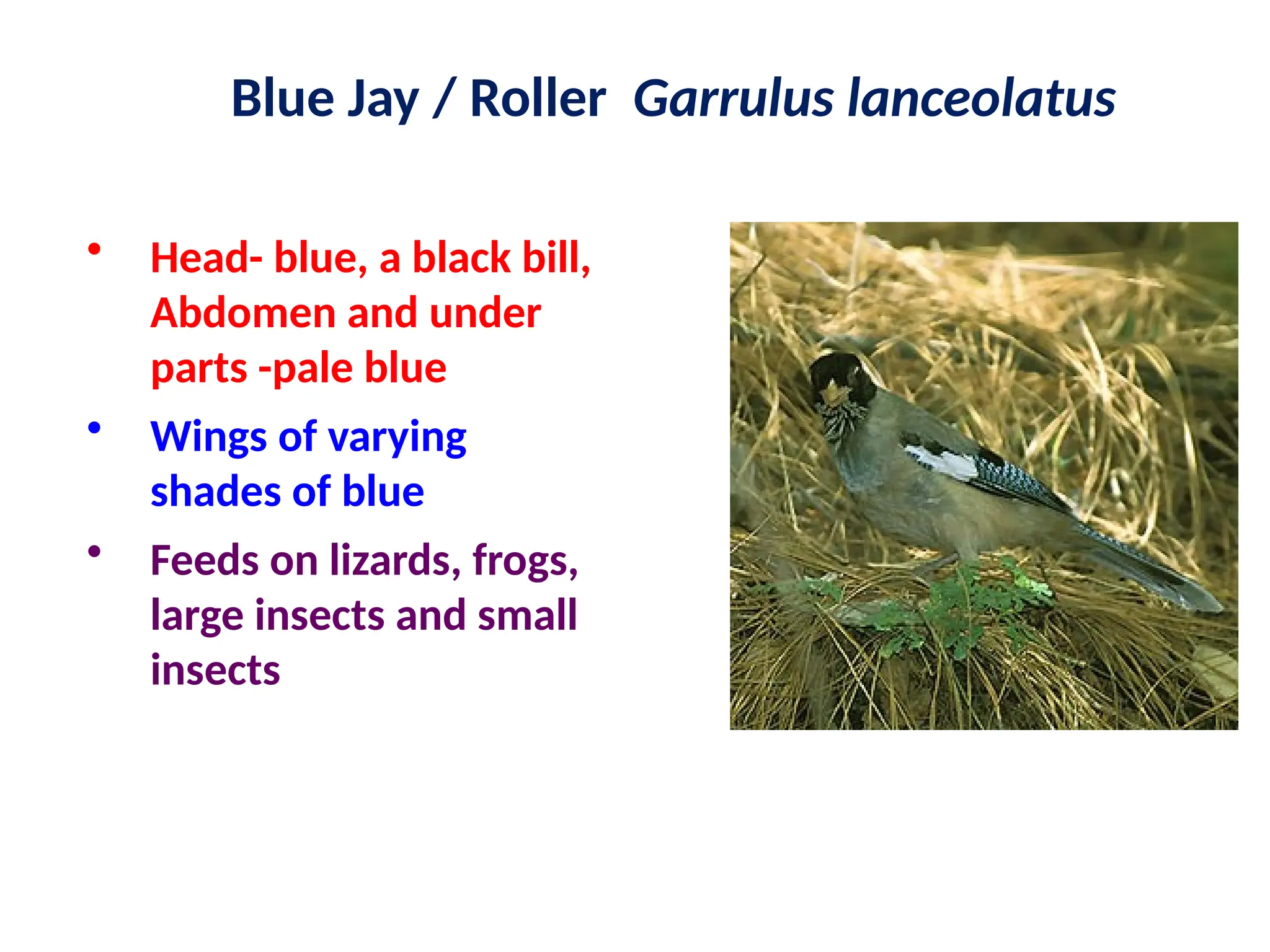
Blue Jay / Roller Garrulus lanceolatus
• Head- blue, a black bill,
Abdomen and under
parts -pale blue
• Wings of varying
shades of blue
• Feeds on lizards, frogs,
large insects and small
insects
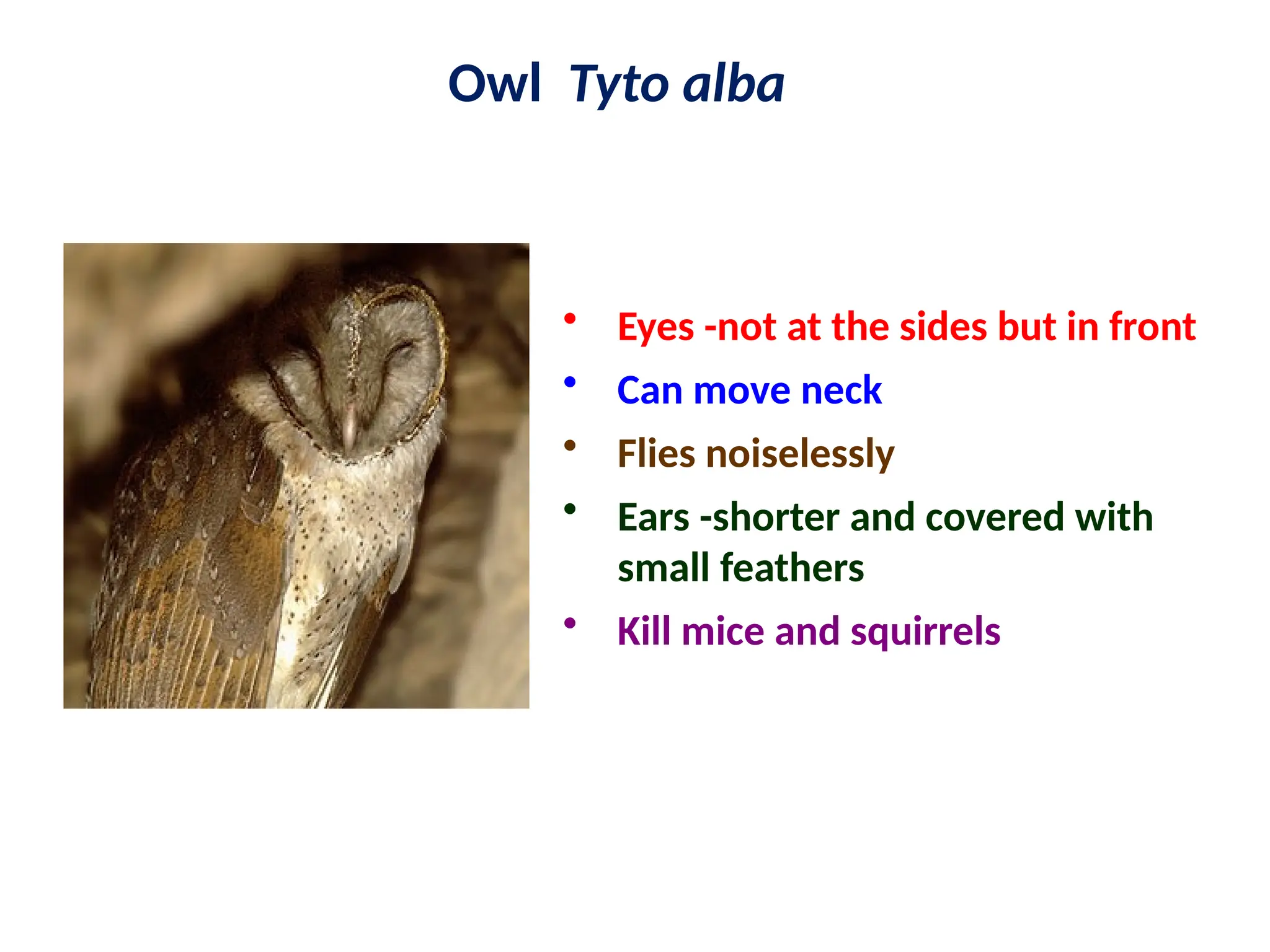
Owl Tyto alba
• Eyes -not at the sides but in front
• Can move neck
• Flies noiselessly
• Ears -shorter and covered with
small feathers
• Kill mice and squirrels
• Cultural methods
– Deep sowing of seeds and covering seeds with soil
– Growing trap crops near main crop
– Use of plant varieties physically and gustatory
unattractive
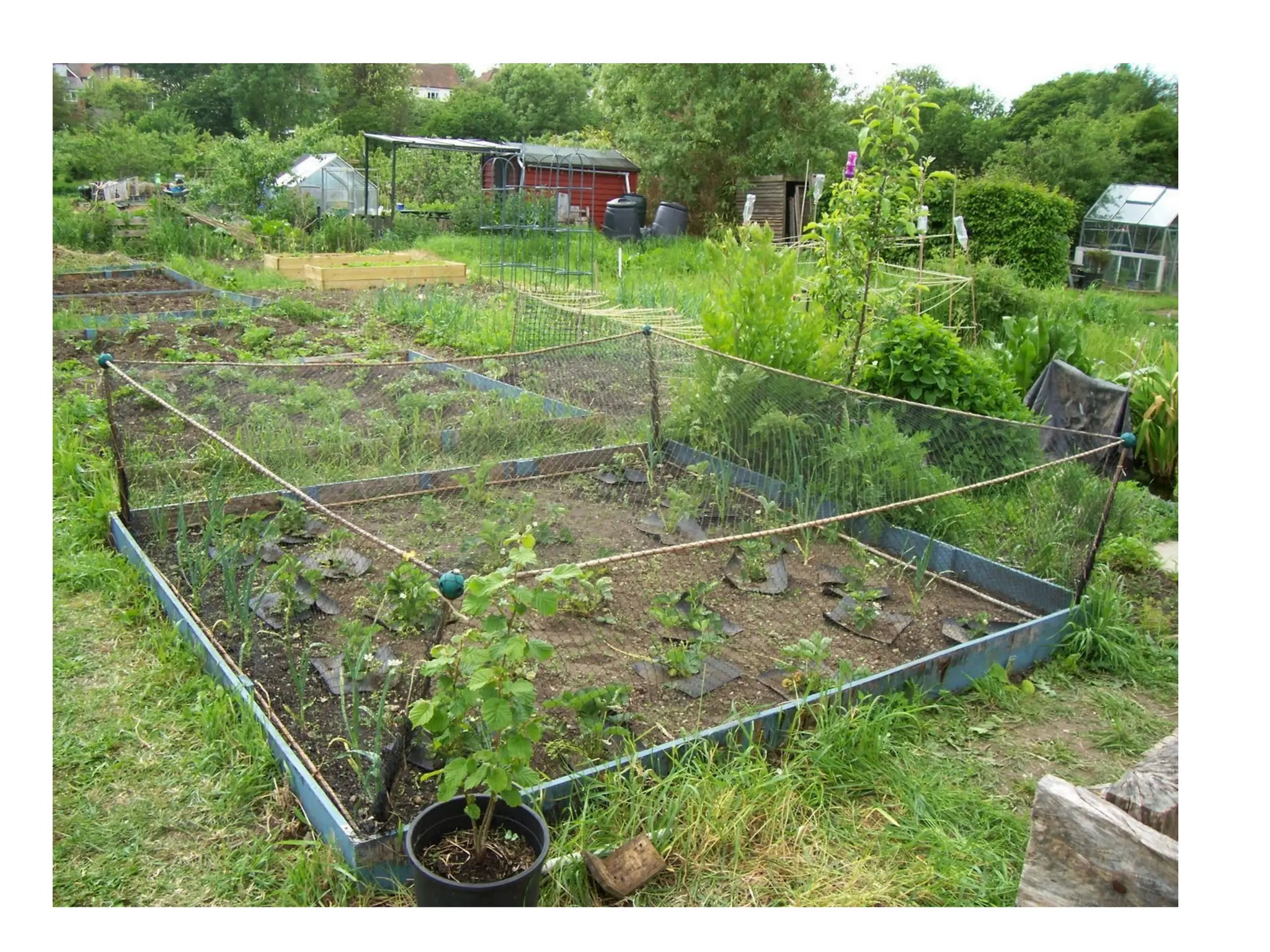
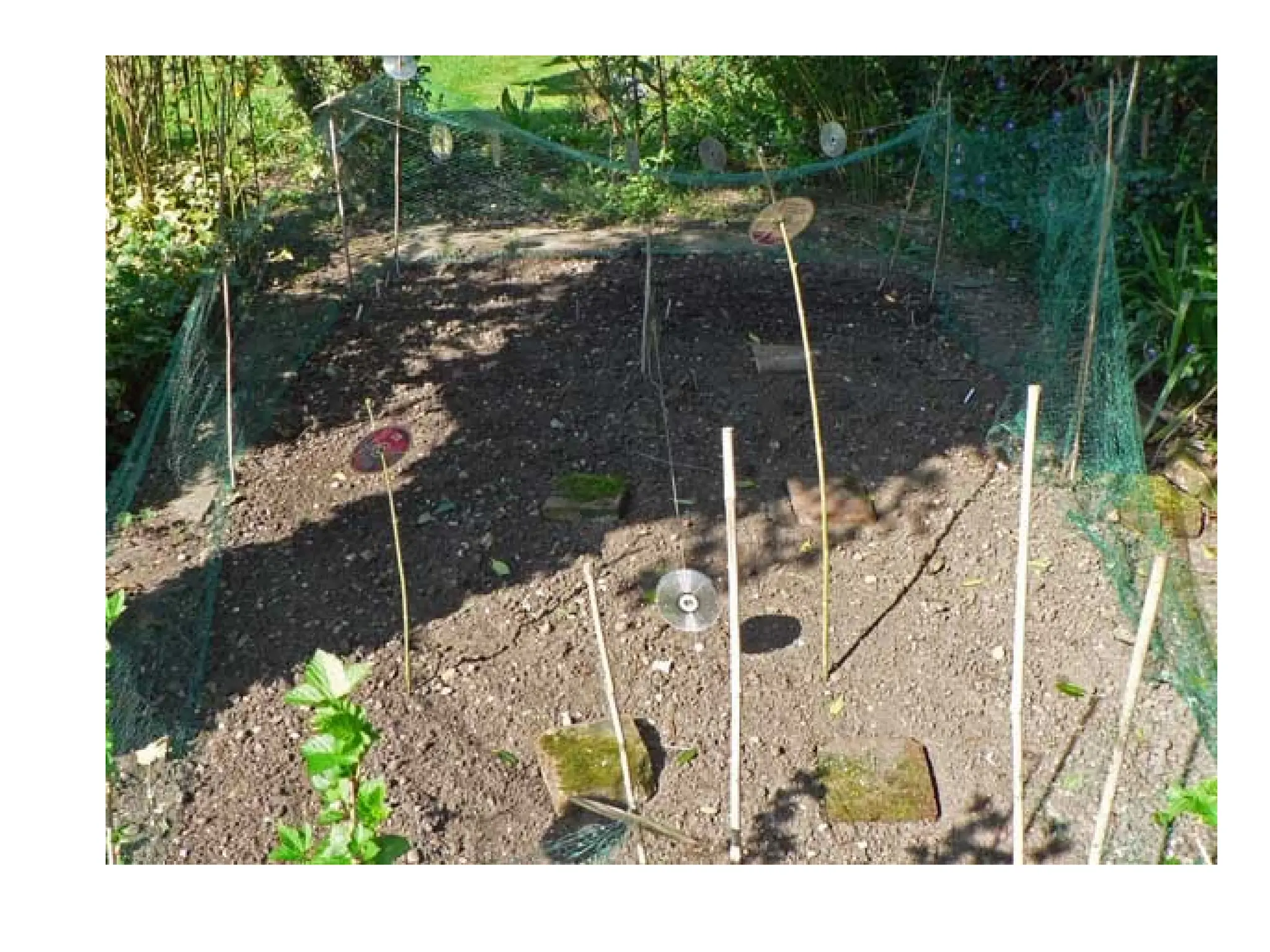
• Use of nylon nets
– Spreading nylon net or reflector tapes over crops
and orchards-protect birds attack
• Habitat manipulation
– Alter preferred bird-habitat by removing food, water
and shelter
Management of Bird Pests
• Use of deterrents
– Use scare-crow or human figure errected in fields-scare
birds like crows
– Acetylene gun-device to produce loud sound by the action
of water on calcium carbide-sound scare away birds
– Making drumming sound on metal tins (tatooning) and
vessels
– Use of bioacoustics –birds alarm signals –recorded and
played in fields at intervals
– Insect repellents – (lindane and malathion 50 EC) or avian
feeding deterrent (tetra methy thiuram disulphide-TMTD)-
repel bird
Management of Bird Pests
• Destruction of nests and roosting places
– Eg. against parrot, Myna (Acridotherestristis) and other birds
– Fumigation with aluminium phosphide –for birds that make
nests on trees or in wall holes (Mynasa, parrots)
– Limited use due to scattered distribution and in accessible
height
• Trapping
– Trapped by using a sticky material-used for meat purpose
– Flood light trap, decoy trap, nets, cages – to trap birds
– Use sticky glue –LASSO- on tip of a pole-Bird catchers
Management of Bird Pests
• Baiting:
– Chappati or grains soaked in insecticide solution -used for
killing some birds- Proper disposal of such birds-necessity
– Immobilizing agents-alpha chloralos (1-2%)-to immobilize
sprrow and pigeons
• Use of resistant variety:
– Varieties of sorghum and bajra have been identified which
are not attacked by birds
• Use of bird scarer:
– Erecting a dummy model or beating of empty kerosene tins
or acetylene guns to create loud noise at regular intervals.
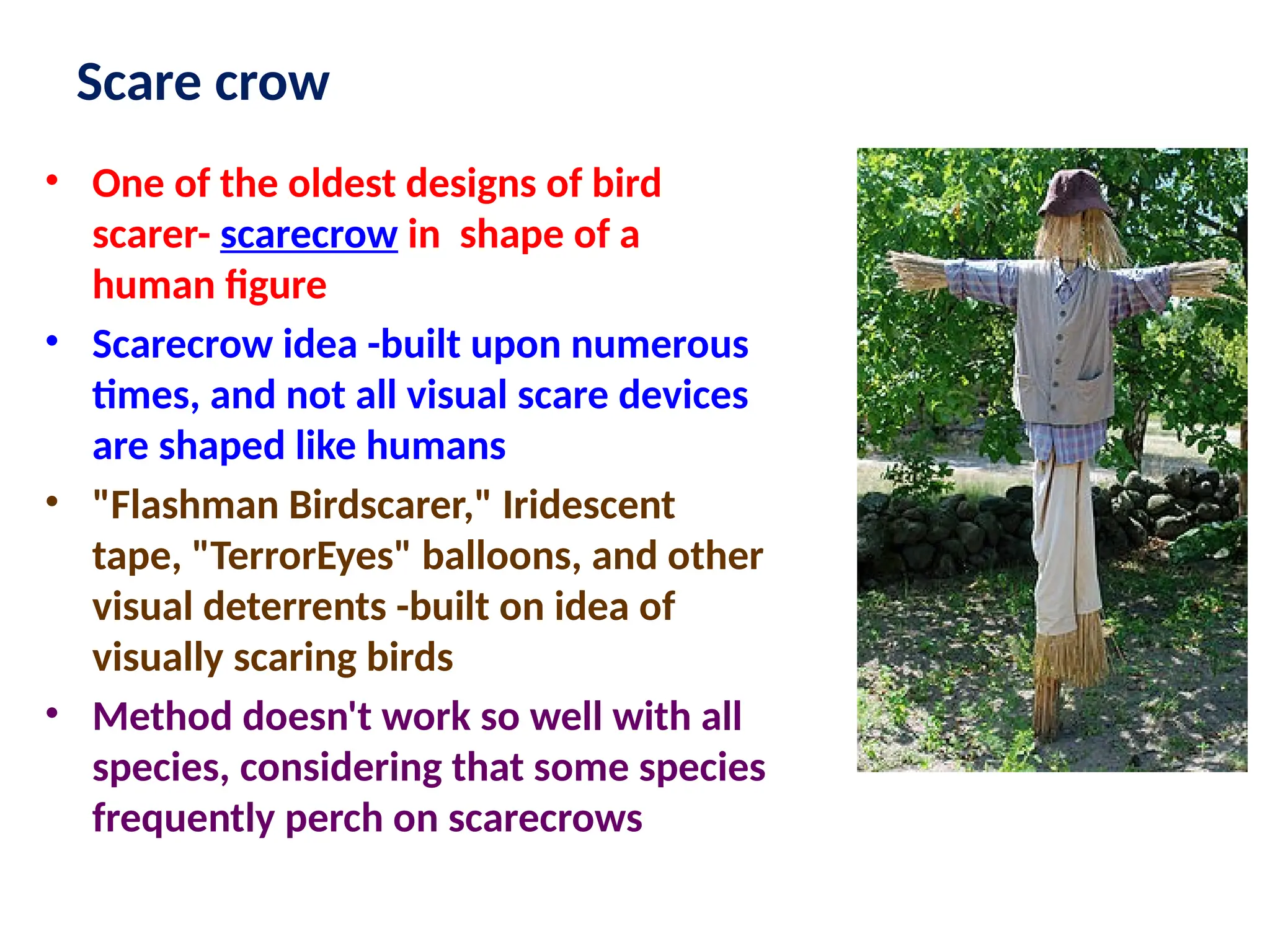
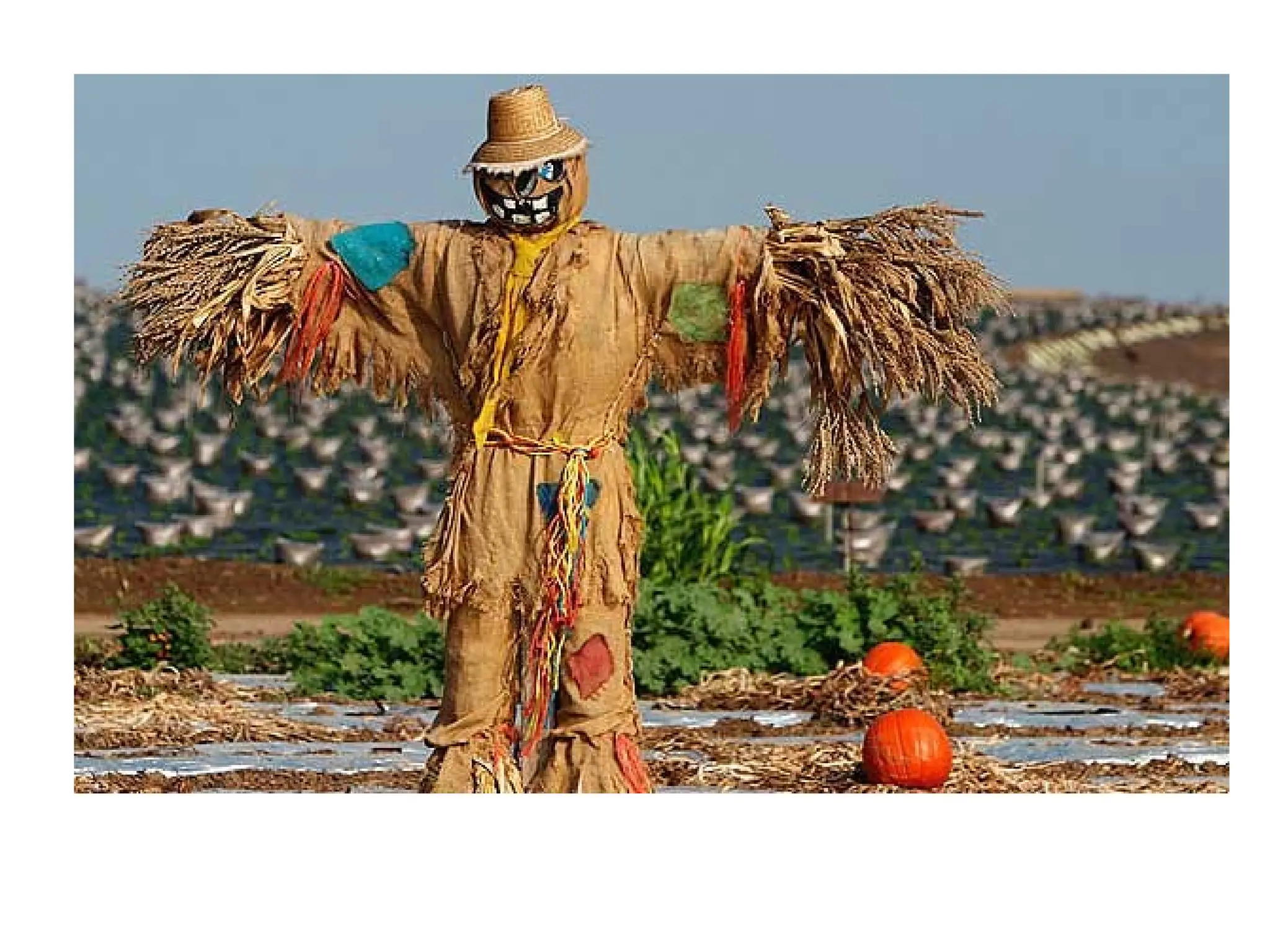
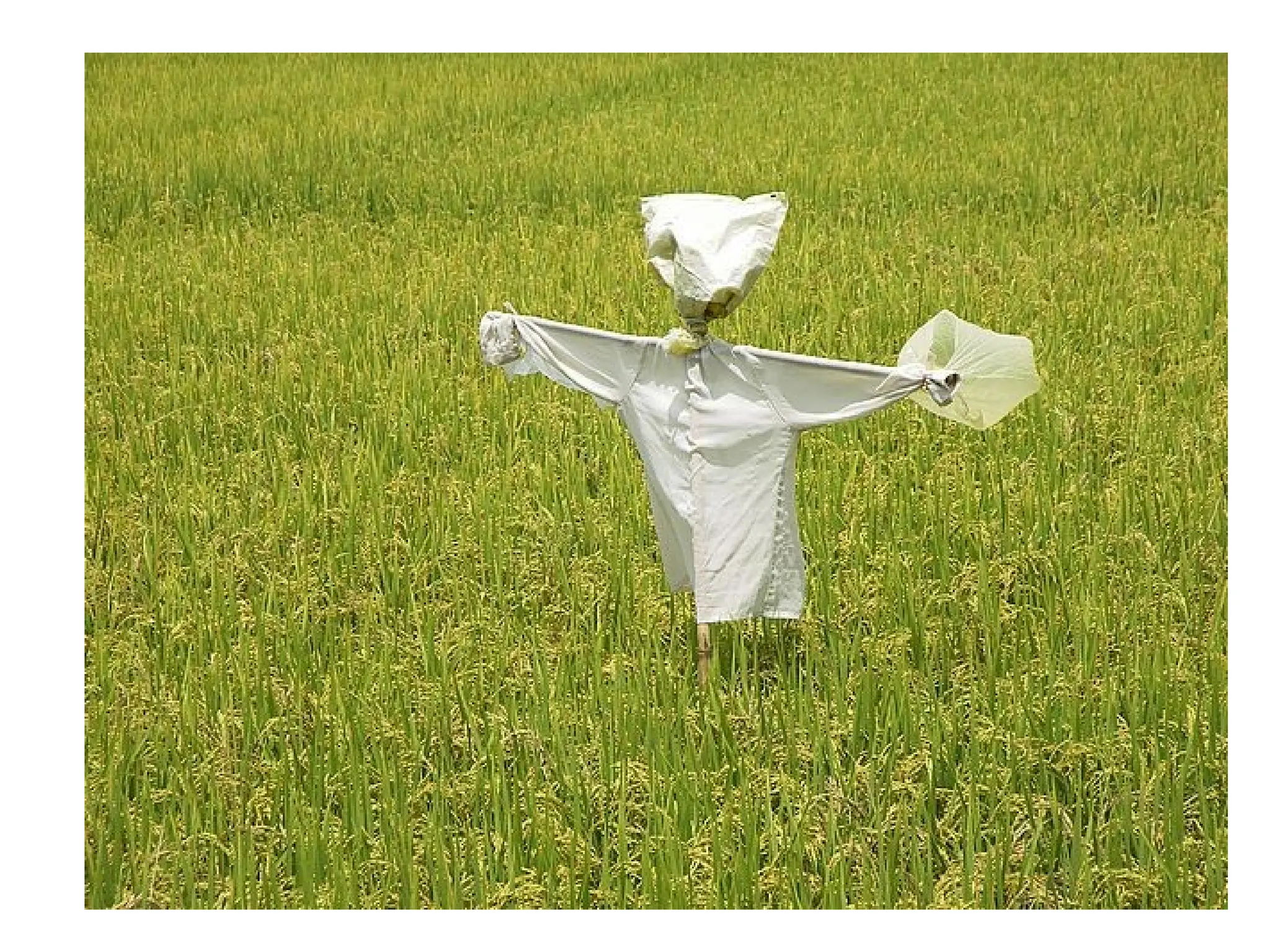
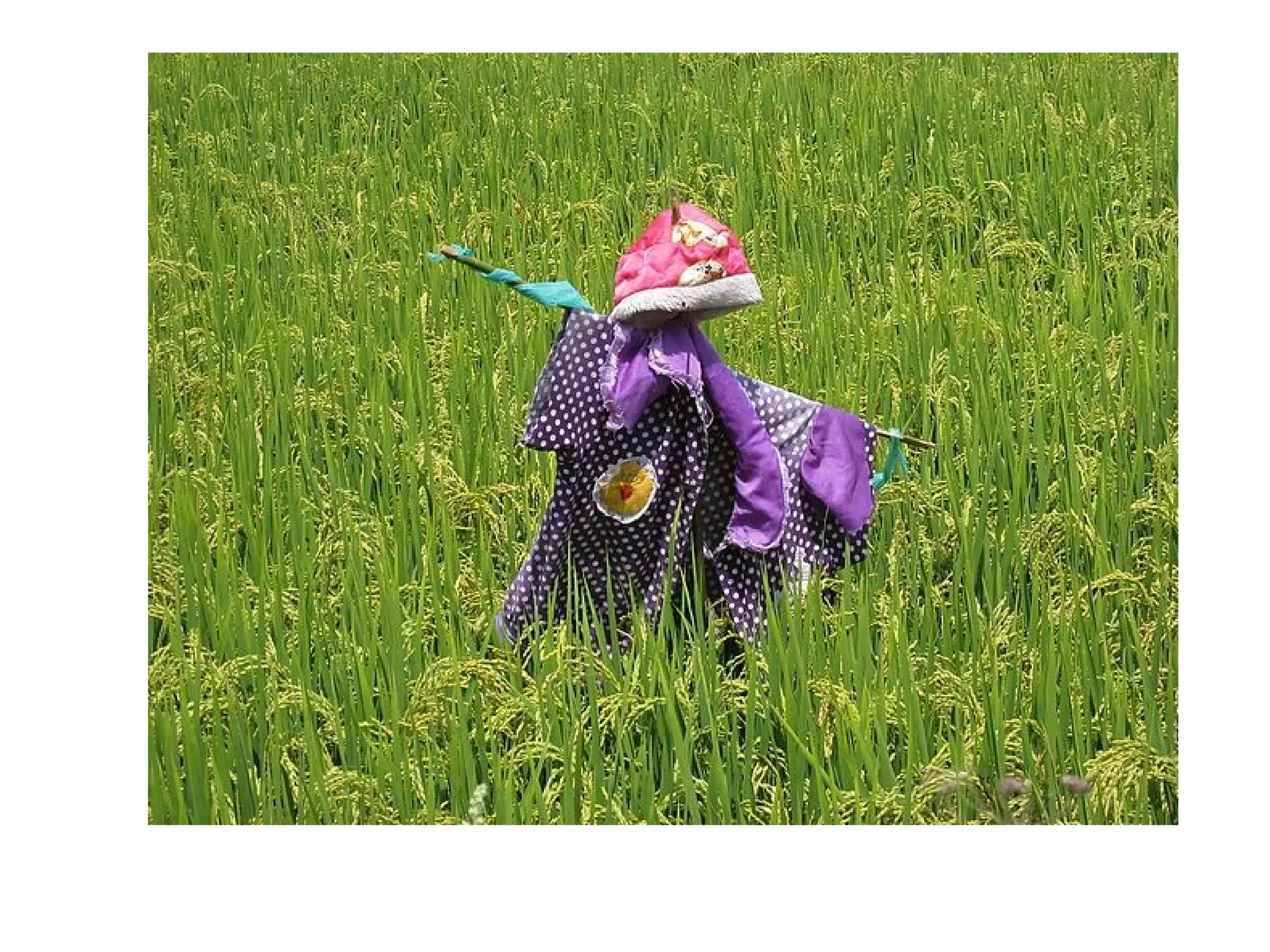
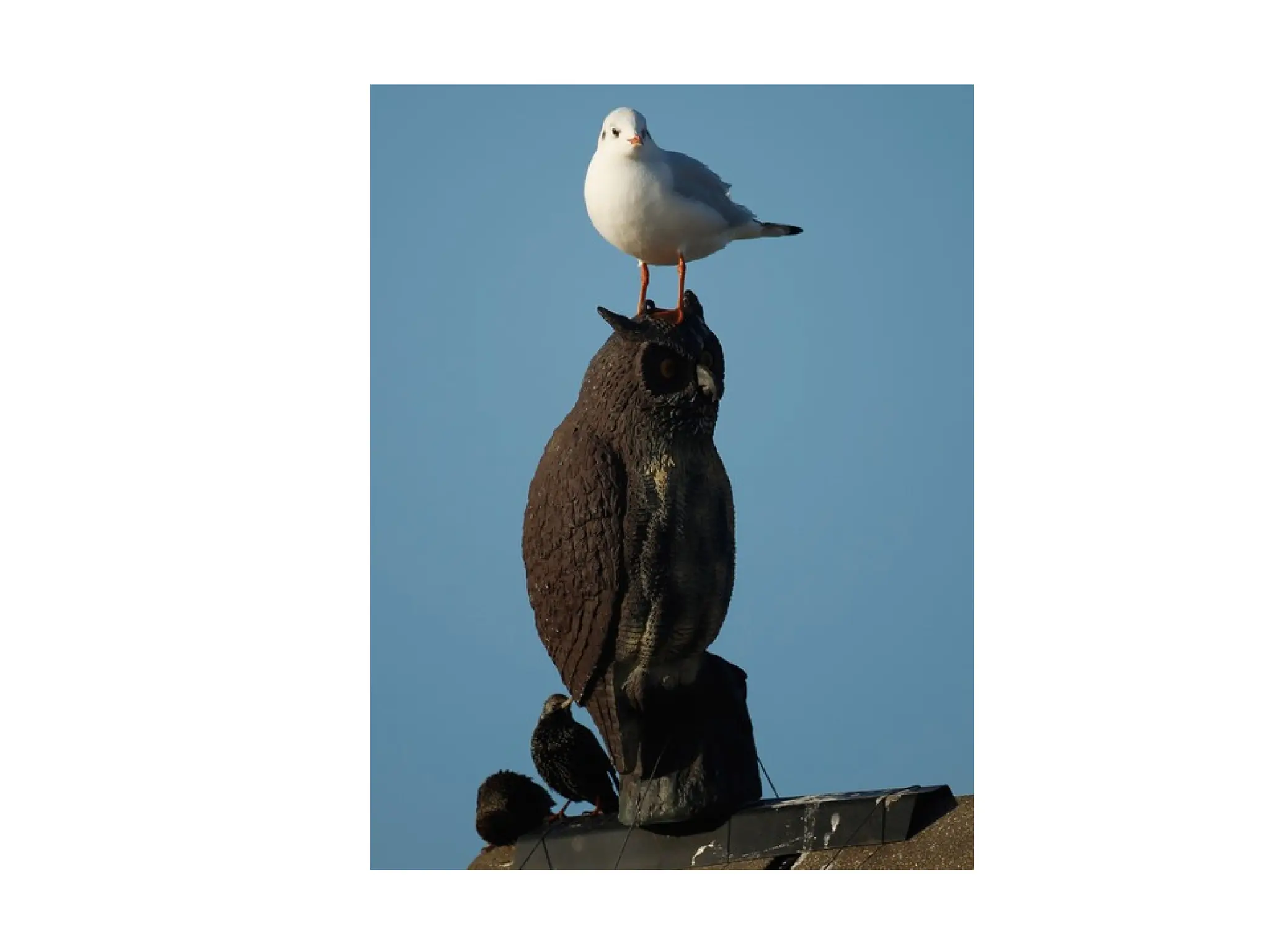
Scare crow
• One of the oldest designs of bird
scarer- scarecrow in shape of a
human figure
• Scarecrow idea -built upon numerous
times, and not all visual scare devices
are shaped like humans
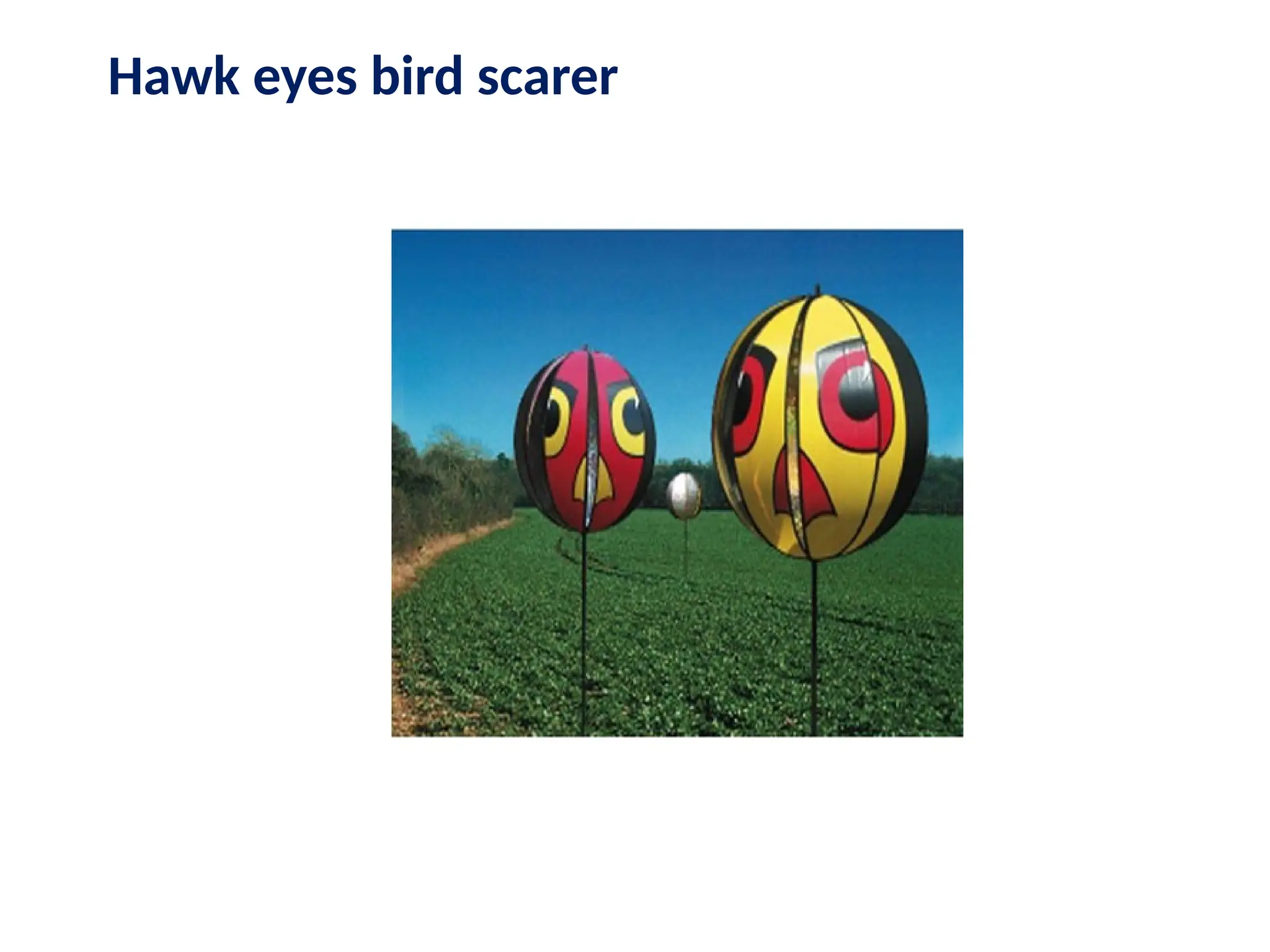
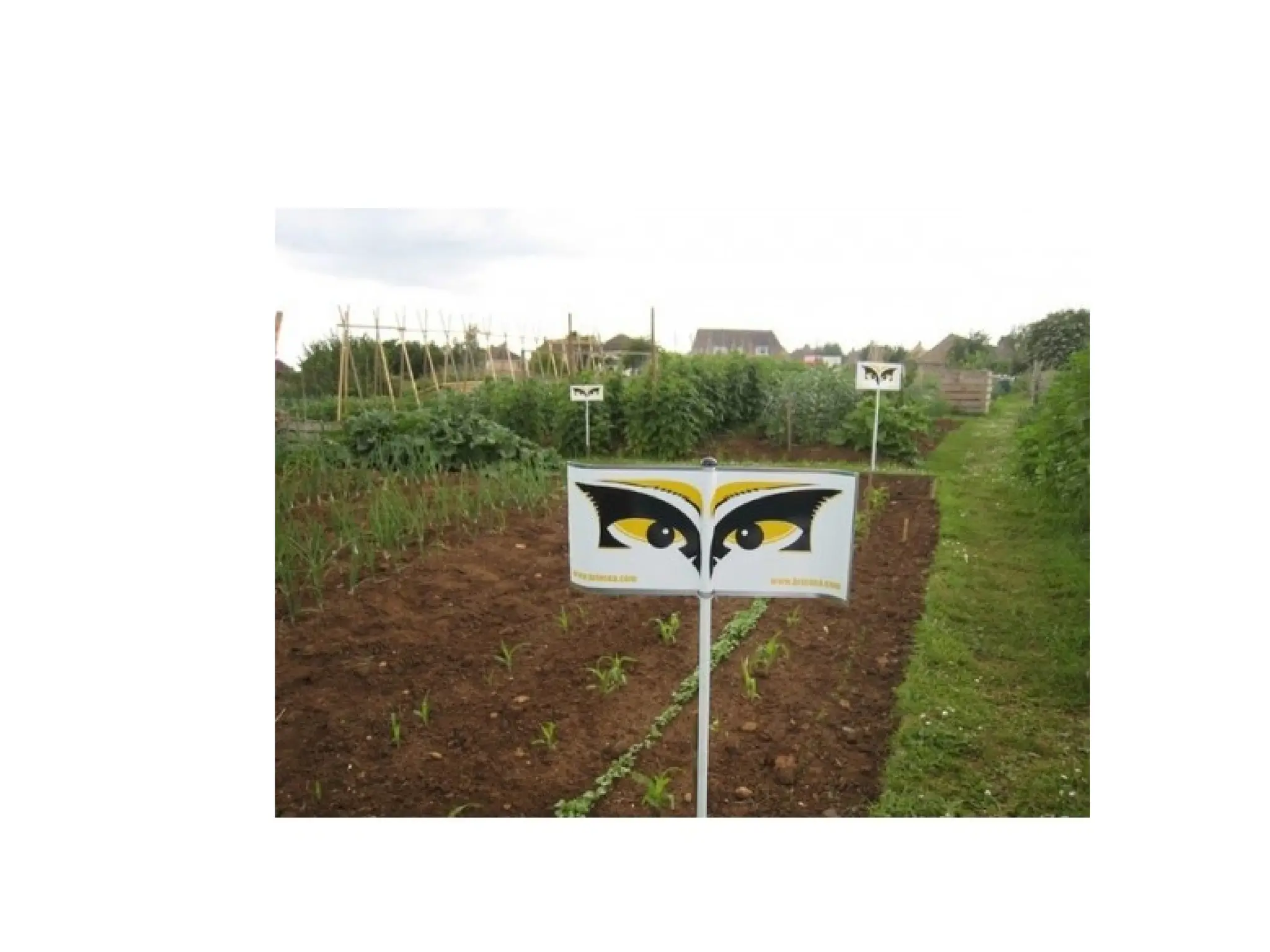
• "Flashman Birdscarer," Iridescent
tape, "TerrorEyes" balloons, and other
visual deterrents -built on idea of
visually scaring birds
• Method doesn't work so well with all
species, considering that some species
frequently perch on scarecrows
Hawk eyes bird scarer
kite
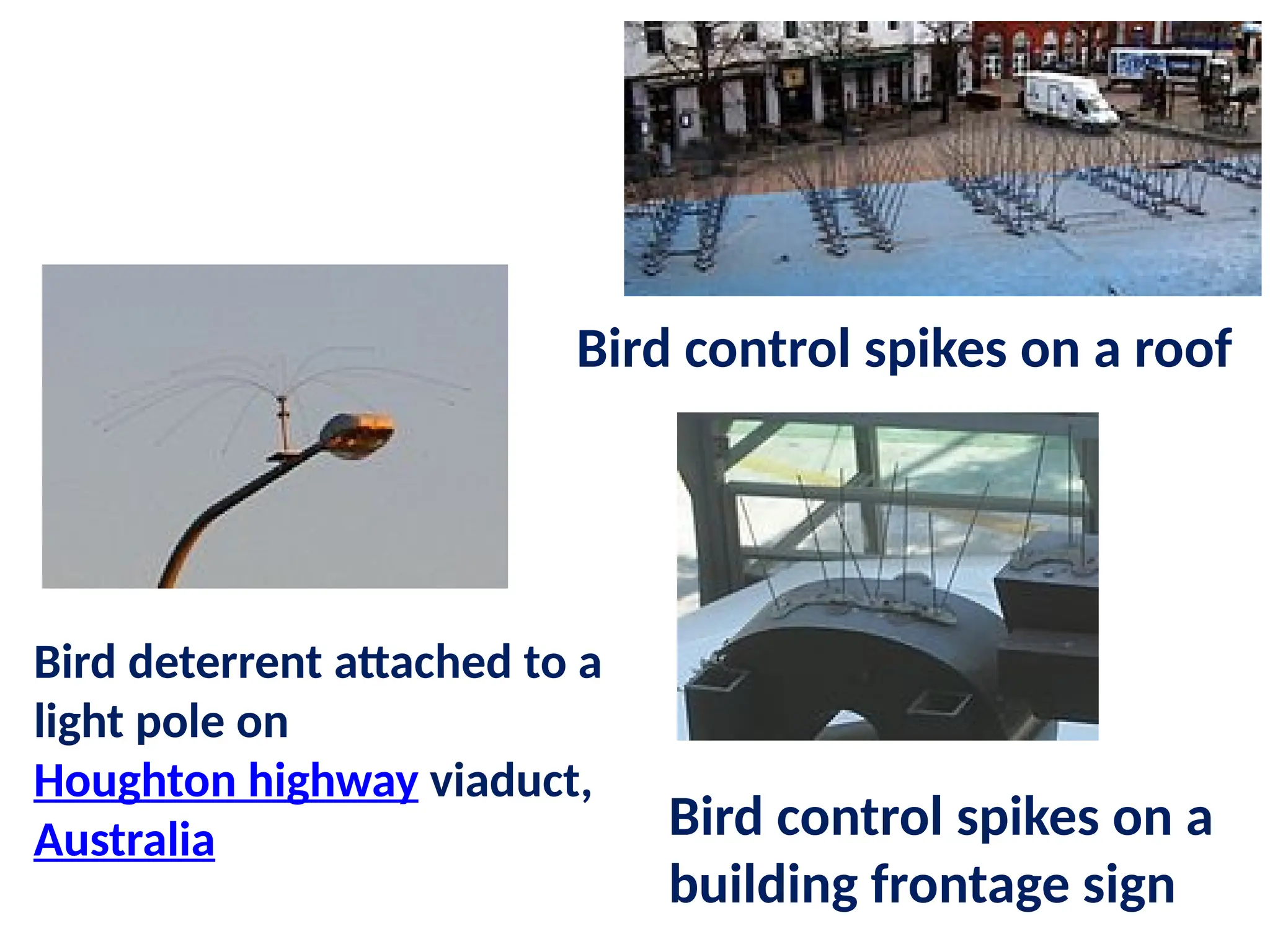
Bird control spikes on a
building frontage sign
Bird control spikes on a roof
Bird deterrent attached to a
light pole on
Houghton highway viaduct,
Australia
Auditory scarers
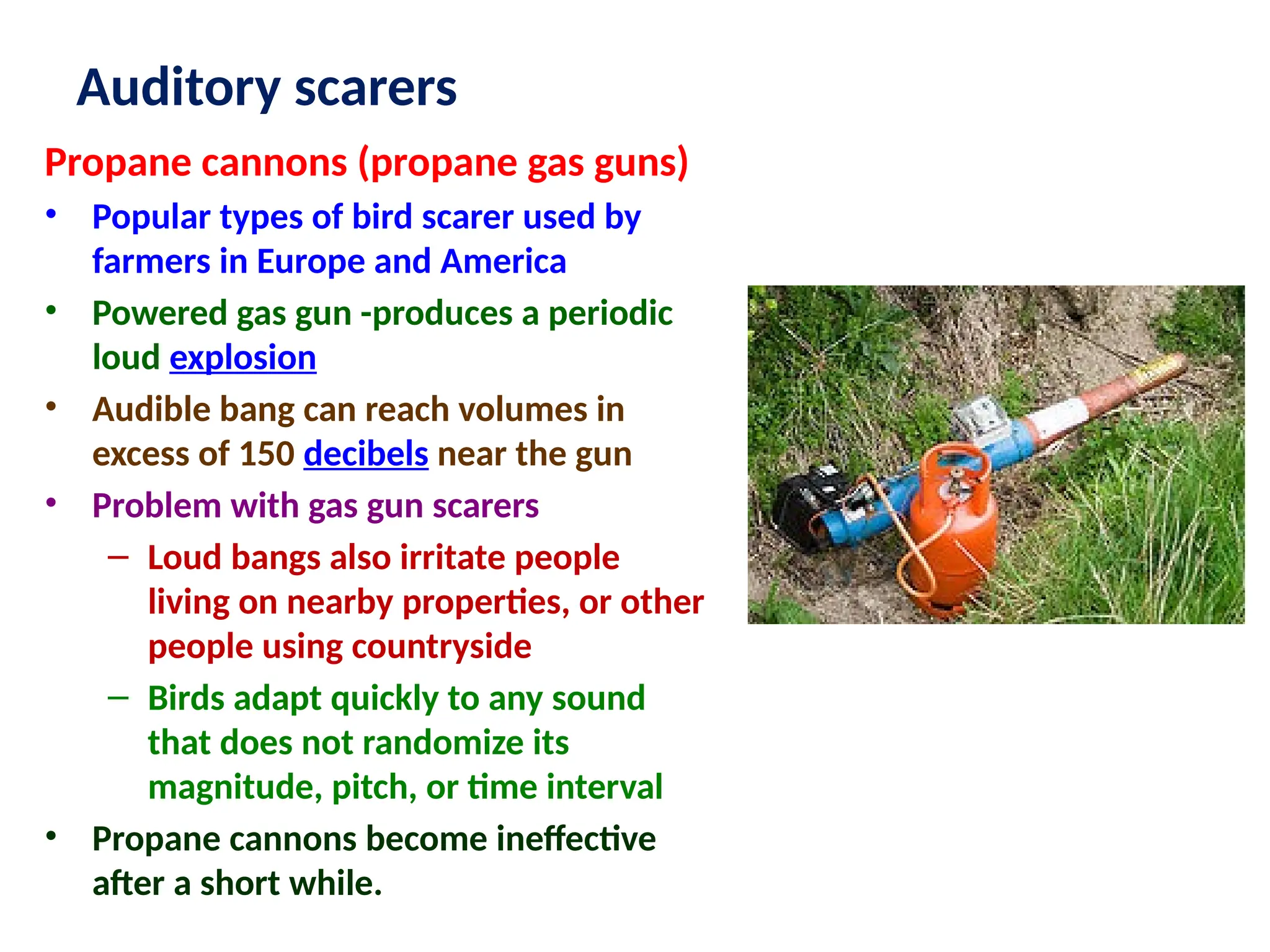
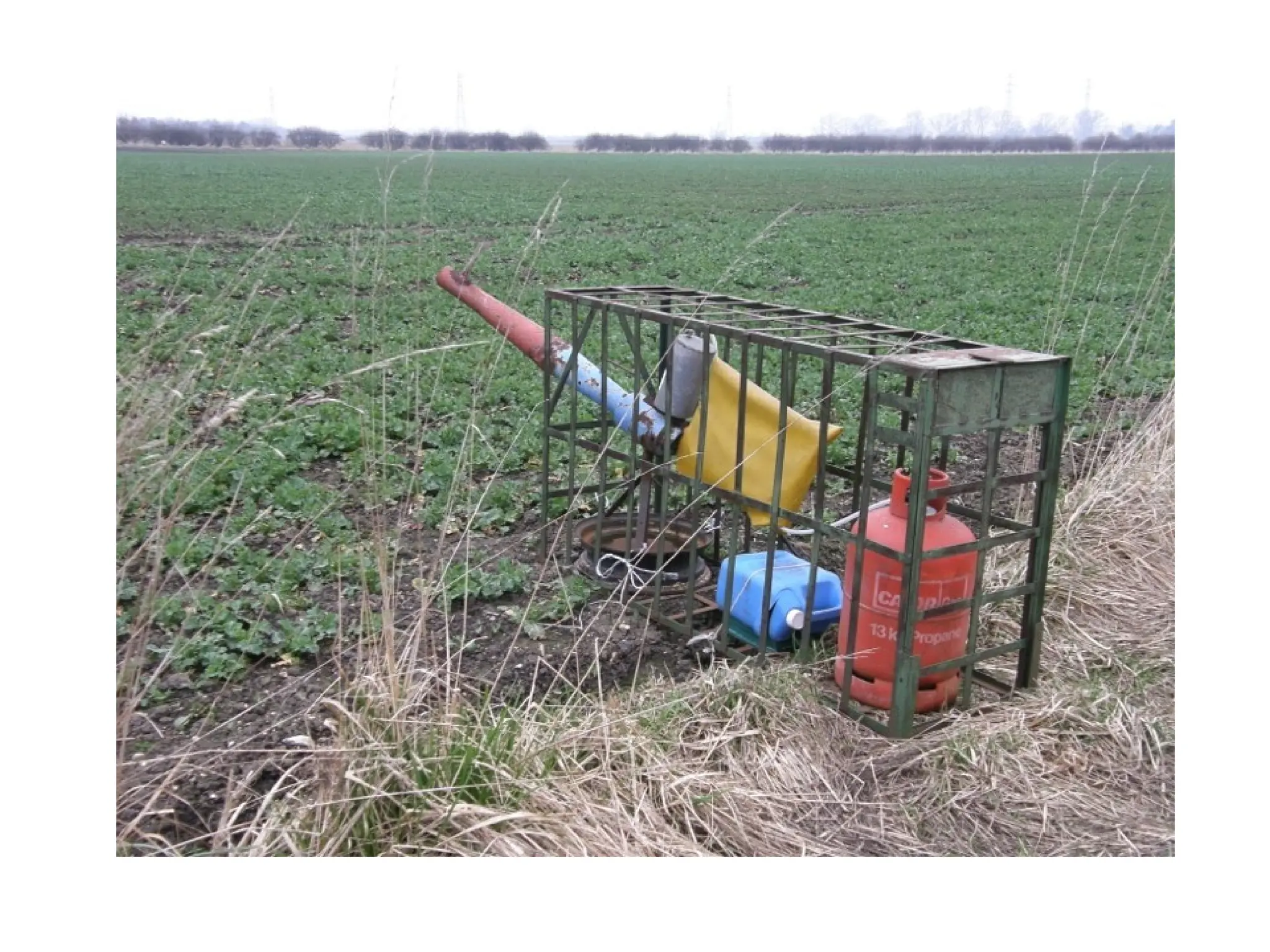
Propane cannons (propane gas guns)
• Popular types of bird scarer used by
farmers in Europe and America
• Powered gas gun -produces a periodic
loud explosion
• Audible bang can reach volumes in
excess of 150 decibels near the gun
• Problem with gas gun scarers
– Loud bangs also irritate people
living on nearby properties, or other
people using countryside
– Birds adapt quickly to any sound
that does not randomize its
magnitude, pitch, or time interval
• Propane cannons become ineffective
after a short while.
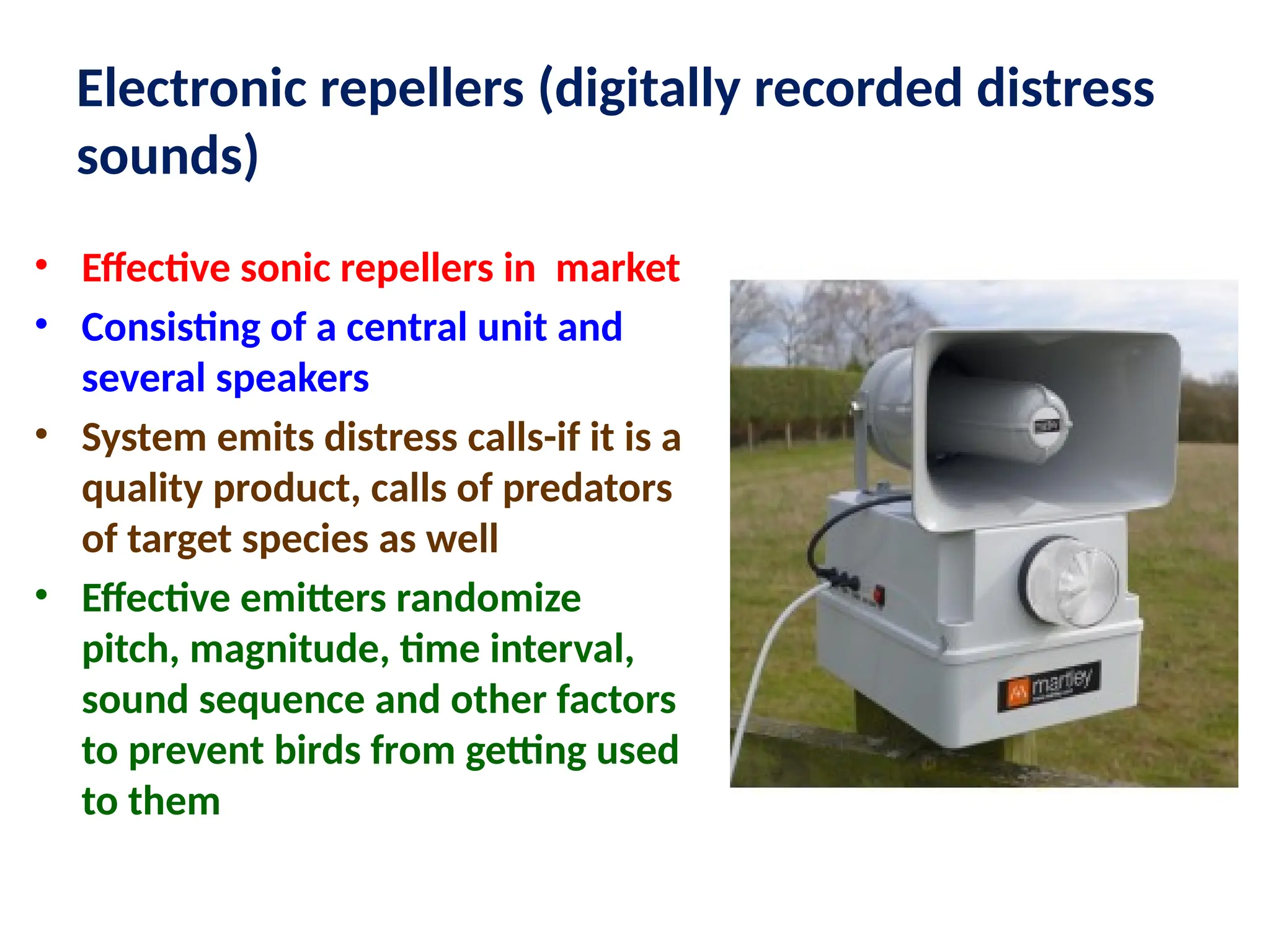
Electronic repellers (digitally recorded distress
sounds)
• Effective sonic repellers in market
• Consisting of a central unit and
several speakers
• System emits distress calls-if it is a
quality product, calls of predators
of target species as well
• Effective emitters randomize
pitch, magnitude, time interval,
sound sequence and other factors
to prevent birds from getting used
to them
Ultrasonic scarers
• Ultrasonic devices -static sound-emitting bird deterrents
• Annoy birds to keep them away from enclosed or semi-
enclosed areas
• Not harmful to birds- however there is debate around birds'
ability to hear these frequencies at loud enough decibels.
• Bird -believed to have similar hearing to humans with
studies showing birds do not hear on an ultrasonic level
• Thus ultrasonic scarers-have little or no effect in deterring
birds
Lec. 32. Bird pests and their management.ppsx

  • 1.
    AEN 301 PESTSOF FIELD CROPS AND THEIR MANAGEMENT (2+1) Lec. No. Title 32 BIRD PESTS AND THEIR MANAGEMENT Dr. N. MUTHUKRISHNAN, Ph.D. Professor (Entomology) Department of Agricultural Entomology Tamil Nadu Agricultural University Coimbatore 641 003 94862 57548
  • 2.
    BIRD PESTS • Vertebratewarm-blooded animals • Total number of bird species -about 8600 • Cause considerable damage to growing field crops, fruit trees, orchards, threshing yards and in houses
  • 3.
    BIRD SPECIES ASPESTS OF CROPS • House sparrow: Passer domesticus • Parrot: Psittacula eupatria; P. krameri; P. cyanocephale • Crow: Corvus splendens • Pigeon: Columba livia • Peacock: Pava cristatus • Bulbul: Pycnonotus cafer • Baya: Ploceus philippinus • Myna: Aeridothares tristis • Green bee eater: Merops orientalis • Wild duck: Pterocyanea discors
  • 4.
    House sparrow: Passerdomesticus • Omnivorous- eats grain, insects, fruit buds, flower nectar and kitchen scraps • Causes severe damage to sorghum, smaller millet, wheat, rice and small succulent fruits both in field and storage conditions • Lives and build nest in a hole in ceiling niche in wall, inverted lamp shade and every conceivable site within or without an occupied building
  • 5.
    • A thinblack patch from beak to eye and a broader one from chin to upper breast • Bill of both male and female - short and stout • Sparrows go in groups to country side when corn and fruits are plentiful • 5 brood/year • Nest untidy
  • 7.
    Parakeet Psittacula krameri •Most familiar -Indian birds • Rose-ringed parakeet-Often band into large flocks • Highly destructive at all times to crops and orchard fruits • Gnawing and wasting far more that actually eats and cause heavy damage to agricultural and horticultural crops • Sunflower, maize, sorghum, smaller millets, wheat, gram, pea, guava, jamun, mango, papaya and other fruits • Sexually dimorphic- adult male sports a red neck-ring and hen and immature birds of both sexes either show no neck rings, or display shadow-like pale to dark grey neck rings
  • 8.
    Parakeet Psittacula krameri •Rose ringed Parakeet • Long and slim tail, grass- green plumage • A short, hooked, red bill • Male -has a collar round neck which is red on top and black at chin • Female- has only green coloured ring round neck
  • 9.
    • Eat Fruitsand grain • In thousands – destroy whole fields within a few hours • Breeding season - February – March • Use debris for nesting materials in holes in trees • Lay 3 to 6 eggs white, oval eggs • Bird wastes more than eats
  • 10.
    House Crow, Corvussplendens • Most familiar bird of Indian towns and villages • Live in close association of man and obtain livelihood from his works • Cause heavy damage to maturing or ripe crops of agricultural and horticultural importance specially to sorghum, groundnut, wheat, chillies, smaller millets, papaya, mango, guava • Also menace to poultry farming as they take away young chicken and eggs and to livestock breeder as they peck eyes out of newly born lambs • Also useful scavenger
  • 11.
    • Not foundin Kodaikanal like hilly areas • Male and female- alike • Smaller in size than jungle crow • Seventeen inches in length • Round wide patch of grey colour in neck -Rest of body -black • Eggs -laid from April to August • Nests seen on trees, telephone poles Twigs of shorts trees, bit of wire • Lay 4 to 7 light blue to greenish eggs with dark spots • Damaging groundnut, sorghum, chillies, and eggs and chicks of birds, eyes of new born lamps, locusts
  • 12.
    Jungle Crow, Corvusmacrorhynchos • Bigger in size • Jet black complexion with heavy bill • Effective scavengers • Grey coloured bird with neck and upper breast of a greenish and purple • Two dark bars on wings and a band across tail - prominent • Commonly seen on old buildings, churches, temples, railway stations, warehouses, etc. • Well adapted to noisy places. • Fly to threshing floors, grain fields, and pickup grains. • Fly in large numbers- heavy losses
  • 13.
    Pigeon Columba livia •Slaty-grey in colour- neck and upper breast metallic green and purple • Two dark bars on wings and a broad black bar across tail-end • A white patch at root of outer feathers • Bill -black, with a swollen base • Legs – reddish
  • 14.
    Bulbul Pycnonotus cafer •Bulbul -found throughout India. • Common in gardens and light scrub jungles, both near and away from human habitations. • Large numbers collect to feed on grain crops, newly sprouting vegetables and fruits and termite swarms
  • 15.
  • 16.
    Baya: Ploceus philippinus •Both males and females are polygamous. Males build many partial nests and begin courting females • Male finishes nest only after finding a mate • Female lays about 2 to 4 white eggs and incubates for about 14 to 17 days.[ • Males may assist in feeding chicks- Chicks leave nest after about 17 days • After mating with a female -male typically court other females at other partially constructed nests • Intraspecific brood parasitism is known- females may lay their eggs in nests of others
  • 17.
    Green bee eater:Merops orientalis • Entire plumage -bright green and tinged with blue especially on chin and throat • Crown and upper back -tinged with golden rufous • Flight feathers -rufous washed with green and tipped with blackish • A fine black line runs in front of and behind eye • Iris -crimson and bill -black while legs- dark grey • Feet - weak with three toes joined at base • Bee-eaters predominantly eat insects, especially bees, wasps and ants -caught in air by sorties from an open perch
  • 18.
    Myna Acridothere tristis •Eleven inches in length • Dark brown with bright yellow bill and legs • Colour around eyes- yellow • Has a larger white patch on inside of flight feathers - clearly seen when flies found up to a height of 2,700 m • Breeding season April –September • Lay 4-6 deep blue eggs • Nest made in holes in wall or tree - trunks out of feathers, twigs, leaves etc. • Eats house scraps, fruits, berries, grain, earthworms, grasshoppers, crickets and caterpillars, and meat of dead animals
  • 19.
    • 5 -6 broods/ year; peak in January to May • Nest on natural rock cliffs • Lays 2 elongate white oval egg • It feeds on grains • Transmits - Ornithosis, Salmonella food poising
  • 20.
    • Bird ofspring • Male and female are not similar • Male - glistening black bill –yellowish green; eyes - crimson • Female- brown with white spots overhead; back, wings and tail barred with white • Lays eggs in crow's nest • Feeds on berries, insects, caterpillars • Not found in hills Quail Coturnix coturnix
  • 21.
    Black Drongo orKing CrowDicrurus macrocercus • Slim, agile bird • Glossy black - Long, forked tail white patch at the end • Male and female alike • Food - mainly of insects • Efficient Predator
  • 22.
    • In thesize of a pigeon with a longer tail and slender body • Back and head -grey • Belly -lighter colour, with brown- coloured hair all over • Middle portion of tail - a number of white and black stripes • Eyes and feet –yellowish • Bill -greenish yellow • Feeds on fruits, berries and insects • Swallows poisonous hairy insects which other birds avoid Hawk Cuckoo Hierococcyx varius
  • 23.
    Jungle Babblers SevenSisters Turdoides striatus • About ten inches in length • Long tail • Ventral - yellowish ashy • Eye lids-white with a touch of yellow • Bill and feet -colour of an onion • Eat spiders, insects, berries, figs, grain and flower nectar
  • 24.
    Kite Milvus migrans •Ash-brown body and forked tail • Wings darker than rest of body • Head and neck -have a pale yellow colour complexion • Bill and claws -black • Feeds on silkworm pupa, rat etc. • Sharp eye; pounce and attack prey
  • 25.
    Hoopoe Upupa epops •Brownish bird with zebra- shaped feathers • Fan shaped crest and a long bill • Fees on caterpillars and other insects that live under grass and fallen leaves
  • 26.
    Blue Jay /Roller Garrulus lanceolatus • Head- blue, a black bill, Abdomen and under parts -pale blue • Wings of varying shades of blue • Feeds on lizards, frogs, large insects and small insects
  • 27.
    Owl Tyto alba •Eyes -not at the sides but in front • Can move neck • Flies noiselessly • Ears -shorter and covered with small feathers • Kill mice and squirrels
  • 28.
    • Cultural methods –Deep sowing of seeds and covering seeds with soil – Growing trap crops near main crop – Use of plant varieties physically and gustatory unattractive • Use of nylon nets – Spreading nylon net or reflector tapes over crops and orchards-protect birds attack • Habitat manipulation – Alter preferred bird-habitat by removing food, water and shelter Management of Bird Pests
  • 29.
    • Use ofdeterrents – Use scare-crow or human figure errected in fields-scare birds like crows – Acetylene gun-device to produce loud sound by the action of water on calcium carbide-sound scare away birds – Making drumming sound on metal tins (tatooning) and vessels – Use of bioacoustics –birds alarm signals –recorded and played in fields at intervals – Insect repellents – (lindane and malathion 50 EC) or avian feeding deterrent (tetra methy thiuram disulphide-TMTD)- repel bird Management of Bird Pests
  • 30.
    Management of BirdPests • Destruction of nests and roosting places – Eg. against parrot, Myna (Acridotherestristis) and other birds – Fumigation with aluminium phosphide –for birds that make nests on trees or in wall holes (Mynasa, parrots) – Limited use due to scattered distribution and in accessible height • Trapping – Trapped by using a sticky material-used for meat purpose – Flood light trap, decoy trap, nets, cages – to trap birds – Use sticky glue –LASSO- on tip of a pole-Bird catchers
  • 31.
    Management of BirdPests • Baiting: – Chappati or grains soaked in insecticide solution -used for killing some birds- Proper disposal of such birds-necessity – Immobilizing agents-alpha chloralos (1-2%)-to immobilize sprrow and pigeons • Use of resistant variety: – Varieties of sorghum and bajra have been identified which are not attacked by birds • Use of bird scarer: – Erecting a dummy model or beating of empty kerosene tins or acetylene guns to create loud noise at regular intervals.
  • 32.
    Scare crow • Oneof the oldest designs of bird scarer- scarecrow in shape of a human figure • Scarecrow idea -built upon numerous times, and not all visual scare devices are shaped like humans • "Flashman Birdscarer," Iridescent tape, "TerrorEyes" balloons, and other visual deterrents -built on idea of visually scaring birds • Method doesn't work so well with all species, considering that some species frequently perch on scarecrows
  • 37.
  • 38.
  • 42.
    Bird control spikeson a building frontage sign Bird control spikes on a roof Bird deterrent attached to a light pole on Houghton highway viaduct, Australia
  • 43.
    Auditory scarers Propane cannons(propane gas guns) • Popular types of bird scarer used by farmers in Europe and America • Powered gas gun -produces a periodic loud explosion • Audible bang can reach volumes in excess of 150 decibels near the gun • Problem with gas gun scarers – Loud bangs also irritate people living on nearby properties, or other people using countryside – Birds adapt quickly to any sound that does not randomize its magnitude, pitch, or time interval • Propane cannons become ineffective after a short while.
  • 45.
    Electronic repellers (digitallyrecorded distress sounds) • Effective sonic repellers in market • Consisting of a central unit and several speakers • System emits distress calls-if it is a quality product, calls of predators of target species as well • Effective emitters randomize pitch, magnitude, time interval, sound sequence and other factors to prevent birds from getting used to them
  • 46.
    Ultrasonic scarers • Ultrasonicdevices -static sound-emitting bird deterrents • Annoy birds to keep them away from enclosed or semi- enclosed areas • Not harmful to birds- however there is debate around birds' ability to hear these frequencies at loud enough decibels. • Bird -believed to have similar hearing to humans with studies showing birds do not hear on an ultrasonic level • Thus ultrasonic scarers-have little or no effect in deterring birds