OMD 421
ORAL
ULCER
Macule: flat and well-demarcated lesion of any size, characterized by color change
in contrast to the surrounding skin. It is generally caused by alteration of melanin
pigment.
Papule: elevated, solid and circumscribed lesion, usually 1 cm or less in diameter.
Plaque: elevated, flat-topped, firm and superficial lesion,
usually greater than 1 cm in diameter; may be coalesced papules.
Vesicle: elevated, thin-walled lesion; filled with serous (clear) fluid, less than 1 cm
in diameter.
Bulla: elevated lesion filled with clear fluid, greater than 1 cm in diameter .
Pustule: elevated lesion filled with purulent fluid. The presence of the pustule does
not necessarily signify the existence of an infection .
Important Causes of Oral Mucosal Ulcers
Vesiculo-Bullous Diseases

Ulceration Without Preceding Vesiculation

Infective:

:Infective

• Primary and recurrent Herpes simplex
lesions.

• Cytomegalovirus – associated ulceration

• Herpes Zoster and Chickenpox
• Hand-foot-and-mouth disease
• Herpangina

Non-infective:
• Pemphigus vulgaris
• Mucous membrane pemphigoid
• Erythema multiform
•Contact allergy

• Some acute specific fevers
• TB
• Syphilis

Non-infective:
• Traumatic ulcers
• Aphthous Stomatitis
• Behcet’s disease
• Reiter’s syndrome
• Lichen planus
•ANUG
•Some mucosal drug reactions
• Carcinoma
Vesiculo-Bullous Diseases
infective:
Primary and recurrent Herpes simplex
lesions.
Herpes Zoster and Chickenpox
Hand-foot-and-mouth disease
Herpangina
Herpes Simplex Virus Infection
Herpes simplex type 1: Causes
oral and pharyngeal infection,
meningeoencephalitis and
dermatitis above the waist.
Herpes simplex type 2: Causes
genital infection and dermatitis
below the waist.
Primary Herpetic Stomatitis
HSV type 1
Transmission by close contact
Most primary infections
In non-immune

Subclinical

acute vesiculating
stomatitis
Clinical Picture
Prodrome (1-2 days)
Early lesion
Vesicles (Any part (hard palate & dorsum of the tongue) – dome shaped 2-3
mm in diameter)
Rupture
Ulcers ( round, sharply defined, shallow, yellowish floor, red margins,
painful)

Gingival Margin
Swollen, red, Regional L.N. (swollen, tender)

Self limiting (week to 10 days)
Primary herpetic gingivostomatitis: multiple ulcers on the tongue.
Primary herpetic gingivostomatitis: erythema and multiple ulcers on the gingiva
Differential diagnosis
Aphthous ulcers
(prodrome of fever and malaise, ulcers preceded by vesicles,
pinpoint size, involve gingiva and a positive history of contact)
Hand-foot-and-mouth disease
(by absence of lesions on palms and soles)
Herpangina
(small vesicles limited to soft palate and oropharynx, while HSV
affects anterior palate)
Recurrent Herpes Simplex Lesion
Recurrent Herpes Libialis
Reactivation of latent virus (20-30 %) leading to cold sores.
Prodrome (burning sensation – Parsesthesia)
Erythema
1-2 hrs
Vesicles (Clusters at the mucocutaneous junction of the lips – can
extend)
Enlarge, Coalesce & weep exudates
2-3 days
Rupture & crust
Recurrent herpes labialis
Recurrent Herpes Simplex Lesion
Recurrent Herpes Libialis
Reactivation of latent virus (20-30 %)
leading to cold sores.

Recurrent Intra Oral Herpes
Clusters of small vesicles
Break into

Prodrome (burning sensation –
Parsesthesia)

Ulcers ( 1-2 mm – On keratinized
mucosa e.g. gingiva, hard palate)

Erythema
1-2 hrs
Vesicles (Clusters at the
mucocutaneous junction of the lips –
can extend)

Chronic Herpes Simplex
Immunocompromised patient
• Skin & mucosa

Enlarge, Coalesce & weep exudates
2-3 days
Rupture & crust

• As recurrent herpes but duration is
weeks to months and develop into large
ulcers (several Cm)
Secondary herpetic stomatitis: small round ulcers on the palate.
Recurrent intraoral herpes
Herpetic Whitlow
Varicella Zoster Infection
Primary Varicella Zoster infection
• Chicken pox

Reactivation of the latent virus
Herpes Zoster of the
Trigeminal area

Herpes Zoster of the
Geniculate ganglion

Herpes Zoster
(reactivation of virus –
adults)

Ramsay Hunt Syndrome
Chicken Pox
Mild systemic symptoms
Maculopapular lesions
(Generalized – Puritic)
Rapidly develop into
Vesicles (on erythematous base)
Rupture
Ulcers
Oral lesions  not diagnostic
Herpes Zoster of the Trigeminal area
Pain
Vesicles (rash)
Stomatitis

In the related dermatome
Trigeminal Nerve
Ophthalmic division
(Corneal scarring – Blindness)
Maxillary (2nd) & Mandibular (3rd) divisions
(Oral lesions)
Herpes Zoster
Prodrome (2-4 days)
Sharp shooting pain, Parsesthesia, burning and tenderness along
the course of the affected dermatome

Vesicles
Unilateral – often confluent
L.N. enlarged and tender

Pain continues until lesion crust over and
heals
Herpes zoster: clusters of vesicles on the palate.
Secondary Infection
Suppuration and scarring of skin
Malaise and fever
Herpes sine eruption
Pain without rash or oral eruptions
Post herpetic neuralgia
Differential Diagnosis

Herpes simplex
(Unilateral distribution in HZ while HSV is
bilateral)
Ramsay Hunt Syndrome
Herpes Zoster of the Geniculate Ganglion

Affects Facial nerve
(motor and sensory fibers)
Prodrome
(Facial pain – may radiate to jaws and misdiagnosed as toothache)

Bell’s Palsy
Herpetic Oticus
(unilateral vesicles on the external ear)

Oral mucosa
(unilateral vesicles
(Chorda Tympani

ulcers on erythematous base)
ant. 2/3 of tongue & soft palate)

Complications
(Permanent facial paralysis)
Hand Foot and Mouth Syndrome
Coxsackie A Virus
Epidemic among school
children
Incubation period 3-10
days
Causes oral ulcers and
rash on the extremities.
Highly infectious
Oral Ulcers
Small, scattered with little pain
Affect Ant. Part of oral cavity
Gingivitis is not a feature
Systemic upset Mild or absent
Hand-foot-and-mouth disease: shallow ulcers on the buccal mucosa
Rash on the extremities
Vesicles (occasionally bullae)
Mainly around the base of fingers and toes,
But can affect any part of the limbs.
Differential diagnosis
Aphthous ulcers
Herpes simplex infection
Herpangina
(by presence of lesions on soles and palms)
Herpangina
Coxsackie A Virus
Epidemic
Children 3-10 years
Incubation period 2-10
days
Prodrome: Fever, chills, sore throat, anorexia,
dysphagia
On soft palate, tonsils and pharynx (posterior
part of the mouth)  Papules & vesicles 
Ulcers (1-2 mm)
Heals within 7 days.
Herpangina: numerous shallow ulcers on the soft palate
Differential diagnosis
Herpetiform ulcers - Aphthous ulcers
(Prodrome of systemic illness)
Primary herpes simplex infection
(small vesicles limited to soft palate and oropharynx,
while HSV affects anterior palate)
Hand-foot-and-mouth disease.
(by presence of lesions on soles and palms)
Important Causes of Oral Mucosal Ulcers
Vesiculo-Bullous Diseases

Ulceration Without Preceding Vesiculation

Infective:

:Infective

• Primary and recurrent Herpes simplex
lesions.

• Cytomegalovirus – associated ulceration

• Herpes Zoster and Chickenpox
• Hand-foot-and-mouth disease
• Herpangina

Non-infective:
• Pemphigus vulgaris
• Mucous membrane pemphigoid
• Erythema multiform
•Contact allergy

• Some acute specific fevers
• TB
• Syphilis

Non-infective:
• Traumatic ulcers
• Aphthous Stomatitis
• Behcet’s disease
• Reiter’s syndrome
• Lichen planus
•ANUG
•Some mucosal drug reactions
• Carcinoma
Ulceration Without Preceding
Vesiculation
:Infective
• Cytomegalovirus – associated
ulceration
• Some acute specific fevers
• TB
• Syphilis
T.B
Ulcer on mid dorsum or
tip of tongue.
Less common on lips
and other parts
Angular or stellate
over-hanging edges &
pale floor.
Indurated base
Painless in early stages.
Syphilis
(Primary syphilis (Chancre
3-4 weeks after infection with Triponema Pallidum.
Affects lips and tip of the tongue.
Firm nodule (1 cm) within few days surface breaks
 Round ulcer with raised indurated edges, painless.
LNs  enlarged and rubbery.
Within 8-9 weeks  healing with no scar.
Secondary syphilis
1-4 month after infection.
Mild fever, malaise, headache, sore throat & generalized
lymphadenopathy Followed by  rash & stomatitis
Rash  starts at trunk, asymptomatic pinkish macules,
symmetrical distribution, few hours to weeks.
Stomatitis  lateral borders of the tongue, tonsils and lips.
ulcers are flat, covered with grayish membrane, snail tract,
may coalesce and form well defined round ulcer.
(Tertiary syphilis (gumma
3 or more years after infection.
Insidious onset.
Affects palate, tongue, tonsils.
Swelling with yellowish center (several inches)  Necrosis
 painless deep ulcer
Ulcer is rounded, soft, punched out edges, floor is depressed
and pale.
Heals with sever scarring  distort tongue and soft palate,
destroy uvula, perforate hard palate.
Important Causes of Oral Mucosal Ulcers
Vesiculo-Bullous Diseases

Ulceration Without Preceding Vesiculation

Infective:

:Infective

• Primary and recurrent Herpes simplex
lesions.

• Cytomegalovirus – associated ulceration

• Herpes Zoster and Chickenpox
• Hand-foot-and-mouth disease
• Herpangina

Non-infective:
• Pemphigus vulgaris
• Mucous membrane pemphigoid
• Erythema multiform
•Contact allergy

• Some acute specific fevers
• TB
• Syphilis

Non-infective:
• Traumatic ulcers
• Aphthous Stomatitis
• Behcet’s disease
• Reiter’s syndrome
• Lichen planus
•ANUG
•Some mucosal drug reactions
• Carcinoma
Ulceration Without Preceding
Vesiculation
Non-Infective:
Traumatic ulcers
Aphthous Stomatitis
Behcet’s disease
Reiter’s syndrome
Lichen planus
Some mucosal drug reactions
Carcinoma
Traumatic ulcers
Obvious cause as sharp edge of denture or a broken tooth
cause traumatic ulcer on tongue and/or buccal mucosa.
Single
Acute onset and Short duration
No systemic features
Painful, yellowish floor, red margins
Removal of the cause  healing within 7-10 days
If not  Biopsy
Recurrent Aphthous Stomatitis
Onset  In childhood
Peak  Adolescence
Recurrent
In healthy patient
Prodrome: Burning sensation 2-48 hrs with localized
erythema
Minor
Most common type
Non keratinized
mucosa
Shallow, rounded,
5-7 mm with red
margins and
yellowish floor
Can be one or many
Healing with no scar
formation in 7-14
days

Major

Herpetiform

Uncommon

Uncommon

Keratinized & non
keratinized mucosa

Non keratinized
mucosa

Several centimeters, deep
and sometimes with
indurated base & everted
edges

1-2 mm

Persistent for several month
Healing with scar formation

Dozens or hundreds (may
cluster  Large ulcers).
Wide spread bright
erythema around the
ulcers.
Minor Aphthous ulcer
Major Aphthous ulcer
Herpetiform Aphthous ulcer
Differential diagnosis
Pemphigus and mm pemphigoid
by absence of vesicles and healing in 7-14 days, and the
well defined appearance, absence of epithelial tags.
Erythema Multiforme
As above + uniform appearance and size, also no lip crusting.
Atrophic candidiasis
predisposing factors in candidiasis, most cases pass through
white necrotic phase or have a minor keratotic component.
Primary herpetic gingivostomatitis
Prodrome of fever and malaise, ulcers preceded
by vesicles, pinpoint size, involve gingiva and
a positive history of contact.

Recurrent Intra oral herpes
Involve keratinized mucosa, while RAU involves
non keratinized mucosa.
Behcet’s disease
Triad of  Oral ulcers – Genital ulcers – Uveitis
 Oral & genital ulcers (aphthous like ulcer)
 Eye lesion (conjunctivitis, Uveitis)
 Skin lesion (erythema nodosum, acneiform eruptions)
 +ve pathergy test
It has Four patterns
1. Mucocutaneous (oral & genital ulcers)
2. Arthritic (joint involvement with or without 1)
3. Neurological (with or without 1 & 2)
4. Ocular (with or without 1,2 & 3)
Eye lesion
Oral ulcers
(aphthous
like ulcer)
Skin lesion
(erythema nodosum)
Pathergy test
+ve pathergy test:
when needle
puncture
Cause pustule
formation after
48h
Differential diagnosis
Stevens–Johnson syndrome
Erythema Multiform
Reiter syndrome
Recurrent aphthous ulcers
Reiter’s Syndrome
Triad of  uritheritis, arthritis, conjunctivitis
Oral manifestations
Painless white lesions which may ulcerate  Aphthous like ulcer
Geographic tongue like lesion
Purpuric rash on palate
Self limiting
Geographic tongue

Characteristically, the lesions
persist for a short time in one area, then disappear completely and
reappear in another area. The condition is usually asymptomatic
Purpuric rash on palate
Squamous cell carcinoma
Deep & large
Indurated base
Raised everted edge
Necrotic fetid floor
Painless unless invade nerve
Metastatic L.N:
Large
Painless
Hard
Fixed to underlying tissues
A.N.U.G
 Painful gingivitis
 Redness
 Swelling
 Gingival bleeding
 Punched out lesion on
interdental papillae
 M.m covered with greyish
necrotic membrane
 Bad breath(foetid oris)
 Bad taste
 lymphadenopathy
Important Causes of Oral Mucosal Ulcers
Vesiculo-Bullous Diseases

Ulceration Without Preceding Vesiculation

Infective:

:Infective

• Primary and recurrent Herpes simplex
lesions.

• Cytomegalovirus – associated ulceration

• Herpes Zoster and Chickenpox
• Hand-foot-and-mouth disease
• Herpangina

Non-infective:
• Pemphigus vulgaris
• Mucous membrane pemphigoid
• Erythema multiform
•Contact allergy

• Some acute specific fevers
• TB
• Syphilis

Non-infective:
• Traumatic ulcers
• Aphthous Stomatitis
• Behcet’s disease
• Reiter’s syndrome
• Lichen planus
•ANUG
•Some mucosal drug reactions
• Carcinoma
Vesiculo-Bullous Diseases
: Non-infective
Pemphigus vulgaris
Mucous membrane pemphigoid
Erythema multiform
Contact allergy
Erythema multiform
Acute
Inflammatory
Mucocutaneous disease
Oral lesions (most prominent or the only one
seen)
E.M. Minor
)(80% of cases
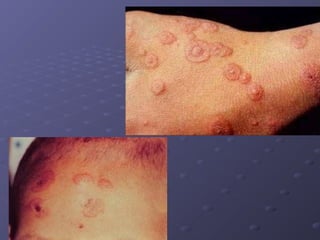
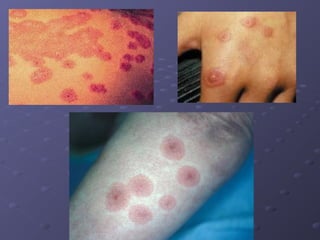
Skin lesions
Maculopapular lesion (dull red – flat or slightly raised)
Remains small or reach 1-3 cm within 48 hrs
Often involve the hands selectively
Kobner phenomenon
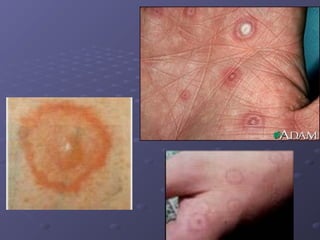
Target (iris) lesions:
Typical: Less than 3 cm in diameter.
Consist of 3 zones.
Atypical: Consist of only 2 zones.
Central zone of
erythema

Middle zone of
edema (paler)

Outer ring
of erythema
(well
defined)
Typical target- or iris-like lesions of the skin.
Koebner phenomenon
Oral manifestations of EM
Mucous membrane
Extensive bullae formation Followed by
Erosions
and a grayish white membrane.
Lips
Show characteristic hemorrhagic crusting.
EM Major
((Steven Johnson Syndrome
Onset :sudden, may be preceded by a prodrome 1-13 days.
Organs involved
Mouth (100%)
Eye Bullae formation may occur – corneal ulceration is frequent –
these changes often regress completely, rarely cause blindness.
Skin variable – typical maculopapular lesion – bullous lesions –
rarely pustular.
Male genitalia
Anal MM
Bronchitis.
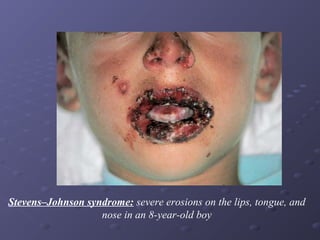
Stevens–Johnson syndrome: severe erosions on the lips, tongue, and
nose in an 8-year-old boy
Differential diagnosis
Primary herpetic gingivostomatitis.
Involve gingiva
Aphthous ulcers.
By absence of vesicles and healing in 7-14 days, and the well
defined appearance, uniform appearance and size, also no
lip crusting.
Pemphigus vulgaris.
Ulcers lacking erythema, Positive Nikolsky’s sign, flaccid
bullae.
Pemphigus Vulgaris
Uncommon
40-60 y
Autoimmune disease
Causing vesicles or bullae on skin and mucous membrane
Fatal if untreated
Oral manifestations
Appears first in mouth

spread to skin.

Vesicles (fragile)
Erosions
(superficial, ragged, painful, tender)
Peeling off of oral epithelium due to lateral movement.
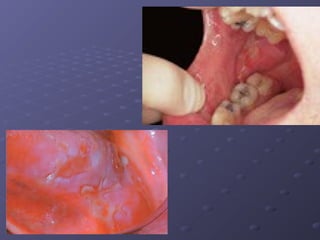
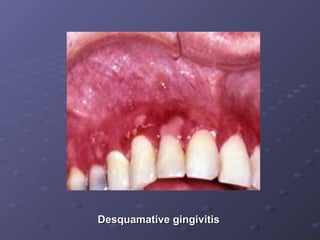
Desquamative gingivitis
Positive Nikolsky’s sign
Desquamative gingivitis
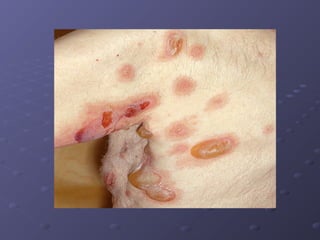
Skin Lesions
Vesicles or flaccid bullae
Ruptures

Erosions
(painful, ragged)
Positive Nikolsky’s sign
Death due to electrolyte imbalance and secondary infection.
Pemphigus vulgaris: severe lesions of the skin of the face.
:Diagnosis confirmed by
Smear taken from base of vesicle (tzank
smear) show tzank cells (acantholytic cells)
High titre of circulating antibodies(IGg4)
against intracellular cementing substance
Direct immunoflouresence
Show binding of
antibodies to
intercellular
substance
Differential diagnosis
Cicatricial pemphigoid & Viral diseases
o Bullae in pemphigus is smaller than mm pemphigoid
and considerably larger than viral diseases such as
herpes and hand-foot-and-mouth disease.
o By immunoflorescence
Erythema Multiforme.
Aphthous ulcers.
Immunofluorescence

PV

MMP
(b.m.m.pemphigoid (autoimmune
Old age
Oral lesion:




Non keratinized mucosa
Desquamative gingivitis
vesicles that rupture leaving
erosions that spread
peripherally more slowly and
self limited than pemphigus.
Skin lesion:

 Large tense bullae
 Stay long time rupture
leaving eroded area
 Nikolsky’s sign is +ve
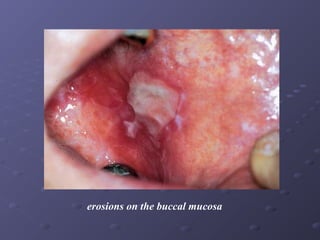
erosions on the buccal mucosa
Desquamative gingivitis
Eye lesion:
 Conjunctival erosion
 Corneal ulcers may
heal by scarring
 symblepharon
conjunctivitis
:Diagnosis confirmed by
Biopsy
Direct
immunoflourescence
Thank you

Oral ulcers(collection)

  • 1.
  • 2.
    Macule: flat andwell-demarcated lesion of any size, characterized by color change in contrast to the surrounding skin. It is generally caused by alteration of melanin pigment.
  • 3.
    Papule: elevated, solidand circumscribed lesion, usually 1 cm or less in diameter.
  • 4.
    Plaque: elevated, flat-topped,firm and superficial lesion, usually greater than 1 cm in diameter; may be coalesced papules.
  • 5.
    Vesicle: elevated, thin-walledlesion; filled with serous (clear) fluid, less than 1 cm in diameter.
  • 6.
    Bulla: elevated lesionfilled with clear fluid, greater than 1 cm in diameter .
  • 7.
    Pustule: elevated lesionfilled with purulent fluid. The presence of the pustule does not necessarily signify the existence of an infection .
  • 8.
    Important Causes ofOral Mucosal Ulcers Vesiculo-Bullous Diseases Ulceration Without Preceding Vesiculation Infective: :Infective • Primary and recurrent Herpes simplex lesions. • Cytomegalovirus – associated ulceration • Herpes Zoster and Chickenpox • Hand-foot-and-mouth disease • Herpangina Non-infective: • Pemphigus vulgaris • Mucous membrane pemphigoid • Erythema multiform •Contact allergy • Some acute specific fevers • TB • Syphilis Non-infective: • Traumatic ulcers • Aphthous Stomatitis • Behcet’s disease • Reiter’s syndrome • Lichen planus •ANUG •Some mucosal drug reactions • Carcinoma
  • 9.
    Vesiculo-Bullous Diseases infective: Primary andrecurrent Herpes simplex lesions. Herpes Zoster and Chickenpox Hand-foot-and-mouth disease Herpangina
  • 10.
    Herpes Simplex VirusInfection Herpes simplex type 1: Causes oral and pharyngeal infection, meningeoencephalitis and dermatitis above the waist. Herpes simplex type 2: Causes genital infection and dermatitis below the waist.
  • 11.
    Primary Herpetic Stomatitis HSVtype 1 Transmission by close contact Most primary infections In non-immune Subclinical acute vesiculating stomatitis
  • 12.
    Clinical Picture Prodrome (1-2days) Early lesion Vesicles (Any part (hard palate & dorsum of the tongue) – dome shaped 2-3 mm in diameter) Rupture Ulcers ( round, sharply defined, shallow, yellowish floor, red margins, painful) Gingival Margin Swollen, red, Regional L.N. (swollen, tender) Self limiting (week to 10 days)
  • 13.
    Primary herpetic gingivostomatitis:multiple ulcers on the tongue.
  • 14.
    Primary herpetic gingivostomatitis:erythema and multiple ulcers on the gingiva
  • 18.
    Differential diagnosis Aphthous ulcers (prodromeof fever and malaise, ulcers preceded by vesicles, pinpoint size, involve gingiva and a positive history of contact) Hand-foot-and-mouth disease (by absence of lesions on palms and soles) Herpangina (small vesicles limited to soft palate and oropharynx, while HSV affects anterior palate)
  • 19.
    Recurrent Herpes SimplexLesion Recurrent Herpes Libialis Reactivation of latent virus (20-30 %) leading to cold sores. Prodrome (burning sensation – Parsesthesia) Erythema 1-2 hrs Vesicles (Clusters at the mucocutaneous junction of the lips – can extend) Enlarge, Coalesce & weep exudates 2-3 days Rupture & crust
  • 21.
  • 23.
    Recurrent Herpes SimplexLesion Recurrent Herpes Libialis Reactivation of latent virus (20-30 %) leading to cold sores. Recurrent Intra Oral Herpes Clusters of small vesicles Break into Prodrome (burning sensation – Parsesthesia) Ulcers ( 1-2 mm – On keratinized mucosa e.g. gingiva, hard palate) Erythema 1-2 hrs Vesicles (Clusters at the mucocutaneous junction of the lips – can extend) Chronic Herpes Simplex Immunocompromised patient • Skin & mucosa Enlarge, Coalesce & weep exudates 2-3 days Rupture & crust • As recurrent herpes but duration is weeks to months and develop into large ulcers (several Cm)
  • 24.
    Secondary herpetic stomatitis:small round ulcers on the palate.
  • 25.
  • 27.
  • 29.
    Varicella Zoster Infection PrimaryVaricella Zoster infection • Chicken pox Reactivation of the latent virus Herpes Zoster of the Trigeminal area Herpes Zoster of the Geniculate ganglion Herpes Zoster (reactivation of virus – adults) Ramsay Hunt Syndrome
  • 30.
    Chicken Pox Mild systemicsymptoms Maculopapular lesions (Generalized – Puritic) Rapidly develop into Vesicles (on erythematous base) Rupture Ulcers
  • 31.
    Oral lesions not diagnostic
  • 33.
    Herpes Zoster ofthe Trigeminal area Pain Vesicles (rash) Stomatitis In the related dermatome
  • 34.
    Trigeminal Nerve Ophthalmic division (Cornealscarring – Blindness) Maxillary (2nd) & Mandibular (3rd) divisions (Oral lesions)
  • 35.
    Herpes Zoster Prodrome (2-4days) Sharp shooting pain, Parsesthesia, burning and tenderness along the course of the affected dermatome Vesicles Unilateral – often confluent L.N. enlarged and tender Pain continues until lesion crust over and heals
  • 36.
    Herpes zoster: clustersof vesicles on the palate.
  • 42.
    Secondary Infection Suppuration andscarring of skin Malaise and fever Herpes sine eruption Pain without rash or oral eruptions Post herpetic neuralgia
  • 43.
    Differential Diagnosis Herpes simplex (Unilateraldistribution in HZ while HSV is bilateral)
  • 44.
    Ramsay Hunt Syndrome HerpesZoster of the Geniculate Ganglion Affects Facial nerve (motor and sensory fibers)
  • 45.
    Prodrome (Facial pain –may radiate to jaws and misdiagnosed as toothache) Bell’s Palsy Herpetic Oticus (unilateral vesicles on the external ear) Oral mucosa (unilateral vesicles (Chorda Tympani ulcers on erythematous base) ant. 2/3 of tongue & soft palate) Complications (Permanent facial paralysis)
  • 47.
    Hand Foot andMouth Syndrome Coxsackie A Virus Epidemic among school children Incubation period 3-10 days Causes oral ulcers and rash on the extremities. Highly infectious
  • 48.
    Oral Ulcers Small, scatteredwith little pain Affect Ant. Part of oral cavity Gingivitis is not a feature Systemic upset Mild or absent
  • 49.
    Hand-foot-and-mouth disease: shallowulcers on the buccal mucosa
  • 51.
    Rash on theextremities Vesicles (occasionally bullae) Mainly around the base of fingers and toes, But can affect any part of the limbs.
  • 53.
    Differential diagnosis Aphthous ulcers Herpessimplex infection Herpangina (by presence of lesions on soles and palms)
  • 54.
    Herpangina Coxsackie A Virus Epidemic Children3-10 years Incubation period 2-10 days
  • 55.
    Prodrome: Fever, chills,sore throat, anorexia, dysphagia On soft palate, tonsils and pharynx (posterior part of the mouth)  Papules & vesicles  Ulcers (1-2 mm) Heals within 7 days.
  • 56.
    Herpangina: numerous shallowulcers on the soft palate
  • 59.
    Differential diagnosis Herpetiform ulcers- Aphthous ulcers (Prodrome of systemic illness) Primary herpes simplex infection (small vesicles limited to soft palate and oropharynx, while HSV affects anterior palate) Hand-foot-and-mouth disease. (by presence of lesions on soles and palms)
  • 60.
    Important Causes ofOral Mucosal Ulcers Vesiculo-Bullous Diseases Ulceration Without Preceding Vesiculation Infective: :Infective • Primary and recurrent Herpes simplex lesions. • Cytomegalovirus – associated ulceration • Herpes Zoster and Chickenpox • Hand-foot-and-mouth disease • Herpangina Non-infective: • Pemphigus vulgaris • Mucous membrane pemphigoid • Erythema multiform •Contact allergy • Some acute specific fevers • TB • Syphilis Non-infective: • Traumatic ulcers • Aphthous Stomatitis • Behcet’s disease • Reiter’s syndrome • Lichen planus •ANUG •Some mucosal drug reactions • Carcinoma
  • 61.
    Ulceration Without Preceding Vesiculation :Infective •Cytomegalovirus – associated ulceration • Some acute specific fevers • TB • Syphilis
  • 62.
    T.B Ulcer on middorsum or tip of tongue. Less common on lips and other parts Angular or stellate over-hanging edges & pale floor. Indurated base Painless in early stages.
  • 65.
    Syphilis (Primary syphilis (Chancre 3-4weeks after infection with Triponema Pallidum. Affects lips and tip of the tongue. Firm nodule (1 cm) within few days surface breaks  Round ulcer with raised indurated edges, painless. LNs  enlarged and rubbery. Within 8-9 weeks  healing with no scar.
  • 68.
    Secondary syphilis 1-4 monthafter infection. Mild fever, malaise, headache, sore throat & generalized lymphadenopathy Followed by  rash & stomatitis Rash  starts at trunk, asymptomatic pinkish macules, symmetrical distribution, few hours to weeks. Stomatitis  lateral borders of the tongue, tonsils and lips. ulcers are flat, covered with grayish membrane, snail tract, may coalesce and form well defined round ulcer.
  • 70.
    (Tertiary syphilis (gumma 3or more years after infection. Insidious onset. Affects palate, tongue, tonsils. Swelling with yellowish center (several inches)  Necrosis  painless deep ulcer Ulcer is rounded, soft, punched out edges, floor is depressed and pale. Heals with sever scarring  distort tongue and soft palate, destroy uvula, perforate hard palate.
  • 74.
    Important Causes ofOral Mucosal Ulcers Vesiculo-Bullous Diseases Ulceration Without Preceding Vesiculation Infective: :Infective • Primary and recurrent Herpes simplex lesions. • Cytomegalovirus – associated ulceration • Herpes Zoster and Chickenpox • Hand-foot-and-mouth disease • Herpangina Non-infective: • Pemphigus vulgaris • Mucous membrane pemphigoid • Erythema multiform •Contact allergy • Some acute specific fevers • TB • Syphilis Non-infective: • Traumatic ulcers • Aphthous Stomatitis • Behcet’s disease • Reiter’s syndrome • Lichen planus •ANUG •Some mucosal drug reactions • Carcinoma
  • 75.
    Ulceration Without Preceding Vesiculation Non-Infective: Traumaticulcers Aphthous Stomatitis Behcet’s disease Reiter’s syndrome Lichen planus Some mucosal drug reactions Carcinoma
  • 76.
    Traumatic ulcers Obvious causeas sharp edge of denture or a broken tooth cause traumatic ulcer on tongue and/or buccal mucosa. Single Acute onset and Short duration No systemic features Painful, yellowish floor, red margins Removal of the cause  healing within 7-10 days If not  Biopsy
  • 82.
    Recurrent Aphthous Stomatitis Onset In childhood Peak  Adolescence Recurrent In healthy patient Prodrome: Burning sensation 2-48 hrs with localized erythema
  • 83.
    Minor Most common type Nonkeratinized mucosa Shallow, rounded, 5-7 mm with red margins and yellowish floor Can be one or many Healing with no scar formation in 7-14 days Major Herpetiform Uncommon Uncommon Keratinized & non keratinized mucosa Non keratinized mucosa Several centimeters, deep and sometimes with indurated base & everted edges 1-2 mm Persistent for several month Healing with scar formation Dozens or hundreds (may cluster  Large ulcers). Wide spread bright erythema around the ulcers.
  • 84.
  • 88.
  • 92.
  • 94.
    Differential diagnosis Pemphigus andmm pemphigoid by absence of vesicles and healing in 7-14 days, and the well defined appearance, absence of epithelial tags. Erythema Multiforme As above + uniform appearance and size, also no lip crusting. Atrophic candidiasis predisposing factors in candidiasis, most cases pass through white necrotic phase or have a minor keratotic component.
  • 95.
    Primary herpetic gingivostomatitis Prodromeof fever and malaise, ulcers preceded by vesicles, pinpoint size, involve gingiva and a positive history of contact. Recurrent Intra oral herpes Involve keratinized mucosa, while RAU involves non keratinized mucosa.
  • 96.
    Behcet’s disease Triad of Oral ulcers – Genital ulcers – Uveitis  Oral & genital ulcers (aphthous like ulcer)  Eye lesion (conjunctivitis, Uveitis)  Skin lesion (erythema nodosum, acneiform eruptions)  +ve pathergy test
  • 97.
    It has Fourpatterns 1. Mucocutaneous (oral & genital ulcers) 2. Arthritic (joint involvement with or without 1) 3. Neurological (with or without 1 & 2) 4. Ocular (with or without 1,2 & 3)
  • 98.
  • 100.
  • 102.
  • 103.
    Pathergy test +ve pathergytest: when needle puncture Cause pustule formation after 48h
  • 104.
    Differential diagnosis Stevens–Johnson syndrome ErythemaMultiform Reiter syndrome Recurrent aphthous ulcers
  • 105.
    Reiter’s Syndrome Triad of uritheritis, arthritis, conjunctivitis Oral manifestations Painless white lesions which may ulcerate  Aphthous like ulcer Geographic tongue like lesion Purpuric rash on palate Self limiting
  • 107.
    Geographic tongue Characteristically, thelesions persist for a short time in one area, then disappear completely and reappear in another area. The condition is usually asymptomatic
  • 109.
  • 110.
    Squamous cell carcinoma Deep& large Indurated base Raised everted edge Necrotic fetid floor Painless unless invade nerve Metastatic L.N: Large Painless Hard Fixed to underlying tissues
  • 114.
    A.N.U.G  Painful gingivitis Redness  Swelling  Gingival bleeding  Punched out lesion on interdental papillae  M.m covered with greyish necrotic membrane  Bad breath(foetid oris)  Bad taste  lymphadenopathy
  • 117.
    Important Causes ofOral Mucosal Ulcers Vesiculo-Bullous Diseases Ulceration Without Preceding Vesiculation Infective: :Infective • Primary and recurrent Herpes simplex lesions. • Cytomegalovirus – associated ulceration • Herpes Zoster and Chickenpox • Hand-foot-and-mouth disease • Herpangina Non-infective: • Pemphigus vulgaris • Mucous membrane pemphigoid • Erythema multiform •Contact allergy • Some acute specific fevers • TB • Syphilis Non-infective: • Traumatic ulcers • Aphthous Stomatitis • Behcet’s disease • Reiter’s syndrome • Lichen planus •ANUG •Some mucosal drug reactions • Carcinoma
  • 118.
    Vesiculo-Bullous Diseases : Non-infective Pemphigusvulgaris Mucous membrane pemphigoid Erythema multiform Contact allergy
  • 119.
    Erythema multiform Acute Inflammatory Mucocutaneous disease Orallesions (most prominent or the only one seen)
  • 120.
    E.M. Minor )(80% ofcases Skin lesions Maculopapular lesion (dull red – flat or slightly raised) Remains small or reach 1-3 cm within 48 hrs Often involve the hands selectively Kobner phenomenon Target (iris) lesions: Typical: Less than 3 cm in diameter. Consist of 3 zones. Atypical: Consist of only 2 zones.
  • 121.
    Central zone of erythema Middlezone of edema (paler) Outer ring of erythema (well defined) Typical target- or iris-like lesions of the skin.
  • 125.
  • 126.
    Oral manifestations ofEM Mucous membrane Extensive bullae formation Followed by Erosions and a grayish white membrane. Lips Show characteristic hemorrhagic crusting.
  • 132.
    EM Major ((Steven JohnsonSyndrome Onset :sudden, may be preceded by a prodrome 1-13 days. Organs involved Mouth (100%) Eye Bullae formation may occur – corneal ulceration is frequent – these changes often regress completely, rarely cause blindness. Skin variable – typical maculopapular lesion – bullous lesions – rarely pustular. Male genitalia Anal MM Bronchitis.
  • 133.
    Stevens–Johnson syndrome: severeerosions on the lips, tongue, and nose in an 8-year-old boy
  • 134.
    Differential diagnosis Primary herpeticgingivostomatitis. Involve gingiva Aphthous ulcers. By absence of vesicles and healing in 7-14 days, and the well defined appearance, uniform appearance and size, also no lip crusting. Pemphigus vulgaris. Ulcers lacking erythema, Positive Nikolsky’s sign, flaccid bullae.
  • 135.
    Pemphigus Vulgaris Uncommon 40-60 y Autoimmunedisease Causing vesicles or bullae on skin and mucous membrane Fatal if untreated
  • 136.
    Oral manifestations Appears firstin mouth spread to skin. Vesicles (fragile) Erosions (superficial, ragged, painful, tender) Peeling off of oral epithelium due to lateral movement. Desquamative gingivitis Positive Nikolsky’s sign
  • 141.
  • 143.
    Skin Lesions Vesicles orflaccid bullae Ruptures Erosions (painful, ragged) Positive Nikolsky’s sign Death due to electrolyte imbalance and secondary infection.
  • 146.
    Pemphigus vulgaris: severelesions of the skin of the face.
  • 148.
    :Diagnosis confirmed by Smeartaken from base of vesicle (tzank smear) show tzank cells (acantholytic cells) High titre of circulating antibodies(IGg4) against intracellular cementing substance Direct immunoflouresence
  • 149.
    Direct immunoflouresence Show bindingof antibodies to intercellular substance
  • 150.
    Differential diagnosis Cicatricial pemphigoid& Viral diseases o Bullae in pemphigus is smaller than mm pemphigoid and considerably larger than viral diseases such as herpes and hand-foot-and-mouth disease. o By immunoflorescence Erythema Multiforme. Aphthous ulcers.
  • 151.
  • 152.
    (b.m.m.pemphigoid (autoimmune Old age Orallesion:    Non keratinized mucosa Desquamative gingivitis vesicles that rupture leaving erosions that spread peripherally more slowly and self limited than pemphigus. Skin lesion:  Large tense bullae  Stay long time rupture leaving eroded area  Nikolsky’s sign is +ve
  • 153.
    erosions on thebuccal mucosa
  • 155.
  • 157.
    Eye lesion:  Conjunctivalerosion  Corneal ulcers may heal by scarring  symblepharon
  • 158.
  • 160.
  • 161.