Preethi Agnes.R
B.D.S 2012 Batch
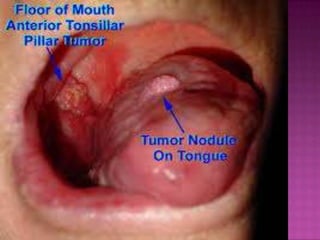
 It

is a Malignant neoplasm of stratified
squamous epithelium in the oral cavity
 capable of local destructive growth and
distant metastasis
 Possible









sites

lower lip
tongue
floor of the mouth
soft palate
gingival / alveolar ridge
buccal mucosa
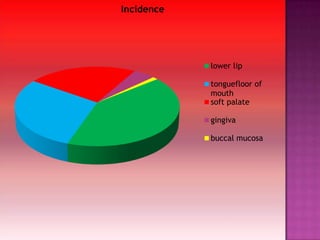
Incidence

lower lip
tonguefloor of
mouth
soft palate
gingiva

buccal mucosa
The etiology is unknown. But a
number of etiological factors have been
implicated.
Strong Association:
•
Tobacco smoking and chewing
•
Chronic alcohol consumption
•
Human papilloma virus infection
 Major

source of intra-oral carcinogen.
 All forms of tobacco consumption have been
linked.
 South east Asia: bethel quid– North Africa
and Middle East: a mixture of Tobacco and
lime water or oil called naswar or nash
 It could be held in the mouth
 Smoked in crude cigars or factory made
cigarettes
 Carcinogens in tobacco: Nitrosamine
(nicotine), the polycyclic aromatic
hydrocarbons (3,4-benzopyrene)
2nd major risk factor
 Associated with cancer of the floor of the mouth
and tongue.
 Excess consumption of EVERY TYPE of
alcohol(including “hard” liquor, wine, and Beer)
raises the risk status of oral cancer
 Potentiates the effects of tobacco
 Mechanism(s)


Dehydrating effects of alcohol on the mucosa
 increasing mucosal permeability,
 Irritation of mucosa
 and it also acts as a solvent for
carcinogens(especially those in tobacco)

Weak association:

Chronic irritation from ill-fitting denture

Sub mucosal fibrosis

Poor orodental hygiene

Nutritional deficiencies

Exposure to sunlight(lip cancer)

Plummer –Vinson syndrome
 NEOPLASIA:The

process of transformation
from a normal cell to a cancerous one.

 An

abnormality of cell growth and
multiplication characterised by:


At cellular level






Excessive cellular proliferation
Uncoordinated growth
Tissue infiltration

At molecular level


Disorder of growth regulatory genes
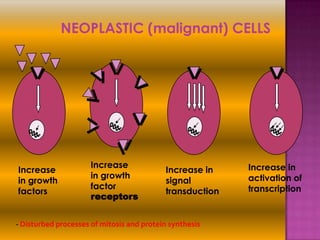
NEOPLASTIC (malignant) CELLS

Increase
in growth
factors

Increase
in growth
factor
receptors

Increase in
signal
transduction

- Disturbed processes of mitosis and protein synthesis

Increase in
activation of
transcription


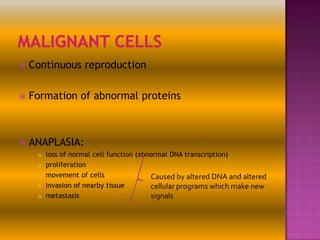
Continuous reproduction



Formation of abnormal proteins



ANAPLASIA:






loss of normal cell function (abnormal DNA transcription)
proliferation
movement of cells
Caused by altered DNA and altered
invasion of nearby tissue
cellular programs which make new
metastasis
signals
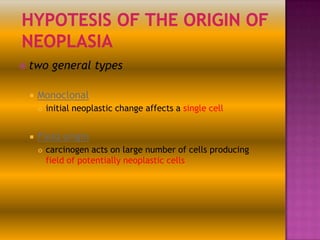
 two


Monoclonal




general types

initial neoplastic change affects a single cell

Field origin


carcinogen acts on large number of cells producing
field of potentially neoplastic cells
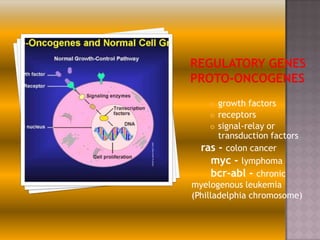
growth factors
 receptors
 signal-relay or
transduction factors
ras - colon cancer
myc - lymphoma
bcr-abl - chronic
myelogenous leukemia
(Philladelphia chromosome)

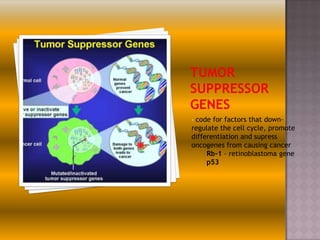
- code for factors that down-

regulate the cell cycle, promote
differentiation and supress
oncogenes from causing cancer
Rb-1 – retinoblastoma gene
p53
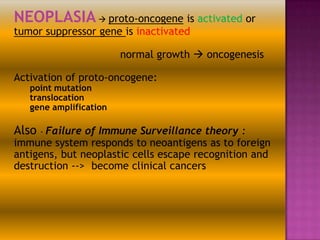
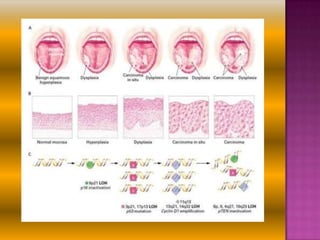
NEOPLASIA  proto-oncogene is activated or
tumor suppressor gene is inactivated

normal growth  oncogenesis
Activation of proto-oncogene:
point mutation
translocation
gene amplification

Also - Failure of Immune Surveillance theory :

immune system responds to neoantigens as to foreign
antigens, but neoplastic cells escape recognition and
destruction --> become clinical cancers






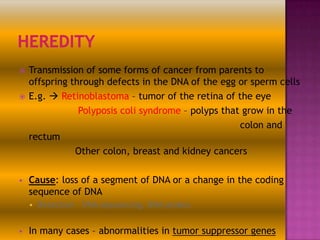
Transmission of some forms of cancer from parents to
offspring through defects in the DNA of the egg or sperm cells
E.g.  Retinoblastoma – tumor of the retina of the eye
Polyposis coli syndrome – polyps that grow in the
colon and
rectum
Other colon, breast and kidney cancers
Cause: loss of a segment of DNA or a change in the coding
sequence of DNA




Detection – DNA sequencing, DNA probes

In many cases – abnormalities in tumor suppressor genes
A sore in the mouth that does not heal (most
common symptom)
 Pain in the mouth
 A persistent lump or thickening in the cheek
 A persistent white or red patch on the
gums, tongue, tonsil, or lining of the mouth
 A sore throat or a feeling that something is
caught in the throat
 Increased salivation

Difficulty chewing or swallowing
 Difficulty moving the jaw or tongue
 Swelling of the jaw that causes dentures to
fit poorly or become uncomfortable
 Loosening of the teeth or pain around the
teeth or jaw
 Voice changes
 A lump or mass in the neck
 Weight loss
 Persistent bad breath

Grossly, squamous cell carcinoma of
oral cavity may have the following types:
 Ulcerative type
 Papillary or verrucous type
 Nodular type
 Scirrhous type
All these types appear on a background of
leukoplakia or erythroplasia of the oral
mucosa.
Enlarged cervical lymph nodes may be
present.
 Increased

mitotic activity
 Well differentiated
 Keratin pearls (abnormal keratinization)
 Hyperchromatic nuclei
 Pleomorphism
 Epithelium islands
 Connective tissue stroma with chronic
inflammation (histiocytes, lymphocytes, etc.)
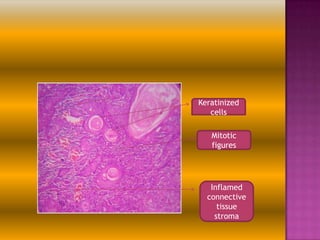
Keratinized
cells
Mitotic
figures

Inflamed
connective
tissue
stroma


Primary:











Photographs
Incisional biopsy
Fine needle aspiration biopsy
Orthopantogram
Mucosal staining
CXR
chemiluminescent light
Routine blood investigations

For staging






MRI
CT face + neck ± CT chest
USG of neck or primary ± USG guided FNAC of suspicious
lymphadenopathy
PET
Endoscopy


Surgery
 Removal
 Removal

of part or all of the jaw
of the tumor on a larger area to remove the
tumor and surrounding healthy tissue
 Maxillectomy
 Removal of lymph nodes and other tissue in the neck
 Plastic surgery, including skin grafts, tissue flaps or
dental implants to restore tissues removed from the
mouth or neck
 Tracheotomy, or placing a hole in the windpipe, to
assist in breathing for patients with large tumors or
after surgical removal of the tumor
 Dental surgery to remove teeth or assist with
reconstruction
Radiation Therapy
-used alone to treat small or early-stage
tumors.
 Proton Therapy
-delivers high radiation doses directly into the
tumor, sparing nearby healthy tissue and vital
organs.
 Chemotherapy
-used to shrink the cancer before surgery or
radiation
 Tumor Growth Factor Inhibitors
-target EGF receptors and may stop cancer
cells from growing.

Mucositis ,an inflammation of the mucous
membranes in the mouth.
 Infection, pain, and bleeding
 Dehydration and malnutrition due to dysphagia
 Xerostomia due to injury to the glands that
produce saliva.
 Trismus due to damage to the muscles and joints
of the jaw and neck.
 Hypovascularization (reduction in blood vessels
and blood supply.
 Affect other forms of dental disease (caries, or
soft tissue complications),
 Cause bone death (osteonecrosis).

 Rehabilitation

of patient after surgery could
be either surgical reconstruction, prosthetic
reconstruction or both
 This is aimed at restoring esthetics, function
and speech.
 All patients must be placed on life-long
review of about 6monthly intervals during
which risk factors should be continually
assessed.
Prevention involves interventions aimed at
eliminating, eradicating or minimizing the
impact of the disease.
 PRIMARY: Reduce the incidence of cancer and
precancer. It is aimed reducing the number of
new cases.



 Discourage

smoking and alcohol consumption
Encourage good oral hygiene
 Encourage balanced diet
 Use of hat in sunlight for farmers
 Wearing of facemasks for factory workers involved
with chemicals and metals
 Health education
 SECONDARY:

aimed at detection of cancer
atan early stage.
 Early detection, especially at the
precancerous stage, offers a better prognosis
with a better chance of cure.
 Public

education on early signs and selfexamination
 Screening
 TERTIARY:

Treat late stage of disease and
complications
Oral squamous cell carcinoma

Oral squamous cell carcinoma

  • 1.
  • 2.
     It is aMalignant neoplasm of stratified squamous epithelium in the oral cavity  capable of local destructive growth and distant metastasis
  • 5.
     Possible       sites lower lip tongue floorof the mouth soft palate gingival / alveolar ridge buccal mucosa
  • 6.
  • 7.
    The etiology isunknown. But a number of etiological factors have been implicated. Strong Association: • Tobacco smoking and chewing • Chronic alcohol consumption • Human papilloma virus infection
  • 9.
     Major source ofintra-oral carcinogen.  All forms of tobacco consumption have been linked.  South east Asia: bethel quid– North Africa and Middle East: a mixture of Tobacco and lime water or oil called naswar or nash  It could be held in the mouth  Smoked in crude cigars or factory made cigarettes  Carcinogens in tobacco: Nitrosamine (nicotine), the polycyclic aromatic hydrocarbons (3,4-benzopyrene)
  • 10.
    2nd major riskfactor  Associated with cancer of the floor of the mouth and tongue.  Excess consumption of EVERY TYPE of alcohol(including “hard” liquor, wine, and Beer) raises the risk status of oral cancer  Potentiates the effects of tobacco  Mechanism(s)  Dehydrating effects of alcohol on the mucosa  increasing mucosal permeability,  Irritation of mucosa  and it also acts as a solvent for carcinogens(especially those in tobacco) 
  • 12.
    Weak association:  Chronic irritationfrom ill-fitting denture  Sub mucosal fibrosis  Poor orodental hygiene  Nutritional deficiencies  Exposure to sunlight(lip cancer)  Plummer –Vinson syndrome
  • 13.
     NEOPLASIA:The process oftransformation from a normal cell to a cancerous one.  An abnormality of cell growth and multiplication characterised by:  At cellular level     Excessive cellular proliferation Uncoordinated growth Tissue infiltration At molecular level  Disorder of growth regulatory genes
  • 14.
    NEOPLASTIC (malignant) CELLS Increase ingrowth factors Increase in growth factor receptors Increase in signal transduction - Disturbed processes of mitosis and protein synthesis Increase in activation of transcription
  • 15.
     Continuous reproduction  Formation ofabnormal proteins  ANAPLASIA:      loss of normal cell function (abnormal DNA transcription) proliferation movement of cells Caused by altered DNA and altered invasion of nearby tissue cellular programs which make new metastasis signals
  • 16.
     two  Monoclonal   general types initialneoplastic change affects a single cell Field origin  carcinogen acts on large number of cells producing field of potentially neoplastic cells
  • 17.
    growth factors  receptors signal-relay or transduction factors ras - colon cancer myc - lymphoma bcr-abl - chronic myelogenous leukemia (Philladelphia chromosome) 
  • 18.
    - code forfactors that down- regulate the cell cycle, promote differentiation and supress oncogenes from causing cancer Rb-1 – retinoblastoma gene p53
  • 19.
    NEOPLASIA  proto-oncogeneis activated or tumor suppressor gene is inactivated normal growth  oncogenesis Activation of proto-oncogene: point mutation translocation gene amplification Also - Failure of Immune Surveillance theory : immune system responds to neoantigens as to foreign antigens, but neoplastic cells escape recognition and destruction --> become clinical cancers
  • 20.
       Transmission of someforms of cancer from parents to offspring through defects in the DNA of the egg or sperm cells E.g.  Retinoblastoma – tumor of the retina of the eye Polyposis coli syndrome – polyps that grow in the colon and rectum Other colon, breast and kidney cancers Cause: loss of a segment of DNA or a change in the coding sequence of DNA   Detection – DNA sequencing, DNA probes In many cases – abnormalities in tumor suppressor genes
  • 22.
    A sore inthe mouth that does not heal (most common symptom)  Pain in the mouth  A persistent lump or thickening in the cheek  A persistent white or red patch on the gums, tongue, tonsil, or lining of the mouth  A sore throat or a feeling that something is caught in the throat  Increased salivation 
  • 23.
    Difficulty chewing orswallowing  Difficulty moving the jaw or tongue  Swelling of the jaw that causes dentures to fit poorly or become uncomfortable  Loosening of the teeth or pain around the teeth or jaw  Voice changes  A lump or mass in the neck  Weight loss  Persistent bad breath 
  • 24.
    Grossly, squamous cellcarcinoma of oral cavity may have the following types:  Ulcerative type  Papillary or verrucous type  Nodular type  Scirrhous type All these types appear on a background of leukoplakia or erythroplasia of the oral mucosa. Enlarged cervical lymph nodes may be present.
  • 25.
     Increased mitotic activity Well differentiated  Keratin pearls (abnormal keratinization)  Hyperchromatic nuclei  Pleomorphism  Epithelium islands  Connective tissue stroma with chronic inflammation (histiocytes, lymphocytes, etc.)
  • 26.
  • 27.
     Primary:          Photographs Incisional biopsy Fine needleaspiration biopsy Orthopantogram Mucosal staining CXR chemiluminescent light Routine blood investigations For staging      MRI CT face + neck ± CT chest USG of neck or primary ± USG guided FNAC of suspicious lymphadenopathy PET Endoscopy
  • 29.
     Surgery  Removal  Removal ofpart or all of the jaw of the tumor on a larger area to remove the tumor and surrounding healthy tissue  Maxillectomy  Removal of lymph nodes and other tissue in the neck  Plastic surgery, including skin grafts, tissue flaps or dental implants to restore tissues removed from the mouth or neck  Tracheotomy, or placing a hole in the windpipe, to assist in breathing for patients with large tumors or after surgical removal of the tumor  Dental surgery to remove teeth or assist with reconstruction
  • 30.
    Radiation Therapy -used aloneto treat small or early-stage tumors.  Proton Therapy -delivers high radiation doses directly into the tumor, sparing nearby healthy tissue and vital organs.  Chemotherapy -used to shrink the cancer before surgery or radiation  Tumor Growth Factor Inhibitors -target EGF receptors and may stop cancer cells from growing. 
  • 31.
    Mucositis ,an inflammationof the mucous membranes in the mouth.  Infection, pain, and bleeding  Dehydration and malnutrition due to dysphagia  Xerostomia due to injury to the glands that produce saliva.  Trismus due to damage to the muscles and joints of the jaw and neck.  Hypovascularization (reduction in blood vessels and blood supply.  Affect other forms of dental disease (caries, or soft tissue complications),  Cause bone death (osteonecrosis). 
  • 32.
     Rehabilitation of patientafter surgery could be either surgical reconstruction, prosthetic reconstruction or both  This is aimed at restoring esthetics, function and speech.  All patients must be placed on life-long review of about 6monthly intervals during which risk factors should be continually assessed.
  • 35.
    Prevention involves interventionsaimed at eliminating, eradicating or minimizing the impact of the disease.  PRIMARY: Reduce the incidence of cancer and precancer. It is aimed reducing the number of new cases.   Discourage smoking and alcohol consumption Encourage good oral hygiene  Encourage balanced diet  Use of hat in sunlight for farmers  Wearing of facemasks for factory workers involved with chemicals and metals  Health education
  • 36.
     SECONDARY: aimed atdetection of cancer atan early stage.  Early detection, especially at the precancerous stage, offers a better prognosis with a better chance of cure.  Public education on early signs and selfexamination  Screening  TERTIARY: Treat late stage of disease and complications