ORAL
COMMUNICATION
IN CONTEXT
UNIT 3: COMMUNICATIVE COMPETENCE STRATEGIES IN VARIOUS SPEECH SITUATIONS
LESSON 7: TURN-TAKING
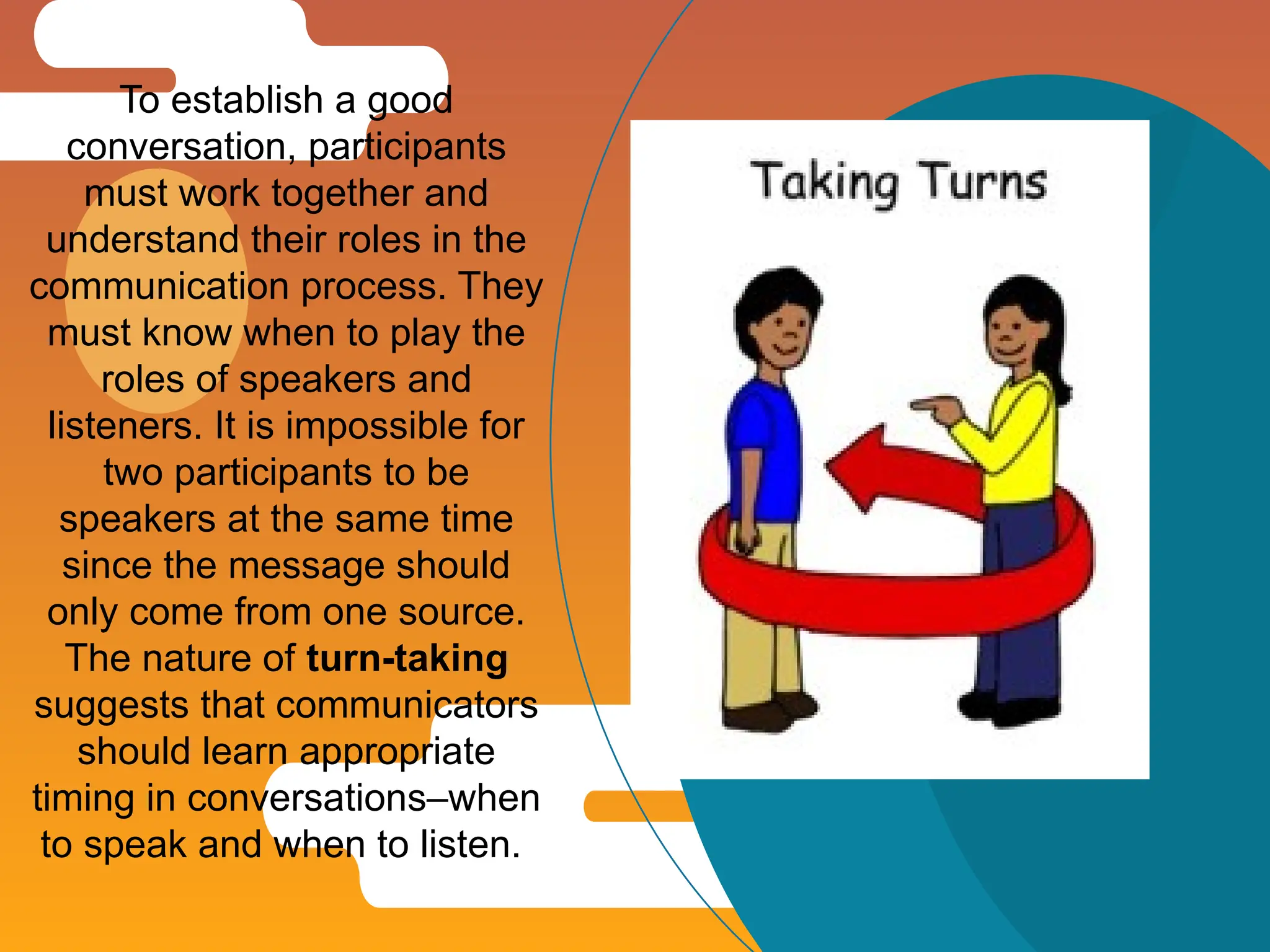
To establish a good
conversation, participants
must work together and
understand their roles in the
communication process. They
must know when to play the
roles of speakers and
listeners. It is impossible for
two participants to be
speakers at the same time
since the message should
only come from one source.
The nature of turn-taking
suggests that communicators
should learn appropriate
timing in conversations–when
to speak and when to listen.
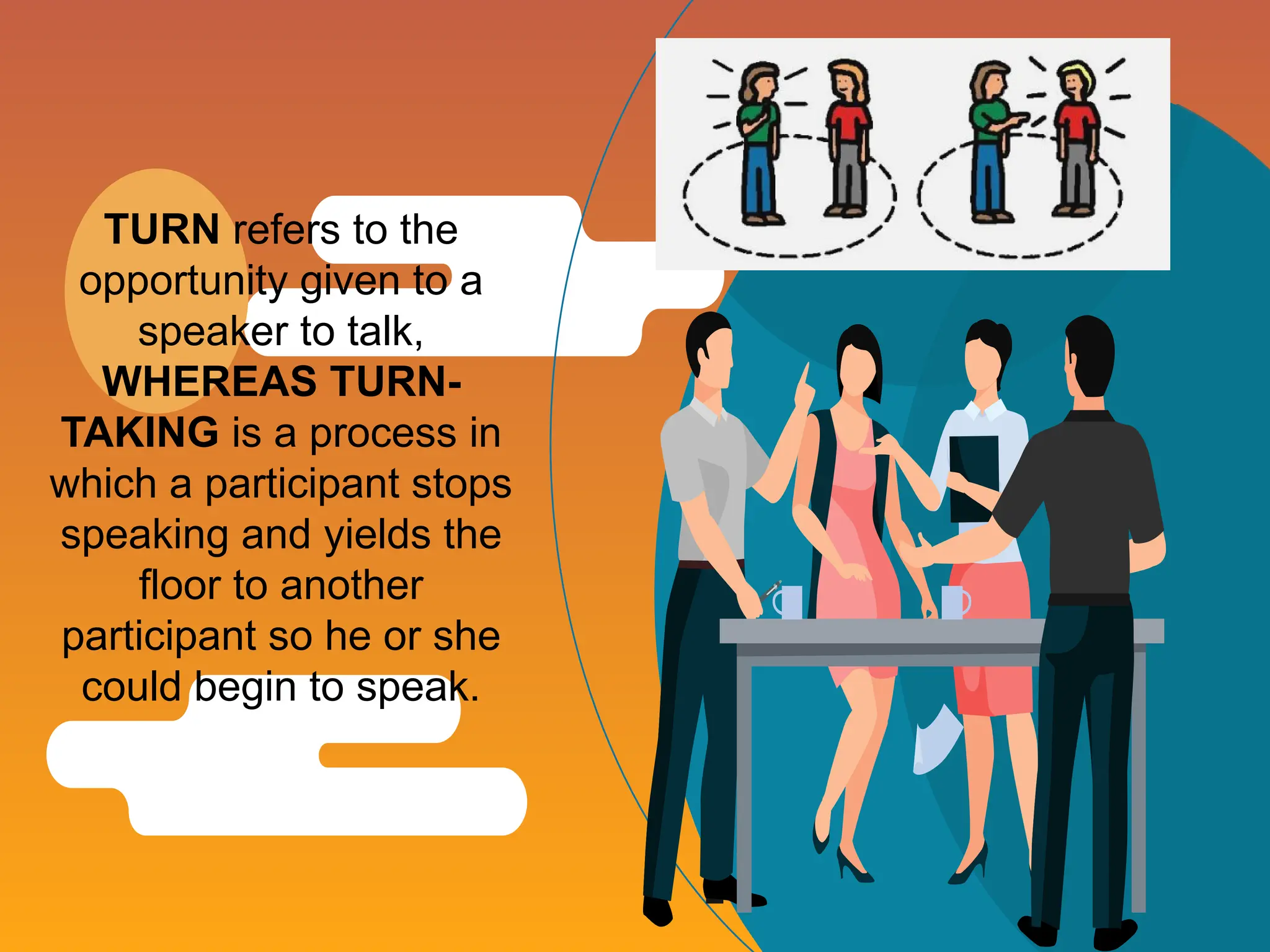
TURN refers to the
opportunity given to a
speaker to talk,
WHEREAS TURN-
TAKING is a process in
which a participant stops
speaking and yields the
floor to another
participant so he or she
could begin to speak.
4
THREE TURN-TAKING
ACTS
suggests that
another participant
can take the role of
the speaker.
TAKE-TURN
suggests that a speaker must
not stop until he fulfills his
purpose in a conversation.
KEEP-TURN
suggests that a
speaker is finished
talking and is ready
to yield the floor to
another person to
take his or her turn.
He or she may use
signals or pause in
a conversation.
RELEASE-
TURN
5
•Signals and cues indicate that a speaker
wants to keep, yield, or take his or her
turn.
• Intonation signals that a speaker wants
to keep or yield his or her turn. Rising
and falling intonations indicate that a
speaker is releasing his or her turn. A
falling intonation indicates that a speaker
is about to end his or her turn, while a
rising intonation implies that a speaker is
asking the participants for clarification
and confirmation or sometimes to
express disbelief.
6
• Verbal cues suggest that a speaker
wants to yield or to keep his or her turn.
For example, calling the participants’
names indicate that a speaker is
releasing his or her turn. Meanwhile,
using sentence connectors such as
“additionally,” “on the contrary,”
“furthermore,” “consequently,” or
“likewise” suggests the speaker has
something more to say.
• Nonverbal cues or gestures like raising
one’s hand show that a participant wants
to take the floor or speak. Also, when a
speaker points to or fixes his or her gaze
on a participant may mean that he or she
wants that participant to speak.
7
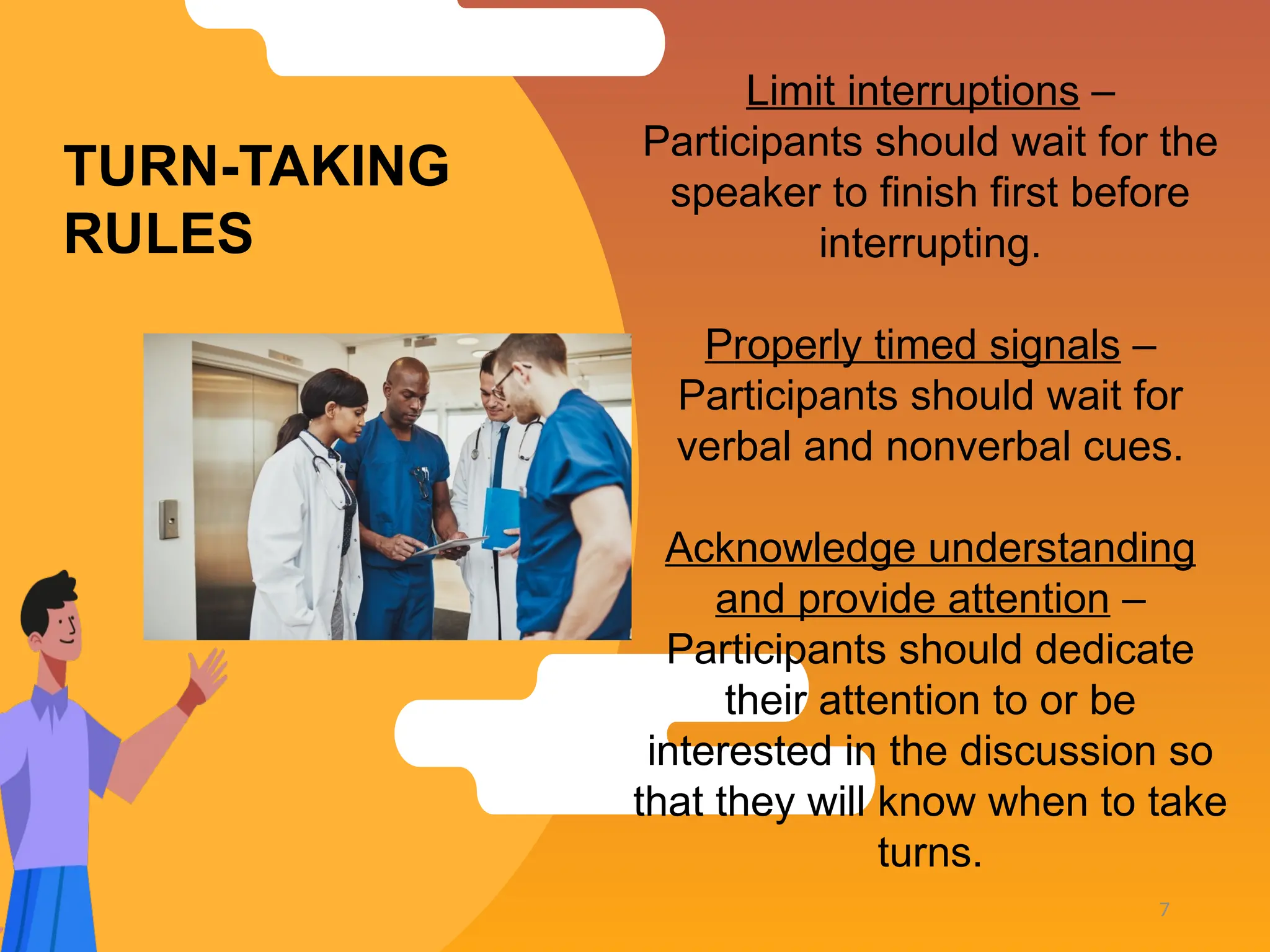
TURN-TAKING
RULES
Limit interruptions –
Participants should wait for the
speaker to finish first before
interrupting.
Properly timed signals –
Participants should wait for
verbal and nonverbal cues.
Acknowledge understanding
and provide attention –
Participants should dedicate
their attention to or be
interested in the discussion so
that they will know when to take
turns.
8
LEARN ABOUT IT!
Mr. Sanchez is going to attend to his first job interview as a
civil engineer. He studied his résumé and prepared for the
responses to questions that might be asked. When he
arrived at the office, he has been asked to wait for twenty
minutes. Once the interviewer calls his name, he may enter
Room D. After twenty minutes, he, together with another
applicant, has been asked to enter the room.
Miss Santos: Good afternoon, Mr. Sanchez and Miss
Sarmiento. I am Miss Santos, the human resource officer.
(She then proceeds to provide information about the history
of the company.)
Mr. Sanchez: Good afternoon, Miss Santos!
Miss Santos: Please take a seat.
Miss Sarmiento: Thank you, Ma’am!
Miss Sanchez: This is going to be a fifteen-minute
interview. I will forward your applications to the supervisors if
I find you–
Miss Sarmiento: Oh? Just a fifteen-minute interview? Miss
Santos: You heard it right. Let me finish first. I will forward
your applications to the supervisors if I find you qualified for
the position. Can you tell me something about your
academic background? Let’s start with you, Mr. Sanchez.
9
LEARN ABOUT IT! (CONTINUATION)
Mr. Sanchez: I graduated as a summa cum laude in
2014. I have always treated my days in the university as a
preparation for my career. Also–
Miss. Sarmiento: Me too! In fact, I have served as a
student leader during my second year in college. That was
amazing! By the way, do you have a position as a team
leader?
Miss Santos: (Nods) We do. However, they are only open
for tenured employees. Mr. Sanchez, do you also want to
work as a team leader?
Mr. Sanchez: (Answers after three seconds) Yes, I do!
However, I understand that I need to have an experience
first as a site engineer before leading a group of people.
Miss Santos: (Flips the résumé of Miss Sarmiento on the
second page)
Miss Sarmiento: (Having seen the action of Miss Santos)
Oh, by the way, the second page does not contain any
significant information, except character references.
Miss Santos: I am just looking at your résumé. Kindly
wait for my next question.
(Miss Santos continues asking questions. The interview
lasts for fifteen minutes.)
10
In the given example, you will
notice various turn-taking acts
that were included. Miss
Santos’s introduction of herself
implied keep-turn. She did not
stop in between, thus achieving
her purpose of briefing the
applicants about the company.
Meanwhile, the act of Miss
Santos calling Mr. Ramirez’s
name to answer her question
means that she was yielding her
turn.
Mr. Ramirez demonstrated the
take-turn act when he
responded to Miss Santos’s
question.
EXPLANATION

ORAL COMMUNICATION IN CONTEXT - TURN TAKING.pptx

  • 1.
    ORAL COMMUNICATION IN CONTEXT UNIT 3:COMMUNICATIVE COMPETENCE STRATEGIES IN VARIOUS SPEECH SITUATIONS LESSON 7: TURN-TAKING
  • 2.
    To establish agood conversation, participants must work together and understand their roles in the communication process. They must know when to play the roles of speakers and listeners. It is impossible for two participants to be speakers at the same time since the message should only come from one source. The nature of turn-taking suggests that communicators should learn appropriate timing in conversations–when to speak and when to listen.
  • 3.
    TURN refers tothe opportunity given to a speaker to talk, WHEREAS TURN- TAKING is a process in which a participant stops speaking and yields the floor to another participant so he or she could begin to speak.
  • 4.
    4 THREE TURN-TAKING ACTS suggests that anotherparticipant can take the role of the speaker. TAKE-TURN suggests that a speaker must not stop until he fulfills his purpose in a conversation. KEEP-TURN suggests that a speaker is finished talking and is ready to yield the floor to another person to take his or her turn. He or she may use signals or pause in a conversation. RELEASE- TURN
  • 5.
    5 •Signals and cuesindicate that a speaker wants to keep, yield, or take his or her turn. • Intonation signals that a speaker wants to keep or yield his or her turn. Rising and falling intonations indicate that a speaker is releasing his or her turn. A falling intonation indicates that a speaker is about to end his or her turn, while a rising intonation implies that a speaker is asking the participants for clarification and confirmation or sometimes to express disbelief.
  • 6.
    6 • Verbal cuessuggest that a speaker wants to yield or to keep his or her turn. For example, calling the participants’ names indicate that a speaker is releasing his or her turn. Meanwhile, using sentence connectors such as “additionally,” “on the contrary,” “furthermore,” “consequently,” or “likewise” suggests the speaker has something more to say. • Nonverbal cues or gestures like raising one’s hand show that a participant wants to take the floor or speak. Also, when a speaker points to or fixes his or her gaze on a participant may mean that he or she wants that participant to speak.
  • 7.
    7 TURN-TAKING RULES Limit interruptions – Participantsshould wait for the speaker to finish first before interrupting. Properly timed signals – Participants should wait for verbal and nonverbal cues. Acknowledge understanding and provide attention – Participants should dedicate their attention to or be interested in the discussion so that they will know when to take turns.
  • 8.
    8 LEARN ABOUT IT! Mr.Sanchez is going to attend to his first job interview as a civil engineer. He studied his résumé and prepared for the responses to questions that might be asked. When he arrived at the office, he has been asked to wait for twenty minutes. Once the interviewer calls his name, he may enter Room D. After twenty minutes, he, together with another applicant, has been asked to enter the room. Miss Santos: Good afternoon, Mr. Sanchez and Miss Sarmiento. I am Miss Santos, the human resource officer. (She then proceeds to provide information about the history of the company.) Mr. Sanchez: Good afternoon, Miss Santos! Miss Santos: Please take a seat. Miss Sarmiento: Thank you, Ma’am! Miss Sanchez: This is going to be a fifteen-minute interview. I will forward your applications to the supervisors if I find you– Miss Sarmiento: Oh? Just a fifteen-minute interview? Miss Santos: You heard it right. Let me finish first. I will forward your applications to the supervisors if I find you qualified for the position. Can you tell me something about your academic background? Let’s start with you, Mr. Sanchez.
  • 9.
    9 LEARN ABOUT IT!(CONTINUATION) Mr. Sanchez: I graduated as a summa cum laude in 2014. I have always treated my days in the university as a preparation for my career. Also– Miss. Sarmiento: Me too! In fact, I have served as a student leader during my second year in college. That was amazing! By the way, do you have a position as a team leader? Miss Santos: (Nods) We do. However, they are only open for tenured employees. Mr. Sanchez, do you also want to work as a team leader? Mr. Sanchez: (Answers after three seconds) Yes, I do! However, I understand that I need to have an experience first as a site engineer before leading a group of people. Miss Santos: (Flips the résumé of Miss Sarmiento on the second page) Miss Sarmiento: (Having seen the action of Miss Santos) Oh, by the way, the second page does not contain any significant information, except character references. Miss Santos: I am just looking at your résumé. Kindly wait for my next question. (Miss Santos continues asking questions. The interview lasts for fifteen minutes.)
  • 10.
    10 In the givenexample, you will notice various turn-taking acts that were included. Miss Santos’s introduction of herself implied keep-turn. She did not stop in between, thus achieving her purpose of briefing the applicants about the company. Meanwhile, the act of Miss Santos calling Mr. Ramirez’s name to answer her question means that she was yielding her turn. Mr. Ramirez demonstrated the take-turn act when he responded to Miss Santos’s question. EXPLANATION

Editor's Notes

  • #1 Illustration by https://www.freepik.com
  • #2 <a href="https://www.freepik.com/free-photos-vectors/business">Business vector created by macrovector - www.freepik.com</a>
  • #3 <a href="https://www.freepik.com/free-photos-vectors/business">Business vector created by macrovector - www.freepik.com</a>
  • #4 Illustration by https://www.freepik.com
  • #7 Illustration by https://www.freepik.com
  • #10 Illustration by https://www.freepik.com