S U C C E S S F U L C O M M U N I C AT I O N R E Q U I R E S U N D E R S TAN D I N G
Types of
Communicative
Strategy
TYPES OF COMMUNICATIVE STRATEGY:
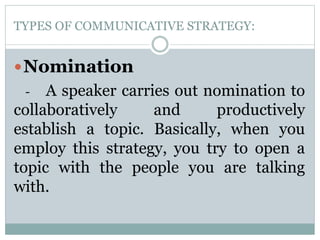
Nomination
- A speaker carries out nomination to
collaboratively and productively
establish a topic. Basically, when you
employ this strategy, you try to open a
topic with the people you are talking
with.
TYPES OF COMMUNICATIVE STRATEGY:
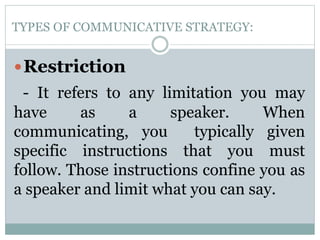
Restriction
- It refers to any limitation you may
have as a speaker. When
communicating, you typically given
specific instructions that you must
follow. Those instructions confine you as
a speaker and limit what you can say.
TYPES OF COMMUNICATIVE STRATEGY:
Turn-taking
- The process by which people decide
who takes the conversational floor. There
are code of behavior behind establishing
a productive conversation. But the
primary purpose of this idea is to give
chance to all communicators to speak.
TYPES OF COMMUNICATIVE STRATEGY:
Topic Control
- It covers how procedural formality or
informality affect the development of
topic in conversations.
TYPES OF COMMUNICATIVE STRATEGY:
Topic Shifting
- It involves moving from one topic to
another. In other words, it is where one
part of a conversation ends and where
another begins.
TYPES OF COMMUNICATIVE STRATEGY:
Repair
- It refers to how speakers address the
problems in speaking, listening, and
comprehending that they may encounter
in a conversation.
TYPES OF COMMUNICATIVE STRATEGY:
Termination
- It refers to the conversation
participants’ close-initiating expressions
that end a topic in a conversation. Most
of the time, the topic initiator takes
responsibility to signal the end of the
discussion as well.
According to Bahman, Gorjian and Parviz Habibi
(2015)
“The effect of conversation on the
classroom interaction: The case of Turn-
Taking” contends that a conversation is a
form of interactive, spontaneous
communication between two or more
people who are following rules of
politeness or ceremonies.
They stressed that turn-taking covers a
wide range of concern, not just a
theoretical construction in the linguistic
field of discourse analysis, but an
essential pattern in communicative
events, governing speech-acts and
defining social roles as it establishes and
maintain social relationships.
It plays an essential role in
structuring people’s social
interactions concerning control and
regulations of conversations. it is the
process by which people in
conversation decide who is to speak
next .
What is turn?
 it is the essential factor within
conversation strategies, which is
attached to a speaker.
 Edelsky (1981) defines turn as an
instance of on-record speaking ,
with the intention of conveying a
message.
Turn-taking is the process of establishing who
is going to speak and the next speaker. It is
usually done to be more organized.
There are two guiding principles in
conversations:
1. Only one person should talk at a time.
2. Interlocutors should not have silence.
The transition between one speaker and the
next must be as smooth as possible and
without a break.
We have different ways of indicating that a turn
will be changed:
 Formal methods: for example, selecting
the next speaker by name or raising a
hand.
 Adjacency pairs: for instance, a
question requires an answer.
 Intonation: for instance, a drop in pitch
or in loudness.
We have different ways of indicating that a turn
will be changed:
Gesture: for instance, a change in
sitting position or an expression of
inquiry.
the most important device for
indicating turn-taking is through a
change in gaze direction.
The rules of turn-taking are designed to help conversation take
place smoothly. Interruptions in a conversation are violations of
the turn-taking rule.
 Interruption: where a new speaker
interrupts and gains the floor.
 Butting in: where a new speaker tries to
gain the floor but does not succeed.
 Overlaps: where two speakers are
talking at the same time.
Responses such as mmmm and yeah
are known as minimal responses.
These are not interruptions but
rather are devices to show the
listener is listening, and they assist
the speaker to continue.
Story-telling within a
conversation is indicated by some
preface. It is a signal to the
listener that for the duration of
the story, there will be no turn-
taking.
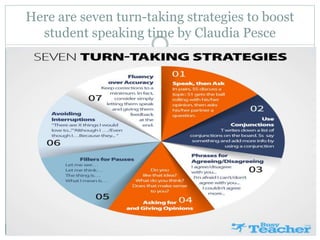
Here are seven turn-taking strategies to boost
student speaking time by Claudia Pesce
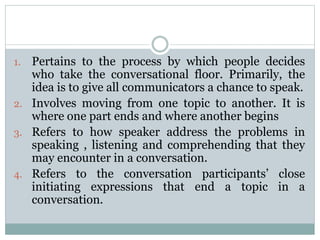
1. Pertains to the process by which people decides
who take the conversational floor. Primarily, the
idea is to give all communicators a chance to speak.
2. Involves moving from one topic to another. It is
where one part ends and where another begins
3. Refers to how speaker address the problems in
speaking , listening and comprehending that they
may encounter in a conversation.
4. Refers to the conversation participants’ close
initiating expressions that end a topic in a
conversation.
Answer
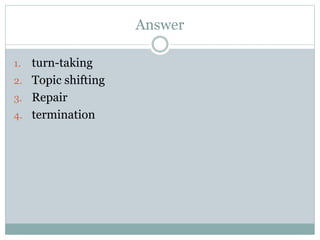
1. turn-taking
2. Topic shifting
3. Repair
4. termination

435386503-Types-of-communicative-strategy.pptx

  • 1.
    S U CC E S S F U L C O M M U N I C AT I O N R E Q U I R E S U N D E R S TAN D I N G Types of Communicative Strategy
  • 2.
    TYPES OF COMMUNICATIVESTRATEGY: Nomination - A speaker carries out nomination to collaboratively and productively establish a topic. Basically, when you employ this strategy, you try to open a topic with the people you are talking with.
  • 3.
    TYPES OF COMMUNICATIVESTRATEGY: Restriction - It refers to any limitation you may have as a speaker. When communicating, you typically given specific instructions that you must follow. Those instructions confine you as a speaker and limit what you can say.
  • 4.
    TYPES OF COMMUNICATIVESTRATEGY: Turn-taking - The process by which people decide who takes the conversational floor. There are code of behavior behind establishing a productive conversation. But the primary purpose of this idea is to give chance to all communicators to speak.
  • 5.
    TYPES OF COMMUNICATIVESTRATEGY: Topic Control - It covers how procedural formality or informality affect the development of topic in conversations.
  • 6.
    TYPES OF COMMUNICATIVESTRATEGY: Topic Shifting - It involves moving from one topic to another. In other words, it is where one part of a conversation ends and where another begins.
  • 7.
    TYPES OF COMMUNICATIVESTRATEGY: Repair - It refers to how speakers address the problems in speaking, listening, and comprehending that they may encounter in a conversation.
  • 8.
    TYPES OF COMMUNICATIVESTRATEGY: Termination - It refers to the conversation participants’ close-initiating expressions that end a topic in a conversation. Most of the time, the topic initiator takes responsibility to signal the end of the discussion as well.
  • 9.
    According to Bahman,Gorjian and Parviz Habibi (2015) “The effect of conversation on the classroom interaction: The case of Turn- Taking” contends that a conversation is a form of interactive, spontaneous communication between two or more people who are following rules of politeness or ceremonies.
  • 10.
    They stressed thatturn-taking covers a wide range of concern, not just a theoretical construction in the linguistic field of discourse analysis, but an essential pattern in communicative events, governing speech-acts and defining social roles as it establishes and maintain social relationships.
  • 11.
    It plays anessential role in structuring people’s social interactions concerning control and regulations of conversations. it is the process by which people in conversation decide who is to speak next .
  • 12.
    What is turn? it is the essential factor within conversation strategies, which is attached to a speaker.  Edelsky (1981) defines turn as an instance of on-record speaking , with the intention of conveying a message.
  • 13.
    Turn-taking is theprocess of establishing who is going to speak and the next speaker. It is usually done to be more organized. There are two guiding principles in conversations: 1. Only one person should talk at a time. 2. Interlocutors should not have silence. The transition between one speaker and the next must be as smooth as possible and without a break.
  • 14.
    We have differentways of indicating that a turn will be changed:  Formal methods: for example, selecting the next speaker by name or raising a hand.  Adjacency pairs: for instance, a question requires an answer.  Intonation: for instance, a drop in pitch or in loudness.
  • 15.
    We have differentways of indicating that a turn will be changed: Gesture: for instance, a change in sitting position or an expression of inquiry. the most important device for indicating turn-taking is through a change in gaze direction.
  • 16.
    The rules ofturn-taking are designed to help conversation take place smoothly. Interruptions in a conversation are violations of the turn-taking rule.  Interruption: where a new speaker interrupts and gains the floor.  Butting in: where a new speaker tries to gain the floor but does not succeed.  Overlaps: where two speakers are talking at the same time.
  • 17.
    Responses such asmmmm and yeah are known as minimal responses. These are not interruptions but rather are devices to show the listener is listening, and they assist the speaker to continue.
  • 18.
    Story-telling within a conversationis indicated by some preface. It is a signal to the listener that for the duration of the story, there will be no turn- taking.
  • 19.
    Here are seventurn-taking strategies to boost student speaking time by Claudia Pesce
  • 21.
    1. Pertains tothe process by which people decides who take the conversational floor. Primarily, the idea is to give all communicators a chance to speak. 2. Involves moving from one topic to another. It is where one part ends and where another begins 3. Refers to how speaker address the problems in speaking , listening and comprehending that they may encounter in a conversation. 4. Refers to the conversation participants’ close initiating expressions that end a topic in a conversation.
  • 23.
    Answer 1. turn-taking 2. Topicshifting 3. Repair 4. termination