1
ORAL
COMMUNICATION
IN CONTEXT
UNIT 2: FUNCTIONS OF
COMMUNICATION
LESSON 2:
MOTIVATION
2
COMMUNICATION
AND MOTIVATION
Communication is a
cooperative activity. You
engage in and maintain
conversations to achieve
a particular goal.
Through communication,
you build social
relationships with other
people.
3
MOTIVATION
Communication also functions to
motivate yourself and
others. Motivation is the driving force
that enables you to take action in order
to accomplish a desired goal. You use
communication to motivate yourself and
others in various situations. For example,
you sometimes engage in an
introspective self-talk (or “talking to
oneself” by examining one’s own
thoughts) when you are faced with a
difficult decision-making situation. You
also talk to a friend who is having a hard
time understanding the lessons in your
class.
4
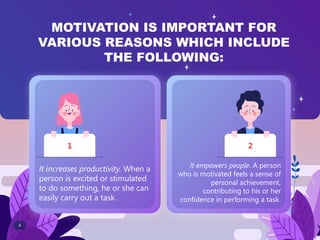
MOTIVATION IS IMPORTANT FOR
VARIOUS REASONS WHICH INCLUDE
THE FOLLOWING:
It empowers people. A person
who is motivated feels a sense of
personal achievement,
contributing to his or her
confidence in performing a task.
2
It increases productivity. When a
person is excited or stimulated
to do something, he or she can
easily carry out a task.
1
5
MOTIVATING OTHERS
THROUGH COMMUNICATION
WALK THE
TALK
You cannot
motivate others
if you are not
motivated
yourself. Know
and understand
what motivates
you. Then, find
ways on how to
better motivate
yourself.
BE AN ACTIVE
LISTENER
Listen
attentively and
genuinely to
what the other
person has to
say. Find out
what the
person’s goal is,
or what he or
she wants to
do.
.
6
MOTIVATING OTHERS
THROUGH COMMUNICATION
REMIND THE
PERSON THAT
HE/ SHE
MAKES A
DIFFERENCE
Every small
contribution or
action makes a
difference. Let
the person
know that his or
her effort is
recognized and
appreciated.
COMMUNICATE
CLEARLY AND
WITH
COMPASSION
Clearly state your
intention to avoid
misinterpretation.
Focus on the
quality, not
quantity, of
communication.
Learn to adapt
your
communication
style to the
person you are
speaking.
.
7
READ THE FOLLOWING DIALOGUE
BETWEEN BEST FRIENDS
Rina: Hey, Carla! Why do look so sad?
Carla: Oh, is it that obvious? I got a poor
mark for my essay despite the hard work
I put into it. (looking glum)
Rina: Oh . . . (gives Carla a pat on the
shoulder) Well, what’s important is that
you did your best. I’m sure you can do
better on your next essay.
Carla: You think so?
Rina: I know so. You can do it! I can
check your next essay before you submit
it if you want.
Carla: That’d be great! Thanks, Rina. You
really are the best! (smiles and hugs
Rina)
Rina: It’s nothing. You’re welcome!
.
8
MOTIVATION IN
VARIOUS SITUATIONS/
SETTINGS
Motivation is observable in different situations
or settings. In a classroom, a teacher motivates
the class to study harder to get good grades
and to graduate. In school club or organization
meetings, the president or leader motivates the
members to do their best in any of their
projects or activities. In a workplace, an
employer or manager encourages the
employees to perform well in their jobs.
9
One of the most popular
ways of motivating others is
by delivering a speech.
A motivational speech is
given to encourage personal
or professional growth in the
audience. It is also designed
to move an audience to
make a positive change.
1
0
EXAMPLE:
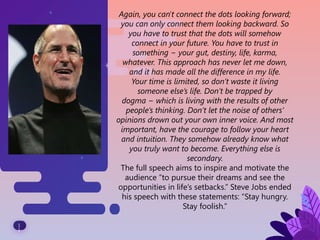
Steve Jobs, CEO of Apple and Pixar
Animation Studios, was one of the most
influential people of the 20th century.
He delivered a motivational
commencement speech at Stanford
University in 2005. Below are
paragraphs taken from his speech.
1
1
Again, you can't connect the dots looking forward;
you can only connect them looking backward. So
you have to trust that the dots will somehow
connect in your future. You have to trust in
something − your gut, destiny, life, karma,
whatever. This approach has never let me down,
and it has made all the difference in my life.
Your time is limited, so don’t waste it living
someone else’s life. Don’t be trapped by
dogma − which is living with the results of other
people’s thinking. Don’t let the noise of others’
opinions drown out your own inner voice. And most
important, have the courage to follow your heart
and intuition. They somehow already know what
you truly want to become. Everything else is
secondary.
The full speech aims to inspire and motivate the
audience “to pursue their dreams and see the
opportunities in life’s setbacks.” Steve Jobs ended
his speech with these statements: “Stay hungry.
Stay foolish.”

FUNCTIONS OF COMMUNICATION SECOND QUARTERpptx

  • 1.
    1 ORAL COMMUNICATION IN CONTEXT UNIT 2:FUNCTIONS OF COMMUNICATION LESSON 2: MOTIVATION
  • 2.
    2 COMMUNICATION AND MOTIVATION Communication isa cooperative activity. You engage in and maintain conversations to achieve a particular goal. Through communication, you build social relationships with other people.
  • 3.
    3 MOTIVATION Communication also functionsto motivate yourself and others. Motivation is the driving force that enables you to take action in order to accomplish a desired goal. You use communication to motivate yourself and others in various situations. For example, you sometimes engage in an introspective self-talk (or “talking to oneself” by examining one’s own thoughts) when you are faced with a difficult decision-making situation. You also talk to a friend who is having a hard time understanding the lessons in your class.
  • 4.
    4 MOTIVATION IS IMPORTANTFOR VARIOUS REASONS WHICH INCLUDE THE FOLLOWING: It empowers people. A person who is motivated feels a sense of personal achievement, contributing to his or her confidence in performing a task. 2 It increases productivity. When a person is excited or stimulated to do something, he or she can easily carry out a task. 1
  • 5.
    5 MOTIVATING OTHERS THROUGH COMMUNICATION WALKTHE TALK You cannot motivate others if you are not motivated yourself. Know and understand what motivates you. Then, find ways on how to better motivate yourself. BE AN ACTIVE LISTENER Listen attentively and genuinely to what the other person has to say. Find out what the person’s goal is, or what he or she wants to do. .
  • 6.
    6 MOTIVATING OTHERS THROUGH COMMUNICATION REMINDTHE PERSON THAT HE/ SHE MAKES A DIFFERENCE Every small contribution or action makes a difference. Let the person know that his or her effort is recognized and appreciated. COMMUNICATE CLEARLY AND WITH COMPASSION Clearly state your intention to avoid misinterpretation. Focus on the quality, not quantity, of communication. Learn to adapt your communication style to the person you are speaking. .
  • 7.
    7 READ THE FOLLOWINGDIALOGUE BETWEEN BEST FRIENDS Rina: Hey, Carla! Why do look so sad? Carla: Oh, is it that obvious? I got a poor mark for my essay despite the hard work I put into it. (looking glum) Rina: Oh . . . (gives Carla a pat on the shoulder) Well, what’s important is that you did your best. I’m sure you can do better on your next essay. Carla: You think so? Rina: I know so. You can do it! I can check your next essay before you submit it if you want. Carla: That’d be great! Thanks, Rina. You really are the best! (smiles and hugs Rina) Rina: It’s nothing. You’re welcome! .
  • 8.
    8 MOTIVATION IN VARIOUS SITUATIONS/ SETTINGS Motivationis observable in different situations or settings. In a classroom, a teacher motivates the class to study harder to get good grades and to graduate. In school club or organization meetings, the president or leader motivates the members to do their best in any of their projects or activities. In a workplace, an employer or manager encourages the employees to perform well in their jobs.
  • 9.
    9 One of themost popular ways of motivating others is by delivering a speech. A motivational speech is given to encourage personal or professional growth in the audience. It is also designed to move an audience to make a positive change.
  • 10.
    1 0 EXAMPLE: Steve Jobs, CEOof Apple and Pixar Animation Studios, was one of the most influential people of the 20th century. He delivered a motivational commencement speech at Stanford University in 2005. Below are paragraphs taken from his speech.
  • 11.
    1 1 Again, you can'tconnect the dots looking forward; you can only connect them looking backward. So you have to trust that the dots will somehow connect in your future. You have to trust in something − your gut, destiny, life, karma, whatever. This approach has never let me down, and it has made all the difference in my life. Your time is limited, so don’t waste it living someone else’s life. Don’t be trapped by dogma − which is living with the results of other people’s thinking. Don’t let the noise of others’ opinions drown out your own inner voice. And most important, have the courage to follow your heart and intuition. They somehow already know what you truly want to become. Everything else is secondary. The full speech aims to inspire and motivate the audience “to pursue their dreams and see the opportunities in life’s setbacks.” Steve Jobs ended his speech with these statements: “Stay hungry. Stay foolish.”