By:Dr Vinesh Raj.S
BDS,FAD,MFDS RCS
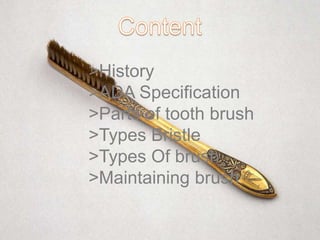
>History
>ADA Specification
>Parts of tooth brush
>Types Bristle
>Types Of brush
>Maintaining brush
Basic evolution of tooth brush
Finger
Chew Stick
Toothbrush with animal hair
Toothbrush with nylon
>The predecessor of the
toothbrush, the chew stick, first
appeared in Egypt and
Babylonia.
> The earliest bristle
toothbrush, the direct
predecessor to the modern
toothbrush, originated in China.
>Toothbrushes were introduced
to Europe through merchants
and travelers in East Asia by the
17th century.
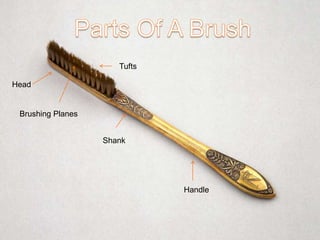
Tufts
Brushing Planes
Handle
Shank
Head
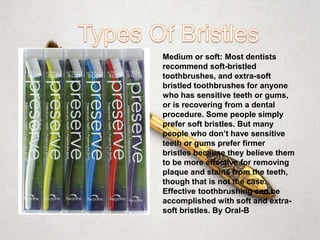
Medium or soft: Most dentists
recommend soft-bristled
toothbrushes, and extra-soft
bristled toothbrushes for anyone
who has sensitive teeth or gums,
or is recovering from a dental
procedure. Some people simply
prefer soft bristles. But many
people who don’t have sensitive
teeth or gums prefer firmer
bristles because they believe them
to be more effective for removing
plaque and stains from the teeth,
though that is not the case.
Effective toothbrushing can be
accomplished with soft and extra-
soft bristles. By Oral-B
Electrical tooth brush
Interdental brush
Sulcabrush
End-Tuft brush
Chewable brush
Ecological brush
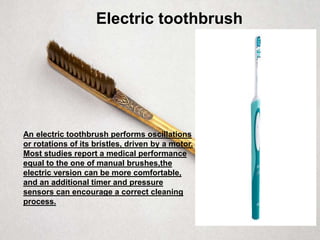
An electric toothbrush performs oscillations
or rotations of its bristles, driven by a motor.
Most studies report a medical performance
equal to the one of manual brushes,the
electric version can be more comfortable,
and an additional timer and pressure
sensors can encourage a correct cleaning
process.
Electric toothbrush
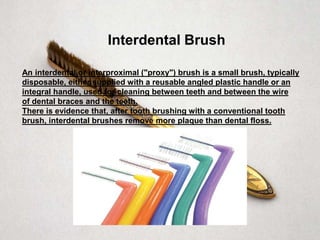
An interdental or interproximal ("proxy") brush is a small brush, typically
disposable, either supplied with a reusable angled plastic handle or an
integral handle, used for cleaning between teeth and between the wire
of dental braces and the teeth.
There is evidence that, after tooth brushing with a conventional tooth
brush, interdental brushes remove more plaque than dental floss.
Interdental Brush
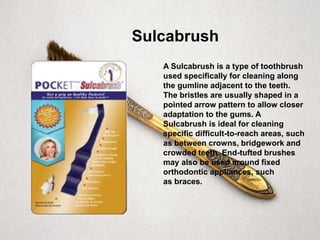
A Sulcabrush is a type of toothbrush
used specifically for cleaning along
the gumline adjacent to the teeth.
The bristles are usually shaped in a
pointed arrow pattern to allow closer
adaptation to the gums. A
Sulcabrush is ideal for cleaning
specific difficult-to-reach areas, such
as between crowns, bridgework and
crowded teeth. End-tufted brushes
may also be used around fixed
orthodontic appliances, such
as braces.
Sulcabrush
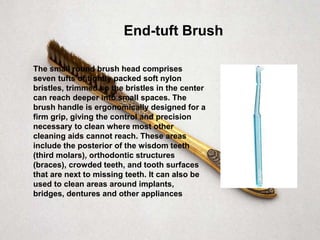
The small round brush head comprises
seven tufts of tightly packed soft nylon
bristles, trimmed so the bristles in the center
can reach deeper into small spaces. The
brush handle is ergonomically designed for a
firm grip, giving the control and precision
necessary to clean where most other
cleaning aids cannot reach. These areas
include the posterior of the wisdom teeth
(third molars), orthodontic structures
(braces), crowded teeth, and tooth surfaces
that are next to missing teeth. It can also be
used to clean areas around implants,
bridges, dentures and other appliances
End-tuft Brush
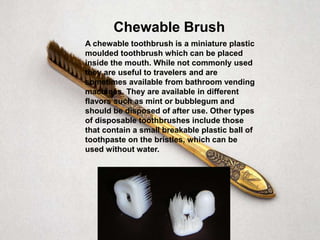
Chewable Brush
A chewable toothbrush is a miniature plastic
moulded toothbrush which can be placed
inside the mouth. While not commonly used
they are useful to travelers and are
sometimes available from bathroom vending
machines. They are available in different
flavors such as mint or bubblegum and
should be disposed of after use. Other types
of disposable toothbrushes include those
that contain a small breakable plastic ball of
toothpaste on the bristles, which can be
used without water.
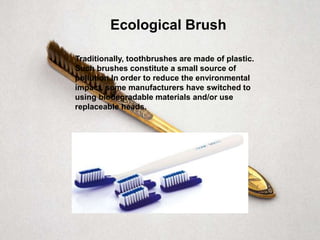
Ecological Brush
Traditionally, toothbrushes are made of plastic.
Such brushes constitute a small source of
pollution.In order to reduce the environmental
impact, some manufacturers have switched to
using biodegradable materials and/or use
replaceable heads.
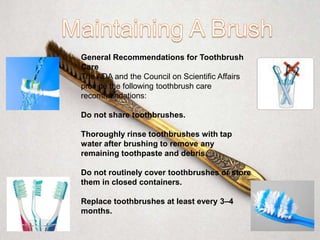
General Recommendations for Toothbrush
Care
The ADA and the Council on Scientific Affairs
provide the following toothbrush care
recommendations:
Do not share toothbrushes.
Thoroughly rinse toothbrushes with tap
water after brushing to remove any
remaining toothpaste and debris.
Do not routinely cover toothbrushes or store
them in closed containers.
Replace toothbrushes at least every 3–4
months.
Methods of brushing;
• Bass
• Charters
• Stillman
• Fones
Hold the brush at the commonly recognized 45 degree angle to the
tooth and gum line.
The main difference in the Bass technique is how small the
movements are. The Bass brushing technique uses very small lateral
strokes along the gum line.
It’s almost like you aren’t “brushing” your teeth. Rather, you place the
toothbrush at a spot along the gum line and gently wiggle using very
small, fine back-and-forth motions to get the bristles down between
the teeth and under the gum line.
Count to 5, then move to the next place with your brush and repeat.
For normal healhty adult oral cavity.
Charter's technique is recommended for post-operative
patients, or painful tissue.
The bristles are angled 45 degrees away from the gingiva
towards the crown with half of the bristles on gum, and half
of on teeth.
The handle is parallel to the horizon or occlusal plane.
Small circular strokes as you move posterior to anterior,
while staying on 2 teeth at a time for a few seconds
Provides gingival stimulation (vibratory motion)
Suitable for gingival recession (Toothbrush bristle ends not directed into sulcus)
Less traumatic to the gingiva
People with continuous gingival recession
Direct bristles apically to sulcus at 45° to the long axis of the tooth .
Place bristles partly on the cervical part and on the gingiva.
Apply vibratory motion with slight pressure to stimulate gingiva
This was probably one the first methods taught by the dental
profession, especially in the US.
Dr. Fones founded the first Dental Hygienists course in the US, and
his technique was the standard method used for many years, it is often
called the Circular method.
With the teeth closed, place the tip of the bristles gently against the
side of the back teeth. Sweep the brush vigorously over the tooth
surface in a circular motion covering both upper and lower teeth
working your way forward. When cleaning the front teeth, bring them
edge to edge and continue brushing.
• Tools – scrapers and brushes
manual/electric toothbrush
Possible tissue trauma due to hard scrubbing
• Technique - start at posterior & drag to tip
- use lateral movement for severe gaggers
- use overlapping strokes until visibly clean
• Frequency - at least once a day
Tooth brush and brushing techniques

Tooth brush and brushing techniques

  • 1.
  • 5.
    >History >ADA Specification >Parts oftooth brush >Types Bristle >Types Of brush >Maintaining brush
  • 6.
    Basic evolution oftooth brush Finger Chew Stick Toothbrush with animal hair Toothbrush with nylon
  • 7.
    >The predecessor ofthe toothbrush, the chew stick, first appeared in Egypt and Babylonia. > The earliest bristle toothbrush, the direct predecessor to the modern toothbrush, originated in China. >Toothbrushes were introduced to Europe through merchants and travelers in East Asia by the 17th century.
  • 9.
  • 10.
    Medium or soft:Most dentists recommend soft-bristled toothbrushes, and extra-soft bristled toothbrushes for anyone who has sensitive teeth or gums, or is recovering from a dental procedure. Some people simply prefer soft bristles. But many people who don’t have sensitive teeth or gums prefer firmer bristles because they believe them to be more effective for removing plaque and stains from the teeth, though that is not the case. Effective toothbrushing can be accomplished with soft and extra- soft bristles. By Oral-B
  • 11.
    Electrical tooth brush Interdentalbrush Sulcabrush End-Tuft brush Chewable brush Ecological brush
  • 12.
    An electric toothbrushperforms oscillations or rotations of its bristles, driven by a motor. Most studies report a medical performance equal to the one of manual brushes,the electric version can be more comfortable, and an additional timer and pressure sensors can encourage a correct cleaning process. Electric toothbrush
  • 13.
    An interdental orinterproximal ("proxy") brush is a small brush, typically disposable, either supplied with a reusable angled plastic handle or an integral handle, used for cleaning between teeth and between the wire of dental braces and the teeth. There is evidence that, after tooth brushing with a conventional tooth brush, interdental brushes remove more plaque than dental floss. Interdental Brush
  • 14.
    A Sulcabrush isa type of toothbrush used specifically for cleaning along the gumline adjacent to the teeth. The bristles are usually shaped in a pointed arrow pattern to allow closer adaptation to the gums. A Sulcabrush is ideal for cleaning specific difficult-to-reach areas, such as between crowns, bridgework and crowded teeth. End-tufted brushes may also be used around fixed orthodontic appliances, such as braces. Sulcabrush
  • 15.
    The small roundbrush head comprises seven tufts of tightly packed soft nylon bristles, trimmed so the bristles in the center can reach deeper into small spaces. The brush handle is ergonomically designed for a firm grip, giving the control and precision necessary to clean where most other cleaning aids cannot reach. These areas include the posterior of the wisdom teeth (third molars), orthodontic structures (braces), crowded teeth, and tooth surfaces that are next to missing teeth. It can also be used to clean areas around implants, bridges, dentures and other appliances End-tuft Brush
  • 16.
    Chewable Brush A chewabletoothbrush is a miniature plastic moulded toothbrush which can be placed inside the mouth. While not commonly used they are useful to travelers and are sometimes available from bathroom vending machines. They are available in different flavors such as mint or bubblegum and should be disposed of after use. Other types of disposable toothbrushes include those that contain a small breakable plastic ball of toothpaste on the bristles, which can be used without water.
  • 17.
    Ecological Brush Traditionally, toothbrushesare made of plastic. Such brushes constitute a small source of pollution.In order to reduce the environmental impact, some manufacturers have switched to using biodegradable materials and/or use replaceable heads.
  • 18.
    General Recommendations forToothbrush Care The ADA and the Council on Scientific Affairs provide the following toothbrush care recommendations: Do not share toothbrushes. Thoroughly rinse toothbrushes with tap water after brushing to remove any remaining toothpaste and debris. Do not routinely cover toothbrushes or store them in closed containers. Replace toothbrushes at least every 3–4 months.
  • 21.
    Methods of brushing; •Bass • Charters • Stillman • Fones
  • 22.
    Hold the brushat the commonly recognized 45 degree angle to the tooth and gum line. The main difference in the Bass technique is how small the movements are. The Bass brushing technique uses very small lateral strokes along the gum line. It’s almost like you aren’t “brushing” your teeth. Rather, you place the toothbrush at a spot along the gum line and gently wiggle using very small, fine back-and-forth motions to get the bristles down between the teeth and under the gum line. Count to 5, then move to the next place with your brush and repeat. For normal healhty adult oral cavity.
  • 24.
    Charter's technique isrecommended for post-operative patients, or painful tissue. The bristles are angled 45 degrees away from the gingiva towards the crown with half of the bristles on gum, and half of on teeth. The handle is parallel to the horizon or occlusal plane. Small circular strokes as you move posterior to anterior, while staying on 2 teeth at a time for a few seconds
  • 26.
    Provides gingival stimulation(vibratory motion) Suitable for gingival recession (Toothbrush bristle ends not directed into sulcus) Less traumatic to the gingiva People with continuous gingival recession Direct bristles apically to sulcus at 45° to the long axis of the tooth . Place bristles partly on the cervical part and on the gingiva. Apply vibratory motion with slight pressure to stimulate gingiva
  • 28.
    This was probablyone the first methods taught by the dental profession, especially in the US. Dr. Fones founded the first Dental Hygienists course in the US, and his technique was the standard method used for many years, it is often called the Circular method. With the teeth closed, place the tip of the bristles gently against the side of the back teeth. Sweep the brush vigorously over the tooth surface in a circular motion covering both upper and lower teeth working your way forward. When cleaning the front teeth, bring them edge to edge and continue brushing.
  • 30.
    • Tools –scrapers and brushes manual/electric toothbrush Possible tissue trauma due to hard scrubbing • Technique - start at posterior & drag to tip - use lateral movement for severe gaggers - use overlapping strokes until visibly clean • Frequency - at least once a day