ENHANCE YOUR BRAIN BY
PRISMS
School of ophthalmic technology
18th batch
Who?
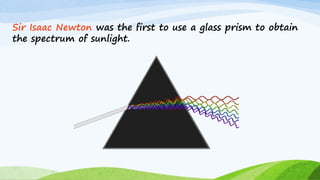
Sir Isaac Newton was the first to use a glass prism to obtain
the spectrum of sunlight.
Case scenario 1
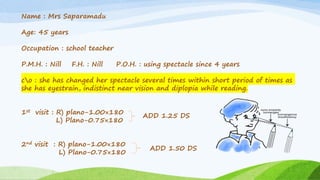
Name : Mrs Saparamadu
Age: 45 years
Occupation : school teacher
P.M.H. : Nill F.H. : Nill P.O.H. : using spectacle since 4 years
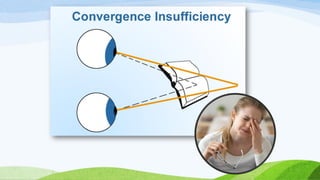
co : she has changed her spectacle several times within short period of times as
she has eyestrain, indistinct near vision and diplopia while reading.
1st visit : R) plano-1.00×180
L) Plano-0.75×180
2nd visit : R) plano-1.00×180
L) Plano-0.75×180
ADD 1.25 DS
ADD 1.50 DS
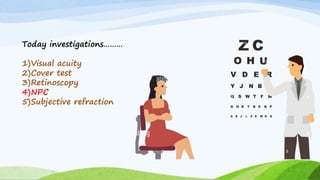
Today investigations………
1)Visual acuity
2)Cover test
3)Retinoscopy
4)NPC
5)Subjective refraction
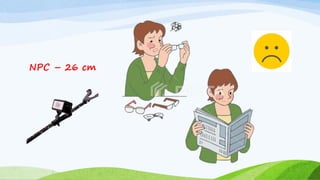
NPC – 26 cm
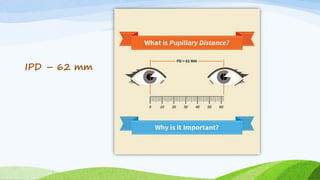
IPD – 62 mm
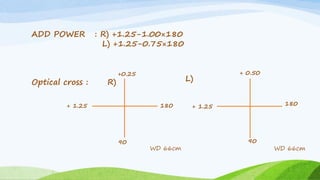
ADD POWER : R) +1.25-1.00×180
L) +1.25-0.75×180
Optical cross : R)
WD 66cm
+ 1.25
+0.25
+ 1.25
+ 0.50
L)
180
90
180
90
WD 66cm
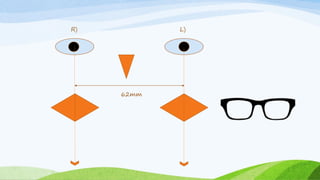
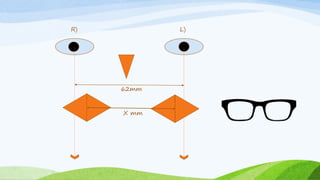
R) L)
62mm
R) L)
62mm
X mm
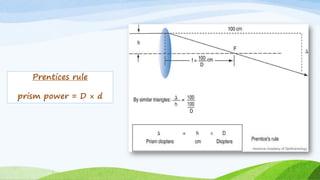
Prentices rule
prism power = D × d
Case scenario 2
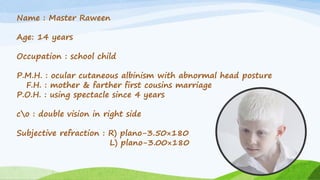
Name : Master Raween
Age: 14 years
Occupation : school child
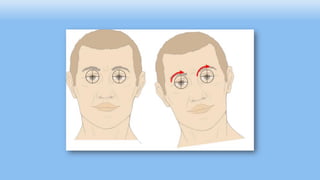
P.M.H. : ocular cutaneous albinism with abnormal head posture
F.H. : mother & farther first cousins marriage
P.O.H. : using spectacle since 4 years
co : double vision in right side
Subjective refraction : R) plano-3.50×180
L) plano-3.00×180
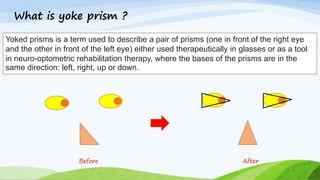
What is yoke prism ?
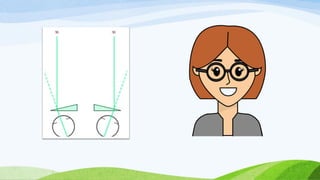
Yoked prisms is a term used to describe a pair of prisms (one in front of the right eye
and the other in front of the left eye) either used therapeutically in glasses or as a tool
in neuro-optometric rehabilitation therapy, where the bases of the prisms are in the
same direction: left, right, up or down.
Before After
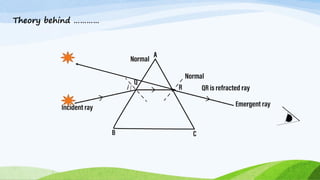
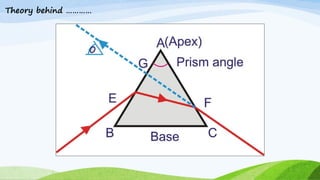
Theory behind …………
Case scenario 3
Name : Mrs Shyamali
Age: 34 years
Occupation : Housewife
P.M.H. :Pitiutary gland tumor
F.H. : Nill
P.O.H. : Nill
co : Peripheral loss of vision
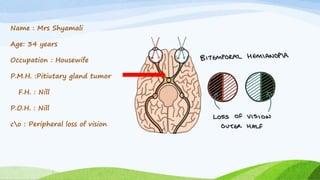
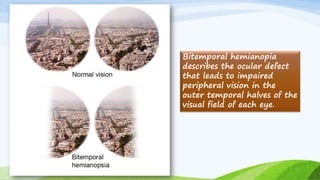
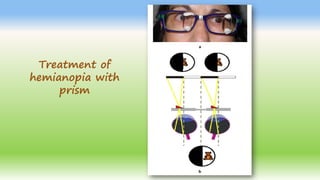
Bitemporal hemianopia
describes the ocular defect
that leads to impaired
peripheral vision in the
outer temporal halves of the
visual field of each eye.
Treatment of
hemianopia with
prism
Theory behind …………
Case scenario 4
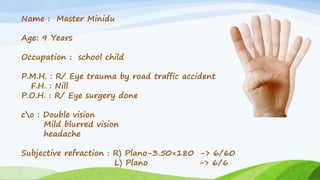
Name : Master Minidu
Age: 9 Years
Occupation : school child
P.M.H. : R/ Eye trauma by road traffic accident
F.H. : Nill
P.O.H. : R/ Eye surgery done
co : Double vision
Mild blurred vision
headache
Subjective refraction : R) Plano-3.50×180 -> 6/60
L) Plano -> 6/6
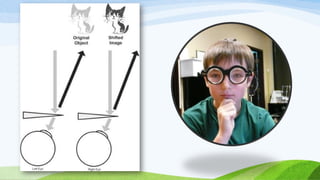
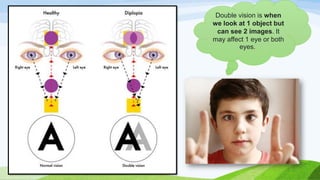
Double vision is when
we look at 1 object but
can see 2 images. It
may affect 1 eye or both
eyes.
Treatment
❖ Patching ( occlusive ) therapy
❖ Identify and treat the underlying cause of the problem.
❖ Other options include eye exercises,
❖ wearing an eye patch on alternative eyes,
❖ prism correction (Fresnel prism)
❖ In more extreme situations, surgery or botulinum toxin
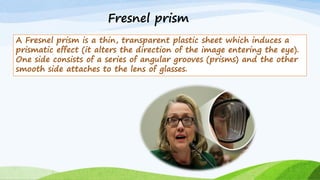
A Fresnel prism is a thin, transparent plastic sheet which induces a
prismatic effect (it alters the direction of the image entering the eye).
One side consists of a series of angular grooves (prisms) and the other
smooth side attaches to the lens of glasses.
Fresnel prism
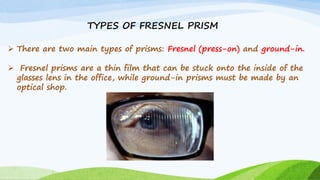
➢ There are two main types of prisms: Fresnel (press-on) and ground-in.
➢ Fresnel prisms are a thin film that can be stuck onto the inside of the
glasses lens in the office, while ground-in prisms must be made by an
optical shop.
TYPES OF FRESNEL PRISM
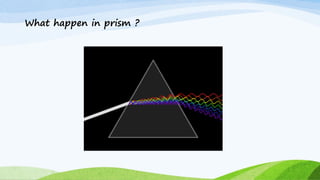
What happen in prism ?
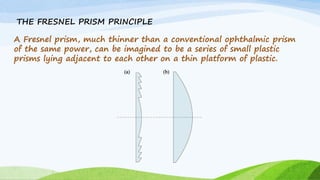
THE FRESNEL PRISM PRINCIPLE
A Fresnel prism, much thinner than a conventional ophthalmic prism
of the same power, can be imagined to be a series of small plastic
prisms lying adjacent to each other on a thin platform of plastic.
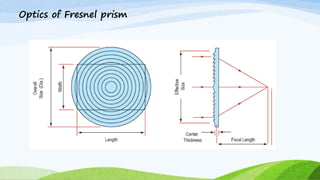
Optics of Fresnel prism
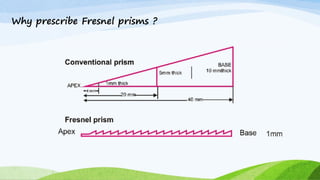
Why prescribe Fresnel prisms ?
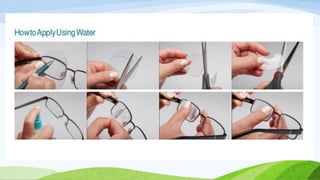
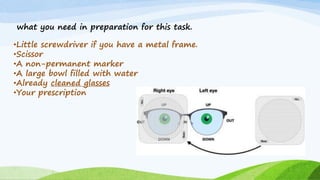
what you need in preparation for this task.
•Little screwdriver if you have a metal frame.
•Scissor
•A non-permanent marker
•A large bowl filled with water
•Already cleaned glasses
•Your prescription
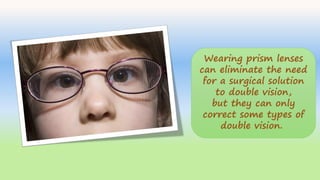
Wearing prism lenses
can eliminate the need
for a surgical solution
to double vision,
but they can only
correct some types of
double vision.
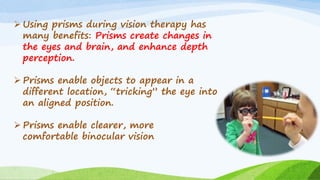
➢ Using prisms during vision therapy has
many benefits: Prisms create changes in
the eyes and brain, and enhance depth
perception.
➢ Prisms enable objects to appear in a
different location, “tricking” the eye into
an aligned position.
➢ Prisms enable clearer, more
comfortable binocular vision
Optometry with Prism

Optometry with Prism

  • 1.
    ENHANCE YOUR BRAINBY PRISMS School of ophthalmic technology 18th batch
  • 2.
  • 3.
    Sir Isaac Newtonwas the first to use a glass prism to obtain the spectrum of sunlight.
  • 4.
  • 5.
    Name : MrsSaparamadu Age: 45 years Occupation : school teacher P.M.H. : Nill F.H. : Nill P.O.H. : using spectacle since 4 years co : she has changed her spectacle several times within short period of times as she has eyestrain, indistinct near vision and diplopia while reading. 1st visit : R) plano-1.00×180 L) Plano-0.75×180 2nd visit : R) plano-1.00×180 L) Plano-0.75×180 ADD 1.25 DS ADD 1.50 DS
  • 6.
    Today investigations……… 1)Visual acuity 2)Covertest 3)Retinoscopy 4)NPC 5)Subjective refraction
  • 7.
  • 9.
  • 10.
    ADD POWER :R) +1.25-1.00×180 L) +1.25-0.75×180 Optical cross : R) WD 66cm + 1.25 +0.25 + 1.25 + 0.50 L) 180 90 180 90 WD 66cm
  • 11.
  • 12.
  • 13.
  • 15.
  • 16.
    Name : MasterRaween Age: 14 years Occupation : school child P.M.H. : ocular cutaneous albinism with abnormal head posture F.H. : mother & farther first cousins marriage P.O.H. : using spectacle since 4 years co : double vision in right side Subjective refraction : R) plano-3.50×180 L) plano-3.00×180
  • 18.
    What is yokeprism ? Yoked prisms is a term used to describe a pair of prisms (one in front of the right eye and the other in front of the left eye) either used therapeutically in glasses or as a tool in neuro-optometric rehabilitation therapy, where the bases of the prisms are in the same direction: left, right, up or down. Before After
  • 20.
  • 21.
  • 22.
    Name : MrsShyamali Age: 34 years Occupation : Housewife P.M.H. :Pitiutary gland tumor F.H. : Nill P.O.H. : Nill co : Peripheral loss of vision
  • 23.
    Bitemporal hemianopia describes theocular defect that leads to impaired peripheral vision in the outer temporal halves of the visual field of each eye.
  • 24.
  • 25.
  • 26.
  • 27.
    Name : MasterMinidu Age: 9 Years Occupation : school child P.M.H. : R/ Eye trauma by road traffic accident F.H. : Nill P.O.H. : R/ Eye surgery done co : Double vision Mild blurred vision headache Subjective refraction : R) Plano-3.50×180 -> 6/60 L) Plano -> 6/6
  • 28.
    Double vision iswhen we look at 1 object but can see 2 images. It may affect 1 eye or both eyes.
  • 29.
    Treatment ❖ Patching (occlusive ) therapy ❖ Identify and treat the underlying cause of the problem. ❖ Other options include eye exercises, ❖ wearing an eye patch on alternative eyes, ❖ prism correction (Fresnel prism) ❖ In more extreme situations, surgery or botulinum toxin
  • 30.
    A Fresnel prismis a thin, transparent plastic sheet which induces a prismatic effect (it alters the direction of the image entering the eye). One side consists of a series of angular grooves (prisms) and the other smooth side attaches to the lens of glasses. Fresnel prism
  • 31.
    ➢ There aretwo main types of prisms: Fresnel (press-on) and ground-in. ➢ Fresnel prisms are a thin film that can be stuck onto the inside of the glasses lens in the office, while ground-in prisms must be made by an optical shop. TYPES OF FRESNEL PRISM
  • 32.
  • 33.
    THE FRESNEL PRISMPRINCIPLE A Fresnel prism, much thinner than a conventional ophthalmic prism of the same power, can be imagined to be a series of small plastic prisms lying adjacent to each other on a thin platform of plastic.
  • 34.
  • 35.
  • 37.
    what you needin preparation for this task. •Little screwdriver if you have a metal frame. •Scissor •A non-permanent marker •A large bowl filled with water •Already cleaned glasses •Your prescription
  • 38.
    Wearing prism lenses caneliminate the need for a surgical solution to double vision, but they can only correct some types of double vision.
  • 39.
    ➢ Using prismsduring vision therapy has many benefits: Prisms create changes in the eyes and brain, and enhance depth perception. ➢ Prisms enable objects to appear in a different location, “tricking” the eye into an aligned position. ➢ Prisms enable clearer, more comfortable binocular vision