Ophthalmologist
Occupational Presentation
Description of Job
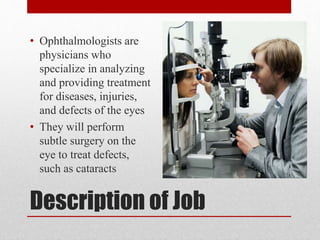
• Ophthalmologists are
physicians who
specialize in analyzing
and providing treatment
for diseases, injuries,
and defects of the eyes
• They will perform
subtle surgery on the
eye to treat defects,
such as cataracts
Differentiating:
Optometrist vs. Ophthalmologist
According to the American Association of Pediatric
Ophthalmology and Strabismus, the two similar
careers differ according to the following:
• “Optometrists are healthcare professionals who provide primary
vision care ranging from sight testing and correction to diagnosis,
treatment, and management of vision changes.”
• Whereas, “an ophthalmologist is a medical osteopathic doctor who
specialize in eye and vision care.”
The two differ in their level of training and in what they can and can’t diagnose
Educational Path
• In order to become a practicing ophthalmologist, it is
necessary to complete the following levels of education
and certification:
• Bachelor’s Degree (most typically)
• 4 years of Medical School
• 4 years of Residency
• First Post-Doctoral year: Internship  focus on general
medical issues
• 3-4 years developing eye care skill
• Enter practice
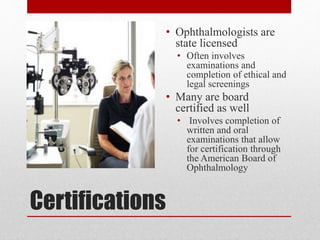
Certifications
• Ophthalmologists are
state licensed
• Often involves
examinations and
completion of ethical and
legal screenings
• Many are board
certified as well
• Involves completion of
written and oral
examinations that allow
for certification through
the American Board of
Ophthalmology
Basic Skills
• Some of the basic skills that are expected of
ophthalmologists include the following:
• Ability to communicate effectively (health literacy)
• Excellent manual dexterity
• Organizational and time management skills
• Good problem-solving and decision-making skills
• Ability to work with multidisciplinary teams
• Adaptability to constantly changing technologies
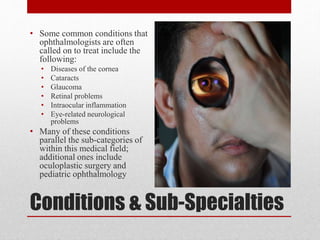
Conditions & Sub-Specialties
• Some common conditions that
ophthalmologists are often
called on to treat include the
following:
• Diseases of the cornea
• Cataracts
• Glaucoma
• Retinal problems
• Intraocular inflammation
• Eye-related neurological
problems
• Many of these conditions
parallel the sub-categories of
within this medical field;
additional ones include
oculoplastic surgery and
pediatric ophthalmology
Benefits
• For the most part, ophthalmologists have modest, full-
time work loads
• In an average week:
• 30-45 hours spent seeing and treating patients
• 5-9 hours carrying out professional or administrative tasks
• According to a 2011 study conducted by Medscape, the
median salary for an ophthalmologist was $248,500
• Above average for a physician
• In this career, you do have the option to work in a
department or as part of a hospital system. Additionally,
many physicians in this field open their own practice
• This allows for more flexible work schedules and the ability to set your
own hours
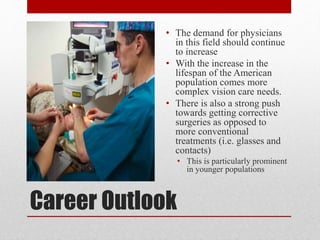
Career Outlook
• The demand for physicians
in this field should continue
to increase
• With the increase in the
lifespan of the American
population comes more
complex vision care needs.
• There is also a strong push
towards getting corrective
surgeries as opposed to
more conventional
treatments (i.e. glasses and
contacts)
• This is particularly prominent
in younger populations
Results form O*Net
• Social: 38
• People with social interest like working with others to help them
learn and grow.
• They like working with people more than working with objects,
machines, or information
• Realistic: 29
• People with realistic interests like work that includes practical,
hands-on problems and answers
• Investigative: 25
• People with investigative interests like work that has to do with
ideas and thinking
• I found these results in line with my attitude towards my career
Why Ophthalmology
• Looking specifically at the skills that are given for
ophthalmologist on my O*Net Interest Profile; I think
that my experiences with Operation Sight has allowed me
to acknowledge problems, come up with solutions and
understand other people’s reactions
• Regarding the personality traits on the profile of an
ophthalmologist, I would consider dependable, very
attentive to detail, and genuinely concerned for others
Conclusion
• Overall, I foresee myself pursing a career in
ophthalmology because I think I possess the traits and
abilities, in accord with my past experiences, to be happy
and successful in this field.
• In volunteering at the Veterans Affairs Hospital, I have
developed a passion for serving others
• With my internship for Operation Sight, I have familiarized
myself with the field, the lifestyle and the overall mentality
that is required to bring about a great sense of
accomplishment in ophthalmology
Resources:
http://www.aapos.org/terms/conditions/132
http://medical-dictionary.thefreedictionary.com/ophthalmologist
http://www.healthcarepathway.com/Health-Care-
Careers/ophthalmologist.html
https://www.healthcareers.nhs.uk/explore-roles/ophthalmology

Occupational PowerPoint

  • 1.
  • 2.
    Description of Job •Ophthalmologists are physicians who specialize in analyzing and providing treatment for diseases, injuries, and defects of the eyes • They will perform subtle surgery on the eye to treat defects, such as cataracts
  • 3.
    Differentiating: Optometrist vs. Ophthalmologist Accordingto the American Association of Pediatric Ophthalmology and Strabismus, the two similar careers differ according to the following: • “Optometrists are healthcare professionals who provide primary vision care ranging from sight testing and correction to diagnosis, treatment, and management of vision changes.” • Whereas, “an ophthalmologist is a medical osteopathic doctor who specialize in eye and vision care.” The two differ in their level of training and in what they can and can’t diagnose
  • 4.
    Educational Path • Inorder to become a practicing ophthalmologist, it is necessary to complete the following levels of education and certification: • Bachelor’s Degree (most typically) • 4 years of Medical School • 4 years of Residency • First Post-Doctoral year: Internship  focus on general medical issues • 3-4 years developing eye care skill • Enter practice
  • 5.
    Certifications • Ophthalmologists are statelicensed • Often involves examinations and completion of ethical and legal screenings • Many are board certified as well • Involves completion of written and oral examinations that allow for certification through the American Board of Ophthalmology
  • 6.
    Basic Skills • Someof the basic skills that are expected of ophthalmologists include the following: • Ability to communicate effectively (health literacy) • Excellent manual dexterity • Organizational and time management skills • Good problem-solving and decision-making skills • Ability to work with multidisciplinary teams • Adaptability to constantly changing technologies
  • 7.
    Conditions & Sub-Specialties •Some common conditions that ophthalmologists are often called on to treat include the following: • Diseases of the cornea • Cataracts • Glaucoma • Retinal problems • Intraocular inflammation • Eye-related neurological problems • Many of these conditions parallel the sub-categories of within this medical field; additional ones include oculoplastic surgery and pediatric ophthalmology
  • 8.
    Benefits • For themost part, ophthalmologists have modest, full- time work loads • In an average week: • 30-45 hours spent seeing and treating patients • 5-9 hours carrying out professional or administrative tasks • According to a 2011 study conducted by Medscape, the median salary for an ophthalmologist was $248,500 • Above average for a physician • In this career, you do have the option to work in a department or as part of a hospital system. Additionally, many physicians in this field open their own practice • This allows for more flexible work schedules and the ability to set your own hours
  • 9.
    Career Outlook • Thedemand for physicians in this field should continue to increase • With the increase in the lifespan of the American population comes more complex vision care needs. • There is also a strong push towards getting corrective surgeries as opposed to more conventional treatments (i.e. glasses and contacts) • This is particularly prominent in younger populations
  • 10.
    Results form O*Net •Social: 38 • People with social interest like working with others to help them learn and grow. • They like working with people more than working with objects, machines, or information • Realistic: 29 • People with realistic interests like work that includes practical, hands-on problems and answers • Investigative: 25 • People with investigative interests like work that has to do with ideas and thinking • I found these results in line with my attitude towards my career
  • 11.
    Why Ophthalmology • Lookingspecifically at the skills that are given for ophthalmologist on my O*Net Interest Profile; I think that my experiences with Operation Sight has allowed me to acknowledge problems, come up with solutions and understand other people’s reactions • Regarding the personality traits on the profile of an ophthalmologist, I would consider dependable, very attentive to detail, and genuinely concerned for others
  • 12.
    Conclusion • Overall, Iforesee myself pursing a career in ophthalmology because I think I possess the traits and abilities, in accord with my past experiences, to be happy and successful in this field. • In volunteering at the Veterans Affairs Hospital, I have developed a passion for serving others • With my internship for Operation Sight, I have familiarized myself with the field, the lifestyle and the overall mentality that is required to bring about a great sense of accomplishment in ophthalmology
  • 13.