Optimizing Uptime in SOA
by Matthew Barlocker
Chief Architect @ Lucid Software Inc
“A distributed system is, at best, a necessary evil; evil
because of the extra complexity...
An application is rarely, if ever, intrinsically distributed.
Distribution is just the lesser of the many evils, or
perhaps better put, a sensible engineering decision
given the trade-offs involved.”
-David Cheriton
Distributed Systems
Local Functions are Deterministic
 Either the function returns or the server
shut down
 No network hops
 Availability of libraries is guaranteed if
the server is on
“My frontside bus fails
for only 1 second every
27.8 hours”
- no one ever
Distributed Systems are Evil
 Network Failure
- Dropped Packets
- Corrupted Packets
- Failed Router
- Traffic Spike
- Idiot with a shovel
 Service Not Running
- Deployment
- Troubleshooting
- Rogue Ops Member
 Sick Server
- Thread starvation
- Swapping
- Open file limit
- Application Monitoring went AWOL
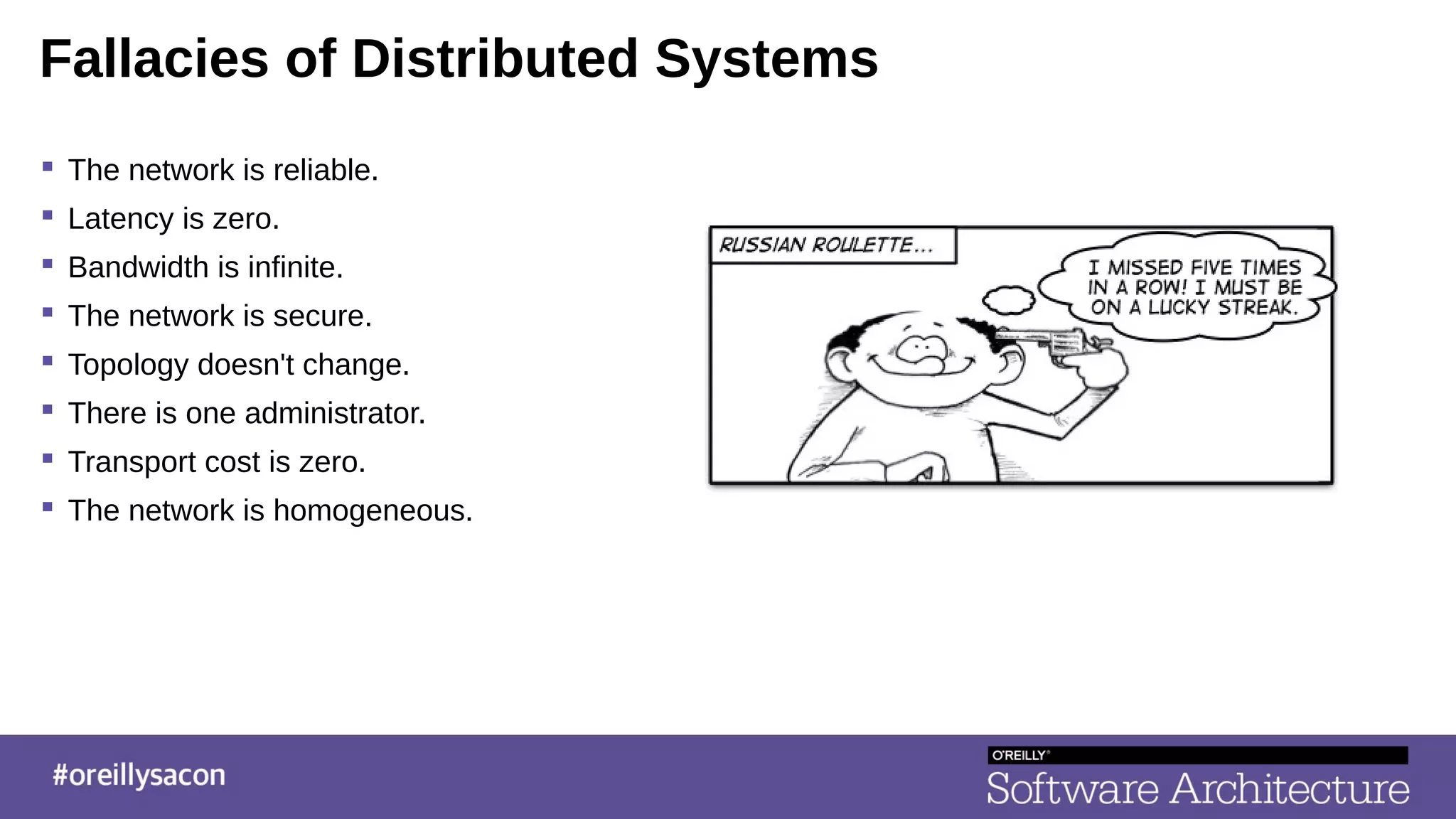
Fallacies of Distributed Systems
 The network is reliable.
 Latency is zero.
 Bandwidth is infinite.
 The network is secure.
 Topology doesn't change.
 There is one administrator.
 Transport cost is zero.
 The network is homogeneous.
Distributed Systems have Good
 Separation of concern in the organization
 Fail independently
 Resource consumption
 Scaling profiles
 Code modularity
 Loose coupling
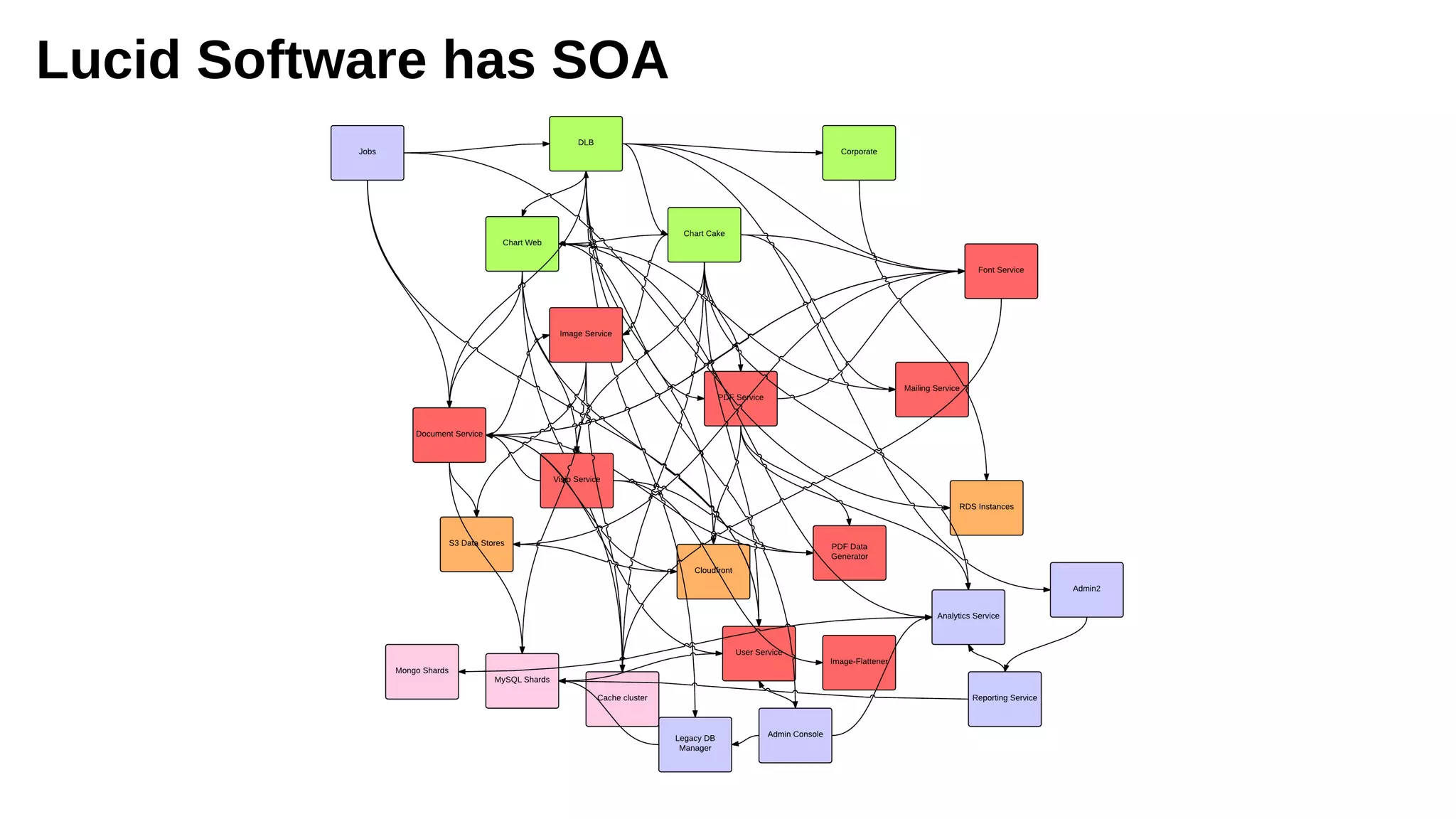
Lucid Software has SOA
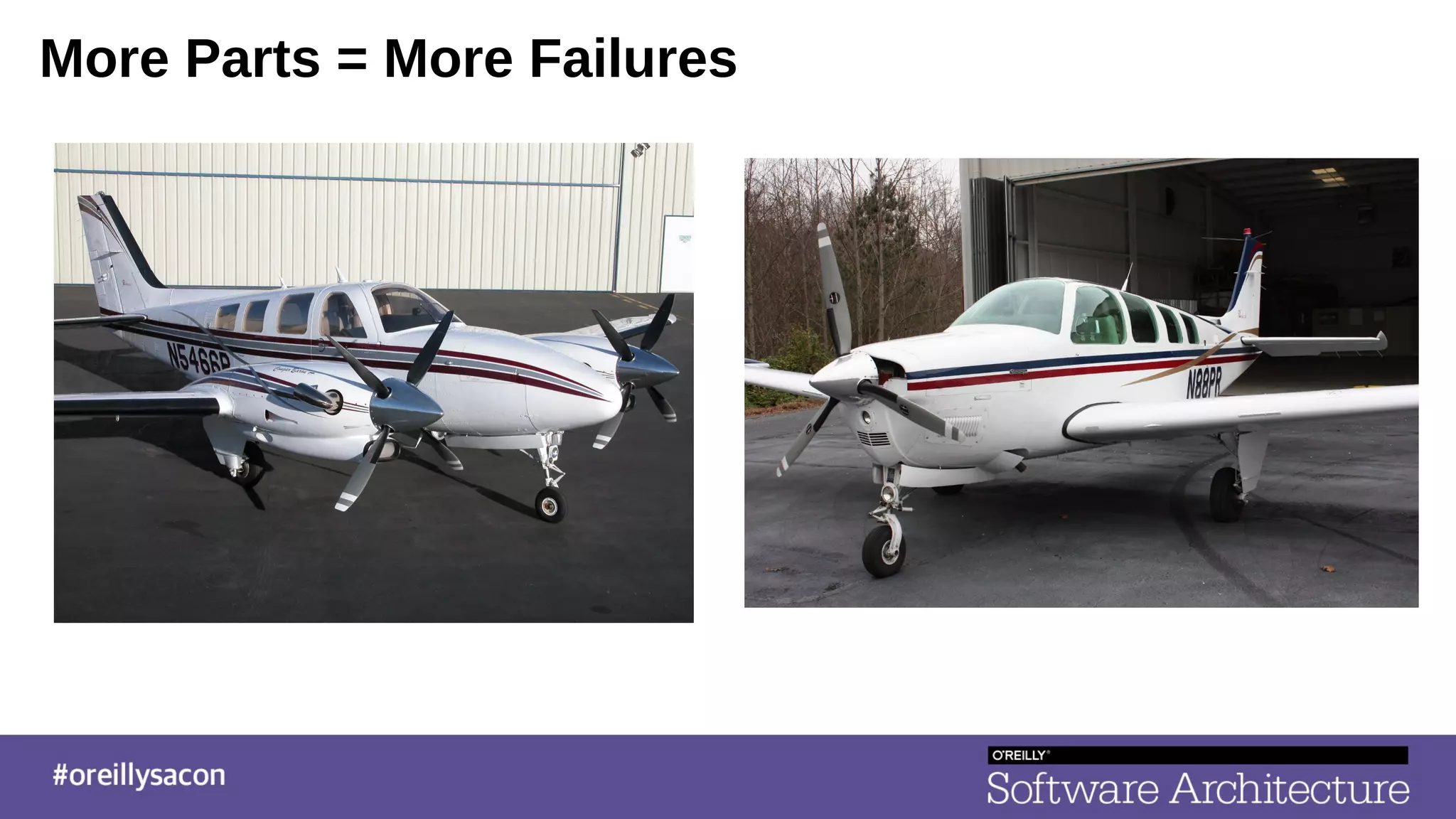
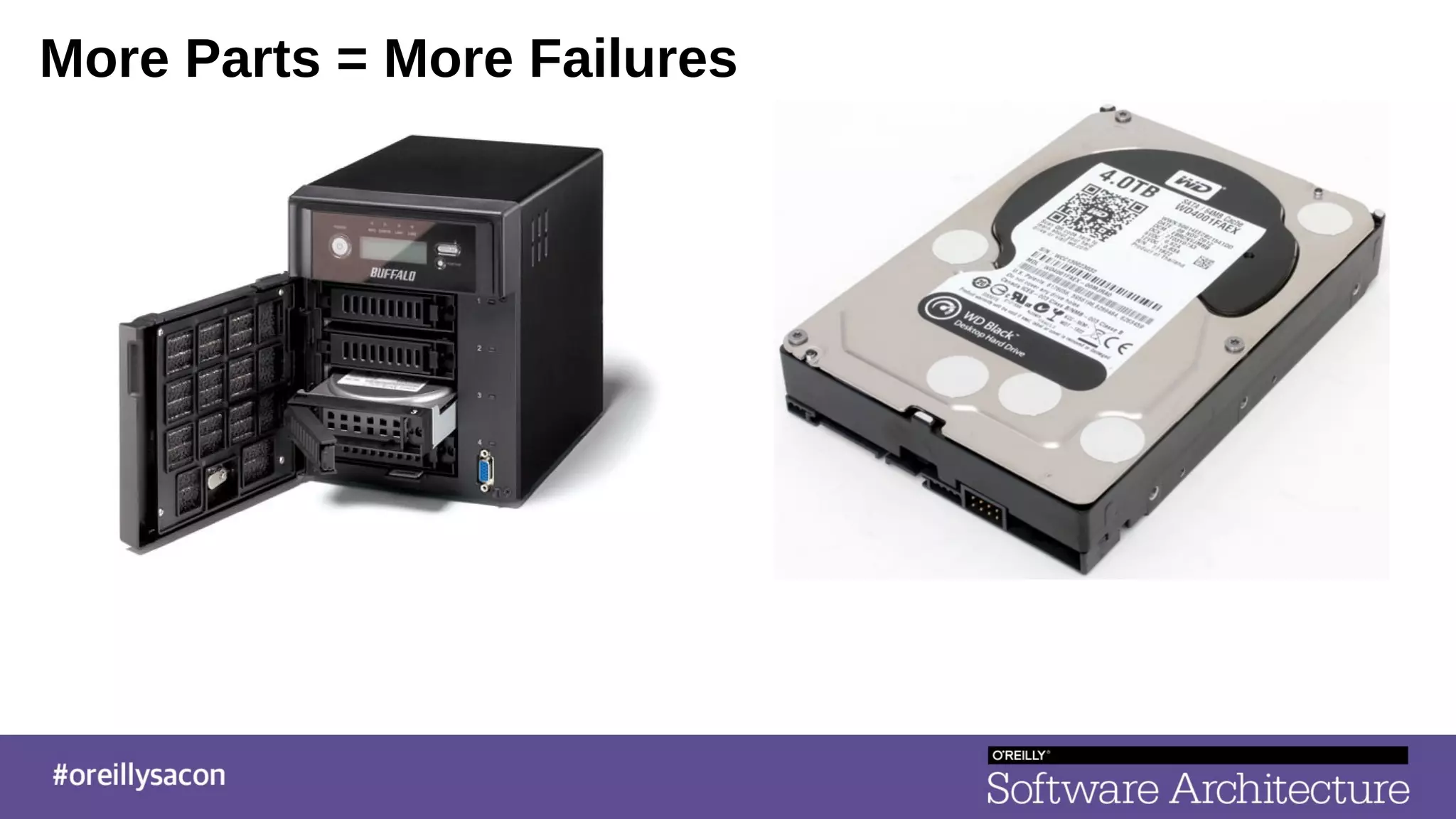
More Parts = More Failures
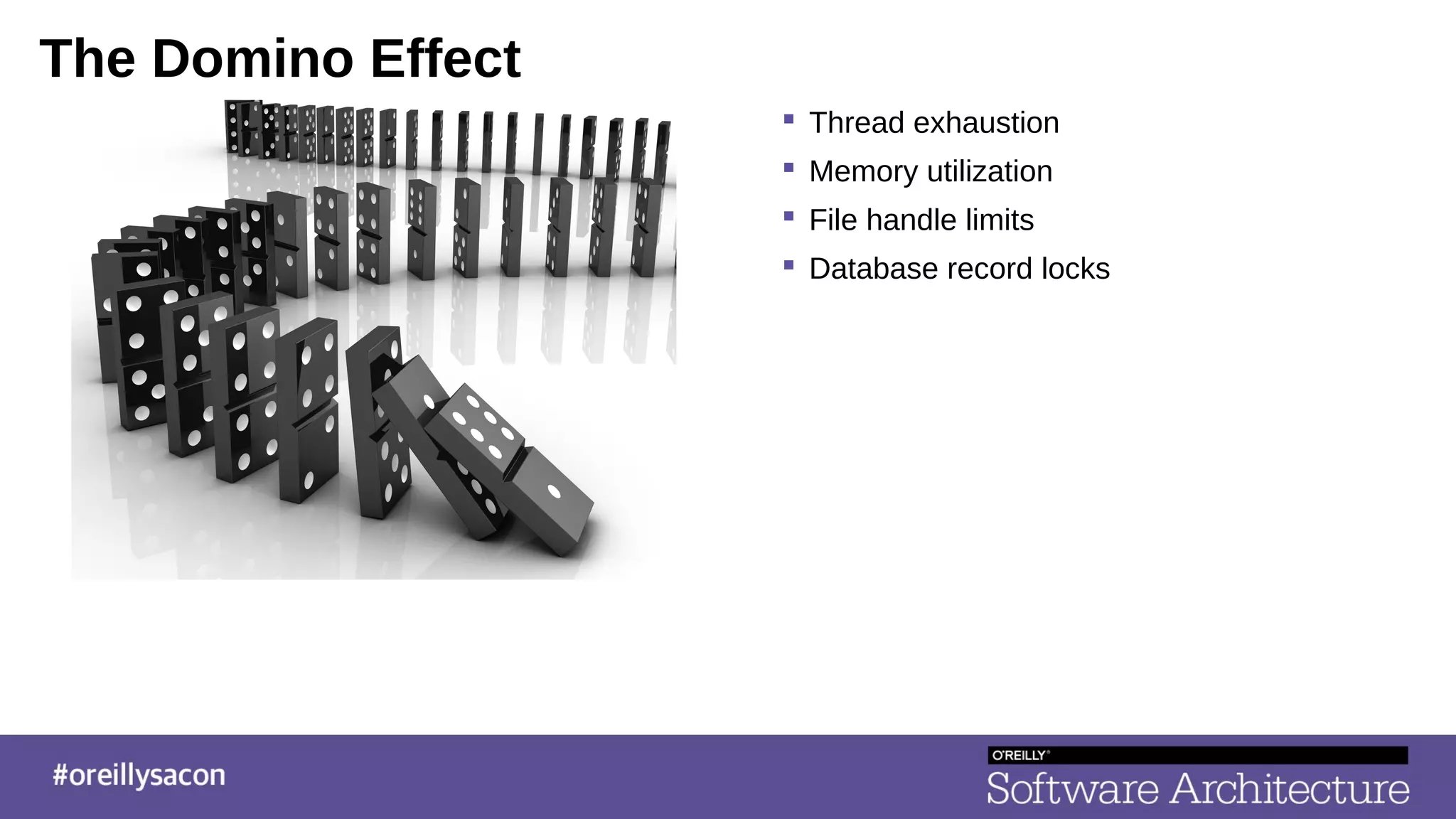
The Domino Effect
 Thread exhaustion
 Memory utilization
 File handle limits
 Database record locks
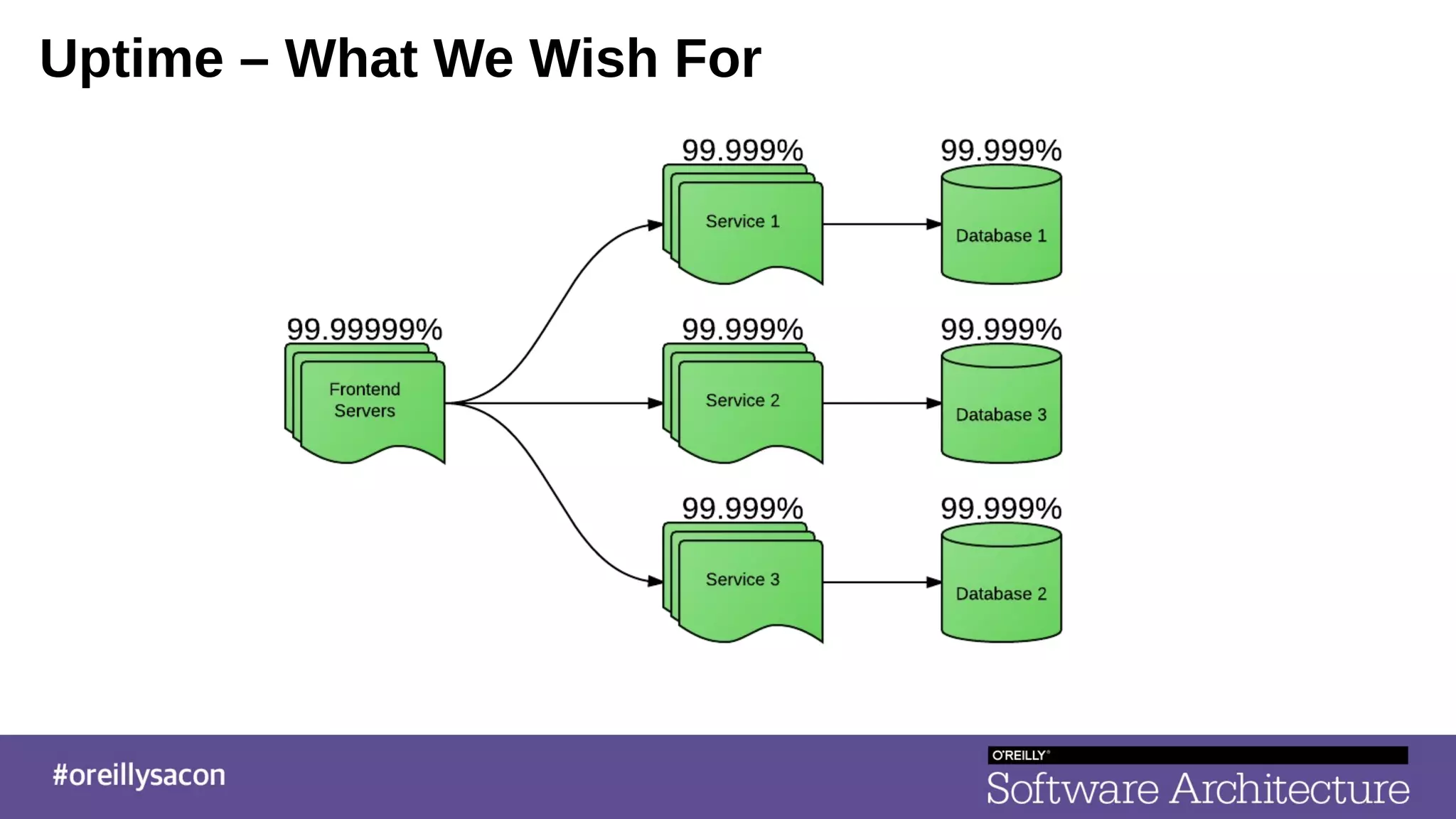
Uptime – What We Wish For
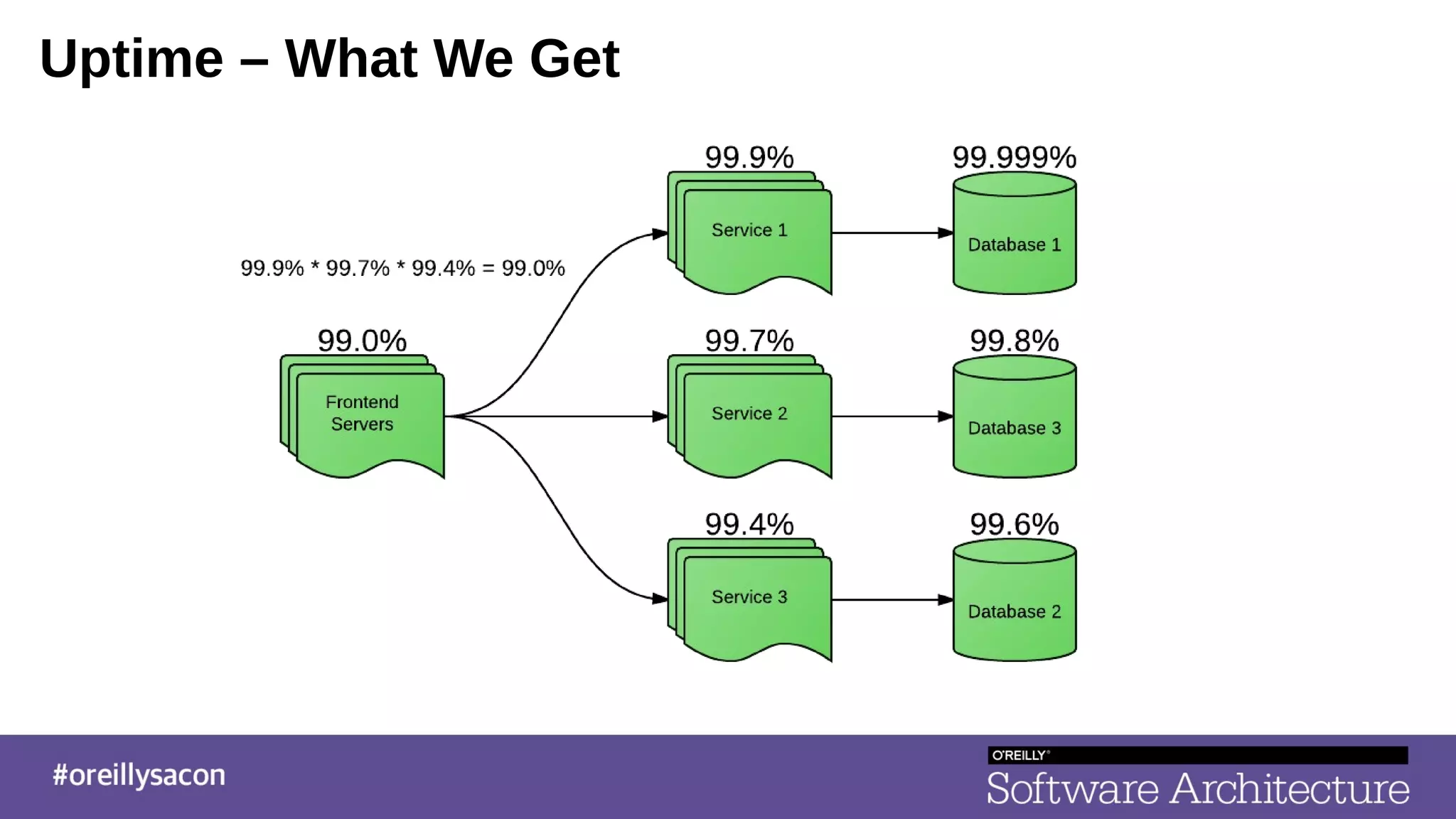
Uptime – What We Get
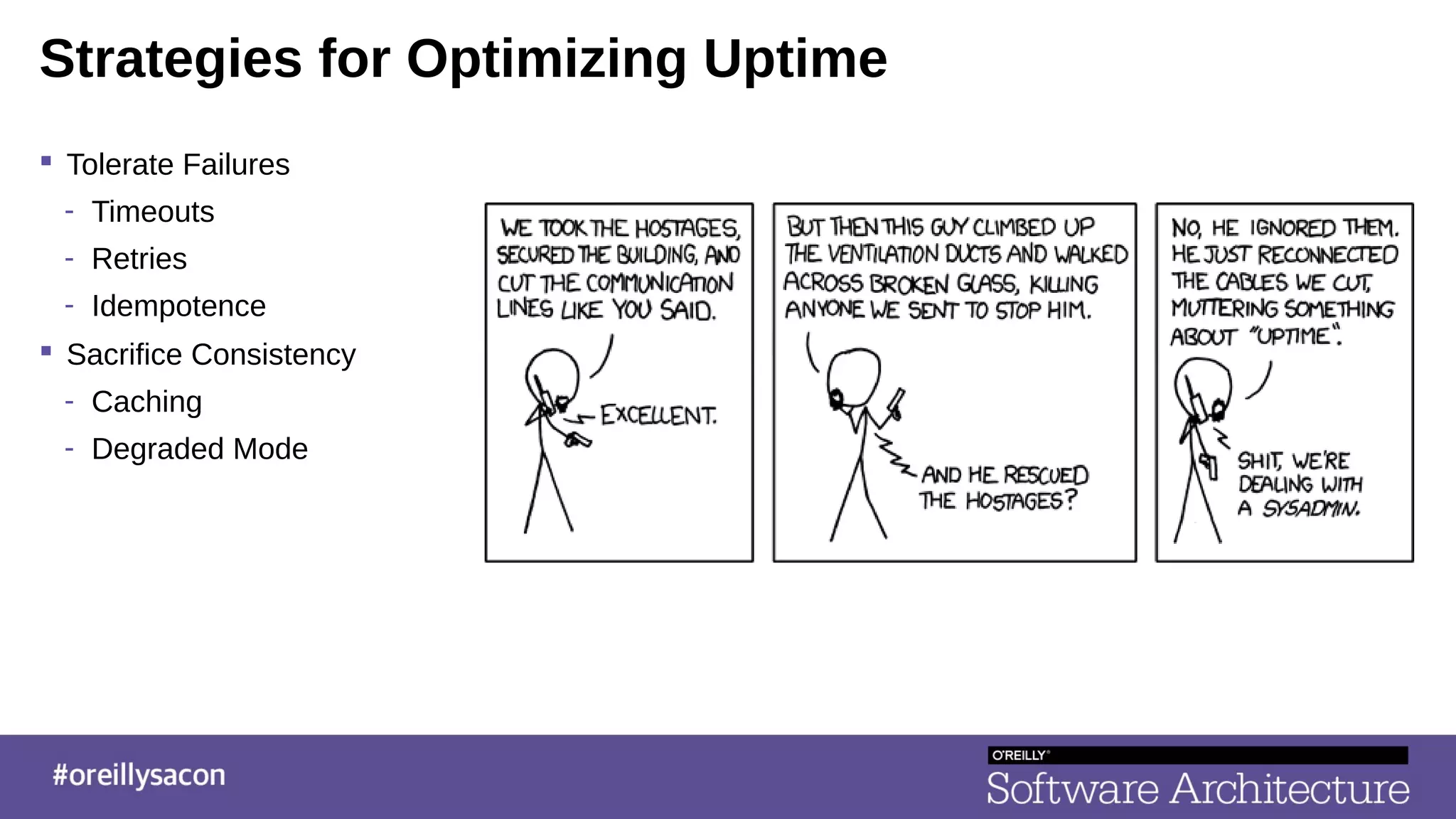
Strategies for Optimizing Uptime
 Tolerate Failures
- Timeouts
- Retries
- Idempotence
 Sacrifice Consistency
- Caching
- Degraded Mode
Tolerating Failures
“Just Like Mom”
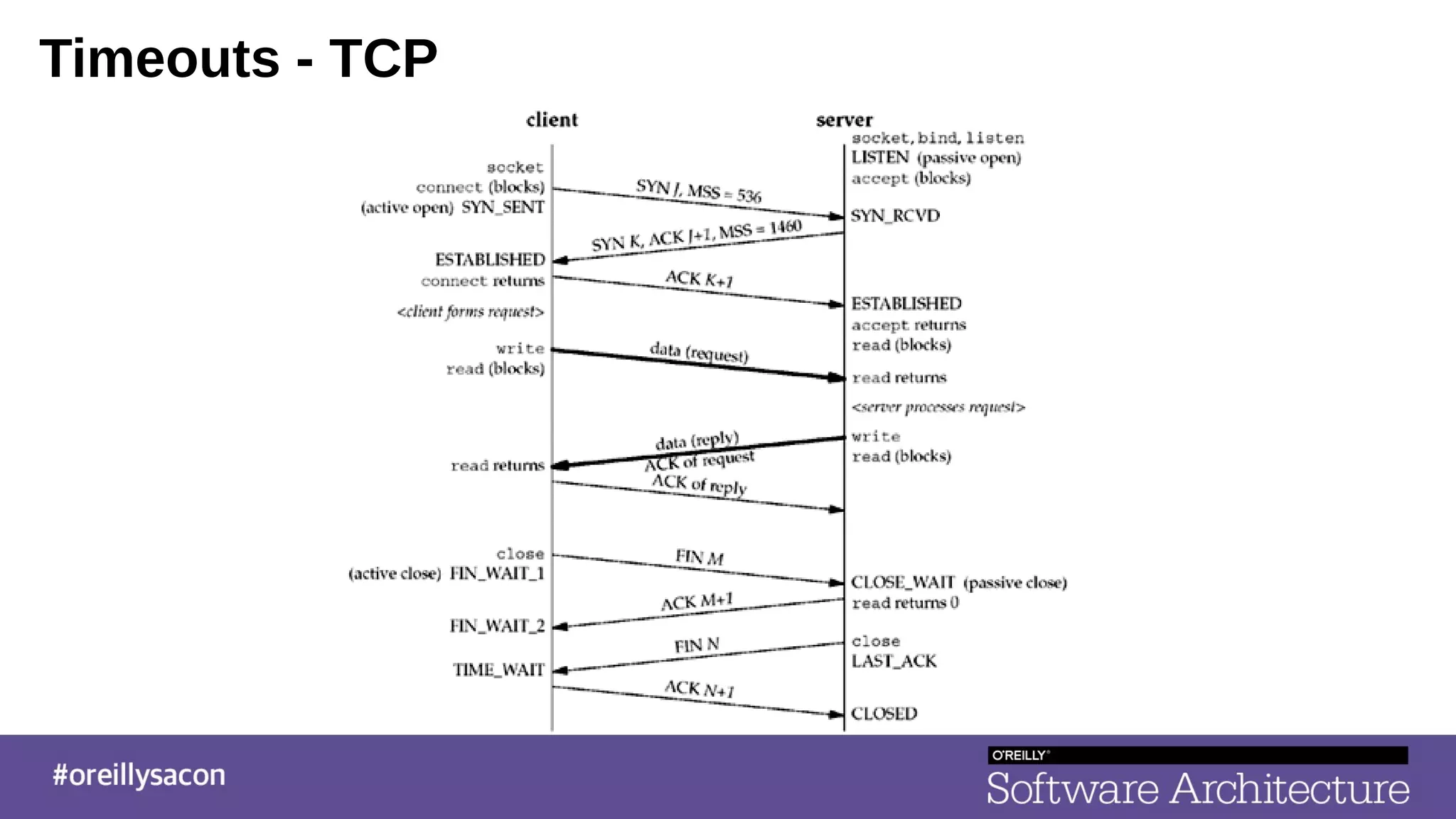
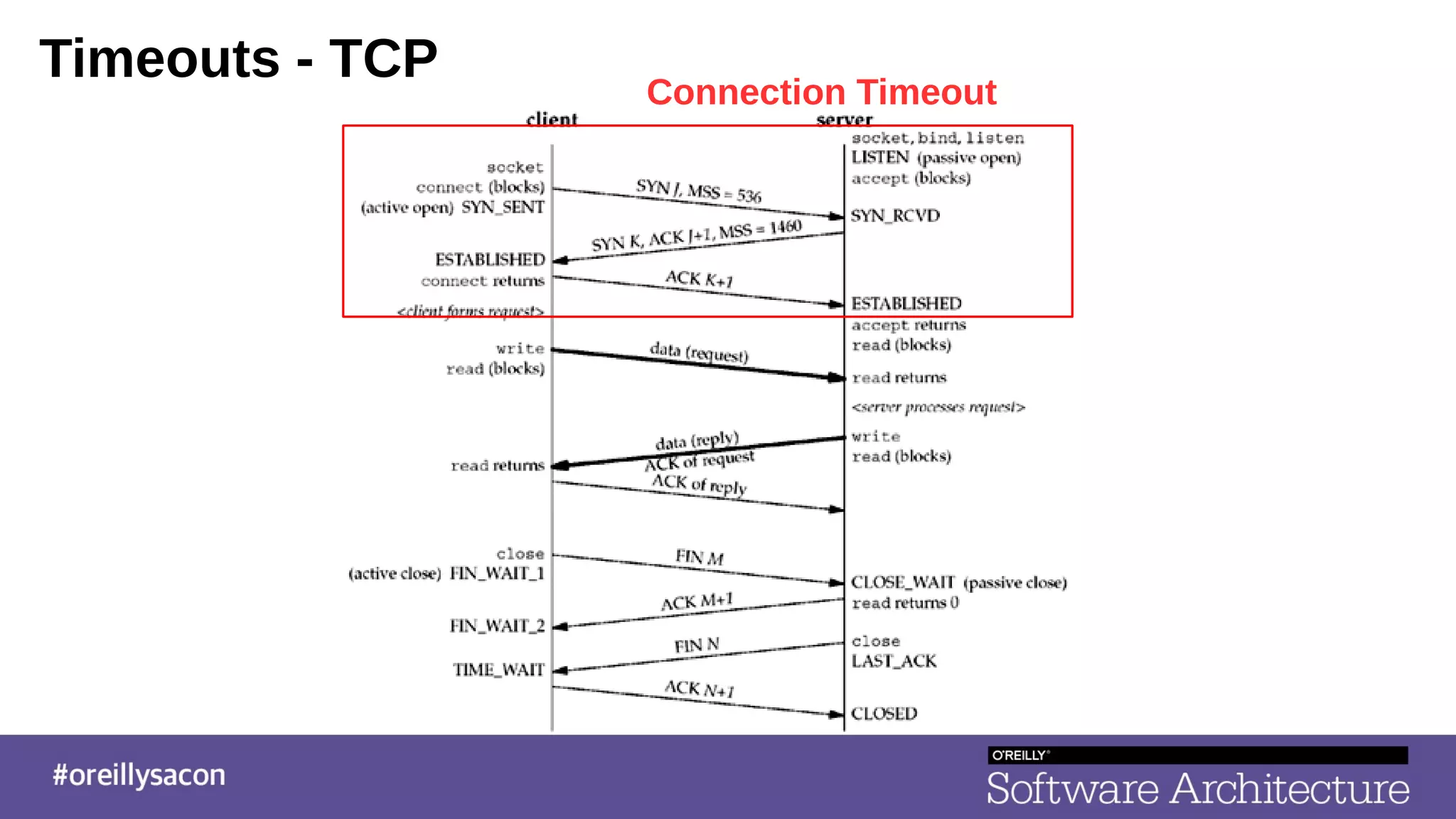
Timeouts - TCP
Timeouts - TCP
Connection Timeout
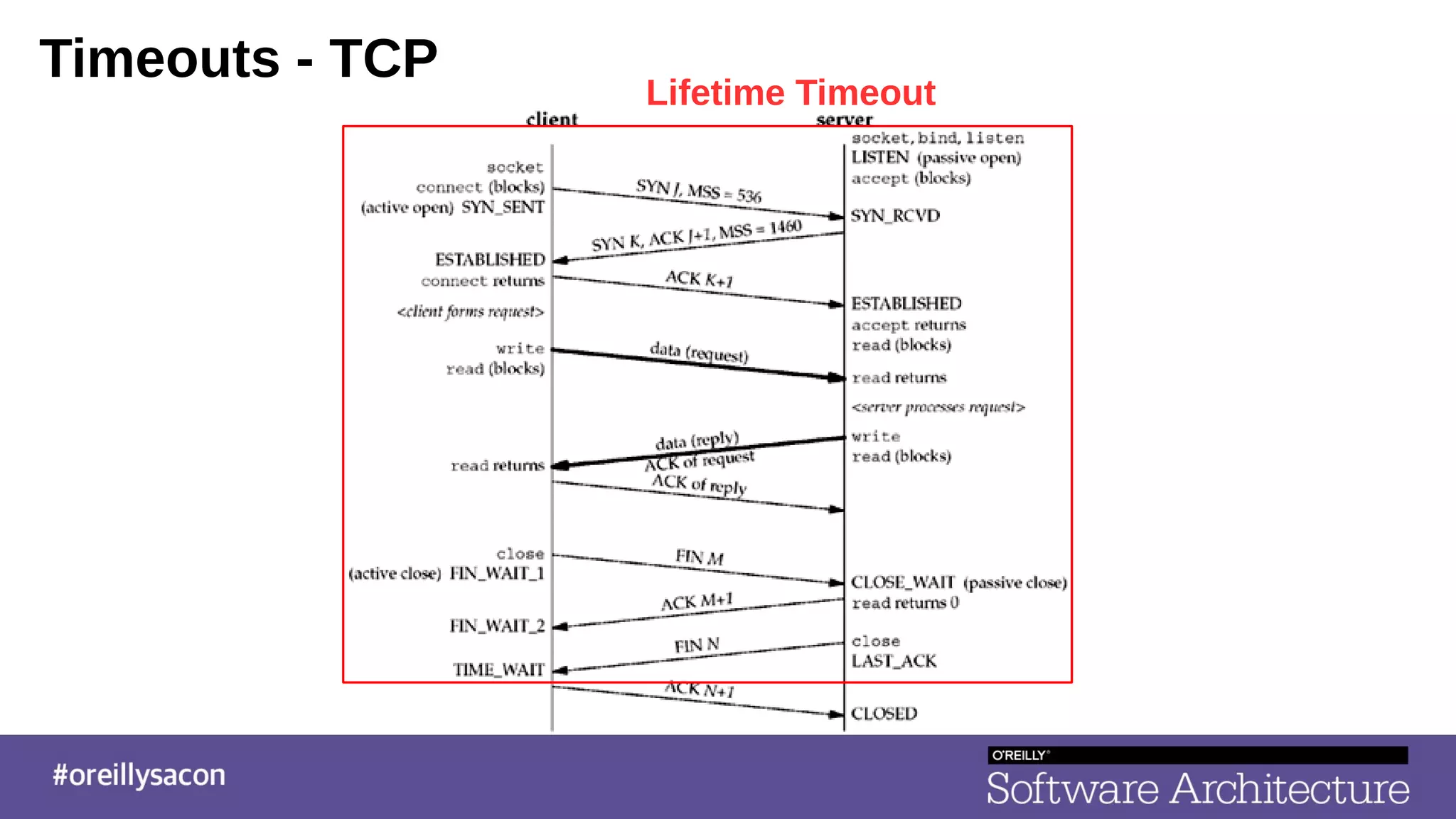
Timeouts - TCP
Lifetime Timeout
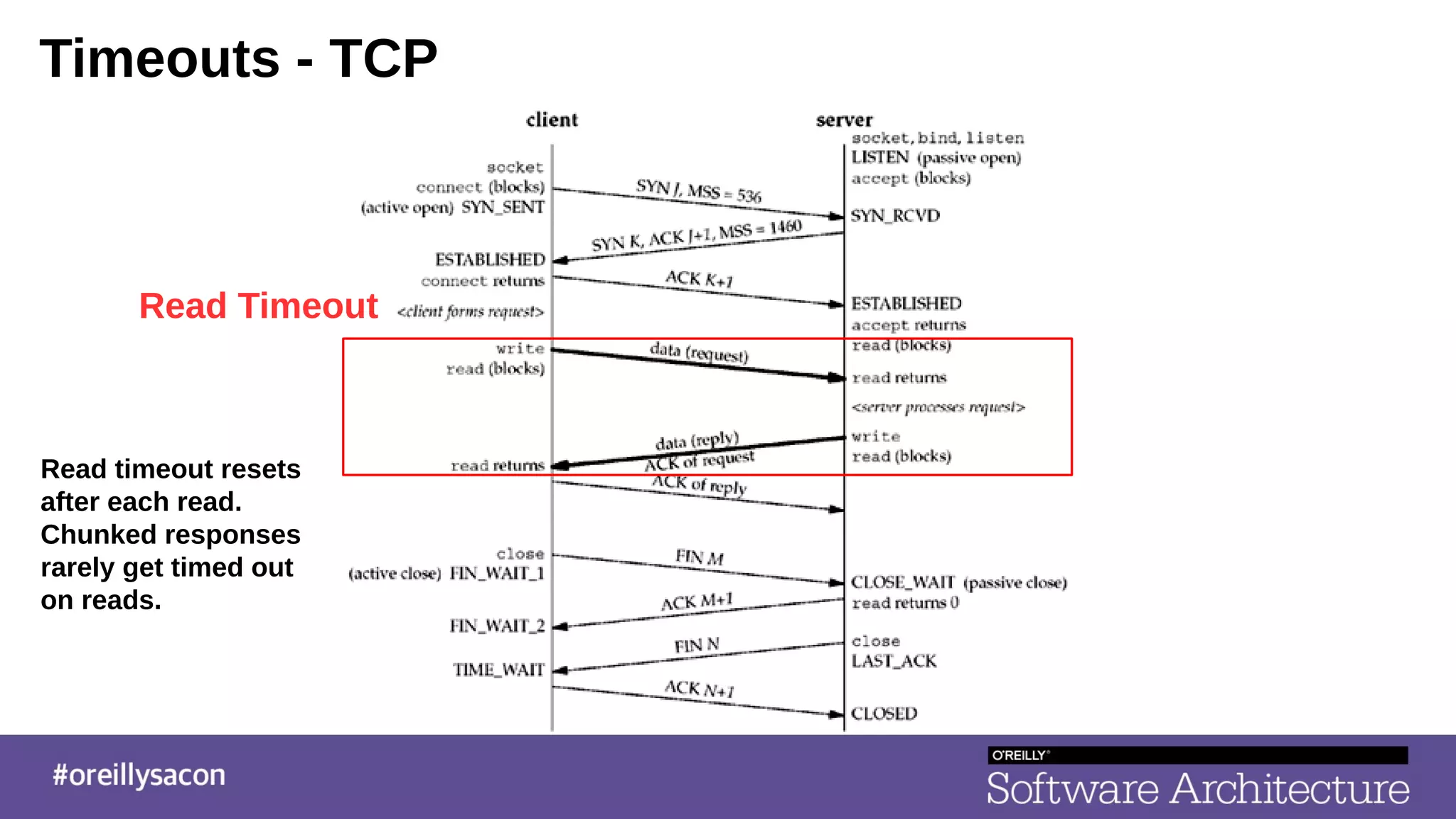
Timeouts - TCP
Read timeout resets
after each read.
Chunked responses
rarely get timed out
on reads.
Read Timeout
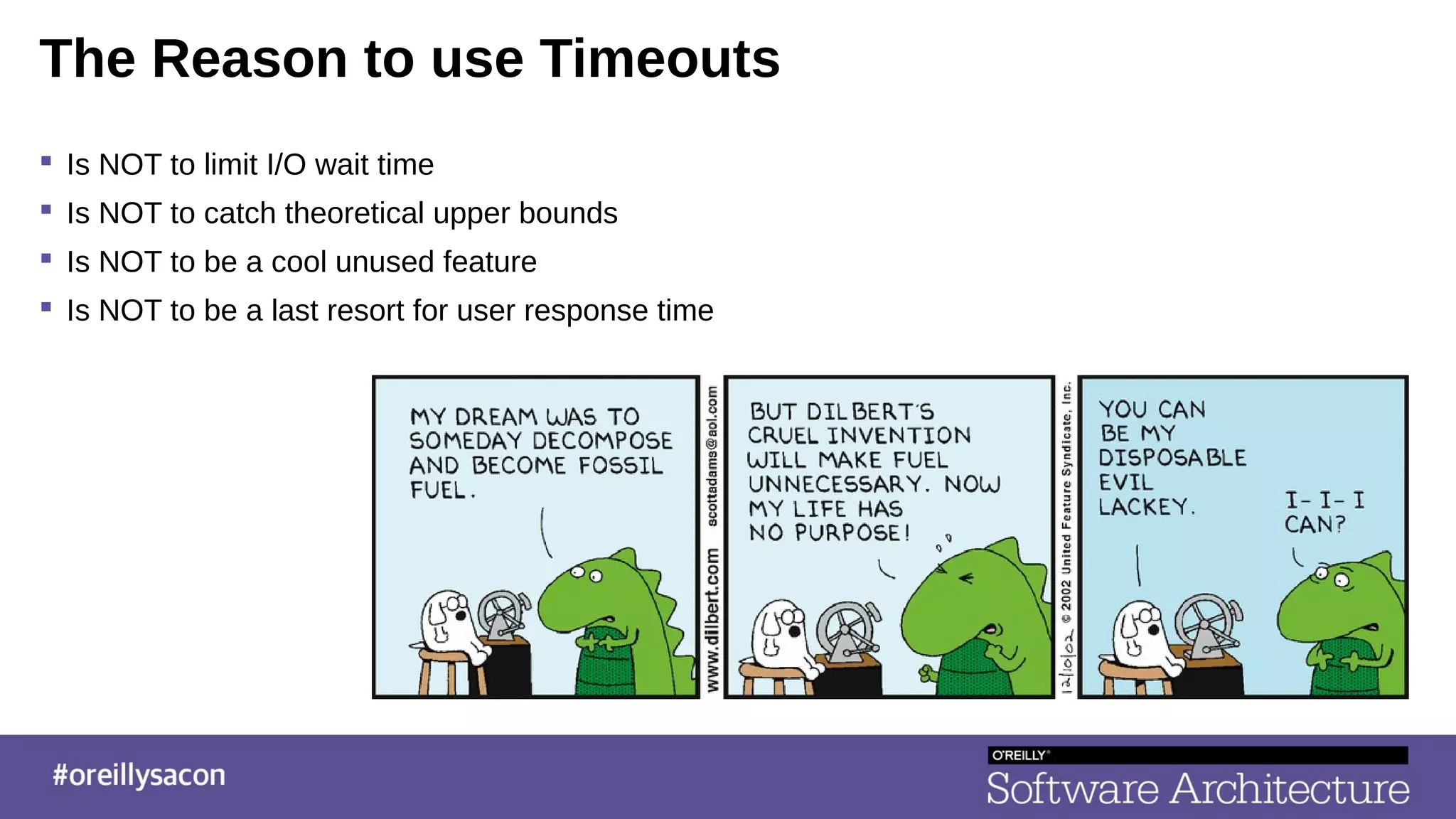
The Reason to use Timeouts
 Is NOT to limit I/O wait time
 Is NOT to catch theoretical upper bounds
 Is NOT to be a cool unused feature
 Is NOT to be a last resort for user response time
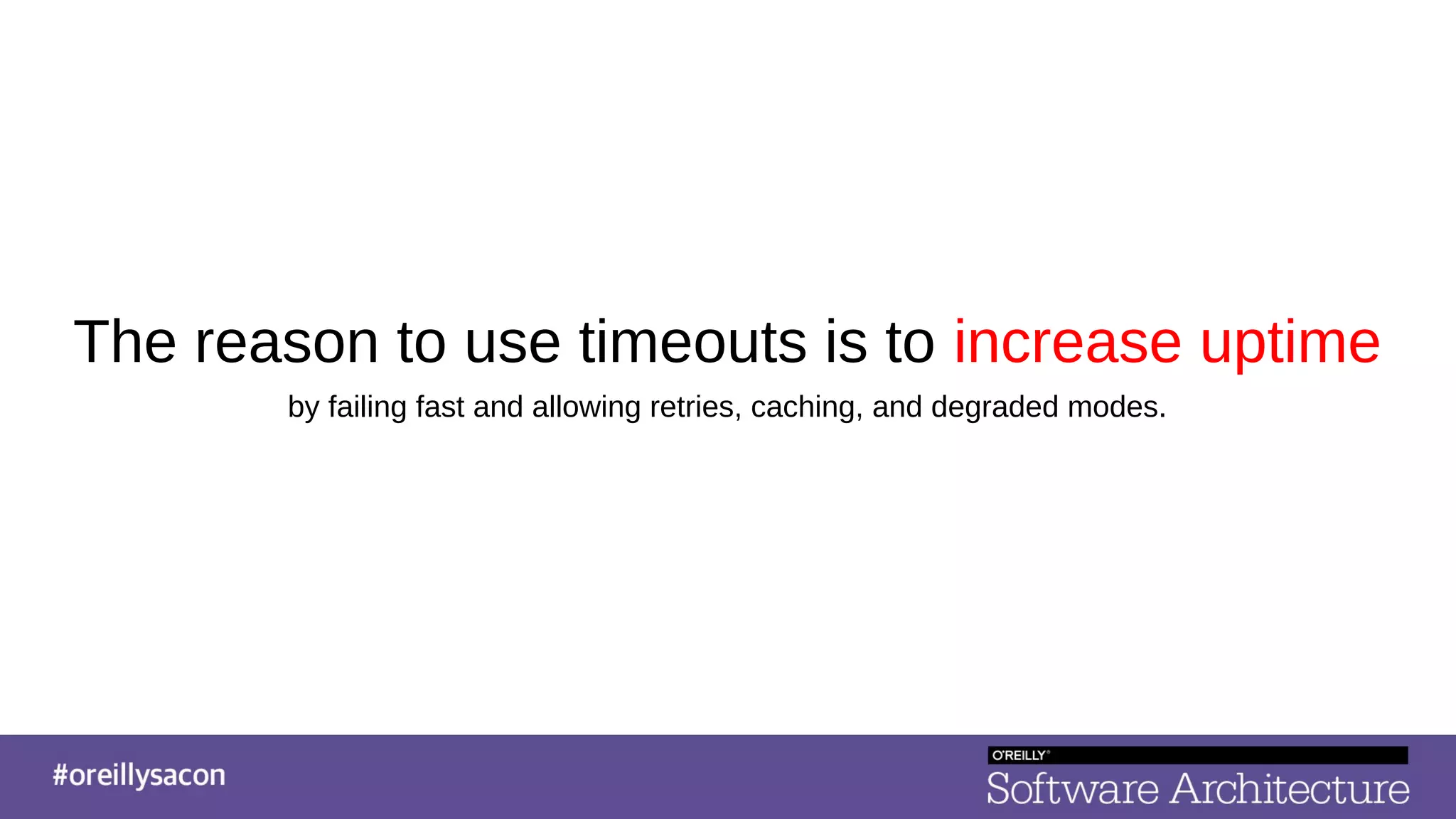
The reason to use timeouts is to increase uptime
by failing fast and allowing retries, caching, and degraded modes.
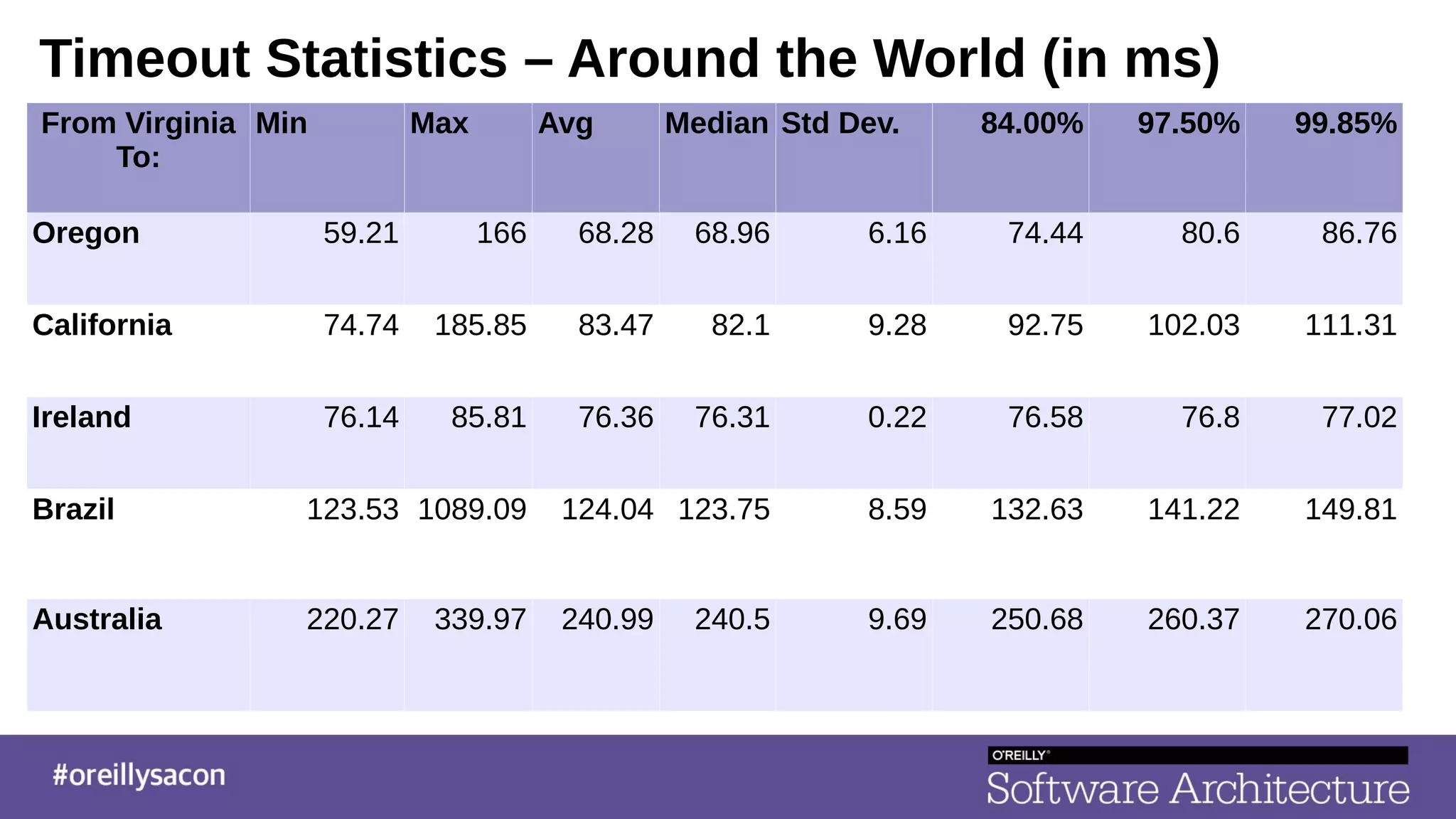
Timeout Statistics – Around the World (in ms)
From Virginia
To:
Min Max Avg Median Std Dev. 84.00% 97.50% 99.85%
Oregon 59.21 166 68.28 68.96 6.16 74.44 80.6 86.76
California 74.74 185.85 83.47 82.1 9.28 92.75 102.03 111.31
Ireland 76.14 85.81 76.36 76.31 0.22 76.58 76.8 77.02
Brazil 123.53 1089.09 124.04 123.75 8.59 132.63 141.22 149.81
Australia 220.27 339.97 240.99 240.5 9.69 250.68 260.37 270.06
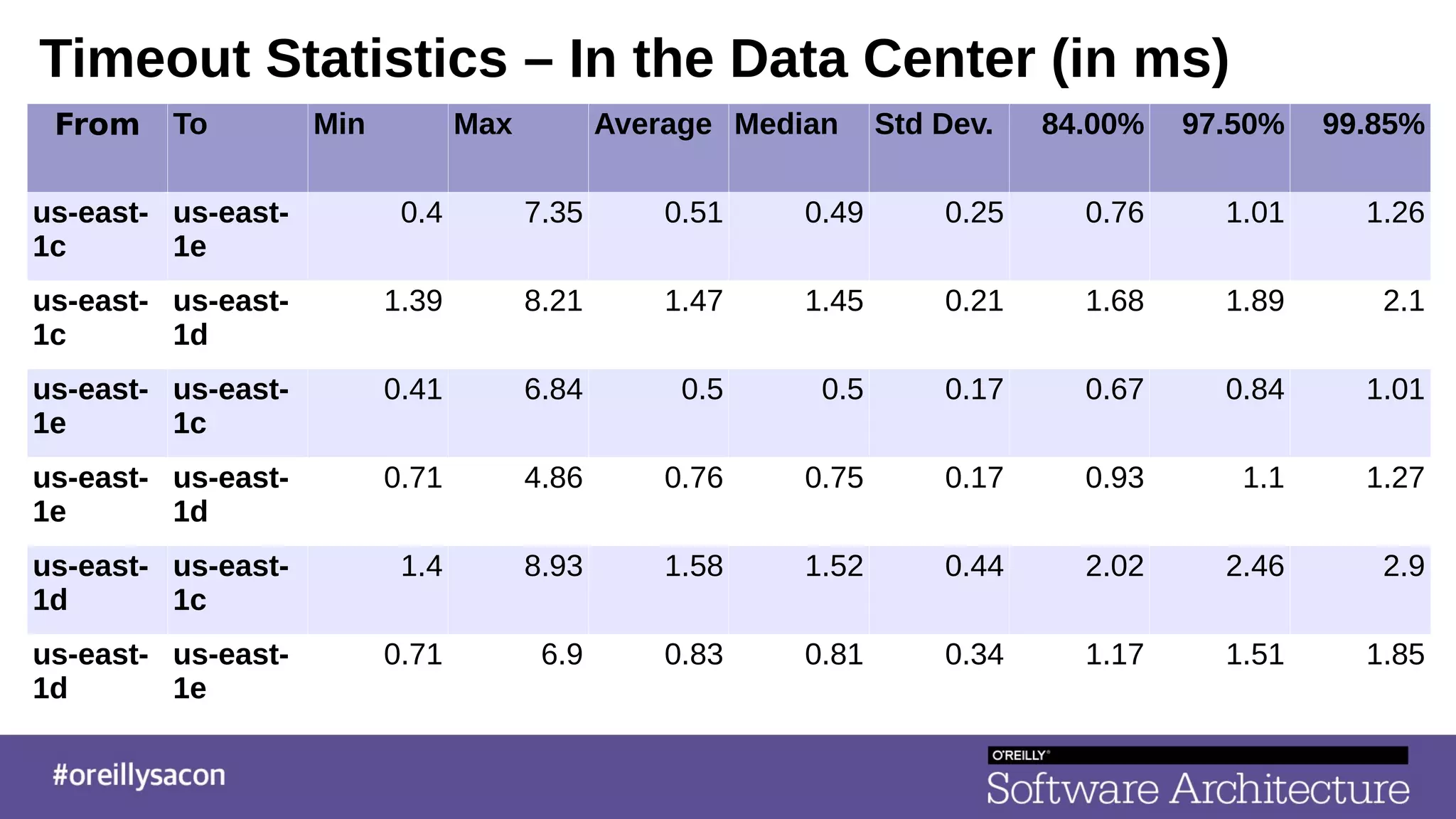
Timeout Statistics – In the Data Center (in ms)
From To Min Max Average Median Std Dev. 84.00% 97.50% 99.85%
us-east-
1c
us-east-
1e
0.4 7.35 0.51 0.49 0.25 0.76 1.01 1.26
us-east-
1c
us-east-
1d
1.39 8.21 1.47 1.45 0.21 1.68 1.89 2.1
us-east-
1e
us-east-
1c
0.41 6.84 0.5 0.5 0.17 0.67 0.84 1.01
us-east-
1e
us-east-
1d
0.71 4.86 0.76 0.75 0.17 0.93 1.1 1.27
us-east-
1d
us-east-
1c
1.4 8.93 1.58 1.52 0.44 2.02 2.46 2.9
us-east-
1d
us-east-
1e
0.71 6.9 0.83 0.81 0.34 1.17 1.51 1.85
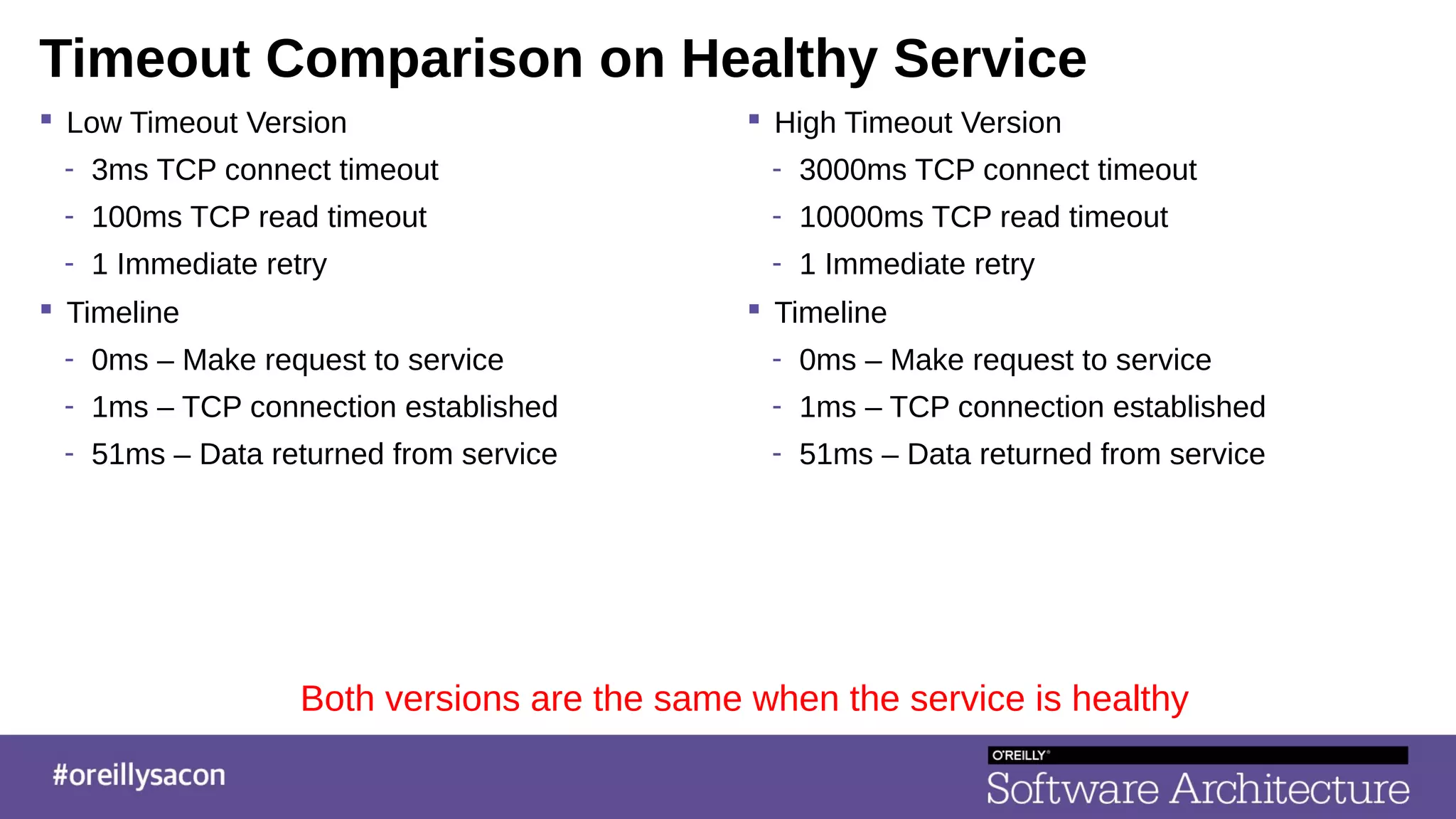
Timeout Comparison on Healthy Service
 Low Timeout Version
- 3ms TCP connect timeout
- 100ms TCP read timeout
- 1 Immediate retry
 Timeline
- 0ms – Make request to service
- 1ms – TCP connection established
- 51ms – Data returned from service
 High Timeout Version
- 3000ms TCP connect timeout
- 10000ms TCP read timeout
- 1 Immediate retry
 Timeline
- 0ms – Make request to service
- 1ms – TCP connection established
- 51ms – Data returned from service
Both versions are the same when the service is healthy
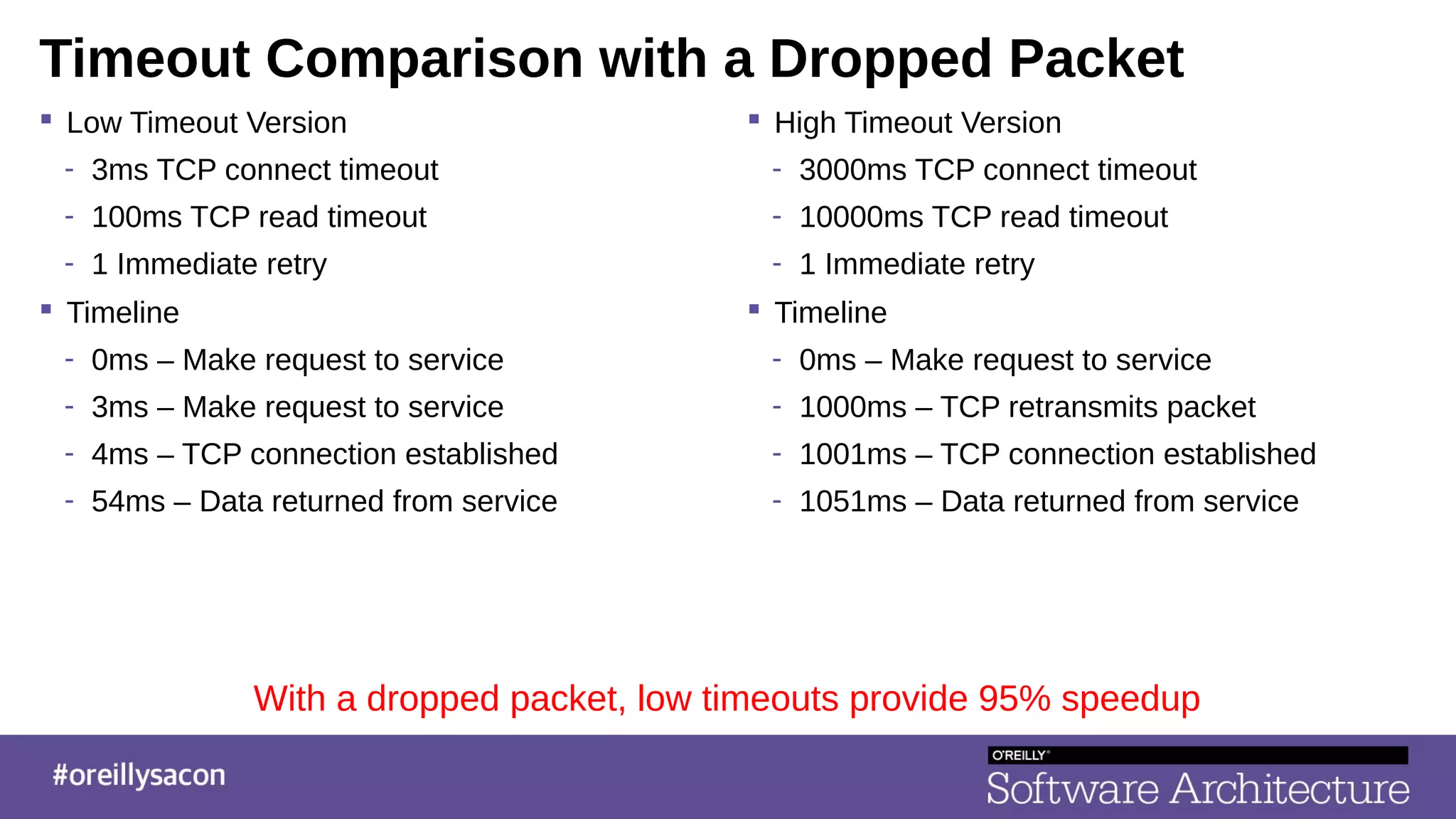
Timeout Comparison with a Dropped Packet
 Low Timeout Version
- 3ms TCP connect timeout
- 100ms TCP read timeout
- 1 Immediate retry
 Timeline
- 0ms – Make request to service
- 3ms – Make request to service
- 4ms – TCP connection established
- 54ms – Data returned from service
 High Timeout Version
- 3000ms TCP connect timeout
- 10000ms TCP read timeout
- 1 Immediate retry
 Timeline
- 0ms – Make request to service
- 1000ms – TCP retransmits packet
- 1001ms – TCP connection established
- 1051ms – Data returned from service
With a dropped packet, low timeouts provide 95% speedup
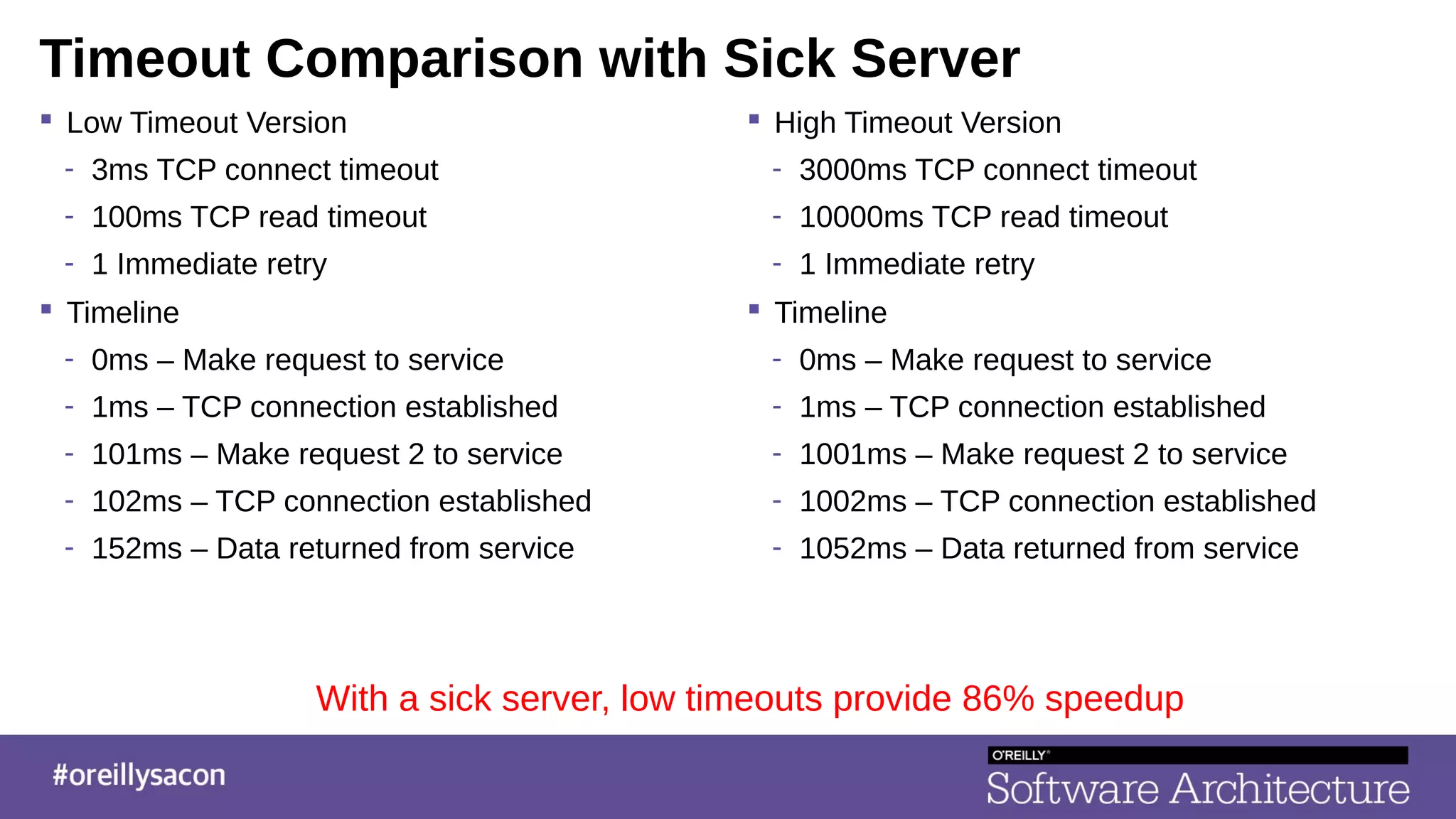
Timeout Comparison with Sick Server
 Low Timeout Version
- 3ms TCP connect timeout
- 100ms TCP read timeout
- 1 Immediate retry
 Timeline
- 0ms – Make request to service
- 1ms – TCP connection established
- 101ms – Make request 2 to service
- 102ms – TCP connection established
- 152ms – Data returned from service
 High Timeout Version
- 3000ms TCP connect timeout
- 10000ms TCP read timeout
- 1 Immediate retry
 Timeline
- 0ms – Make request to service
- 1ms – TCP connection established
- 1001ms – Make request 2 to service
- 1002ms – TCP connection established
- 1052ms – Data returned from service
With a sick server, low timeouts provide 86% speedup
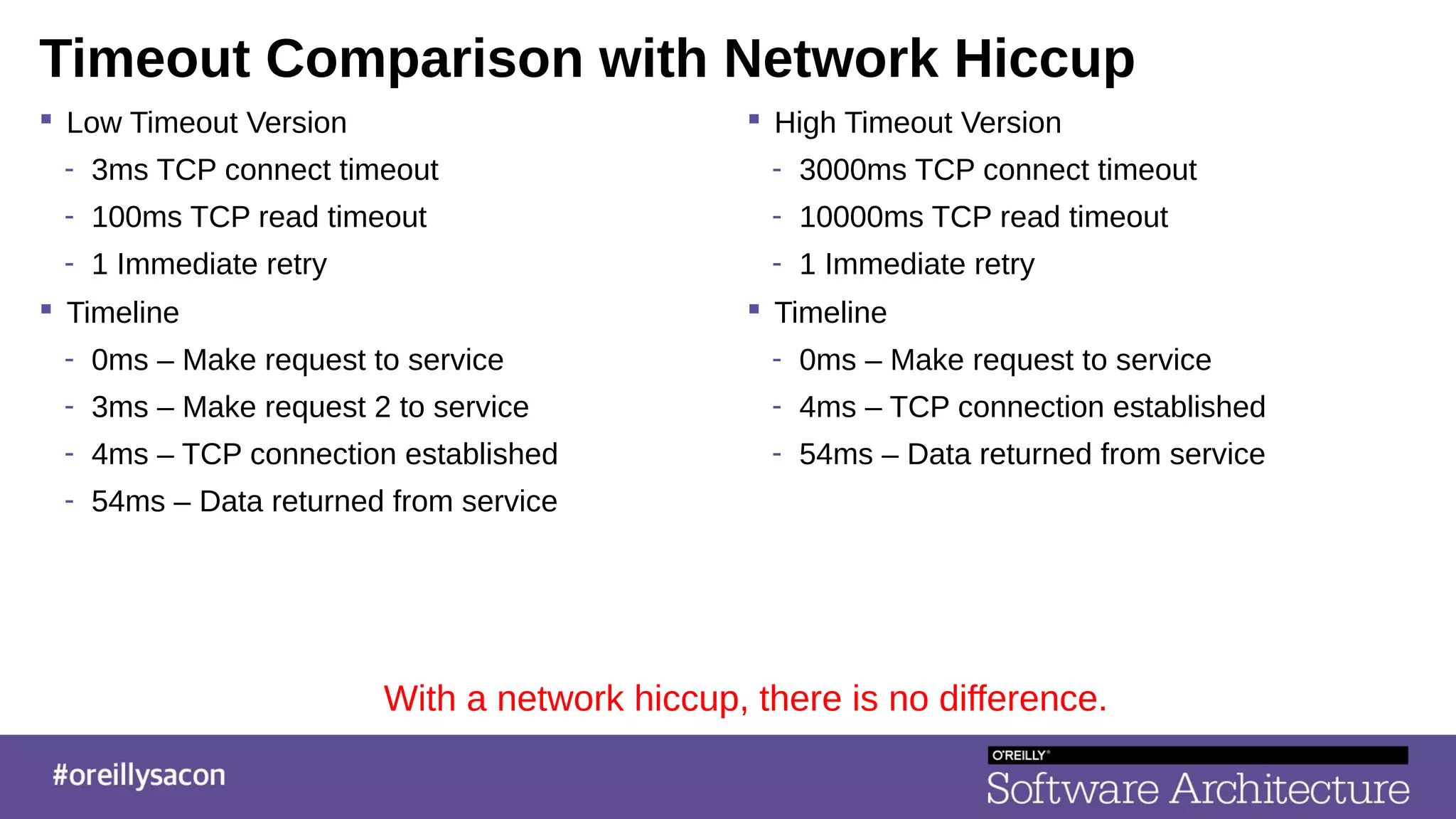
Timeout Comparison with Network Hiccup
 Low Timeout Version
- 3ms TCP connect timeout
- 100ms TCP read timeout
- 1 Immediate retry
 Timeline
- 0ms – Make request to service
- 3ms – Make request 2 to service
- 4ms – TCP connection established
- 54ms – Data returned from service
 High Timeout Version
- 3000ms TCP connect timeout
- 10000ms TCP read timeout
- 1 Immediate retry
 Timeline
- 0ms – Make request to service
- 4ms – TCP connection established
- 54ms – Data returned from service
With a network hiccup, there is no difference.
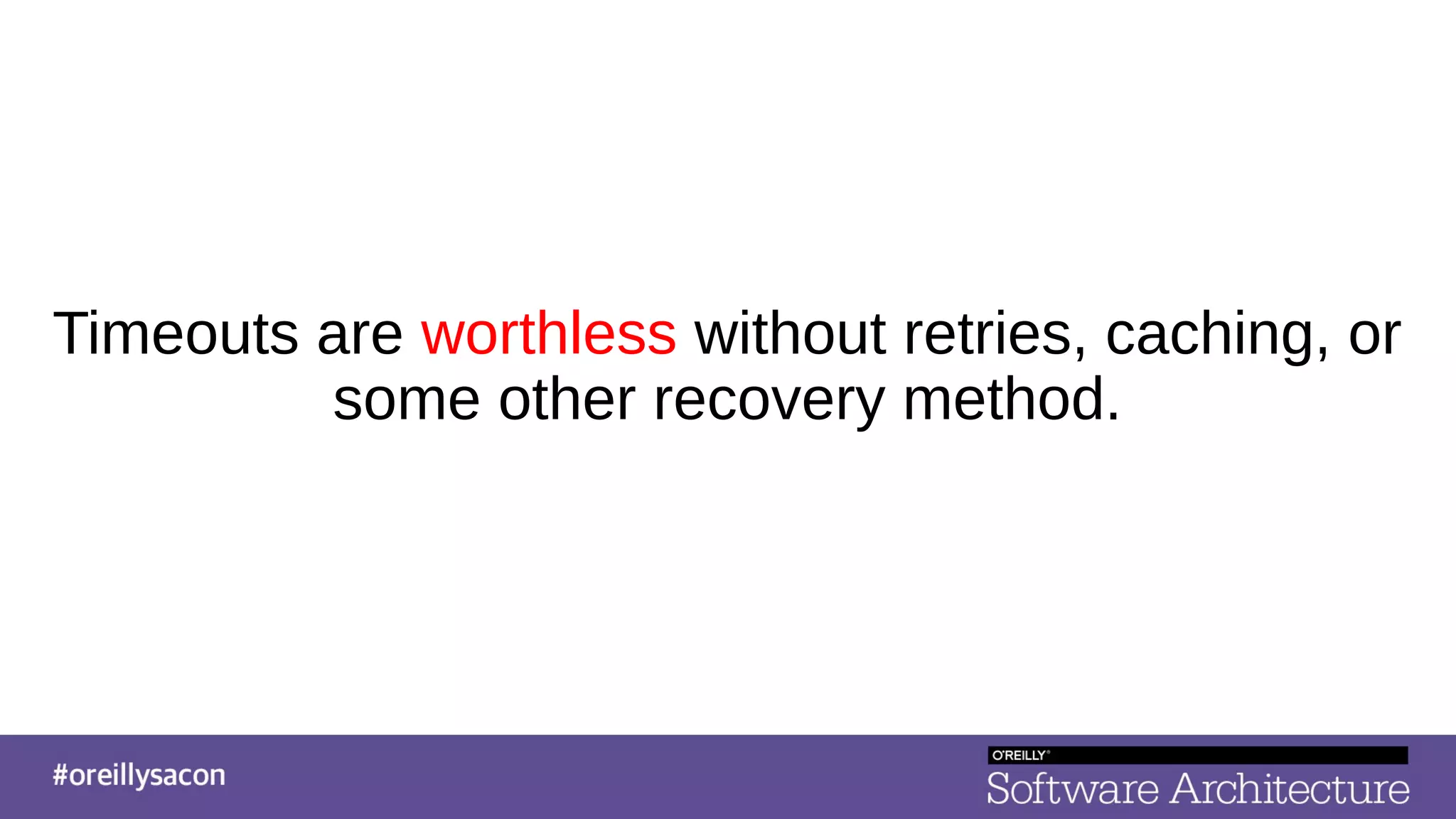
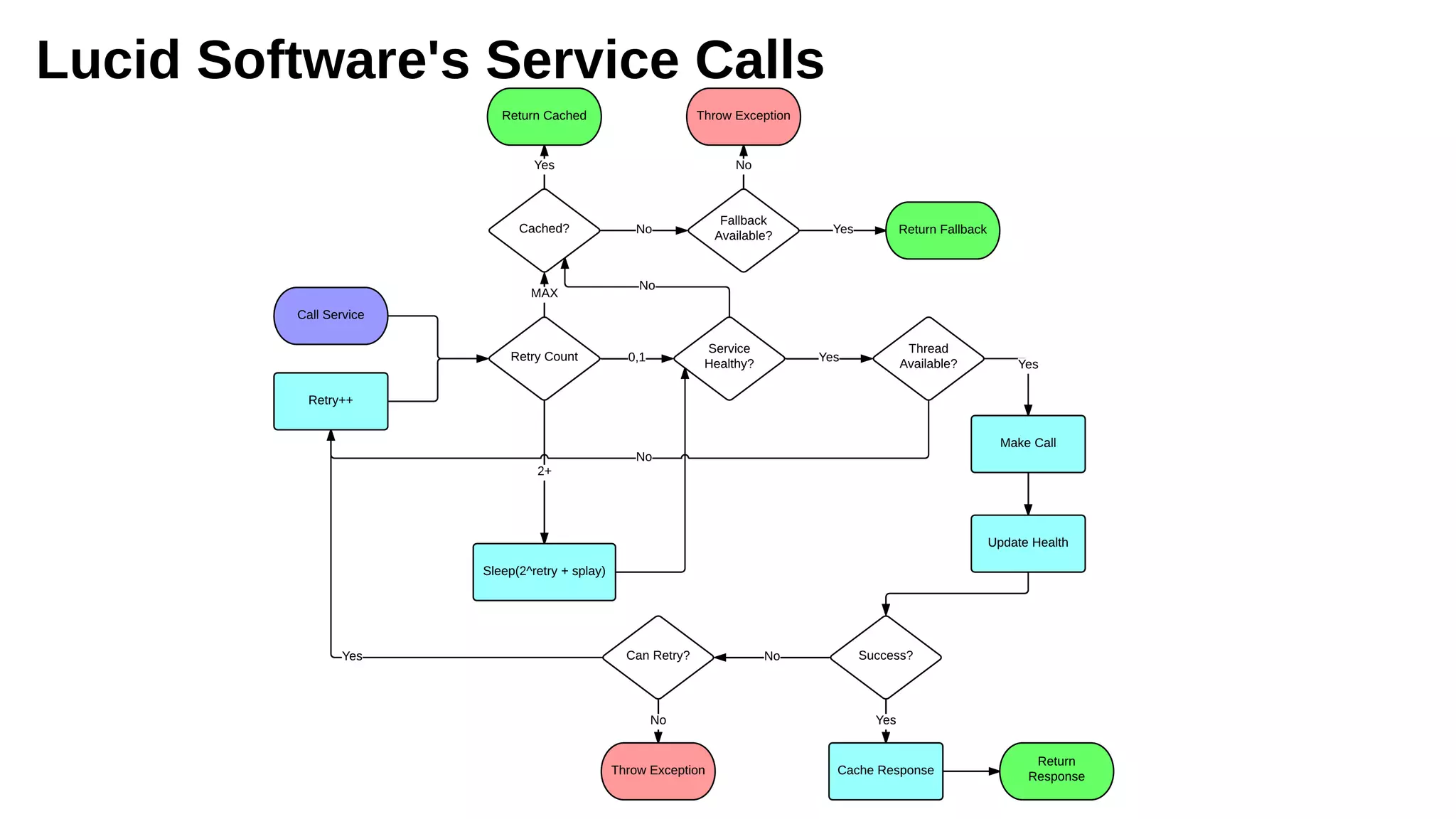
Timeouts are worthless without retries, caching, or
some other recovery method.
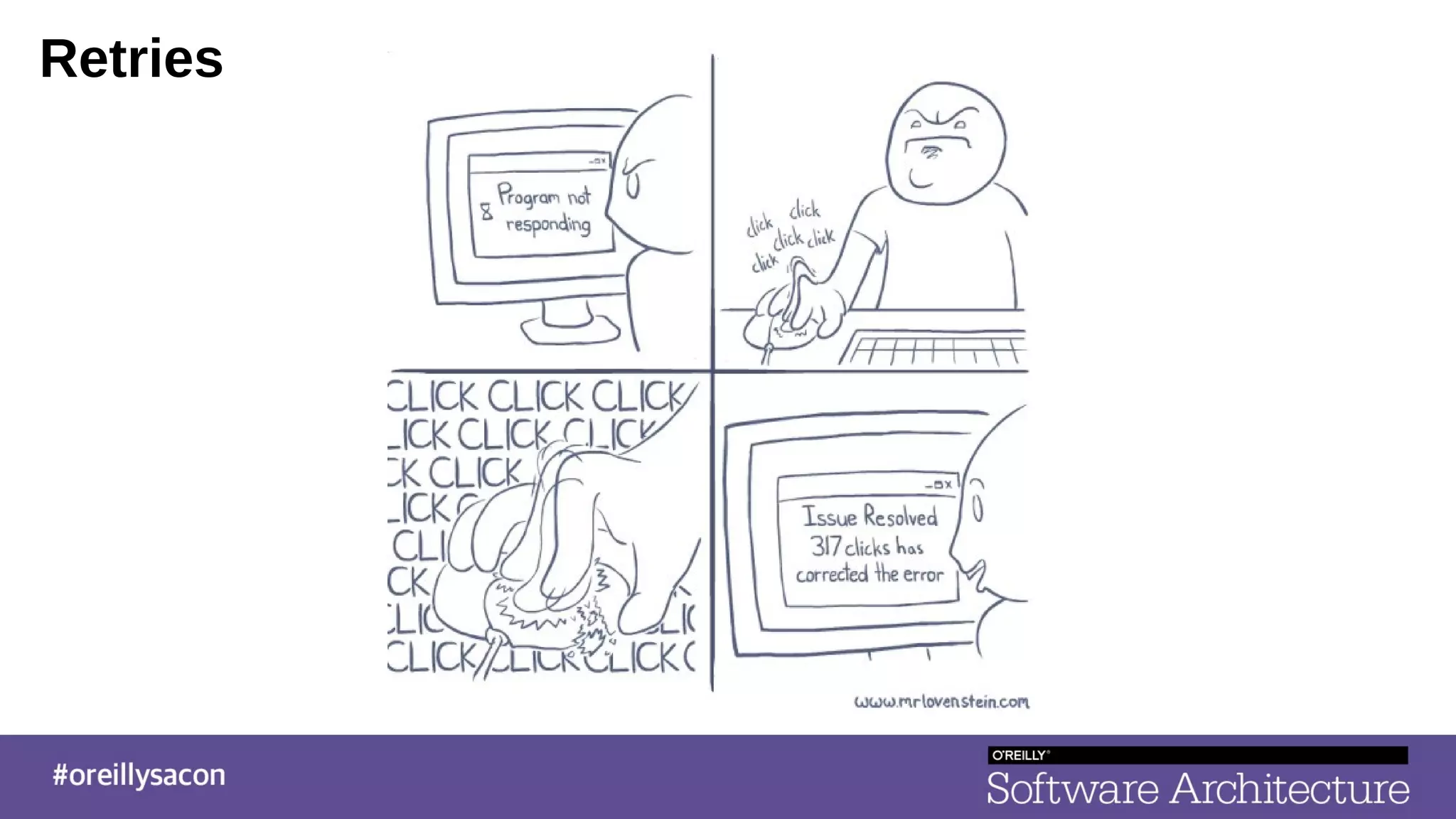
Retries
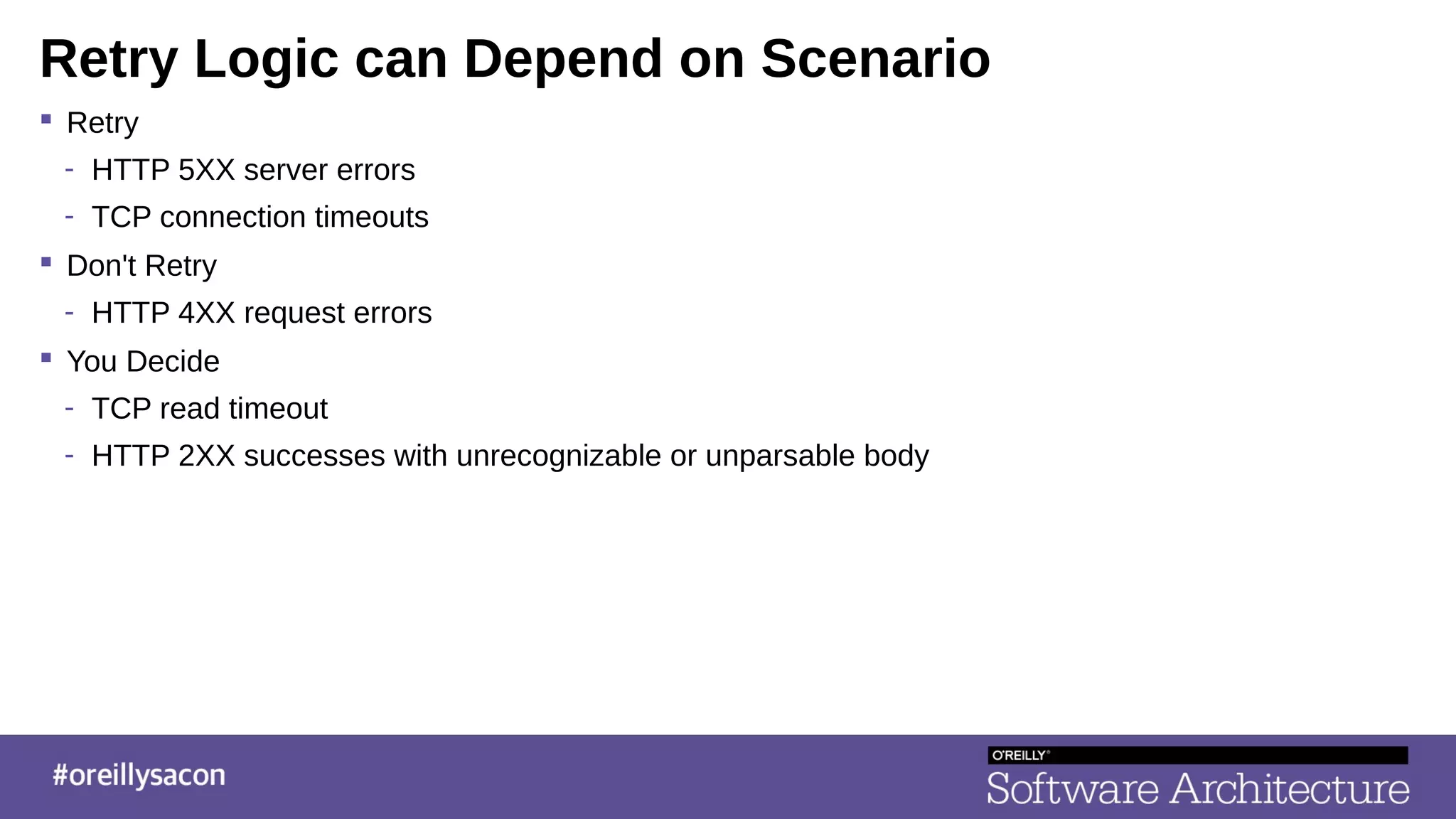
Retry Logic can Depend on Scenario
 Retry
- HTTP 5XX server errors
- TCP connection timeouts
 Don't Retry
- HTTP 4XX request errors
 You Decide
- TCP read timeout
- HTTP 2XX successes with unrecognizable or unparsable body
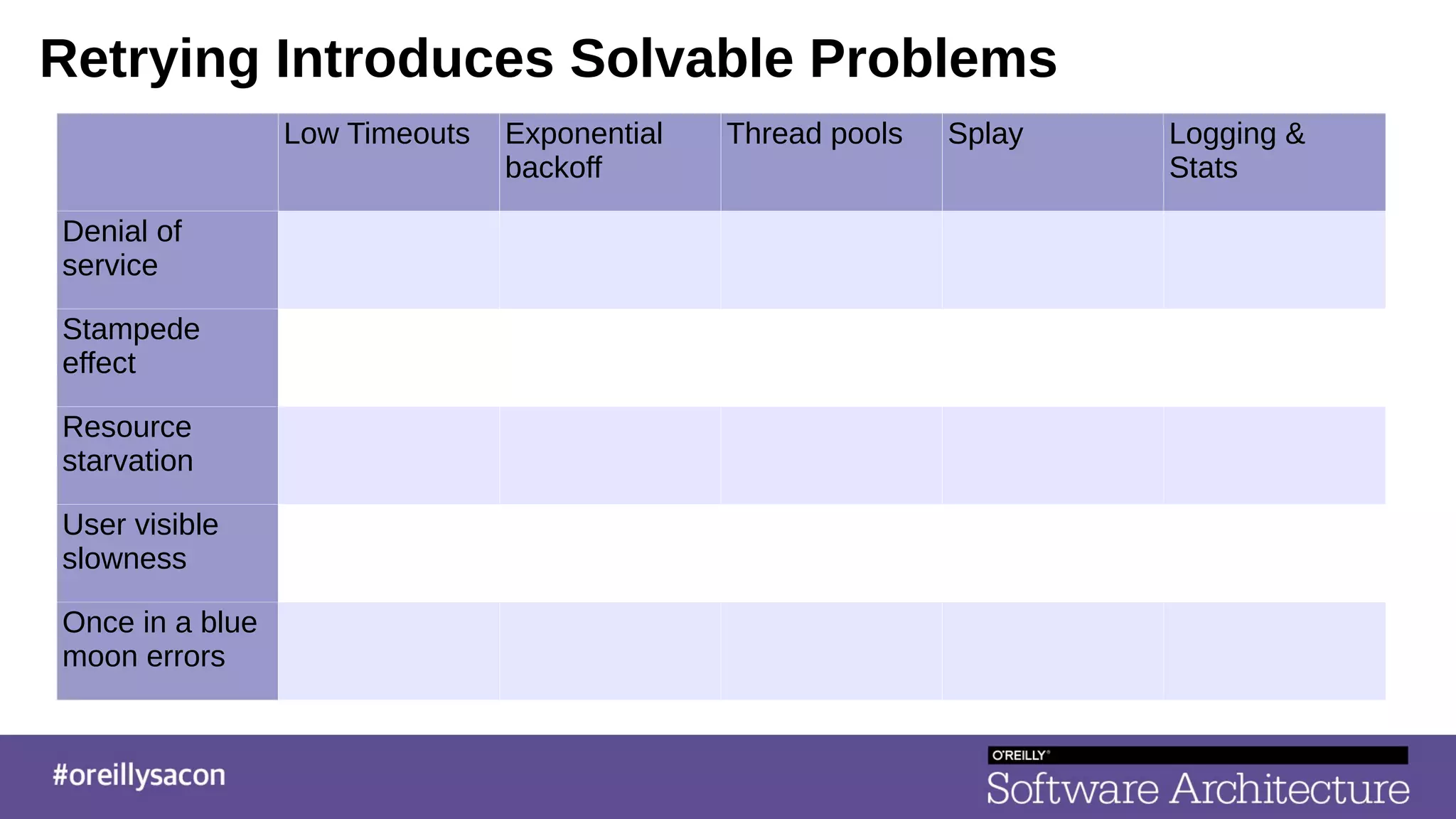
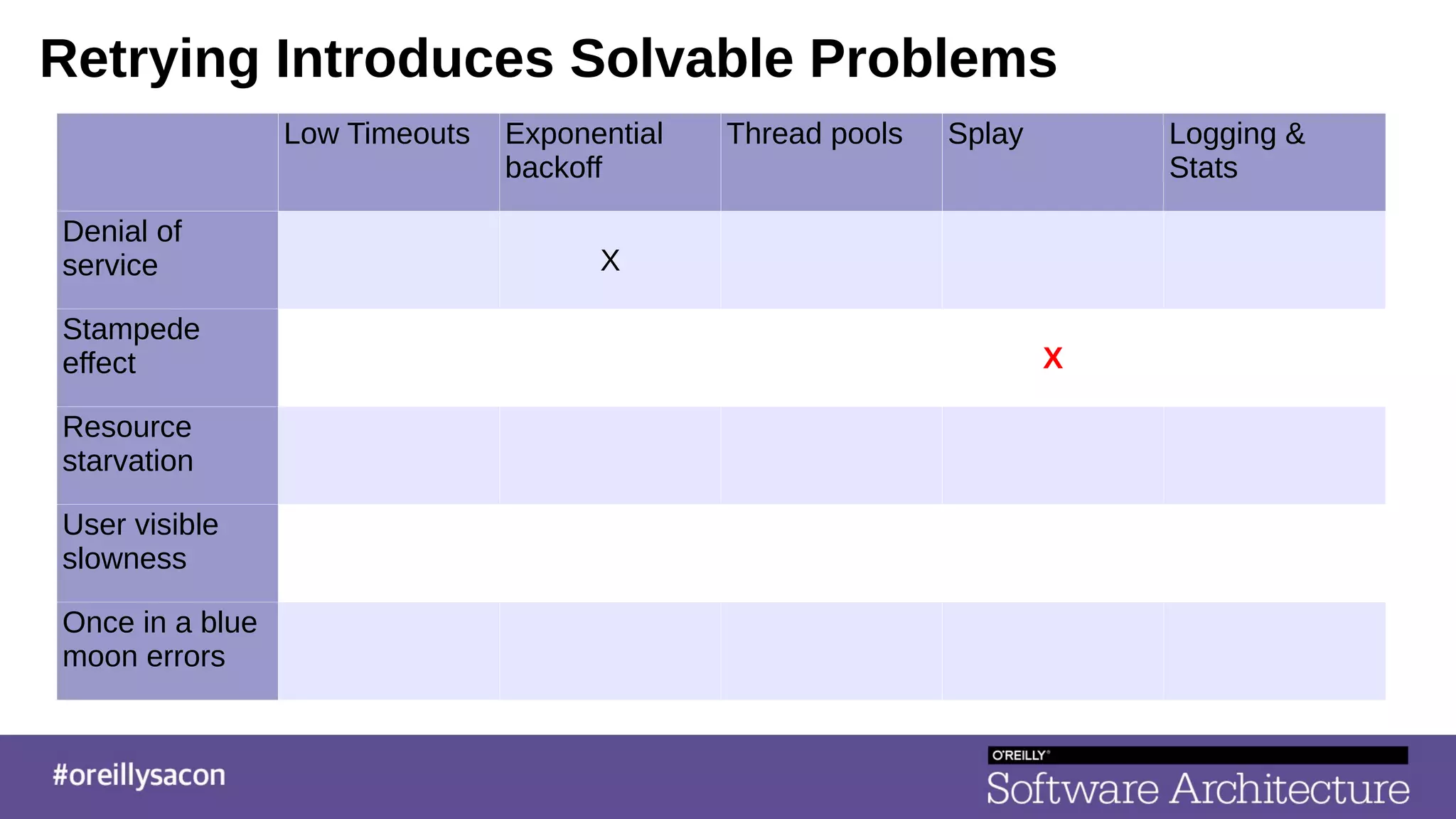
Retrying Introduces Solvable Problems
Low Timeouts Exponential
backoff
Thread pools Splay Logging &
Stats
Denial of
service
Stampede
effect
Resource
starvation
User visible
slowness
Once in a blue
moon errors
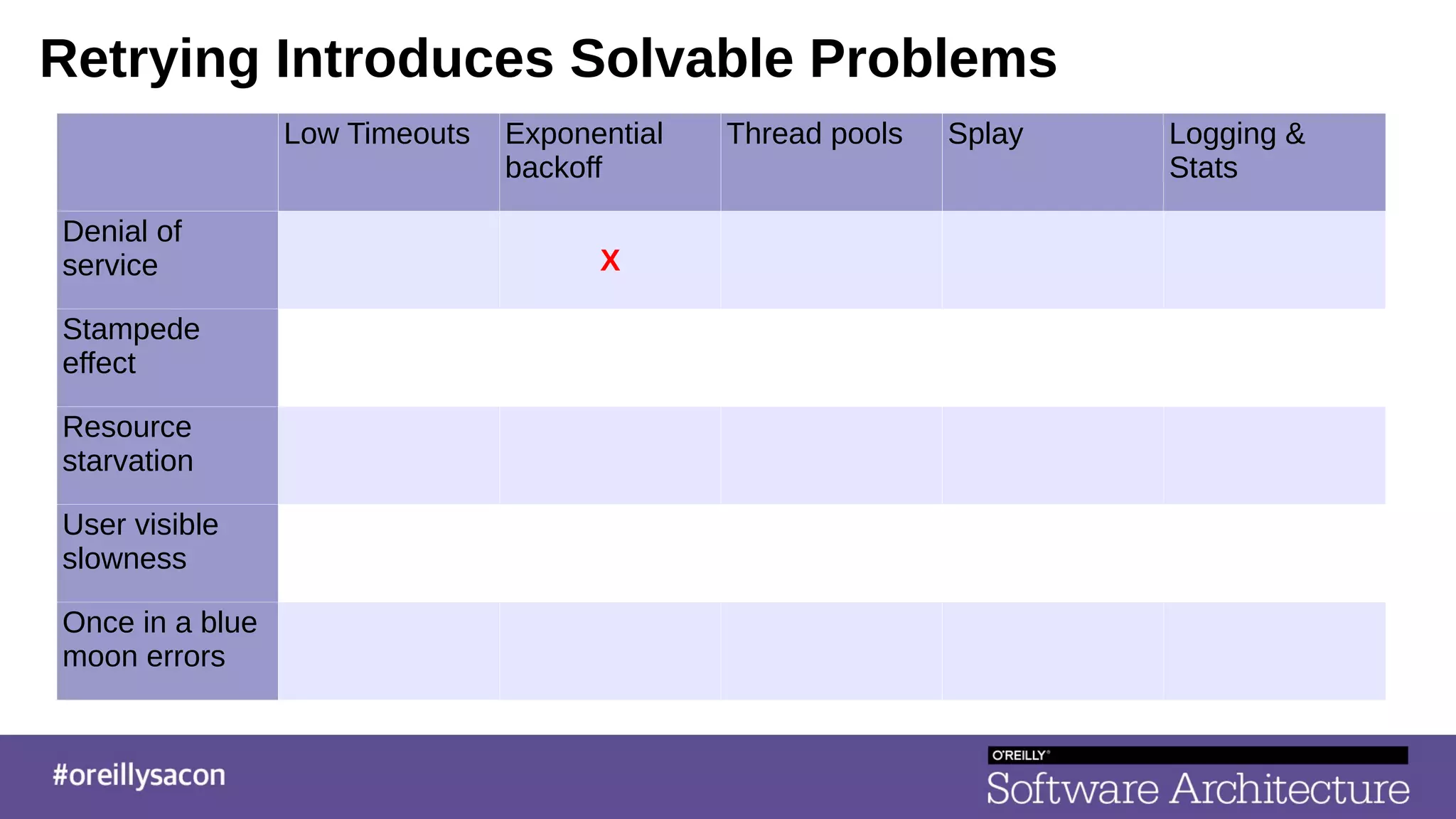
Retrying Introduces Solvable Problems
Low Timeouts Exponential
backoff
Thread pools Splay Logging &
Stats
Denial of
service X
Stampede
effect
Resource
starvation
User visible
slowness
Once in a blue
moon errors
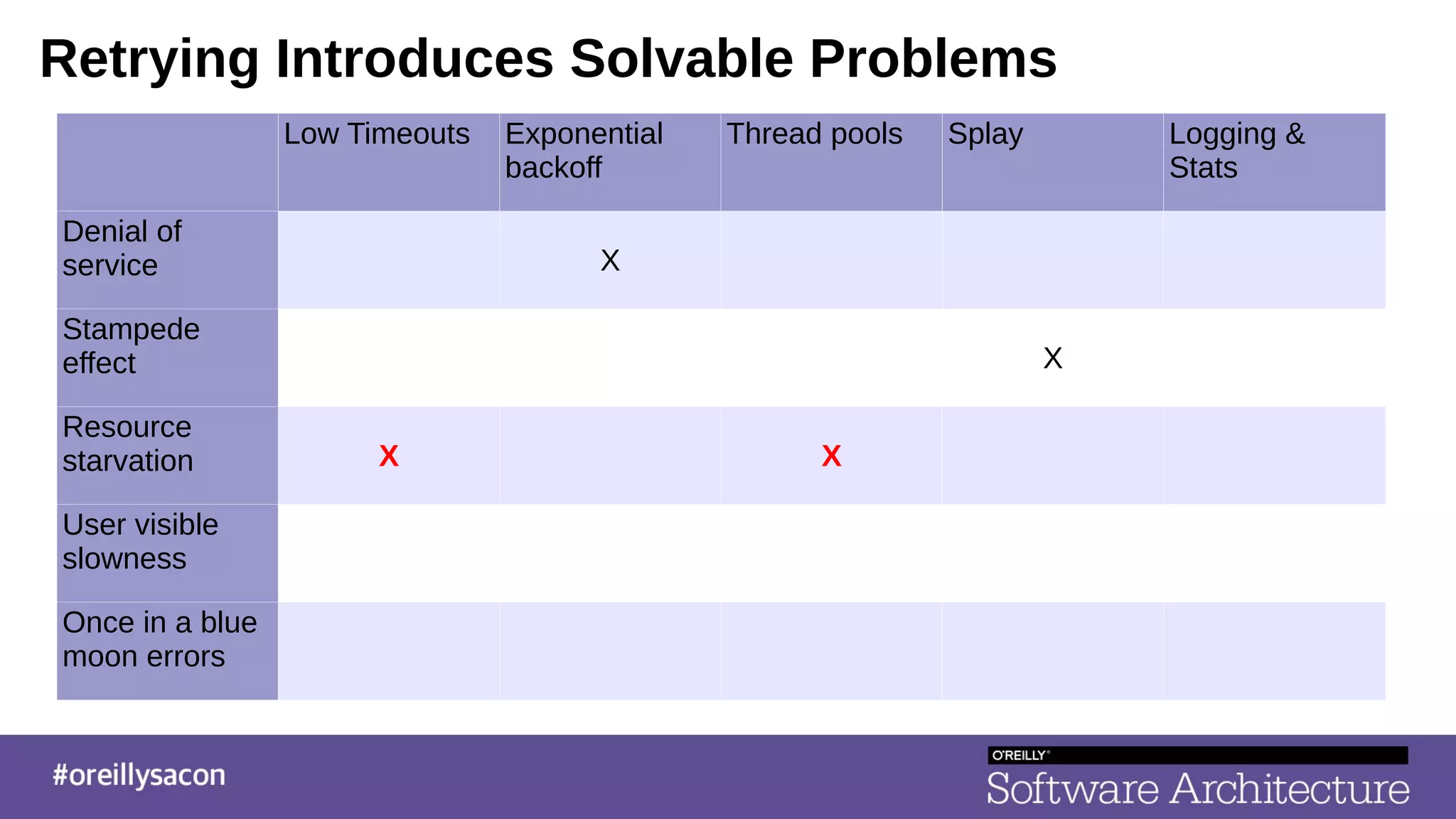
Retrying Introduces Solvable Problems
Low Timeouts Exponential
backoff
Thread pools Splay Logging &
Stats
Denial of
service X
Stampede
effect X
Resource
starvation
User visible
slowness
Once in a blue
moon errors
Retrying Introduces Solvable Problems
Low Timeouts Exponential
backoff
Thread pools Splay Logging &
Stats
Denial of
service X
Stampede
effect X
Resource
starvation X X
User visible
slowness
Once in a blue
moon errors
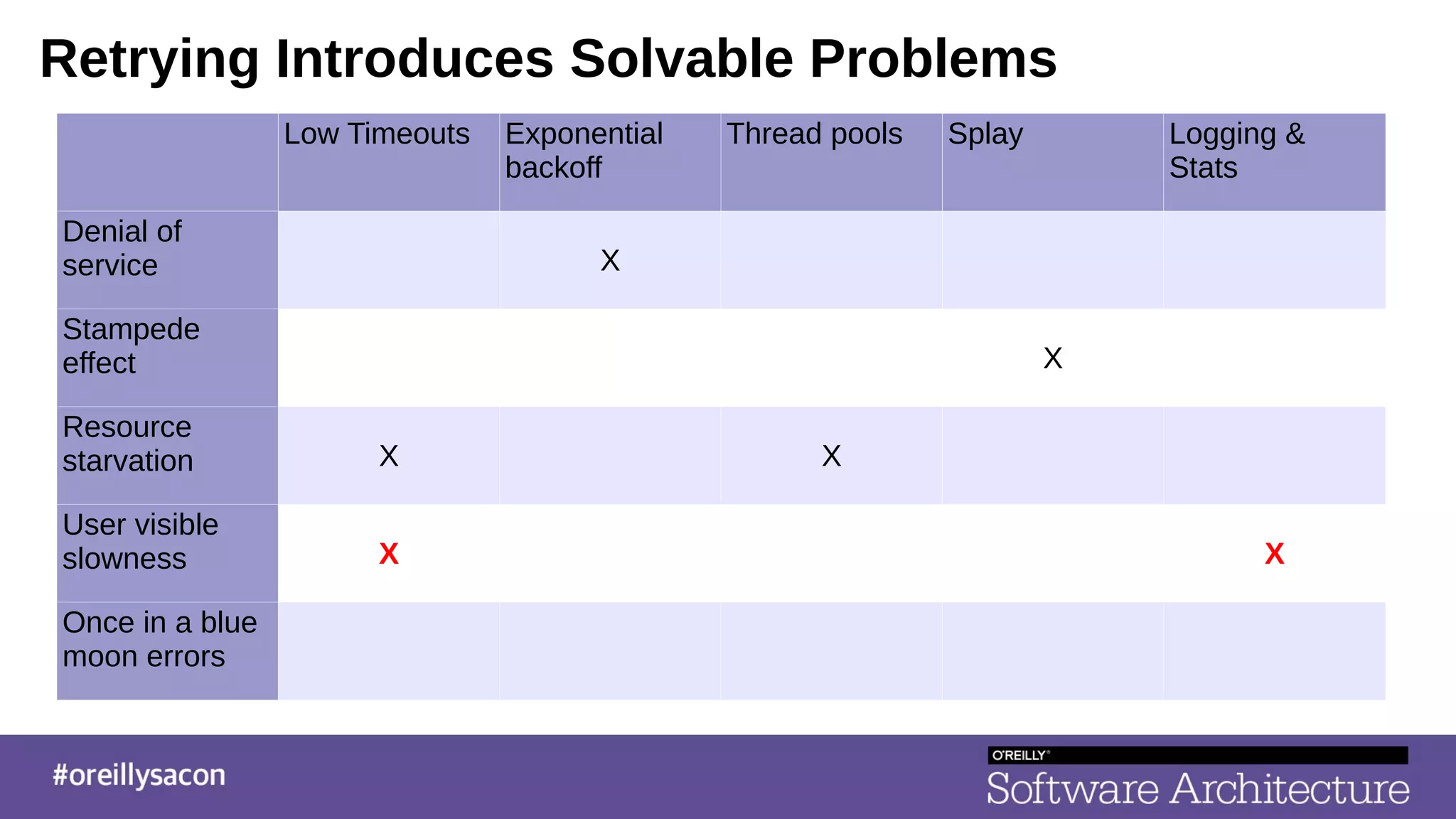
Retrying Introduces Solvable Problems
Low Timeouts Exponential
backoff
Thread pools Splay Logging &
Stats
Denial of
service X
Stampede
effect X
Resource
starvation X X
User visible
slowness X X
Once in a blue
moon errors
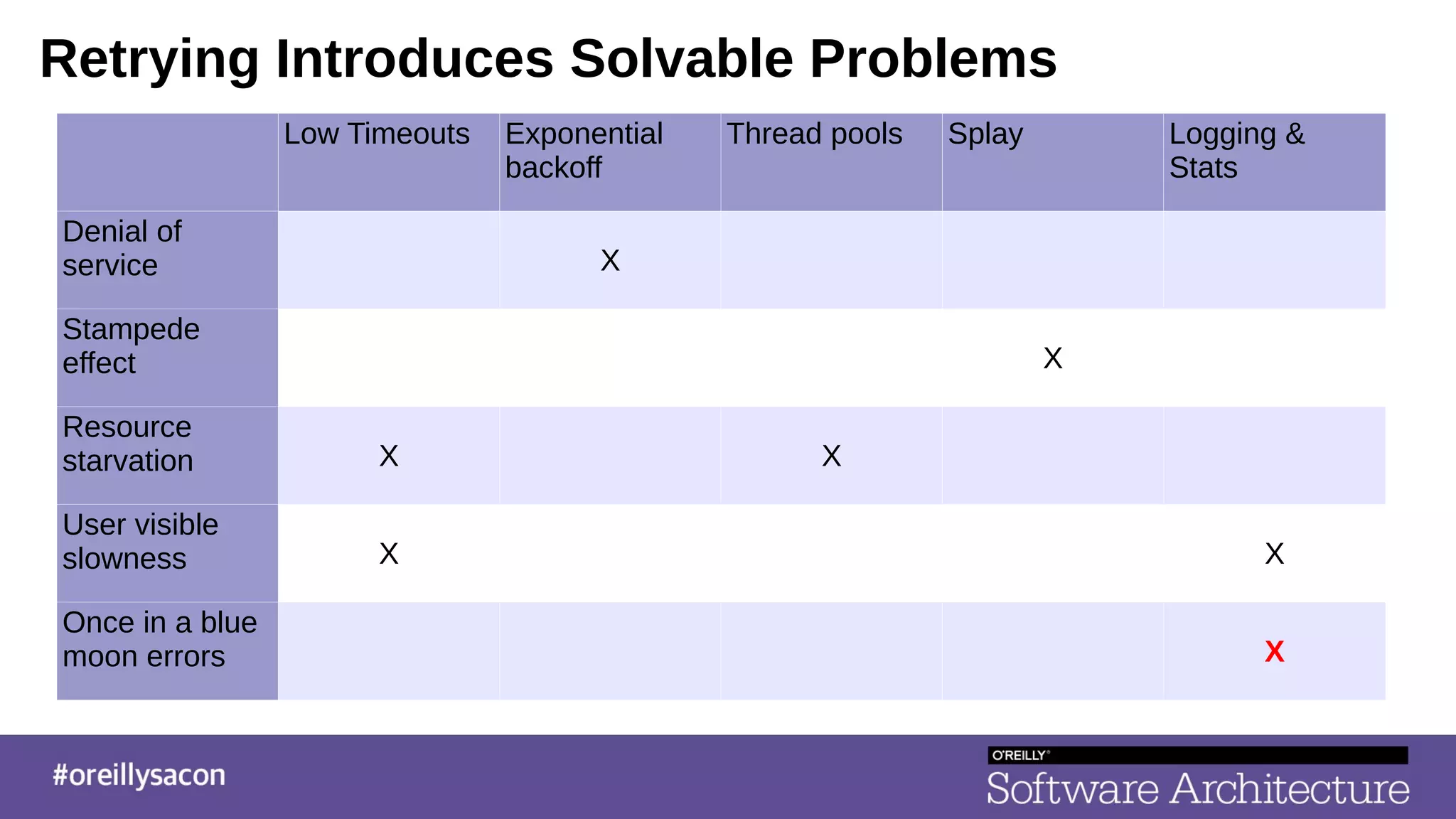
Retrying Introduces Solvable Problems
Low Timeouts Exponential
backoff
Thread pools Splay Logging &
Stats
Denial of
service X
Stampede
effect X
Resource
starvation X X
User visible
slowness X X
Once in a blue
moon errors X
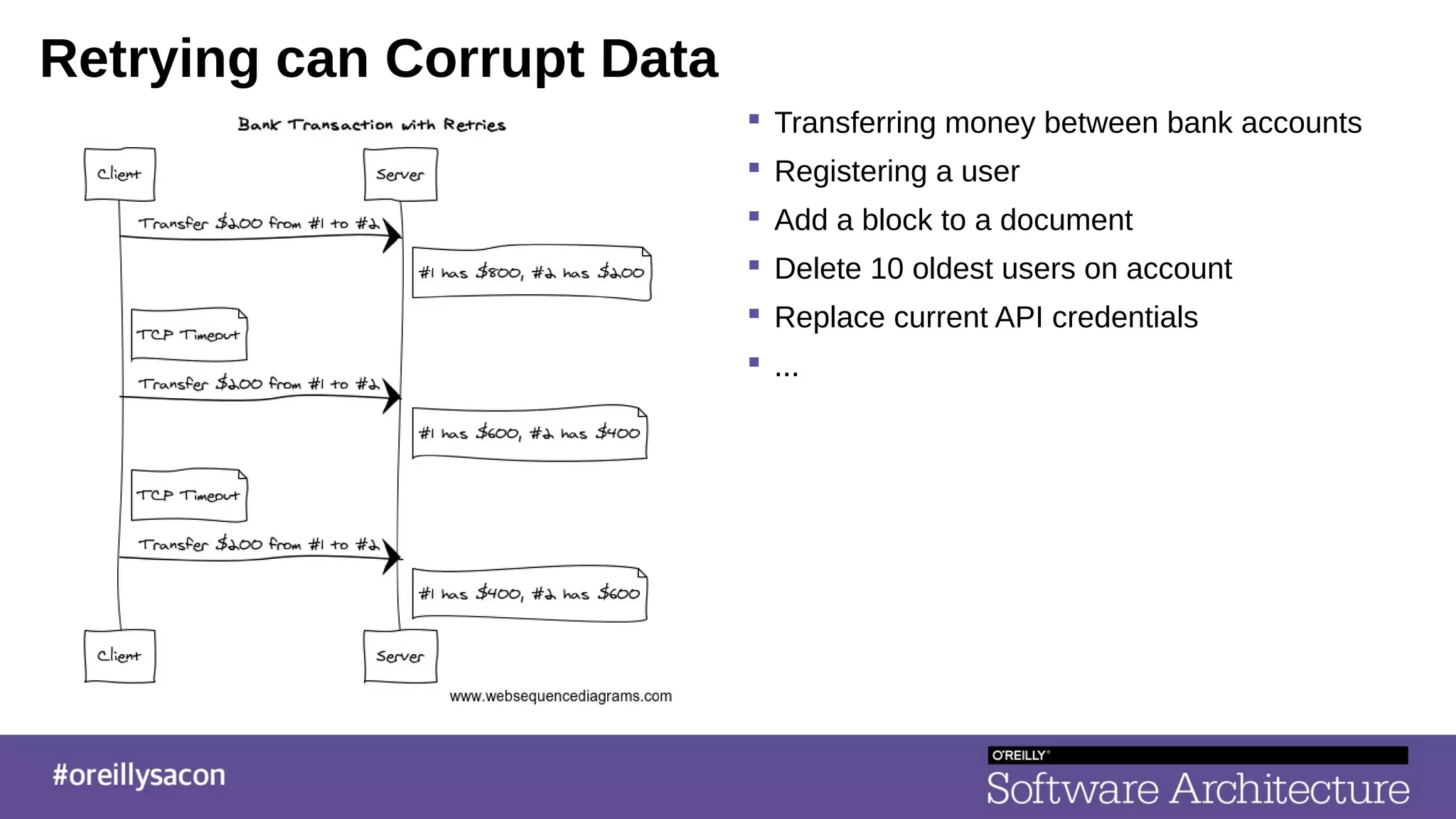
Retrying can Corrupt Data
 Transferring money between bank accounts
 Registering a user
 Add a block to a document
 Delete 10 oldest users on account
 Replace current API credentials
 ...
Idempotence is the property of certain operations
in mathematics and computer science, that can be
applied multiple times without changing the result
beyond the initial application.
Sacrificing Consistency
“Just Like Dad”
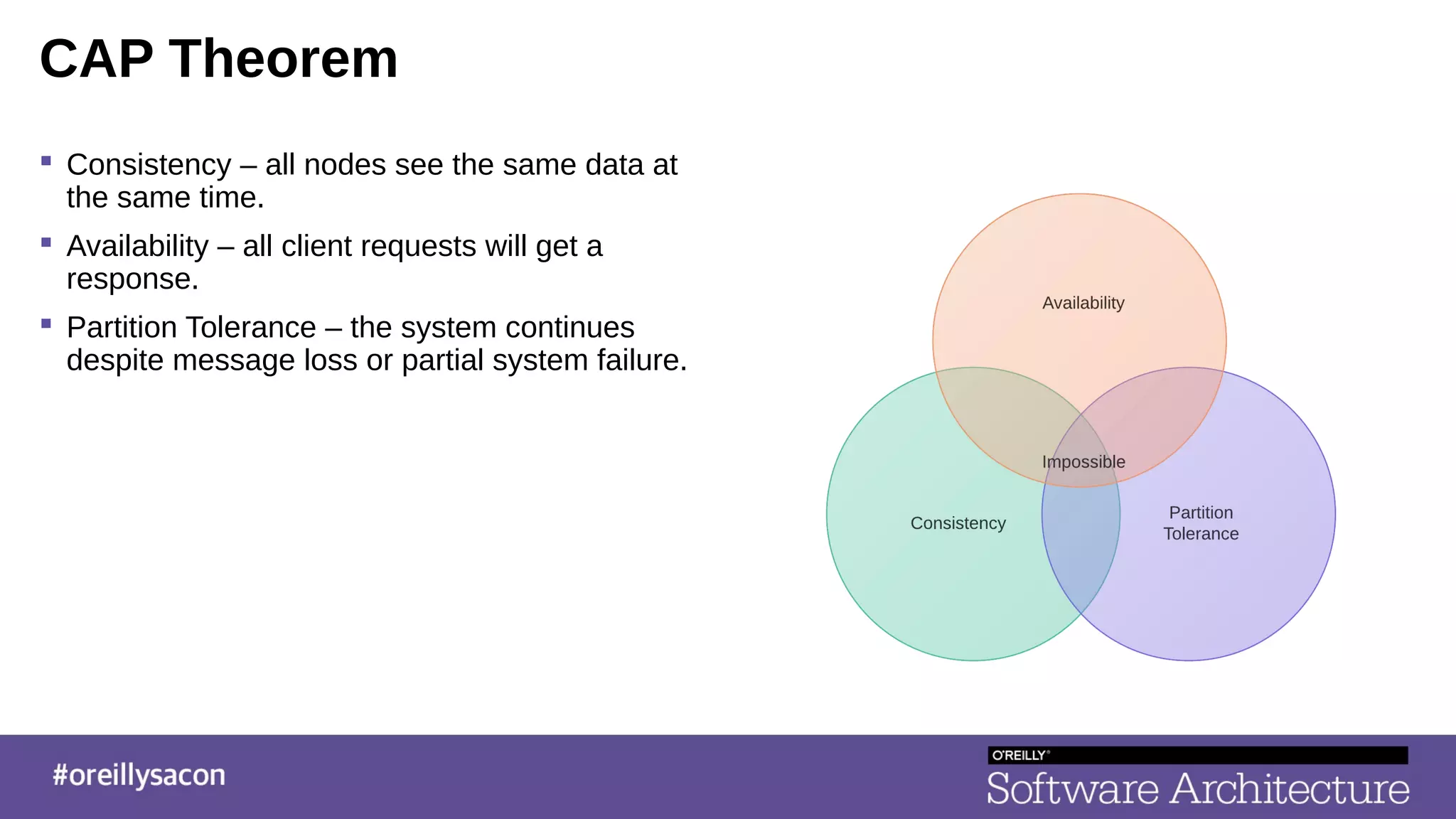
CAP Theorem
 Consistency – all nodes see the same data at
the same time.
 Availability – all client requests will get a
response.
 Partition Tolerance – the system continues
despite message loss or partial system failure.
“Partitions are rare, there is little reason to forfeit
consistency or availability when the system is not
partitioned.... the choice between consistency and
availability can occur many times within the same
system at very fine granularity”
-Eric Brewer
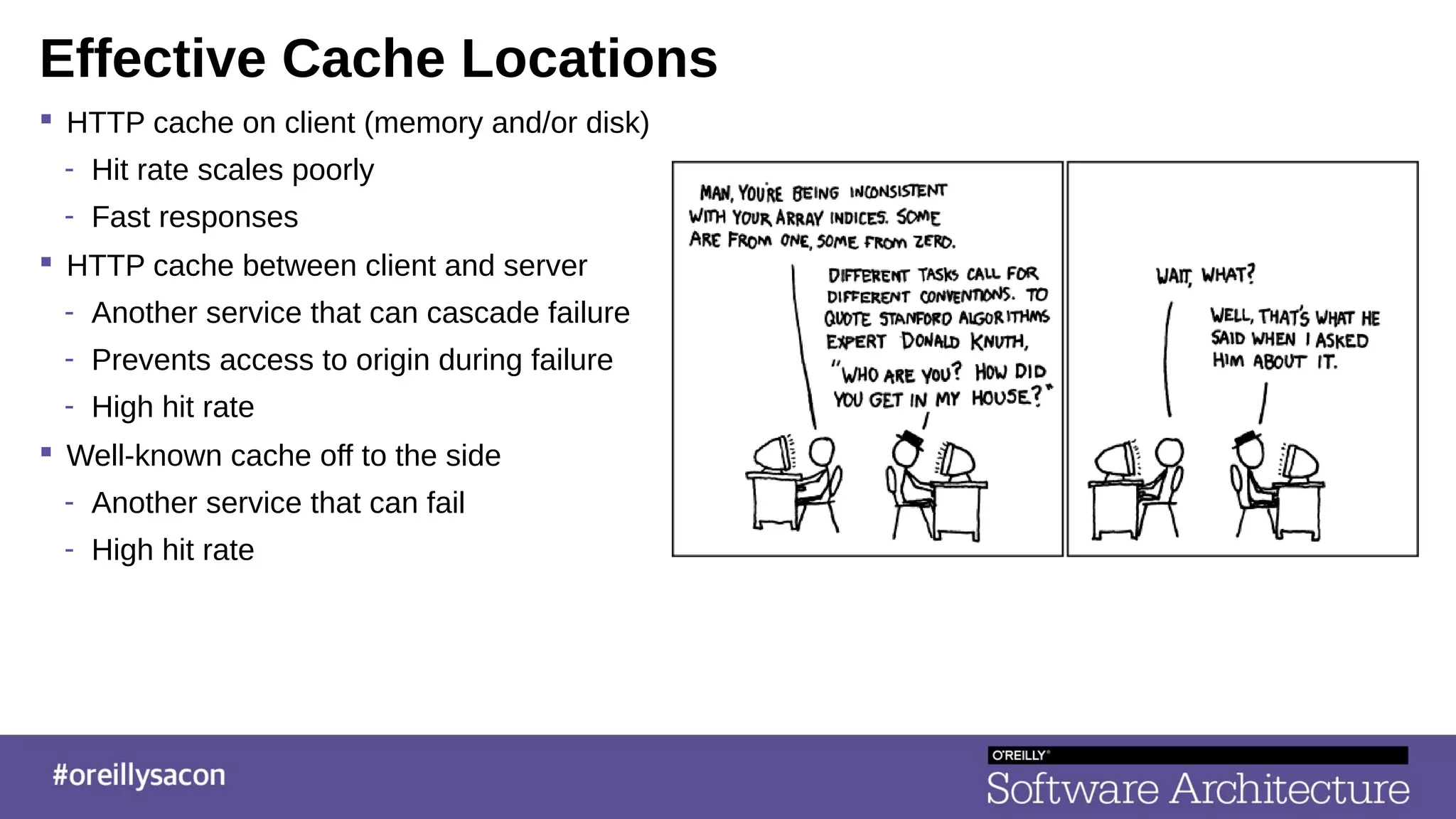
Effective Cache Locations
 HTTP cache on client (memory and/or disk)
- Hit rate scales poorly
- Fast responses
 HTTP cache between client and server
- Another service that can cascade failure
- Prevents access to origin during failure
- High hit rate
 Well-known cache off to the side
- Another service that can fail
- High hit rate
Effective Caching Strategies
 Respect caching headers from server
- Allows server to determine consistency
- Mitigates fewer failures
 Prefer origin, fallback to respected cache
- Always consistent
- Sometimes unavailable
 Store responses until overwritten, prefer origin
- Always consistent unless availability would be sacrificed
- Sometimes unavailable
Sometimes, the origin is down and the cache is empty.
You will need a failsafe.
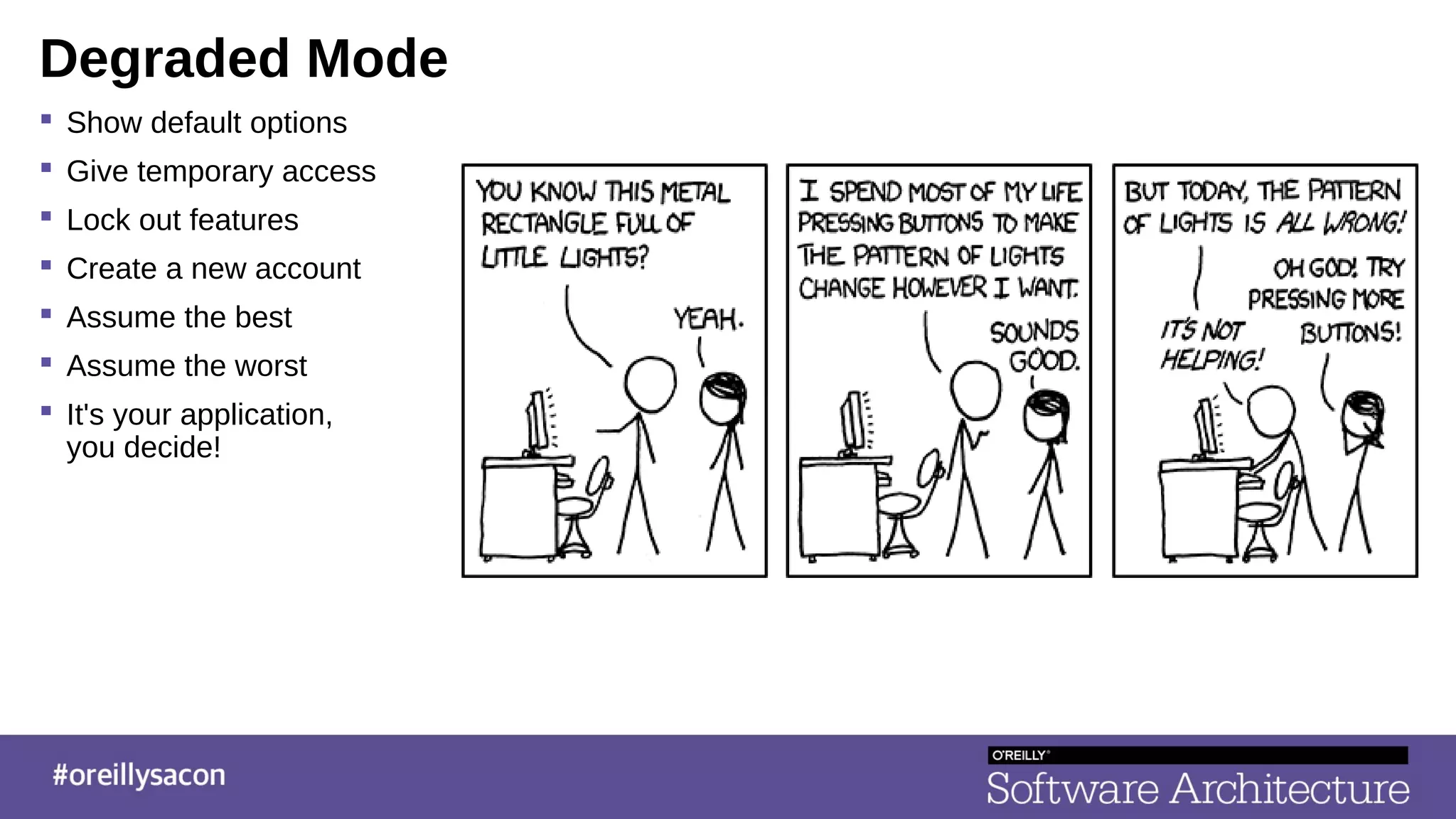
Degraded Mode
 Show default options
 Give temporary access
 Lock out features
 Create a new account
 Assume the best
 Assume the worst
 It's your application,
you decide!
Lucid Software
On Availability
Lucid Software's Service Calls
Questions
Survey @ http://goo.gl/VDmCrt

Optimizing Uptime in SOA

  • 1.
    Optimizing Uptime inSOA by Matthew Barlocker Chief Architect @ Lucid Software Inc
  • 2.
    “A distributed systemis, at best, a necessary evil; evil because of the extra complexity... An application is rarely, if ever, intrinsically distributed. Distribution is just the lesser of the many evils, or perhaps better put, a sensible engineering decision given the trade-offs involved.” -David Cheriton
  • 3.
  • 4.
    Local Functions areDeterministic  Either the function returns or the server shut down  No network hops  Availability of libraries is guaranteed if the server is on “My frontside bus fails for only 1 second every 27.8 hours” - no one ever
  • 5.
    Distributed Systems areEvil  Network Failure - Dropped Packets - Corrupted Packets - Failed Router - Traffic Spike - Idiot with a shovel  Service Not Running - Deployment - Troubleshooting - Rogue Ops Member  Sick Server - Thread starvation - Swapping - Open file limit - Application Monitoring went AWOL
  • 6.
    Fallacies of DistributedSystems  The network is reliable.  Latency is zero.  Bandwidth is infinite.  The network is secure.  Topology doesn't change.  There is one administrator.  Transport cost is zero.  The network is homogeneous.
  • 7.
    Distributed Systems haveGood  Separation of concern in the organization  Fail independently  Resource consumption  Scaling profiles  Code modularity  Loose coupling
  • 8.
  • 9.
    More Parts =More Failures
  • 10.
    More Parts =More Failures
  • 11.
    The Domino Effect Thread exhaustion  Memory utilization  File handle limits  Database record locks
  • 12.
    Uptime – WhatWe Wish For
  • 13.
  • 14.
    Strategies for OptimizingUptime  Tolerate Failures - Timeouts - Retries - Idempotence  Sacrifice Consistency - Caching - Degraded Mode
  • 15.
  • 16.
  • 17.
  • 18.
  • 19.
    Timeouts - TCP Readtimeout resets after each read. Chunked responses rarely get timed out on reads. Read Timeout
  • 20.
    The Reason touse Timeouts  Is NOT to limit I/O wait time  Is NOT to catch theoretical upper bounds  Is NOT to be a cool unused feature  Is NOT to be a last resort for user response time
  • 21.
    The reason touse timeouts is to increase uptime by failing fast and allowing retries, caching, and degraded modes.
  • 22.
    Timeout Statistics –Around the World (in ms) From Virginia To: Min Max Avg Median Std Dev. 84.00% 97.50% 99.85% Oregon 59.21 166 68.28 68.96 6.16 74.44 80.6 86.76 California 74.74 185.85 83.47 82.1 9.28 92.75 102.03 111.31 Ireland 76.14 85.81 76.36 76.31 0.22 76.58 76.8 77.02 Brazil 123.53 1089.09 124.04 123.75 8.59 132.63 141.22 149.81 Australia 220.27 339.97 240.99 240.5 9.69 250.68 260.37 270.06
  • 23.
    Timeout Statistics –In the Data Center (in ms) From To Min Max Average Median Std Dev. 84.00% 97.50% 99.85% us-east- 1c us-east- 1e 0.4 7.35 0.51 0.49 0.25 0.76 1.01 1.26 us-east- 1c us-east- 1d 1.39 8.21 1.47 1.45 0.21 1.68 1.89 2.1 us-east- 1e us-east- 1c 0.41 6.84 0.5 0.5 0.17 0.67 0.84 1.01 us-east- 1e us-east- 1d 0.71 4.86 0.76 0.75 0.17 0.93 1.1 1.27 us-east- 1d us-east- 1c 1.4 8.93 1.58 1.52 0.44 2.02 2.46 2.9 us-east- 1d us-east- 1e 0.71 6.9 0.83 0.81 0.34 1.17 1.51 1.85
  • 24.
    Timeout Comparison onHealthy Service  Low Timeout Version - 3ms TCP connect timeout - 100ms TCP read timeout - 1 Immediate retry  Timeline - 0ms – Make request to service - 1ms – TCP connection established - 51ms – Data returned from service  High Timeout Version - 3000ms TCP connect timeout - 10000ms TCP read timeout - 1 Immediate retry  Timeline - 0ms – Make request to service - 1ms – TCP connection established - 51ms – Data returned from service Both versions are the same when the service is healthy
  • 25.
    Timeout Comparison witha Dropped Packet  Low Timeout Version - 3ms TCP connect timeout - 100ms TCP read timeout - 1 Immediate retry  Timeline - 0ms – Make request to service - 3ms – Make request to service - 4ms – TCP connection established - 54ms – Data returned from service  High Timeout Version - 3000ms TCP connect timeout - 10000ms TCP read timeout - 1 Immediate retry  Timeline - 0ms – Make request to service - 1000ms – TCP retransmits packet - 1001ms – TCP connection established - 1051ms – Data returned from service With a dropped packet, low timeouts provide 95% speedup
  • 26.
    Timeout Comparison withSick Server  Low Timeout Version - 3ms TCP connect timeout - 100ms TCP read timeout - 1 Immediate retry  Timeline - 0ms – Make request to service - 1ms – TCP connection established - 101ms – Make request 2 to service - 102ms – TCP connection established - 152ms – Data returned from service  High Timeout Version - 3000ms TCP connect timeout - 10000ms TCP read timeout - 1 Immediate retry  Timeline - 0ms – Make request to service - 1ms – TCP connection established - 1001ms – Make request 2 to service - 1002ms – TCP connection established - 1052ms – Data returned from service With a sick server, low timeouts provide 86% speedup
  • 27.
    Timeout Comparison withNetwork Hiccup  Low Timeout Version - 3ms TCP connect timeout - 100ms TCP read timeout - 1 Immediate retry  Timeline - 0ms – Make request to service - 3ms – Make request 2 to service - 4ms – TCP connection established - 54ms – Data returned from service  High Timeout Version - 3000ms TCP connect timeout - 10000ms TCP read timeout - 1 Immediate retry  Timeline - 0ms – Make request to service - 4ms – TCP connection established - 54ms – Data returned from service With a network hiccup, there is no difference.
  • 28.
    Timeouts are worthlesswithout retries, caching, or some other recovery method.
  • 29.
  • 30.
    Retry Logic canDepend on Scenario  Retry - HTTP 5XX server errors - TCP connection timeouts  Don't Retry - HTTP 4XX request errors  You Decide - TCP read timeout - HTTP 2XX successes with unrecognizable or unparsable body
  • 31.
    Retrying Introduces SolvableProblems Low Timeouts Exponential backoff Thread pools Splay Logging & Stats Denial of service Stampede effect Resource starvation User visible slowness Once in a blue moon errors
  • 32.
    Retrying Introduces SolvableProblems Low Timeouts Exponential backoff Thread pools Splay Logging & Stats Denial of service X Stampede effect Resource starvation User visible slowness Once in a blue moon errors
  • 33.
    Retrying Introduces SolvableProblems Low Timeouts Exponential backoff Thread pools Splay Logging & Stats Denial of service X Stampede effect X Resource starvation User visible slowness Once in a blue moon errors
  • 34.
    Retrying Introduces SolvableProblems Low Timeouts Exponential backoff Thread pools Splay Logging & Stats Denial of service X Stampede effect X Resource starvation X X User visible slowness Once in a blue moon errors
  • 35.
    Retrying Introduces SolvableProblems Low Timeouts Exponential backoff Thread pools Splay Logging & Stats Denial of service X Stampede effect X Resource starvation X X User visible slowness X X Once in a blue moon errors
  • 36.
    Retrying Introduces SolvableProblems Low Timeouts Exponential backoff Thread pools Splay Logging & Stats Denial of service X Stampede effect X Resource starvation X X User visible slowness X X Once in a blue moon errors X
  • 37.
    Retrying can CorruptData  Transferring money between bank accounts  Registering a user  Add a block to a document  Delete 10 oldest users on account  Replace current API credentials  ...
  • 38.
    Idempotence is theproperty of certain operations in mathematics and computer science, that can be applied multiple times without changing the result beyond the initial application.
  • 39.
  • 40.
    CAP Theorem  Consistency– all nodes see the same data at the same time.  Availability – all client requests will get a response.  Partition Tolerance – the system continues despite message loss or partial system failure.
  • 41.
    “Partitions are rare,there is little reason to forfeit consistency or availability when the system is not partitioned.... the choice between consistency and availability can occur many times within the same system at very fine granularity” -Eric Brewer
  • 42.
    Effective Cache Locations HTTP cache on client (memory and/or disk) - Hit rate scales poorly - Fast responses  HTTP cache between client and server - Another service that can cascade failure - Prevents access to origin during failure - High hit rate  Well-known cache off to the side - Another service that can fail - High hit rate
  • 43.
    Effective Caching Strategies Respect caching headers from server - Allows server to determine consistency - Mitigates fewer failures  Prefer origin, fallback to respected cache - Always consistent - Sometimes unavailable  Store responses until overwritten, prefer origin - Always consistent unless availability would be sacrificed - Sometimes unavailable
  • 44.
    Sometimes, the originis down and the cache is empty. You will need a failsafe.
  • 45.
    Degraded Mode  Showdefault options  Give temporary access  Lock out features  Create a new account  Assume the best  Assume the worst  It's your application, you decide!
  • 46.
  • 47.
  • 48.