Download to read offline
![IJRET: International Journal of Research in Engineering and Technology eISSN: 2319-1163 | pISSN: 2321-7308
__________________________________________________________________________________________
Volume: 02 Issue: 09 | Sep-2013, Available @ http://www.ijret.org 487
OPTIMIZATION OF CULTURAL CONDITIONS FOR LACTIC ACID
PRODUCTION BY LACTOBACILLUS BULGARICUS ATTC 11842 GROWN
ON WHEY
M. Kitouni1
, L. Oulmi2
1,2
Laboratory of applied biology and health, Faculty of natural sciences and life, University Constantine 1, Ain El Bey
street 25000, Constantine, ALGERIA, mahmoudkitouni@yahoo.fr
Abstract
The effects on the lactic acid (LA) production by thermophile Lactobacillus bulgaricus ATTC 11842 on whey as a basal medium of
seven factors namely, temperature °C, pH, Lactose g/l, Yeast extract g/l, corn steep liquor (CSL) g/l, K2HPO4 g/l, and salts g/l
(MnSO4, MgSO4 and FeSO4) were investigated, through the statistical analysis of the results by Plackett and Burmann experimental
design. pH was found to have the high significant effect on lactic acid production. By response surface methodology (RSM) design the
optimal value of pH and concentrations in the medium of yeast extract, K2HPO4 and salts were then investigated, it should be 5.5 of
pH, 2.73 g/l of K2HPO4, 1.59 g/l of yeast extract and 0.0326 g/l, 0.1304 g/l, 0.01304 g/l of MgSO4, MnSO4 and FeSO4 respectively.
The results obtained with the optimal results were 20.9592 g/l. of lactic acid and the corresponding yields was 0.5665% (ratio
between the amount of lactic acid produced and the initial concentration of lactose).
Index Terms: Lactic acid, experimental design, Plackett and Burmann, Lactobacillus bulgaricus, whey
---------------------------------------------------------------------***------------------------------------------------------------------------
1. INTRODUCTION
Lactic acid is a natural organic acid, which has many
applications in pharmaceutical, food and chemical industries.
These include: uses as an acidulant, preservative and in recent
years as a substrate for the production of biodegradable
plastics. These plastics besides its application in food and
cosmetic industry [19] are applied as drug-carriers [13] and
for biodegradable packaging [11].
Lactic acid is produced by chemical synthesis and microbial
fermentation. Chemical synthesis results in racemic mixture of
lactic acid whereas specific stereo isomeric form can be
obtained by microbial fermentation [15]. The fermentative
production of lactic acid is interesting due to the prospect of
using cheap raw materials. The most attractive method for
lactic acid production is fermentation of lactose in whey, a
typical e uent from dairies. Hence, two problems could be
solved at the same time wastewater treatment due to its high
biochemical oxygen demand (BOD) 30000-50000 ppm [18]
and useful product recovery. There are many reports on the
lactic acid fermentation potential of Lactobacillus bacteria
using lactose as substrate [9, 23].
Lactic acid production from various substrates like corn [21],
sugarcane [5], cassava [22], beets [12], paper sludge [14],
biodiesel [3] and green microalga, Hydrodictyon reticulum
[16] has been studied to meet the increasing demands for
lactic acid. In this article, lactic acid production from whey
using Lactobacillus bulgaricus (ATCC 11842) has been
studied. The optimal conditions for the production of lactic
acid were determined in flask culture.
2. MATERIALS AND MEDTHODS
2.1 Microorganism
The lactic acid bacterium used was Lactobacillus
bulgaricus (ATCC 11842). The strain was stored in De Man,
Rogosa and Sharpe (MRS) broth with 20 % (v/v) glycerol at –
18 °C..
2. 2 Media and Culture Conditions
Cheese whey containing 52 % (w/v) lactose was obtained
from Boudouaou ONALAIT Algiers. Deproteinization was
carried out by heat treatment (100°C for 10 min) Then
adjusted to pH= 4.6 (isoelectric point of protein flocculation)
by adding to whey 10 M HCl solution and cooled at room
temperature. The resulting whey solution was centrifuged at
10 000 g to remove the solids and the supernatant was diluted
to reach the desired lactose concentration. The inoculum was
prepared by transferring glycerol stock culture (1 ml) to an
Erlenmeyer flask containing 100 ml of MRS medium and
incubated at 46°C for 18 h on a rotary shaker at 200 rpm.
Experiments were performed in 250 ml Erlenmeyer flasks
containing 50 ml of production medium inoculated with 10 %
inoculum grown in the MRS medium. The flasks were then
incubated on a rotary shaker at 200 rpm and at the desired](https://image.slidesharecdn.com/optimizationofculturalconditionsforlacticacid-140805021608-phpapp01/75/Optimization-of-cultural-conditions-for-lactic-acid-1-2048.jpg)
![IJRET: International Journal of Research in Engineering and Technology eISSN: 2319-1163 | pISSN: 2321-7308
__________________________________________________________________________________________
Volume: 02 Issue: 09 | Sep-2013, Available @ http://www.ijret.org 488
temperature according to experimental design. To avoid pH
decrease due to lactic acid production, 50 g/l of sterile
CaCO3 in powder form was added to each flask [10].
2.3 Experimental Design and Statistical Analysis
To select the factors that affect the lactic acid production we
chose the Plackett-Burmann experimental design. It allows the
study of k variables with k+1 experiment. The experimental
design applied to this study is presented in Table 1. The
columns represent different variables and the rows represent
different experiments. To estimate the experimental error four
variables (X3, X6, X9 and X11) are designed as dummy
variables. In each case a high and a low level of each variable
(nutrient, pH) were tested. The Plakett–Burman design
assumes that there are no interactions between the different
media constituents, Xi in the range of variables (factors) under
consideration [17]. A linear approach is considered to be
sufficient for screening. Y = β0 + ∑βiXi (i= 1…….k) where Y
is the experimental response, β0 the main effects of the factors,
βi are the regression coefficients. The Plackett–Burman
experimental design is a fractional factorial design and the
main effect of such a design may be simply calculated as the
difference between the average of measurements made at the
high level (+1) of the factor and the average of measurements
at the low level (−1). All experiments were carried out in
duplicate. Identification of factors and their concentrations are
shown in Table 2. The first order polynomial coefficients were
calculated and analyzed using the ‘R’ software (version 2.14.1
(2011-12-22) statistical package. Statistical analysis of the
model was performed to evaluate the analysis of variance
(ANOVA).
Table 1 twelve trials Plackett-Burman Design with the
responses (lactic acid production g/l)
.
+: Higher level; -: Lower level The four factors X 3 , X 6 , X 9
, and X 11 are designated as ‘‘dummy factors’’.
Table 2 Relationship between the coded levels and the actual
levels of the used 11 factors
Factors
Levels
- +
X1 : Temperatur °C 45 48
X2 : pH 5 6
X3 : Dummy 1 - -
X4 : Lactose g/l 26 37
X5 : Yeast extract g/l 0 2
X6 : Dummy 2 - -
X7 : K2HPO4 g/l 0 5
X8 : Cornsteep g/l 0 2
X9 : Dummy 3 - -
X10 : Salts g/l :
MnSO4
MgSO4
FeSO4
0
0
0
0.5
2
0.2
X11 : Dummy 4 - -
To optimize pH, phosphate, salts and yeast extract for lactic
acid production a central composite design was used. It allows
us to study each factor at five different levels [4]. It is
composed of three distinct parts:16 points with coordinates (-
1, +1), which forms a full factorial design, 8 star points with
levels -2 and +2 and 4 repetitions of the central point (level 0).
In this study, the value of the dependent response (lactic acid
production) was the averages of duplicate experiments.
Experimental conditions are mentioned in Tables 3, 4.
The second order polynomial coefficients were calculated and
analyzed using the ‘R’ software (version 2.14.1 (2011-12-22)
statistical package. Statistical analysis of the model was
performed to evaluate the analysis of variance (ANOVA).
Response surfaces (3D plots) were drawn for experimental
results obtained from the interactive effects of the independent
variables on the lactic acid production.
Table 3 Experimental range and levels of the independent
variables X1-X4 used in central composite design
Run
Factors
Production
g/l
X1
X2
X3
X4
X5
X6
X7
X8
X9
X10
X11
01 + + - + + + - - - + - 17.89
02 - + + - + + + - - - + 12.45
03 + - + + - + + + - - - 3.11
04 - + - + + - + + + - - 20.18
05 - - + - + + - + + + - 6.22
06 - - - + - + + - + + + 5.51
07 + - - - + - + + - + + 2.73
08 + + - - - + - + + - + 8.48
09 + + + - - - + - + + - 17.36
10 - + + + - - - + - + + 12.62
11 + - + + + - - - + - + 8.71
12 - - - - - - - - - - - 3.73
Factor
Level
-α (-2) -1 0 1 +α (+2)
X1 : K2HPO4
(g/l)
0.5 1.5 2.5 3.5 4.5
X2 : Salts (g/l) :
MnSO4
MgSO4
FeSO4
0.025
0.1
0.01
0.075
0.3
0.03
0.125
0.5
0.05
0.175
0.7
0.07
0.225
0.9
0.09
X3 : pH 5.2 5.350 5.5 5.650 5.8
X4 : Yeast
extract (g/l)
1 1.25 1.5 1.75 2](https://image.slidesharecdn.com/optimizationofculturalconditionsforlacticacid-140805021608-phpapp01/75/Optimization-of-cultural-conditions-for-lactic-acid-2-2048.jpg)
![IJRET: International Journal of Research in Engineering and Technology eISSN: 2319-1163 | pISSN: 2321-7308
__________________________________________________________________________________________
Volume: 02 Issue: 09 | Sep-2013, Available @ http://www.ijret.org 489
Table 4 Central composite design for optimization of three
variables (each on five levels) for the production of D-lactic
acid by isolated Lactobacillus bulgaricus ATTC
Run
Factors Response
X1:K2HPO4
X2:Sels
X3:pH
X4:Yeast
extract
Lacticacid
production
(g/l)
1 -1 -1 -1 -1 25.612
2 1 -1 -1 -1 25.944
3 -1 1 -1 -1 19.694
4 1 1 -1 -1 22.321
5 -1 -1 1 -1 28.887
6 1 -1 1 -1 25.486
7 -1 1 1 -1 12.59
8 1 1 1 -1 25.454
9 -1 -1 -1 1 28.16
10 1 -1 -1 1 29.394
11 -1 1 -1 1 22.558
12 1 1 -1 1 15.311
13 -1 -1 1 1 20.723
14 1 -1 1 1 28.872
15 -1 1 1 1 26.103
16 1 1 1 1 27.242
17 -2 0 0 0 7.796
18 2 0 0 0 9.758
19 0 -2 0 0 11.039
20 0 2 0 0 7.479
21 0 0 -2 0 15.201
22 0 0 2 0 29.679
23 0 0 0 -2 15.802
24 0 0 0 2 15.486
25 0 0 0 0 17.21
26 0 0 0 0 18.508
27 0 0 0 0 16.878
28 0 0 0 0 18.65
The optimized conditions generated during response surface
methodology implementation were validated by conducting
experiment on given optimal medium setting. Three runs were
carried out in triplicate to confirm the results.
2. 4 Analytical methods
Lactose and lactic acid concentration in the supernatant were
determined spectrophotometrically by the phenol-sulphuric
acid method [8] and Fe3+
.lactate complex methode [2]
respectively.
3. RESULTS AND DISCUSSION
3.1 Selection of variables
The results obtained after fermentation flasks are expressed in
g/l for the amount of lactic acid produced and mentioned in
table 2. Statistical Treatment was made using a program R
package and the results are shown in (Table 5).
Table 5 The effects of the explicative factors on the
production of lactic acid
Factors
Estimateof
coefficients
Testvalue
Signification
of
probability
X1 : Temperatur -0.406 0.191 -
X2 : pH 9.826 4.6 95 %
X3 : Dummy 1 0.322 0.151 -
X4 : Lactose 2.841 1.330 70 %
X5 : Yeast extract 2.896 1.356 70 %
X6 : Dummy 2 -1.946 0.911 -
X7 : K2HPO4 0.617 0.289 -
X8 : Cornsteep -2.052 0.961 -
X9 : Dummy 3 2.321 1.086 -
X10 : Salts 0.944 0.442 -
X11 : Dummy 4 -2.996 1.403 70 %
The signification column represents the acceptance probability
of the factor to be selected.
Average = 9.91, variance = 4.56, degrees of freedom = 4.
For a minimal probability of significance 70% all variables
with a probability lower than 70% are rejected and considered
without effect on the response (the production of lactic acid)
Table 5 indicate that: Within the range of this study,
temperature have not effect on the lactic acid production, the
same result was obtained by Tuli et al. [20].
The variation of the pH of 5 to 6 causes an increase in the
lactic acid production of 9.83 g/l. The strong effect of pH on
the production of lactic acid and the efficiency of the strain
indicates that we are near to the optimum value of pH which
would be between 5.5 and 5.9 according to results obtained by
Cristian et al. [7].
The increase in the amount of lactose 26 g/l (diluted whey) to
36 g/l (raw whey) increases the production of lactic acid of
2.84 g/l, this leads to the conclusion that the amount of lactose](https://image.slidesharecdn.com/optimizationofculturalconditionsforlacticacid-140805021608-phpapp01/75/Optimization-of-cultural-conditions-for-lactic-acid-3-2048.jpg)
![IJRET: International Journal of Research in Engineering and Technology eISSN: 2319-1163 | pISSN: 2321-7308
__________________________________________________________________________________________
Volume: 02 Issue: 09 | Sep-2013, Available @ http://www.ijret.org 490
present in the undiluted whey is far to cause a substrate
inhibition.
The presence of yeast extract increases the production of lactic
acid with a value of 2.9 g/l this result has already obtained by
Aeschlimann and von Stockar [1]. The presence of corn-steep
has no effect on the lactic acid production these results allow
us to conclude that yeast extract was the best nitrogen source
and growth factors compared to cornsteep, which corroborates
the results reported by CHIARINI et al. [6]. The use of
manganese, magnesium and iron sulfates as sources of
oligoelements serving as cofactors of enzymes involved in the
lactic acid fermentation [20] and K2HPO4 as a source of
phosphate appears to have no significant effect on the
response (lactic acid production).
One dummy in the case of lactic acid production have
significant effect. Normally if there is no interaction between
the studied variables, or errors in the measurement of the
response (production of lactic acid), The effects of dummy are
equal to zero, the values found can be explained by the fact
that the matrices experience of Plackett and Burman
experience and view the high order of fractionation effects are
confounded with simple interaction of second order or more so
the dummy can be confused with a significant interaction
effect or dummy are due to truly errors measurements or
assays performed.
The mean dummy is 0.575 for the production of lactic acid
with insignificant T values (0.269). The results are therefore
acceptable, which is confirmed by the percent effects
compared to the average which shows that the effects of the
factors are real and not just mathematical. For example, the
pH affect with 99% lactic acid production so we can say that
the pH plays an important role in this fermentation.
These results allow us to represent the response (the
production of lactic acid) by the first degree polynomial
equation.
Y = β0 + β1X1 + β2X2 + β3X3 + β4X4 + β5X5 + β6X6 + β7X7 + ɛ
Where Y represents the experimental response (lactic acid
production), β0 the main effects of the factors, βi are the
regression coefficients and ɛ represents the average of the
experimental errors. The resulting equation for lactic acid
production is:
Y = 9.914 - 0.406 X1 + 9.826 X2 + 2.841 X3 + 2.896 X4 +
0.617 X5 + 2.321 X6 + 0.944 X7 + 0.575
So to get a good production of lactic acid it is appropriate to
use:
- a temperaure of incubation 46 °C;
- a pH between 5.5 and 6;
- yeast extract;
- low concentrations of salts and phosphate;
- Raw whey.
It should be noted that to determine exactly the optima of the
selected factors we should at least use a quadratic model.
3.2 Determination of optimal conditions of pH,
phosphate, salts and yeast extract
Experimental conditions and results of fermentations in
Erlenmeyer flasks are mentioned in the table 4. Statistical
treatment was made by using statistical software (R) and the
results are shown in tables 6 and 7.
High values of the correlation coefficient R (0.969) and the
coefficient of determination R2
(0.940) shows that the chosen
model is representative of our system (lactic acid production).
The coefficient of determination (R2
) was 0.940, indicating
that 94 % of the variability in the response lactic acid
production could be explained by the model. In the
following polynom:
(Pr) = β0 + β1X1 + β2X2 + β3X3 + β4X4 + β11X1
2
+ β22X2
2
+
β33X3
2
+ β44X4
2
+ β12 X1 X2 + β13 X1 X3 + β14 X1 X4 + β23 X2 X3
+ β24 X2 X4 + β34 X3 X4
The regressors are denoted X1, X2, X3 and X4, the hypothesis
H0 is rejected, at least one of the coefficients is significantly
different from zero. We can then use the estimated values of
the coefficients to write that the best model for lactic acid
production is:
Pr = 17.811 + 0.818X1 – 2.039X2 + 1.472X3 + 0.489X4 –
0.593X1
2
- 0.473X2
2
+ 2.822X3
2
+ 1.123X4
2
+ 0.192 X1 X2 +
1.363 X1 X3 - 0.572 X1 X4 + 1.04 X2 X3 + 0.621 X2 X4 + 0.542
X3 X4
As illustrated in Table 7, the insignificant lack-of-fit for all
investigated variables shows that the polynomial models were
satisfactorily accurate for predicting the relevant responses.
Table 6 Model coefficient estimated by linear regression
Regressors
Production of lactic acid
Estimate Std. Error t value Pr(>|t|)
Intercept 17.81150 3.84883 4.6278 0.0004732 ***
β1 0.81754 1.57128 0.5203 0.6115990
β2 -2.03854 1.57128 -1.2974 0.2170528
β3 1.47163 1.57128 0.9366 0.3660498
β4 0.48929 1.57128 0.3114 0.7604363
β12 0.19181 1.92442 0.0997 0.9221245
β13 1.36281 1.92442 0.7082 0.4913434
β14 -0.57169 1.92442 -0.2971 0.7711062](https://image.slidesharecdn.com/optimizationofculturalconditionsforlacticacid-140805021608-phpapp01/75/Optimization-of-cultural-conditions-for-lactic-acid-4-2048.jpg)
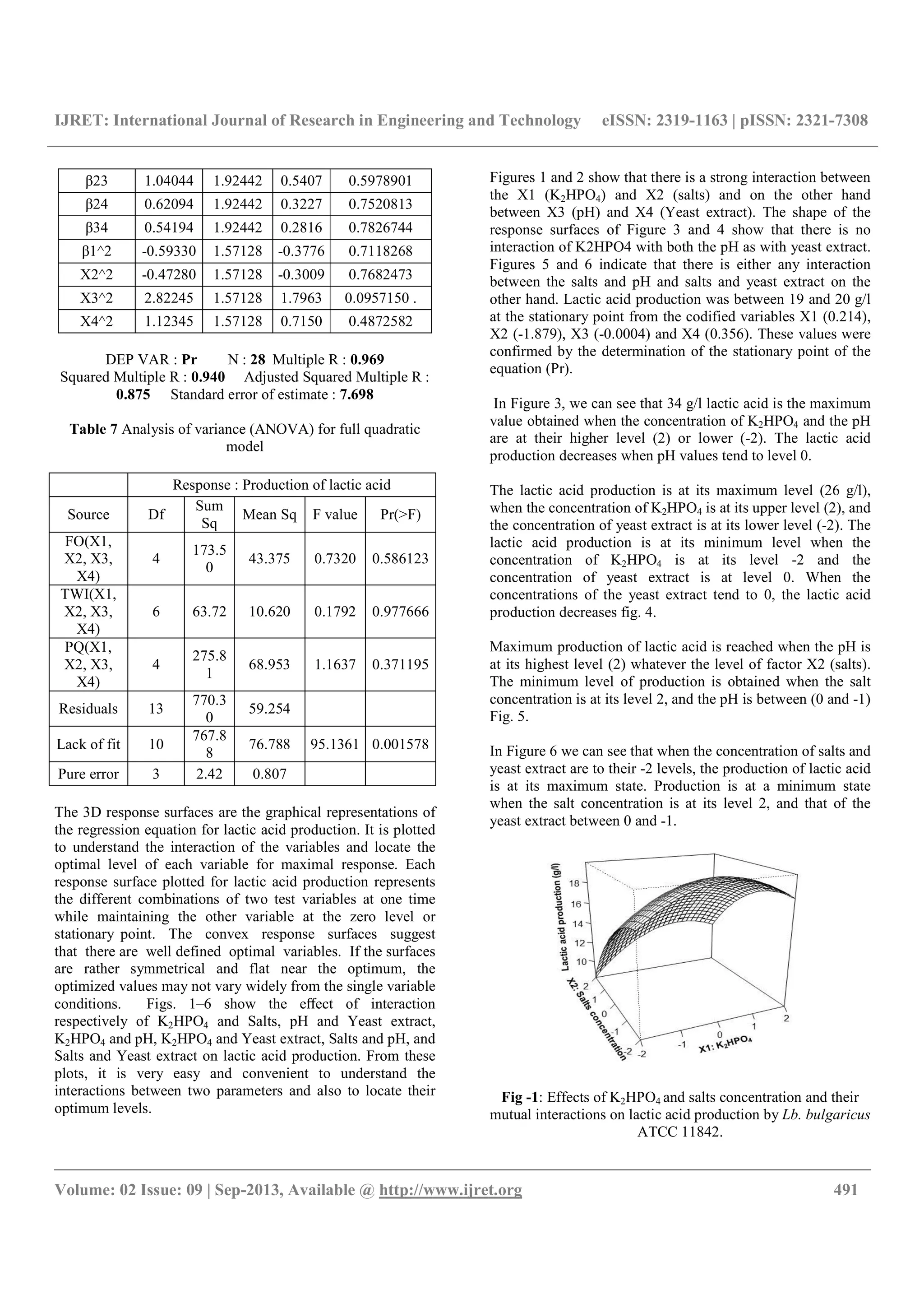
![IJRET: International Journal of Research in Engineering and Technology eISSN: 2319-1163 | pISSN: 2321-7308
__________________________________________________________________________________________
Volume: 02 Issue: 09 | Sep-2013, Available @ http://www.ijret.org 493
REFERENCES
[1]. Aeschlimann and Von Stockar U (1990) The effect of
yeast extract supplementation on the production of lactic acid
from whey permeate by Lactobacillus helveticus. Appl.
microbiol. Biotechnol. 432 1: 398402
[2]. Ayroulet-Martin M et Fournaud J (1979) Application de la
méthode de LING au dosage de l'acide lactique. An. Technol.
agric. 4281, 3 : 333343
[3]. Bhushan C, Hiren P, Mayank P, Bharatkumar D (2012)
Microbial Production of Lactic Acid by Using Crude Glycerol
from Biodiesel. J. Microbiol. Biotech. Res. 2 (1): 90-93.
[4]. Box GEP and Wilson KB (1951) On the experimental
attainment of optimal conditions. J. r. Stat. Soc. B13, 1–45
[5]. Calabia BP and Tokiwa Y (2007) Production of d-lactic
acid from sugarcane molasses, sugarcane juice and sugar beet
juice by Lactobacillus delbrueckii. Biotechnol Lett 29:1329–
1332
[6]. Chiarini L, Mara L and Tabaccbioni S (1992) Influence
of growth supplements on lactic acid production in whey
ultrafiltrate by Lactobacillus helveticus. Appl. Microbiol.
Biotechnol. 36: 461 - 464.
[7]. Cristian J. B. de Lima, Luciana F. Coelho and Jonas
Contiero. 2010. The Use of Response Surface Methodology in
Optimization of Lactic Acid Production: Focus on Medium
Supplementation, Temperature and pH Control. Food Technol.
Biotechnol. 48 (2) 175–181.
[8]. Dubois M, Gilles KA, Hamilton JK, Rebers PA. and
Smith F. Colorimetric method for determination of sugar and
related substances. Anal. Chem. 1956, 4281, 3 : 350356.
[9]. Gonçalves LMD, Barreto MTO, Xavier AMBR. and Klein
J (1992) Inert supports for lactic acid fermentation – a
technology assessment. Appl. Microbiol. Biotechnol. 38,
305–311.
[10]. Hamamci H, Ryu DY (1994) Production of L(+)-
lactic acid using immobilized Rhizopus oryzae reactor
performance based on kinetic model and simulation. Appl.
Biochem. Biotechnol. 44: 125-133.
[11]. Hashitani T, Yano E and Ando Y (2002).
Biodegradable Packing Materials for LSIs. FUTJITSU Sci.
Technol. J. 38, 112–118.
[12]. Kotzamanidis CH, Roukas T and Skaracis G (2002)
Optimization of lactic acid production from beet molasses by
Lactobacillus delbrueckii NCIMB 8130. World J. Microbiol.
Biotech. 18, 441-448
[13]. Lipinsky ES and Sinclair RG (1986) Is lactic acid a
commodity chemical?. Chem. Eng. Prog. 82, 26–32.
[14]. Marques S, Santos JAL, Girio FM, Roseiro JC (2008)
Lactic acid production from recycled paper sludge by
simultaneous saccharification and fermentation.
Biochem. Eng. J. 41 210-216.
[15]. Naveena BJ, Altaf M, Bhadrayya K, Madhavendra SS
and Reddy G (2005). Direct fermentation of starch to L (þ)-
lactic acid in SSF by Lactobacillus amylophilus GV6 using
wheat bran as support and substrate: medium optimization
using RSM. Process Biochem. 40, 681e690.
[16]. Nguyen CM, Kim JS, Hwang HJ, Park MS, Choi GJ,
Choi YH, Jang KS and Kim JC (2012) Production of l-lactic
acid from a green microalga, Hydrodictyon reticulum, by
Lactobacillus paracasei LA104 isolated from the traditional
Korean food, makgeolli. Bioresour Technol. 2012
Apr;110:552-9.
[17]. Plackett RL and Burman JP (1946) The design of
optimum multifactorial experiments. Biometrika, 33: 305325.
[18]. Tango MSA and Ghaly AE (1999) Amelioration of
lactic acid production from cheese whey using micro-
aeration. Biomass bioenerg. 17, 3: 221 - 238.
[19]. Tashiro Y, Kaneko W, Sun Y, Shibata K, Inokuma K,
Zendo T and Sonomoto K (2011) Continuous D-lactic acid
production by a novel thermotolerant Lactobacillus
delbrueckii subsp. lactis QU 41. Appl Microbiol Biotechnol.
89(6):1741-50
[20]. Tuli A, Sethi RP, Khana PK and Marwaha SS (1985)
Lactic acid production from whey permeate by
immobilized Lactobacillus casei. Enz. Microb. Technol. 7 :
164168
[21]. Vishnu C, Seenayya G and Reddy G (2000) Direct
fermentation of starch to l(+) lactic acid by amylase producing
Lactobacillus amylophilus GV6. Bioprocess Eng 23:155–158
[22]. Xiaodong W, Xuan G and Rakshit SK (1997) Direct
fermentative production of lactic acid on cassava and other
starch substrates. Biotechnol. Lett. 19(9), 841-843
[23]. Zayed G and Winter J (1995) Batch and Continuous
Production of Lactic Acid from Salt Whey using Free and
Immobilized Cultures of Lactobacilli. J. Appl. Microbiol.
Biotechnol. 44: 362-366.](https://image.slidesharecdn.com/optimizationofculturalconditionsforlacticacid-140805021608-phpapp01/75/Optimization-of-cultural-conditions-for-lactic-acid-7-2048.jpg)

This study investigates the optimization of lactic acid production by Lactobacillus bulgaricus ATCC 11842 using whey as a medium, analyzing the effects of various factors such as temperature, pH, and nutrient concentrations through experimental designs, notably Plackett-Burmann and response surface methodology. The findings indicate that pH significantly influences lactic acid production, with optimal conditions identified at a pH of 5.5 and specific concentrations of nutrients leading to a maximum yield of 20.9592 g/l of lactic acid. The study highlights the potential of using dairy waste as a substrate for microbial fermentation to produce valuable lactic acid while addressing wastewater management.


