Presented By:-
Ex. Capt. Mrs. Geeta Parwanda
Principal of PDM Subharti Nursing College
Swami Vivekanand Subharti University, Meerut
FIELD EXPERIENCE IN
PUBLIC HEALTH
 By the end of this presentation,
participants will be able to…
1. Define Public Health & Public Health
Nursing
2. Importance of Field Experience in
Nursing Education
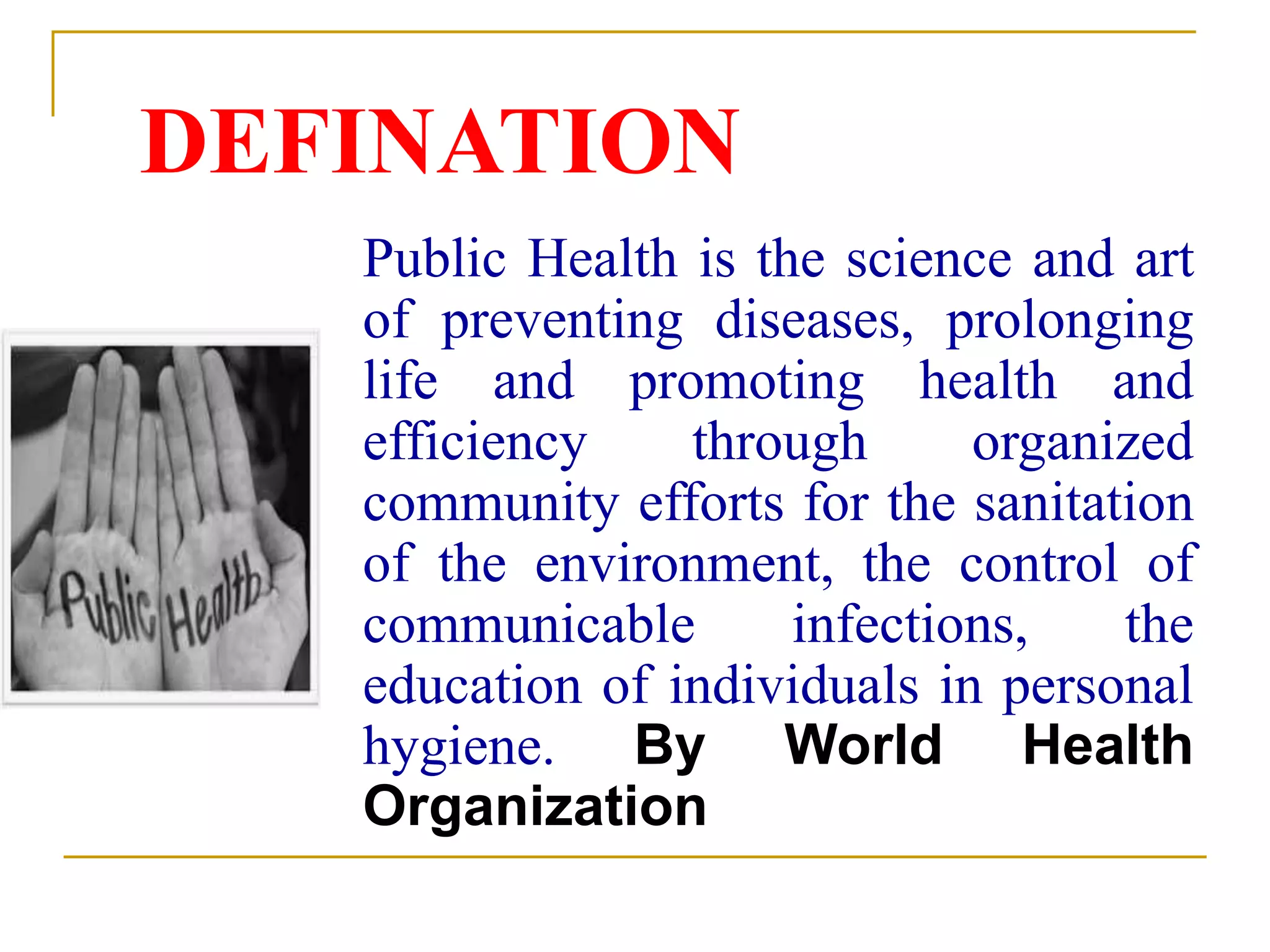
Public Health is the science and art
of preventing diseases, prolonging
life and promoting health and
efficiency through organized
community efforts for the sanitation
of the environment, the control of
communicable infections, the
education of individuals in personal
hygiene. By World Health
Organization
DEFINATION
5/23/2020 4
~Vision~
Healthy People in Healthy Communities
~Mission~
Promote physical and mental health
and
Prevent disease, injury, disability
Public Health in India
5/23/2020 6
1. What is a
community?
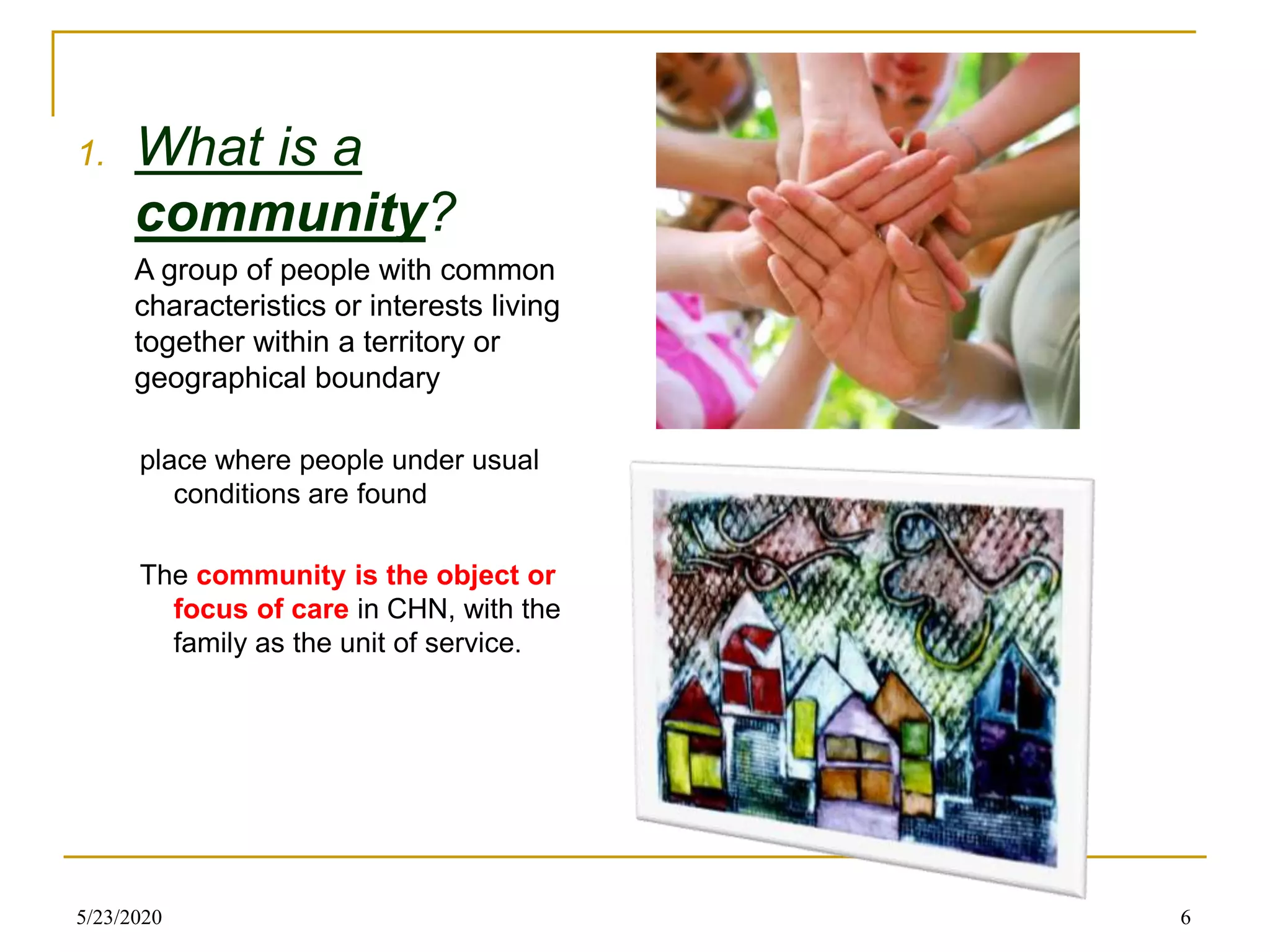
A group of people with common
characteristics or interests living
together within a territory or
geographical boundary
place where people under usual
conditions are found
The community is the object or
focus of care in CHN, with the
family as the unit of service.
5/23/2020 7
2. What Is Health?
A state of complete
physical, mental, and
social well-being and
not merely the
absence of disease
and infirmity (WHO,
1995).
 Prevents epidemics and the spread
of disease
 Protects against environmental
hazards
 Responds to disasters and assists
communities in recovery
Public Health…
 Prevents injuries
 Promotes healthy behaviors
 Assures the quality and accessibility
of health services
Public Health…
 Public health nursing is the practice of
promoting and protecting the health of
population using knowledge of nursing,
social and public health sciences.
5/23/2020 11
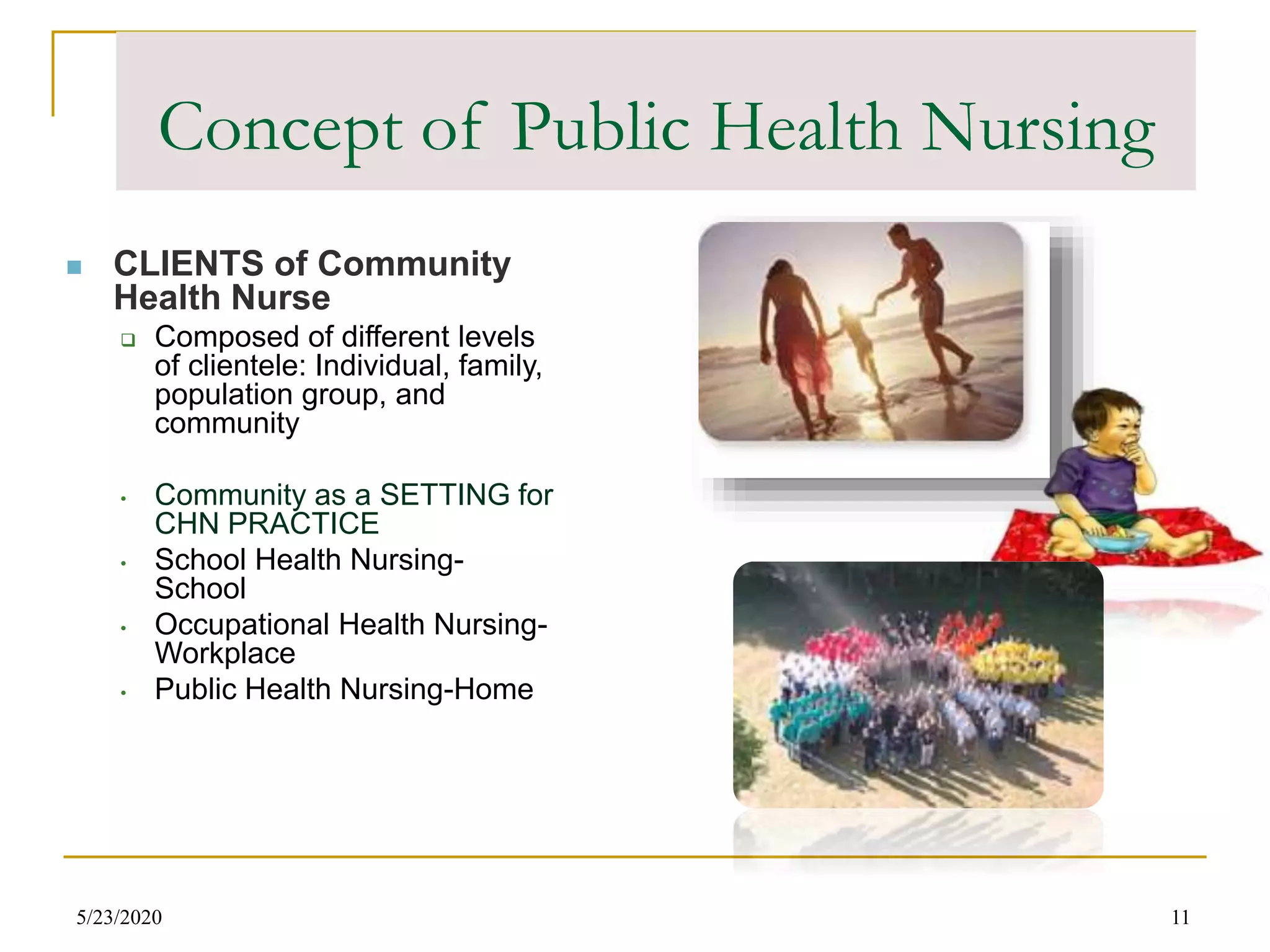
 CLIENTS of Community
Health Nurse
 Composed of different levels
of clientele: Individual, family,
population group, and
community
• Community as a SETTING for
CHN PRACTICE
• School Health Nursing-
School
• Occupational Health Nursing-
Workplace
• Public Health Nursing-Home
Concept of Public Health Nursing
5/23/2020 12
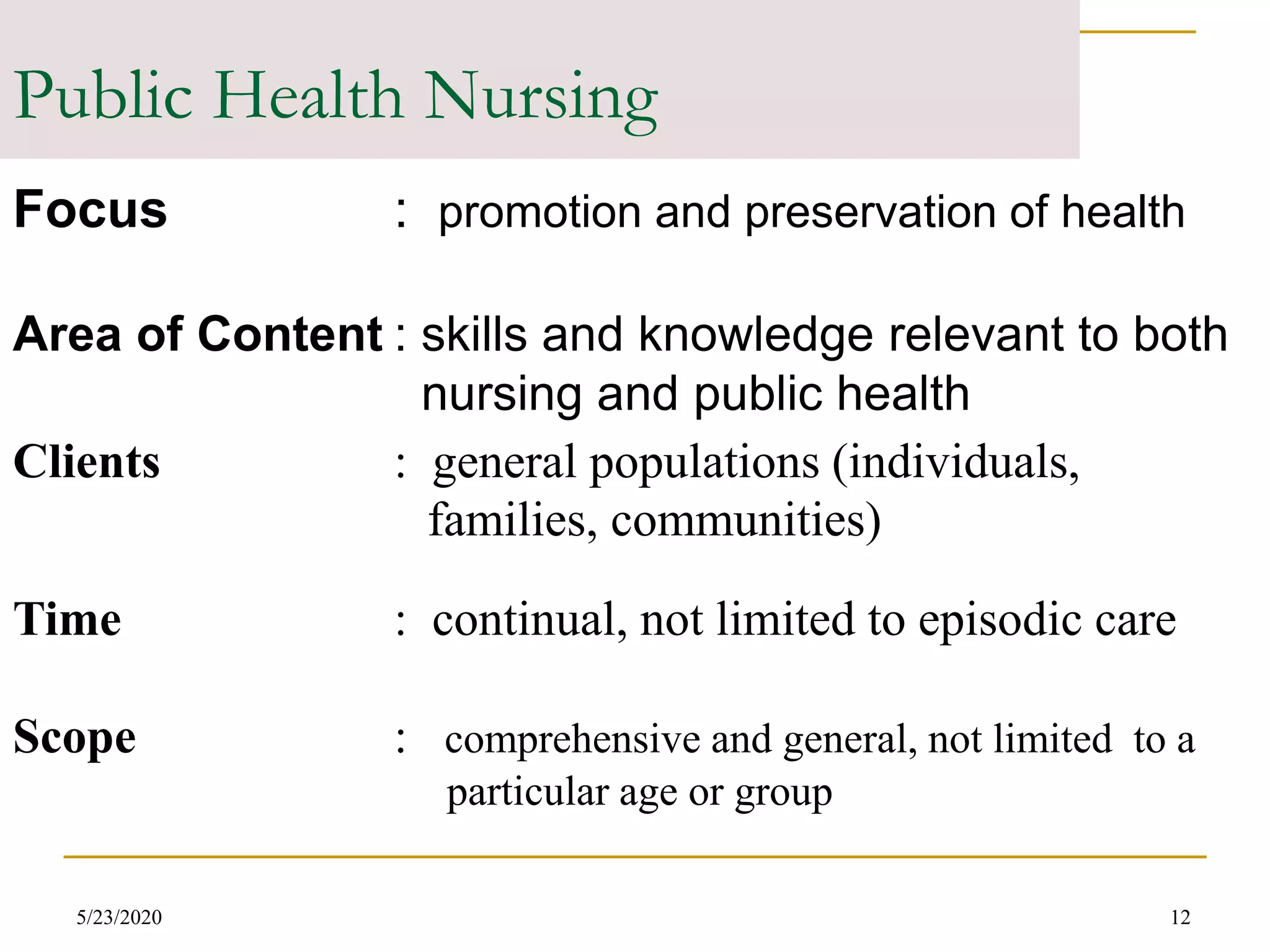
Focus : promotion and preservation of health
Area of Content : skills and knowledge relevant to both
nursing and public health
Clients : general populations (individuals,
families, communities)
Time : continual, not limited to episodic care
Scope : comprehensive and general, not limited to a
particular age or group
Public Health Nursing
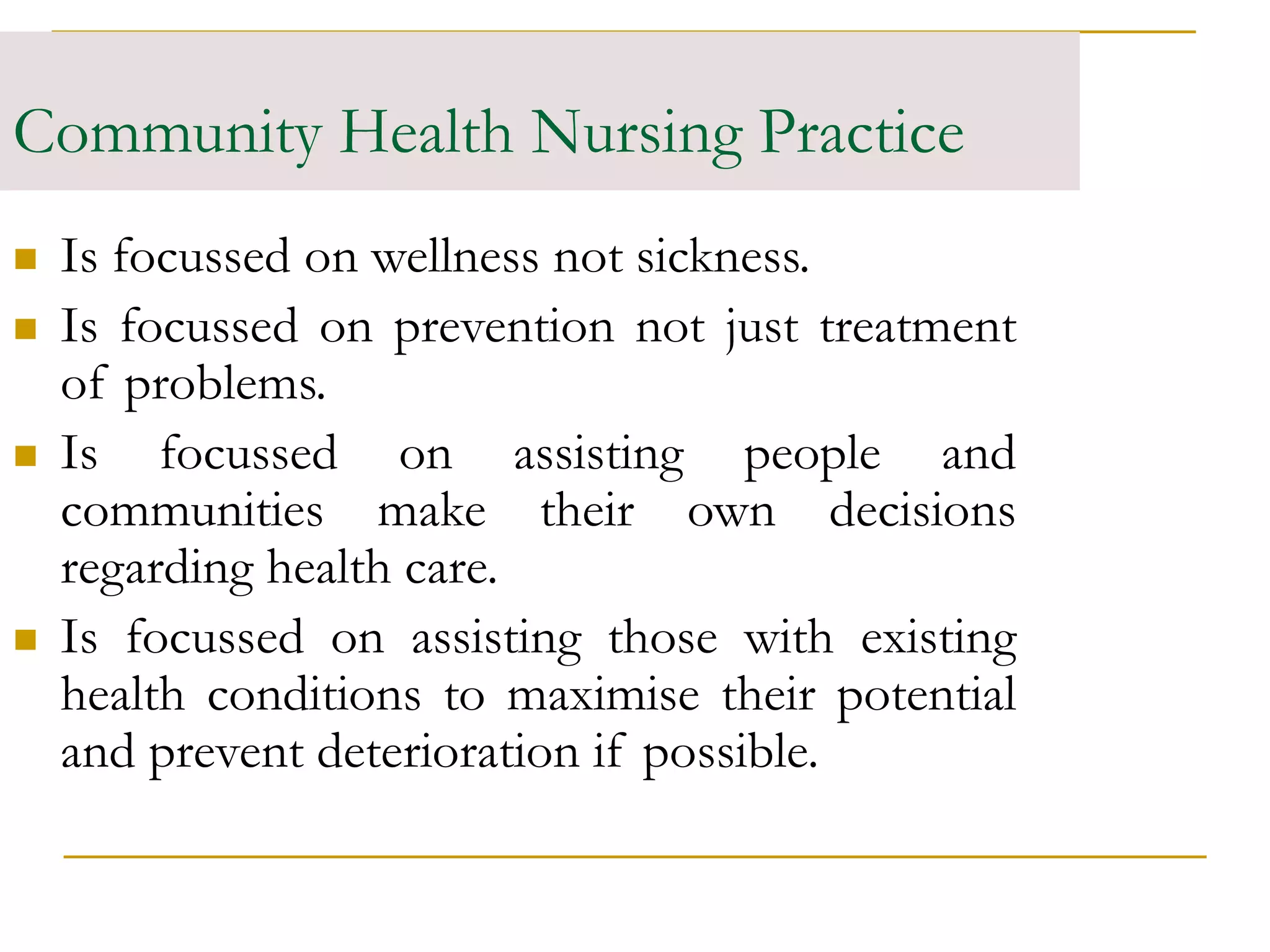
 Is focussed on wellness not sickness.
 Is focussed on prevention not just treatment
of problems.
 Is focussed on assisting people and
communities make their own decisions
regarding health care.
 Is focussed on assisting those with existing
health conditions to maximise their potential
and prevent deterioration if possible.
Community Health Nursing Practice
 Is based in the community in a range of
settings, wherever there is a need for support,
information and education.
 Responds to public health needs in relation
to communicable diseases.
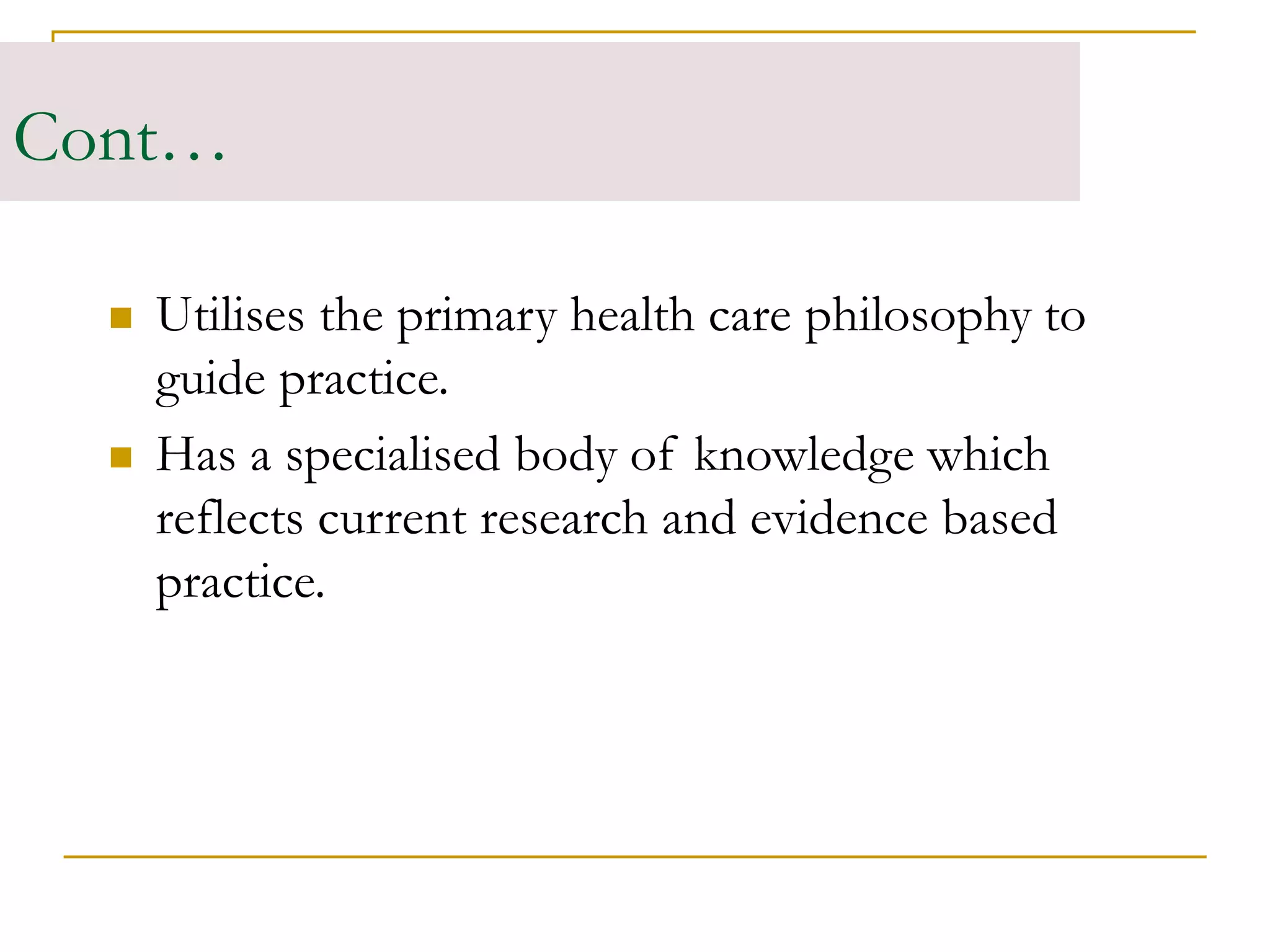
Cont…
 Utilises the primary health care philosophy to
guide practice.
 Has a specialised body of knowledge which
reflects current research and evidence based
practice.
Cont…
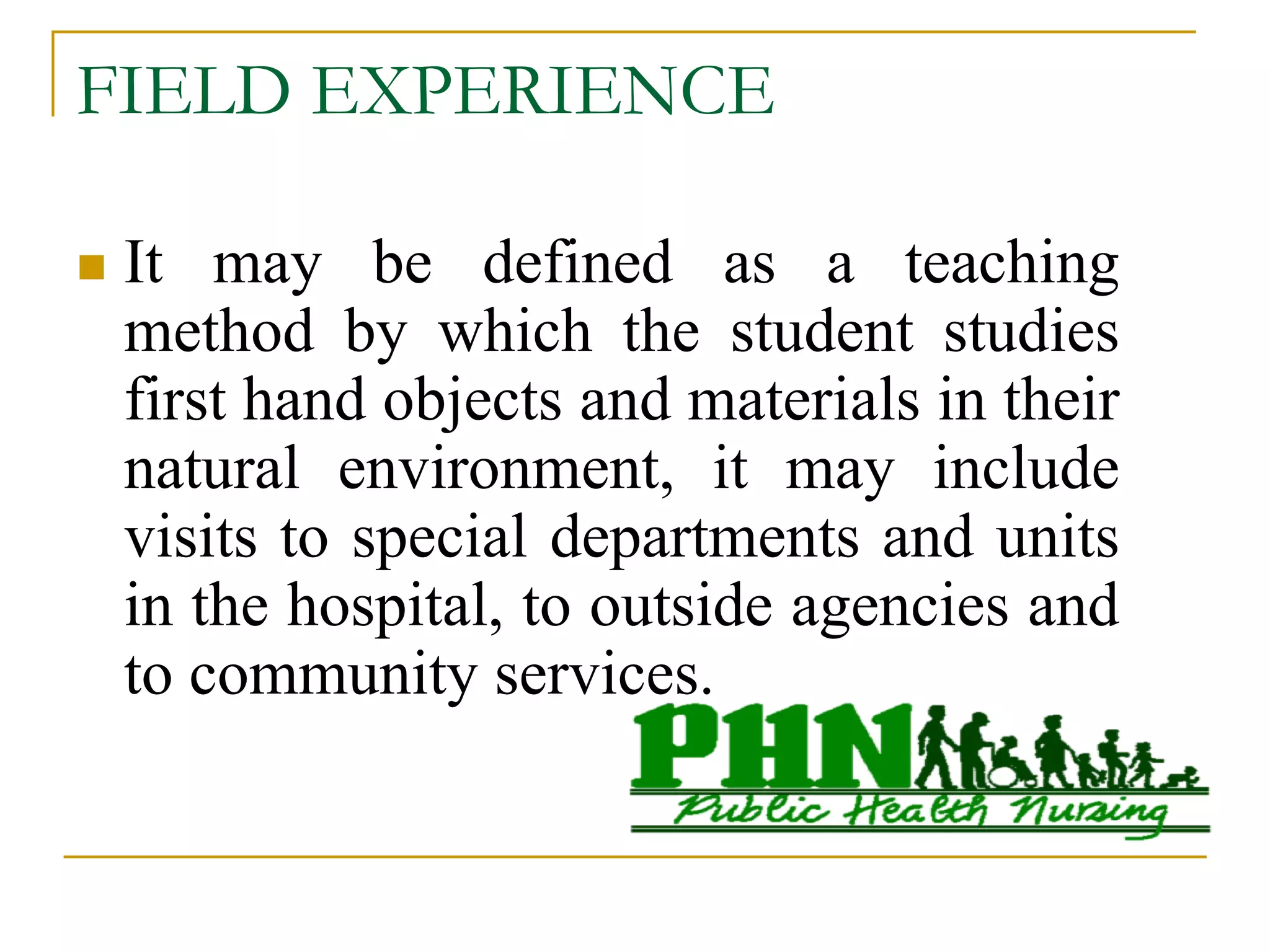
FIELD EXPERIENCE
 It may be defined as a teaching
method by which the student studies
first hand objects and materials in their
natural environment, it may include
visits to special departments and units
in the hospital, to outside agencies and
to community services.
Knowledge Regarding
 Community dynamics
 Community health concepts
 Epidemiological concepts of health
problems
 Health planning administration and
delivery system
Skills
They need to have skills
 Community identification
 Community health assessment
diagnosis
 Community organization
 Team functioning
 Collection and compilation of vital
health statistics
Preparation of Nursing Students in
Public Health Setting
Nurses require sound preparation to function as community health
nurses/public health nurses.
PURPOSES
 Gains first hand knowledge of the
community services and agencies
and their relationships to the
hospital in helping the client.
 Develop a better understanding of
the aetiology factors of disease –
housing, sanitation, economic
conditions, industry.
Cont…
 Provides actual source
material for study.
 Arouses interest and vitalizes
instruction, there by providing
motivation.
 Serve as an effective means of
correlating the subjects of the
curriculum.
PRACTICAL CONCERNS
1. Field experience are time
consuming.
2. Field experience has to be planned
at the convenience of the
establishment visited, so it may not
correlate with the most effective
time in the curriculum.
3. If the size of the group is large, it
may be divided into smaller groups
and this may take up considerable
time at the place visited.
SCIENTIFIC REVIEW
Optimal health implies wellness
in all dimensions of human
being. The individual is one
whole comprised of body, mind,
soul and social entity which are
blended together and not in
isolated compartments. Blum
title is as “Force Field and
wellbeing paradigm of Health”.
Cont…
 Nursing education should train qualified nurses to
respond to the needs of clients, based on the changes
in the health-care system and its objectives.
 The performance of the community health nurse
depends on a comprehensive combination of scientific
and practical competencies which are acquired during
the nursing course.
 Curriculum planners of nursing education need to
understand to train professional and community-
oriented nurses.
Cont…
 Despite the program
syllabus, students
considered hospitals as the
work place for nurses.
 This type of view leads to
lack of enough motivation
for good practice and
leads to weak attitude
toward community
orientation.
Problems Faced during Practical Experience
in Public Heath Setting
 Delshad (2005) said “One of the main challenges for community-oriented
nursing care” is lack of position for community health nurses”.
 The findings of Saberian (2003) revealed that 20.51% of the participants
believed that community health nursing is irrelevant to the nursing
profession. In the study by Dalir (2011), internal motivation of students
decreased during their study.
 Lack of preparedness of students is conducive to a decrease in motivation
and leads to a decrease in confidence of clients. In a study by Leh (2006),
lack of confidence and preparedness were mentioned in the experiences of
students.
 Public health is everywhere, it is at
work everyday, and it affects
everyone. It fulfills its mission in
ways so invisible that few working
outside of the world of public
health will even notice.
Nonetheless, to maintain and
ensure the health of our
communities, we as public health
leaders must continue to face the
challenges of the new millennium.
Conclusion
 Swarnkar’s, Community Health Nursing, 3rd, 2012, 24-25.
 K.K. Gulani, Community Health Nursing, Principles and Practice,, 1st
, 2007, 47-51
 Pamela A. Kulbok, DNSc, RN, PHCNS-BC,
Online J Issues Nursing. 2012;17(2)
 Gebbie K, Raziano A, Elliott S. Public health workforce enumeration.
American Journal of Public Health. 2009; 99(5): 786-787.
 Quad Council of Public Health Nursing Organizations. The public
health nursing shortage: a threat to the public’s health. [place
unknown]: Quad Council of Public Health Nursing Organizations;
2007.
http://www.astdn.org/downloadablefiles/Final%20Nursing%20Shortage%20Pa
per.pdf. .
References
 Quiram B, Meit M, Carpender K, Penne C, Castillo G, Duchicela D.
Rural public health infrastructure: a literature review [Internet]. In
gamm, L & Hutchison, L (Eds.) Rural healthy people 2010: a
companion document to healthy people 2010. Volume 3; College
Station, TX: The Texas A&M University System Health Science
Center, School of Rural Public Health, Southwest Rural Health
Research Center; 2005. Available form:
http://www.srph.tamhsc.edu/centers/rhp2010/Volume_3/Vol3Ch5LR
.htm
 American Nurses Association. Public health nursing scope and
standards of practice. Silver Spring (MD): American Nurses
Association, 2007.
References
Public health

Public health

  • 1.
    Presented By:- Ex. Capt.Mrs. Geeta Parwanda Principal of PDM Subharti Nursing College Swami Vivekanand Subharti University, Meerut FIELD EXPERIENCE IN PUBLIC HEALTH
  • 2.
     By theend of this presentation, participants will be able to… 1. Define Public Health & Public Health Nursing 2. Importance of Field Experience in Nursing Education
  • 3.
    Public Health isthe science and art of preventing diseases, prolonging life and promoting health and efficiency through organized community efforts for the sanitation of the environment, the control of communicable infections, the education of individuals in personal hygiene. By World Health Organization DEFINATION
  • 4.
  • 5.
    ~Vision~ Healthy People inHealthy Communities ~Mission~ Promote physical and mental health and Prevent disease, injury, disability Public Health in India
  • 6.
    5/23/2020 6 1. Whatis a community? A group of people with common characteristics or interests living together within a territory or geographical boundary place where people under usual conditions are found The community is the object or focus of care in CHN, with the family as the unit of service.
  • 7.
    5/23/2020 7 2. WhatIs Health? A state of complete physical, mental, and social well-being and not merely the absence of disease and infirmity (WHO, 1995).
  • 8.
     Prevents epidemicsand the spread of disease  Protects against environmental hazards  Responds to disasters and assists communities in recovery Public Health…
  • 9.
     Prevents injuries Promotes healthy behaviors  Assures the quality and accessibility of health services Public Health…
  • 10.
     Public healthnursing is the practice of promoting and protecting the health of population using knowledge of nursing, social and public health sciences.
  • 11.
    5/23/2020 11  CLIENTSof Community Health Nurse  Composed of different levels of clientele: Individual, family, population group, and community • Community as a SETTING for CHN PRACTICE • School Health Nursing- School • Occupational Health Nursing- Workplace • Public Health Nursing-Home Concept of Public Health Nursing
  • 12.
    5/23/2020 12 Focus :promotion and preservation of health Area of Content : skills and knowledge relevant to both nursing and public health Clients : general populations (individuals, families, communities) Time : continual, not limited to episodic care Scope : comprehensive and general, not limited to a particular age or group Public Health Nursing
  • 13.
     Is focussedon wellness not sickness.  Is focussed on prevention not just treatment of problems.  Is focussed on assisting people and communities make their own decisions regarding health care.  Is focussed on assisting those with existing health conditions to maximise their potential and prevent deterioration if possible. Community Health Nursing Practice
  • 14.
     Is basedin the community in a range of settings, wherever there is a need for support, information and education.  Responds to public health needs in relation to communicable diseases. Cont…
  • 15.
     Utilises theprimary health care philosophy to guide practice.  Has a specialised body of knowledge which reflects current research and evidence based practice. Cont…
  • 16.
    FIELD EXPERIENCE  Itmay be defined as a teaching method by which the student studies first hand objects and materials in their natural environment, it may include visits to special departments and units in the hospital, to outside agencies and to community services.
  • 17.
    Knowledge Regarding  Communitydynamics  Community health concepts  Epidemiological concepts of health problems  Health planning administration and delivery system Skills They need to have skills  Community identification  Community health assessment diagnosis  Community organization  Team functioning  Collection and compilation of vital health statistics Preparation of Nursing Students in Public Health Setting Nurses require sound preparation to function as community health nurses/public health nurses.
  • 18.
    PURPOSES  Gains firsthand knowledge of the community services and agencies and their relationships to the hospital in helping the client.  Develop a better understanding of the aetiology factors of disease – housing, sanitation, economic conditions, industry.
  • 19.
    Cont…  Provides actualsource material for study.  Arouses interest and vitalizes instruction, there by providing motivation.  Serve as an effective means of correlating the subjects of the curriculum.
  • 20.
    PRACTICAL CONCERNS 1. Fieldexperience are time consuming. 2. Field experience has to be planned at the convenience of the establishment visited, so it may not correlate with the most effective time in the curriculum. 3. If the size of the group is large, it may be divided into smaller groups and this may take up considerable time at the place visited.
  • 21.
    SCIENTIFIC REVIEW Optimal healthimplies wellness in all dimensions of human being. The individual is one whole comprised of body, mind, soul and social entity which are blended together and not in isolated compartments. Blum title is as “Force Field and wellbeing paradigm of Health”.
  • 22.
    Cont…  Nursing educationshould train qualified nurses to respond to the needs of clients, based on the changes in the health-care system and its objectives.  The performance of the community health nurse depends on a comprehensive combination of scientific and practical competencies which are acquired during the nursing course.  Curriculum planners of nursing education need to understand to train professional and community- oriented nurses.
  • 23.
    Cont…  Despite theprogram syllabus, students considered hospitals as the work place for nurses.  This type of view leads to lack of enough motivation for good practice and leads to weak attitude toward community orientation.
  • 24.
    Problems Faced duringPractical Experience in Public Heath Setting  Delshad (2005) said “One of the main challenges for community-oriented nursing care” is lack of position for community health nurses”.  The findings of Saberian (2003) revealed that 20.51% of the participants believed that community health nursing is irrelevant to the nursing profession. In the study by Dalir (2011), internal motivation of students decreased during their study.  Lack of preparedness of students is conducive to a decrease in motivation and leads to a decrease in confidence of clients. In a study by Leh (2006), lack of confidence and preparedness were mentioned in the experiences of students.
  • 25.
     Public healthis everywhere, it is at work everyday, and it affects everyone. It fulfills its mission in ways so invisible that few working outside of the world of public health will even notice. Nonetheless, to maintain and ensure the health of our communities, we as public health leaders must continue to face the challenges of the new millennium. Conclusion
  • 26.
     Swarnkar’s, CommunityHealth Nursing, 3rd, 2012, 24-25.  K.K. Gulani, Community Health Nursing, Principles and Practice,, 1st , 2007, 47-51  Pamela A. Kulbok, DNSc, RN, PHCNS-BC, Online J Issues Nursing. 2012;17(2)  Gebbie K, Raziano A, Elliott S. Public health workforce enumeration. American Journal of Public Health. 2009; 99(5): 786-787.  Quad Council of Public Health Nursing Organizations. The public health nursing shortage: a threat to the public’s health. [place unknown]: Quad Council of Public Health Nursing Organizations; 2007. http://www.astdn.org/downloadablefiles/Final%20Nursing%20Shortage%20Pa per.pdf. . References
  • 27.
     Quiram B,Meit M, Carpender K, Penne C, Castillo G, Duchicela D. Rural public health infrastructure: a literature review [Internet]. In gamm, L & Hutchison, L (Eds.) Rural healthy people 2010: a companion document to healthy people 2010. Volume 3; College Station, TX: The Texas A&M University System Health Science Center, School of Rural Public Health, Southwest Rural Health Research Center; 2005. Available form: http://www.srph.tamhsc.edu/centers/rhp2010/Volume_3/Vol3Ch5LR .htm  American Nurses Association. Public health nursing scope and standards of practice. Silver Spring (MD): American Nurses Association, 2007. References

Editor's Notes