Introduction
An optical scanning device combines
specialized computer hardware and
software. The hardware devices capture
an image and software converts the
image to computer-readable data.
There are four main types of optical
scanning technologies:
• Optical Mark Reading (OMR)
• Optical Character Recognition (OCR)
• Intelligent Character Recognition (ICR)
• Optical Imaging Technology
OPTICAL MARK
READING (OMR)
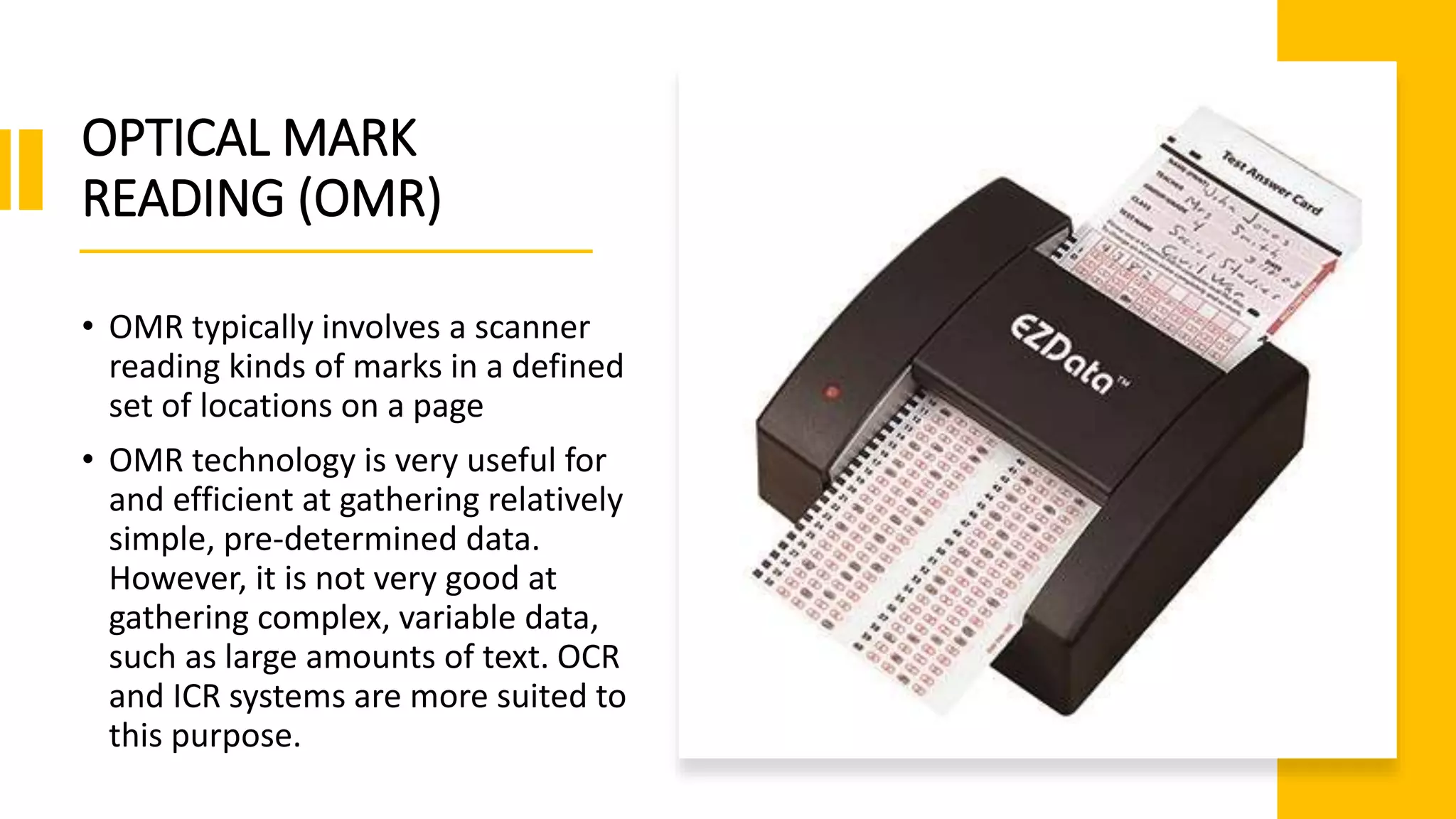
• OMR typically involves a scanner
reading kinds of marks in a defined
set of locations on a page
• OMR technology is very useful for
and efficient at gathering relatively
simple, pre-determined data.
However, it is not very good at
gathering complex, variable data,
such as large amounts of text. OCR
and ICR systems are more suited to
this purpose.
OPTICAL MARK
READING (OMR)
OPTICAL CHARACTER
RECOGNITION (OCR)
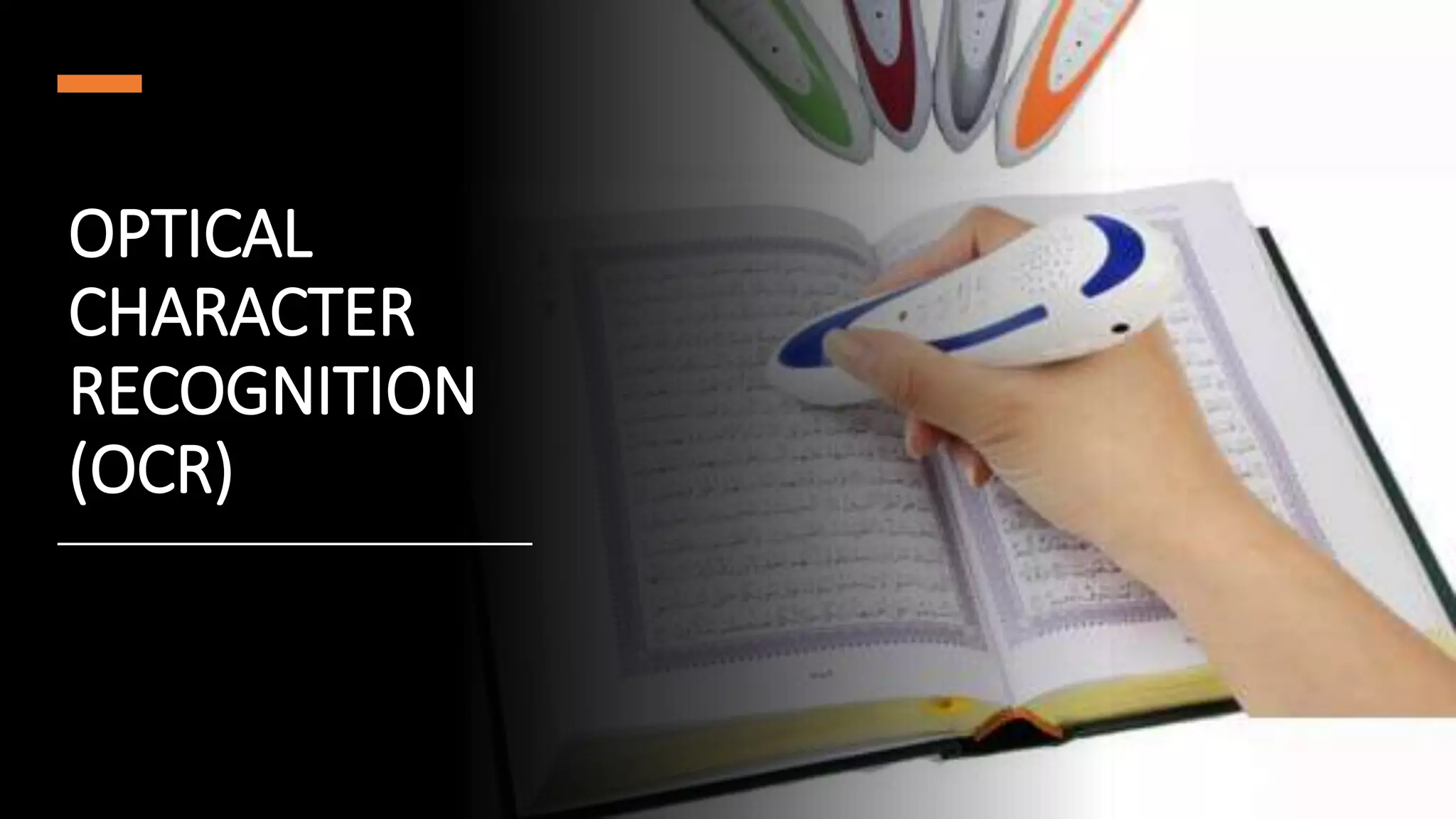
• OCR scanning systems take
scanned images and use computer
software to recognize the shapes
of printed such as numbers and
letters and store them as
computer-readable data.
• OCR is typically used to convert
printed text into computer-
readable text.
OPTICAL
CHARACTER
RECOGNITION
(OCR)
INTELLIGENT CHARACTER RECOGNITION (ICR)
• ICR takes OCR systems one step further by
using computer software to apply intelligent
logic tests to scanned characters so as to more
reliably convert them into computer-readable
data.
• It can also convert handwritten data into
computerized readable data.
• It can recognize complex fonts.
• More detailed involved technology than OCR.
OPTICAL IMAGING TECHNOLOGY
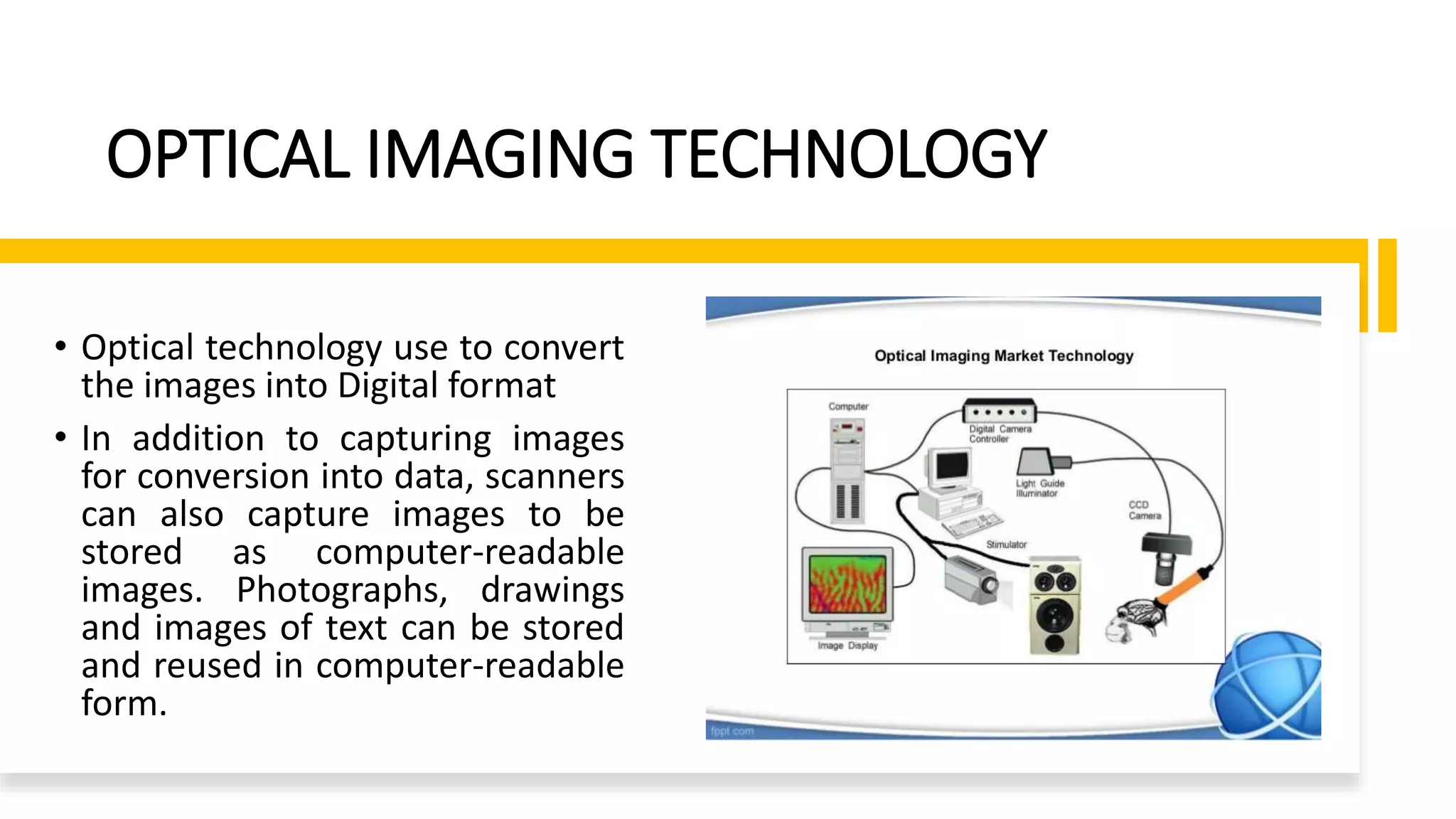
• Optical technology use to convert
the images into Digital format
• In addition to capturing images
for conversion into data, scanners
can also capture images to be
stored as computer-readable
images. Photographs, drawings
and images of text can be stored
and reused in computer-readable
form.
OPTICAL IMAGING TECHNOLOGY
• Optical imaging is a technique for non-invasively looking inside
the body, as is done with x-rays.
• Unlike x-rays, which use ionizing radiation, optical imaging uses
visible light and the special properties of photons to obtain
detailed images of organs and tissues as well as smaller
structures including cells and even molecules.
• These images are used by scientists for research and by
clinicians for disease diagnosis and treatment.
THANKYOU

Optical scanning system

  • 1.
    Introduction An optical scanningdevice combines specialized computer hardware and software. The hardware devices capture an image and software converts the image to computer-readable data. There are four main types of optical scanning technologies: • Optical Mark Reading (OMR) • Optical Character Recognition (OCR) • Intelligent Character Recognition (ICR) • Optical Imaging Technology
  • 2.
    OPTICAL MARK READING (OMR) •OMR typically involves a scanner reading kinds of marks in a defined set of locations on a page • OMR technology is very useful for and efficient at gathering relatively simple, pre-determined data. However, it is not very good at gathering complex, variable data, such as large amounts of text. OCR and ICR systems are more suited to this purpose.
  • 3.
  • 4.
    OPTICAL CHARACTER RECOGNITION (OCR) •OCR scanning systems take scanned images and use computer software to recognize the shapes of printed such as numbers and letters and store them as computer-readable data. • OCR is typically used to convert printed text into computer- readable text.
  • 5.
  • 6.
    INTELLIGENT CHARACTER RECOGNITION(ICR) • ICR takes OCR systems one step further by using computer software to apply intelligent logic tests to scanned characters so as to more reliably convert them into computer-readable data. • It can also convert handwritten data into computerized readable data. • It can recognize complex fonts. • More detailed involved technology than OCR.
  • 7.
    OPTICAL IMAGING TECHNOLOGY •Optical technology use to convert the images into Digital format • In addition to capturing images for conversion into data, scanners can also capture images to be stored as computer-readable images. Photographs, drawings and images of text can be stored and reused in computer-readable form.
  • 8.
    OPTICAL IMAGING TECHNOLOGY •Optical imaging is a technique for non-invasively looking inside the body, as is done with x-rays. • Unlike x-rays, which use ionizing radiation, optical imaging uses visible light and the special properties of photons to obtain detailed images of organs and tissues as well as smaller structures including cells and even molecules. • These images are used by scientists for research and by clinicians for disease diagnosis and treatment.
  • 9.