Optical mark recognition 
Presented by 
Himanshu Popli 
Jaanvi Parekh 
Janvi Sanghvi
Optical mark recognition (also called optical mark reading and OMR) is the 
process of capturing human-marked data from document forms such as surveys 
and tests. 
It is a technology where 
An omr device senses the 
Presence or absence of a 
Mark, such as a pencil mark
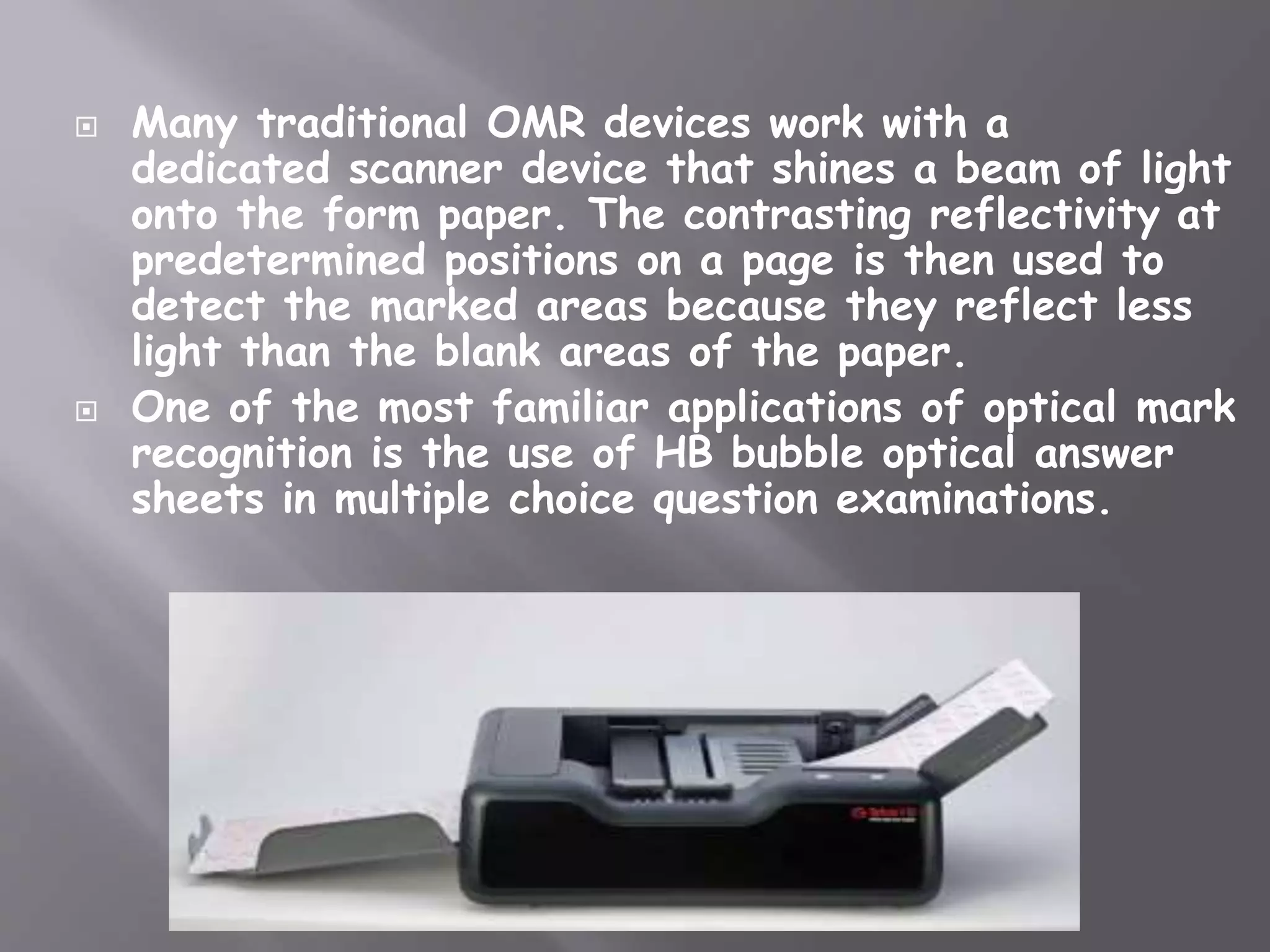
 Many traditional OMR devices work with a 
dedicated scanner device that shines a beam of light 
onto the form paper. The contrasting reflectivity at 
predetermined positions on a page is then used to 
detect the marked areas because they reflect less 
light than the blank areas of the paper. 
 One of the most familiar applications of optical mark 
recognition is the use of HB bubble optical answer 
sheets in multiple choice question examinations.
HISTORY 
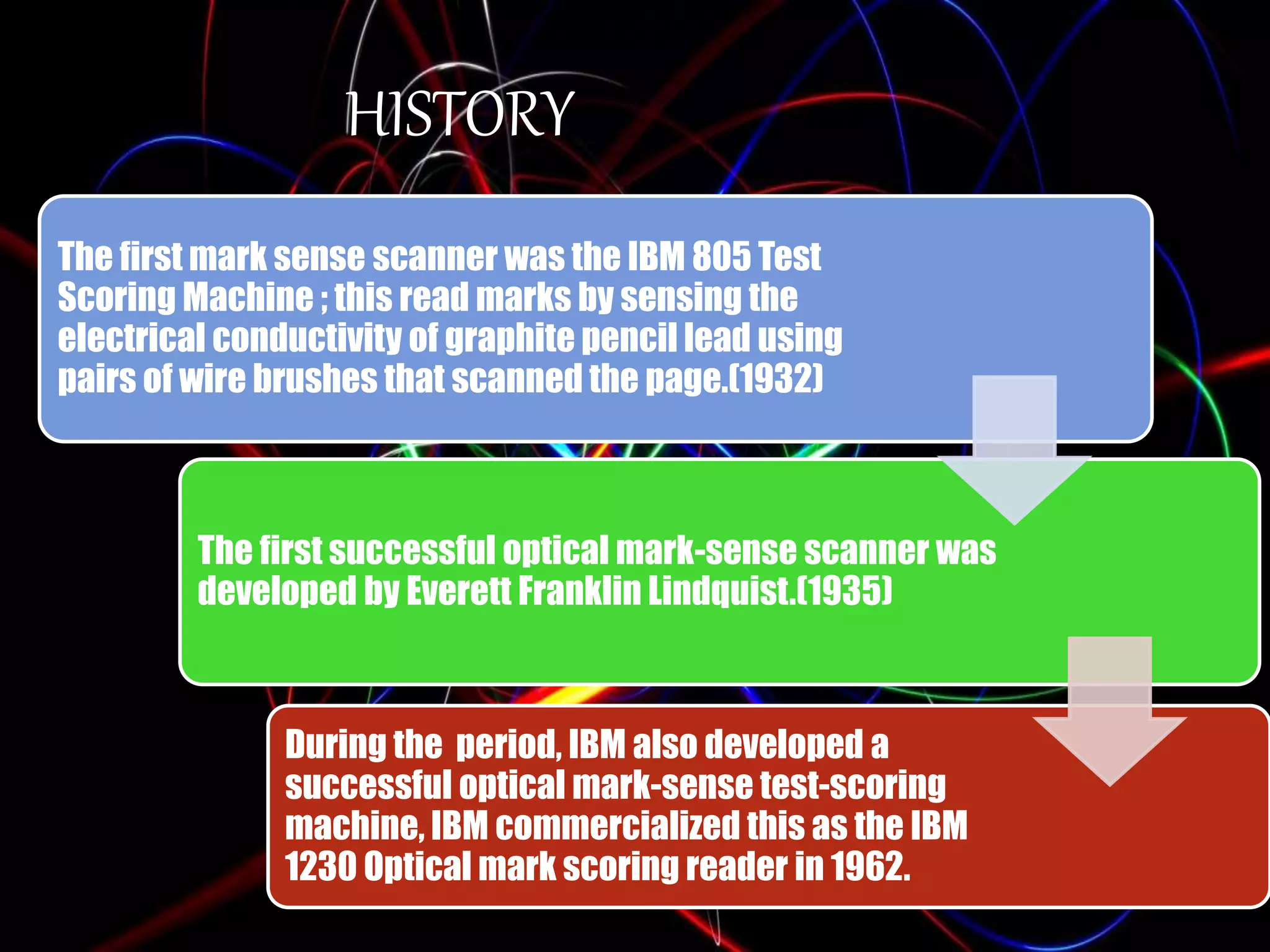
The first mark sense scanner was the IBM 805 Test 
Scoring Machine ; this read marks by sensing the 
electrical conductivity of graphite pencil lead using 
pairs of wire brushes that scanned the page.(1932) 
The first successful optical mark-sense scanner was 
developed by Everett Franklin Lindquist.(1935) 
During the period, IBM also developed a 
successful optical mark-sense test-scoring 
machine, IBM commercialized this as the IBM 
1230 Optical mark scoring reader in 1962.
The computer test forms designed for the OMR 
are known as NCS compatible scan forms. 
Tests and surveys completed on these forms 
are read in by the scanner, checked, and the 
results are saved to a file. This data file can 
be converted into an output file of several 
different formats, depending on which type 
of output you desire.
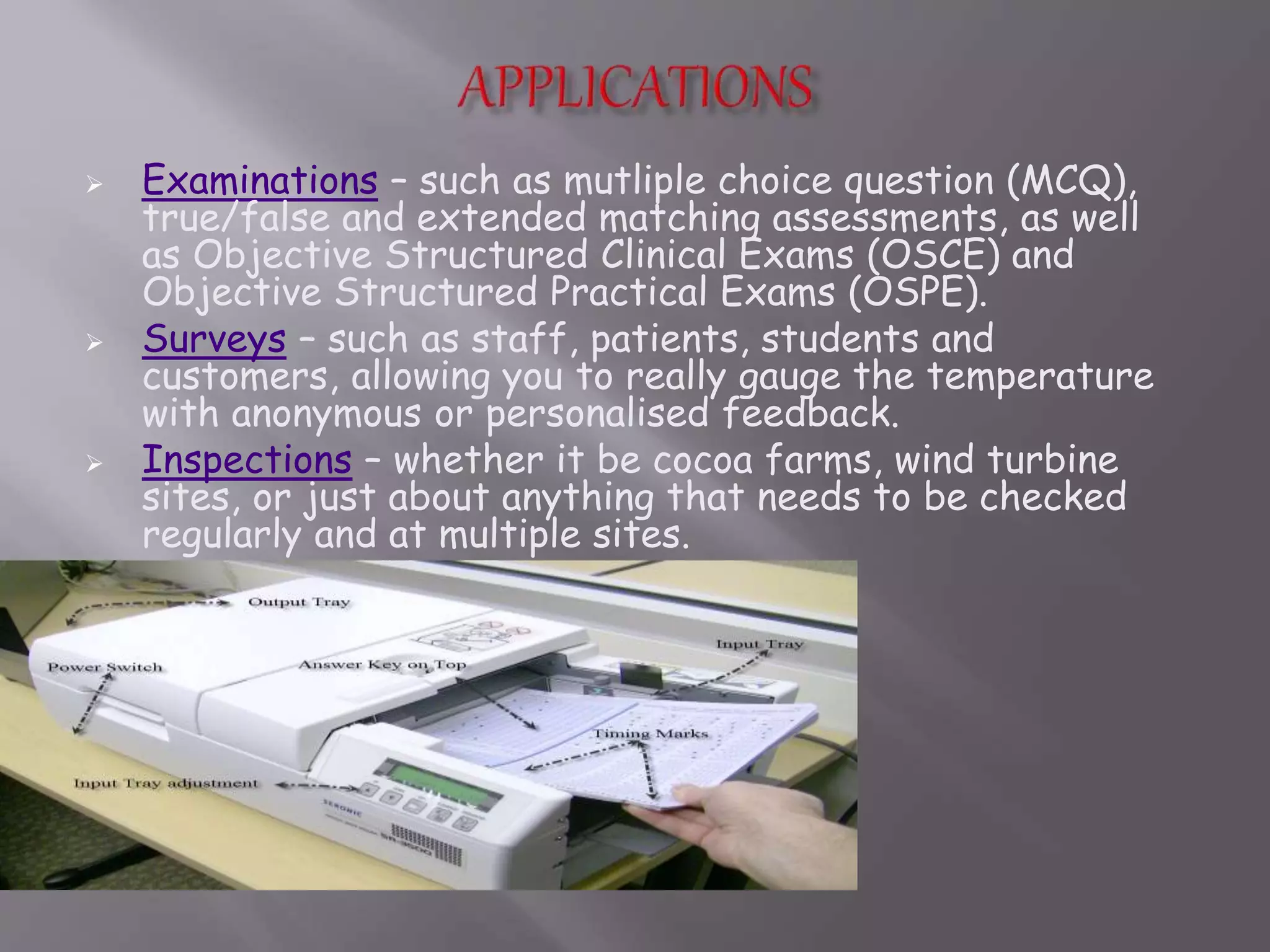
 Examinations – such as mutliple choice question (MCQ), 
true/false and extended matching assessments, as well 
as Objective Structured Clinical Exams (OSCE) and 
Objective Structured Practical Exams (OSPE). 
 Surveys – such as staff, patients, students and 
customers, allowing you to really gauge the temperature 
with anonymous or personalised feedback. 
 Inspections – whether it be cocoa farms, wind turbine 
sites, or just about anything that needs to be checked 
regularly and at multiple sites.
 Alcohol Screening – one of the newest applications 
for this technology, it uses a standard AUDIT or 
FAST form and scores it when scanned to identify 
‘at risk’ patients. 
 Outpatient Feedback – another NHS application, 
but this time capturing patient feedback from 
outpatient clinics, in an anonymous manner, but 
retaining the patient opinions and doctor ID 
number from a barcode label. 
 Research Studies – such as detailed health studies, 
opinion research, social studies, psychology 
monitoring and medicinal trials.
Optical Mark Recognition

Optical Mark Recognition

  • 1.
    Optical mark recognition Presented by Himanshu Popli Jaanvi Parekh Janvi Sanghvi
  • 2.
    Optical mark recognition(also called optical mark reading and OMR) is the process of capturing human-marked data from document forms such as surveys and tests. It is a technology where An omr device senses the Presence or absence of a Mark, such as a pencil mark
  • 3.
     Many traditionalOMR devices work with a dedicated scanner device that shines a beam of light onto the form paper. The contrasting reflectivity at predetermined positions on a page is then used to detect the marked areas because they reflect less light than the blank areas of the paper.  One of the most familiar applications of optical mark recognition is the use of HB bubble optical answer sheets in multiple choice question examinations.
  • 5.
    HISTORY The firstmark sense scanner was the IBM 805 Test Scoring Machine ; this read marks by sensing the electrical conductivity of graphite pencil lead using pairs of wire brushes that scanned the page.(1932) The first successful optical mark-sense scanner was developed by Everett Franklin Lindquist.(1935) During the period, IBM also developed a successful optical mark-sense test-scoring machine, IBM commercialized this as the IBM 1230 Optical mark scoring reader in 1962.
  • 6.
    The computer testforms designed for the OMR are known as NCS compatible scan forms. Tests and surveys completed on these forms are read in by the scanner, checked, and the results are saved to a file. This data file can be converted into an output file of several different formats, depending on which type of output you desire.
  • 7.
     Examinations –such as mutliple choice question (MCQ), true/false and extended matching assessments, as well as Objective Structured Clinical Exams (OSCE) and Objective Structured Practical Exams (OSPE).  Surveys – such as staff, patients, students and customers, allowing you to really gauge the temperature with anonymous or personalised feedback.  Inspections – whether it be cocoa farms, wind turbine sites, or just about anything that needs to be checked regularly and at multiple sites.
  • 8.
     Alcohol Screening– one of the newest applications for this technology, it uses a standard AUDIT or FAST form and scores it when scanned to identify ‘at risk’ patients.  Outpatient Feedback – another NHS application, but this time capturing patient feedback from outpatient clinics, in an anonymous manner, but retaining the patient opinions and doctor ID number from a barcode label.  Research Studies – such as detailed health studies, opinion research, social studies, psychology monitoring and medicinal trials.