Optical Phenomena
By:
Lindsay Gunter & Megan Oliver
Objectives

• Recognize atmospheric conditions that
cause refraction.
• Explain dispersion and phenomena such
•

as rainbows in terms of the relationship
between the index of refraction and the
wavelength.
Demonstrate internal reflection with
fiber optics.
Introduction

• In this lesson, we will be looking at what
causes refraction.

• We will also be learning about how

phenomena occur due to the interaction
between light and matter.
What causes refraction?

• Changes in:
o temperature
o pressure
o moisture
o medium

Refraction happens when there is a
change in density.
What does light do when
it is refracted at
different angles?
Critical Angle

• The angle that causes the refracted light
rays to move parallel to the boundary at
a 90o angle to the normal.
Angles greater than the
critical angle will be totally
internally reflected.
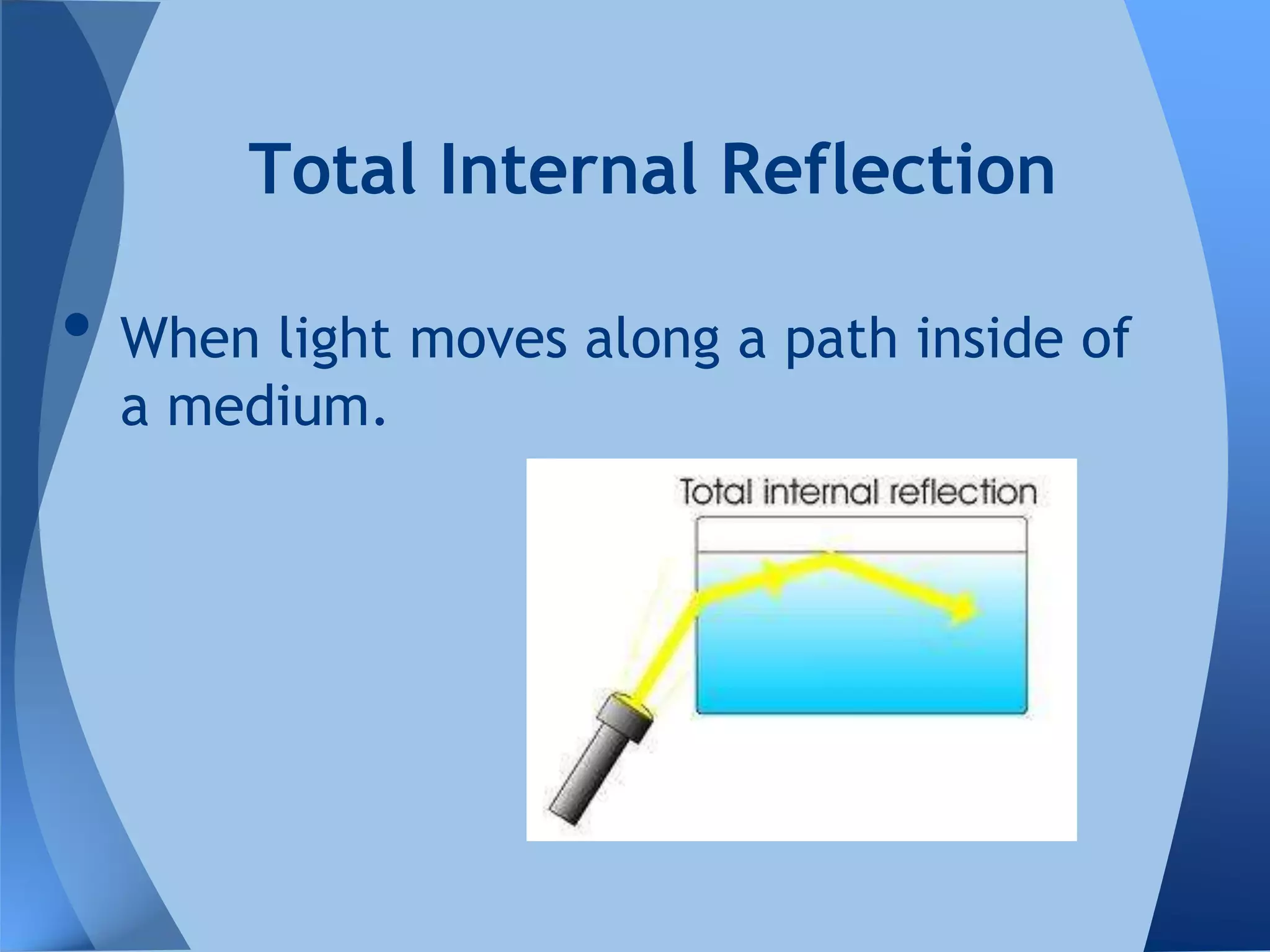
Total Internal Reflection

• When light moves along a path inside of
a medium.
Fiber Optics

• When light is internally reflected until it
reaches the end.
Light (Sun) Pillars

• When the light

reflects off of ice
crystals in the sky.

• You may get pillars

of light in yellows,
blues, reds, and violet colors.
Ice Halo

• Happens when the Sun or Moon refracts
in the ice crystals in the clouds.

• Sometimes the light isn’t refracted by its
wavelength, which causes a white color
halo. Other times,
it creates a rainbow
of reflected color.
Mirage

•

•

A mirage occurs when the ground heats the
air above making it hotter than the air at
higher altitudes.

This results in you seeing
the upright image and the
inverted image, which
appears to you as a reflection in water.
Dispersion

• The bending of light at different angles
due to each wavelengths’ index of
refraction.

• Longer wavelengths=
less refraction
• Shorter wavelengths=
more refraction
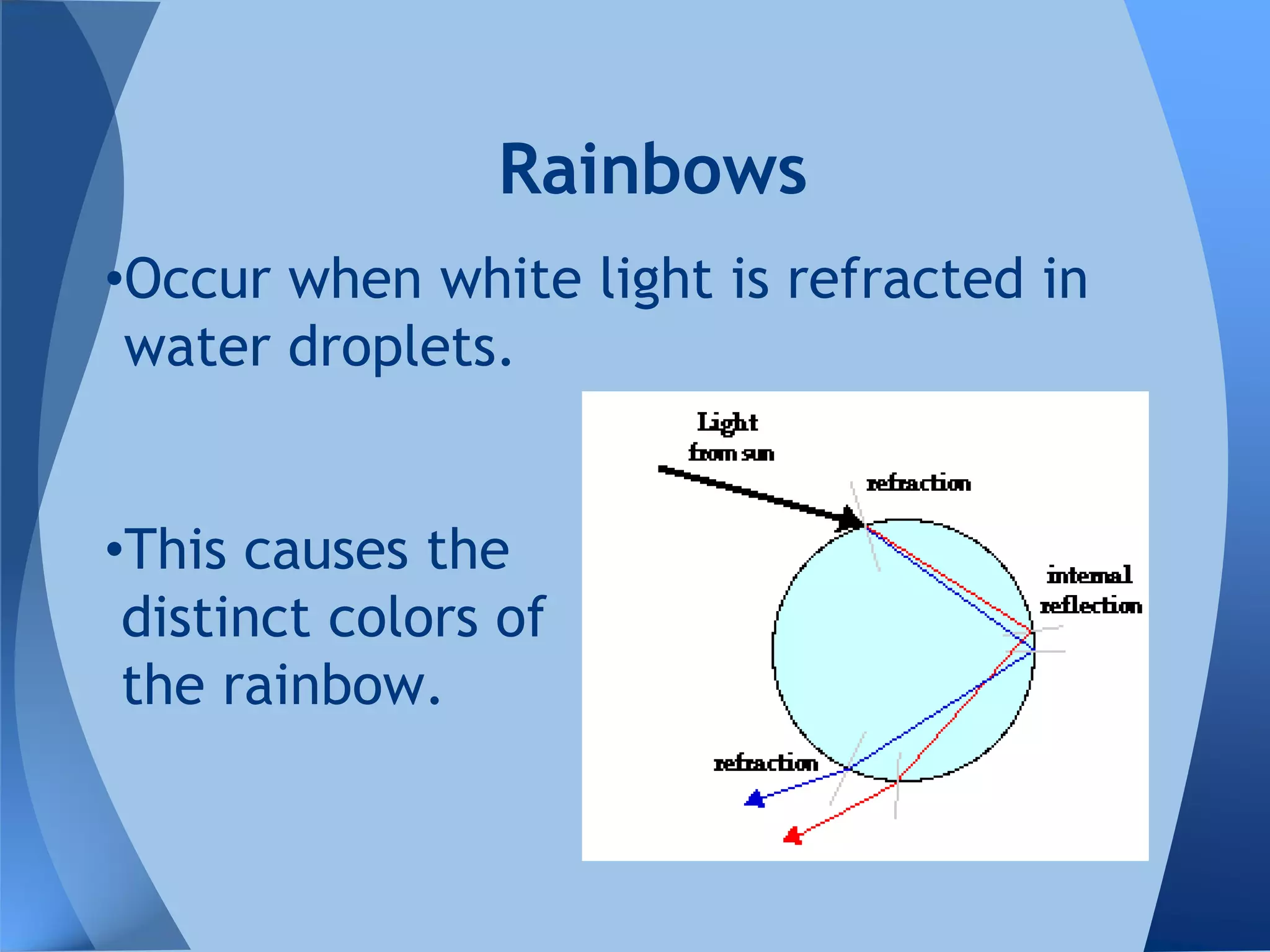
Rainbows
•Occur when white light is refracted in
water droplets.
•This causes the
distinct colors of
the rainbow.
Review Questions
1. What changes in the atmosphere could
cause refraction?
2. What happens when an angle is totally
internally reflected?
3. What is one phenomena that is caused by
total internal reflection?
4. How does a mirage occur?
5. In dispersion what causes the light to
bend at different angles?
Bibliography
•
•
•
•
•

•

LIGHT PILLAR PICTURES: Mysterious Sky Shows Explained. (n.d.).
National Geographic. Retrieved October 29, 2013, from
http://news.nationalgeographic.com/news/2009/02/photogalleries/lig
ht-pillars/
halo. (2013). In Encyclopædia Britannica. Retrieved from
http://www.britannica.com/EBchecked/topic/252957/halo
Serway, R. A., & Faughn, J. S. (2009). Physics. Austin: Holt.
Crowley, L. (n.d.). Atmospheric Optics. Atmospheric Optics. Retrieved
October 29, 2013, from http://www.atoptics.co.uk/
Internal Reflection. (n.d.). Tutor Dynamic. Retrieved October 29,
2013, from http://www.tutordynamic.com/physics/internalreflection.htm
Deprest, M. S. (n.d.). Atmospheric Optical Phenomena.. Atmospheric
Optical Phenomena.. Retrieved October 29, 2013, from
http://www.umich.edu/~lowbrows/reflections/2009/mdeprest.35.htm
l

Optical phenomena

  • 1.
  • 2.
    Objectives • Recognize atmosphericconditions that cause refraction. • Explain dispersion and phenomena such • as rainbows in terms of the relationship between the index of refraction and the wavelength. Demonstrate internal reflection with fiber optics.
  • 3.
    Introduction • In thislesson, we will be looking at what causes refraction. • We will also be learning about how phenomena occur due to the interaction between light and matter.
  • 4.
    What causes refraction? •Changes in: o temperature o pressure o moisture o medium Refraction happens when there is a change in density.
  • 5.
    What does lightdo when it is refracted at different angles?
  • 6.
    Critical Angle • Theangle that causes the refracted light rays to move parallel to the boundary at a 90o angle to the normal.
  • 7.
    Angles greater thanthe critical angle will be totally internally reflected.
  • 8.
    Total Internal Reflection •When light moves along a path inside of a medium.
  • 9.
    Fiber Optics • Whenlight is internally reflected until it reaches the end.
  • 10.
    Light (Sun) Pillars •When the light reflects off of ice crystals in the sky. • You may get pillars of light in yellows, blues, reds, and violet colors.
  • 11.
    Ice Halo • Happenswhen the Sun or Moon refracts in the ice crystals in the clouds. • Sometimes the light isn’t refracted by its wavelength, which causes a white color halo. Other times, it creates a rainbow of reflected color.
  • 12.
    Mirage • • A mirage occurswhen the ground heats the air above making it hotter than the air at higher altitudes. This results in you seeing the upright image and the inverted image, which appears to you as a reflection in water.
  • 13.
    Dispersion • The bendingof light at different angles due to each wavelengths’ index of refraction. • Longer wavelengths= less refraction • Shorter wavelengths= more refraction
  • 14.
    Rainbows •Occur when whitelight is refracted in water droplets. •This causes the distinct colors of the rainbow.
  • 15.
    Review Questions 1. Whatchanges in the atmosphere could cause refraction? 2. What happens when an angle is totally internally reflected? 3. What is one phenomena that is caused by total internal reflection? 4. How does a mirage occur? 5. In dispersion what causes the light to bend at different angles?
  • 16.
    Bibliography • • • • • • LIGHT PILLAR PICTURES:Mysterious Sky Shows Explained. (n.d.). National Geographic. Retrieved October 29, 2013, from http://news.nationalgeographic.com/news/2009/02/photogalleries/lig ht-pillars/ halo. (2013). In Encyclopædia Britannica. Retrieved from http://www.britannica.com/EBchecked/topic/252957/halo Serway, R. A., & Faughn, J. S. (2009). Physics. Austin: Holt. Crowley, L. (n.d.). Atmospheric Optics. Atmospheric Optics. Retrieved October 29, 2013, from http://www.atoptics.co.uk/ Internal Reflection. (n.d.). Tutor Dynamic. Retrieved October 29, 2013, from http://www.tutordynamic.com/physics/internalreflection.htm Deprest, M. S. (n.d.). Atmospheric Optical Phenomena.. Atmospheric Optical Phenomena.. Retrieved October 29, 2013, from http://www.umich.edu/~lowbrows/reflections/2009/mdeprest.35.htm l

Editor's Notes

  • #15 The water acts as a tiny prism.