Optic Disc
Melanocytoma
Dr Pavan Shroff
Fellow – Vitreous-Retina Department,
M.M. Joshi Eye Institute.
Case History
• 42 years old lady visits OPD for a routine check-up.
• No h/o systemic illness.
• RE BCVA: 6/6
• LE BCVA: 6/6
• Anterior Segment: Appears normal.
• Pupils: Reacting
• RE: Pseudophakia
• LE: Early Nuclear Sclerosis
• Fundus Examination:
• RE: Normal
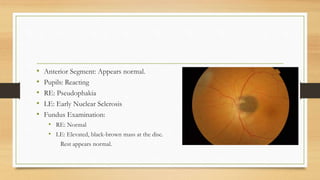
• LE: Elevated, black-brown mass at the disc.
Rest appears normal.
• Anterior Segment: Appears normal.
• Pupils: Reacting
• RE: Pseudophakia
• LE: Early Nuclear Sclerosis
• Fundus Examination:
• RE: Normal
• LE: Elevated, black-brown mass at the disc.
Rest appears normal.
B-Scan:
• Iso-echoic, elevated lesion over optic nerve head.
• No internal reflectivity was seen.
• Patient was followed up for 2 years
• Maintains BCVA 6/6 in BE.
• RE Fundus: Normal
• LE Fundus:
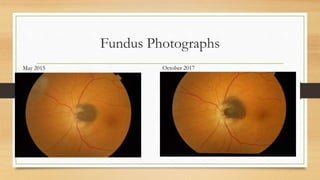
• Mild increase in the size of the lesion.
• Rest appears normal.
Fundus Photographs
May 2015 October 2017
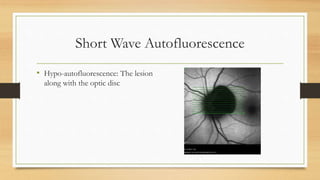
Short Wave Autofluorescence
• Hypo-autofluorescence: The lesion
along with the optic disc
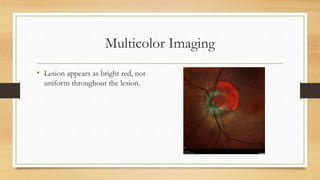
Multicolor Imaging
• Lesion appears as bright red, not
uniform throughout the lesion.
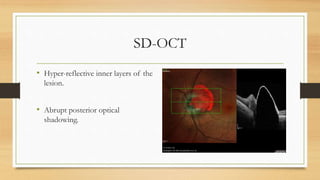
SD-OCT
• Hyper-reflective inner layers of the
lesion.
• Abrupt posterior optical
shadowing.
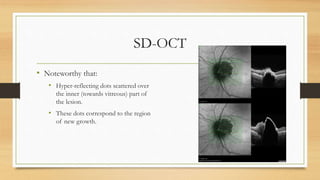
SD-OCT
• Noteworthy that:
• Hyper-reflecting dots scattered over
the inner (towards vitreous) part of
the lesion.
• These dots correspond to the region
of new growth.

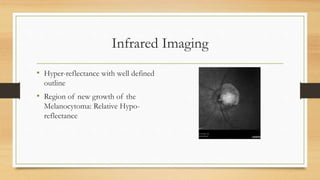
Infrared Imaging
• Hyper-reflectance with well defined
outline
• Region of new growth of the
Melanocytoma: Relative Hypo-
reflectance
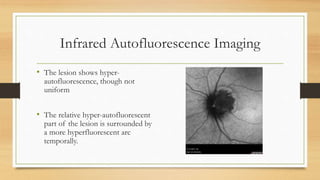
Infrared Autofluorescence Imaging
• The lesion shows hyper-
autofluorescence, though not
uniform
• The relative hyper-autofluorescent
part of the lesion is surrounded by
a more hyperfluorescent arc
temporally.
• Thus Infrared and IR-AF imaging helps determining the growth and activity
of Optic Disc Melanocytoma.
• Morphological features of the lesion can be better studied.
Management
• Majority of cases will maintain good vision
• Less association with complications
• 2-3% will show malignant transformation
• Thickness of >1.5 mm: associated with poor prognosis
• Follow-up the patient yearly.
• Minimal increase in lesion does not indicate malignant transformation
• Diminution of Vision with significant increase in lesion-> Malignancy
• Enucleation may be needed in case of malignancy.
Message
• Infrared autofluorescence is based on the melanin content of the tissue and
that can be helpful in studying the activity of various lesions.

Optic disc melanocytoma

  • 1.
    Optic Disc Melanocytoma Dr PavanShroff Fellow – Vitreous-Retina Department, M.M. Joshi Eye Institute.
  • 2.
    Case History • 42years old lady visits OPD for a routine check-up. • No h/o systemic illness. • RE BCVA: 6/6 • LE BCVA: 6/6
  • 3.
    • Anterior Segment:Appears normal. • Pupils: Reacting • RE: Pseudophakia • LE: Early Nuclear Sclerosis • Fundus Examination: • RE: Normal • LE: Elevated, black-brown mass at the disc. Rest appears normal.
  • 4.
    • Anterior Segment:Appears normal. • Pupils: Reacting • RE: Pseudophakia • LE: Early Nuclear Sclerosis • Fundus Examination: • RE: Normal • LE: Elevated, black-brown mass at the disc. Rest appears normal.
  • 5.
    B-Scan: • Iso-echoic, elevatedlesion over optic nerve head. • No internal reflectivity was seen.
  • 6.
    • Patient wasfollowed up for 2 years • Maintains BCVA 6/6 in BE. • RE Fundus: Normal • LE Fundus: • Mild increase in the size of the lesion. • Rest appears normal.
  • 7.
  • 8.
    Short Wave Autofluorescence •Hypo-autofluorescence: The lesion along with the optic disc
  • 9.
    Multicolor Imaging • Lesionappears as bright red, not uniform throughout the lesion.
  • 10.
    SD-OCT • Hyper-reflective innerlayers of the lesion. • Abrupt posterior optical shadowing.
  • 11.
    SD-OCT • Noteworthy that: •Hyper-reflecting dots scattered over the inner (towards vitreous) part of the lesion. • These dots correspond to the region of new growth.
  • 12.
    Infrared Imaging • Hyper-reflectancewith well defined outline • Region of new growth of the Melanocytoma: Relative Hypo- reflectance
  • 13.
    Infrared Autofluorescence Imaging •The lesion shows hyper- autofluorescence, though not uniform • The relative hyper-autofluorescent part of the lesion is surrounded by a more hyperfluorescent arc temporally.
  • 14.
    • Thus Infraredand IR-AF imaging helps determining the growth and activity of Optic Disc Melanocytoma. • Morphological features of the lesion can be better studied.
  • 15.
    Management • Majority ofcases will maintain good vision • Less association with complications • 2-3% will show malignant transformation • Thickness of >1.5 mm: associated with poor prognosis
  • 16.
    • Follow-up thepatient yearly. • Minimal increase in lesion does not indicate malignant transformation • Diminution of Vision with significant increase in lesion-> Malignancy • Enucleation may be needed in case of malignancy.
  • 17.
    Message • Infrared autofluorescenceis based on the melanin content of the tissue and that can be helpful in studying the activity of various lesions.