Presentation On Oracle Process
manufacturing
How OPM benefits your business?
Purpose of OPM

In my previous post, Understanding OPM, we have briefly touched upon what Process
Manufacturing is all about and how it could be synchronized with the day to day plant
operations. In this blog entry we’ll look at how the entire manufacturing process (let’s
call it manufacturing for now) is divided procedurally, strengths and usefulness of OPM
solution suite and a sneak peek into OPM extensions for Endeca.
In terms of ERP, Manufacturing can be divided
into 3 types:



Flow manufacturing



Discrete Manufacturing



Process Manufacturing


Flow Manufacturing is an innovative manufacturing method which synchronizes
production with customer demand. Flow manufacturing production lines are
designed to support the inter-mixed production of multiple products within a family
on the same line at a constant rate



Discrete manufacturing on the other hand is a different business altogether. Discrete
manufacturing is a manufacturing process in which distinct items/products(which
you can easily count, see and touch) are built or manufactured in discrete batches on
manufacturing floor. It creates physical products which go directly to business and
consumers, and assemblies that are used by other manufacturers.
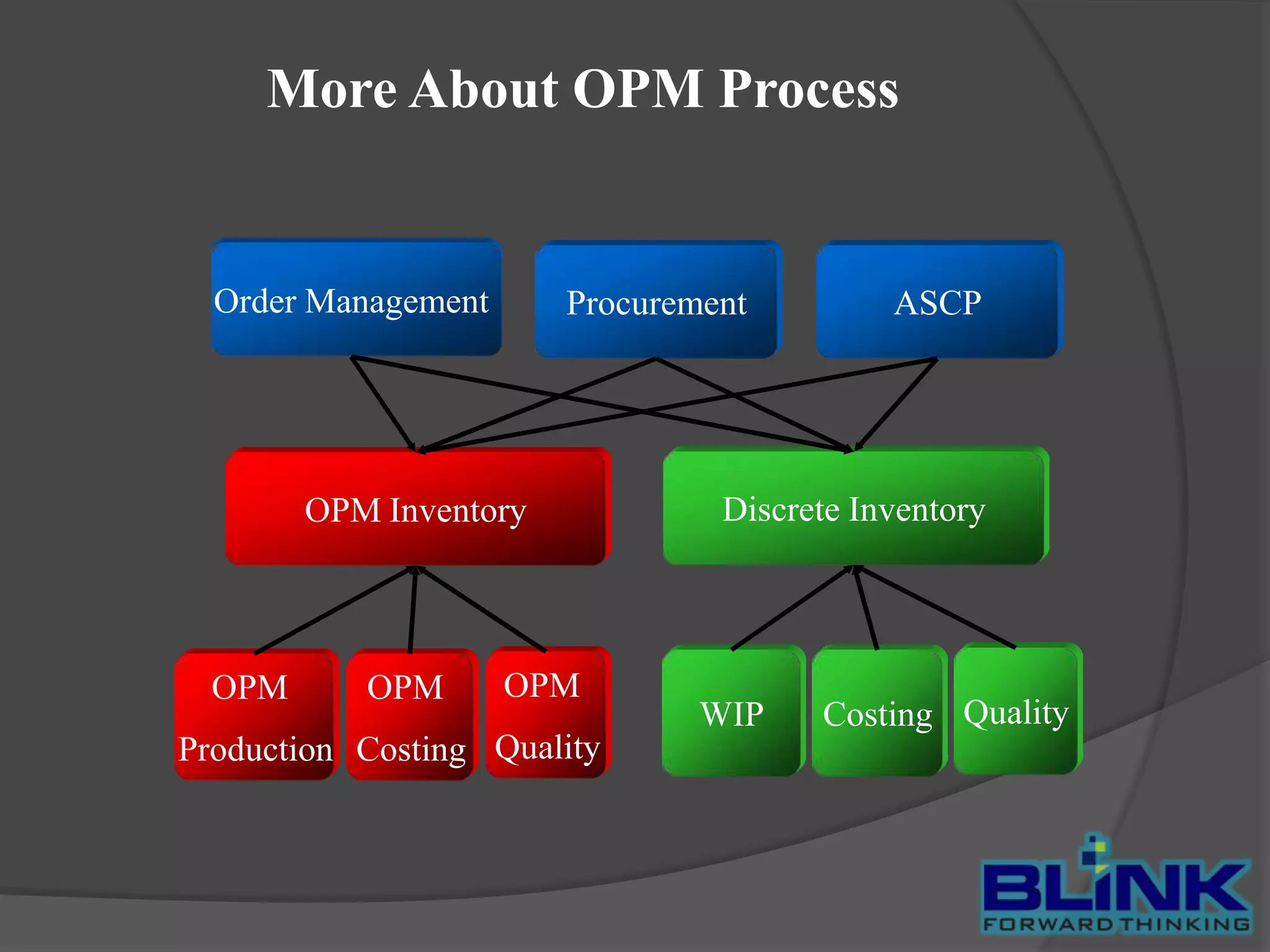
More About OPM Process

Order Management

Procurement

OPM Inventory

OPM

OPM

OPM

Production Costing Quality

ASCP

Discrete Inventory

WIP

Costing Quality
Oracle Process manufacturing, or batch production as it is popularly known, is a
process of pressing/mixing/chemical processing/heating/boiling liquid/semi liquid/solid
and powder or raw materials. Once you manufacture a product by using process
manufacturing, the output cannot be brought to it's original basic form. Every individual
product here is identical in terms of quality and composition. The production process,
raw material quantities, packaging pattern etc. is predetermined. The machines combine
and give out the product at the rate of multiple units per hour.

Oracle Process Manufacturing as a module is designed exclusively for all the process
and discrete manufacturing industries. Businesses belonging to these industry vertical
either produce physically similar products in bulk or customize every individual product
as per customer requirement.
Need Of OPM

Process manufacturers face a distinct set of challenges. They need precise control over
inventory and manufacturing processes. They need comprehensive visibility into
existing inventory to scale batches up and down to meet changing demand. Exact
formulations and recipes demand the strictest compliance with policies on sourcing
and storage. And, because quality is more than just a customer satisfaction issue, they
need the ability to collect accurate data at every step of the manufacturing process.
Blink's OPM Solution

Blink's solution of Oracle Process Manufacturing (OPM) allows process
manufacturers to collect data using radio-frequency (RF) devices to increase the
availability of information on receiving, shipping, manufacturing and inventory
activity as it happens. With handheld devices, users can collect data and perform
OPM transactions directly on the shop floor, in the warehouse and on the loading
dock. The information collected is immediately available to OPM applications
throughout the enterprise to improve control and visibility of key processes as they
occur.
Thank you

Oracle Process Manufacturing

  • 1.
    Presentation On OracleProcess manufacturing
  • 2.
    How OPM benefitsyour business?
  • 3.
    Purpose of OPM Inmy previous post, Understanding OPM, we have briefly touched upon what Process Manufacturing is all about and how it could be synchronized with the day to day plant operations. In this blog entry we’ll look at how the entire manufacturing process (let’s call it manufacturing for now) is divided procedurally, strengths and usefulness of OPM solution suite and a sneak peek into OPM extensions for Endeca.
  • 4.
    In terms ofERP, Manufacturing can be divided into 3 types:  Flow manufacturing  Discrete Manufacturing  Process Manufacturing
  • 5.
     Flow Manufacturing isan innovative manufacturing method which synchronizes production with customer demand. Flow manufacturing production lines are designed to support the inter-mixed production of multiple products within a family on the same line at a constant rate  Discrete manufacturing on the other hand is a different business altogether. Discrete manufacturing is a manufacturing process in which distinct items/products(which you can easily count, see and touch) are built or manufactured in discrete batches on manufacturing floor. It creates physical products which go directly to business and consumers, and assemblies that are used by other manufacturers.
  • 6.
    More About OPMProcess Order Management Procurement OPM Inventory OPM OPM OPM Production Costing Quality ASCP Discrete Inventory WIP Costing Quality
  • 7.
    Oracle Process manufacturing,or batch production as it is popularly known, is a process of pressing/mixing/chemical processing/heating/boiling liquid/semi liquid/solid and powder or raw materials. Once you manufacture a product by using process manufacturing, the output cannot be brought to it's original basic form. Every individual product here is identical in terms of quality and composition. The production process, raw material quantities, packaging pattern etc. is predetermined. The machines combine and give out the product at the rate of multiple units per hour. Oracle Process Manufacturing as a module is designed exclusively for all the process and discrete manufacturing industries. Businesses belonging to these industry vertical either produce physically similar products in bulk or customize every individual product as per customer requirement.
  • 9.
    Need Of OPM Processmanufacturers face a distinct set of challenges. They need precise control over inventory and manufacturing processes. They need comprehensive visibility into existing inventory to scale batches up and down to meet changing demand. Exact formulations and recipes demand the strictest compliance with policies on sourcing and storage. And, because quality is more than just a customer satisfaction issue, they need the ability to collect accurate data at every step of the manufacturing process.
  • 10.
    Blink's OPM Solution Blink'ssolution of Oracle Process Manufacturing (OPM) allows process manufacturers to collect data using radio-frequency (RF) devices to increase the availability of information on receiving, shipping, manufacturing and inventory activity as it happens. With handheld devices, users can collect data and perform OPM transactions directly on the shop floor, in the warehouse and on the loading dock. The information collected is immediately available to OPM applications throughout the enterprise to improve control and visibility of key processes as they occur.
  • 11.