Optimizing
Manufacturing
Processes with
Oracle EBS:
Unleashing Efficiency
and Control
Introduction
Oracle E-Business Suite (EBS) is a
comprehensive suite of business
applications that enables organizations to
streamline their business processes and
improve operational efficiency. EBS
provides a range of modules that cater to
various business functions such as
finance, supply chain management,
human resources, and more. With EBS,
organizations can gain better control over
their business operations and make
informed decisions.
Agenda
Introduction
Challenges in Manufacturing
Benefits of Oracle EBS
Key Features
Manufacturing Process
Implementation Process
Best Practices
Integration with Other Systems
Reporting and Analytics
Security and Compliance
Training and Support
Cost Analysis
Q&A Session
Next Steps
Conclusion
Challenges in
Manufacturing
Manufacturers face numerous
challenges such as inefficient
processes, lack of real-time visibility,
and limited control over operations.
These challenges can lead to increased
costs,production delays,and
customer dissatisfaction. It is crucial to
address these challenges to stay
competitive in
the market.
Benefits of Oracle EBS
Oracle EBS offers a comprehensive
solution to address manufacturing
challenges.It provides real-time
visibility streamlined processes and
enhanced control over operations.
With Oracle EBS,manufacturers can
achieve cost saving, improved
efficiency,and better customer
satisfcation
Key Features
Oracle EBS offers a range of key
features including inventory
management, production
planning, quality control,
supply chain management and
financial. These features enable
manufacturers to manage their
operations effectively and make data-
driven decisions.
Manufacturing to Cost Management Solution
Define Execute Cost
Visually Model Shop Floor Processes | Simplify Shop Floor Experience | Enforce Execution Compliance | Control Job Order Variances
Procure
Material
Run Material
Requirement
Planning
Define Recipe, formula,
operation, resources
Process
Execution
Inspection Results
Create Sales Order
Manufacturing / Quality Inspection Management Cost Management
Review Costing
Oracle
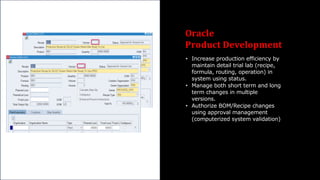
Product Development
• Increase production efficiency by
maintain detail trial lab (recipe,
formula, routing, operation) in
system using status.
• Manage both short term and long
term changes in multiple
versions.
• Authorize BOM/Recipe changes
using approval management
(computerized system validation)
Oracle
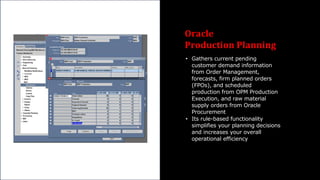
Production Planning
• Gathers current pending
customer demand information
from Order Management,
forecasts, firm planned orders
(FPOs), and scheduled
production from OPM Production
Execution, and raw material
supply orders from Oracle
Procurement
• Its rule-based functionality
simplifies your planning decisions
and increases your overall
operational efficiency
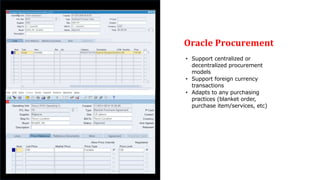
Oracle Procurement
• Support centralized or
decentralized procurement
models
• Support foreign currency
transactions
• Adapts to any purchasing
practices (blanket order,
purchase item/services, etc)
Oracle
Process Execution
• Manage shop floor operations
more efficiently by providing
real-time visibility into production
using batch/Job Order.
• Easily monitor the progress of a
job order and identify any issues
that may arise by using status
updates
• Traceable product using lot/serial
number from batch
Oracle
Quality Management
• Quality results entered are
automatically evaluated againts
specifications, determining the
accepted and rejected quantities
while completing an operation
• To ensure your products adhere
to quality specifications,
inspection can be enforced at any
point in your production process.
• Quality result can change
inventory status to prevent or
process further transactions
Oracle
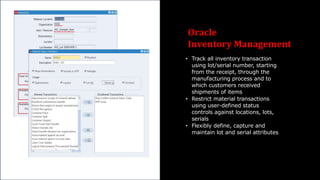
Inventory Management
• Track all inventory transaction
using lot/serial number, starting
from the receipt, through the
manufacturing process and to
which customers received
shipments of items
• Restrict material transactions
using user-defined status
controls against locations, lots,
serials
• Flexibly define, capture and
maintain lot and serial attributes
Oracle
Cost Management
• Control cost by separate cost
component of item cost and
analyze it using cost element/
cost component
• You can track product cost details
up to cost per batch
• If you have fluctuating inventory
costs, you can use period moving
average cost (PMAC) method to
smooth out the cost of goods
sold and provide a more accurate
picture of profitability
Oracle
Order Management
• automate all shipping-related
processes, including picking,
packing and ship confirmation.
Companies can enable Auto-Pick,
Auto-Pack and Auto-Ship
individually or in combination
• Honoring of credit holds across
business units
• Deferred invoicing and revenue
recognition until customer
acceptance for shipment
Implementation Process
Implementing Oracle EBS involves
several stages: requirements
gathering, system configuration,
testing, training, data migration.
It is essential to follow a
structured approach to ensure a
successful implementation and
minimize disruptions to the
manufacturing processes.
Best Practices
To maximize the benefits of Oracle
EBS,it is essential to follow best
practices such as standardizing
processes, regular system
maintenance, continuous
training, and ongoing process
improvement. These practices
ensure the system's optimal
performance and long-term
success.
Integration with Other Systems
Oracle EBS can be seamlessly
integrated with other systems such as
payment gateway,POS,and etc.
This integration enables
manufacturers to have a unified view
of their operations and facilitates data
exchange between different
departments, leading to improved
collaboration and decision- making.
Reporting and Analytics
Oracle EBS provides robust reporting
and analytics capabilities,allowing
manufacturers to gain valuable
insights into their operations.With real-
time dashboards and customizable
reports,users can monitor key
performance indicators,identify trends,
and make data-driven decisions to
optimize manufacturing processes.
Security and Compliance
Manufacturers must ensure the
security and compliance of their
systems and data.Oracle EBS offers
role-based access control,data
encryption, and audit trails to
protect sensitive information.It
also helps manufacturers comply
with industry regulations and
standards,ensuring data integrity
and confidentiality.
Training and Support
Proper training and ongoing support
are crucial for successful adoption and
optimal utilization of Oracle EBS.
Manufacturers should invest in user
training, system documentation,
and helpdesk support to empower
their employees and address any
system- related issues effectively.
Cost Analysis
Implementing Oracle EBS involves
costs such as licensing,
implementation services,and
infrastructure.However,a thorough
cost analysis should consider the
potential cost savings through
process optimization,reduced
errors,and improved resource
allocation,resulting in a positive
return on investment (ROI).
Q & A
Ne tSteps
After the presentation,the next steps
involve evaluation business
requirements, conducting a feasibility
study, and engaging with Oracle
EBS experts to plan the
implementation process. It is
essential to define a roadmap and
timeline for successful adoption of
Oracle EBS in manufacturing
operations.
Conclusion
Oracle EBS is a powerful solution for optimizing
manufacturing processes, enabling manufacturers to achieve
efficiency, control, and competitive advantage. By
addressing the challenges faced in manufacturing and
leveraging the key features of Oracle EBS, manufacturers can
streamline operations,enhance productivity,and drive
business success.
Thanks!
D o you have any questions? xxx@metrodata.co.id
+62 999 999 999
www.metrodata.co.id
manufacture process draft.pptx

manufacture process draft.pptx

  • 1.
  • 2.
    Introduction Oracle E-Business Suite(EBS) is a comprehensive suite of business applications that enables organizations to streamline their business processes and improve operational efficiency. EBS provides a range of modules that cater to various business functions such as finance, supply chain management, human resources, and more. With EBS, organizations can gain better control over their business operations and make informed decisions.
  • 3.
    Agenda Introduction Challenges in Manufacturing Benefitsof Oracle EBS Key Features Manufacturing Process Implementation Process Best Practices Integration with Other Systems Reporting and Analytics Security and Compliance Training and Support Cost Analysis Q&A Session Next Steps Conclusion
  • 4.
    Challenges in Manufacturing Manufacturers facenumerous challenges such as inefficient processes, lack of real-time visibility, and limited control over operations. These challenges can lead to increased costs,production delays,and customer dissatisfaction. It is crucial to address these challenges to stay competitive in the market.
  • 5.
    Benefits of OracleEBS Oracle EBS offers a comprehensive solution to address manufacturing challenges.It provides real-time visibility streamlined processes and enhanced control over operations. With Oracle EBS,manufacturers can achieve cost saving, improved efficiency,and better customer satisfcation
  • 6.
    Key Features Oracle EBSoffers a range of key features including inventory management, production planning, quality control, supply chain management and financial. These features enable manufacturers to manage their operations effectively and make data- driven decisions.
  • 7.
    Manufacturing to CostManagement Solution Define Execute Cost Visually Model Shop Floor Processes | Simplify Shop Floor Experience | Enforce Execution Compliance | Control Job Order Variances Procure Material Run Material Requirement Planning Define Recipe, formula, operation, resources Process Execution Inspection Results Create Sales Order Manufacturing / Quality Inspection Management Cost Management Review Costing
  • 8.
    Oracle Product Development • Increaseproduction efficiency by maintain detail trial lab (recipe, formula, routing, operation) in system using status. • Manage both short term and long term changes in multiple versions. • Authorize BOM/Recipe changes using approval management (computerized system validation)
  • 9.
    Oracle Production Planning • Gatherscurrent pending customer demand information from Order Management, forecasts, firm planned orders (FPOs), and scheduled production from OPM Production Execution, and raw material supply orders from Oracle Procurement • Its rule-based functionality simplifies your planning decisions and increases your overall operational efficiency
  • 10.
    Oracle Procurement • Supportcentralized or decentralized procurement models • Support foreign currency transactions • Adapts to any purchasing practices (blanket order, purchase item/services, etc)
  • 11.
    Oracle Process Execution • Manageshop floor operations more efficiently by providing real-time visibility into production using batch/Job Order. • Easily monitor the progress of a job order and identify any issues that may arise by using status updates • Traceable product using lot/serial number from batch
  • 12.
    Oracle Quality Management • Qualityresults entered are automatically evaluated againts specifications, determining the accepted and rejected quantities while completing an operation • To ensure your products adhere to quality specifications, inspection can be enforced at any point in your production process. • Quality result can change inventory status to prevent or process further transactions
  • 13.
    Oracle Inventory Management • Trackall inventory transaction using lot/serial number, starting from the receipt, through the manufacturing process and to which customers received shipments of items • Restrict material transactions using user-defined status controls against locations, lots, serials • Flexibly define, capture and maintain lot and serial attributes
  • 14.
    Oracle Cost Management • Controlcost by separate cost component of item cost and analyze it using cost element/ cost component • You can track product cost details up to cost per batch • If you have fluctuating inventory costs, you can use period moving average cost (PMAC) method to smooth out the cost of goods sold and provide a more accurate picture of profitability
  • 15.
    Oracle Order Management • automateall shipping-related processes, including picking, packing and ship confirmation. Companies can enable Auto-Pick, Auto-Pack and Auto-Ship individually or in combination • Honoring of credit holds across business units • Deferred invoicing and revenue recognition until customer acceptance for shipment
  • 16.
    Implementation Process Implementing OracleEBS involves several stages: requirements gathering, system configuration, testing, training, data migration. It is essential to follow a structured approach to ensure a successful implementation and minimize disruptions to the manufacturing processes.
  • 17.
    Best Practices To maximizethe benefits of Oracle EBS,it is essential to follow best practices such as standardizing processes, regular system maintenance, continuous training, and ongoing process improvement. These practices ensure the system's optimal performance and long-term success.
  • 18.
    Integration with OtherSystems Oracle EBS can be seamlessly integrated with other systems such as payment gateway,POS,and etc. This integration enables manufacturers to have a unified view of their operations and facilitates data exchange between different departments, leading to improved collaboration and decision- making.
  • 19.
    Reporting and Analytics OracleEBS provides robust reporting and analytics capabilities,allowing manufacturers to gain valuable insights into their operations.With real- time dashboards and customizable reports,users can monitor key performance indicators,identify trends, and make data-driven decisions to optimize manufacturing processes.
  • 20.
    Security and Compliance Manufacturersmust ensure the security and compliance of their systems and data.Oracle EBS offers role-based access control,data encryption, and audit trails to protect sensitive information.It also helps manufacturers comply with industry regulations and standards,ensuring data integrity and confidentiality.
  • 21.
    Training and Support Propertraining and ongoing support are crucial for successful adoption and optimal utilization of Oracle EBS. Manufacturers should invest in user training, system documentation, and helpdesk support to empower their employees and address any system- related issues effectively.
  • 22.
    Cost Analysis Implementing OracleEBS involves costs such as licensing, implementation services,and infrastructure.However,a thorough cost analysis should consider the potential cost savings through process optimization,reduced errors,and improved resource allocation,resulting in a positive return on investment (ROI).
  • 23.
  • 24.
    Ne tSteps After thepresentation,the next steps involve evaluation business requirements, conducting a feasibility study, and engaging with Oracle EBS experts to plan the implementation process. It is essential to define a roadmap and timeline for successful adoption of Oracle EBS in manufacturing operations.
  • 25.
    Conclusion Oracle EBS isa powerful solution for optimizing manufacturing processes, enabling manufacturers to achieve efficiency, control, and competitive advantage. By addressing the challenges faced in manufacturing and leveraging the key features of Oracle EBS, manufacturers can streamline operations,enhance productivity,and drive business success.
  • 26.
    Thanks! D o youhave any questions? xxx@metrodata.co.id +62 999 999 999 www.metrodata.co.id

Editor's Notes

  • #12 - real-time visibility include material/packaging/resources usage, job order status - By using status updates, you can easily monitor the progress of a job order and identify any issues that may arise. This can help you to make informed decisions about how to allocate resources and prioritize tasks.
  • #20 Easy to custom, using java programming language