Contents
1. Introduction of operators.
2. Types of operator
3. Arithmetic operator
4. Relational operator
5. Logical operator
6. Bitwise operator
7. Assignment operator
8. Conditional operator
9. Special operator
10. Increment and decrement operator.
Introduction of operator :-
C language supports a rich set of built-in
operators.
An operator is a symbol that tells the compiler to
perform a certain mathematical or logical
manipulation.
Operators are used in programs to manipulate data
and variables .
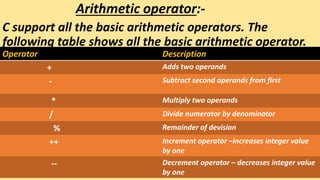
Arithmetic operator:-
C support all the basic arithmetic operators. The
following table shows all the basic arithmetic operator.
Operator Description
+ Adds two operands
- Subtract second operands from first
* Multiply two operands
/ Divide numerator by denominator
% Remainder of devision
++ Increment operator –increases integer value
by one
-- Decrement operator – decreases integer value
by one
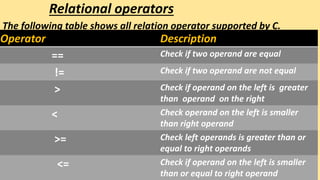
Relational operators
The following table shows all relation operator supported by C.
Operator Description
== Check if two operand are equal
!= Check if two operand are not equal
> Check if operand on the left is greater
than operand on the right
< Check operand on the left is smaller
than right operand
>= Check left operands is greater than or
equal to right operands
<= Check if operand on the left is smaller
than or equal to right operand
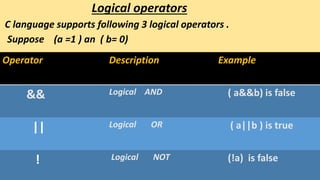
Logical operators
C language supports following 3 logical operators .
Suppose (a =1 ) an ( b= 0)
Operator Description Example
&& Logical AND ( a&&b) is false
|| Logical OR ( a||b ) is true
! Logical NOT (!a) is false
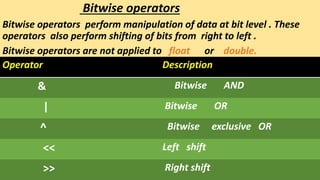
Bitwise operators
Bitwise operators perform manipulation of data at bit level . These
operators also perform shifting of bits from right to left .
Bitwise operators are not applied to float or double.
Operator Description
& Bitwise AND
| Bitwise OR
^ Bitwise exclusive OR
<< Left shift
>> Right shift
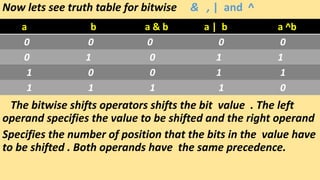
Now lets see truth table for bitwise & , | and ^
The bitwise shifts operators shifts the bit value . The left
operand specifies the value to be shifted and the right operand
Specifies the number of position that the bits in the value have
to be shifted . Both operands have the same precedence.
a b a & b a | b a ^b
0 0 0 0 0
0 1 0 1 1
1 0 0 1 1
1 1 1 1 0
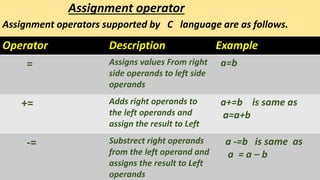
Assignment operator
Assignment operators supported by C language are as follows.
Operator Description Example
= Assigns values From right
side operands to left side
operands
a=b
+= Adds right operands to
the left operands and
assign the result to Left
a+=b is same as
a=a+b
-= Substrect right operands
from the left operand and
assigns the result to Left
operands
a -=b is same as
a = a – b
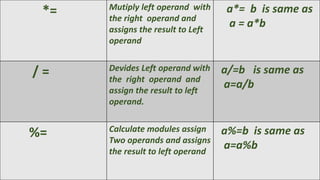
*= Mutiply left operand with
the right operand and
assigns the result to Left
operand
a*= b is same as
a = a*b
/ = Devides Left operand with
the right operand and
assign the result to left
operand.
a/=b is same as
a=a/b
%= Calculate modules assign
Two operands and assigns
the result to left operand
a%=b is same as
a=a%b
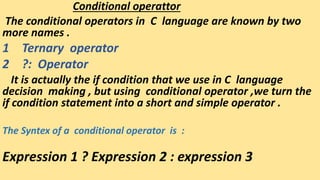
Conditional operattor
The conditional operators in C language are known by two
more names .
1 Ternary operator
2 ?: Operator
It is actually the if condition that we use in C language
decision making , but using conditional operator ,we turn the
if condition statement into a short and simple operator .
The Syntex of a conditional operator is :
Expression 1 ? Expression 2 : expression 3
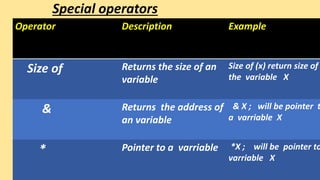
Special operators
Operator Description Example
Size of Returns the size of an
variable
Size of (x) return size of
the variable X
& Returns the address of
an variable
& X ; will be pointer t
a varriable X
* Pointer to a varriable *X ; will be pointer to
varriable X
Incrementanddecrementoperator
Increament operators are used to increased the value of the varriable
by one and Decrement operators are used to decrease the value of
the varriable by one in C program .
Both increment and Decrement operator are used on a single open
and or variable , so it is called as a unary operator .
Unary operators are having higher priority that the other operators it
means unary operators are excuted before other operators.
Syntax ; [ ++ // Increment operator ]
[ -- // Decrement operator ]
Operators and it's type

Operators and it's type

  • 1.
    Contents 1. Introduction ofoperators. 2. Types of operator 3. Arithmetic operator 4. Relational operator 5. Logical operator 6. Bitwise operator 7. Assignment operator 8. Conditional operator 9. Special operator 10. Increment and decrement operator.
  • 2.
    Introduction of operator:- C language supports a rich set of built-in operators. An operator is a symbol that tells the compiler to perform a certain mathematical or logical manipulation. Operators are used in programs to manipulate data and variables .
  • 3.
    Arithmetic operator:- C supportall the basic arithmetic operators. The following table shows all the basic arithmetic operator. Operator Description + Adds two operands - Subtract second operands from first * Multiply two operands / Divide numerator by denominator % Remainder of devision ++ Increment operator –increases integer value by one -- Decrement operator – decreases integer value by one
  • 4.
    Relational operators The followingtable shows all relation operator supported by C. Operator Description == Check if two operand are equal != Check if two operand are not equal > Check if operand on the left is greater than operand on the right < Check operand on the left is smaller than right operand >= Check left operands is greater than or equal to right operands <= Check if operand on the left is smaller than or equal to right operand
  • 5.
    Logical operators C languagesupports following 3 logical operators . Suppose (a =1 ) an ( b= 0) Operator Description Example && Logical AND ( a&&b) is false || Logical OR ( a||b ) is true ! Logical NOT (!a) is false
  • 6.
    Bitwise operators Bitwise operatorsperform manipulation of data at bit level . These operators also perform shifting of bits from right to left . Bitwise operators are not applied to float or double. Operator Description & Bitwise AND | Bitwise OR ^ Bitwise exclusive OR << Left shift >> Right shift
  • 7.
    Now lets seetruth table for bitwise & , | and ^ The bitwise shifts operators shifts the bit value . The left operand specifies the value to be shifted and the right operand Specifies the number of position that the bits in the value have to be shifted . Both operands have the same precedence. a b a & b a | b a ^b 0 0 0 0 0 0 1 0 1 1 1 0 0 1 1 1 1 1 1 0
  • 8.
    Assignment operator Assignment operatorssupported by C language are as follows. Operator Description Example = Assigns values From right side operands to left side operands a=b += Adds right operands to the left operands and assign the result to Left a+=b is same as a=a+b -= Substrect right operands from the left operand and assigns the result to Left operands a -=b is same as a = a – b
  • 9.
    *= Mutiply leftoperand with the right operand and assigns the result to Left operand a*= b is same as a = a*b / = Devides Left operand with the right operand and assign the result to left operand. a/=b is same as a=a/b %= Calculate modules assign Two operands and assigns the result to left operand a%=b is same as a=a%b
  • 10.
    Conditional operattor The conditionaloperators in C language are known by two more names . 1 Ternary operator 2 ?: Operator It is actually the if condition that we use in C language decision making , but using conditional operator ,we turn the if condition statement into a short and simple operator . The Syntex of a conditional operator is : Expression 1 ? Expression 2 : expression 3
  • 11.
    Special operators Operator DescriptionExample Size of Returns the size of an variable Size of (x) return size of the variable X & Returns the address of an variable & X ; will be pointer t a varriable X * Pointer to a varriable *X ; will be pointer to varriable X
  • 12.
    Incrementanddecrementoperator Increament operators areused to increased the value of the varriable by one and Decrement operators are used to decrease the value of the varriable by one in C program . Both increment and Decrement operator are used on a single open and or variable , so it is called as a unary operator . Unary operators are having higher priority that the other operators it means unary operators are excuted before other operators. Syntax ; [ ++ // Increment operator ] [ -- // Decrement operator ]