Operators And Expression
Operators and Expressions
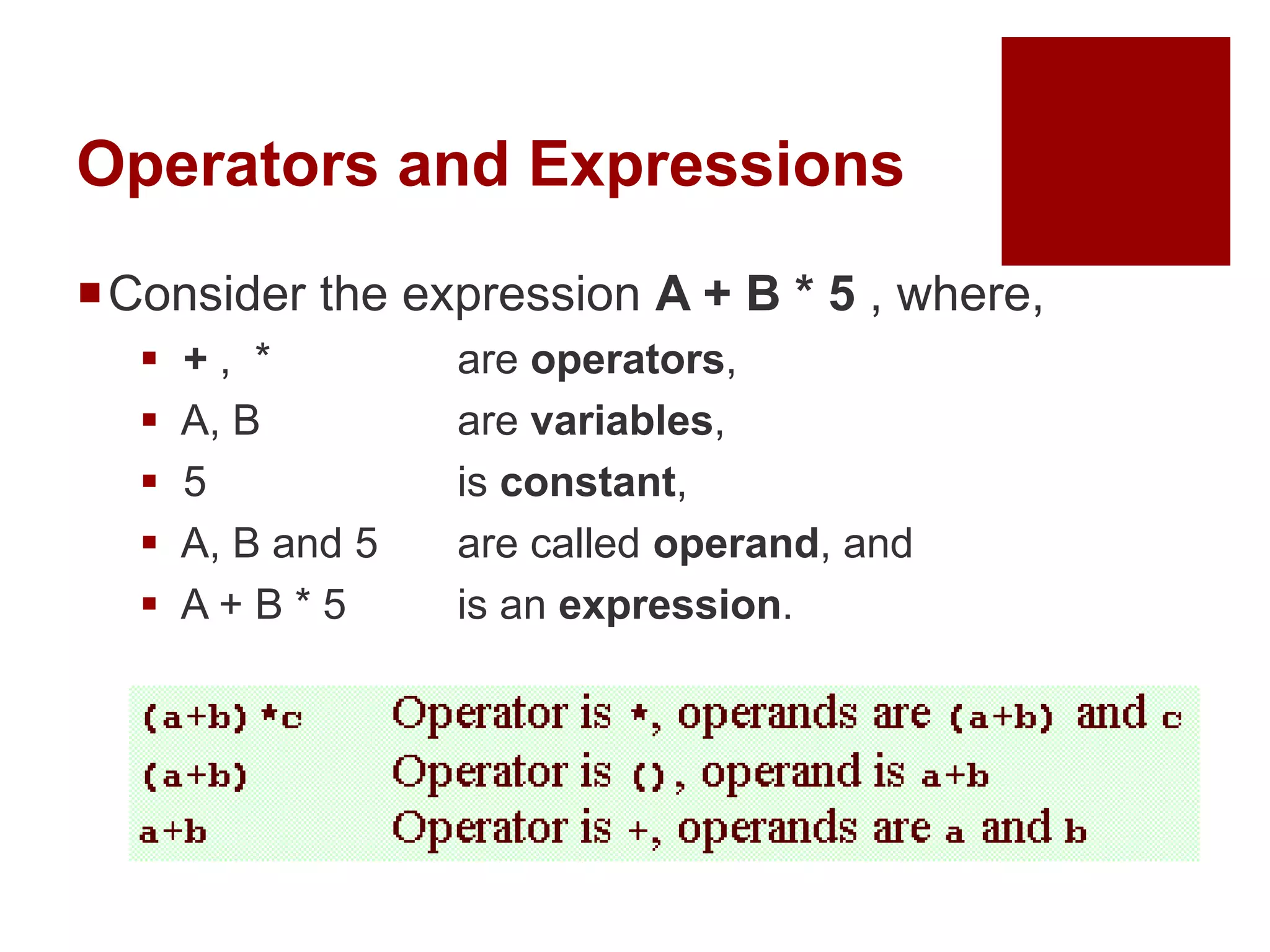
Consider the expression A + B * 5 , where,
 + , * are operators,
 A, B are variables,
 5 is constant,
 A, B and 5 are called operand, and
 A + B * 5 is an expression.
Types of C operators
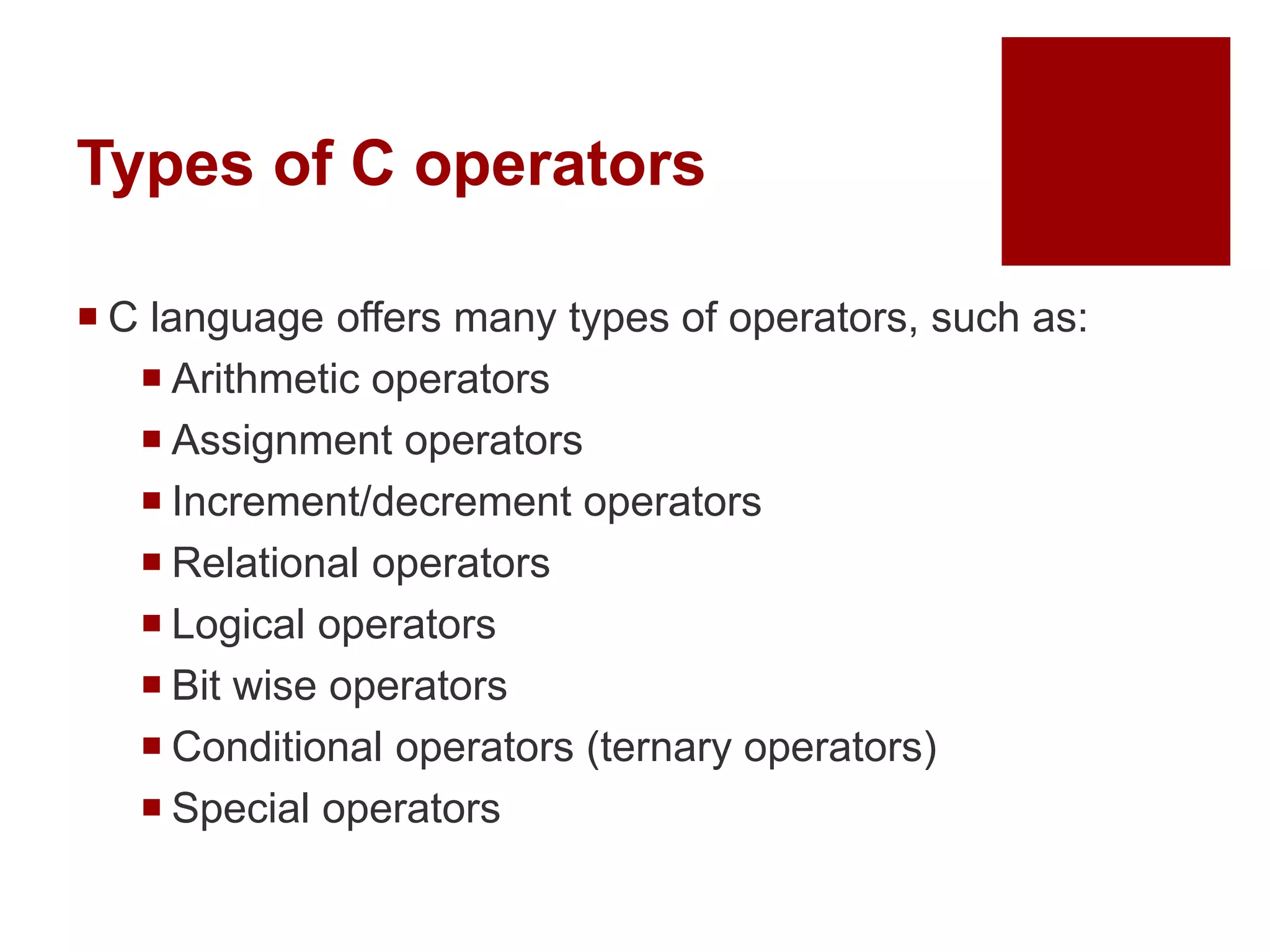
 C language offers many types of operators, such as:
 Arithmetic operators
 Assignment operators
 Increment/decrement operators
 Relational operators
 Logical operators
 Bit wise operators
 Conditional operators (ternary operators)
 Special operators
Arithmetic Operators
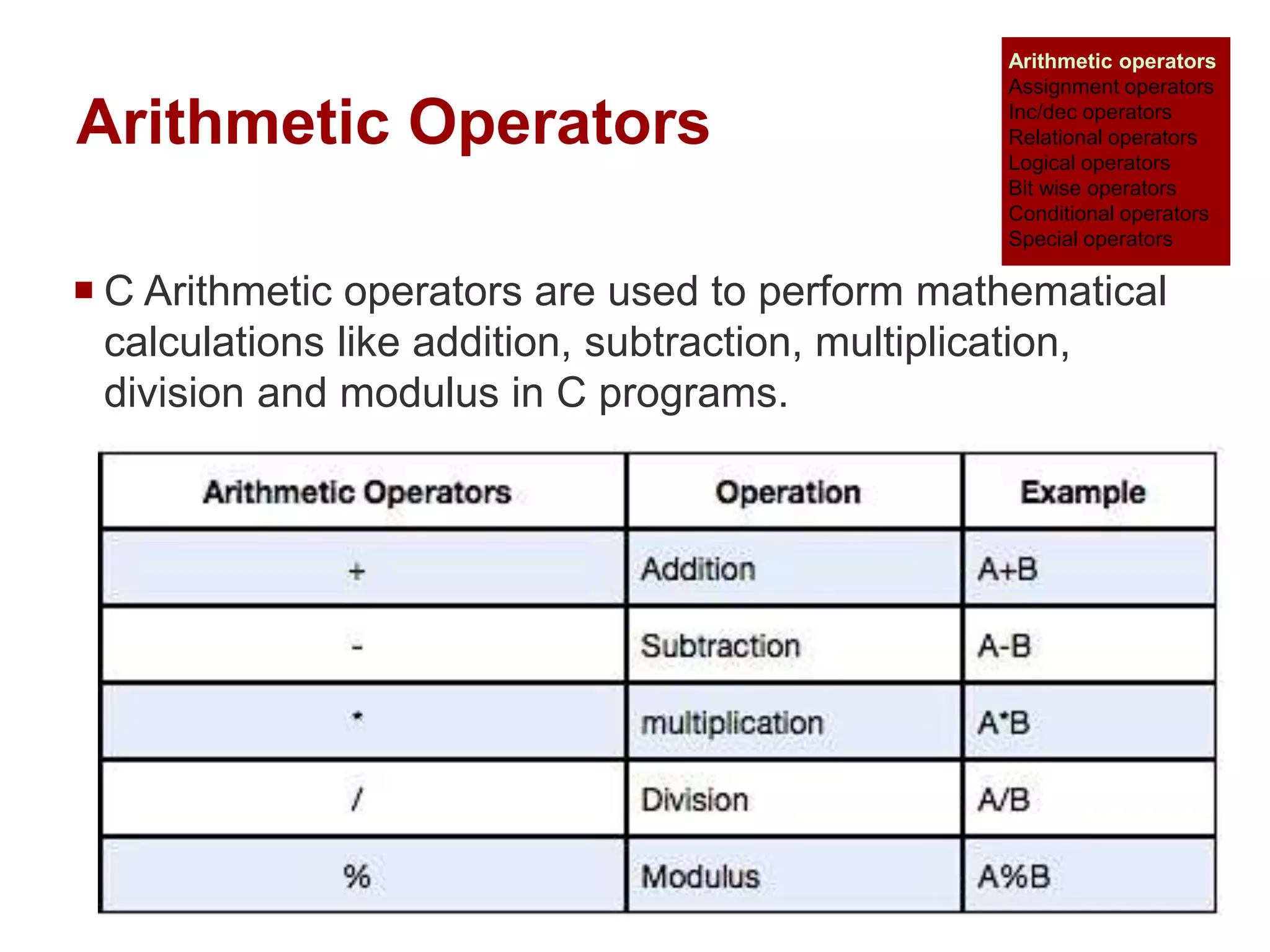
 C Arithmetic operators are used to perform mathematical
calculations like addition, subtraction, multiplication,
division and modulus in C programs.
Arithmetic operators
Assignment operators
Inc/dec operators
Relational operators
Logical operators
Bit wise operators
Conditional operators
Special operators
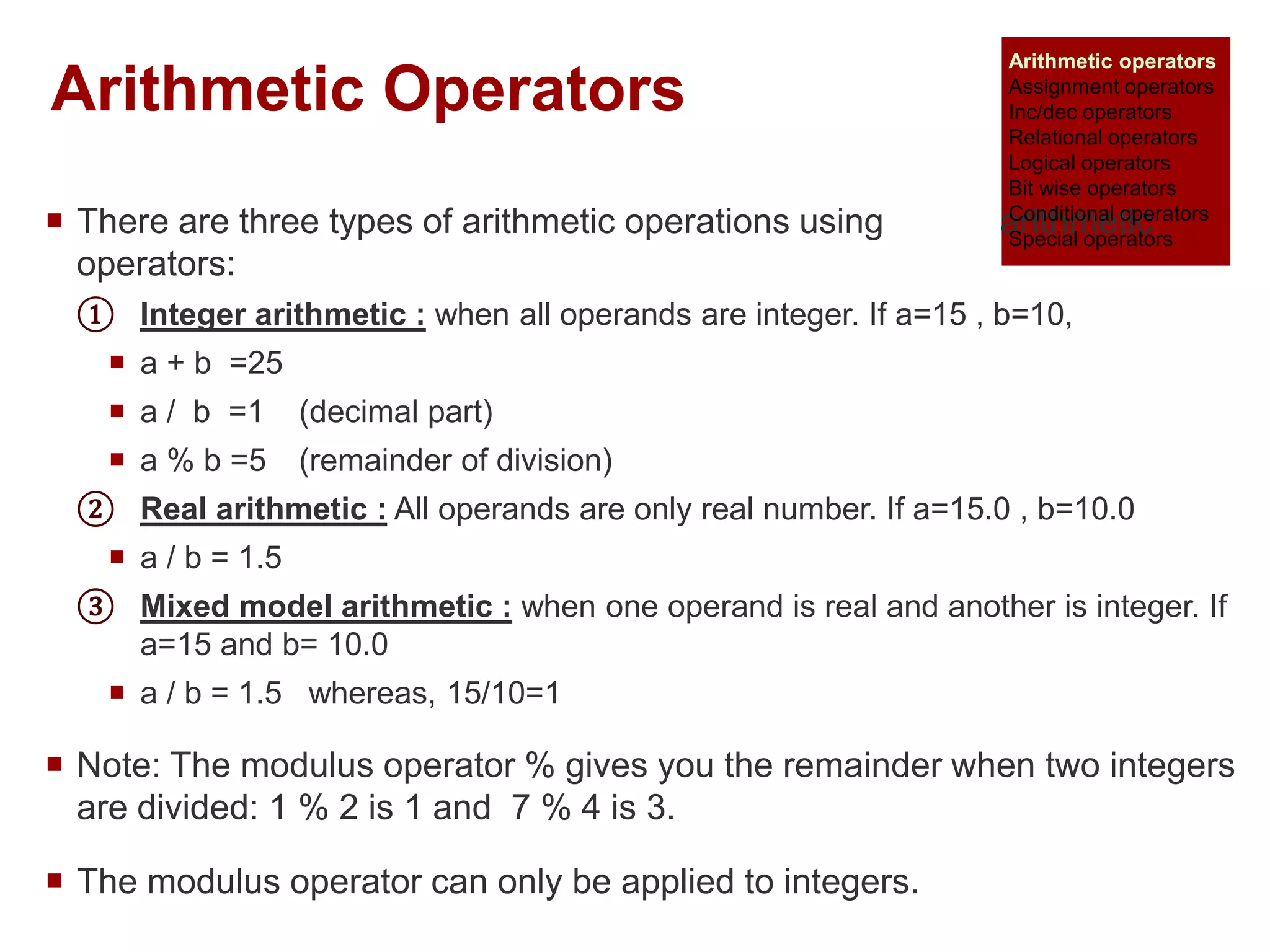
 There are three types of arithmetic operations using arithmetic
operators:
① Integer arithmetic : when all operands are integer. If a=15 , b=10,
 a + b =25
 a / b =1 (decimal part)
 a % b =5 (remainder of division)
② Real arithmetic : All operands are only real number. If a=15.0 , b=10.0
 a / b = 1.5
③ Mixed model arithmetic : when one operand is real and another is integer. If
a=15 and b= 10.0
 a / b = 1.5 whereas, 15/10=1
 Note: The modulus operator % gives you the remainder when two integers
are divided: 1 % 2 is 1 and 7 % 4 is 3.
 The modulus operator can only be applied to integers.
Arithmetic Operators
Arithmetic operators
Assignment operators
Inc/dec operators
Relational operators
Logical operators
Bit wise operators
Conditional operators
Special operators
① Integer arithmetic :
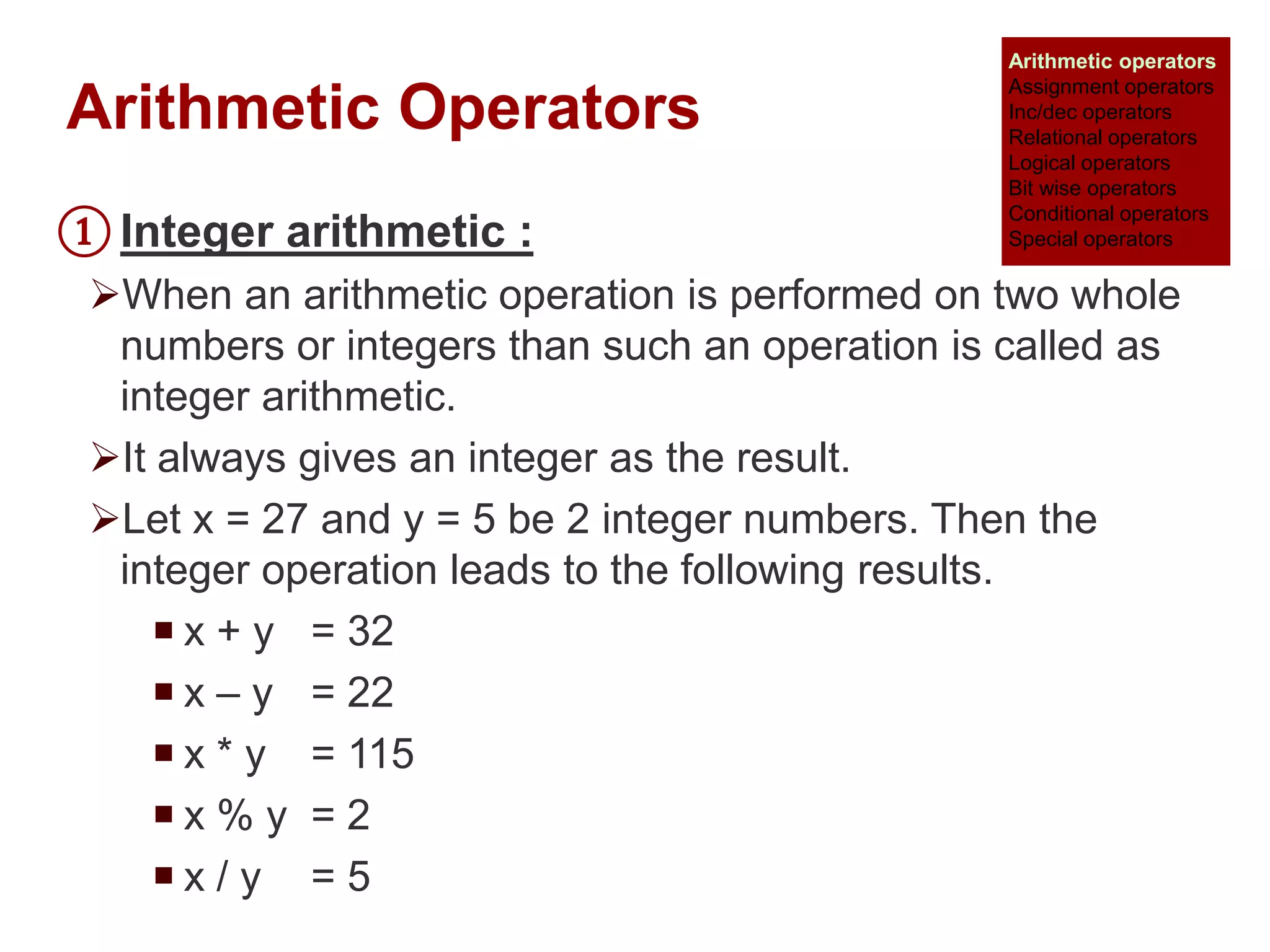
When an arithmetic operation is performed on two whole
numbers or integers than such an operation is called as
integer arithmetic.
It always gives an integer as the result.
Let x = 27 and y = 5 be 2 integer numbers. Then the
integer operation leads to the following results.
 x + y = 32
 x – y = 22
 x * y = 115
 x % y = 2
 x / y = 5
Arithmetic Operators
Arithmetic operators
Assignment operators
Inc/dec operators
Relational operators
Logical operators
Bit wise operators
Conditional operators
Special operators
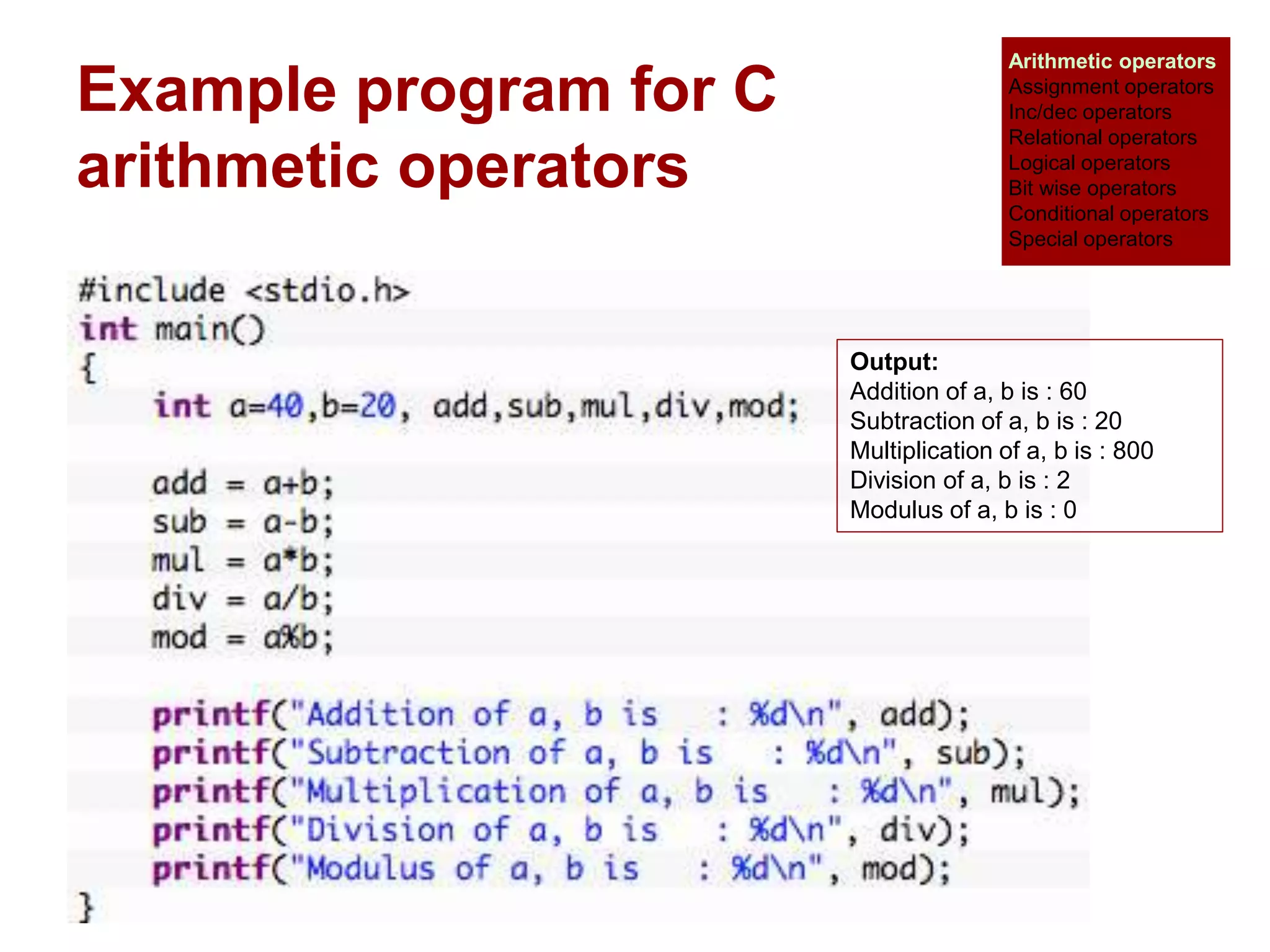
Example program for C
arithmetic operators
Output:
Addition of a, b is : 60
Subtraction of a, b is : 20
Multiplication of a, b is : 800
Division of a, b is : 2
Modulus of a, b is : 0
Arithmetic operators
Assignment operators
Inc/dec operators
Relational operators
Logical operators
Bit wise operators
Conditional operators
Special operators
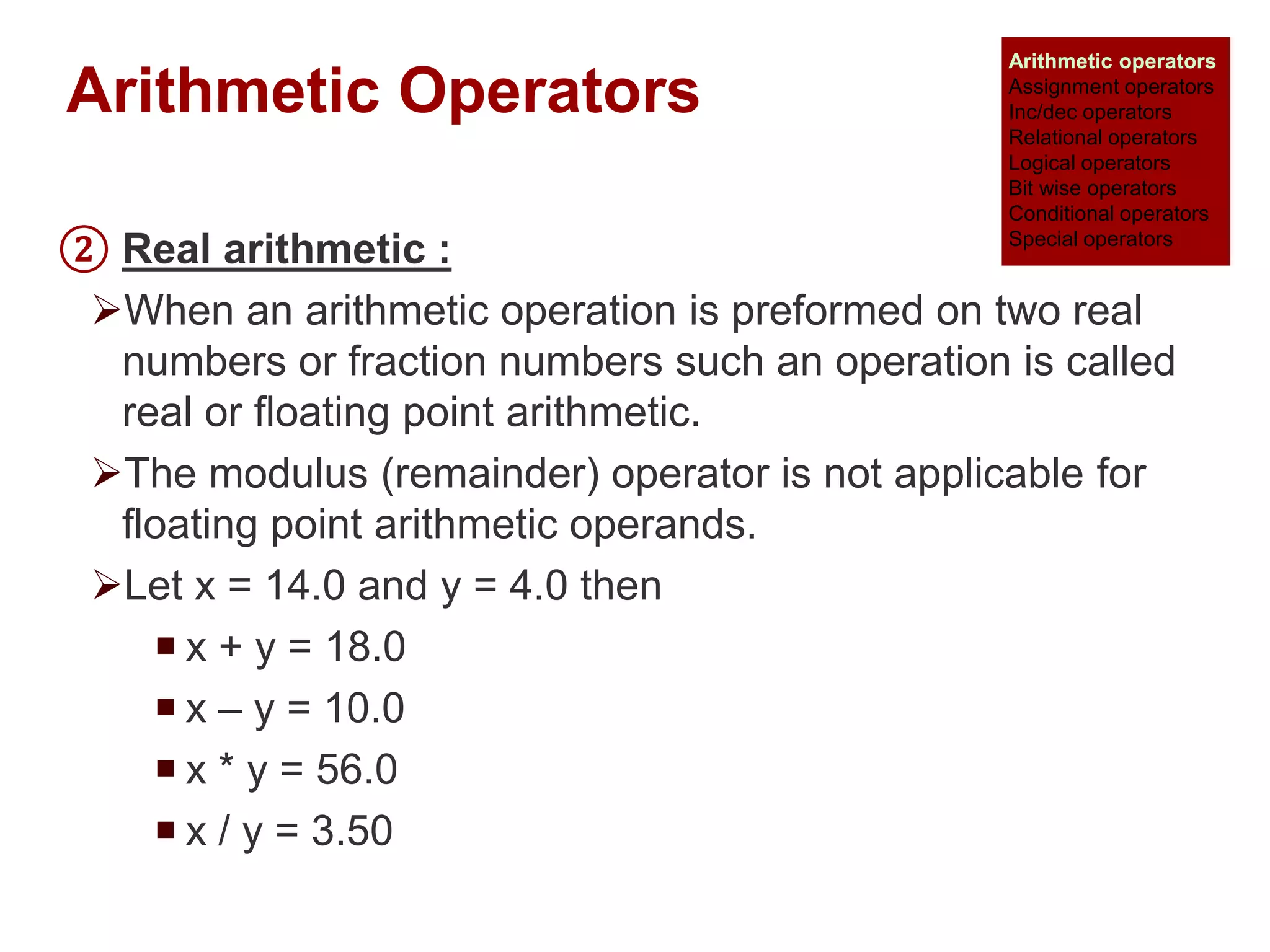
② Real arithmetic :
When an arithmetic operation is preformed on two real
numbers or fraction numbers such an operation is called
real or floating point arithmetic.
The modulus (remainder) operator is not applicable for
floating point arithmetic operands.
Let x = 14.0 and y = 4.0 then
 x + y = 18.0
 x – y = 10.0
 x * y = 56.0
 x / y = 3.50
Arithmetic Operators
Arithmetic operators
Assignment operators
Inc/dec operators
Relational operators
Logical operators
Bit wise operators
Conditional operators
Special operators
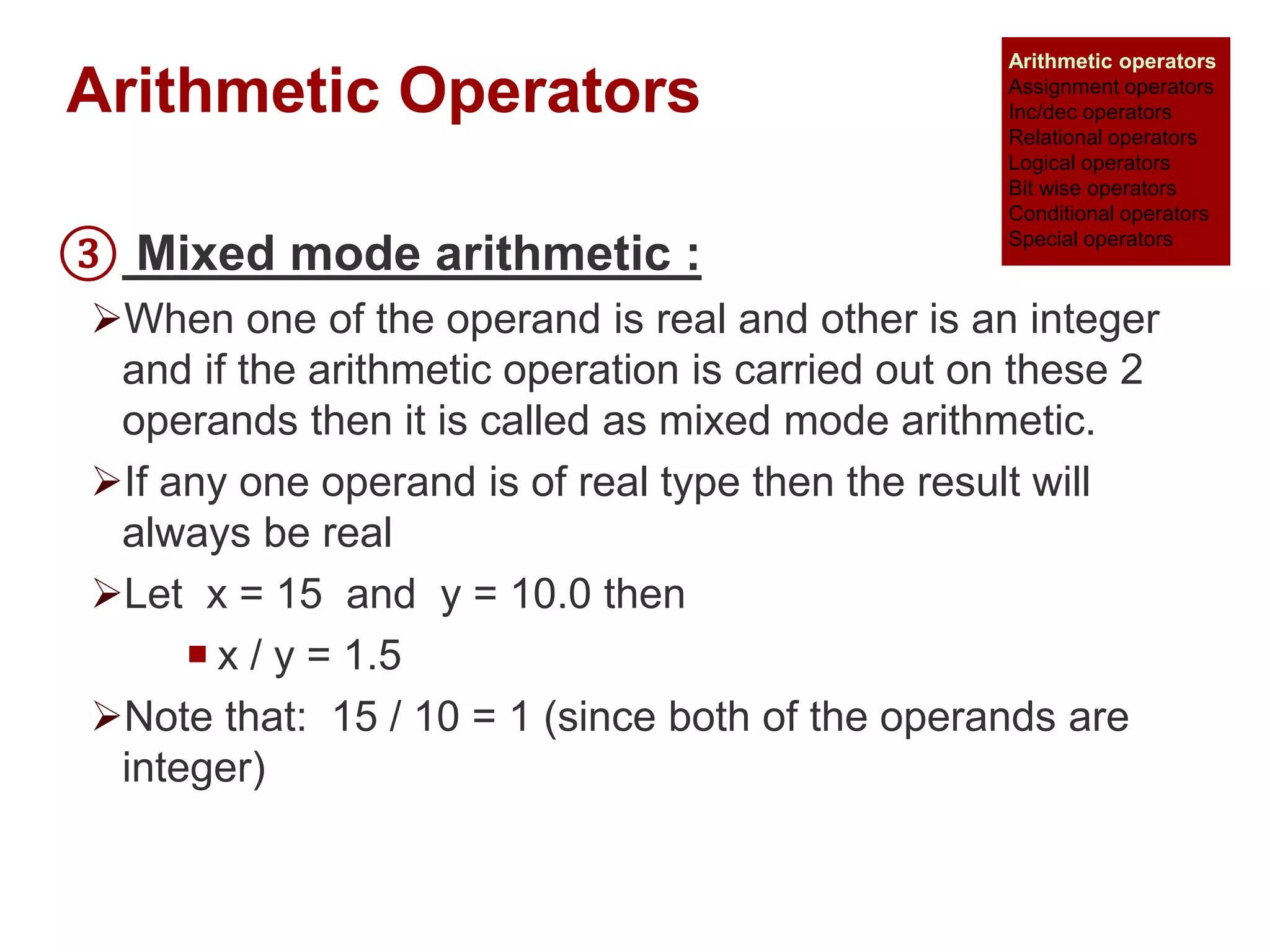
③ Mixed mode arithmetic :
When one of the operand is real and other is an integer
and if the arithmetic operation is carried out on these 2
operands then it is called as mixed mode arithmetic.
If any one operand is of real type then the result will
always be real
Let x = 15 and y = 10.0 then
 x / y = 1.5
Note that: 15 / 10 = 1 (since both of the operands are
integer)
Arithmetic Operators
Arithmetic operators
Assignment operators
Inc/dec operators
Relational operators
Logical operators
Bit wise operators
Conditional operators
Special operators
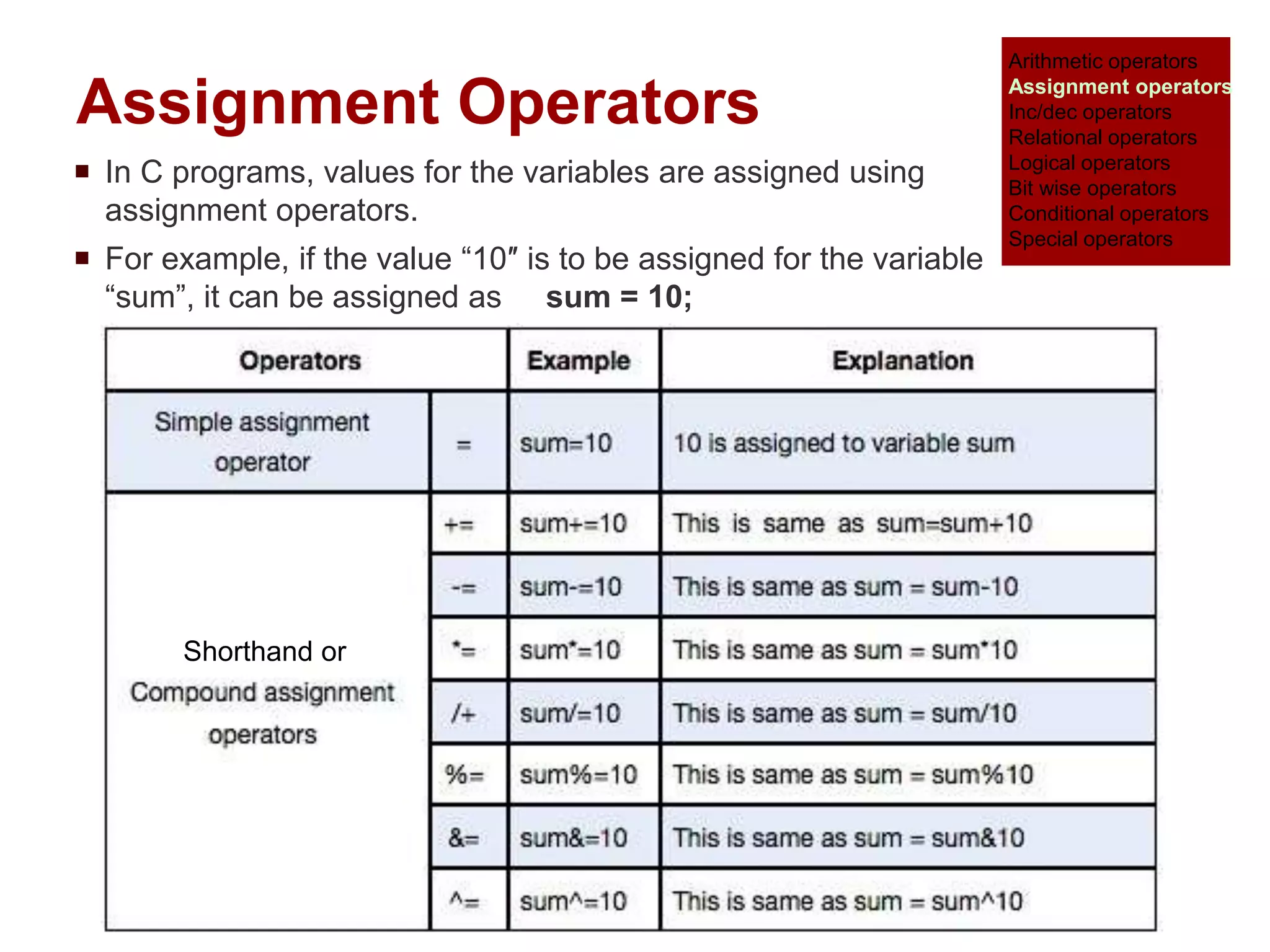
Assignment Operators
 In C programs, values for the variables are assigned using
assignment operators.
 For example, if the value “10″ is to be assigned for the variable
“sum”, it can be assigned as sum = 10;
Shorthand or
Arithmetic operators
Assignment operators
Inc/dec operators
Relational operators
Logical operators
Bit wise operators
Conditional operators
Special operators
Increment and Decrement
Operators
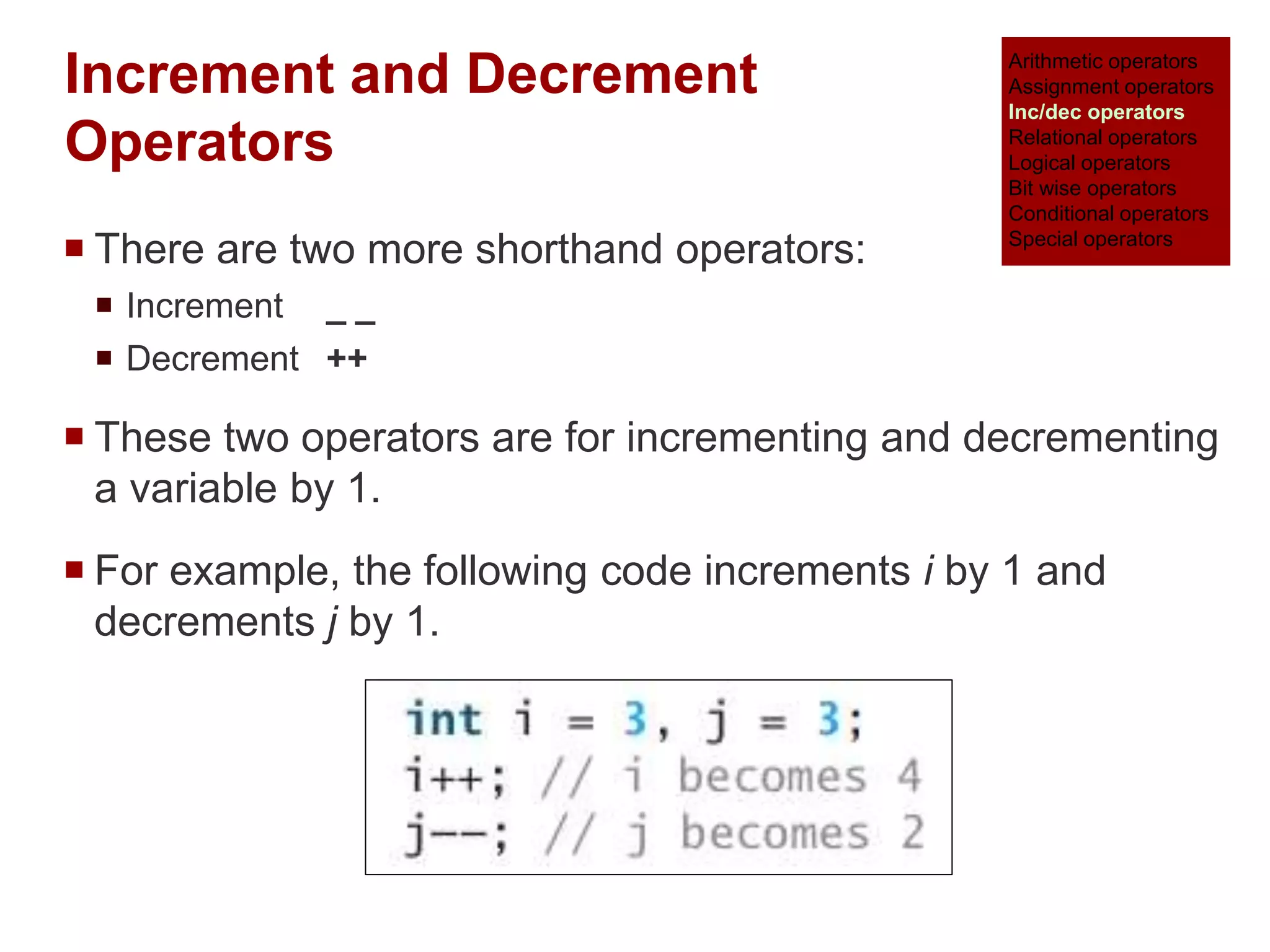
 There are two more shorthand operators:
 Increment _ _
 Decrement ++
 These two operators are for incrementing and decrementing
a variable by 1.
 For example, the following code increments i by 1 and
decrements j by 1.
Arithmetic operators
Assignment operators
Inc/dec operators
Relational operators
Logical operators
Bit wise operators
Conditional operators
Special operators
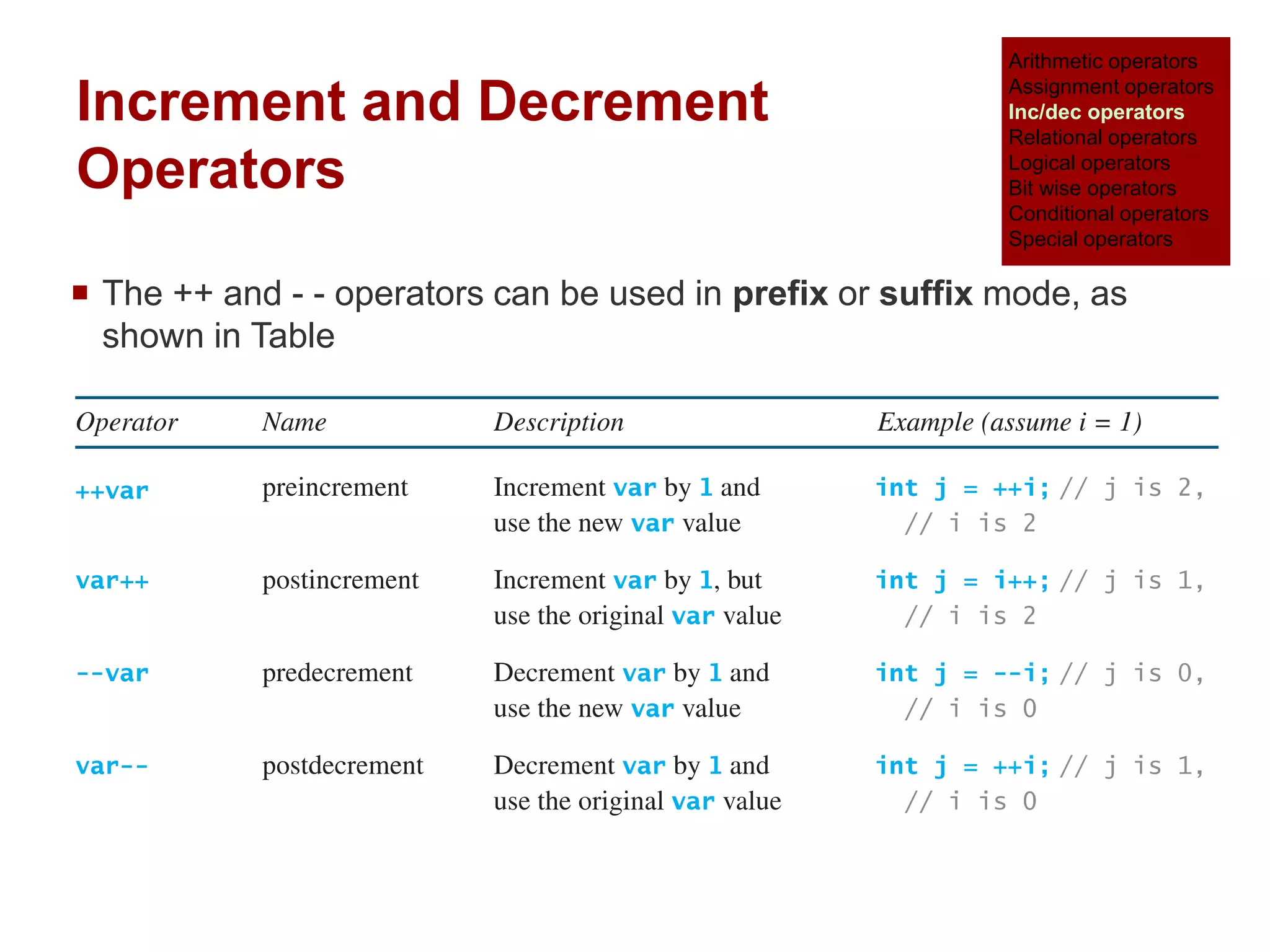
 The ++ and - - operators can be used in prefix or suffix mode, as
shown in Table
Increment and Decrement
Operators
Arithmetic operators
Assignment operators
Inc/dec operators
Relational operators
Logical operators
Bit wise operators
Conditional operators
Special operators
 If the operator is before (prefixed to) the variable, the
variable is incremented or decremented by 1, then the new
value of the variable is returned.
 If the operator is after (suffixed to) the variable, then the
variable is incremented or decremented by 1, but the
original old value of the variable is returned.
 Therefore, the prefixes ++x and --x are referred to,
respectively, as the preincrement operator and the
predecrement operator; and the suffixes x++ and x -- are
referred to, respectively, as the postincrement operator and
the postdecrement operator.
Increment and Decrement
Operators
Arithmetic operators
Assignment operators
Inc/dec operators
Relational operators
Logical operators
Bit wise operators
Conditional operators
Special operators
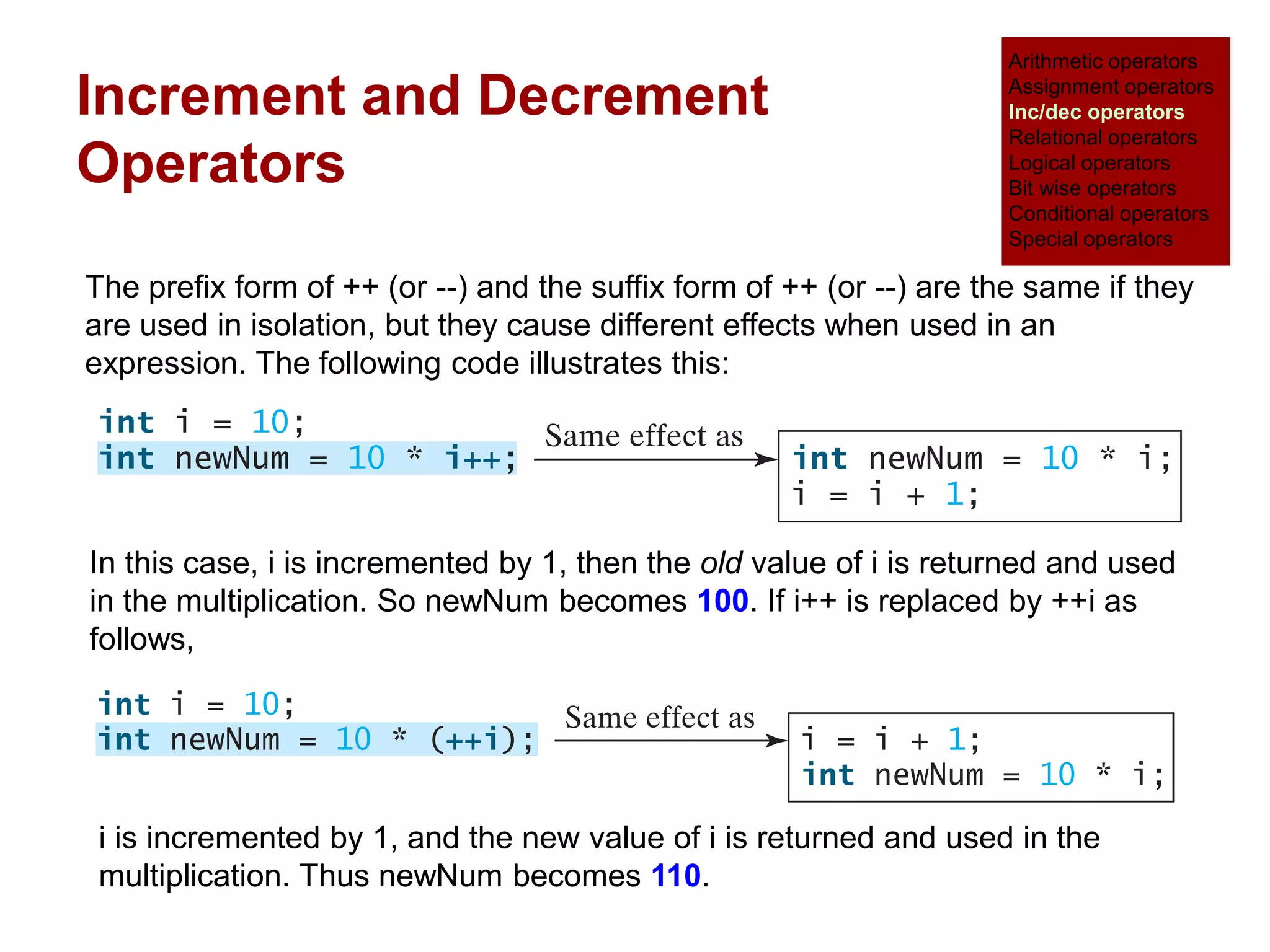
In this case, i is incremented by 1, then the old value of i is returned and used
in the multiplication. So newNum becomes 100. If i++ is replaced by ++i as
follows,
i is incremented by 1, and the new value of i is returned and used in the
multiplication. Thus newNum becomes 110.
The prefix form of ++ (or --) and the suffix form of ++ (or --) are the same if they
are used in isolation, but they cause different effects when used in an
expression. The following code illustrates this:
Increment and Decrement
Operators
Arithmetic operators
Assignment operators
Inc/dec operators
Relational operators
Logical operators
Bit wise operators
Conditional operators
Special operators
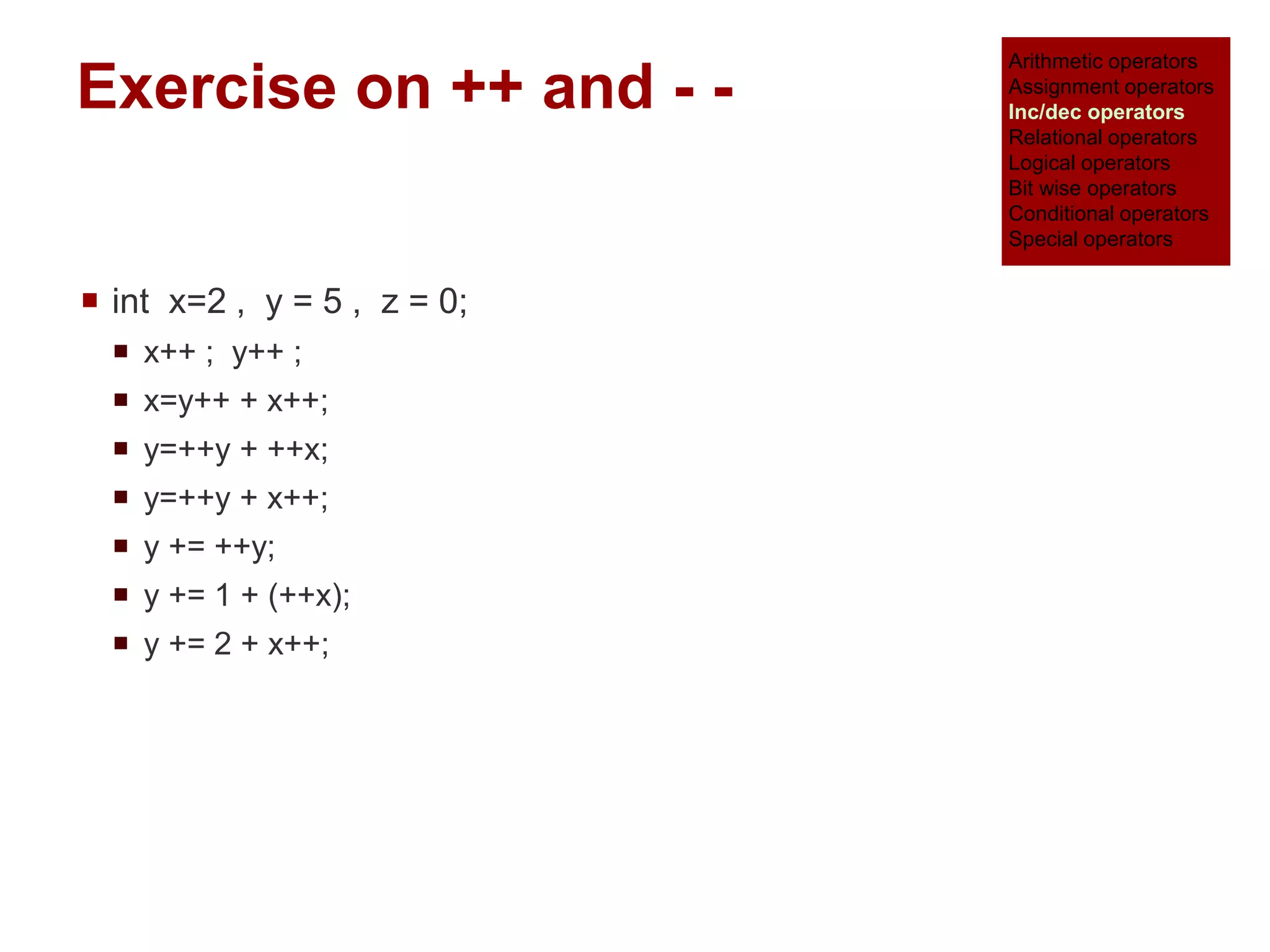
Exercise on ++ and - -
 int x=2 , y = 5 , z = 0;
 x++ ; y++ ;
 x=y++ + x++;
 y=++y + ++x;
 y=++y + x++;
 y += ++y;
 y += 1 + (++x);
 y += 2 + x++;
Arithmetic operators
Assignment operators
Inc/dec operators
Relational operators
Logical operators
Bit wise operators
Conditional operators
Special operators
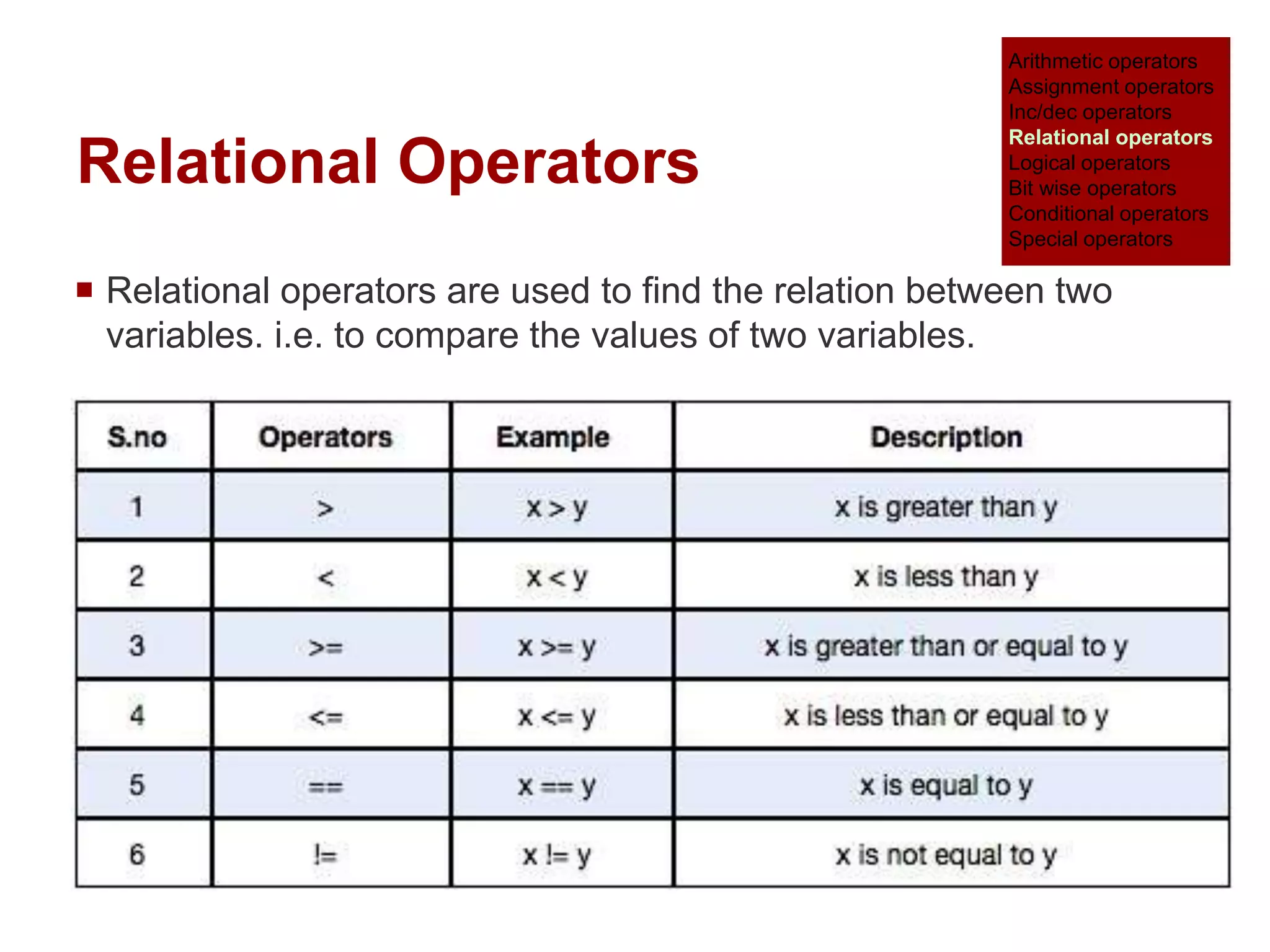
Relational Operators
 Relational operators are used to find the relation between two
variables. i.e. to compare the values of two variables.
Arithmetic operators
Assignment operators
Inc/dec operators
Relational operators
Logical operators
Bit wise operators
Conditional operators
Special operators
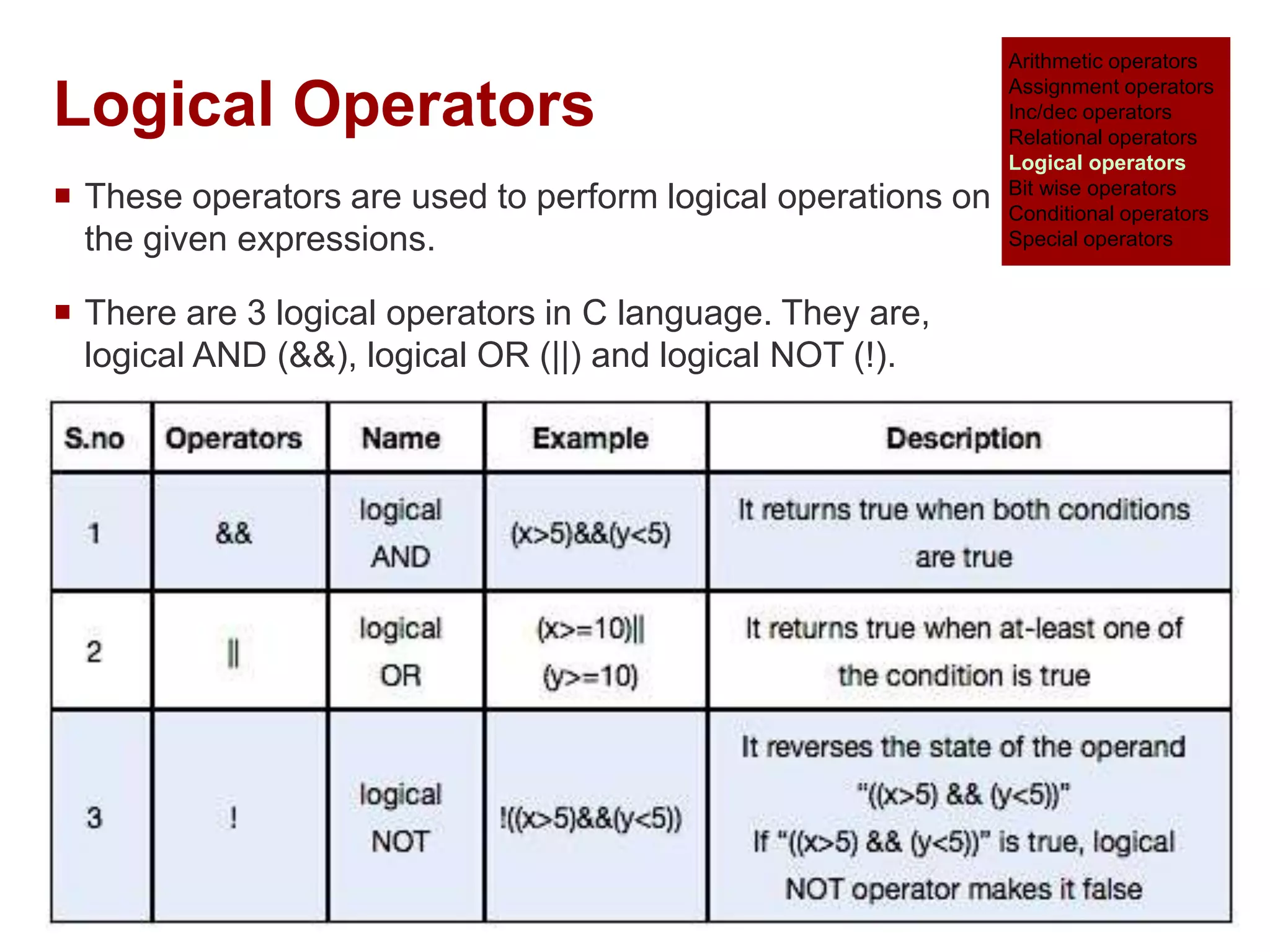
Logical Operators
 These operators are used to perform logical operations on
the given expressions.
 There are 3 logical operators in C language. They are,
logical AND (&&), logical OR (||) and logical NOT (!).
Arithmetic operators
Assignment operators
Inc/dec operators
Relational operators
Logical operators
Bit wise operators
Conditional operators
Special operators
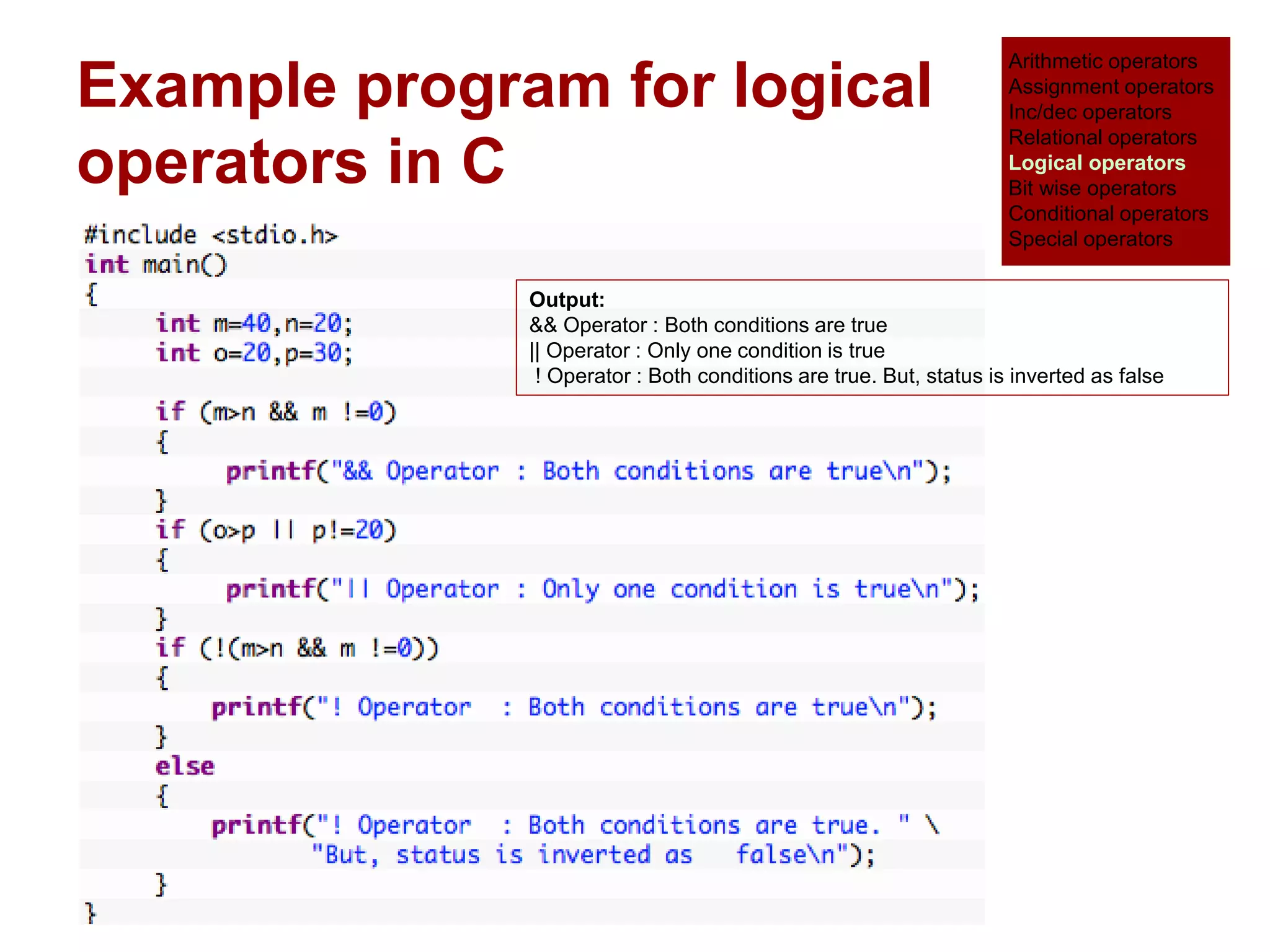
Example program for logical
operators in C
Output:
&& Operator : Both conditions are true
|| Operator : Only one condition is true
! Operator : Both conditions are true. But, status is inverted as false
Arithmetic operators
Assignment operators
Inc/dec operators
Relational operators
Logical operators
Bit wise operators
Conditional operators
Special operators
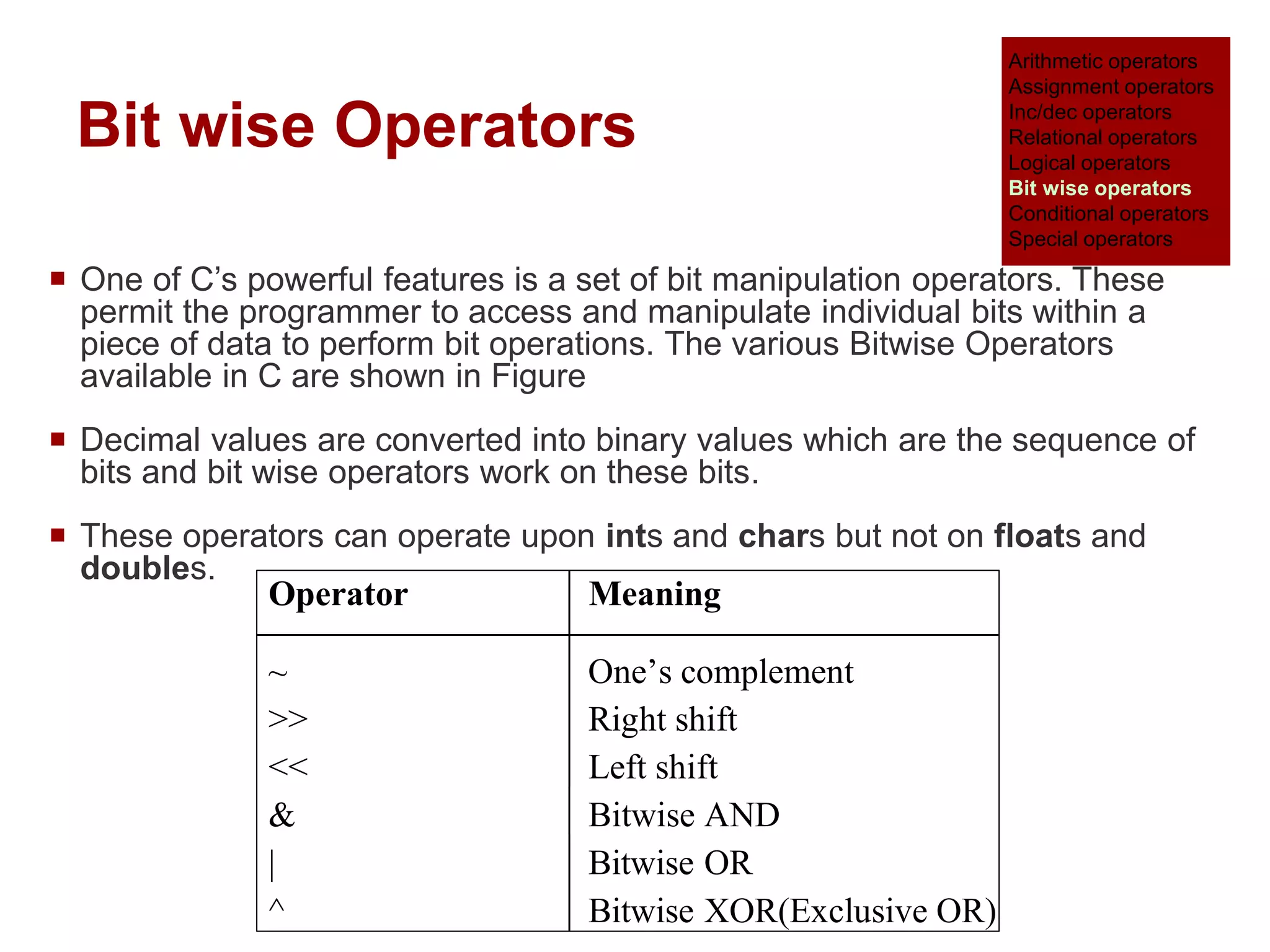
Bit wise Operators
 One of C’s powerful features is a set of bit manipulation operators. These
permit the programmer to access and manipulate individual bits within a
piece of data to perform bit operations. The various Bitwise Operators
available in C are shown in Figure
 Decimal values are converted into binary values which are the sequence of
bits and bit wise operators work on these bits.
 These operators can operate upon ints and chars but not on floats and
doubles.
Arithmetic operators
Assignment operators
Inc/dec operators
Relational operators
Logical operators
Bit wise operators
Conditional operators
Special operators
now delve inside the byte and see how it is constructed and how it
can be manipulated effectively. So let us take apart the byte... bit
by bit.
Bitwise Operators
One of C’s powerful features is a set of bit manipulation operators.
These permit the programmer to access and manipulate individual
bits within a piece of data. The various Bitwise Operators available
in C are shown in Figure 14.1.
Operator Meaning
~ One’s complement
>> Right shift
<< Left shift
& Bitwise AND
| Bitwise OR
^ Bitwise XOR(Exclusive OR)
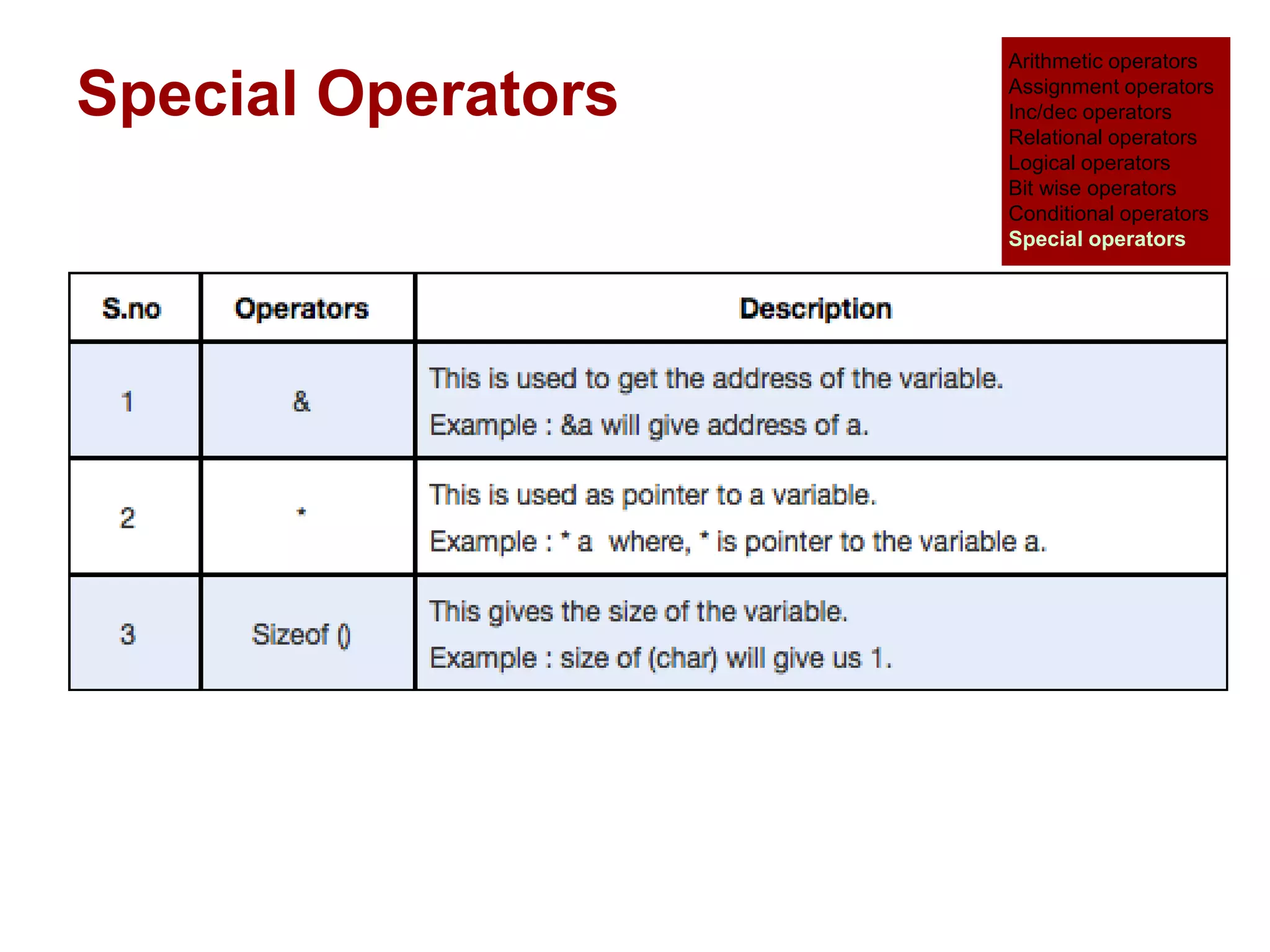
Special Operators
Arithmetic operators
Assignment operators
Inc/dec operators
Relational operators
Logical operators
Bit wise operators
Conditional operators
Special operators
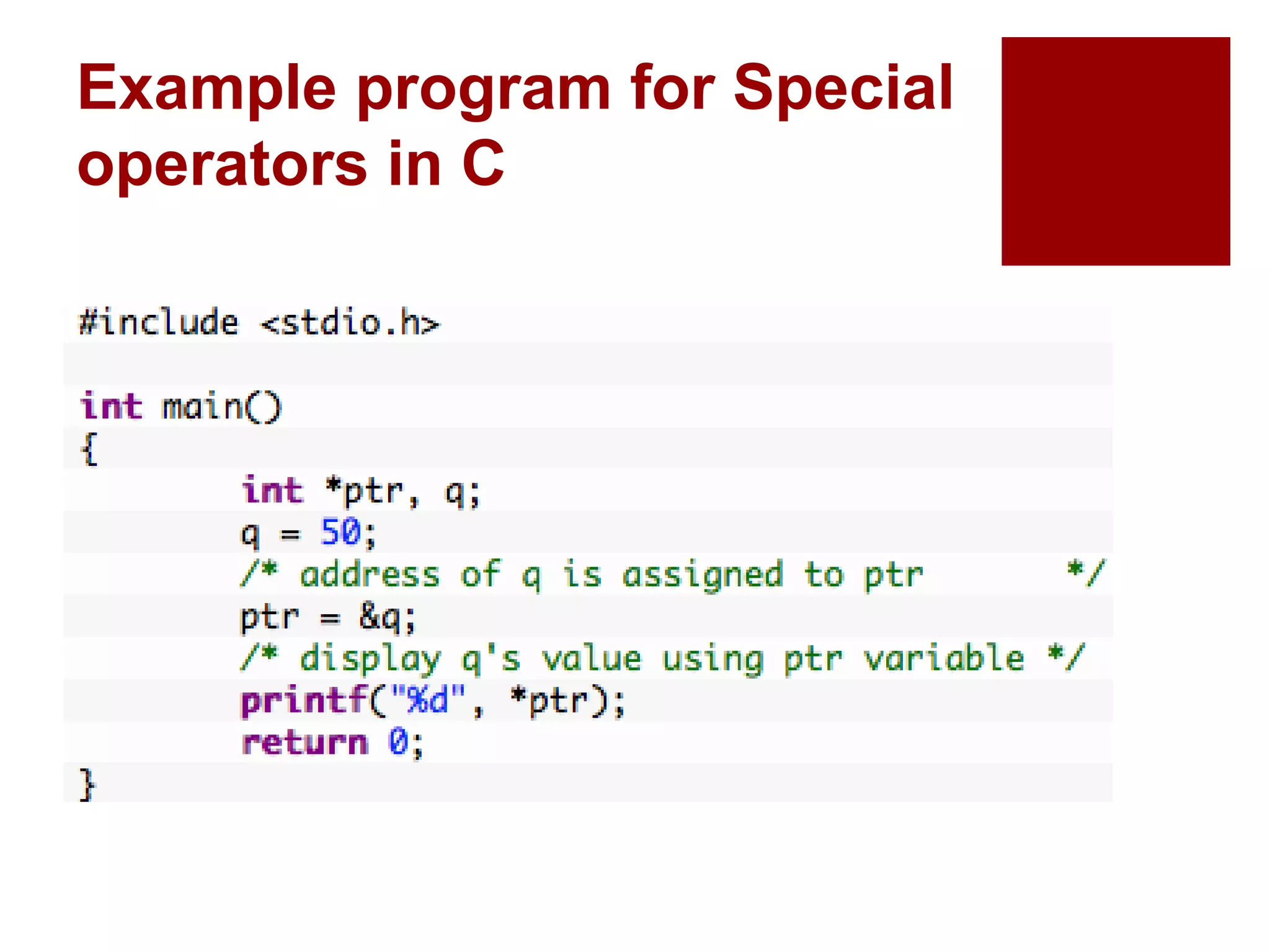
Example program for Special
operators in C
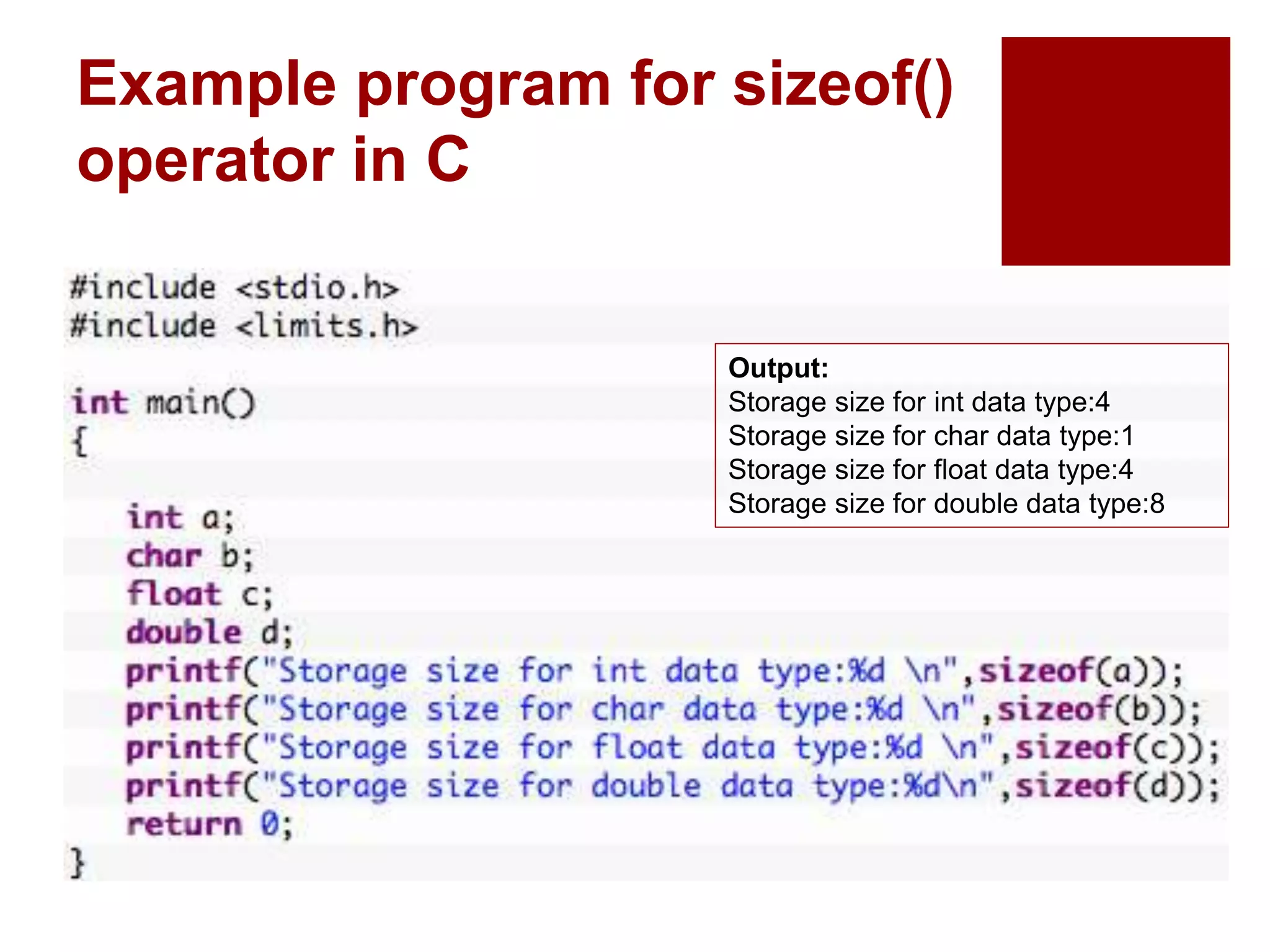
Example program for sizeof()
operator in C
Output:
Storage size for int data type:4
Storage size for char data type:1
Storage size for float data type:4
Storage size for double data type:8

Cse lecture-4.1-c operators and expression

  • 1.
  • 2.
    Operators and Expressions Considerthe expression A + B * 5 , where,  + , * are operators,  A, B are variables,  5 is constant,  A, B and 5 are called operand, and  A + B * 5 is an expression.
  • 3.
    Types of Coperators  C language offers many types of operators, such as:  Arithmetic operators  Assignment operators  Increment/decrement operators  Relational operators  Logical operators  Bit wise operators  Conditional operators (ternary operators)  Special operators
  • 4.
    Arithmetic Operators  CArithmetic operators are used to perform mathematical calculations like addition, subtraction, multiplication, division and modulus in C programs. Arithmetic operators Assignment operators Inc/dec operators Relational operators Logical operators Bit wise operators Conditional operators Special operators
  • 5.
     There arethree types of arithmetic operations using arithmetic operators: ① Integer arithmetic : when all operands are integer. If a=15 , b=10,  a + b =25  a / b =1 (decimal part)  a % b =5 (remainder of division) ② Real arithmetic : All operands are only real number. If a=15.0 , b=10.0  a / b = 1.5 ③ Mixed model arithmetic : when one operand is real and another is integer. If a=15 and b= 10.0  a / b = 1.5 whereas, 15/10=1  Note: The modulus operator % gives you the remainder when two integers are divided: 1 % 2 is 1 and 7 % 4 is 3.  The modulus operator can only be applied to integers. Arithmetic Operators Arithmetic operators Assignment operators Inc/dec operators Relational operators Logical operators Bit wise operators Conditional operators Special operators
  • 6.
    ① Integer arithmetic: When an arithmetic operation is performed on two whole numbers or integers than such an operation is called as integer arithmetic. It always gives an integer as the result. Let x = 27 and y = 5 be 2 integer numbers. Then the integer operation leads to the following results.  x + y = 32  x – y = 22  x * y = 115  x % y = 2  x / y = 5 Arithmetic Operators Arithmetic operators Assignment operators Inc/dec operators Relational operators Logical operators Bit wise operators Conditional operators Special operators
  • 7.
    Example program forC arithmetic operators Output: Addition of a, b is : 60 Subtraction of a, b is : 20 Multiplication of a, b is : 800 Division of a, b is : 2 Modulus of a, b is : 0 Arithmetic operators Assignment operators Inc/dec operators Relational operators Logical operators Bit wise operators Conditional operators Special operators
  • 8.
    ② Real arithmetic: When an arithmetic operation is preformed on two real numbers or fraction numbers such an operation is called real or floating point arithmetic. The modulus (remainder) operator is not applicable for floating point arithmetic operands. Let x = 14.0 and y = 4.0 then  x + y = 18.0  x – y = 10.0  x * y = 56.0  x / y = 3.50 Arithmetic Operators Arithmetic operators Assignment operators Inc/dec operators Relational operators Logical operators Bit wise operators Conditional operators Special operators
  • 9.
    ③ Mixed modearithmetic : When one of the operand is real and other is an integer and if the arithmetic operation is carried out on these 2 operands then it is called as mixed mode arithmetic. If any one operand is of real type then the result will always be real Let x = 15 and y = 10.0 then  x / y = 1.5 Note that: 15 / 10 = 1 (since both of the operands are integer) Arithmetic Operators Arithmetic operators Assignment operators Inc/dec operators Relational operators Logical operators Bit wise operators Conditional operators Special operators
  • 10.
    Assignment Operators  InC programs, values for the variables are assigned using assignment operators.  For example, if the value “10″ is to be assigned for the variable “sum”, it can be assigned as sum = 10; Shorthand or Arithmetic operators Assignment operators Inc/dec operators Relational operators Logical operators Bit wise operators Conditional operators Special operators
  • 11.
    Increment and Decrement Operators There are two more shorthand operators:  Increment _ _  Decrement ++  These two operators are for incrementing and decrementing a variable by 1.  For example, the following code increments i by 1 and decrements j by 1. Arithmetic operators Assignment operators Inc/dec operators Relational operators Logical operators Bit wise operators Conditional operators Special operators
  • 12.
     The ++and - - operators can be used in prefix or suffix mode, as shown in Table Increment and Decrement Operators Arithmetic operators Assignment operators Inc/dec operators Relational operators Logical operators Bit wise operators Conditional operators Special operators
  • 13.
     If theoperator is before (prefixed to) the variable, the variable is incremented or decremented by 1, then the new value of the variable is returned.  If the operator is after (suffixed to) the variable, then the variable is incremented or decremented by 1, but the original old value of the variable is returned.  Therefore, the prefixes ++x and --x are referred to, respectively, as the preincrement operator and the predecrement operator; and the suffixes x++ and x -- are referred to, respectively, as the postincrement operator and the postdecrement operator. Increment and Decrement Operators Arithmetic operators Assignment operators Inc/dec operators Relational operators Logical operators Bit wise operators Conditional operators Special operators
  • 14.
    In this case,i is incremented by 1, then the old value of i is returned and used in the multiplication. So newNum becomes 100. If i++ is replaced by ++i as follows, i is incremented by 1, and the new value of i is returned and used in the multiplication. Thus newNum becomes 110. The prefix form of ++ (or --) and the suffix form of ++ (or --) are the same if they are used in isolation, but they cause different effects when used in an expression. The following code illustrates this: Increment and Decrement Operators Arithmetic operators Assignment operators Inc/dec operators Relational operators Logical operators Bit wise operators Conditional operators Special operators
  • 15.
    Exercise on ++and - -  int x=2 , y = 5 , z = 0;  x++ ; y++ ;  x=y++ + x++;  y=++y + ++x;  y=++y + x++;  y += ++y;  y += 1 + (++x);  y += 2 + x++; Arithmetic operators Assignment operators Inc/dec operators Relational operators Logical operators Bit wise operators Conditional operators Special operators
  • 16.
    Relational Operators  Relationaloperators are used to find the relation between two variables. i.e. to compare the values of two variables. Arithmetic operators Assignment operators Inc/dec operators Relational operators Logical operators Bit wise operators Conditional operators Special operators
  • 17.
    Logical Operators  Theseoperators are used to perform logical operations on the given expressions.  There are 3 logical operators in C language. They are, logical AND (&&), logical OR (||) and logical NOT (!). Arithmetic operators Assignment operators Inc/dec operators Relational operators Logical operators Bit wise operators Conditional operators Special operators
  • 18.
    Example program forlogical operators in C Output: && Operator : Both conditions are true || Operator : Only one condition is true ! Operator : Both conditions are true. But, status is inverted as false Arithmetic operators Assignment operators Inc/dec operators Relational operators Logical operators Bit wise operators Conditional operators Special operators
  • 19.
    Bit wise Operators One of C’s powerful features is a set of bit manipulation operators. These permit the programmer to access and manipulate individual bits within a piece of data to perform bit operations. The various Bitwise Operators available in C are shown in Figure  Decimal values are converted into binary values which are the sequence of bits and bit wise operators work on these bits.  These operators can operate upon ints and chars but not on floats and doubles. Arithmetic operators Assignment operators Inc/dec operators Relational operators Logical operators Bit wise operators Conditional operators Special operators now delve inside the byte and see how it is constructed and how it can be manipulated effectively. So let us take apart the byte... bit by bit. Bitwise Operators One of C’s powerful features is a set of bit manipulation operators. These permit the programmer to access and manipulate individual bits within a piece of data. The various Bitwise Operators available in C are shown in Figure 14.1. Operator Meaning ~ One’s complement >> Right shift << Left shift & Bitwise AND | Bitwise OR ^ Bitwise XOR(Exclusive OR)
  • 20.
    Special Operators Arithmetic operators Assignmentoperators Inc/dec operators Relational operators Logical operators Bit wise operators Conditional operators Special operators
  • 21.
    Example program forSpecial operators in C
  • 22.
    Example program forsizeof() operator in C Output: Storage size for int data type:4 Storage size for char data type:1 Storage size for float data type:4 Storage size for double data type:8