0.1 Sets
Chapter 0 – Review of Basic Concepts
Concepts & Objectives
⚫ Sets
⚫ Definition of sets
⚫ Set notation
⚫ Complements of sets
⚫ Intersection and union of sets
Basic Definitions
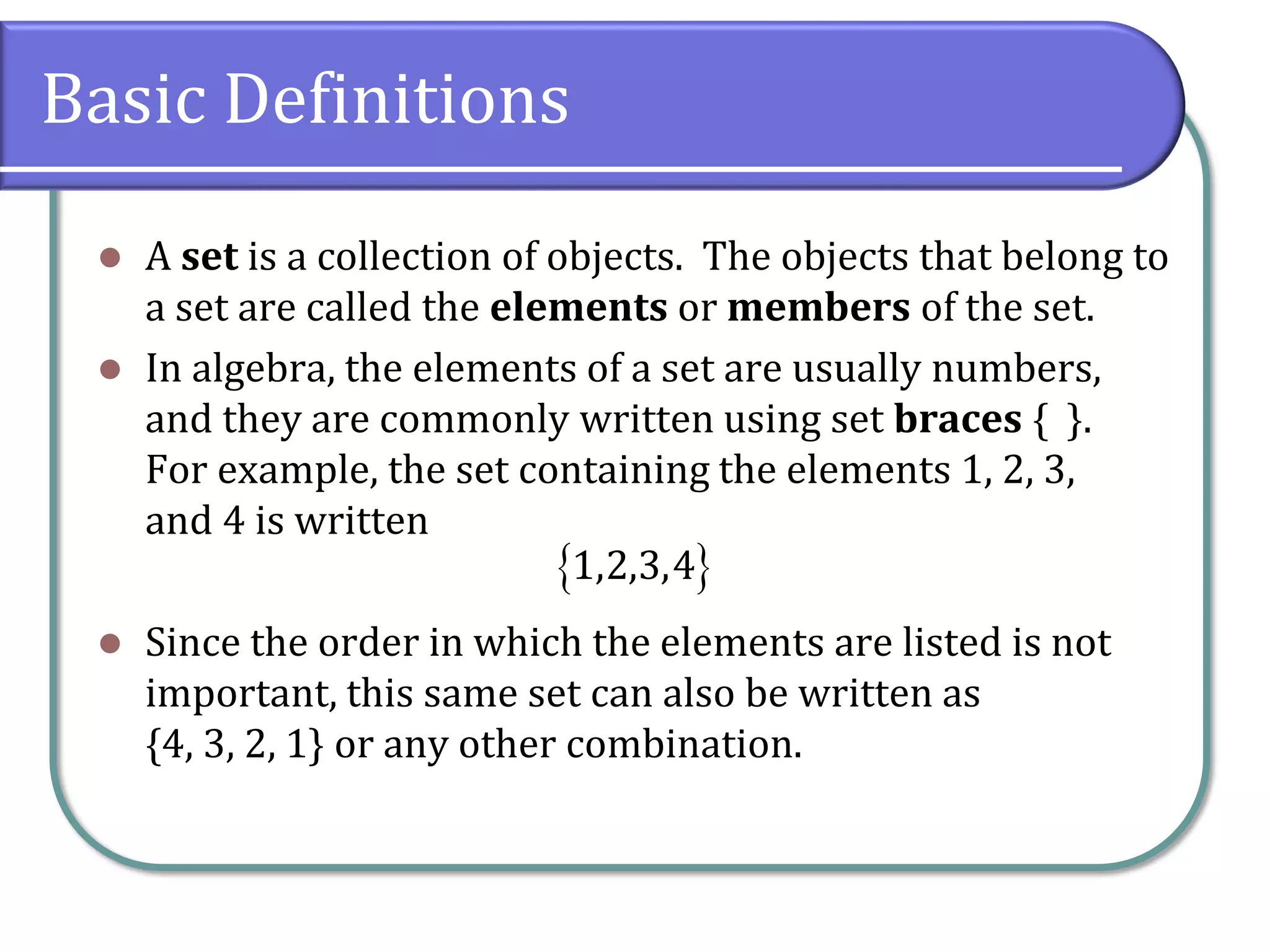
⚫ A set is a collection of objects. The objects that belong to
a set are called the elements or members of the set.
⚫ In algebra, the elements of a set are usually numbers,
and they are commonly written using set braces { }.
For example, the set containing the elements 1, 2, 3,
and 4 is written
⚫ Since the order in which the elements are listed is not
important, this same set can also be written as
{4, 3, 2, 1} or any other combination.
 1,2,3,4
Basic Definitions (cont.)
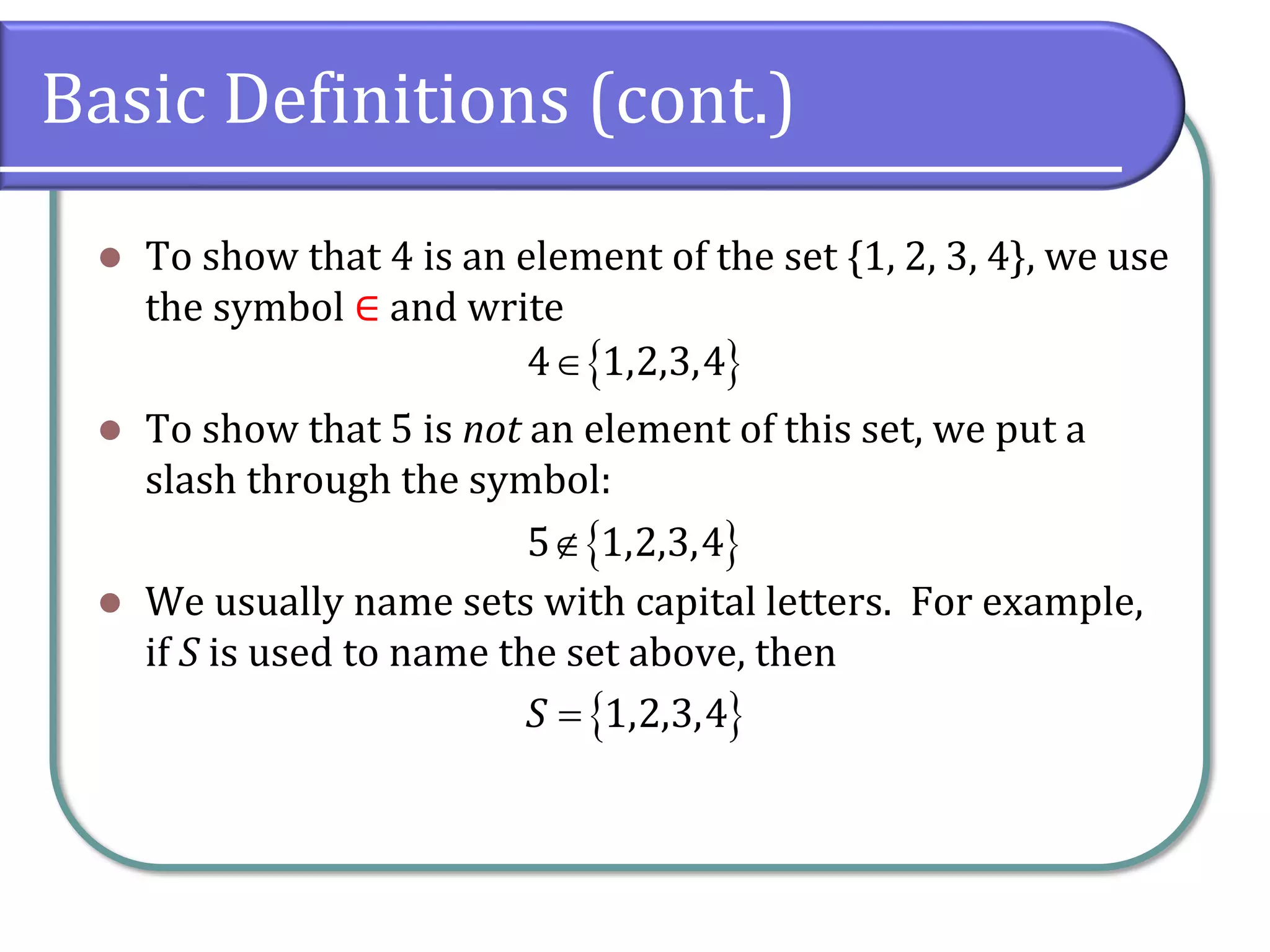
⚫ To show that 4 is an element of the set {1, 2, 3, 4}, we use
the symbol ∈ and write
⚫ To show that 5 is not an element of this set, we put a
slash through the symbol:
⚫ We usually name sets with capital letters. For example,
if S is used to name the set above, then
 4 1,2,3,4
 5 1,2,3,4
 1,2,3,4S =
Basic Definitions (cont.)
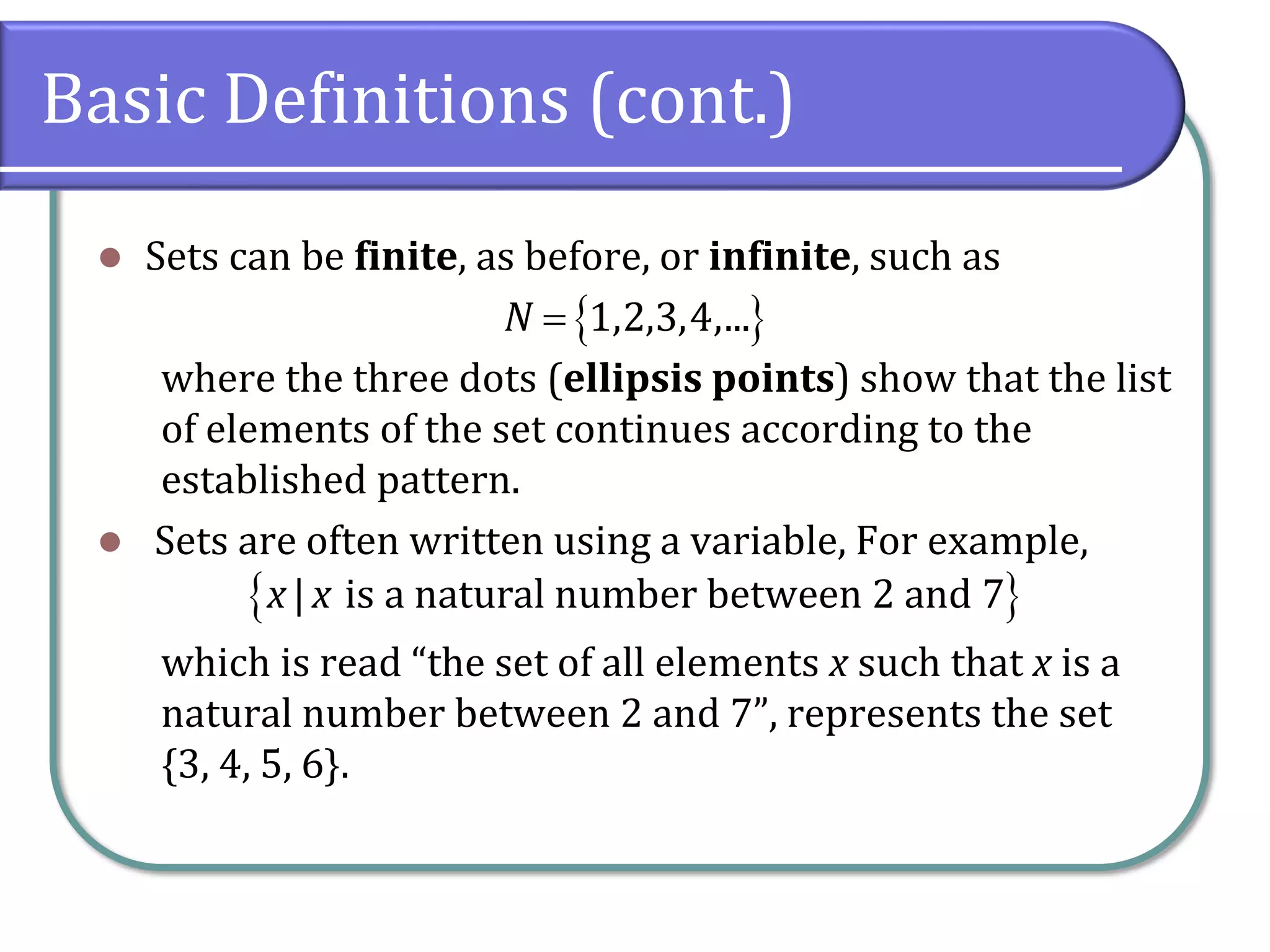
⚫ Sets can be finite, as before, or infinite, such as
where the three dots (ellipsis points) show that the list
of elements of the set continues according to the
established pattern.
⚫ Sets are often written using a variable, For example,
which is read “the set of all elements x such that x is a
natural number between 2 and 7”, represents the set
{3, 4, 5, 6}.
 1,2,3,4,...N =
 | is a natural number between 2 and 7x x
Basic Definitions (cont.)
⚫ We will occasionally identify a universal set (either
expressed or implied) that contains all the elements
appearing in any set used in the given problem.
⚫ At the other extreme is the null set or empty set, the set
containing no elements.
⚫ There are two ways to write the null set: the special
symbol ∅ or set braces enclosing no elements: { }
⚫ Do not combine the two: {∅} doesn’t mean anything.
Subsets
⚫ By definition, set A is a subset of set B if every element
of set A is also an element of set B. For example, if
A = {2, 5, 9} and B = {2, 3, 5, 6, 9, 10}, then A is a subset of
B, written A ⊆ B.
⚫ There are some elements of B that are not in A, so B is
not a subset of A, written B ⊈ A.
⚫ By definition, ∅ is a subset of every set.
U
BA
Set Operations
⚫ Two sets A and B are equal whenever A ⊆ B and B ⊆ A.
In other words, A = B if the two sets contain exactly the
same elements.
⚫ Given a set A and a universal set U, the set of the
elements of U that do not belong to set A is called the
complement of set A, written A′.
A′
A
Set Operations (cont.)
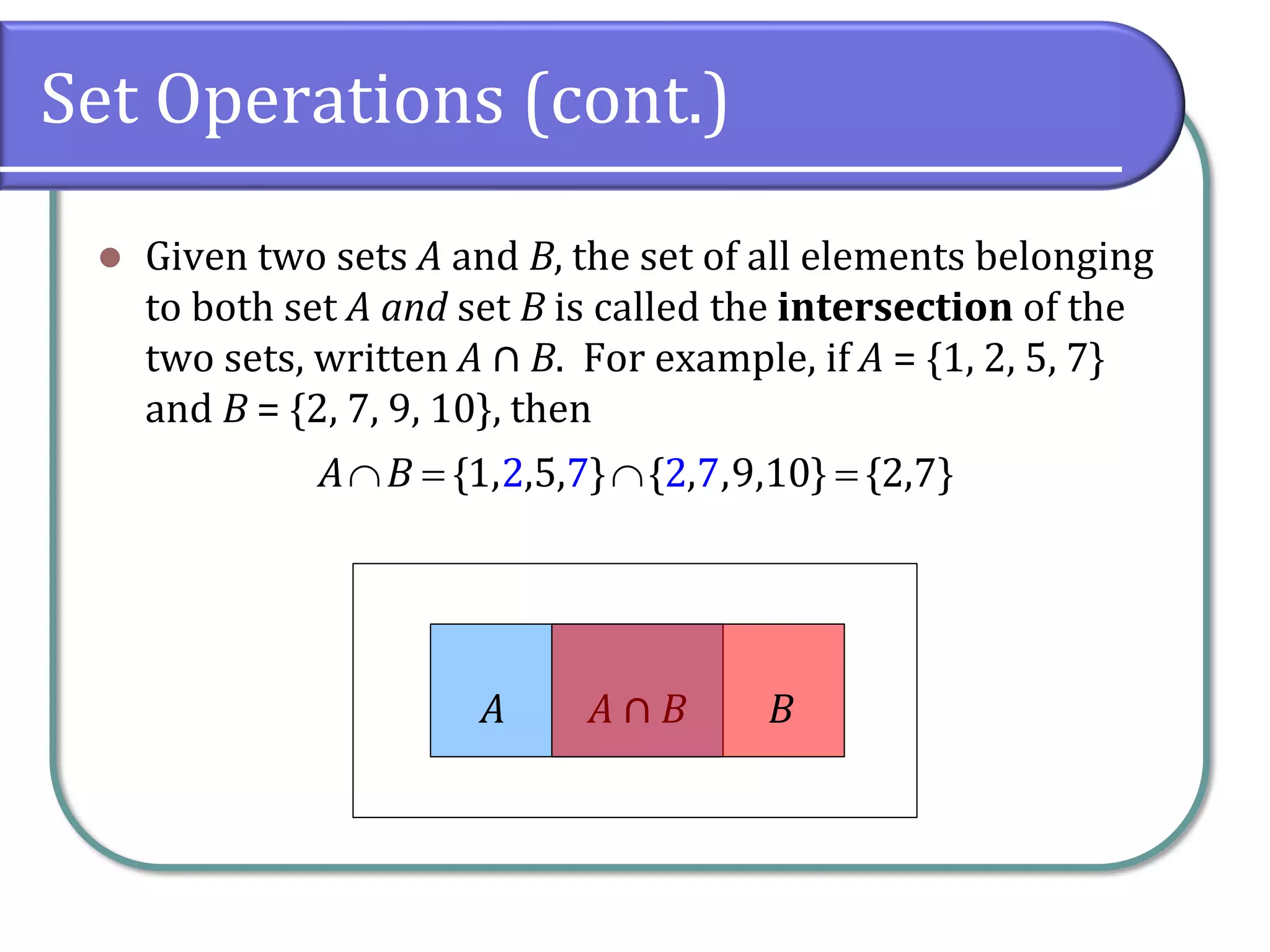
⚫ Given two sets A and B, the set of all elements belonging
to both set A and set B is called the intersection of the
two sets, written A ∩ B. For example, if A = {1, 2, 5, 7}
and B = {2, 7, 9, 10}, then
}2 7 2 7{1, ,5, } { , ,9,10} {2,7A B =  =
A A ∩ B B
Set Operations (cont.)
⚫ Two sets that have no elements in common are called
disjoint sets. In other words, if A ∩ B = ∅, then A and B
are disjoint.
⚫ The set of all elements belonging to set A or set B is
called the union of the two sets, written A ∪ B. For
example,
{1,3,5} {3,5,7,9} {1,3,5,7,9} =
Classwork
⚫ College Algebra & Trigonometry
⚫ Page 6: 4-28 (×4) [i.e. 0.1 Assignment]
⚫ 0.1 Classwork Check
⚫ You may retake the classwork check as many times as
you wish until you get the grade you want.
⚫ If you are still struggling after a couple of retakes,
please reach out to me for help.

0.1 Sets

  • 1.
    0.1 Sets Chapter 0– Review of Basic Concepts
  • 2.
    Concepts & Objectives ⚫Sets ⚫ Definition of sets ⚫ Set notation ⚫ Complements of sets ⚫ Intersection and union of sets
  • 3.
    Basic Definitions ⚫ Aset is a collection of objects. The objects that belong to a set are called the elements or members of the set. ⚫ In algebra, the elements of a set are usually numbers, and they are commonly written using set braces { }. For example, the set containing the elements 1, 2, 3, and 4 is written ⚫ Since the order in which the elements are listed is not important, this same set can also be written as {4, 3, 2, 1} or any other combination.  1,2,3,4
  • 4.
    Basic Definitions (cont.) ⚫To show that 4 is an element of the set {1, 2, 3, 4}, we use the symbol ∈ and write ⚫ To show that 5 is not an element of this set, we put a slash through the symbol: ⚫ We usually name sets with capital letters. For example, if S is used to name the set above, then  4 1,2,3,4  5 1,2,3,4  1,2,3,4S =
  • 5.
    Basic Definitions (cont.) ⚫Sets can be finite, as before, or infinite, such as where the three dots (ellipsis points) show that the list of elements of the set continues according to the established pattern. ⚫ Sets are often written using a variable, For example, which is read “the set of all elements x such that x is a natural number between 2 and 7”, represents the set {3, 4, 5, 6}.  1,2,3,4,...N =  | is a natural number between 2 and 7x x
  • 6.
    Basic Definitions (cont.) ⚫We will occasionally identify a universal set (either expressed or implied) that contains all the elements appearing in any set used in the given problem. ⚫ At the other extreme is the null set or empty set, the set containing no elements. ⚫ There are two ways to write the null set: the special symbol ∅ or set braces enclosing no elements: { } ⚫ Do not combine the two: {∅} doesn’t mean anything.
  • 7.
    Subsets ⚫ By definition,set A is a subset of set B if every element of set A is also an element of set B. For example, if A = {2, 5, 9} and B = {2, 3, 5, 6, 9, 10}, then A is a subset of B, written A ⊆ B. ⚫ There are some elements of B that are not in A, so B is not a subset of A, written B ⊈ A. ⚫ By definition, ∅ is a subset of every set. U BA
  • 8.
    Set Operations ⚫ Twosets A and B are equal whenever A ⊆ B and B ⊆ A. In other words, A = B if the two sets contain exactly the same elements. ⚫ Given a set A and a universal set U, the set of the elements of U that do not belong to set A is called the complement of set A, written A′. A′ A
  • 9.
    Set Operations (cont.) ⚫Given two sets A and B, the set of all elements belonging to both set A and set B is called the intersection of the two sets, written A ∩ B. For example, if A = {1, 2, 5, 7} and B = {2, 7, 9, 10}, then }2 7 2 7{1, ,5, } { , ,9,10} {2,7A B =  = A A ∩ B B
  • 10.
    Set Operations (cont.) ⚫Two sets that have no elements in common are called disjoint sets. In other words, if A ∩ B = ∅, then A and B are disjoint. ⚫ The set of all elements belonging to set A or set B is called the union of the two sets, written A ∪ B. For example, {1,3,5} {3,5,7,9} {1,3,5,7,9} =
  • 11.
    Classwork ⚫ College Algebra& Trigonometry ⚫ Page 6: 4-28 (×4) [i.e. 0.1 Assignment] ⚫ 0.1 Classwork Check ⚫ You may retake the classwork check as many times as you wish until you get the grade you want. ⚫ If you are still struggling after a couple of retakes, please reach out to me for help.