
A 
B C 
Made by 
Anshika Singh, 
Mansi Bhatia & 
Payal Batra 
XI F
A set is a collection of distinct objects, considered as an 
object in its own right. 
Theory of sets wwaass iinnvveenntteedd bbyy 
GGeeoorrggee CCaannttoorr iinn eenndd ooff 
nniinneetteeeenntthh cceennttuurryy.. 
F o r e x a m p l e c o l l e c t i o n o f 
b e s t t e a c h e r s o f a s c h o o l 
i s n o t d e f i n e d t h u s , i t i s 
n o t a s e t w h e r e a s 
c o l l e c t i o n o f m o s t 
e x p e r i e n c e d t e a c h e r s c a n 
b e d e f i n e d a n d i t i s a s e t .
Roaster form 
Roaster form is notated by enclosing the list of members in 
braces. 
Roaster form of A is the set whose members 
are the first four positive integers is {1,2,3,4}. 
All set operations preserve the property that each element of the set 
is unique. The order in which the elements of a set are listed is 
irrelevant, unlike a sequence. For example, 
{6, 11} = {11, 6} = {11, 11, 6, 11}
Set builder form 
 In set-builder form, all the members of a set has a single common 
Property which is not possessed by any other element outside the set. 
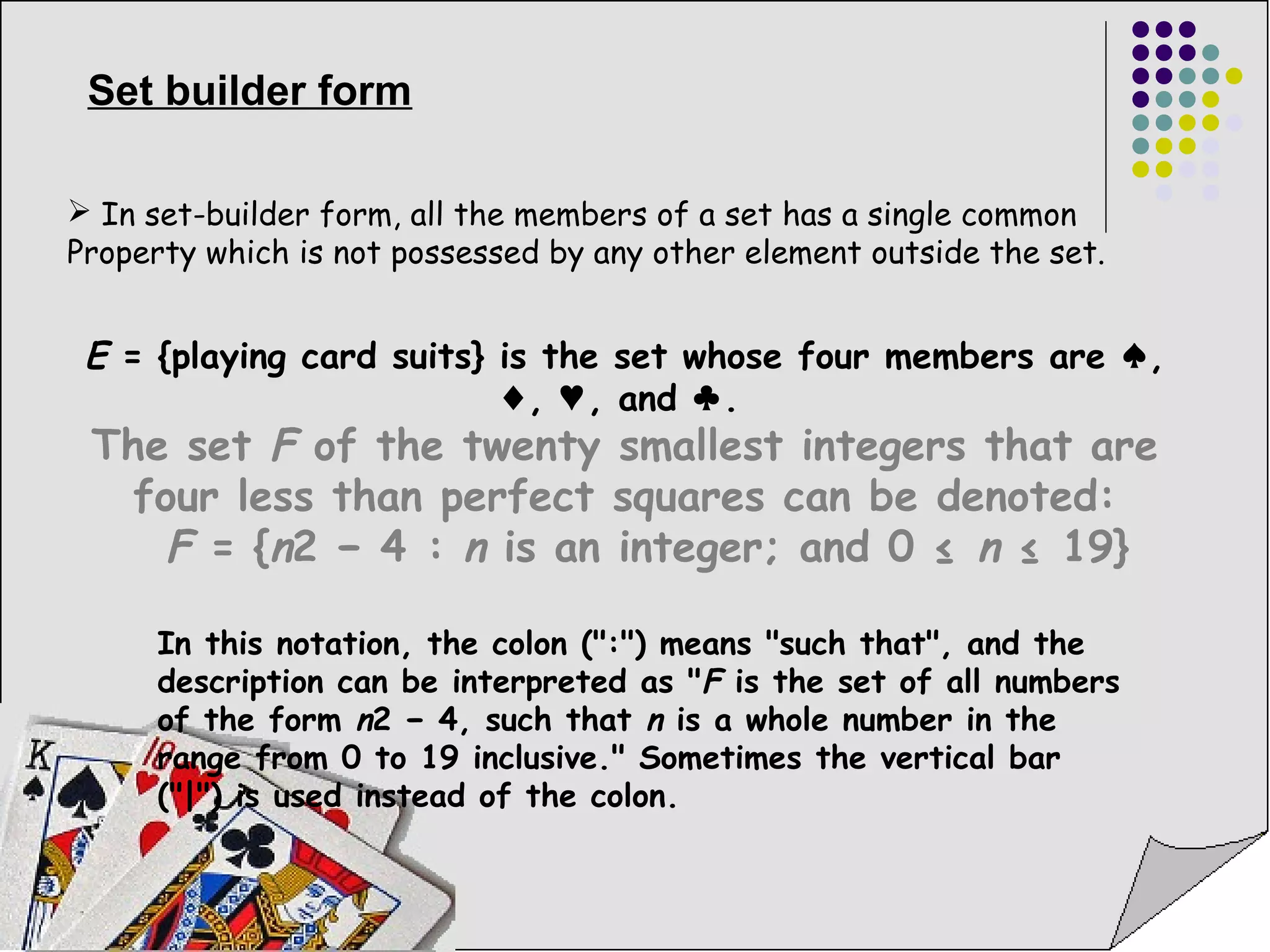
E = {playing card suits} is the set whose four members are ♠, 
♦, ♥, and ♣. 
The set F of the twenty smallest integers that are 
four less than perfect squares can be denoted: 
F = {n2 − 4 : n is an integer; and 0 ≤ n ≤ 19} 
In this notation, the colon (":") means "such that", and the 
description can be interpreted as "F is the set of all numbers 
of the form n2 − 4, such that n is a whole number in the 
range from 0 to 19 inclusive." Sometimes the vertical bar 
("|") is used instead of the colon.
The Empty set 
the empty set is the unique set having no 
elements; its size is zero. Many possible 
properties of sets are trivially true for the 
empty set. Common notations for the empty set 
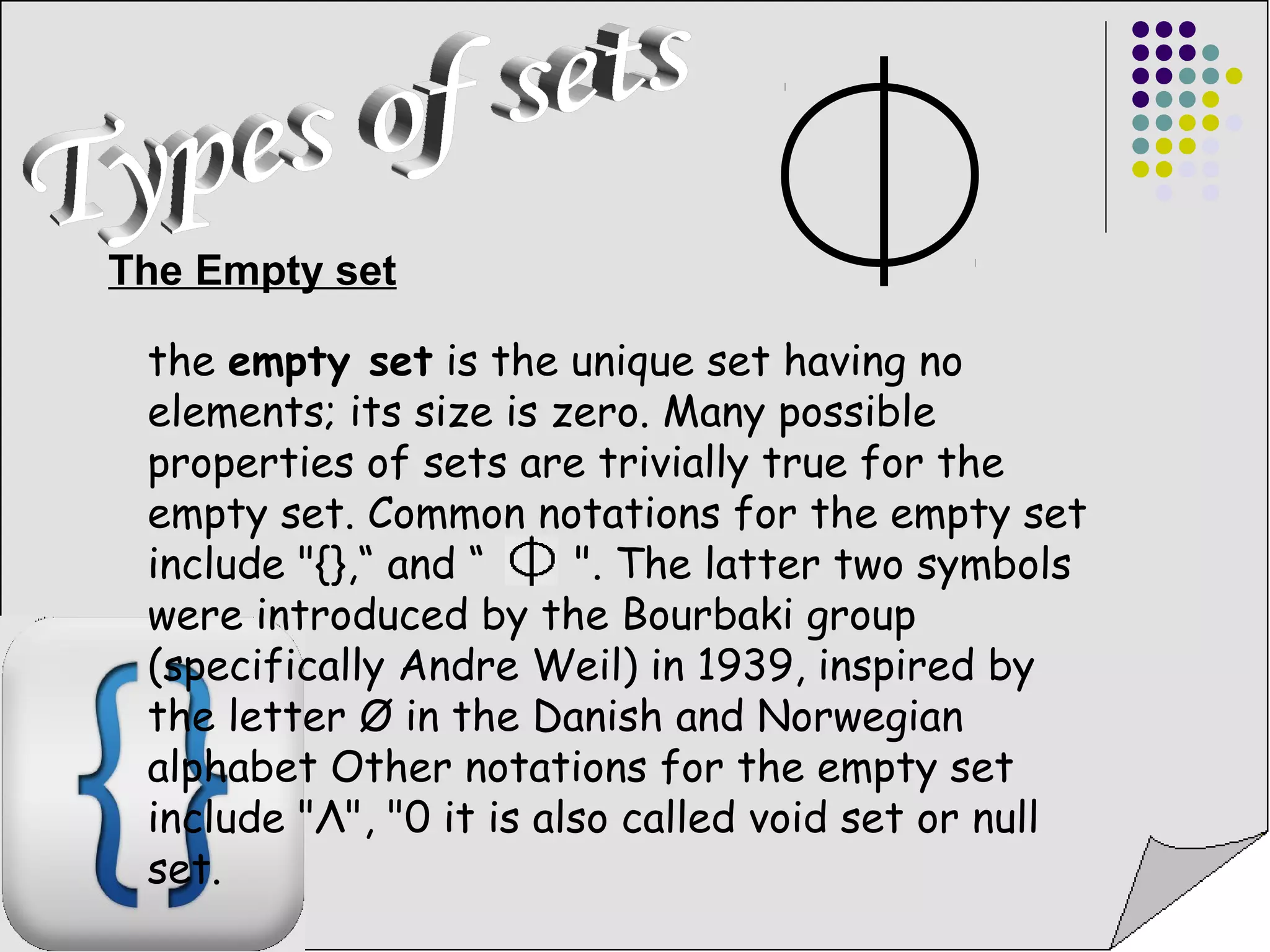
include "{},“ and “ ". The latter two symbols 
were introduced by the Bourbaki group 
(specifically Andre Weil) in 1939, inspired by 
the letter Ø in the Danish and Norwegian 
alphabet Other notations for the empty set 
include "Λ", "0 it is also called void set or null 
set.
For example Consider the set 
A = { x : x is a student presently studying in both Classes II and I } 
We observe that a student cannot study simultaneously in 
both Classes I and II. Thus, the set A contains no element 
at all. It is empty set, null set or void set. 
Equal sets 
When every element of set A is present in set B and 
vice versa then A and B are called equal sets. 
we write A = B. Otherwise, the sets are said to be unequal 
and we write A ≠ B. 
We consider the following examples : 
(i) Let A = {1, 2, 3, 4} and B = {3, 1, 4, 2}. Then A = B. 
(ii) Let A be the set of two consecutive natural numbers less 
than 6 and P the set of prime factors of 20. Then A and P are 
equal, since 4 and 5are the only prime factors of 20 and also 
these are less than 6.
Finite and Infinite Sets 
Finite set is a set that has a finite number of 
elements. 
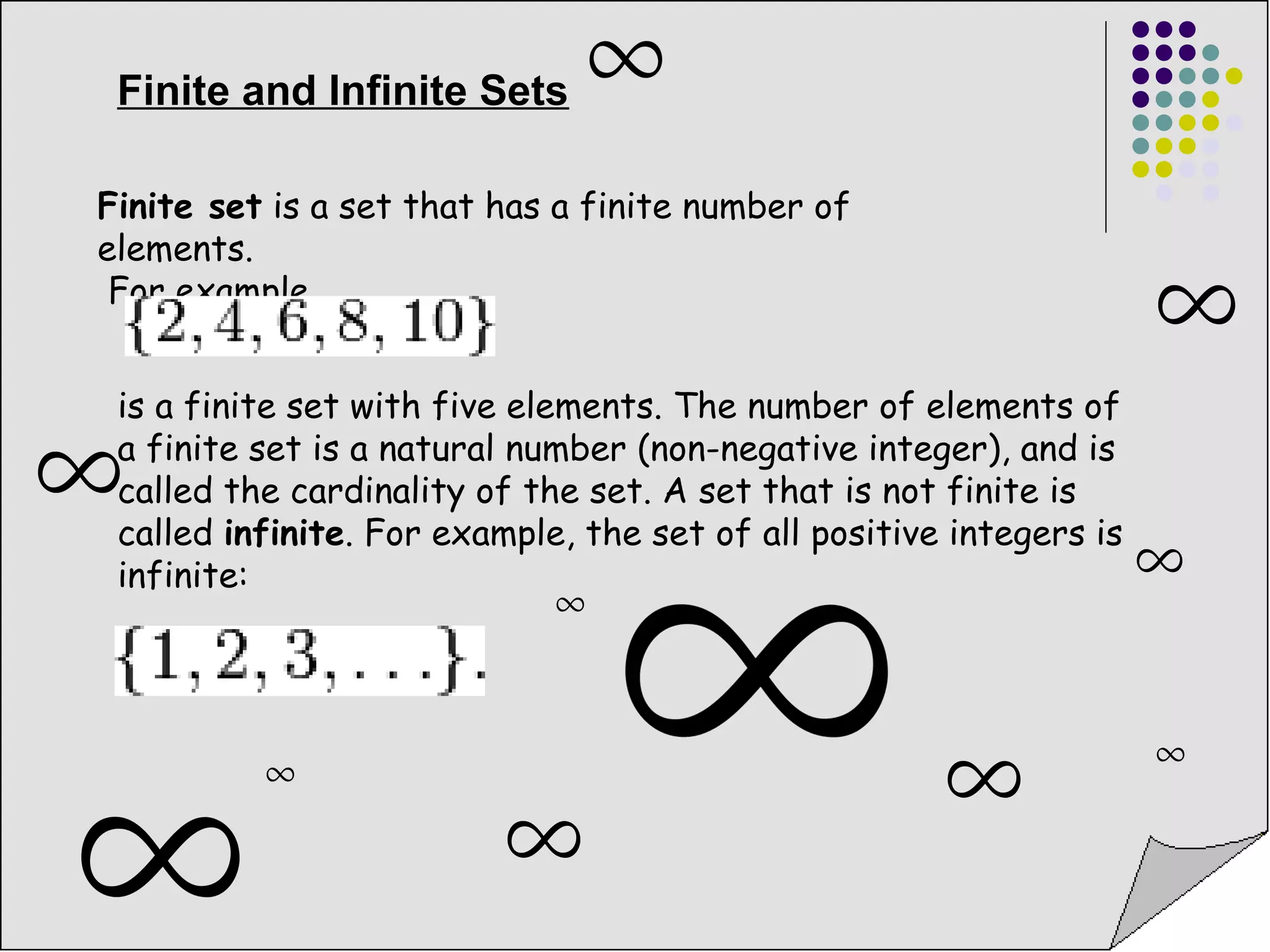
For example, 
is a finite set with five elements. The number of elements of 
a finite set is a natural number (non-negative integer), and is 
called the cardinality of the set. A set that is not finite is 
called infinite. For example, the set of all positive integers is 
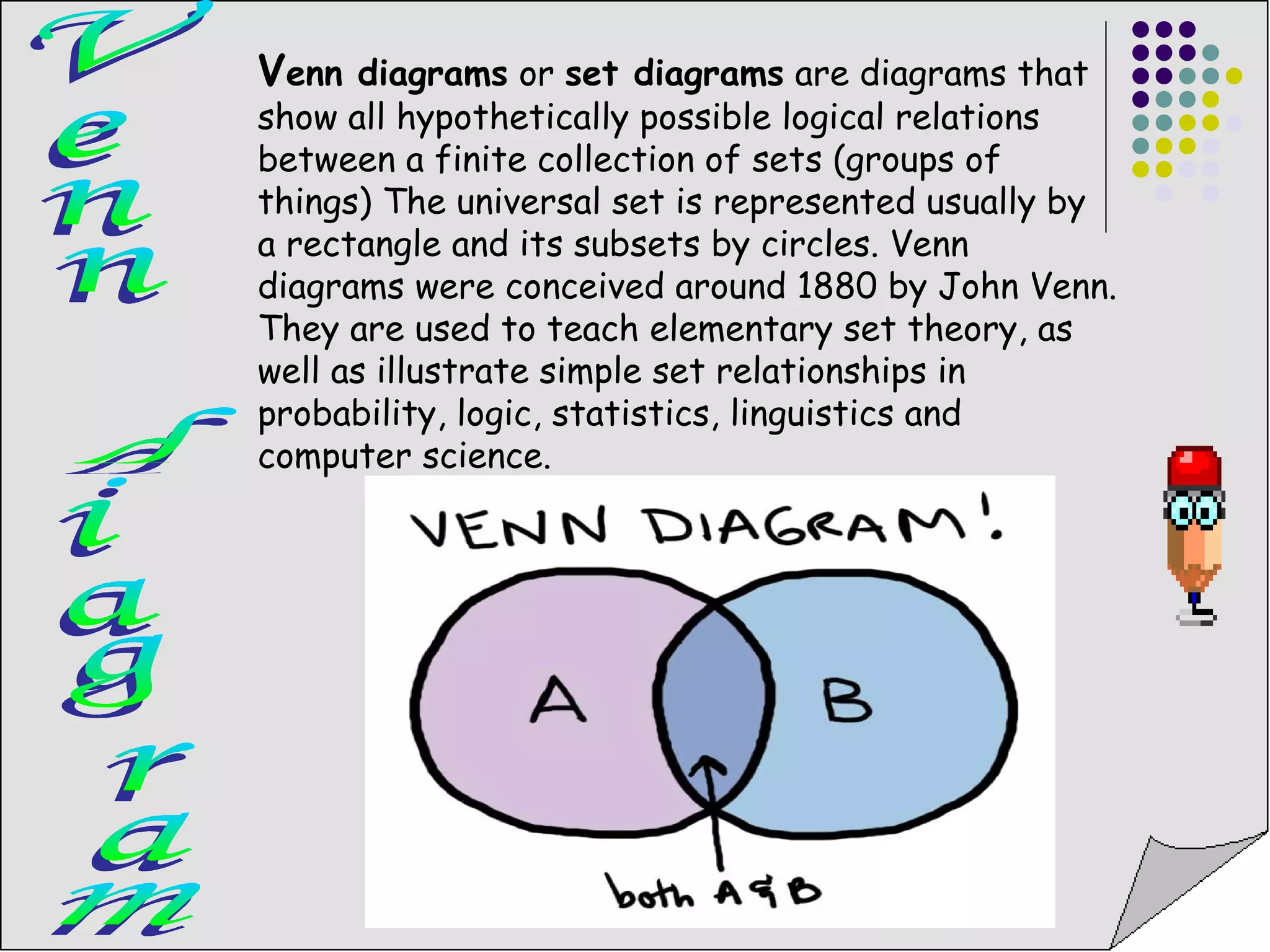
infinite:
Venn diagrams or set diagrams are diagrams that 
show all hypothetically possible logical relations 
between a finite collection of sets (groups of 
things) The universal set is represented usually by 
a rectangle and its subsets by circles. Venn 
diagrams were conceived around 1880 by John Venn. 
They are used to teach elementary set theory, as 
well as illustrate simple set relationships in 
probability, logic, statistics, linguistics and 
computer science.
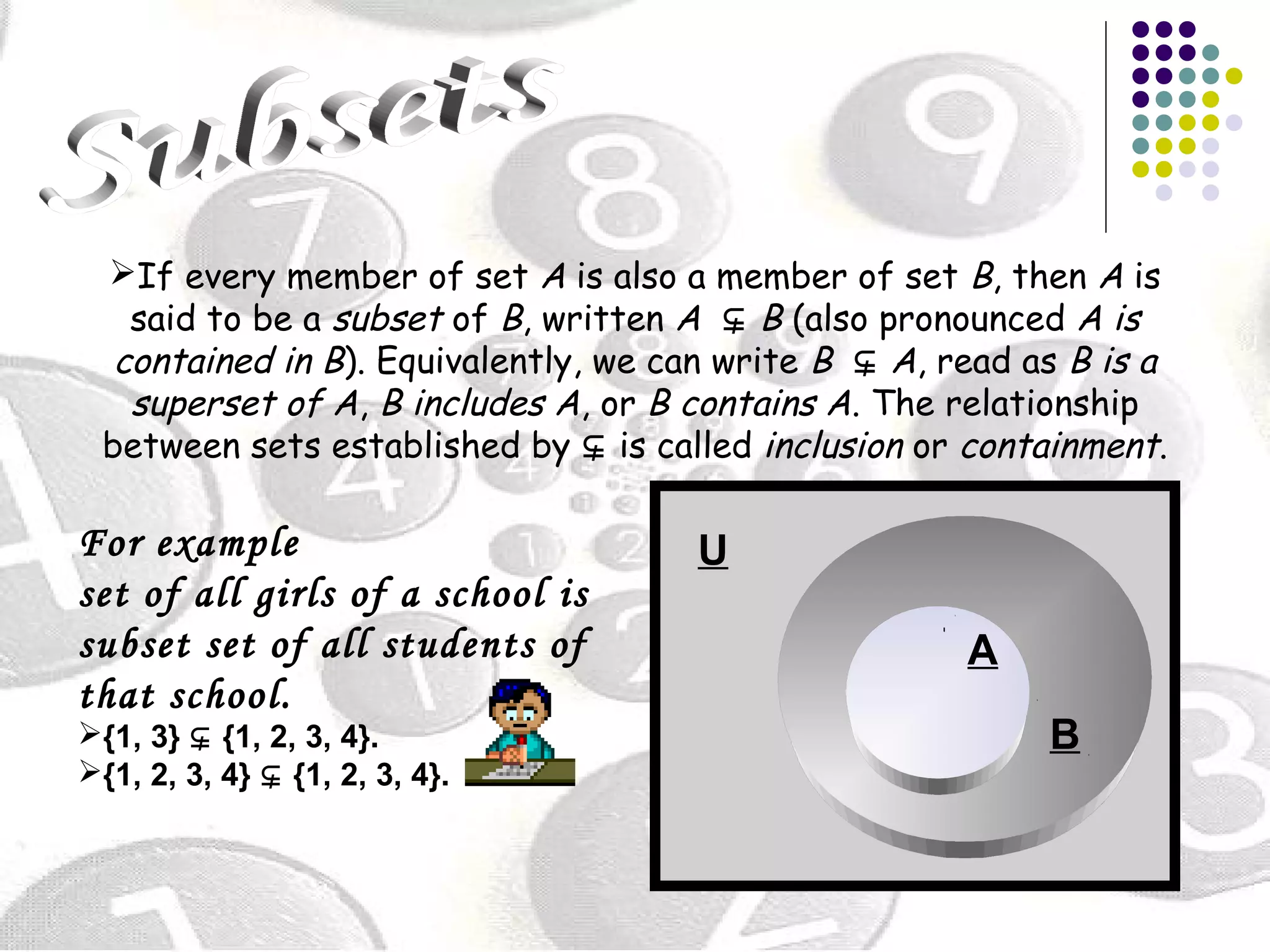
If every member of set A is also a member of set B, then A is 
said to be a subset of B, written A ⊊ B (also pronounced A is 
contained in B). Equivalently, we can write B ⊊ A, read as B is a 
superset of A, B includes A, or B contains A. The relationship 
between sets established by ⊊ is called inclusion or containment. 
B 
A 
For example 
set of all girls of a school is 
subset set of all students of 
that school. 
{1, 3} ⊊ {1, 2, 3, 4}. 
{1, 2, 3, 4} ⊊ {1, 2, 3, 4}. 
U
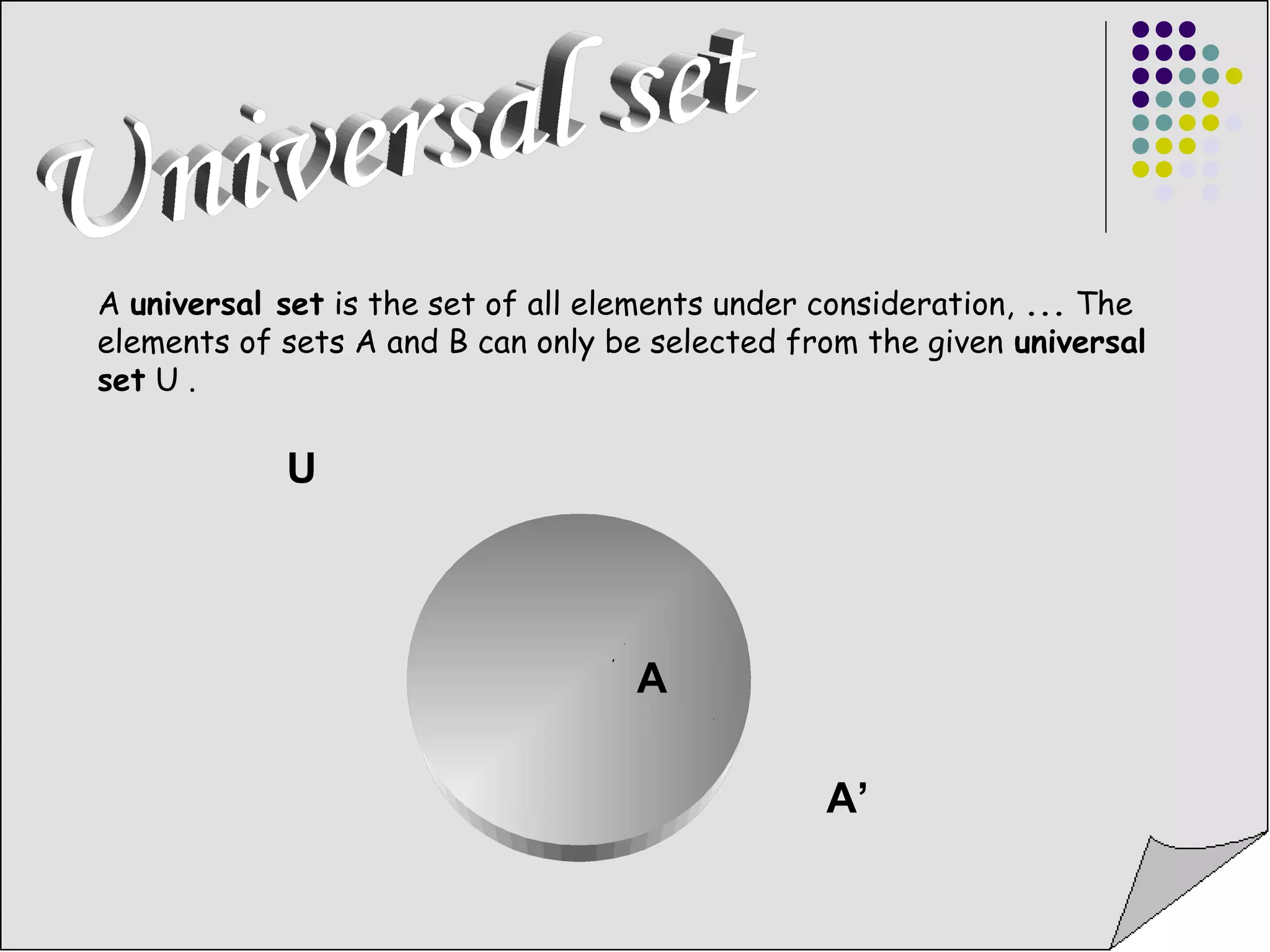
A universal set is the set of all elements under consideration, ... The 
elements of sets A and B can only be selected from the given universal 
set U . 
A 
A’ 
U
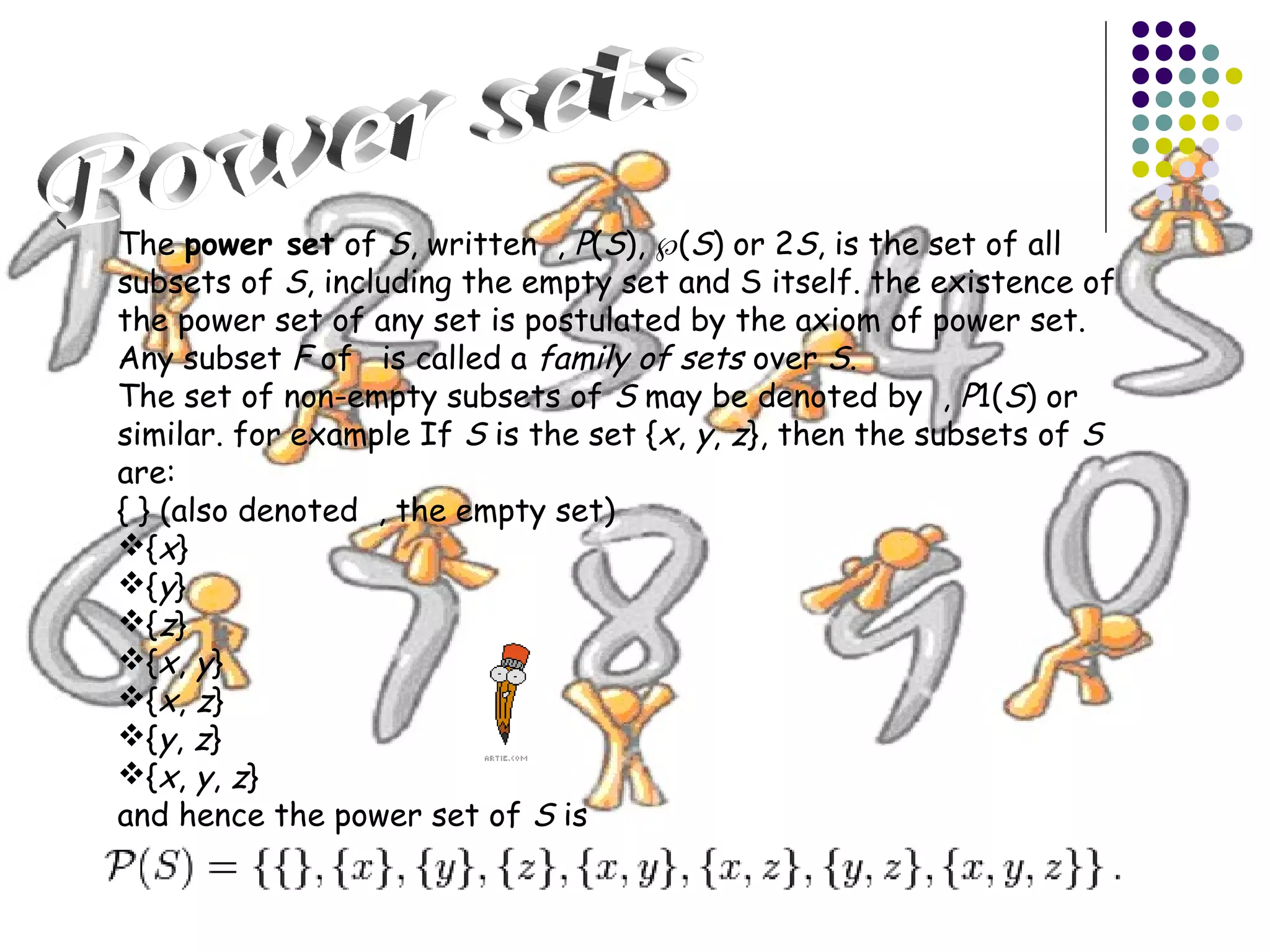
The power set of S, written , P(S), ℘(S) or 2S, is the set of all 
subsets of S, including the empty set and S itself. the existence of 
the power set of any set is postulated by the axiom of power set. 
Any subset F of is called a family of sets over S. 
The set of non-empty subsets of S may be denoted by , P1(S) or 
similar. for example If S is the set {x, y, z}, then the subsets of S 
are: 
{ } (also denoted , the empty set) 
{x} 
{y} 
{z} 
{x, y} 
{x, z} 
{y, z} 
{x, y, z} 
and hence the power set of S is
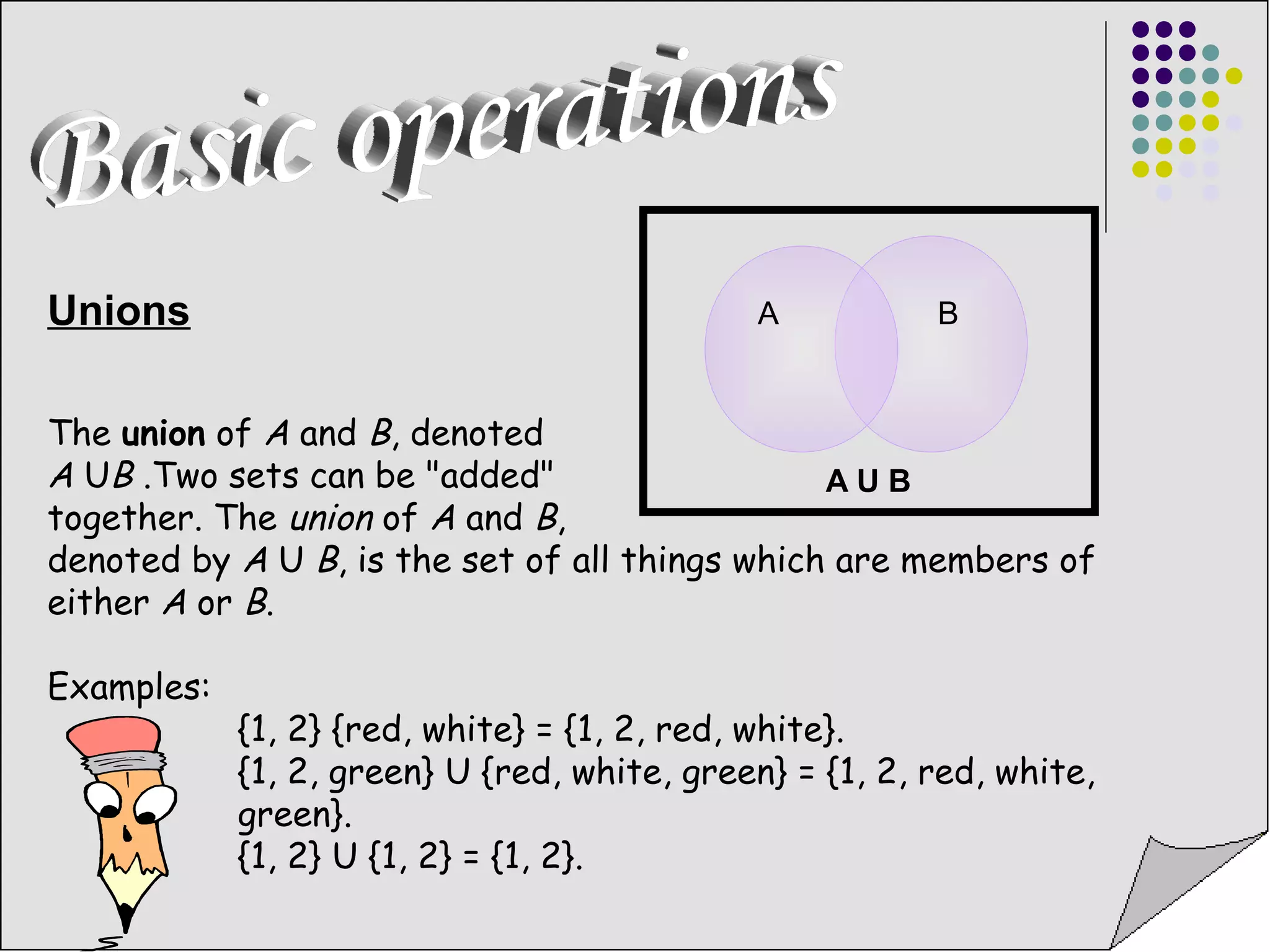
Unions 
A B 
The union of A and B, denoted 
A UB .Two sets can be "added" 
A U B 
together. The union of A and B, 
denoted by A U B, is the set of all things which are members of 
either A or B. 
Examples: 
{1, 2} {red, white} = {1, 2, red, white}. 
{1, 2, green} U {red, white, green} = {1, 2, red, white, 
green}. 
{1, 2} U {1, 2} = {1, 2}.
Intersections 
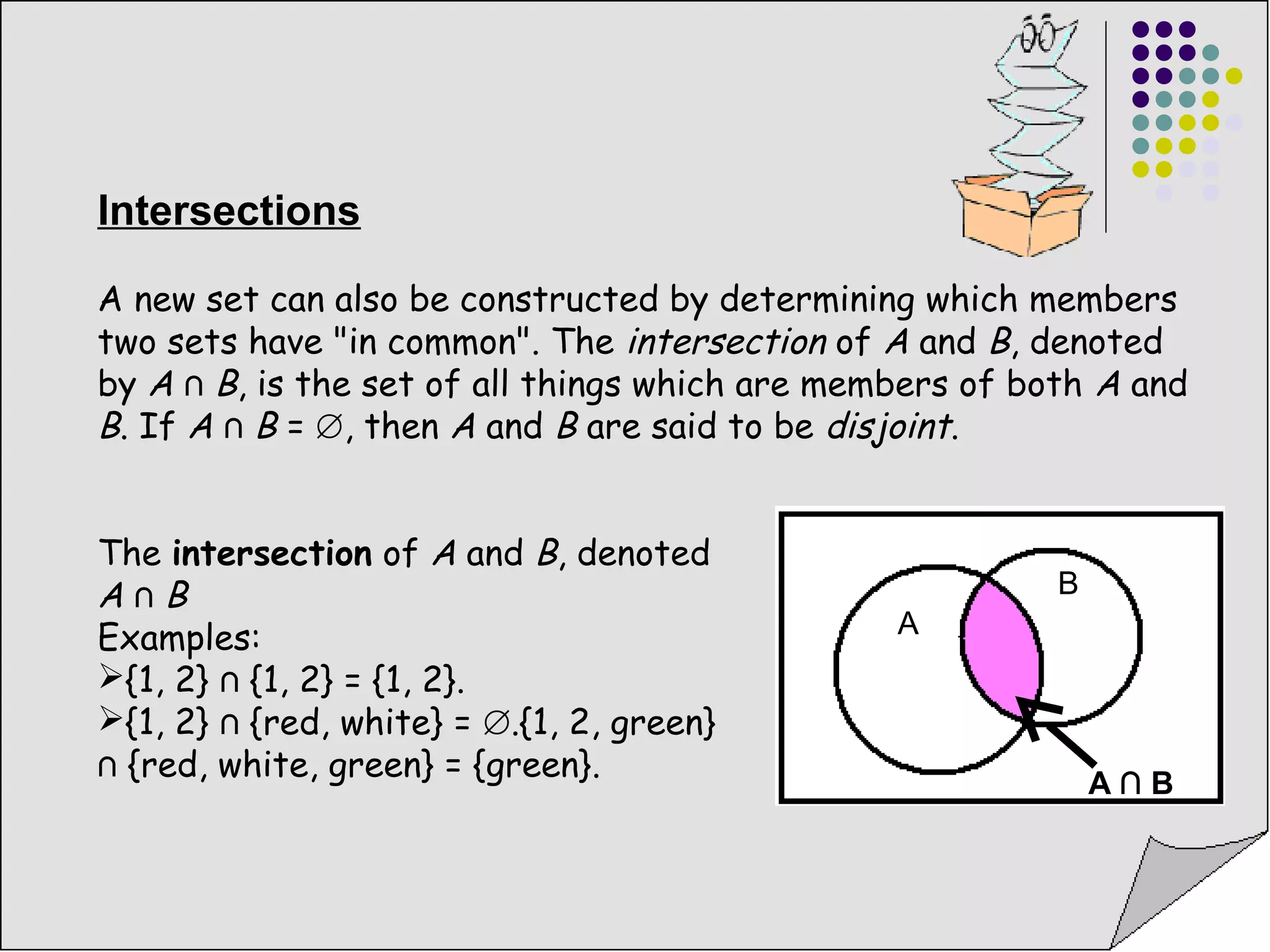
A new set can also be constructed by determining which members 
two sets have "in common". The intersection of A and B, denoted 
by A ∩ B, is the set of all things which are members of both A and 
B. If A ∩ B = ∅, then A and B are said to be disjoint. 
The intersection of A and B, denoted 
A ∩ B 
Examples: 
{1, 2} ∩ {1, 2} = {1, 2}. 
{1, 2} ∩ {red, white} = ∅.{1, 2, green} 
∩ {red, white, green} = {green}. 
A 
B 
A ∩ B
Complements 
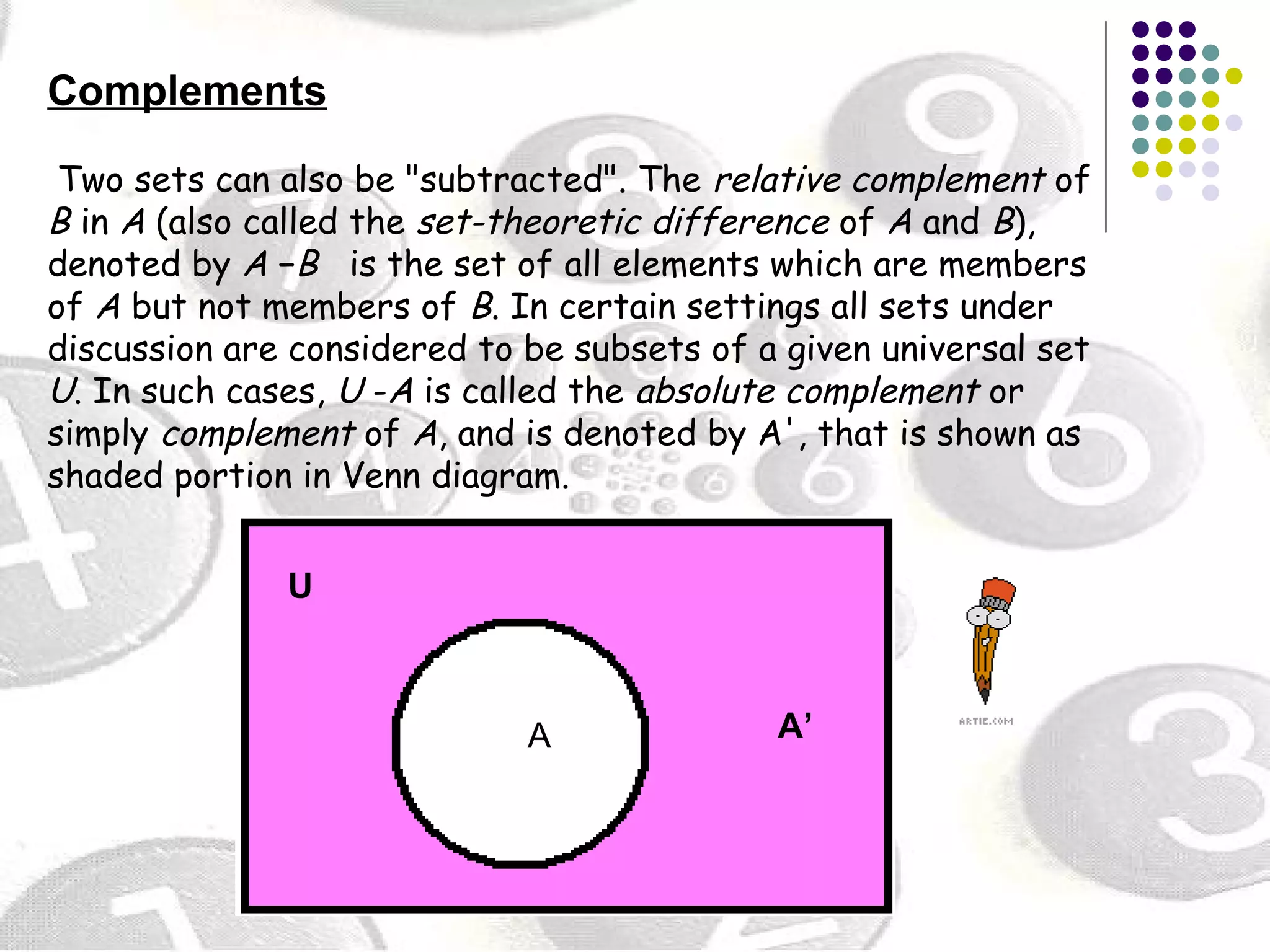
Two sets can also be "subtracted". The relative complement of 
B in A (also called the set-theoretic difference of A and B), 
denoted by A −B is the set of all elements which are members 
of A but not members of B. In certain settings all sets under 
discussion are considered to be subsets of a given universal set 
U. In such cases, U -A is called the absolute complement or 
simply complement of A, and is denoted by A', that is shown as 
shaded portion in Venn diagram. 
U 
A A’
Examples: 
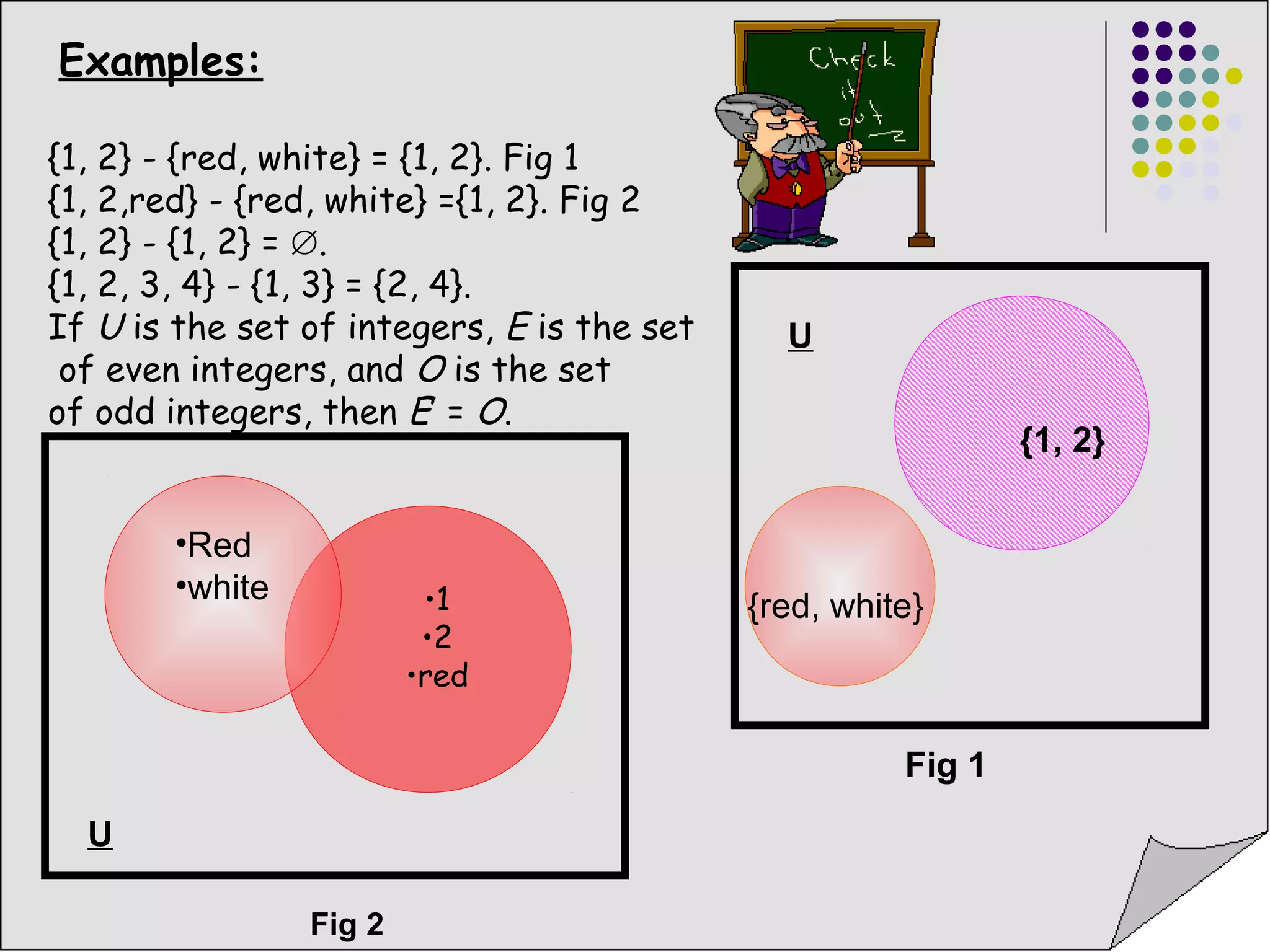
{1, 2} - {red, white} = {1, 2}. Fig 1 
{1, 2,red} - {red, white} ={1, 2}. Fig 2 
{1, 2} - {1, 2} = ∅. 
{1, 2, 3, 4} - {1, 3} = {2, 4}. 
If U is the set of integers, E is the set 
of even integers, and O is the set 
of odd integers, then E′ = O. 
{1, 2} 
U 
•1 {red, white} 
•2 
•red 
Fig 2 
•Red 
•white 
U 
Fig 1
Some Properties of Complement Sets 
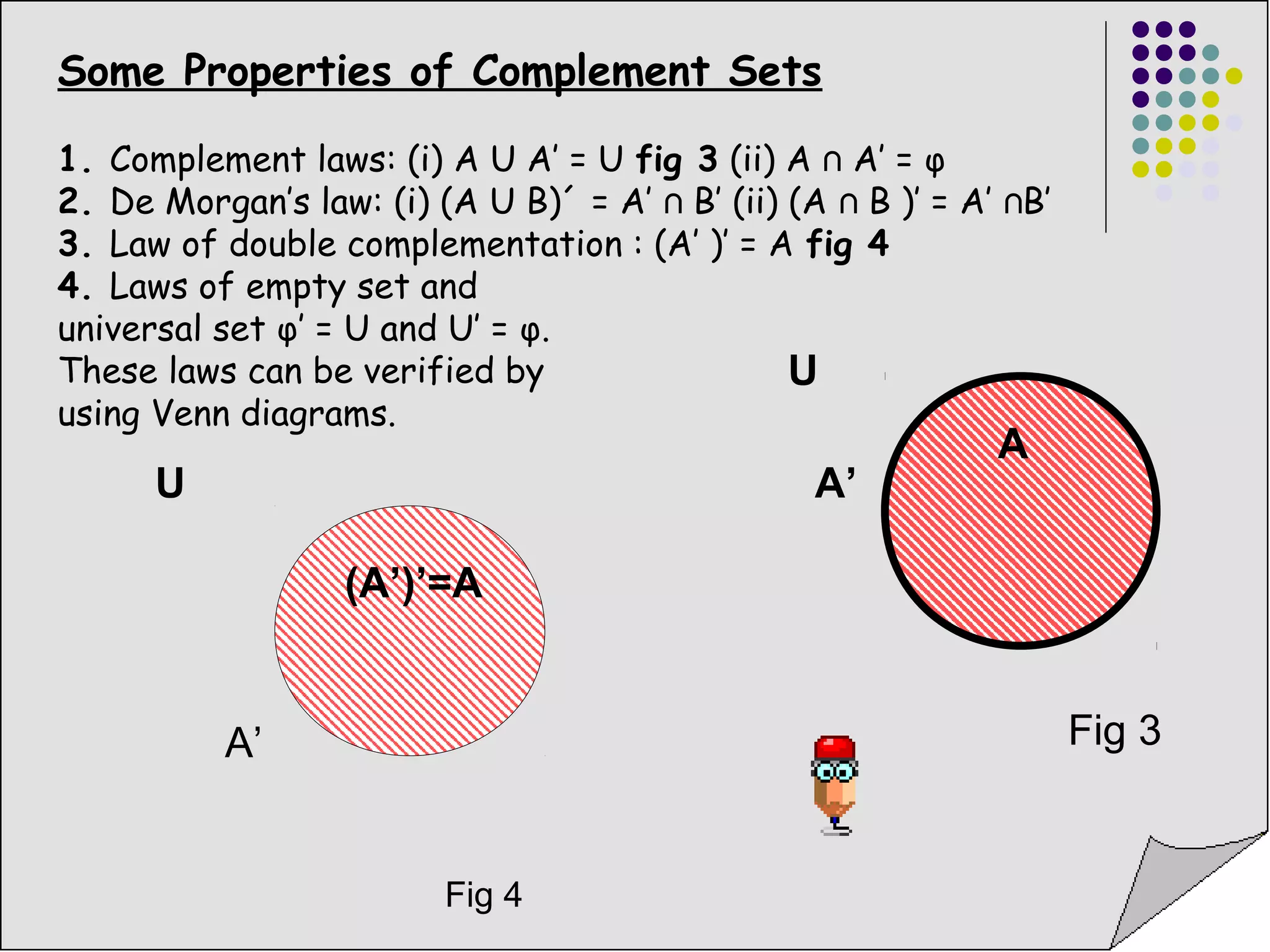
1. Complement laws: (i) A U A′ = U fig 3 (ii) A ∩ A′ = φ 
2. De Morgan’s law: (i) (A U B)´ = A′ ∩ B′ (ii) (A ∩ B )′ = A′ ∩B′ 
3. Law of double complementation : (A′ )′ = A fig 4 
4. Laws of empty set and 
universal set φ′ = U and U′ = φ. 
These laws can be verified by 
using Venn diagrams. 
U 
A’ 
A 
Fig 3 
U 
(A’)’=A 
A’ 
Fig 4
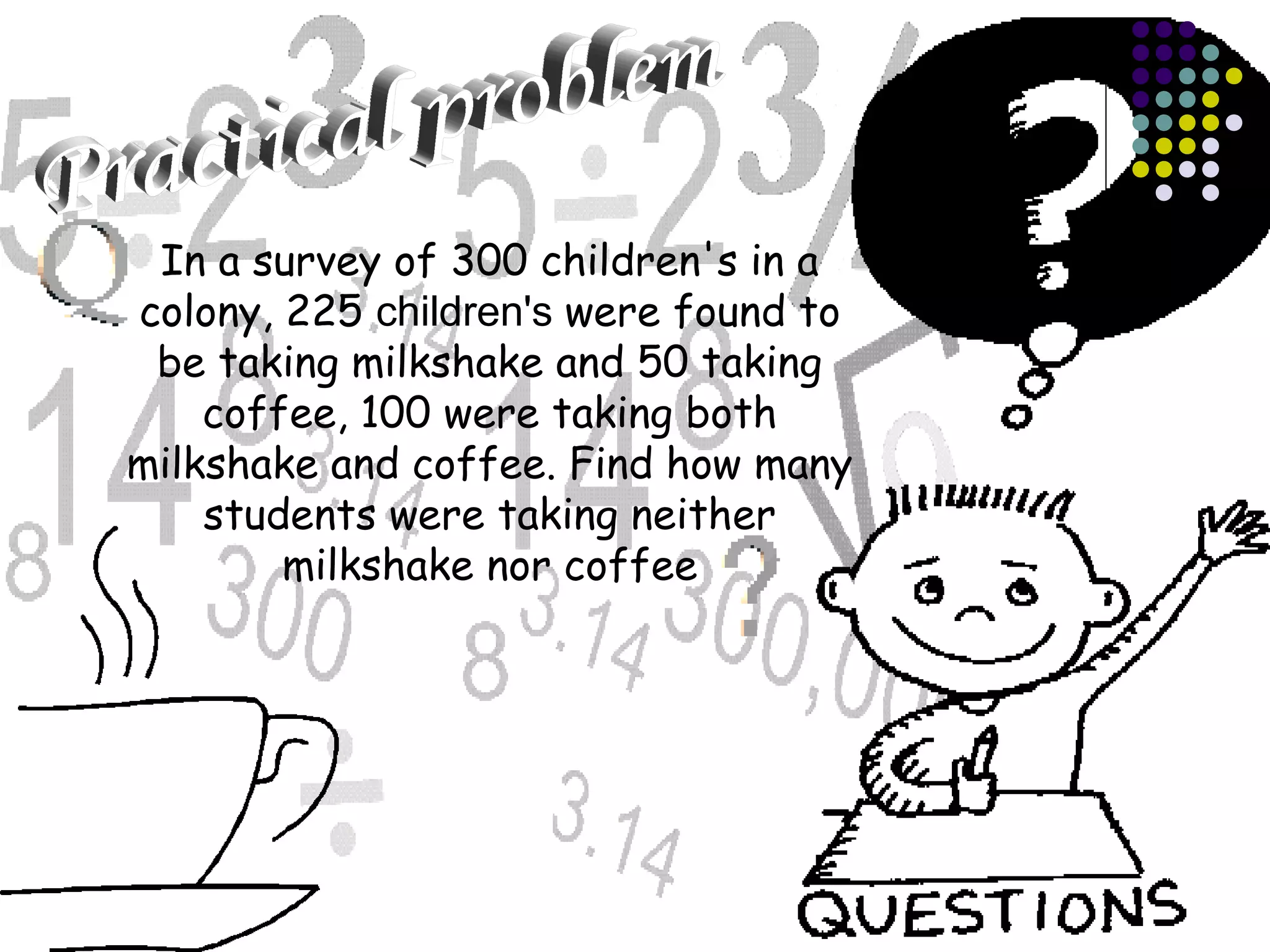
In a survey of 300 children's in a 
colony, 225 children's were found to 
be taking milkshake and 50 taking 
coffee, 100 were taking both 
milkshake and coffee. Find how many 
students were taking neither 
milkshake nor coffee
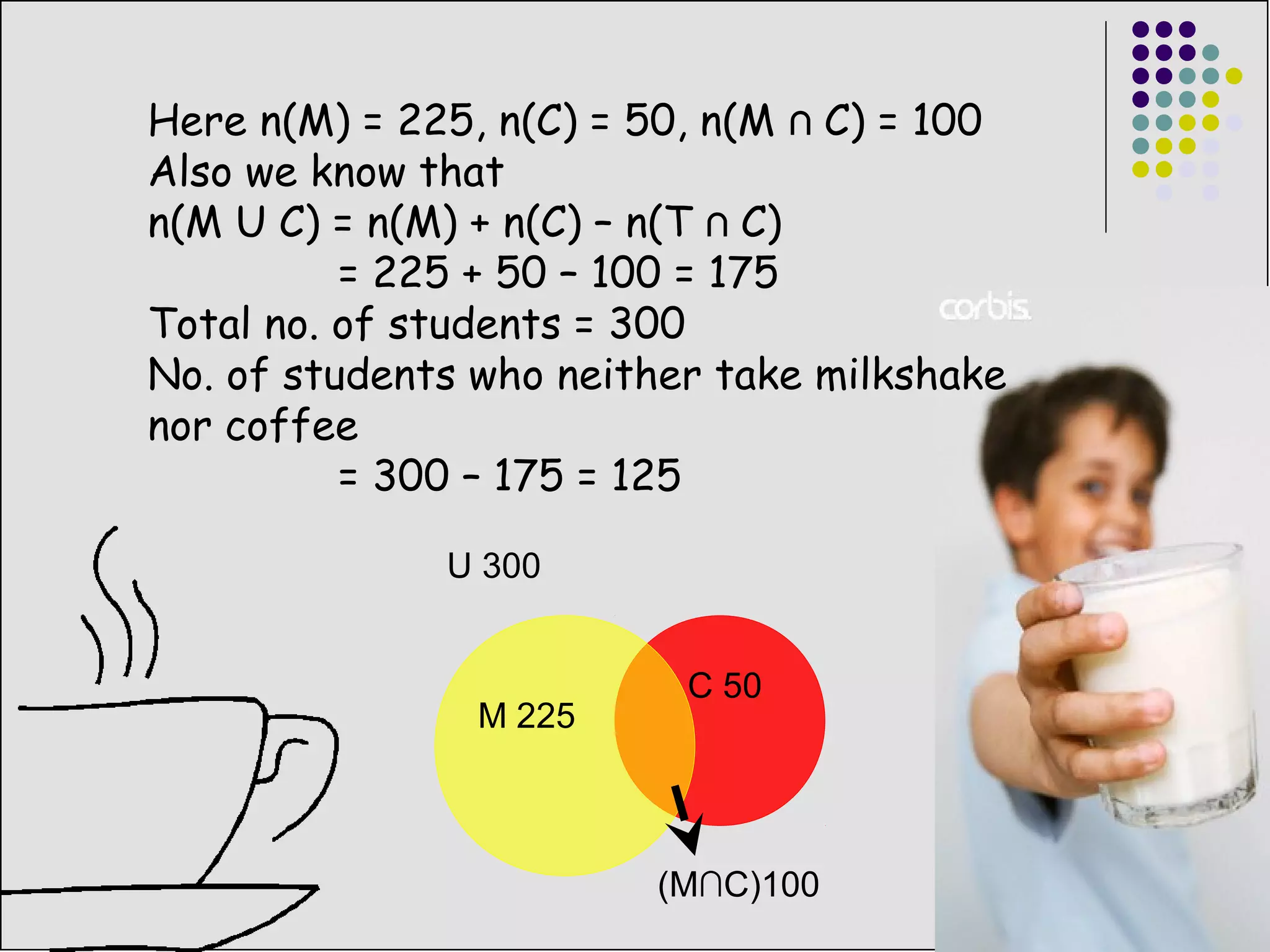
Here n(M) = 225, n(C) = 50, n(M ∩ C) = 100 
Also we know that 
n(M U C) = n(M) + n(C) – n(T ∩ C) 
= 225 + 50 – 100 = 175 
Total no. of students = 300 
No. of students who neither take milkshake 
nor coffee 
= 300 – 175 = 125 
M 225 
C 50 
U 300 
(M∩C)100
Sets

Sets

  • 1.
    A B C Made by Anshika Singh, Mansi Bhatia & Payal Batra XI F
  • 2.
    A set isa collection of distinct objects, considered as an object in its own right. Theory of sets wwaass iinnvveenntteedd bbyy GGeeoorrggee CCaannttoorr iinn eenndd ooff nniinneetteeeenntthh cceennttuurryy.. F o r e x a m p l e c o l l e c t i o n o f b e s t t e a c h e r s o f a s c h o o l i s n o t d e f i n e d t h u s , i t i s n o t a s e t w h e r e a s c o l l e c t i o n o f m o s t e x p e r i e n c e d t e a c h e r s c a n b e d e f i n e d a n d i t i s a s e t .
  • 3.
    Roaster form Roasterform is notated by enclosing the list of members in braces. Roaster form of A is the set whose members are the first four positive integers is {1,2,3,4}. All set operations preserve the property that each element of the set is unique. The order in which the elements of a set are listed is irrelevant, unlike a sequence. For example, {6, 11} = {11, 6} = {11, 11, 6, 11}
  • 4.
    Set builder form  In set-builder form, all the members of a set has a single common Property which is not possessed by any other element outside the set. E = {playing card suits} is the set whose four members are ♠, ♦, ♥, and ♣. The set F of the twenty smallest integers that are four less than perfect squares can be denoted: F = {n2 − 4 : n is an integer; and 0 ≤ n ≤ 19} In this notation, the colon (":") means "such that", and the description can be interpreted as "F is the set of all numbers of the form n2 − 4, such that n is a whole number in the range from 0 to 19 inclusive." Sometimes the vertical bar ("|") is used instead of the colon.
  • 5.
    The Empty set the empty set is the unique set having no elements; its size is zero. Many possible properties of sets are trivially true for the empty set. Common notations for the empty set include "{},“ and “ ". The latter two symbols were introduced by the Bourbaki group (specifically Andre Weil) in 1939, inspired by the letter Ø in the Danish and Norwegian alphabet Other notations for the empty set include "Λ", "0 it is also called void set or null set.
  • 6.
    For example Considerthe set A = { x : x is a student presently studying in both Classes II and I } We observe that a student cannot study simultaneously in both Classes I and II. Thus, the set A contains no element at all. It is empty set, null set or void set. Equal sets When every element of set A is present in set B and vice versa then A and B are called equal sets. we write A = B. Otherwise, the sets are said to be unequal and we write A ≠ B. We consider the following examples : (i) Let A = {1, 2, 3, 4} and B = {3, 1, 4, 2}. Then A = B. (ii) Let A be the set of two consecutive natural numbers less than 6 and P the set of prime factors of 20. Then A and P are equal, since 4 and 5are the only prime factors of 20 and also these are less than 6.
  • 7.
    Finite and InfiniteSets Finite set is a set that has a finite number of elements. For example, is a finite set with five elements. The number of elements of a finite set is a natural number (non-negative integer), and is called the cardinality of the set. A set that is not finite is called infinite. For example, the set of all positive integers is infinite:
  • 8.
    Venn diagrams orset diagrams are diagrams that show all hypothetically possible logical relations between a finite collection of sets (groups of things) The universal set is represented usually by a rectangle and its subsets by circles. Venn diagrams were conceived around 1880 by John Venn. They are used to teach elementary set theory, as well as illustrate simple set relationships in probability, logic, statistics, linguistics and computer science.
  • 9.
    If every memberof set A is also a member of set B, then A is said to be a subset of B, written A ⊊ B (also pronounced A is contained in B). Equivalently, we can write B ⊊ A, read as B is a superset of A, B includes A, or B contains A. The relationship between sets established by ⊊ is called inclusion or containment. B A For example set of all girls of a school is subset set of all students of that school. {1, 3} ⊊ {1, 2, 3, 4}. {1, 2, 3, 4} ⊊ {1, 2, 3, 4}. U
  • 10.
    A universal setis the set of all elements under consideration, ... The elements of sets A and B can only be selected from the given universal set U . A A’ U
  • 11.
    The power setof S, written , P(S), ℘(S) or 2S, is the set of all subsets of S, including the empty set and S itself. the existence of the power set of any set is postulated by the axiom of power set. Any subset F of is called a family of sets over S. The set of non-empty subsets of S may be denoted by , P1(S) or similar. for example If S is the set {x, y, z}, then the subsets of S are: { } (also denoted , the empty set) {x} {y} {z} {x, y} {x, z} {y, z} {x, y, z} and hence the power set of S is
  • 12.
    Unions A B The union of A and B, denoted A UB .Two sets can be "added" A U B together. The union of A and B, denoted by A U B, is the set of all things which are members of either A or B. Examples: {1, 2} {red, white} = {1, 2, red, white}. {1, 2, green} U {red, white, green} = {1, 2, red, white, green}. {1, 2} U {1, 2} = {1, 2}.
  • 13.
    Intersections A newset can also be constructed by determining which members two sets have "in common". The intersection of A and B, denoted by A ∩ B, is the set of all things which are members of both A and B. If A ∩ B = ∅, then A and B are said to be disjoint. The intersection of A and B, denoted A ∩ B Examples: {1, 2} ∩ {1, 2} = {1, 2}. {1, 2} ∩ {red, white} = ∅.{1, 2, green} ∩ {red, white, green} = {green}. A B A ∩ B
  • 14.
    Complements Two setscan also be "subtracted". The relative complement of B in A (also called the set-theoretic difference of A and B), denoted by A −B is the set of all elements which are members of A but not members of B. In certain settings all sets under discussion are considered to be subsets of a given universal set U. In such cases, U -A is called the absolute complement or simply complement of A, and is denoted by A', that is shown as shaded portion in Venn diagram. U A A’
  • 15.
    Examples: {1, 2}- {red, white} = {1, 2}. Fig 1 {1, 2,red} - {red, white} ={1, 2}. Fig 2 {1, 2} - {1, 2} = ∅. {1, 2, 3, 4} - {1, 3} = {2, 4}. If U is the set of integers, E is the set of even integers, and O is the set of odd integers, then E′ = O. {1, 2} U •1 {red, white} •2 •red Fig 2 •Red •white U Fig 1
  • 16.
    Some Properties ofComplement Sets 1. Complement laws: (i) A U A′ = U fig 3 (ii) A ∩ A′ = φ 2. De Morgan’s law: (i) (A U B)´ = A′ ∩ B′ (ii) (A ∩ B )′ = A′ ∩B′ 3. Law of double complementation : (A′ )′ = A fig 4 4. Laws of empty set and universal set φ′ = U and U′ = φ. These laws can be verified by using Venn diagrams. U A’ A Fig 3 U (A’)’=A A’ Fig 4
  • 17.
    In a surveyof 300 children's in a colony, 225 children's were found to be taking milkshake and 50 taking coffee, 100 were taking both milkshake and coffee. Find how many students were taking neither milkshake nor coffee
  • 18.
    Here n(M) =225, n(C) = 50, n(M ∩ C) = 100 Also we know that n(M U C) = n(M) + n(C) – n(T ∩ C) = 225 + 50 – 100 = 175 Total no. of students = 300 No. of students who neither take milkshake nor coffee = 300 – 175 = 125 M 225 C 50 U 300 (M∩C)100