SUBJECT
MBA303:OPERATION MANAGEMENT
LECTURE NO.-1
Dr. Moiz Akhtar
Faculty of Commerce & Management
Integral University, Lucknow
CENTRE FOR DISTANCE AND ONLINE EDUCATION
INTEGRAL UNIVERSITY, LUCKNOW
Topics Covered
Operation Management
Operation Performance
Topic 1
Operation Management
Contents
1- What is Operations Management (OM)?
2- Importance of OM .
3- OM decisions.
4- OM's contributions to society.
5- OM of service & manufacturing organizations
6- The ever-changing world of OM
7- Make or buy decision
8- Historical development of OM.
What is operations management (OM)?
 OM definition
 Responsibilities of Operations Managers
 Difference between OM and PM
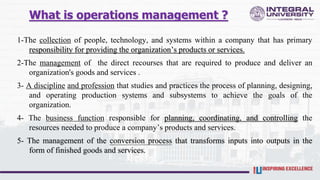
What is operations management ?
1-The collection of people, technology, and systems within a company that has primary
responsibility for providing the organization’s products or services.
2-The management of the direct recourses that are required to produce and deliver an
organization's goods and services .
3- A discipline and profession that studies and practices the process of planning, designing,
and operating production systems and subsystems to achieve the goals of the
organization.
4- The business function responsible for planning, coordinating, and controlling the
resources needed to produce a company’s products and services.
5- The management of the conversion process that transforms inputs into outputs in the
form of finished goods and services.
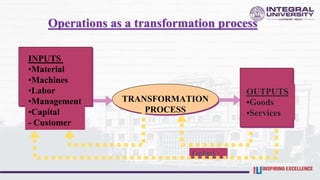
INPUTS
•Material
•Machines
•Labor
•Management
•Capital
- Customer
TRANSFORMATION
PROCESS
OUTPUTS
•Goods
•Services
Feedback
Operations as a transformation process
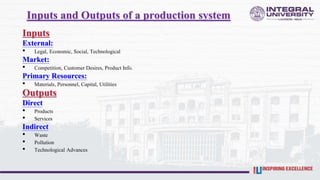
Inputs and Outputs of a production system
Inputs
External:
• Legal, Economic, Social, Technological
Market:
• Competition, Customer Desires, Product Info.
Primary Resources:
• Materials, Personnel, Capital, Utilities
Outputs
Direct
• Products
• Services
Indirect
• Waste
• Pollution
• Technological Advances
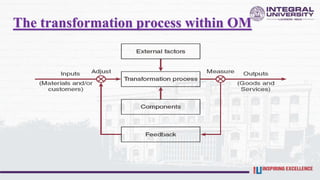
The transformation process within OM
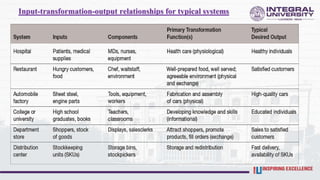
Input-transformation-output relationships for typical systems
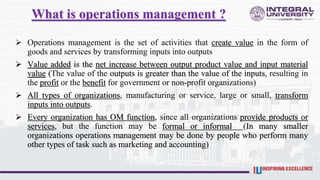
What is operations management ?
 Operations management is the set of activities that create value in the form of
goods and services by transforming inputs into outputs
 Value added is the net increase between output product value and input material
value (The value of the outputs is greater than the value of the inputs, resulting in
the profit or the benefit for government or non-profit organizations)
 All types of organizations, manufacturing or service, large or small, transform
inputs into outputs.
 Every organization has OM function, since all organizations provide products or
services, but the function may be formal or informal (In many smaller
organizations operations management may be done by people who perform many
other types of task such as marketing and accounting)
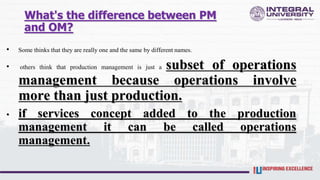
What's the difference between PM
and OM?
• Some thinks that they are really one and the same by different names.
• others think that production management is just a subset of operations
management because operations involve
more than just production.
• if services concept added to the production
management it can be called operations
management.
What responsibilities do operations managers
have?
• Direct responsibilities :the activities which are
directly related to producing and delivering products
and services.
• Indirect responsibilities :the activities involved in
interfacing with other parts of the organization.
• Broad responsibilities :a wider set of tasks that
involve scanning the business, social and political
environment in which the organization exists in order
to understand its context.
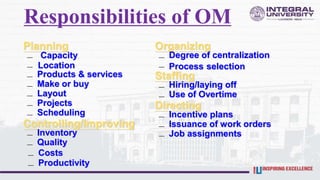
Responsibilities of OM
Products & services
Planning
– Capacity
– Location
–
– Make or buy
– Layout
– Projects
– Scheduling
Controlling/Improving
– Inventory
– Quality
Organizing
– Degree of centralization
– Process selection
Staffing
– Hiring/laying off
– Use of Overtime
Directing
– Incentive plans
– Issuance of work orders
– Job assignments
– Costs
– Productivity
Importance of OM
1- Operations is an important part of every organization
2- We should know how goods and services are produced (All managers should have an
understanding the main principles and tools of OM)
3- It is responsible for the customer fulfillment aspects of an organization. Thus, it
manages customer satisfaction.
4- OM is such a costly part of an organization. (For most organizations it absorbs a huge
percentage of required capital )
Companies need to have efficient operations to survive. To succeed, a firm must have a
strong operations function teaming with the other organization functions.
5- OM responsible to increase productivity and profitability. Increasing overall
productivity leads to economic growth and a higher standard of living.
6- Operational decision-making requires a long-term perspective and requires inputs
from all business functions.
OM Decisions tend to be costly and difficult to reverse
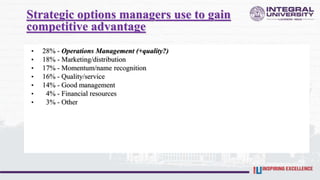
Strategic options managers use to gain
competitive advantage
• 28% - Operations Management (+quality?)
• 18% - Marketing/distribution
• 17% - Momentum/name recognition
• 16% - Quality/service
• 14% - Good management
• 4% - Financial resources
• 3% - Other
Some definitions
• Productivity: The ration of what is produced by an operation or process to what is
required to produced it, that is ,the output from the operations divided by the input to
the input operation (ratio of output to input)
• Efficiency: producing something at the lowest possible cost
• Effectiveness: doing the right things to create the most value for the firm
• Value: quality divided by price
• Competitive advantage: competitive advantage is an advantage over competitors
gained by offering consumers greater value, either by means of lower prices or by
providing greater benefits and service that justifies higher prices
3- OM decisions
Strategic
Tactical
operational
• Where should we locate our facility
• How much capacity do we need
• What should we make, what should we buy
• What technology should we use
• How do we insure appropriate quality
• Who should we use as vendors
• How much inventory do we need
• How should we schedule our resources
Main operational decisions
Critical decisions of OM
• Product & service design.
• Quality management.
• Process design.
• Capacity & location of facilities.
• Layout of facilities.
• Human resource & Job design.
• Supply-chain management.
• Inventory management.
• Scheduling.
• Maintenance.
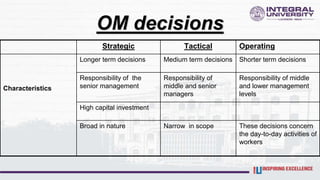
OM decisions
Operations managers must make decisions on three levels:
Strategic decisions
• senior management responsibility
• More broad in nature
• Determine the success of an organization's strategy,
• Very risky and hard to reverse
• Have significant long - term impact, ,and
• less frequent.
• Examples:
• How will we make the product?
• Where do we locate the facility?
• How much capacity do we need?
• When should we add more capacity?
Tactical decisions
• Medium- range decisions focus on resource needs, schedules, &
quantities to produce
• Tactical decisions are frequent, must align with strategic decisions.
• Involves resource allocation and utilization.
• Involves a moderate degree of uncertainty and risk..
• They are the link between lower and high level management
• Examples:
• How many workers do we need?
• When do we need them?
• Should we work overtime or put on a second sift?
• When should we have material delivered?
• Should we have a finished goods inventory?
Operational decisions
• Involves a short time horizon.
• Involves very little uncertainty and risk.
• Examples :
• What jobs do we work on today or this week?
• To whom do we assign what task?
• What jobs have priority?
OM decisions
Strategic Tactical Operating
Characteristics
Longer term decisions Medium term decisions Shorter term decisions
Responsibility of the
senior management
Responsibility of
middle and senior
managers
Responsibility of middle
and lower management
levels
High capital investment
Broad in nature Narrow in scope These decisions concern
the day-to-day activities of
workers
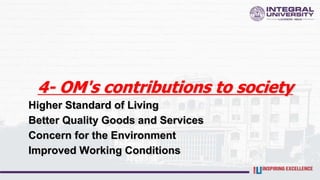
4- OM's contributions to society
Higher Standard of Living
Better Quality Goods and Services
Concern for the Environment
Improved Working Conditions
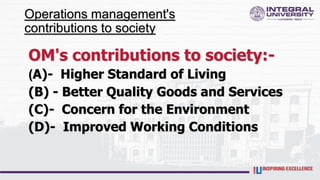
Operations management's
contributions to society
OM's contributions to society:-
(A)- Higher Standard of Living
(B) - Better Quality Goods and Services
(C)- Concern for the Environment
(D)- Improved Working Conditions
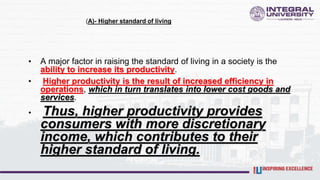
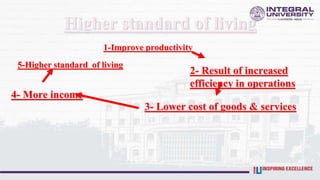
(A)- Higher standard of living
• A major factor in raising the standard of living in a society is the
ability to increase its productivity.
• Higher productivity is the result of increased efficiency in
operations, which in turn translates into lower cost goods and
services.
• Thus, higher productivity provides
consumers with more discretionary
income, which contributes to their
higher standard of living.
(B) - Better quality of goods and services
• One of the many consumer benefits of increased
competition is the higher-quality products that are
available today.
• Quality standards are continually increasing.
• Many companies today have established Six-Sigma quality
standards (pioneered by Motorola in the late 1980s),
resulting in no more than 3.4 defects per million
opportunities.
• Such high quality standards were once considered not
only prohibitively expensive but also virtually impossible
to achieve even if cost wasn't a consideration.
• Today we know that such high quality is not only very
possible, but also results in lower costs, because firms
can reduce their waste and rework.
1-Improve productivity
3- Lower cost of goods & services
5-Higher standard of living
Higher standard of living
2- Result of increased
efficiency in operations
4- More income
(C)- Concern for the
environment
Many companies today are taking up the
challenge to produce environmentally
friendly products with environmentally
friendly processes, all of which falls
under the purview of operations
management.
• Recycling and concern for air and water
quality
(D)-Improved working
conditions
• Managers recognize the benefits of providing workers with better
working conditions.
• This includes not only the work environment but also the design of the
jobs themselves.
• Workers are now encouraged to participate in improving
operations through suggestions.
• After all, who would know better how to do a particular operation
than that person who does it every day.
• Managers also have learned that there is a very clear relationship
between satisfied workers and satisfied customers, especially in
service operations.
• (Empowerment :The concept of encouraging and authorizing
workers to take the initiative to improve operations, reduce
costs, and improve product quality and customer service.)
5- OM of service and manufacturing organizations
Importance of service now
Service nature
The affect of service nature on OM activities
OM of service and manufacturing
organizations
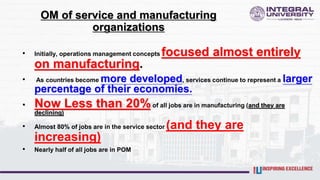
• Initially, operations management concepts focused almost entirely
on manufacturing.
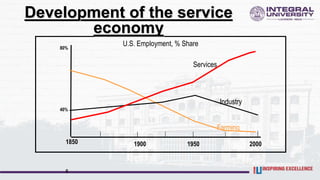
• As countries become more developed, services continue to represent a larger
percentage of their economies.
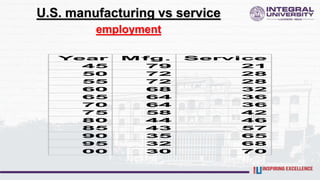
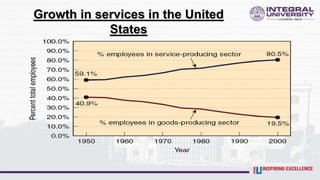
• Now Less than 20%of all jobs are in manufacturing (and they are
declining)
• Almost 80% of jobs are in the service sector (and they are
increasing)
• Nearly half of all jobs are in POM
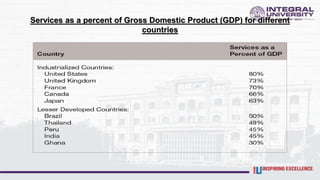
Services as a percent of Gross Domestic Product (GDP) for different
countries
1850
Services
Industry
Farming
80%
40%
0
U.S. Employment, % Share
Development of the service
economy
1950
1900 2000
U.S. manufacturing vs service
employment
Year M fg. Service
45 79 21
50 72 28
55 72 28
60 68 32
65 64 36
70 64 36
75 58 42
80 44 46
85 43 57
90 35 65
95 32 68
00 30 70
Growth in services in the United
States
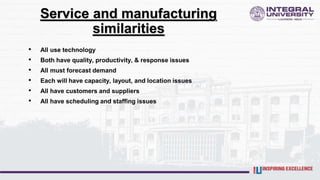
Service and manufacturing
similarities
• All use technology
• Both have quality, productivity, & response issues
• All must forecast demand
• Each will have capacity, layout, and location issues
• All have customers and suppliers
• All have scheduling and staffing issues
Topic 2
Operation Performance
Thank You
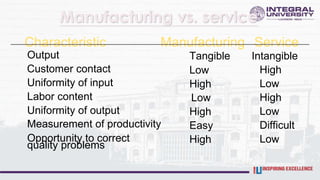
Manufacturing vs. service
Characteristic Manufacturing Service
Output
Customer contact
Uniformity of input
Labor content
Uniformity of output
Measurement of productivity
Opportunity to correct
Tangible
Low
High
Low
High
Easy
High
Intangible
High
Low
High
Low
Difficult
Low
quality problems
High
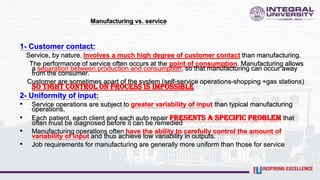
Manufacturing vs. service
1- Customer contact:
Service, by nature, involves a much high degree of customer contact than manufacturing.
The performance of service often occurs at the point of consumption. Manufacturing allows
a separation between production and consumption, so that manufacturing can occur away
from the consumer.
Customer are sometimes apart of the system (self-service operations-shopping +gas stations)
so tight control on process is impossible
2- Uniformity of input:
• Service operations are subject to greater variability of input than typical manufacturing
operations.
• Each patient, each client and each auto repair presents a specific problem that
often must be diagnosed before it can be remedied
• Manufacturing operations often have the ability to carefully control the amount of
variability of input and thus achieve low variability in outputs.
• Job requirements for manufacturing are generally more uniform than those for service
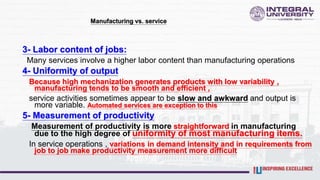
Manufacturing vs. service
3- Labor content of jobs:
Many services involve a higher labor content than manufacturing operations
4- Uniformity of output
Because high mechanization generates products with low variability ,
manufacturing tends to be smooth and efficient ,
service activities sometimes appear to be slow and awkward and output is
more variable. Automated services are exception to this
5- Measurement of productivity
Measurement of productivity is more straightforward in manufacturing
due to the high degree of uniformity of most manufacturing items.
In service operations , variations in demand intensity and in requirements from
job to job make productivity measurement more difficult
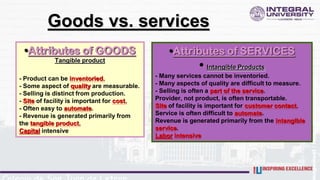
•Attributes of GOODS
Tangible product
- Product can be inventoried.
- Some aspect of quality are measurable.
- Selling is distinct from production.
- Site of facility is important for cost.
- Often easy to automate.
- Revenue is generated primarily from
the tangible product.
Capital intensive
Goods vs. services
•Attributes of SERVICES
• Intangible Products
- Many services cannot be inventoried.
- Many aspects of quality are difficult to measure.
- Selling is often a part of the service.
Provider, not product, is often transportable.
Site of facility is important for customer contact.
Service is often difficult to automate.
Revenue is generated primarily from the intangible
service.
Labor intensive
6- The ever - changing world of OM
Increased global competition
Advances in technology
Linking OM to customers and suppliers
The ever-changing world
of OM
• Operations management is continuously
changing to meet the new and exciting
challenges of today's business world.
• This ever-changing world is characterized by
increasing global competition and advances in
technology. Emphasis is also shifting within the
operations function to link it more closely with
both customers and suppliers.
• Here we will consider these issues:
(A)- Increased global
competition
• Global (economy, village, and landscape): are terms used to describe how the
world is becoming smaller, and countries are becoming
more dependent on each other.
• The world is rapidly transforming itself into a single global economy, which
referred to as a global village or global landscape.
• Markets once dominated by local or national companies are now vulnerable
to competition from literally all corners of the world. For example, in the
1960s, only 7 percent of the firms in the United States exposed to foreign
competition; by the late 1980s,
• This figure exceeded 70 percent, and that percentage has continued to
grow.
• Consequently, as companies expand their business to include foreign
markets, so too must the operations management function take a more
global perspective in order for companies to remain
competitive.
• To s prosper in such a global marketplace companies must excel in
more than one dimension, which previously was the norm.
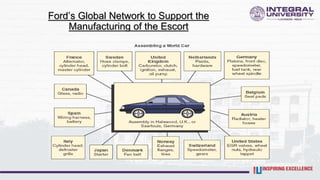
Ford’s Global Network to Support the
Manufacturing of the Escort
(B)- Advances in technology
• Advance in technology in recent years have had a
significant effect on the OM function:
• IT+ automation + Internet
• Competition
• Product life cycle
• New jobs
• Robots
• E-???
(C )- Linking OM to customers
and suppliers
• In the past, most manufacturing organizations viewed operations
strictly as an internal function that had to be buffered from
the external environment by other organizational functions.
• Orders were generated by the marketing function; supplies and raw
materials were obtained through the purchasing function; capital for
equipment purchases came from the finance function; the labor
force was obtained through the human resources function; and the
product was delivered by the distribution function
• Now more and more firms are recognizing the competitive
advantage achieved when the transformation process is not
isolated, as when customers are invited to view their
operating facilities firsthand
(C )- Linking OM to customers
and suppliers
companies are working more closely with suppliers.
• Firms like Toyota, have suppliers deliver product directly to the
factory floor, eliminating need for a stockroom.
• The relationship between the transformation processes of suppliers and
customer often referred to as a product's value chain.
• ( steps an organization requires to produce a good or service, regardless of where
the are performed)
• A value chain consists of all the steps actually add value to the
product. This concept helps managers to eliminate all non added steps
(such as inspections and inventory) and consequently results in a
higher of dependence among the value-added functions within the chain.
• This integration of both suppliers and customers into the transformation
process to blur the boundaries between what were previously totally
independent organizations (Virtual enterprises)
• (company whose boundaries are not clearly defined due to the integration of
customers and suppliers)
7- Make or buy?
Capacity
Expertise
Quality
Demand
Cost
Risk
Make or buy?
• Many organizations buy parts or contract out services, for a
variety of reasons. Among those factors are:
1- Available capacity:
• If an organization has available the equipment, necessary
skills, and time, it often make sense to produce an item or
perform a service in-house.
• The additional costs would be relatively small compared with
required to buy items or subcontract services.
2- Expertise:
• If a firm lacks the expertise to do a job satisfactorily, buying
might be a reasonable alternative.
Make or buy?
3- Quality consideration:
Firms that specialize can usually offer high quality than an organization
can attain itself.
Conversely, unique quality requirements or the desire to closely monitor quality
may cause an organization to perform a job itself.
4- The nature of demand:
When demand for an item is high and steady, the organization is often better
off doing the work itself.
However, wide fluctuations in demand or small orders are usually better
handled by specializations who are able to combine orders from multiple
sources, which results in a higher volume and tends to offset individual
buyer fluctuations.
Make or buy?
5- Cost:
Any cost savings achieved from buying or making must be weighted against the preceding
factors.
Cost saving might come from the item itself or from transportation cost savings.
If there are fixed costs associated with making an item that cannot be reallocated if the service or
product is outsourced , that has to be recognized in the analysis.
Conversely, outsourcing may help a firm avoid incurring fixed costs.
6- Risk:
Outsourcing may involve certain risks. one is loss of control operations. Another is the
need to disclose propriety information.
In some cases , a firm might choose to perform part of the job itself and let
others handle the rest in order to maintain flexibility and to hedge against
loss of a subcontractor .
If part or all the work will be done “ in-house”, capacity alternatives will need to
developed
8- Historical development of OM
Prior to 1900
Scientific Management
Other Management Pioneers (Gilbreth + Gantt)
Moving Assembly Line
Hawthorne Studies
Operations Research
OM Emerges as a Field
The Marriage of OM and IT
OM in Services
Integration of Manufacturing and Services
Historical development of OM
Prior to 1900:
• Cottage industry produced custom-made goods.
• Watt’s steam engine in 1785.
• Whitney’s standardized gun parts in 1801.
• Industrial Revolution began at mid-century.
Scientific Management (Frederick W. Taylor):
• Systematic approach to increasing worker productivity through time study,
standardization of work, and incentives.
• Viewed workers as an interchangeable asset.
Other Management Pioneers:
• Frank and Lillian Gilbreth
• Motion study and industrial psychology
• Henry L. Gantt
• Scheduling and the Gantt chart
Historical development of OM
Moving Assembly Line (1913):
• Labor specialization reduced assembly time.
Hawthorne Studies:
• Yielded unexpected results in the productivity of Western Electric plant
workers after changes in their production environment.
• Led to recognition of the importance of work design and employee
motivation.
Operations Research (Management Science):
• Outgrowth of WWII needs for logistics control and weapons-systems
design.
• Seeks to obtain mathematically optimal (quantitative) solutions to complex
problems.
OM Emerges as a Field:
• 1950–1960, OM moved beyond industrial engineering and operations
research to the view of the production operation as a system.
• 1950–1960, OM moved beyond industrial engineering and operations
research to the view of the production operation as a system
Historical development of OM
The Marriage of OM and IT:
• Integrated solutions approaches
• Business process reengineering
• Supply chain management
• Systems integration (SAP)
Operations Management in Services:
• OM concepts can apply to both manufacturing and service
operations.
Integration of Manufacturing and Services:
• Conducting world class operations requires compatible
manufacturing and service operations
Last word
• Shifts from cost and efficiency to value, from mass production to lean
production, from manufacturing technology to information technology, and from
national economy to world economy have made OM critically important
in modern business.
• Workers are different; they demand increasing levels of empowerment and more
meaningful work.
• Customers are different, their demands and expectations are much higher.
• Technology is different; computers & automation have dramatically changed the
nature of work, requiring constant learning and more abstract thinking.
• Finally the environment is different, we live in a global business environment
without boundaries .
• Such changes in business are occurring at an increasingly rapid pace, and we can
expect them to continue in the future. Operations managers clearly face
important challenges in preparing for this century.
Last word?
• “Paying attention to customers and knowing what they
want is a fundamental and important beginning.
• However, given that several competing companies pay
attention to what customers want, the key to
competitiveness then becomes production capability.
What differentiates winners from losers is that winners
are better able to consistently provide products and
services that are competitive with regard to
quality, price, time and agility

The Operations as a transformation process

  • 1.
    SUBJECT MBA303:OPERATION MANAGEMENT LECTURE NO.-1 Dr.Moiz Akhtar Faculty of Commerce & Management Integral University, Lucknow CENTRE FOR DISTANCE AND ONLINE EDUCATION INTEGRAL UNIVERSITY, LUCKNOW
  • 2.
  • 3.
  • 4.
    Contents 1- What isOperations Management (OM)? 2- Importance of OM . 3- OM decisions. 4- OM's contributions to society. 5- OM of service & manufacturing organizations 6- The ever-changing world of OM 7- Make or buy decision 8- Historical development of OM.
  • 5.
    What is operationsmanagement (OM)?  OM definition  Responsibilities of Operations Managers  Difference between OM and PM
  • 6.
    What is operationsmanagement ? 1-The collection of people, technology, and systems within a company that has primary responsibility for providing the organization’s products or services. 2-The management of the direct recourses that are required to produce and deliver an organization's goods and services . 3- A discipline and profession that studies and practices the process of planning, designing, and operating production systems and subsystems to achieve the goals of the organization. 4- The business function responsible for planning, coordinating, and controlling the resources needed to produce a company’s products and services. 5- The management of the conversion process that transforms inputs into outputs in the form of finished goods and services.
  • 7.
  • 8.
    Inputs and Outputsof a production system Inputs External: • Legal, Economic, Social, Technological Market: • Competition, Customer Desires, Product Info. Primary Resources: • Materials, Personnel, Capital, Utilities Outputs Direct • Products • Services Indirect • Waste • Pollution • Technological Advances
  • 9.
  • 10.
  • 11.
    What is operationsmanagement ?  Operations management is the set of activities that create value in the form of goods and services by transforming inputs into outputs  Value added is the net increase between output product value and input material value (The value of the outputs is greater than the value of the inputs, resulting in the profit or the benefit for government or non-profit organizations)  All types of organizations, manufacturing or service, large or small, transform inputs into outputs.  Every organization has OM function, since all organizations provide products or services, but the function may be formal or informal (In many smaller organizations operations management may be done by people who perform many other types of task such as marketing and accounting)
  • 12.
    What's the differencebetween PM and OM? • Some thinks that they are really one and the same by different names. • others think that production management is just a subset of operations management because operations involve more than just production. • if services concept added to the production management it can be called operations management.
  • 13.
    What responsibilities dooperations managers have? • Direct responsibilities :the activities which are directly related to producing and delivering products and services. • Indirect responsibilities :the activities involved in interfacing with other parts of the organization. • Broad responsibilities :a wider set of tasks that involve scanning the business, social and political environment in which the organization exists in order to understand its context.
  • 14.
    Responsibilities of OM Products& services Planning – Capacity – Location – – Make or buy – Layout – Projects – Scheduling Controlling/Improving – Inventory – Quality Organizing – Degree of centralization – Process selection Staffing – Hiring/laying off – Use of Overtime Directing – Incentive plans – Issuance of work orders – Job assignments – Costs – Productivity
  • 15.
    Importance of OM 1-Operations is an important part of every organization 2- We should know how goods and services are produced (All managers should have an understanding the main principles and tools of OM) 3- It is responsible for the customer fulfillment aspects of an organization. Thus, it manages customer satisfaction. 4- OM is such a costly part of an organization. (For most organizations it absorbs a huge percentage of required capital ) Companies need to have efficient operations to survive. To succeed, a firm must have a strong operations function teaming with the other organization functions. 5- OM responsible to increase productivity and profitability. Increasing overall productivity leads to economic growth and a higher standard of living. 6- Operational decision-making requires a long-term perspective and requires inputs from all business functions. OM Decisions tend to be costly and difficult to reverse
  • 16.
    Strategic options managersuse to gain competitive advantage • 28% - Operations Management (+quality?) • 18% - Marketing/distribution • 17% - Momentum/name recognition • 16% - Quality/service • 14% - Good management • 4% - Financial resources • 3% - Other
  • 17.
    Some definitions • Productivity:The ration of what is produced by an operation or process to what is required to produced it, that is ,the output from the operations divided by the input to the input operation (ratio of output to input) • Efficiency: producing something at the lowest possible cost • Effectiveness: doing the right things to create the most value for the firm • Value: quality divided by price • Competitive advantage: competitive advantage is an advantage over competitors gained by offering consumers greater value, either by means of lower prices or by providing greater benefits and service that justifies higher prices
  • 18.
  • 19.
    • Where shouldwe locate our facility • How much capacity do we need • What should we make, what should we buy • What technology should we use • How do we insure appropriate quality • Who should we use as vendors • How much inventory do we need • How should we schedule our resources Main operational decisions
  • 20.
    Critical decisions ofOM • Product & service design. • Quality management. • Process design. • Capacity & location of facilities. • Layout of facilities. • Human resource & Job design. • Supply-chain management. • Inventory management. • Scheduling. • Maintenance.
  • 21.
    OM decisions Operations managersmust make decisions on three levels:
  • 22.
    Strategic decisions • seniormanagement responsibility • More broad in nature • Determine the success of an organization's strategy, • Very risky and hard to reverse • Have significant long - term impact, ,and • less frequent. • Examples: • How will we make the product? • Where do we locate the facility? • How much capacity do we need? • When should we add more capacity?
  • 23.
    Tactical decisions • Medium-range decisions focus on resource needs, schedules, & quantities to produce • Tactical decisions are frequent, must align with strategic decisions. • Involves resource allocation and utilization. • Involves a moderate degree of uncertainty and risk.. • They are the link between lower and high level management • Examples: • How many workers do we need? • When do we need them? • Should we work overtime or put on a second sift? • When should we have material delivered? • Should we have a finished goods inventory?
  • 24.
    Operational decisions • Involvesa short time horizon. • Involves very little uncertainty and risk. • Examples : • What jobs do we work on today or this week? • To whom do we assign what task? • What jobs have priority?
  • 25.
    OM decisions Strategic TacticalOperating Characteristics Longer term decisions Medium term decisions Shorter term decisions Responsibility of the senior management Responsibility of middle and senior managers Responsibility of middle and lower management levels High capital investment Broad in nature Narrow in scope These decisions concern the day-to-day activities of workers
  • 26.
    4- OM's contributionsto society Higher Standard of Living Better Quality Goods and Services Concern for the Environment Improved Working Conditions
  • 27.
    Operations management's contributions tosociety OM's contributions to society:- (A)- Higher Standard of Living (B) - Better Quality Goods and Services (C)- Concern for the Environment (D)- Improved Working Conditions
  • 28.
    (A)- Higher standardof living • A major factor in raising the standard of living in a society is the ability to increase its productivity. • Higher productivity is the result of increased efficiency in operations, which in turn translates into lower cost goods and services. • Thus, higher productivity provides consumers with more discretionary income, which contributes to their higher standard of living.
  • 29.
    (B) - Betterquality of goods and services • One of the many consumer benefits of increased competition is the higher-quality products that are available today. • Quality standards are continually increasing. • Many companies today have established Six-Sigma quality standards (pioneered by Motorola in the late 1980s), resulting in no more than 3.4 defects per million opportunities. • Such high quality standards were once considered not only prohibitively expensive but also virtually impossible to achieve even if cost wasn't a consideration. • Today we know that such high quality is not only very possible, but also results in lower costs, because firms can reduce their waste and rework.
  • 30.
    1-Improve productivity 3- Lowercost of goods & services 5-Higher standard of living Higher standard of living 2- Result of increased efficiency in operations 4- More income
  • 31.
    (C)- Concern forthe environment Many companies today are taking up the challenge to produce environmentally friendly products with environmentally friendly processes, all of which falls under the purview of operations management. • Recycling and concern for air and water quality
  • 32.
    (D)-Improved working conditions • Managersrecognize the benefits of providing workers with better working conditions. • This includes not only the work environment but also the design of the jobs themselves. • Workers are now encouraged to participate in improving operations through suggestions. • After all, who would know better how to do a particular operation than that person who does it every day. • Managers also have learned that there is a very clear relationship between satisfied workers and satisfied customers, especially in service operations. • (Empowerment :The concept of encouraging and authorizing workers to take the initiative to improve operations, reduce costs, and improve product quality and customer service.)
  • 33.
    5- OM ofservice and manufacturing organizations Importance of service now Service nature The affect of service nature on OM activities
  • 34.
    OM of serviceand manufacturing organizations • Initially, operations management concepts focused almost entirely on manufacturing. • As countries become more developed, services continue to represent a larger percentage of their economies. • Now Less than 20%of all jobs are in manufacturing (and they are declining) • Almost 80% of jobs are in the service sector (and they are increasing) • Nearly half of all jobs are in POM
  • 35.
    Services as apercent of Gross Domestic Product (GDP) for different countries
  • 36.
    1850 Services Industry Farming 80% 40% 0 U.S. Employment, %Share Development of the service economy 1950 1900 2000
  • 37.
    U.S. manufacturing vsservice employment Year M fg. Service 45 79 21 50 72 28 55 72 28 60 68 32 65 64 36 70 64 36 75 58 42 80 44 46 85 43 57 90 35 65 95 32 68 00 30 70
  • 38.
    Growth in servicesin the United States
  • 39.
    Service and manufacturing similarities •All use technology • Both have quality, productivity, & response issues • All must forecast demand • Each will have capacity, layout, and location issues • All have customers and suppliers • All have scheduling and staffing issues
  • 40.
  • 41.
  • 42.
    Manufacturing vs. service CharacteristicManufacturing Service Output Customer contact Uniformity of input Labor content Uniformity of output Measurement of productivity Opportunity to correct Tangible Low High Low High Easy High Intangible High Low High Low Difficult Low quality problems High
  • 43.
    Manufacturing vs. service 1-Customer contact: Service, by nature, involves a much high degree of customer contact than manufacturing. The performance of service often occurs at the point of consumption. Manufacturing allows a separation between production and consumption, so that manufacturing can occur away from the consumer. Customer are sometimes apart of the system (self-service operations-shopping +gas stations) so tight control on process is impossible 2- Uniformity of input: • Service operations are subject to greater variability of input than typical manufacturing operations. • Each patient, each client and each auto repair presents a specific problem that often must be diagnosed before it can be remedied • Manufacturing operations often have the ability to carefully control the amount of variability of input and thus achieve low variability in outputs. • Job requirements for manufacturing are generally more uniform than those for service
  • 44.
    Manufacturing vs. service 3-Labor content of jobs: Many services involve a higher labor content than manufacturing operations 4- Uniformity of output Because high mechanization generates products with low variability , manufacturing tends to be smooth and efficient , service activities sometimes appear to be slow and awkward and output is more variable. Automated services are exception to this 5- Measurement of productivity Measurement of productivity is more straightforward in manufacturing due to the high degree of uniformity of most manufacturing items. In service operations , variations in demand intensity and in requirements from job to job make productivity measurement more difficult
  • 45.
    •Attributes of GOODS Tangibleproduct - Product can be inventoried. - Some aspect of quality are measurable. - Selling is distinct from production. - Site of facility is important for cost. - Often easy to automate. - Revenue is generated primarily from the tangible product. Capital intensive Goods vs. services •Attributes of SERVICES • Intangible Products - Many services cannot be inventoried. - Many aspects of quality are difficult to measure. - Selling is often a part of the service. Provider, not product, is often transportable. Site of facility is important for customer contact. Service is often difficult to automate. Revenue is generated primarily from the intangible service. Labor intensive
  • 46.
    6- The ever- changing world of OM Increased global competition Advances in technology Linking OM to customers and suppliers
  • 47.
    The ever-changing world ofOM • Operations management is continuously changing to meet the new and exciting challenges of today's business world. • This ever-changing world is characterized by increasing global competition and advances in technology. Emphasis is also shifting within the operations function to link it more closely with both customers and suppliers. • Here we will consider these issues:
  • 48.
    (A)- Increased global competition •Global (economy, village, and landscape): are terms used to describe how the world is becoming smaller, and countries are becoming more dependent on each other. • The world is rapidly transforming itself into a single global economy, which referred to as a global village or global landscape. • Markets once dominated by local or national companies are now vulnerable to competition from literally all corners of the world. For example, in the 1960s, only 7 percent of the firms in the United States exposed to foreign competition; by the late 1980s, • This figure exceeded 70 percent, and that percentage has continued to grow. • Consequently, as companies expand their business to include foreign markets, so too must the operations management function take a more global perspective in order for companies to remain competitive. • To s prosper in such a global marketplace companies must excel in more than one dimension, which previously was the norm.
  • 49.
    Ford’s Global Networkto Support the Manufacturing of the Escort
  • 50.
    (B)- Advances intechnology • Advance in technology in recent years have had a significant effect on the OM function: • IT+ automation + Internet • Competition • Product life cycle • New jobs • Robots • E-???
  • 51.
    (C )- LinkingOM to customers and suppliers • In the past, most manufacturing organizations viewed operations strictly as an internal function that had to be buffered from the external environment by other organizational functions. • Orders were generated by the marketing function; supplies and raw materials were obtained through the purchasing function; capital for equipment purchases came from the finance function; the labor force was obtained through the human resources function; and the product was delivered by the distribution function • Now more and more firms are recognizing the competitive advantage achieved when the transformation process is not isolated, as when customers are invited to view their operating facilities firsthand
  • 52.
    (C )- LinkingOM to customers and suppliers companies are working more closely with suppliers. • Firms like Toyota, have suppliers deliver product directly to the factory floor, eliminating need for a stockroom. • The relationship between the transformation processes of suppliers and customer often referred to as a product's value chain. • ( steps an organization requires to produce a good or service, regardless of where the are performed) • A value chain consists of all the steps actually add value to the product. This concept helps managers to eliminate all non added steps (such as inspections and inventory) and consequently results in a higher of dependence among the value-added functions within the chain. • This integration of both suppliers and customers into the transformation process to blur the boundaries between what were previously totally independent organizations (Virtual enterprises) • (company whose boundaries are not clearly defined due to the integration of customers and suppliers)
  • 53.
    7- Make orbuy? Capacity Expertise Quality Demand Cost Risk
  • 54.
    Make or buy? •Many organizations buy parts or contract out services, for a variety of reasons. Among those factors are: 1- Available capacity: • If an organization has available the equipment, necessary skills, and time, it often make sense to produce an item or perform a service in-house. • The additional costs would be relatively small compared with required to buy items or subcontract services. 2- Expertise: • If a firm lacks the expertise to do a job satisfactorily, buying might be a reasonable alternative.
  • 55.
    Make or buy? 3-Quality consideration: Firms that specialize can usually offer high quality than an organization can attain itself. Conversely, unique quality requirements or the desire to closely monitor quality may cause an organization to perform a job itself. 4- The nature of demand: When demand for an item is high and steady, the organization is often better off doing the work itself. However, wide fluctuations in demand or small orders are usually better handled by specializations who are able to combine orders from multiple sources, which results in a higher volume and tends to offset individual buyer fluctuations.
  • 56.
    Make or buy? 5-Cost: Any cost savings achieved from buying or making must be weighted against the preceding factors. Cost saving might come from the item itself or from transportation cost savings. If there are fixed costs associated with making an item that cannot be reallocated if the service or product is outsourced , that has to be recognized in the analysis. Conversely, outsourcing may help a firm avoid incurring fixed costs. 6- Risk: Outsourcing may involve certain risks. one is loss of control operations. Another is the need to disclose propriety information. In some cases , a firm might choose to perform part of the job itself and let others handle the rest in order to maintain flexibility and to hedge against loss of a subcontractor . If part or all the work will be done “ in-house”, capacity alternatives will need to developed
  • 57.
    8- Historical developmentof OM Prior to 1900 Scientific Management Other Management Pioneers (Gilbreth + Gantt) Moving Assembly Line Hawthorne Studies Operations Research OM Emerges as a Field The Marriage of OM and IT OM in Services Integration of Manufacturing and Services
  • 58.
    Historical development ofOM Prior to 1900: • Cottage industry produced custom-made goods. • Watt’s steam engine in 1785. • Whitney’s standardized gun parts in 1801. • Industrial Revolution began at mid-century. Scientific Management (Frederick W. Taylor): • Systematic approach to increasing worker productivity through time study, standardization of work, and incentives. • Viewed workers as an interchangeable asset. Other Management Pioneers: • Frank and Lillian Gilbreth • Motion study and industrial psychology • Henry L. Gantt • Scheduling and the Gantt chart
  • 59.
    Historical development ofOM Moving Assembly Line (1913): • Labor specialization reduced assembly time. Hawthorne Studies: • Yielded unexpected results in the productivity of Western Electric plant workers after changes in their production environment. • Led to recognition of the importance of work design and employee motivation. Operations Research (Management Science): • Outgrowth of WWII needs for logistics control and weapons-systems design. • Seeks to obtain mathematically optimal (quantitative) solutions to complex problems. OM Emerges as a Field: • 1950–1960, OM moved beyond industrial engineering and operations research to the view of the production operation as a system. • 1950–1960, OM moved beyond industrial engineering and operations research to the view of the production operation as a system
  • 60.
    Historical development ofOM The Marriage of OM and IT: • Integrated solutions approaches • Business process reengineering • Supply chain management • Systems integration (SAP) Operations Management in Services: • OM concepts can apply to both manufacturing and service operations. Integration of Manufacturing and Services: • Conducting world class operations requires compatible manufacturing and service operations
  • 61.
    Last word • Shiftsfrom cost and efficiency to value, from mass production to lean production, from manufacturing technology to information technology, and from national economy to world economy have made OM critically important in modern business. • Workers are different; they demand increasing levels of empowerment and more meaningful work. • Customers are different, their demands and expectations are much higher. • Technology is different; computers & automation have dramatically changed the nature of work, requiring constant learning and more abstract thinking. • Finally the environment is different, we live in a global business environment without boundaries . • Such changes in business are occurring at an increasingly rapid pace, and we can expect them to continue in the future. Operations managers clearly face important challenges in preparing for this century.
  • 62.
    Last word? • “Payingattention to customers and knowing what they want is a fundamental and important beginning. • However, given that several competing companies pay attention to what customers want, the key to competitiveness then becomes production capability. What differentiates winners from losers is that winners are better able to consistently provide products and services that are competitive with regard to quality, price, time and agility