PRESENTED BY,
Anitha Thomas
WINNERS GROUP
VIDEO
OPERATIONS MANAGEMENT
 What is operations?
 The part of a business organization that is responsible for
producing goods or services
 How can we define operations management?
 The management of systems or processes that create goods
and/or provide services
Goods are physical items that include raw materials, parts,
subassemblies, and final products.
•Automobile
•Computer
•Oven
•Shampoo
Services are activities that provide some combination of
time, location, form or psychological value.
•Air travel
•Education
•Haircut
•Legal counsel
Goods & Services
 Services
 Intangible product
 Product cannot be
inventoried
 High customer contact
 Short response time
 Labor intensive
 Manufacturing
 Tangible product
 Product can be
inventoried
 Low customer contact
 Longer response time
 Capital intensive
 OM Transforms inputs to outputs
 Inputs are resources such as
 People, Material, and Money
 Outputs are goods and services
What is Role of OM?
OM’s Transformation Process
Inputs
•Land
•Labor
•Capital
•Information
Outputs
•Goods
•Services
Transformation/
Conversion
Process
Control
Measurement
and Feedback
Measurement
and Feedback
Measurement
and Feedback
Value-Added
Feedback = measurements taken at various points in the transformation process
Control = The comparison of feedback against previously established
standards to determine if corrective action is needed.
Input-Transformation-Output
Relationships for Typical Systems
The operations function includes many interrelated
activities such as:
 Forecasting
 Capacity planning
 Facilities and layout
 Scheduling
 Managing inventories
 Assuring quality
 Motivating employees
 Deciding where to locate facilities
The scope of operations management ranges across
the organization.
Production Planning and Control
Planning
 Production planning may be defined as the technique of foreseeing every
step in a long series of separate operations, each step to be taken at the
right time and in the right place and each operation to be performed in
maximum efficiency.
 It helps entrepreneur to work out the quantity of material manpower,
machine and money requires for producing predetermined level of output in
given period of time.
Routing
 Under this, the operations, their path and sequence are established.
 To perform these operations the proper class of machines and personnel
required are also worked out. The main aim of routing is to determine
the best and cheapest sequence of operations and to ensure that this
sequence is strictly followed.
Scheduling
 It means working out of time that should be required to perform each
operation and also the time necessary to perform the entire series as
routed, making allowances for all factors concerned.
 It mainly concerns with time element and priorities of a job.
 The pattern of scheduling differs from one job to another.
Loading
 The next step is the execution of the schedule plan as per the route
chalked out it includes the assignment of the work to the operators at
their machines or work places.
 So loading determines who will do the work as routing determines where
and scheduling determines when it shall be done.
Dispatching
 Dispatching involves issue of production orders for starting the operations.
 Activity of releasing documents.
 To prepare various documents such as Job Cards, Route sheets, Move
Cards, Inspection Cards for each and every component of the product.
 These documents are to be released from Production Management
department to give green signal for starting the production.
 The activities of the shop floor will follow the instructions given in these
documents.
Follow up
 Once the document are dispatched, the management wants to
know whether the activity is being carried out as per the plans or
not.
 Compare the actual work with the plan.
Inspection
 This is mainly to ensure the quality of goods. It can be
required as effective agency of production control.
Corrective measures
Corrective action may involve any of those activities of
 adjusting the route,
 rescheduling of work
 changing the workloads,
 repairs and maintenance of machinery or equipment,
 control over inventories of the cause of deviation is the poor
performance of the employees.
Functional Areas of
Management
PRESENTED BY,
Dias John
Human Resource Management
 It is concerned with obtaining and maintaining of a satisfactory
and satisfied work force. It is a specialized branch of
management concerned with man management.
 It consist of recruitment, placement, induction, orientation,
training, promotion, motivation, performance appraisal, wage
and salary, etc…
Production Management
 It refers to planning, organization, direction, coordination and
control of the production function in such a way that desired goods
and services could be produced at the right time in right quantity
and at the right cost.
It involves
 Production planning and development
 Plant location, layout and maintenance
 Production systems and machines
 Management of purchase and storage of materials
 Ensuring effective production control
Office Management
 It can be defined as the organization of an office in order to
achieve a specified purpose and to make the best use of the
personnel by using the most appropriate machines and equipment,
the best possible methods of work and by providing the most
suitable environment
 It includes office accommodation, layout and environment,
communication, office reporting and office supervision.
Financial Management
 It is the study of relationship between the raising of funds and the
deployment of funds.
 It includes cost of capital, portfolio management, dividend policy,
short term and long term sources of finance. It involves 3 decisions
mainly they are,
 Investment Policies : it dictates associated with capital budgeting
and expenditures. All proposals to spend money are ranked and
investment decisions are taken whether to sanction money for
these proposed ventures or not.
 Method of Financing : a proper mix of short and long term
financing is ensured in order to provide necessary funds for
proposed ventures at a minimum risk to the enterprise .
 Dividend Decisions : This decision affects the amount
paid to shareholders and distribution of additional shares
of stock.
Marketing Management
 It refers to the process of “planning and executing the conception,
pricing, promotion and distribution of ideas, goods and services to
create exchange that satisfy individual and organizational
objectives”.
 It includes marketing concept, consumer behavior, marketing mix,
market segmentation, product and price decisions, international
marketing etc…
MANUFACTURING
VERSUS
SERVICE OPERATION
PRESENTED BY,
Pooja Antony
INTRODUCTION
EVERYDAY WE COME IN CONTACT WITH VARIOUS GOODS & SERVICES.
IN THE BROADEST SENSE OPERATION MANAGEMENT IS CONCERNED
WITH THE PRODUCTION OF GOODS & SERVICES. ACCORDINGLY THE FIELD
OF OPERATIONS CAN BE DIVIDED INTO  MANUFACTURING OPERATIONS
& SERVICE OPERATIONS.
MANUFACTURING
OPERATIONS
MANUFACTURING
OPERATIONS
FORMING
PROCESS
MACHINING
PROCESS
ASSEMBLY
PROCESS
IT CONVERTS INPUT LIKE MATERIALS,LABOUR & CAPITAL INTO SOME
TANGIBLE OUTPUTS. IT CAN BE CATEGORISED UNDER THREE HEADS :
FORMING PROCESS: THIS PROCESS CHANGES THE SHAPE OF THE
WORK PIECE WITHOUT NECESSARILY REMOVING OR ADDING
MATERIALS.. EX: CASTING,STAMPING,FORGING ETC.
MACHINING PROCESS: IT INVOLVES BASICALLY METAL REMOVAL.
EX: DRILLING, GRINDING, MILLING & BORING ETC.
ASSEMBLY PROCESS: IT INVOLVES JOINING OF COMPONENTS OR
PIECE-PARTS TO PRODUCE A SINGLE COMPONENT THAT HAS A
SPECIFIC FUNCTION. EX: FASTENING WITH BOLTS & NUTS, JOINING
BY ADHESIVES.
THE OBJECTIVES OF EACH PROCESS IS TO CHANGE THE
SHAPE OR PHYSICAL CHARACTERISTICS OF THE RAW-
MATERIALS OR INPUTS.
SERVICE OPERATIONS
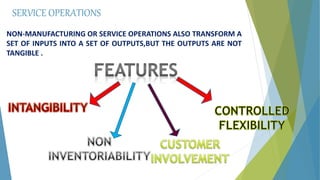
NON-MANUFACTURING OR SERVICE OPERATIONS ALSO TRANSFORM A
SET OF INPUTS INTO A SET OF OUTPUTS,BUT THE OUTPUTS ARE NOT
TANGIBLE .
INTANGIBILITY
IT IS NOT TANGIBLE LIKE THE PHYSICAL GOODS. IT CAN NOT BE SEEN
PHYSICALLY, BUT IT CAN BE FELT.
NON-INVENTORIABILITY
AS OPPOSED TO PHYSICAL GOODS SERVICES ARE NOT INVENTORIABLE,
BECAUSE A SERVICE IS PRODUCED AND CONSUMED SIMULTANEOUSLY. IN
THIS SENSE A SERVICE DOES N’T EXIST , HOWEVER THE RESULT OF
SERVICE LAST FOR SOMETIME.
BESIDES THE QUALITY ASPECTS, THE INVENTORIABILITY OF SERVICES ALSO
MEANS THAT THE CUSTOMER MAY BE DIRECTLY INVOLVED IN OPERATIONS,
WHERE THE PRODUCTION AND CONSUMPTION TAKES PLACE SIMULTANEOUSLY.
SO THE SERVICE AND THE SERVICE PROVIDER BOTH ARE THERE WITH THE
CUSTOMER.
FLEXIBILITY IS A CHARACTERISTIC OF A FIRM’S OPERATIONS THAT ENABLES IT TO
REACT TO CUSTOMER NEEDS QUICKLY & EFFICIENTLY. BUT WHERE THERE IS
FLEXIBILITY THE POSSIBILITY OF CHAOTIC SITUATION CAN BE FOUND IN THE
PRODUCTION & DELIVERY SYSTEM. IN SERVICE OPERATIONS AS THERE ARE
INTANGIBLE OBJECTS , IT IS VERY MUCH CONTROLLED HERE.
CLASSIFICATIONS OF SERVICES
TANGIBLE ACTIONS TO PEOPLES BODIES:
EX: HAIR CUTTING,RESTAURANT,HEALTH CARE ETC.
TANGIBLE ACTIONS TO PEOPLES GOODS :
EX: LAUNDRY, REPAIRING CENTRES,TAILOR ETC.
INTANGIBLE ACTIONS DIRECTED TO PEOPLES MIND:
EX : TRAINING, INFORMATION SERVICES,BROADCASTING ETC.
INTANGIBLE ACTIONS DIRECTED TO PEOPLES INTANGIBLE ASSETS :
EX : BANKING, INSURANCE & ACCOUNTING ETC.
BASED ON TANGIBLE & INTANGIBLE NATURE OF SERVICES.
DIFFERENCES
DESPITE MANY DIFFERENCES,THERE ARE A LOT OF SIMILARITIES BETWEEN
MANUFACTURING & SERVICE OPERATIONS.THERE IS A INTERDEPENDENCY OF
PRODUCTS & SERVICES, FOR EX: CUSTOMERS WANT BOTH GOOD FOOD AS WELL
AS GOOD SERVICE AT A RESTAURANT.
AGAIN THOUGH SERVICE PROVIDERS CAN NOT INVENTORY THEIR OUTPUTS, BUT
MUST INVENTORY THEIR INPUTS,FOR EX : HOSPITALS MUST MAINTAIN AN
ADEQUATE SUPPLY OF MEDICATIONS, NURSES & DOCTORS.
WHILE BUYING A CAR WE NOT ONLY BUY A PRODUCT BUT ALSO A GURANTEE.
HOSPITAL CARE INVOLVES MEDICATION, BANDAGES & X-RAY FILMS & SO ON, SO
DESPITE A LOT OF DIFFERENCES BOTH PRODUCT & SERVICE ARE PART OF EACH
OTHER
OPERATION
STRATEGY
PRESENTED BY,
Della Thomas
 According to Slack and Lewis, operations strategy holds the
following definition:
 Operations strategy is the total pattern of decisions which
shape the long-term capabilities of any type of operations and
their contribution to the overall strategy.
 Operations strategy is the tool that helps to define the methods
of producing goods or a service offered to the customer
Operation strategy focuses on the questions:
 Where are we going?
 How are we going to compete?
 How are we going to meet customer needs in order to
accomplish our objectives
Typical steps in setting an organization's strategy:
1. Establishing Goals
2. Market and Competitive Analysis
- See the Society of Competitive Intelligence Professionals site
for information
3. Identification of Products, Markets and Competitive
Priorities
4. Establishment of Policy Guidelines and Constraints
Mission - Why are we in the business?
Vision - What do we want our organization to look like 5 years from now?
Strategic Goals- Specific intended targets that indicate how the organization
will achieve its mission and vision.
A short history of operation strategy
 In the period following World War II corporate strategy in the United States was usually developed by
the marketing and finance functions within a company With the high demand or consumer products that
had built up during the war years U.S. companies could sell virtually everything they made at
comparatively high prices. In addition there was very little international competition. The main industrial
competitors of the United States today Germany and Japan. lay in ruins from massive bombings. They
could not even satisfy their own markets. let alone export globally. Within the business environment that
existed that time the manufacturing or operations function was assigned the responsibility to produce
large quantities of standard products at minimum costs. regardless of the overall goals of the firm. To
accomplish this the
operations function focused on obtaining low-cost unskilled labour and installing highly automated
assembly-line-type facilities.
 With no global competition and continued high demand the role of
operations management (that is. to minimize costs) 1950 and early 1960 By the late 1960
however Wick Skinner of the Harvard Business School. who is often referred to as the
grandfather of operations strategy, recognized this weakness among U.S. manufacturers. He
suggested that companies develop an operations strategy that would complement the
existing marketing and finance strategies. In one of his early articles on the subject. Skinner
referred to manufacturing as the missing link in corporate strategy.” Subsequent work in this
area by researchers at the Harvard Business School. including Abernathy. Clark. Hayes. and
Wheelwright, continued to emphasize the importance of using the strengths of a firm’s
manufacturing facilities and people as a competitive weapon in the marketplace as well as
taking a longer-term view of how to deploy them
2.Features of Operations Strategy
 Determined by KSF(Key Success Factor)
 Should be comprehensive and be integrated with corporate
strategy.
 Should be designed to anticipate future
needs.
 Involves a long term process that must
inevitable change.
 Involves decisions that relate to the design of the process and the
infrastructure needed to support the process.
3.Factors Influencing Operations Strategy
a) Quality customers
 Customers come and stay because
 of this factor. It also includes
 cost reduction by various methods of JIT, Lean Manufacturing,
TQM,TPM etc. It enables the firm to be more agile in its manufacture
b) Time
 This aspect considers that deliveries be on time to meet customers’
expectations and thus seek more business.
 It means that the operations conducted have this focus and is achieved by
reducing planning time, design time, processing time and changeover
time ,delivery time and response time to customers’ complaints are
also relevant in this context.
c) Flexibility
To meet the changing demands of customers, to develop new
processes and materials and to make the organization more agile
in its manufacture.
d)Process design
Includes:
 Selection of appropriate technology
 Role of inventory in the process
 Locating the process
e) Infrastructure Decisions
includes:
 Planning and Control of Machines
 Quality assurance and Control approaches
 Payment Structures
 Organization of Operations function
Components
of
Operation Strategy
PRESENTED BY,
Minnu Priya
Operation Strategy
 Operations strategy is defined as the set of decisions that are
warranted in the operational processes in order to support the
competitive strategies of the business.
 It will give the firm competitive advantages in the products or
services that are served to the customers.
Elements of Operations Strategy
 Designing of the production system
 Facilities for production and services
 Product or service design and development
 Technology selection, development, and process development
 Allocation of resources
 Focus on facilities planning
Designing of the Production System
 The designing of the production system involves the selection of the type
of product design, processing system, inventory plan for finished goods,
etc. The product design has two varieties. They are:
 Customized product design
 Standard product design
Facilities for Production and Services
 Certain specialization in production allows the firm to provide the customers
with products of lower cost, faster delivery, on-time delivery, high product
Quality, and flexibility. Here, overheads will be less and the firm can
Outperform compared to the competitors .
 The stages followed in developing a product are:
1. Generating the idea
2. Creating the feasibility reports
3. Designing the prototype and testing
4. Preparing a production model
5. Evaluating the economies of scale for production
6. Testing the product in the market
7. Obtaining feedback
8. Creating the final design and starting the production.
Product or Service Design and Development
Technology Selection and Process Development
 A product selected for production will be analyzed for the process and the
Applicable technology for optimal production. There are many challenges
faced by the operations managers in this decision as the alternatives are
many. The techno-economic analysis for each alternative will help to
decide the required technology.
Allocation of Resources
 The production units face continuous problems of allocating the scarce resources
like capital, machines, equipments, materials, manpower, services, etc. Allocation
at the right time to the right place of production indicates the efficiency of the
production planners.
Facility, Capacity and Layout planning
 The location, layout, and facilities creation for the production are the key
decision areas for the operations manager .
Operations forecasting
PRESENTED BY,
Harikrishnan
Forecasting
It is a method for translating past experience into estimates
of the future.
importance of forecasting
a) Economic development:
The economic conditions of the country as well as global economy would
have significant effect on the operations of an organization. The
necessary elements of such forecasts include predictions relating to GNP
and GDP, currency strength, industrial expansion, job market, inflation
rate, interests rate, and balance of payments and so on.
b) Technological forecasts:
These forecasts predict the new technological developments that may
change the operations of an organization.
c) Competition forecasts:
It is equally necessary to predict as to what strategies your competitors would be
employing to acquire gains in the market share, perhaps at the cost of your market
share.
The competitor may be planning to employ a different market strategy for the
product or to bring out a substitute for the product which could be cheaper and
easily acceptable by consumers.
d) Social forecasts:
These forecasts involve predicting changes in the consumer tastes, demands and
attitudes. Consumers have already established a trend for convenience, comfort and
for products that are easy to use and manage. Matters of taste and preference may
change over a period of time.
Forecasting methods:
1.Qualitative methods
2.Quantitative methods
Qualitative Forecasting Methods
Using qualitative approach, a company forecasts based on judgment and
opinion. Grouped under this approach are
1. Delphi method
2. Market Research
3. Expert Judgment
4. Product Life-cycle analogy
Delphi method
This is a group technique in which a panel of experts is questioned individually
about their perceptions of future events
Forecast is developed by a panel of experts who answer a series of questions.
• Responses are feedback to panel members who then may change their original
responses.
• It does not require the physical presence of group members.
• The experts answer questionnaires in two or more rounds.
Advantages: This type of method is useful and quite effective for long-range
forecasting. The technique is done by questionnaire format and eliminates the
disadvantages of group think.
Market Research
It is any organized effort to gather information about markets or
customers.
• It is a very important component of business strategy.
• Market research provides important information to identify and analyze
the market need, market size and market need, and competition.
• It uses panels, questionnaires, test markets, surveys, etc.
Expert Judgment
The subjective views of executives or experts from sales, production,
finance, purchasing, and administration are averaged to generate a
forecast about future sales.
This approach is used to obtain a rapid assessment of the state of
knowledge about a particular aspect of climate change.
• It is frequently used in a panel format, aggregating opinions to cover a
broad range of issues regarding a topic.
Advantage: The forecasting is done quickly and easily, without need of
elaborate statistics.
Product Life-cycle analogy
Forecasts based on life-cycles of similar products, services, or processes
Quantitative Forecasting Methods
 Time series Forecasting Methods
Time series forecasting methods are based on analysis of historical data
• Analyzing past trends to predict future
• Statistical method used to analyze the sales pattern
 Graphical Methods:
Plotting information in a graphical form. It is relatively easy to convert a
spreadsheet into a graph that conveys the information in a visual manner. Trends
& patterns are easier to spot & extrapolation of previous demand can be used to
predict future demands.
 Econometric Modeling:
A set of equations intended to be used simultaneously to capture the way in which
dependent and independent variables are interrelated.
 Life Cycle Modeling:
“A quantitative forecasting technique based on applying past patterns of demand
data covering introduction, growth, maturity, saturation, and decline of similar
products to a new product family”.
THANK YOU!

OPERATIONS MANAGEMENT

  • 1.
  • 2.
  • 3.
    OPERATIONS MANAGEMENT  Whatis operations?  The part of a business organization that is responsible for producing goods or services  How can we define operations management?  The management of systems or processes that create goods and/or provide services
  • 4.
    Goods are physicalitems that include raw materials, parts, subassemblies, and final products. •Automobile •Computer •Oven •Shampoo Services are activities that provide some combination of time, location, form or psychological value. •Air travel •Education •Haircut •Legal counsel
  • 5.
    Goods & Services Services  Intangible product  Product cannot be inventoried  High customer contact  Short response time  Labor intensive  Manufacturing  Tangible product  Product can be inventoried  Low customer contact  Longer response time  Capital intensive
  • 6.
     OM Transformsinputs to outputs  Inputs are resources such as  People, Material, and Money  Outputs are goods and services What is Role of OM?
  • 7.
    OM’s Transformation Process Inputs •Land •Labor •Capital •Information Outputs •Goods •Services Transformation/ Conversion Process Control Measurement andFeedback Measurement and Feedback Measurement and Feedback Value-Added Feedback = measurements taken at various points in the transformation process Control = The comparison of feedback against previously established standards to determine if corrective action is needed.
  • 8.
  • 9.
    The operations functionincludes many interrelated activities such as:  Forecasting  Capacity planning  Facilities and layout  Scheduling  Managing inventories  Assuring quality  Motivating employees  Deciding where to locate facilities The scope of operations management ranges across the organization.
  • 10.
  • 11.
    Planning  Production planningmay be defined as the technique of foreseeing every step in a long series of separate operations, each step to be taken at the right time and in the right place and each operation to be performed in maximum efficiency.  It helps entrepreneur to work out the quantity of material manpower, machine and money requires for producing predetermined level of output in given period of time.
  • 12.
    Routing  Under this,the operations, their path and sequence are established.  To perform these operations the proper class of machines and personnel required are also worked out. The main aim of routing is to determine the best and cheapest sequence of operations and to ensure that this sequence is strictly followed.
  • 13.
    Scheduling  It meansworking out of time that should be required to perform each operation and also the time necessary to perform the entire series as routed, making allowances for all factors concerned.  It mainly concerns with time element and priorities of a job.  The pattern of scheduling differs from one job to another.
  • 14.
    Loading  The nextstep is the execution of the schedule plan as per the route chalked out it includes the assignment of the work to the operators at their machines or work places.  So loading determines who will do the work as routing determines where and scheduling determines when it shall be done.
  • 15.
    Dispatching  Dispatching involvesissue of production orders for starting the operations.  Activity of releasing documents.  To prepare various documents such as Job Cards, Route sheets, Move Cards, Inspection Cards for each and every component of the product.  These documents are to be released from Production Management department to give green signal for starting the production.  The activities of the shop floor will follow the instructions given in these documents.
  • 16.
    Follow up  Oncethe document are dispatched, the management wants to know whether the activity is being carried out as per the plans or not.  Compare the actual work with the plan.
  • 17.
    Inspection  This ismainly to ensure the quality of goods. It can be required as effective agency of production control.
  • 18.
    Corrective measures Corrective actionmay involve any of those activities of  adjusting the route,  rescheduling of work  changing the workloads,  repairs and maintenance of machinery or equipment,  control over inventories of the cause of deviation is the poor performance of the employees.
  • 19.
  • 21.
    Human Resource Management It is concerned with obtaining and maintaining of a satisfactory and satisfied work force. It is a specialized branch of management concerned with man management.  It consist of recruitment, placement, induction, orientation, training, promotion, motivation, performance appraisal, wage and salary, etc…
  • 22.
    Production Management  Itrefers to planning, organization, direction, coordination and control of the production function in such a way that desired goods and services could be produced at the right time in right quantity and at the right cost.
  • 23.
    It involves  Productionplanning and development  Plant location, layout and maintenance  Production systems and machines  Management of purchase and storage of materials  Ensuring effective production control
  • 24.
    Office Management  Itcan be defined as the organization of an office in order to achieve a specified purpose and to make the best use of the personnel by using the most appropriate machines and equipment, the best possible methods of work and by providing the most suitable environment  It includes office accommodation, layout and environment, communication, office reporting and office supervision.
  • 25.
    Financial Management  Itis the study of relationship between the raising of funds and the deployment of funds.  It includes cost of capital, portfolio management, dividend policy, short term and long term sources of finance. It involves 3 decisions mainly they are,
  • 26.
     Investment Policies: it dictates associated with capital budgeting and expenditures. All proposals to spend money are ranked and investment decisions are taken whether to sanction money for these proposed ventures or not.  Method of Financing : a proper mix of short and long term financing is ensured in order to provide necessary funds for proposed ventures at a minimum risk to the enterprise .
  • 27.
     Dividend Decisions: This decision affects the amount paid to shareholders and distribution of additional shares of stock.
  • 28.
    Marketing Management  Itrefers to the process of “planning and executing the conception, pricing, promotion and distribution of ideas, goods and services to create exchange that satisfy individual and organizational objectives”.  It includes marketing concept, consumer behavior, marketing mix, market segmentation, product and price decisions, international marketing etc…
  • 29.
  • 30.
    INTRODUCTION EVERYDAY WE COMEIN CONTACT WITH VARIOUS GOODS & SERVICES. IN THE BROADEST SENSE OPERATION MANAGEMENT IS CONCERNED WITH THE PRODUCTION OF GOODS & SERVICES. ACCORDINGLY THE FIELD OF OPERATIONS CAN BE DIVIDED INTO  MANUFACTURING OPERATIONS & SERVICE OPERATIONS.
  • 31.
    MANUFACTURING OPERATIONS MANUFACTURING OPERATIONS FORMING PROCESS MACHINING PROCESS ASSEMBLY PROCESS IT CONVERTS INPUTLIKE MATERIALS,LABOUR & CAPITAL INTO SOME TANGIBLE OUTPUTS. IT CAN BE CATEGORISED UNDER THREE HEADS :
  • 32.
    FORMING PROCESS: THISPROCESS CHANGES THE SHAPE OF THE WORK PIECE WITHOUT NECESSARILY REMOVING OR ADDING MATERIALS.. EX: CASTING,STAMPING,FORGING ETC. MACHINING PROCESS: IT INVOLVES BASICALLY METAL REMOVAL. EX: DRILLING, GRINDING, MILLING & BORING ETC. ASSEMBLY PROCESS: IT INVOLVES JOINING OF COMPONENTS OR PIECE-PARTS TO PRODUCE A SINGLE COMPONENT THAT HAS A SPECIFIC FUNCTION. EX: FASTENING WITH BOLTS & NUTS, JOINING BY ADHESIVES. THE OBJECTIVES OF EACH PROCESS IS TO CHANGE THE SHAPE OR PHYSICAL CHARACTERISTICS OF THE RAW- MATERIALS OR INPUTS.
  • 33.
    SERVICE OPERATIONS NON-MANUFACTURING ORSERVICE OPERATIONS ALSO TRANSFORM A SET OF INPUTS INTO A SET OF OUTPUTS,BUT THE OUTPUTS ARE NOT TANGIBLE .
  • 34.
    INTANGIBILITY IT IS NOTTANGIBLE LIKE THE PHYSICAL GOODS. IT CAN NOT BE SEEN PHYSICALLY, BUT IT CAN BE FELT. NON-INVENTORIABILITY AS OPPOSED TO PHYSICAL GOODS SERVICES ARE NOT INVENTORIABLE, BECAUSE A SERVICE IS PRODUCED AND CONSUMED SIMULTANEOUSLY. IN THIS SENSE A SERVICE DOES N’T EXIST , HOWEVER THE RESULT OF SERVICE LAST FOR SOMETIME.
  • 35.
    BESIDES THE QUALITYASPECTS, THE INVENTORIABILITY OF SERVICES ALSO MEANS THAT THE CUSTOMER MAY BE DIRECTLY INVOLVED IN OPERATIONS, WHERE THE PRODUCTION AND CONSUMPTION TAKES PLACE SIMULTANEOUSLY. SO THE SERVICE AND THE SERVICE PROVIDER BOTH ARE THERE WITH THE CUSTOMER. FLEXIBILITY IS A CHARACTERISTIC OF A FIRM’S OPERATIONS THAT ENABLES IT TO REACT TO CUSTOMER NEEDS QUICKLY & EFFICIENTLY. BUT WHERE THERE IS FLEXIBILITY THE POSSIBILITY OF CHAOTIC SITUATION CAN BE FOUND IN THE PRODUCTION & DELIVERY SYSTEM. IN SERVICE OPERATIONS AS THERE ARE INTANGIBLE OBJECTS , IT IS VERY MUCH CONTROLLED HERE.
  • 36.
    CLASSIFICATIONS OF SERVICES TANGIBLEACTIONS TO PEOPLES BODIES: EX: HAIR CUTTING,RESTAURANT,HEALTH CARE ETC. TANGIBLE ACTIONS TO PEOPLES GOODS : EX: LAUNDRY, REPAIRING CENTRES,TAILOR ETC. INTANGIBLE ACTIONS DIRECTED TO PEOPLES MIND: EX : TRAINING, INFORMATION SERVICES,BROADCASTING ETC. INTANGIBLE ACTIONS DIRECTED TO PEOPLES INTANGIBLE ASSETS : EX : BANKING, INSURANCE & ACCOUNTING ETC. BASED ON TANGIBLE & INTANGIBLE NATURE OF SERVICES.
  • 37.
  • 38.
    DESPITE MANY DIFFERENCES,THEREARE A LOT OF SIMILARITIES BETWEEN MANUFACTURING & SERVICE OPERATIONS.THERE IS A INTERDEPENDENCY OF PRODUCTS & SERVICES, FOR EX: CUSTOMERS WANT BOTH GOOD FOOD AS WELL AS GOOD SERVICE AT A RESTAURANT. AGAIN THOUGH SERVICE PROVIDERS CAN NOT INVENTORY THEIR OUTPUTS, BUT MUST INVENTORY THEIR INPUTS,FOR EX : HOSPITALS MUST MAINTAIN AN ADEQUATE SUPPLY OF MEDICATIONS, NURSES & DOCTORS. WHILE BUYING A CAR WE NOT ONLY BUY A PRODUCT BUT ALSO A GURANTEE. HOSPITAL CARE INVOLVES MEDICATION, BANDAGES & X-RAY FILMS & SO ON, SO DESPITE A LOT OF DIFFERENCES BOTH PRODUCT & SERVICE ARE PART OF EACH OTHER
  • 39.
  • 40.
     According toSlack and Lewis, operations strategy holds the following definition:  Operations strategy is the total pattern of decisions which shape the long-term capabilities of any type of operations and their contribution to the overall strategy.  Operations strategy is the tool that helps to define the methods of producing goods or a service offered to the customer
  • 41.
    Operation strategy focuseson the questions:  Where are we going?  How are we going to compete?  How are we going to meet customer needs in order to accomplish our objectives
  • 42.
    Typical steps insetting an organization's strategy: 1. Establishing Goals 2. Market and Competitive Analysis - See the Society of Competitive Intelligence Professionals site for information 3. Identification of Products, Markets and Competitive Priorities 4. Establishment of Policy Guidelines and Constraints Mission - Why are we in the business? Vision - What do we want our organization to look like 5 years from now? Strategic Goals- Specific intended targets that indicate how the organization will achieve its mission and vision.
  • 43.
    A short historyof operation strategy  In the period following World War II corporate strategy in the United States was usually developed by the marketing and finance functions within a company With the high demand or consumer products that had built up during the war years U.S. companies could sell virtually everything they made at comparatively high prices. In addition there was very little international competition. The main industrial competitors of the United States today Germany and Japan. lay in ruins from massive bombings. They could not even satisfy their own markets. let alone export globally. Within the business environment that existed that time the manufacturing or operations function was assigned the responsibility to produce large quantities of standard products at minimum costs. regardless of the overall goals of the firm. To accomplish this the operations function focused on obtaining low-cost unskilled labour and installing highly automated assembly-line-type facilities.
  • 44.
     With noglobal competition and continued high demand the role of operations management (that is. to minimize costs) 1950 and early 1960 By the late 1960 however Wick Skinner of the Harvard Business School. who is often referred to as the grandfather of operations strategy, recognized this weakness among U.S. manufacturers. He suggested that companies develop an operations strategy that would complement the existing marketing and finance strategies. In one of his early articles on the subject. Skinner referred to manufacturing as the missing link in corporate strategy.” Subsequent work in this area by researchers at the Harvard Business School. including Abernathy. Clark. Hayes. and Wheelwright, continued to emphasize the importance of using the strengths of a firm’s manufacturing facilities and people as a competitive weapon in the marketplace as well as taking a longer-term view of how to deploy them
  • 45.
    2.Features of OperationsStrategy  Determined by KSF(Key Success Factor)  Should be comprehensive and be integrated with corporate strategy.  Should be designed to anticipate future needs.  Involves a long term process that must inevitable change.  Involves decisions that relate to the design of the process and the infrastructure needed to support the process.
  • 46.
    3.Factors Influencing OperationsStrategy a) Quality customers  Customers come and stay because  of this factor. It also includes  cost reduction by various methods of JIT, Lean Manufacturing, TQM,TPM etc. It enables the firm to be more agile in its manufacture
  • 47.
    b) Time  Thisaspect considers that deliveries be on time to meet customers’ expectations and thus seek more business.  It means that the operations conducted have this focus and is achieved by reducing planning time, design time, processing time and changeover time ,delivery time and response time to customers’ complaints are also relevant in this context.
  • 48.
    c) Flexibility To meetthe changing demands of customers, to develop new processes and materials and to make the organization more agile in its manufacture. d)Process design Includes:  Selection of appropriate technology  Role of inventory in the process  Locating the process
  • 49.
    e) Infrastructure Decisions includes: Planning and Control of Machines  Quality assurance and Control approaches  Payment Structures  Organization of Operations function
  • 50.
  • 51.
    Operation Strategy  Operationsstrategy is defined as the set of decisions that are warranted in the operational processes in order to support the competitive strategies of the business.  It will give the firm competitive advantages in the products or services that are served to the customers.
  • 52.
    Elements of OperationsStrategy  Designing of the production system  Facilities for production and services  Product or service design and development  Technology selection, development, and process development  Allocation of resources  Focus on facilities planning
  • 53.
    Designing of theProduction System  The designing of the production system involves the selection of the type of product design, processing system, inventory plan for finished goods, etc. The product design has two varieties. They are:  Customized product design  Standard product design
  • 54.
    Facilities for Productionand Services  Certain specialization in production allows the firm to provide the customers with products of lower cost, faster delivery, on-time delivery, high product Quality, and flexibility. Here, overheads will be less and the firm can Outperform compared to the competitors .
  • 55.
     The stagesfollowed in developing a product are: 1. Generating the idea 2. Creating the feasibility reports 3. Designing the prototype and testing 4. Preparing a production model 5. Evaluating the economies of scale for production 6. Testing the product in the market 7. Obtaining feedback 8. Creating the final design and starting the production. Product or Service Design and Development
  • 56.
    Technology Selection andProcess Development  A product selected for production will be analyzed for the process and the Applicable technology for optimal production. There are many challenges faced by the operations managers in this decision as the alternatives are many. The techno-economic analysis for each alternative will help to decide the required technology.
  • 57.
    Allocation of Resources The production units face continuous problems of allocating the scarce resources like capital, machines, equipments, materials, manpower, services, etc. Allocation at the right time to the right place of production indicates the efficiency of the production planners.
  • 58.
    Facility, Capacity andLayout planning  The location, layout, and facilities creation for the production are the key decision areas for the operations manager .
  • 59.
  • 60.
    Forecasting It is amethod for translating past experience into estimates of the future.
  • 62.
    importance of forecasting a)Economic development: The economic conditions of the country as well as global economy would have significant effect on the operations of an organization. The necessary elements of such forecasts include predictions relating to GNP and GDP, currency strength, industrial expansion, job market, inflation rate, interests rate, and balance of payments and so on. b) Technological forecasts: These forecasts predict the new technological developments that may change the operations of an organization.
  • 63.
    c) Competition forecasts: Itis equally necessary to predict as to what strategies your competitors would be employing to acquire gains in the market share, perhaps at the cost of your market share. The competitor may be planning to employ a different market strategy for the product or to bring out a substitute for the product which could be cheaper and easily acceptable by consumers. d) Social forecasts: These forecasts involve predicting changes in the consumer tastes, demands and attitudes. Consumers have already established a trend for convenience, comfort and for products that are easy to use and manage. Matters of taste and preference may change over a period of time.
  • 64.
  • 65.
    Qualitative Forecasting Methods Usingqualitative approach, a company forecasts based on judgment and opinion. Grouped under this approach are 1. Delphi method 2. Market Research 3. Expert Judgment 4. Product Life-cycle analogy
  • 66.
    Delphi method This isa group technique in which a panel of experts is questioned individually about their perceptions of future events Forecast is developed by a panel of experts who answer a series of questions. • Responses are feedback to panel members who then may change their original responses. • It does not require the physical presence of group members. • The experts answer questionnaires in two or more rounds. Advantages: This type of method is useful and quite effective for long-range forecasting. The technique is done by questionnaire format and eliminates the disadvantages of group think.
  • 67.
    Market Research It isany organized effort to gather information about markets or customers. • It is a very important component of business strategy. • Market research provides important information to identify and analyze the market need, market size and market need, and competition. • It uses panels, questionnaires, test markets, surveys, etc.
  • 68.
    Expert Judgment The subjectiveviews of executives or experts from sales, production, finance, purchasing, and administration are averaged to generate a forecast about future sales. This approach is used to obtain a rapid assessment of the state of knowledge about a particular aspect of climate change. • It is frequently used in a panel format, aggregating opinions to cover a broad range of issues regarding a topic. Advantage: The forecasting is done quickly and easily, without need of elaborate statistics.
  • 69.
    Product Life-cycle analogy Forecastsbased on life-cycles of similar products, services, or processes
  • 70.
  • 71.
     Time seriesForecasting Methods Time series forecasting methods are based on analysis of historical data • Analyzing past trends to predict future • Statistical method used to analyze the sales pattern
  • 72.
     Graphical Methods: Plottinginformation in a graphical form. It is relatively easy to convert a spreadsheet into a graph that conveys the information in a visual manner. Trends & patterns are easier to spot & extrapolation of previous demand can be used to predict future demands.  Econometric Modeling: A set of equations intended to be used simultaneously to capture the way in which dependent and independent variables are interrelated.  Life Cycle Modeling: “A quantitative forecasting technique based on applying past patterns of demand data covering introduction, growth, maturity, saturation, and decline of similar products to a new product family”.
  • 73.