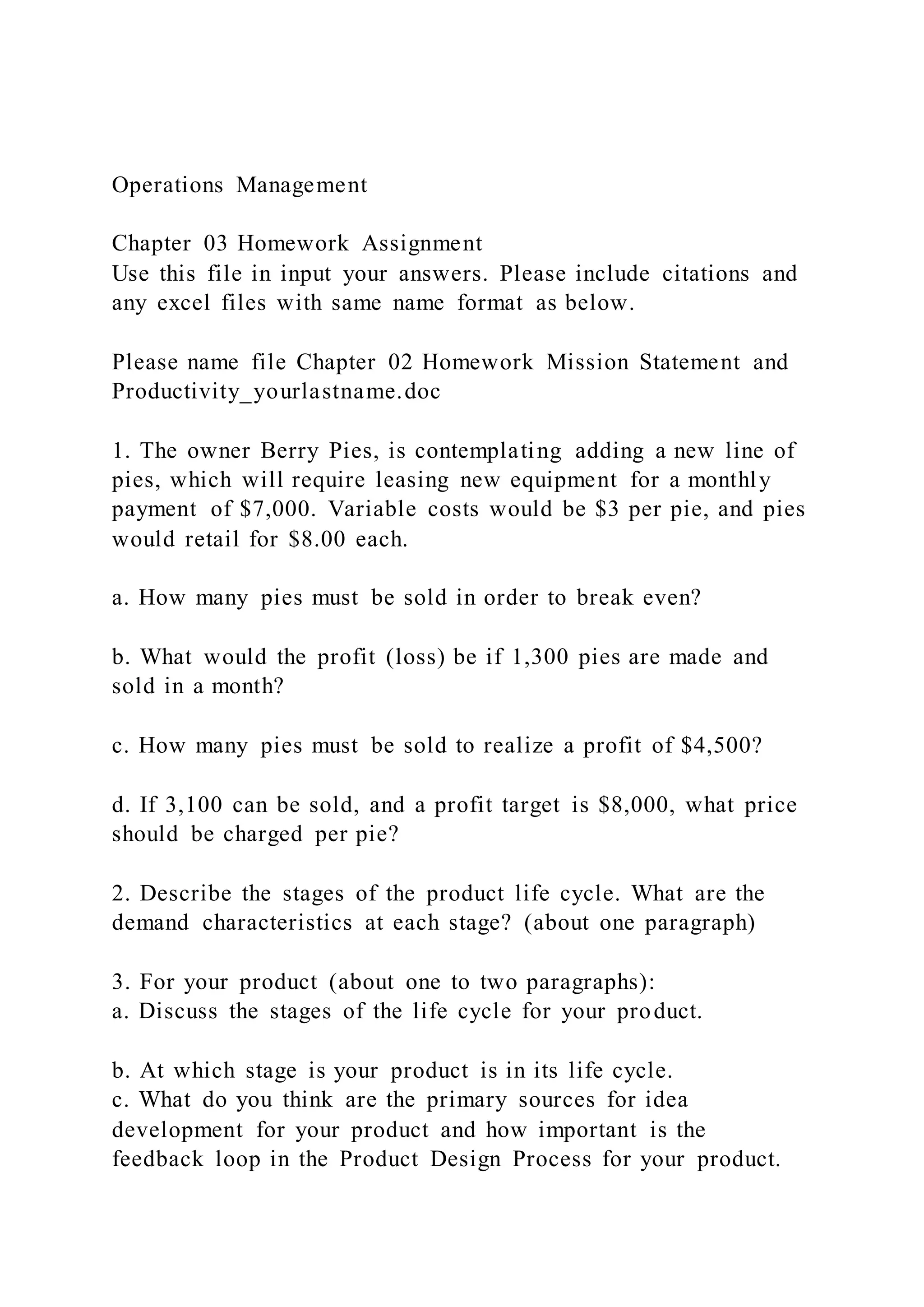
Operations Management
Chapter 03 Homework Assignment
Use this file in input your answers. Please include citations and
any excel files with same name format as below.
Please name file Chapter 02 Homework Mission Statement and
Productivity_yourlastname.doc
1. The owner Berry Pies, is contemplating adding a new line of
pies, which will require leasing new equipment for a monthly
payment of $7,000. Variable costs would be $3 per pie, and pies
would retail for $8.00 each.
a. How many pies must be sold in order to break even?
b. What would the profit (loss) be if 1,300 pies are made and
sold in a month?
c. How many pies must be sold to realize a profit of $4,500?
d. If 3,100 can be sold, and a profit target is $8,000, what price
should be charged per pie?
2. Describe the stages of the product life cycle. What are the
demand characteristics at each stage? (about one paragraph)
3. For your product (about one to two paragraphs):
a. Discuss the stages of the life cycle for your product.
b. At which stage is your product is in its life cycle.
c. What do you think are the primary sources for idea
development for your product and how important is the
feedback loop in the Product Design Process for your product.
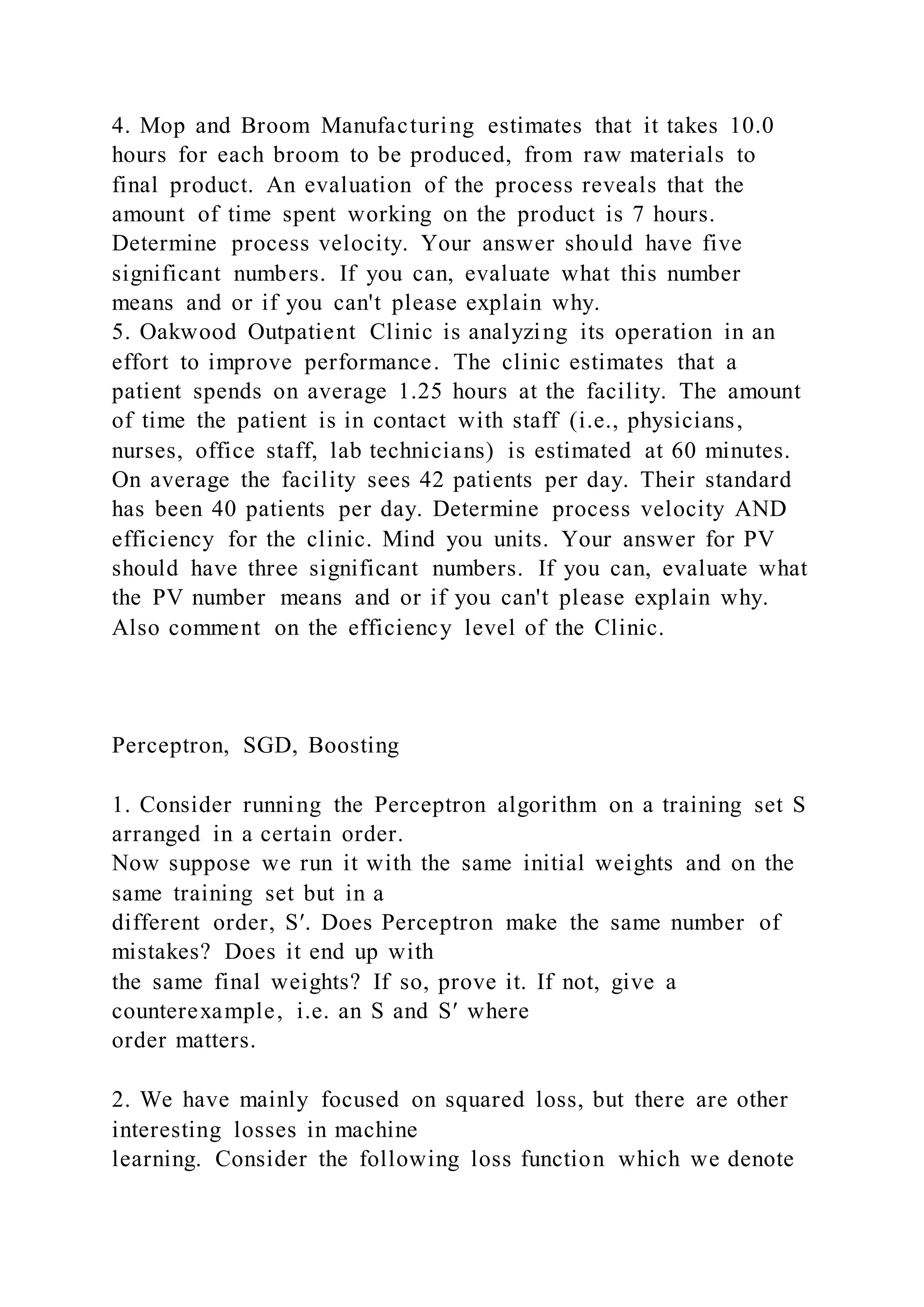
4. Mop and Broom Manufacturing estimates that it takes 10.0
hours for each broom to be produced, from raw materials to
final product. An evaluation of the process reveals that the
amount of time spent working on the product is 7 hours.
Determine process velocity. Your answer should have five
significant numbers. If you can, evaluate what this number
means and or if you can't please explain why.
5. Oakwood Outpatient Clinic is analyzing its operation in an
effort to improve performance. The clinic estimates that a
patient spends on average 1.25 hours at the facility. The amount
of time the patient is in contact with staff (i.e., physicians,
nurses, office staff, lab technicians) is estimated at 60 minutes.
On average the facility sees 42 patients per day. Their standard
has been 40 patients per day. Determine process velocity AND
efficiency for the clinic. Mind you units. Your answer for PV
should have three significant numbers. If you can, evaluate what
the PV number means and or if you can't please explain why.
Also comment on the efficiency level of the Clinic.
Perceptron, SGD, Boosting
1. Consider running the Perceptron algorithm on a training set S
arranged in a certain order.
Now suppose we run it with the same initial weights and on the
same training set but in a
different order, S′. Does Perceptron make the same number of
mistakes? Does it end up with
the same final weights? If so, prove it. If not, give a
counterexample, i.e. an S and S′ where
order matters.
2. We have mainly focused on squared loss, but there are other
interesting losses in machine
learning. Consider the following loss function which we denote
by φ(z) = max(0,−z). Let S
be a training set (x1,y1), . . . , (xm,ym) where each xi ∈ Rn and
yi ∈ {−1, 1}. Consider running
stochastic gradient descent (SGD) to find a weight vector w that
minimizes 1
m
∑m
i=1 φ(y
i ·
wTxi). Explain the explicit relationship between this algorithm
and the Perceptron algorithm.
Recall that for SGD, the update rule when the ith example is
picked at random is
wnew = wold −η∇ φ
(
yiwTxi
)
.
3. Here we will give an illustrative example of a weak learner
for a simple concept class. Let the
domain be the real line, R, and let C refer to the concept class
of “3-piece classifiers”, which
are functions of the following form: for θ1 < θ2 and b ∈ {−1,
1}, hθ1,θ2,b(x) is b if x ∈ [θ1,θ2]
and −b otherwise. In other words, they take a certain Boolean
value inside a certain interval
and the opposite value everywhere else. For example,
h10,20,1(x) would be +1 on [10, 20], and
−1 everywhere else. Let H refer to the simpler class of
“decision stumps”, i.e. functions hθ,b
such that h(x) is b for all x ≤ θ and −b otherwise.
(a) Show formally that for any distribution on R (assume finite
support, for simplicity; i.e.,
assume the distribution is bounded within [−B, B] for some
large B) and any unknown
labeling function c ∈ C that is a 3-piece classifier, there exists
a decision stump h ∈ H
that has error at most 1/3, i.e. P[h(x) 6= c(x)] ≤ 1/3.
(b) Describe a simple, efficient procedure for finding a decision
stump that minimizes error
with respect to a finite training set of size m. Such a procedure
is called an empirical
risk minimizer (ERM).
(c) Give a short intuitive explanation for why we should expect
that we can easily pick m
sufficiently large that the training error is a good approximation
of the true error, i.e.
why we can ensure generalization. (Your answer should relate
to what we have gained in
going from requiring a learner for C to requiring a learner for
H.) This lets us conclude
that we can weakly learn C using H.
1
4. Consider an iteration of the AdaBoost algorithm (using
notation from the video lecture on
Boosting) where we have obtained classifer ht. Show that with
respect to the distribution
Dt+1 generated for the next iteration, ht has accuracy exactly
1/2.
2

Operations management chapter 03 homework assignment use this

  • 1.
    Operations Management Chapter 03Homework Assignment Use this file in input your answers. Please include citations and any excel files with same name format as below. Please name file Chapter 02 Homework Mission Statement and Productivity_yourlastname.doc 1. The owner Berry Pies, is contemplating adding a new line of pies, which will require leasing new equipment for a monthly payment of $7,000. Variable costs would be $3 per pie, and pies would retail for $8.00 each. a. How many pies must be sold in order to break even? b. What would the profit (loss) be if 1,300 pies are made and sold in a month? c. How many pies must be sold to realize a profit of $4,500? d. If 3,100 can be sold, and a profit target is $8,000, what price should be charged per pie? 2. Describe the stages of the product life cycle. What are the demand characteristics at each stage? (about one paragraph) 3. For your product (about one to two paragraphs): a. Discuss the stages of the life cycle for your product. b. At which stage is your product is in its life cycle. c. What do you think are the primary sources for idea development for your product and how important is the feedback loop in the Product Design Process for your product.
  • 2.
    4. Mop andBroom Manufacturing estimates that it takes 10.0 hours for each broom to be produced, from raw materials to final product. An evaluation of the process reveals that the amount of time spent working on the product is 7 hours. Determine process velocity. Your answer should have five significant numbers. If you can, evaluate what this number means and or if you can't please explain why. 5. Oakwood Outpatient Clinic is analyzing its operation in an effort to improve performance. The clinic estimates that a patient spends on average 1.25 hours at the facility. The amount of time the patient is in contact with staff (i.e., physicians, nurses, office staff, lab technicians) is estimated at 60 minutes. On average the facility sees 42 patients per day. Their standard has been 40 patients per day. Determine process velocity AND efficiency for the clinic. Mind you units. Your answer for PV should have three significant numbers. If you can, evaluate what the PV number means and or if you can't please explain why. Also comment on the efficiency level of the Clinic. Perceptron, SGD, Boosting 1. Consider running the Perceptron algorithm on a training set S arranged in a certain order. Now suppose we run it with the same initial weights and on the same training set but in a different order, S′. Does Perceptron make the same number of mistakes? Does it end up with the same final weights? If so, prove it. If not, give a counterexample, i.e. an S and S′ where order matters. 2. We have mainly focused on squared loss, but there are other interesting losses in machine learning. Consider the following loss function which we denote
  • 3.
    by φ(z) =max(0,−z). Let S be a training set (x1,y1), . . . , (xm,ym) where each xi ∈ Rn and yi ∈ {−1, 1}. Consider running stochastic gradient descent (SGD) to find a weight vector w that minimizes 1 m ∑m i=1 φ(y i · wTxi). Explain the explicit relationship between this algorithm and the Perceptron algorithm. Recall that for SGD, the update rule when the ith example is picked at random is wnew = wold −η∇ φ ( yiwTxi ) . 3. Here we will give an illustrative example of a weak learner for a simple concept class. Let the domain be the real line, R, and let C refer to the concept class of “3-piece classifiers”, which are functions of the following form: for θ1 < θ2 and b ∈ {−1, 1}, hθ1,θ2,b(x) is b if x ∈ [θ1,θ2] and −b otherwise. In other words, they take a certain Boolean value inside a certain interval and the opposite value everywhere else. For example, h10,20,1(x) would be +1 on [10, 20], and −1 everywhere else. Let H refer to the simpler class of
  • 4.
    “decision stumps”, i.e.functions hθ,b such that h(x) is b for all x ≤ θ and −b otherwise. (a) Show formally that for any distribution on R (assume finite support, for simplicity; i.e., assume the distribution is bounded within [−B, B] for some large B) and any unknown labeling function c ∈ C that is a 3-piece classifier, there exists a decision stump h ∈ H that has error at most 1/3, i.e. P[h(x) 6= c(x)] ≤ 1/3. (b) Describe a simple, efficient procedure for finding a decision stump that minimizes error with respect to a finite training set of size m. Such a procedure is called an empirical risk minimizer (ERM). (c) Give a short intuitive explanation for why we should expect that we can easily pick m sufficiently large that the training error is a good approximation of the true error, i.e. why we can ensure generalization. (Your answer should relate to what we have gained in going from requiring a learner for C to requiring a learner for H.) This lets us conclude that we can weakly learn C using H. 1 4. Consider an iteration of the AdaBoost algorithm (using notation from the video lecture on Boosting) where we have obtained classifer ht. Show that with
  • 5.
    respect to thedistribution Dt+1 generated for the next iteration, ht has accuracy exactly 1/2. 2