Towards a Pattern Recognition Approach for Transferring Knowledge in ACM 
Thanh Tran Thi Kim 
Christoph Ruhsam 
Max J. Pucher 
ISIS Papyrus Europe AG, Austria 
Maximilian Kobler 
University of Applied Sciences Burgenland, Autria 
Jan Mendling 
Vienna University of Economics and Business, Institute for Information Business, Austria
Overview Motivation ACM fundamental concepts User-Trained Agent (UTA) principles Applying the UTA in ACM Benefits of the approach
Motivation ACM helps KWs to deal with unpredictable situations. Support KWs with context- sensitive proposals instead of extensive prescriptive procedures. How to support knowledge acquisition, sharing and collaboration by ACM?
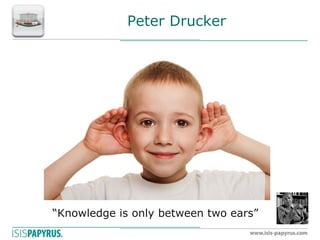
Peter Drucker 
“Knowledge is only between two ears”
The User Trained Agent (UTA) Capture knowledge by observing KWs activities! Real-time transductive learning through observations during normal user interaction. No training needed! Knowledge is stored in a central knowledge base. Share knowledge between individuals, groups, departments and across locations. Propose best next actions to influence future ACM execution. A learning organization needs a learning system.
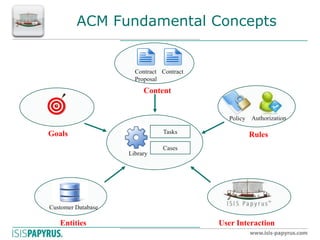
Contract 
Contract Proposal 
Content 
Customer Database 
Entities 
Goals 
Authorization 
Policy 
Rules 
Library 
Tasks 
User Interaction 
Cases 
ACM Fundamental Concepts
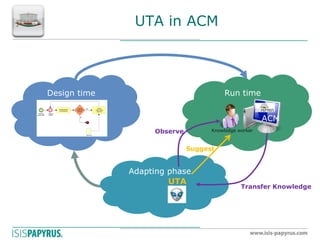
UTA Principles UTA is built on pattern recognition principles. Instant activity observations through behavioural data patterns UTA observes state patterns of a Case: Goals, Data artefacts, Tasks and Processes, Rules, etc. Learning related to the role of the performer.
UTA in ACM 
Design time 
Run time 
Adapting phase 
ACM 
Observe 
Transfer Knowledge 
Suggest 
UTA 
Knowledge worker
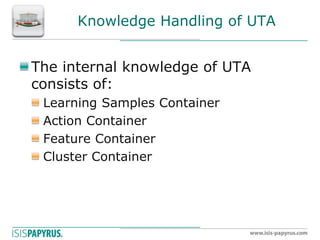
Knowledge Handling of UTA The internal knowledge of UTA consists of: Learning Samples Container Action Container Feature Container Cluster Container
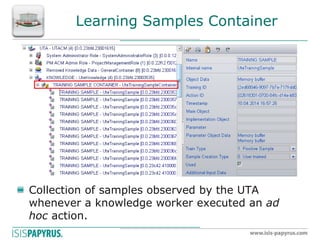
Learning Samples Container Collection of samples observed by the UTA whenever a knowledge worker executed an ad hoc action.
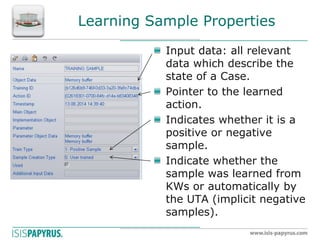
Learning Sample Properties Input data: all relevant data which describe the state of a Case. Pointer to the learned action. Indicates whether it is a positive or negative sample. Indicate whether the sample was learned from KWs or automatically by the UTA (implicit negative samples).
UTA Learning Modes Positive learning Perform matching actions (“positive”). More samples needed to find differences. Negative learning is needed. Explicit negative learning Declare samples explicitly as “negative”. Implicit negative learning Assume that samples for a certain action are negative samples for other actions
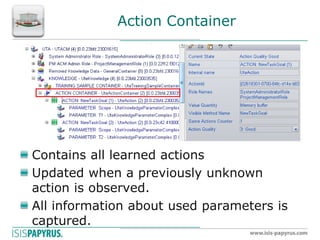
Action Container Contains all learned actions Updated when a previously unknown action is observed. All information about used parameters is captured.
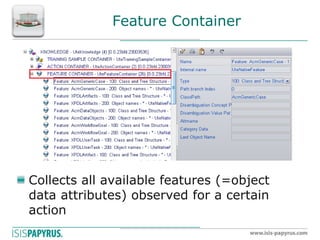
Feature Container Collects all available features (=object data attributes) observed for a certain action
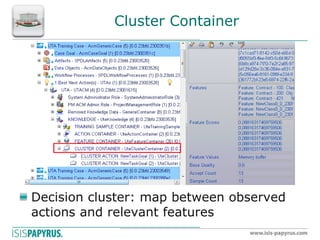
Cluster Container Decision cluster: map between observed actions and relevant features
UTA Main Functions 
1.Learn user actions related to case patterns. Triggered in real-time by changes in the defined state space of the Case. 
2.Recommend actions when similar patterns are identified Role of performer is considered KWs can decide whether to follow the recommendation or execute another ad hoc action.
State Space Scopes Theoretically all data attributes of a certain Case can be observed Contains a lot of „noise“ Business Ontologies map business objects with the underlying ACM object model Filter only for business relevant items Faster learning
UTA Recommendations Current sample is compared against the knowledge base in respect to the relevant features. Good match: sample already exists in the knowledge base, confidence will be increased. Confidence rated from 1 (low) – 5 (high). No match: Sample added to the knowledge base for evaluation of feature relevance. Knowledge can stem from diverse business situations of a company, a certain department or only specific case types.
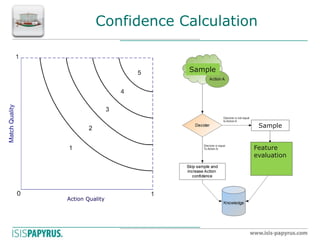
Confidence Calculation 
Sample 
Sample 
Feature evaluation 
0 
Action Quality
UTA Test Case: Contract Management Standard covered by a predefined Case Template. KW finds out that an exception handling is needed for a contract value within a certain range. E.g. perform additional checks before approving when the value is 500.000 – 700.000 EUR. Check transfer fees, transfer conditions between the banks These activities and the range were not foreseen in the Case Template. KW defines an ad hoc Task. UTA learns and supports others with BNAs in similar situations.
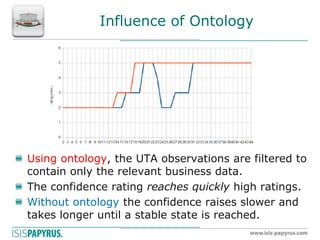
Influence of Ontology Using ontology, the UTA observations are filtered to contain only the relevant business data. The confidence rating reaches quickly high ratings. Without ontology the confidence raises slower and takes longer until a stable state is reached.
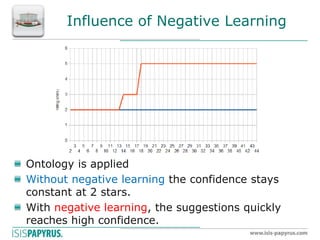
Influence of Negative Learning Ontology is applied Without negative learning the confidence stays constant at 2 stars. With negative learning, the suggestions quickly reaches high confidence.
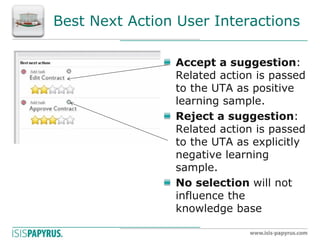
Best Next Action User Interactions Accept a suggestion: Related action is passed to the UTA as positive learning sample. Reject a suggestion: Related action is passed to the UTA as explicitly negative learning sample. No selection will not influence the knowledge base
Benefits of the UTA Approach The UTA observes user actions and transfers the acquired knowledge from single KWs to teams. Continuous knowledge acquisition and sharing. The UTA‘s knowledge is gradually built by learning during normal work with the ACM system. No extra training by specialists is needed! Negative learning samples are important! The rating of observed situations is maintained by the UTA throughout the life-time of the system with full transparency to ACM Users. The recommendations from the UTA are objective and increase in confidence accordingly.
Thank you for your attention!

Towards a pattern recognition approach for transferring knowledge in acm v4 for publication

  • 1.
    Towards a PatternRecognition Approach for Transferring Knowledge in ACM Thanh Tran Thi Kim Christoph Ruhsam Max J. Pucher ISIS Papyrus Europe AG, Austria Maximilian Kobler University of Applied Sciences Burgenland, Autria Jan Mendling Vienna University of Economics and Business, Institute for Information Business, Austria
  • 2.
    Overview Motivation ACMfundamental concepts User-Trained Agent (UTA) principles Applying the UTA in ACM Benefits of the approach
  • 3.
    Motivation ACM helpsKWs to deal with unpredictable situations. Support KWs with context- sensitive proposals instead of extensive prescriptive procedures. How to support knowledge acquisition, sharing and collaboration by ACM?
  • 4.
    Peter Drucker “Knowledgeis only between two ears”
  • 5.
    The User TrainedAgent (UTA) Capture knowledge by observing KWs activities! Real-time transductive learning through observations during normal user interaction. No training needed! Knowledge is stored in a central knowledge base. Share knowledge between individuals, groups, departments and across locations. Propose best next actions to influence future ACM execution. A learning organization needs a learning system.
  • 6.
    Contract Contract Proposal Content Customer Database Entities Goals Authorization Policy Rules Library Tasks User Interaction Cases ACM Fundamental Concepts
  • 7.
    UTA Principles UTAis built on pattern recognition principles. Instant activity observations through behavioural data patterns UTA observes state patterns of a Case: Goals, Data artefacts, Tasks and Processes, Rules, etc. Learning related to the role of the performer.
  • 8.
    UTA in ACM Design time Run time Adapting phase ACM Observe Transfer Knowledge Suggest UTA Knowledge worker
  • 9.
    Knowledge Handling ofUTA The internal knowledge of UTA consists of: Learning Samples Container Action Container Feature Container Cluster Container
  • 10.
    Learning Samples ContainerCollection of samples observed by the UTA whenever a knowledge worker executed an ad hoc action.
  • 11.
    Learning Sample PropertiesInput data: all relevant data which describe the state of a Case. Pointer to the learned action. Indicates whether it is a positive or negative sample. Indicate whether the sample was learned from KWs or automatically by the UTA (implicit negative samples).
  • 12.
    UTA Learning ModesPositive learning Perform matching actions (“positive”). More samples needed to find differences. Negative learning is needed. Explicit negative learning Declare samples explicitly as “negative”. Implicit negative learning Assume that samples for a certain action are negative samples for other actions
  • 13.
    Action Container Containsall learned actions Updated when a previously unknown action is observed. All information about used parameters is captured.
  • 14.
    Feature Container Collectsall available features (=object data attributes) observed for a certain action
  • 15.
    Cluster Container Decisioncluster: map between observed actions and relevant features
  • 16.
    UTA Main Functions 1.Learn user actions related to case patterns. Triggered in real-time by changes in the defined state space of the Case. 2.Recommend actions when similar patterns are identified Role of performer is considered KWs can decide whether to follow the recommendation or execute another ad hoc action.
  • 17.
    State Space ScopesTheoretically all data attributes of a certain Case can be observed Contains a lot of „noise“ Business Ontologies map business objects with the underlying ACM object model Filter only for business relevant items Faster learning
  • 18.
    UTA Recommendations Currentsample is compared against the knowledge base in respect to the relevant features. Good match: sample already exists in the knowledge base, confidence will be increased. Confidence rated from 1 (low) – 5 (high). No match: Sample added to the knowledge base for evaluation of feature relevance. Knowledge can stem from diverse business situations of a company, a certain department or only specific case types.
  • 19.
    Confidence Calculation Sample Sample Feature evaluation 0 Action Quality
  • 20.
    UTA Test Case:Contract Management Standard covered by a predefined Case Template. KW finds out that an exception handling is needed for a contract value within a certain range. E.g. perform additional checks before approving when the value is 500.000 – 700.000 EUR. Check transfer fees, transfer conditions between the banks These activities and the range were not foreseen in the Case Template. KW defines an ad hoc Task. UTA learns and supports others with BNAs in similar situations.
  • 21.
    Influence of OntologyUsing ontology, the UTA observations are filtered to contain only the relevant business data. The confidence rating reaches quickly high ratings. Without ontology the confidence raises slower and takes longer until a stable state is reached.
  • 22.
    Influence of NegativeLearning Ontology is applied Without negative learning the confidence stays constant at 2 stars. With negative learning, the suggestions quickly reaches high confidence.
  • 23.
    Best Next ActionUser Interactions Accept a suggestion: Related action is passed to the UTA as positive learning sample. Reject a suggestion: Related action is passed to the UTA as explicitly negative learning sample. No selection will not influence the knowledge base
  • 24.
    Benefits of theUTA Approach The UTA observes user actions and transfers the acquired knowledge from single KWs to teams. Continuous knowledge acquisition and sharing. The UTA‘s knowledge is gradually built by learning during normal work with the ACM system. No extra training by specialists is needed! Negative learning samples are important! The rating of observed situations is maintained by the UTA throughout the life-time of the system with full transparency to ACM Users. The recommendations from the UTA are objective and increase in confidence accordingly.
  • 25.
    Thank you foryour attention!