© Copyright 2011-2014 Vulkans Forge Consulting Ltd.
Training Course Total Course Hours Class Size Duration
Operational
Excellence
32 hours on-site 4 to 20 employees 30 to 90 days
What is the subject of this curriculum?
Overview:
Through training in best practices and implementation of operational improvements, company
employees will be better equipped to define customer value, visualize the current state, and
identify and eliminate waste from business and/or manufacturing processes. Employees will
be trained to a standard as defined by SME Lean Certification, and successful implementation
within the business will be assessed relative to APQC Open Standards Benchmarking
Measures. Outcomes will include both transferable skills for employees and improved
financial performance for the company.
Desired Results: What do you want participants to learn?
Established Goal(s):
● Participants will be able to implement the principles, systems, techniques, and
practices of continuous process improvement, including the following:
○ Identify and eliminate limitations to flow;
○ Define and calculate takt time for a process;
○ Match rate of production to level of customer demand;
○ Identify and use basic problem solving and data collection/analysis tools;
○ Point to measures in a work process that indicate success or problems;
○ Identify supplier before and customer after the area where work is performed
or improvement efforts are being undertaken (SIPOC);
○ Manage a work area using visual systems and methods;
○ Explain what is meant by stability and standardization and point to what these
concepts mean in the context of the work area or improvement project; and
○ Represent flow within a work cell.
© Copyright 2011-2014 Vulkans Forge Consulting Ltd.
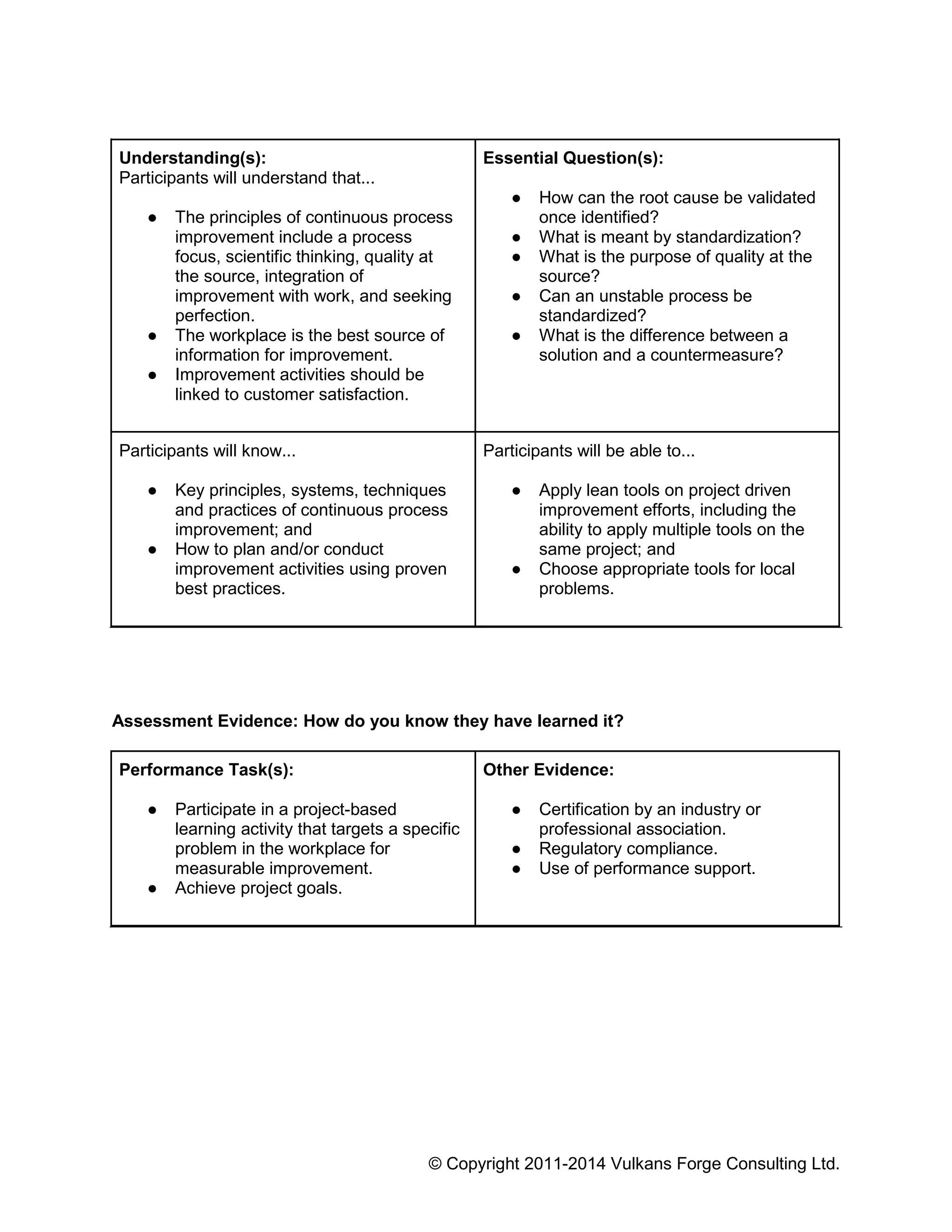
Understanding(s):
Participants will understand that...
● The principles of continuous process
improvement include a process
focus, scientific thinking, quality at
the source, integration of
improvement with work, and seeking
perfection.
● The workplace is the best source of
information for improvement.
● Improvement activities should be
linked to customer satisfaction.
Essential Question(s):
● How can the root cause be validated
once identified?
● What is meant by standardization?
● What is the purpose of quality at the
source?
● Can an unstable process be
standardized?
● What is the difference between a
solution and a countermeasure?
Participants will know...
● Key principles, systems, techniques
and practices of continuous process
improvement; and
● How to plan and/or conduct
improvement activities using proven
best practices.
Participants will be able to...
● Apply lean tools on project driven
improvement efforts, including the
ability to apply multiple tools on the
same project; and
● Choose appropriate tools for local
problems.
Assessment Evidence: How do you know they have learned it?
Performance Task(s):
● Participate in a project-based
learning activity that targets a specific
problem in the workplace for
measurable improvement.
● Achieve project goals.
Other Evidence:
● Certification by an industry or
professional association.
● Regulatory compliance.
● Use of performance support.
© Copyright 2011-2014 Vulkans Forge Consulting Ltd.
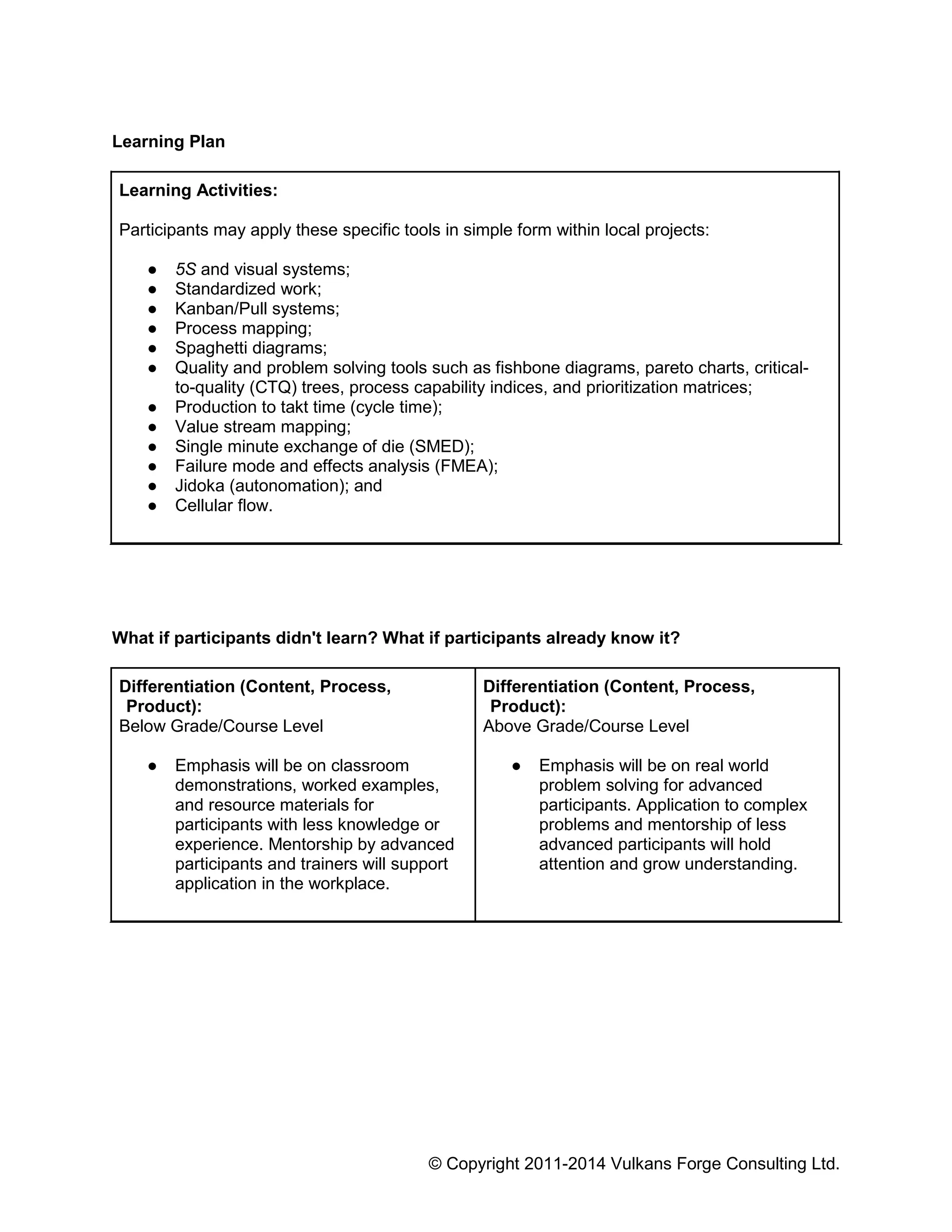
Learning Plan
Learning Activities:
Participants may apply these specific tools in simple form within local projects:
● 5S and visual systems;
● Standardized work;
● Kanban/Pull systems;
● Process mapping;
● Spaghetti diagrams;
● Quality and problem solving tools such as fishbone diagrams, pareto charts, critical-
to-quality (CTQ) trees, process capability indices, and prioritization matrices;
● Production to takt time (cycle time);
● Value stream mapping;
● Single minute exchange of die (SMED);
● Failure mode and effects analysis (FMEA);
● Jidoka (autonomation); and
● Cellular flow.
What if participants didn't learn? What if participants already know it?
Differentiation (Content, Process,
Product):
Below Grade/Course Level
● Emphasis will be on classroom
demonstrations, worked examples,
and resource materials for
participants with less knowledge or
experience. Mentorship by advanced
participants and trainers will support
application in the workplace.
Differentiation (Content, Process,
Product):
Above Grade/Course Level
● Emphasis will be on real world
problem solving for advanced
participants. Application to complex
problems and mentorship of less
advanced participants will hold
attention and grow understanding.
© Copyright 2011-2014 Vulkans Forge Consulting Ltd.
How will business results and performance be assessed?
Standards:
● Lean Certification Body of Knowledge Module 2: Continuous Process Improvement.
Benchmarks:
● APQC Open Standards Benchmarking Measures.
Are there any acronyms that need to be defined?
Glossary of Terms:
● 5S - Sort, Set in order, Shine, Standardize, Sustain
● APQC - American Productivity and Quality Center
● SIPOC - Supplier, Input, Process, Output, Customer
● SME - Society of Manufacturing Engineers

Operational Excellence Curriculum

  • 1.
    © Copyright 2011-2014Vulkans Forge Consulting Ltd. Training Course Total Course Hours Class Size Duration Operational Excellence 32 hours on-site 4 to 20 employees 30 to 90 days What is the subject of this curriculum? Overview: Through training in best practices and implementation of operational improvements, company employees will be better equipped to define customer value, visualize the current state, and identify and eliminate waste from business and/or manufacturing processes. Employees will be trained to a standard as defined by SME Lean Certification, and successful implementation within the business will be assessed relative to APQC Open Standards Benchmarking Measures. Outcomes will include both transferable skills for employees and improved financial performance for the company. Desired Results: What do you want participants to learn? Established Goal(s): ● Participants will be able to implement the principles, systems, techniques, and practices of continuous process improvement, including the following: ○ Identify and eliminate limitations to flow; ○ Define and calculate takt time for a process; ○ Match rate of production to level of customer demand; ○ Identify and use basic problem solving and data collection/analysis tools; ○ Point to measures in a work process that indicate success or problems; ○ Identify supplier before and customer after the area where work is performed or improvement efforts are being undertaken (SIPOC); ○ Manage a work area using visual systems and methods; ○ Explain what is meant by stability and standardization and point to what these concepts mean in the context of the work area or improvement project; and ○ Represent flow within a work cell.
  • 2.
    © Copyright 2011-2014Vulkans Forge Consulting Ltd. Understanding(s): Participants will understand that... ● The principles of continuous process improvement include a process focus, scientific thinking, quality at the source, integration of improvement with work, and seeking perfection. ● The workplace is the best source of information for improvement. ● Improvement activities should be linked to customer satisfaction. Essential Question(s): ● How can the root cause be validated once identified? ● What is meant by standardization? ● What is the purpose of quality at the source? ● Can an unstable process be standardized? ● What is the difference between a solution and a countermeasure? Participants will know... ● Key principles, systems, techniques and practices of continuous process improvement; and ● How to plan and/or conduct improvement activities using proven best practices. Participants will be able to... ● Apply lean tools on project driven improvement efforts, including the ability to apply multiple tools on the same project; and ● Choose appropriate tools for local problems. Assessment Evidence: How do you know they have learned it? Performance Task(s): ● Participate in a project-based learning activity that targets a specific problem in the workplace for measurable improvement. ● Achieve project goals. Other Evidence: ● Certification by an industry or professional association. ● Regulatory compliance. ● Use of performance support.
  • 3.
    © Copyright 2011-2014Vulkans Forge Consulting Ltd. Learning Plan Learning Activities: Participants may apply these specific tools in simple form within local projects: ● 5S and visual systems; ● Standardized work; ● Kanban/Pull systems; ● Process mapping; ● Spaghetti diagrams; ● Quality and problem solving tools such as fishbone diagrams, pareto charts, critical- to-quality (CTQ) trees, process capability indices, and prioritization matrices; ● Production to takt time (cycle time); ● Value stream mapping; ● Single minute exchange of die (SMED); ● Failure mode and effects analysis (FMEA); ● Jidoka (autonomation); and ● Cellular flow. What if participants didn't learn? What if participants already know it? Differentiation (Content, Process, Product): Below Grade/Course Level ● Emphasis will be on classroom demonstrations, worked examples, and resource materials for participants with less knowledge or experience. Mentorship by advanced participants and trainers will support application in the workplace. Differentiation (Content, Process, Product): Above Grade/Course Level ● Emphasis will be on real world problem solving for advanced participants. Application to complex problems and mentorship of less advanced participants will hold attention and grow understanding.
  • 4.
    © Copyright 2011-2014Vulkans Forge Consulting Ltd. How will business results and performance be assessed? Standards: ● Lean Certification Body of Knowledge Module 2: Continuous Process Improvement. Benchmarks: ● APQC Open Standards Benchmarking Measures. Are there any acronyms that need to be defined? Glossary of Terms: ● 5S - Sort, Set in order, Shine, Standardize, Sustain ● APQC - American Productivity and Quality Center ● SIPOC - Supplier, Input, Process, Output, Customer ● SME - Society of Manufacturing Engineers