


















PMP EXAM PREP COURSE ON NEW
FORMAT EFFECTIVE 2 JAN 2021
AUTHORIZED
PROJECT
MANAGEMENT
PROFESSIONAL
EXAMINATION
PREPARATION
COURSE
PMP EXAM PREP COURSE ON NEW
FORMAT EFFECTIVE 2 JAN 2021
AUTHORIZED
PROJECT
MANAGEMENT
PROFESSIONAL
EXAMINATION
PREPARATION
COURSE
PMP EXAM PREP COURSE ON NEW
FORMAT EFFECTIVE 2 JAN 2021
AUTHORIZED
PROJECT
MANAGEMENT
PROFESSIONAL
EXAMINATION
PREPARATION
COURSE
AUTHORIZED
PROJECT
MANAGEMENT
PROFESSIONAL
EXAMINATION
PREPARATION
COURSE
PMP EXAM PREP COURSE ON NEW
FORMAT EFFECTIVE 2 JAN 2021
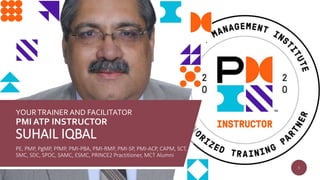
YOURTRAINER AND FACILITATOR
PMI ATP INSTRUCTOR
SUHAIL IQBAL
PE, PMP, PgMP, PfMP, PMI-PBA, PMI-RMP, PMI-SP, PMI-ACP, CAPM, SCT,
SMC, SDC, SPOC, SAMC, ESMC, PRINCE2 Practitioner, MCT Alumni
5
ABOUT PMP
MODULE 0
REFERENCES
The Guides & Standards, Practice Guides &
Standards, Maturity Models and Frameworks,
Handbooks and Examination Content Outlines
9
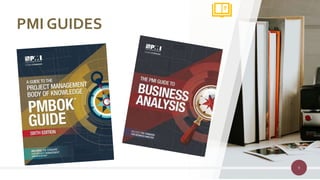
PMI GUIDES
10
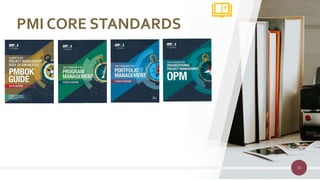
PMI CORE STANDARDS
11
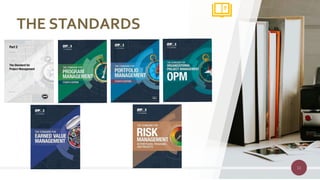
THE STANDARDS
12
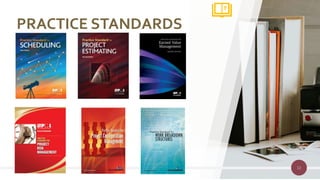
PRACTICE STANDARDS
13
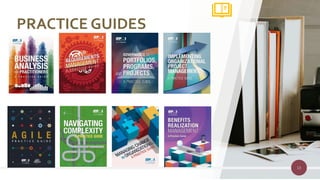
PRACTICE GUIDES
14
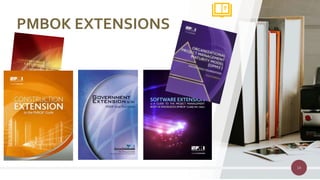
PMBOK EXTENSIONS
15
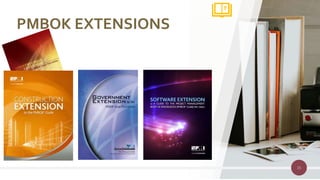
PMBOK EXTENSIONS
16
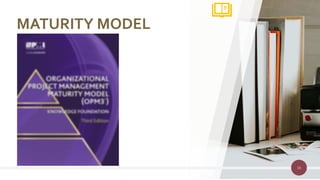
MATURITY MODEL
17
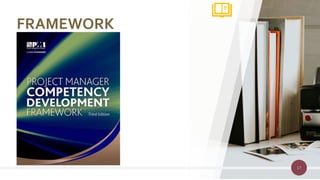
FRAMEWORK
18
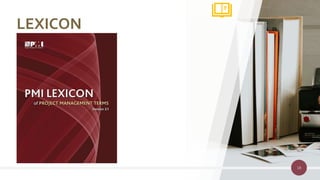
LEXICON
19
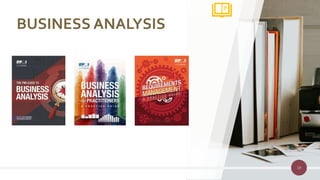
BUSINESS ANALYSIS
20
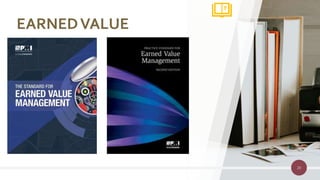
EARNEDVALUE
21
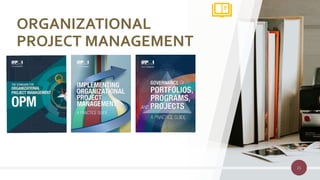
ORGANIZATIONAL
PROJECT MANAGEMENT
22
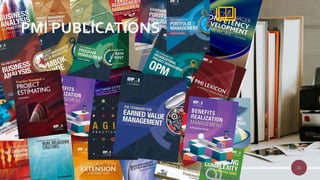
PMI PUBLICATIONS
PMI PUBLICATIONS
23
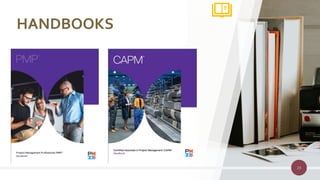
HANDBOOKS
24
EXAMINATION
CONTENT OUTLINES
PMI CREDENTIALS
PMP & CAPM
25
26
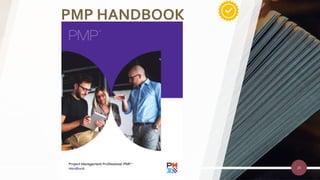
PMP HANDBOOK
27
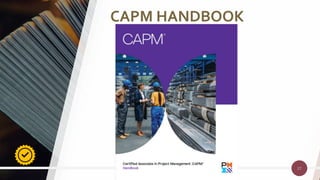
CAPM HANDBOOK
27
30
EXAMINATION
CONTENT OUTLINES
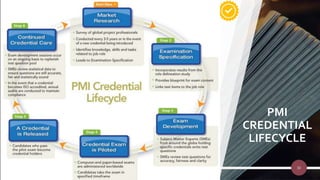
PMI
CREDENTIAL
LIFECYCLE
30
31
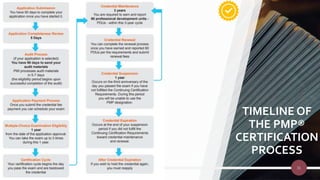
TIMELINE OF
THE PMP®
CERTIFICATION
PROCESS
31
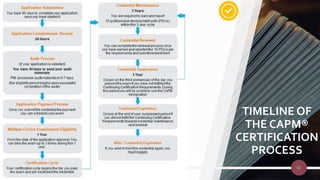
32
TIMELINE OF
THE CAPM®
CERTIFICATION
PROCESS
32
33
33
• Conducted every 5-7 years
• Third Party conducts the study
• Discuss roles associated with credential
• Tasks and responsibilities expected to be
performed
• Provides blueprint for the exam
• Links the exam questions to the role
PMP JobTask Analysis (JTA)
34
34
The candidate for the PMP credential will:
• Perform their duties under general supervision and
are responsible for all aspects of the project for the
life of the project.
• Lead and direct cross-functional teams to deliver
projects within the constraints of schedule, budget
and scope.
• Demonstrate sufficient knowledge and experience to
appropriately apply a methodology to projects that
have reasonably well-defined requirements and
deliverables.
PMP JobTask Analysis (JTA)
35
35
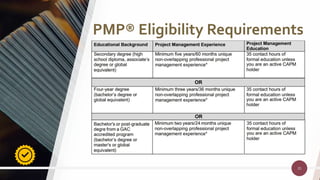
PMP® Eligibility Requirements
36
36
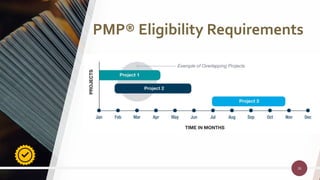
PMP® Eligibility Requirements
37
37
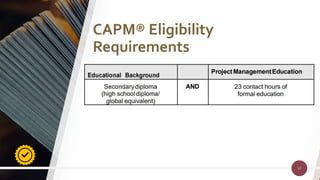
CAPM® Eligibility
Requirements
38
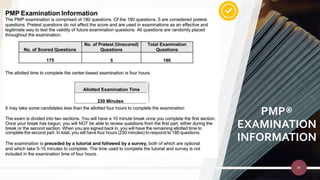
PMP®
EXAMINATION
INFORMATION
38
39
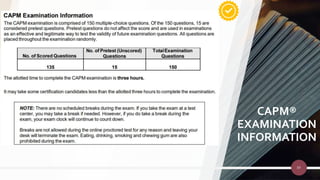
CAPM®
EXAMINATION
INFORMATION
39
40
40
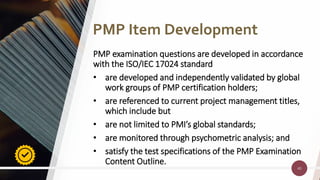
PMP examination questions are developed in accordance
with the ISO/IEC 17024 standard
• are developed and independently validated by global
work groups of PMP certification holders;
• are referenced to current project management titles,
which include but
• are not limited to PMI’s global standards;
• are monitored through psychometric analysis; and
• satisfy the test specifications of the PMP Examination
Content Outline.
PMP Item Development
41
41
• Many of the domains, tasks, knowledge, and skills
outlined in PMP Examination Content Outline are
covered by the PMBOK® Guide.
• Some are unique to the PMP Examination Content
Outline.
• Current edition of PMBOK® Guide can certainly be
included as one of the study references.
• Also advised to study other current titles on project
management, utilized in PMP examination
development.
PMP Item Development
42
42
CAPM examination questions
• developed and independently validated by
global work groups of project management
practitioners
• Reference information in A Guide to the Project
Management Body of Knowledge (PMBOK®
Guide) – Sixth Edition
• Are monitored through psychometric analysis
CAPM Item Development
43
43
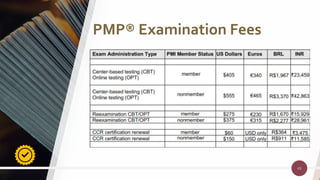
PMP® Examination Fees
44
44
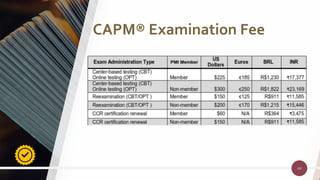
CAPM® Examination Fee
45
45
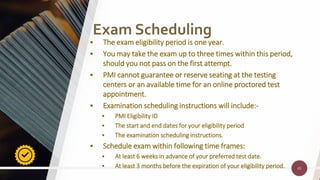
Exam Scheduling
• The exam eligibility period is one year.
• You may take the exam up to three times within this period,
should you not pass on the first attempt.
• PMI cannot guarantee or reserve seating at the testing
centers or an available time for an online proctored test
appointment.
• Examination scheduling instructions will include:-
• PMI Eligibility ID
• The start and end dates for your eligibility period
• The examination scheduling instructions.
• Schedule exam within following time frames:
• At least 6 weeks in advance of your preferred test date.
• At least 3 months before the expiration of your eligibility period.
46
46
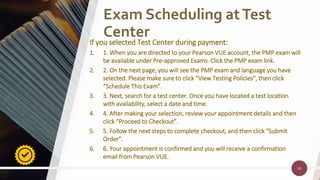
Exam Scheduling atTest
Center
If you selected Test Center during payment:
1. 1. When you are directed to your Pearson VUE account, the PMP exam will
be available under Pre-approved Exams. Click the PMP exam link.
2. 2. On the next page, you will see the PMP exam and language you have
selected. Please make sure to click “View Testing Policies”, then click
“Schedule This Exam”.
3. 3. Next, search for a test center. Once you have located a test location
with availability, select a date and time.
4. 4. After making your selection, review your appointment details and then
click “Proceed to Checkout”.
5. 5. Follow the next steps to complete checkout, and then click “Submit
Order”.
6. 6. Your appointment is confirmed and you will receive a confirmation
email from Pearson VUE.
47
47
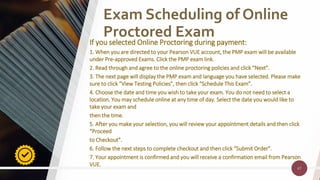
Exam Scheduling of Online
Proctored Exam
If you selected Online Proctoring during payment:
1. When you are directed to your Pearson VUE account, the PMP exam will be available
under Pre-approved Exams. Click the PMP exam link.
2. Read through and agree to the online proctoring policies and click “Next”.
3. The next page will display the PMP exam and language you have selected. Please make
sure to click “View Testing Policies”, then click “Schedule This Exam”.
4. Choose the date and time you wish to take your exam. You do not need to select a
location. You may schedule online at any time of day. Select the date you would like to
take your exam and
then the time.
5. After you make your selection, you will review your appointment details and then click
“Proceed
to Checkout”.
6. Follow the next steps to complete checkout and then click “Submit Order”.
7. Your appointment is confirmed and you will receive a confirmation email from Pearson
VUE.
48
48
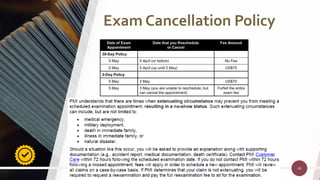
Exam Cancellation Policy
49
49
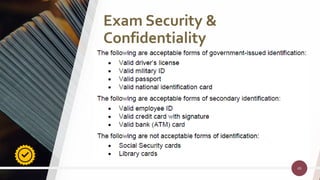
Exam Security &
Confidentiality
50
50
CCR Handbook
51
51
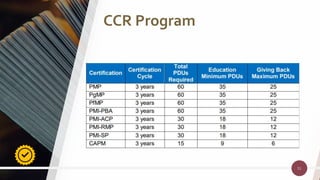
CCR Program
52
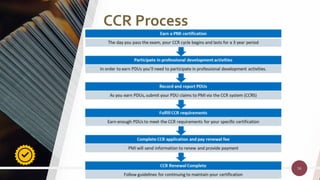
CCR Process
52
53
53
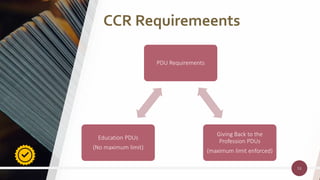
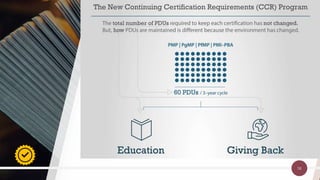
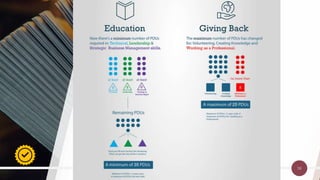
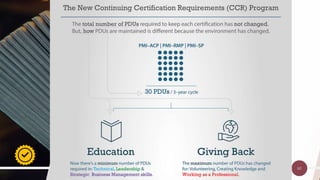
CCR Requiremeents
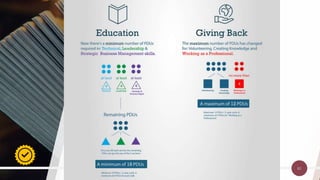
PDU Requirements
Giving Back to the
Profession PDUs
(maximum limit enforced)
Education PDUs
(No maximum limit)
54
54
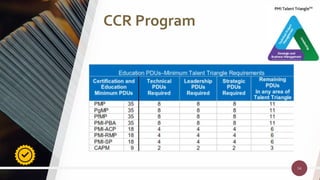
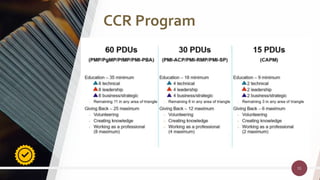
CCR Program
55
55
CCR Program
56
56
CCR Process
57
CCR Process
57
58
CCR Process
58
59
CCR Process
59
60
CCR Process
60
61
CCR Process
61
62
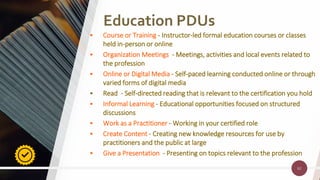
Education PDUs
62
• Course or Training - Instructor-led formal education courses or classes
held in-person or online
• Organization Meetings - Meetings, activities and local events related to
the profession
• Online or Digital Media - Self-paced learning conducted online or through
varied forms of digital media
• Read - Self-directed reading that is relevant to the certification you hold
• Informal Learning - Educational opportunities focused on structured
discussions
• Work as a Practitioner - Working in your certified role
• Create Content - Creating new knowledge resources for use by
practitioners and the public at large
• Give a Presentation - Presenting on topics relevant to the profession
63
Giving Back to the Profession
63
• Share Knowledge - Sharing your domain
knowledge to help others learn and
grow
• Volunteer - Providing volunteer services
to non-employer or non-client
organizations
64
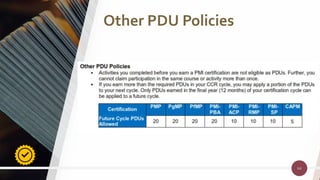
Other PDU Policies
64
DOMAINS
People, Process and
Business Environment
66
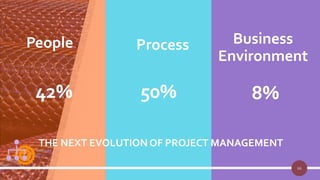
THE NEXT EVOLUTION OF PROJECT MANAGEMENT
66
42% 50% 8%
People Business
Environment
Process
67
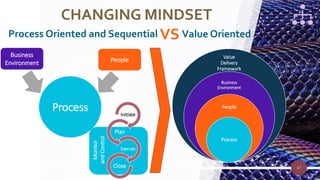
CHANGING MINDSET
Value
Delivery
Framework
Business
Environment
People
Process
Business
Environment People
Process
Process Oriented and Sequential
Initiate
Plan
Execute
Close
Monitor
and
Control
Value Oriented
VS
68
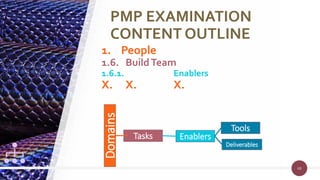
PMP EXAMINATION
CONTENT OUTLINE
68
Domains
Tasks Enablers
Tools
Deliverables
1. People
1.6. BuildTeam
1.6.1. Enablers
X. X. X.
69
PMP ECO
EXAMINATION
CONTENT
OUTLINE
70
70
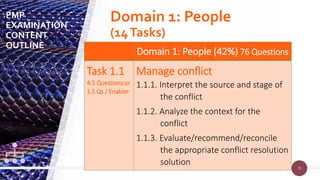
Domain 1: People (42%) 76 Questions
Task 1.1
4.5 Questions or
1.5 Qs / Enabler
Manage conflict
1.1.1. Interpret the source and stage of
the conflict
1.1.2. Analyze the context for the
conflict
1.1.3. Evaluate/recommend/reconcile
the appropriate conflict resolution
solution
PMP
EXAMINATION
CONTENT
OUTLINE
Domain 1: People
(14Tasks)
71
71
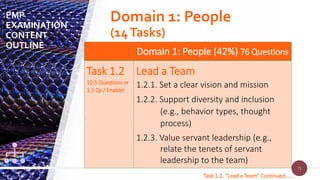
Domain 1: People (42%) 76 Questions
Task 1.2
10.5 Questions or
1.5 Qs / Enabler
Lead a Team
1.2.1. Set a clear vision and mission
1.2.2. Support diversity and inclusion
(e.g., behavior types, thought
process)
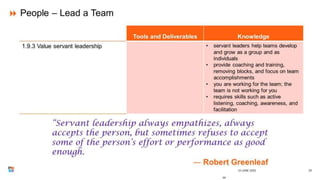
1.2.3. Value servant leadership (e.g.,
relate the tenets of servant
leadership to the team)
Task 1.2. “Lead a Team” Continued……
PMP
EXAMINATION
CONTENT
OUTLINE
Domain 1: People
(14Tasks)
72
72
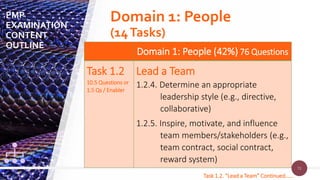
Domain 1: People (42%) 76 Questions
Task 1.2
10.5 Questions or
1.5 Qs / Enabler
Lead a Team
1.2.4. Determine an appropriate
leadership style (e.g., directive,
collaborative)
1.2.5. Inspire, motivate, and influence
team members/stakeholders (e.g.,
team contract, social contract,
reward system)
Task 1.2. “Lead a Team” Continued……
PMP
EXAMINATION
CONTENT
OUTLINE
Domain 1: People
(14Tasks)
73
73
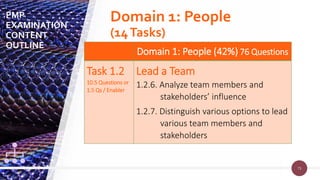
Domain 1: People (42%) 76 Questions
Task 1.2
10.5 Questions or
1.5 Qs / Enabler
Lead a Team
1.2.6. Analyze team members and
stakeholders’ influence
1.2.7. Distinguish various options to lead
various team members and
stakeholders
PMP
EXAMINATION
CONTENT
OUTLINE
Domain 1: People
(14Tasks)
74
74
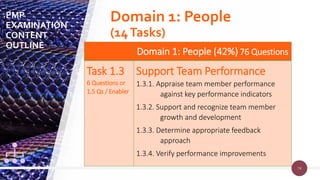
Domain 1: People (42%) 76 Questions
Task 1.3
6 Questions or
1.5 Qs / Enabler
Support Team Performance
1.3.1. Appraise team member performance
against key performance indicators
1.3.2. Support and recognize team member
growth and development
1.3.3. Determine appropriate feedback
approach
1.3.4. Verify performance improvements
PMP
EXAMINATION
CONTENT
OUTLINE
Domain 1: People
(14Tasks)
75
75
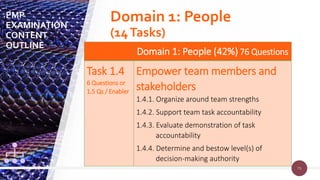
Domain 1: People (42%) 76 Questions
Task 1.4
6 Questions or
1.5 Qs / Enabler
Empower team members and
stakeholders
1.4.1. Organize around team strengths
1.4.2. Support team task accountability
1.4.3. Evaluate demonstration of task
accountability
1.4.4. Determine and bestow level(s) of
decision-making authority
PMP
EXAMINATION
CONTENT
OUTLINE
Domain 1: People
(14Tasks)
76
76
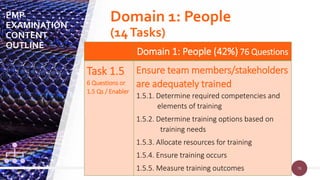
Domain 1: People (42%) 76 Questions
Task 1.5
6 Questions or
1.5 Qs / Enabler
Ensure team members/stakeholders
are adequately trained
1.5.1. Determine required competencies and
elements of training
1.5.2. Determine training options based on
training needs
1.5.3. Allocate resources for training
1.5.4. Ensure training occurs
1.5.5. Measure training outcomes
PMP
EXAMINATION
CONTENT
OUTLINE
Domain 1: People
(14Tasks)
78
78
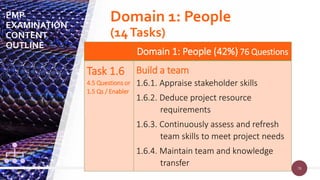
Domain 1: People (42%) 76 Questions
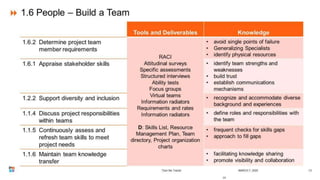
Task 1.6
4.5 Questions or
1.5 Qs / Enabler
Build a team
1.6.1. Appraise stakeholder skills
1.6.2. Deduce project resource
requirements
1.6.3. Continuously assess and refresh
team skills to meet project needs
1.6.4. Maintain team and knowledge
transfer
PMP
EXAMINATION
CONTENT
OUTLINE
Domain 1: People
(14Tasks)
79
79
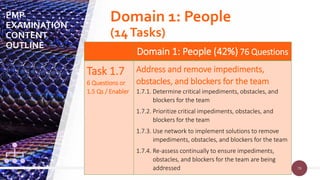
Domain 1: People (42%) 76 Questions
Task 1.7
6 Questions or
1.5 Qs / Enabler
Address and remove impediments,
obstacles, and blockers for the team
1.7.1. Determine critical impediments, obstacles, and
blockers for the team
1.7.2. Prioritize critical impediments, obstacles, and
blockers for the team
1.7.3. Use network to implement solutions to remove
impediments, obstacles, and blockers for the team
1.7.4. Re-assess continually to ensure impediments,
obstacles, and blockers for the team are being
addressed
PMP
EXAMINATION
CONTENT
OUTLINE
Domain 1: People
(14Tasks)
80
80
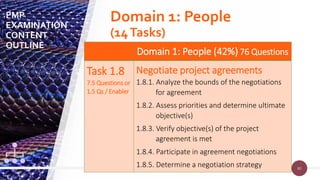
Domain 1: People (42%) 76 Questions
Task 1.8
7.5 Questions or
1.5 Qs / Enabler
Negotiate project agreements
1.8.1. Analyze the bounds of the negotiations
for agreement
1.8.2. Assess priorities and determine ultimate
objective(s)
1.8.3. Verify objective(s) of the project
agreement is met
1.8.4. Participate in agreement negotiations
1.8.5. Determine a negotiation strategy
PMP
EXAMINATION
CONTENT
OUTLINE
Domain 1: People
(14Tasks)
81
81
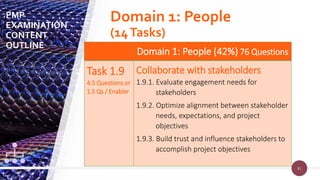
Domain 1: People (42%) 76 Questions
Task 1.9
4.5 Questions or
1.5 Qs / Enabler
Collaborate with stakeholders
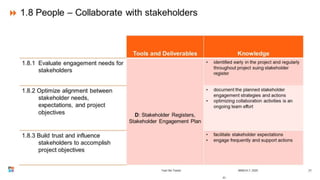
1.9.1. Evaluate engagement needs for
stakeholders
1.9.2. Optimize alignment between stakeholder
needs, expectations, and project
objectives
1.9.3. Build trust and influence stakeholders to
accomplish project objectives
PMP
EXAMINATION
CONTENT
OUTLINE
Domain 1: People
(14Tasks)
82
82
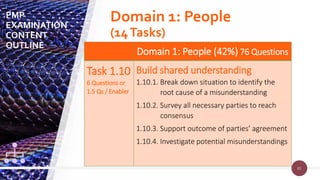
Domain 1: People (42%) 76 Questions
Task 1.10
6 Questions or
1.5 Qs / Enabler
Build shared understanding
1.10.1. Break down situation to identify the
root cause of a misunderstanding
1.10.2. Survey all necessary parties to reach
consensus
1.10.3. Support outcome of parties’ agreement
1.10.4. Investigate potential misunderstandings
PMP
EXAMINATION
CONTENT
OUTLINE
Domain 1: People
(14Tasks)
83
83
Domain 1: People (42%) 76 Questions
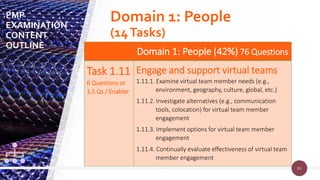
Task 1.11
6 Questions or
1.5 Qs / Enabler
Engage and support virtual teams
1.11.1. Examine virtual team member needs (e.g.,
environment, geography, culture, global, etc.)
1.11.2. Investigate alternatives (e.g., communication
tools, colocation) for virtual team member
engagement
1.11.3. Implement options for virtual team member
engagement
1.11.4. Continually evaluate effectiveness of virtual team
member engagement
PMP
EXAMINATION
CONTENT
OUTLINE
Domain 1: People
(14Tasks)
84
84
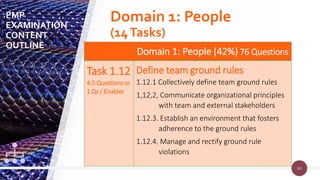
Domain 1: People (42%) 76 Questions
Task 1.12
4.5 Questions or
1 Qs / Enabler
Define team ground rules
1.12.1 Collectively define team ground rules
1,12,2, Communicate organizational principles
with team and external stakeholders
1.12.3. Establish an environment that fosters
adherence to the ground rules
1.12.4. Manage and rectify ground rule
violations
PMP
EXAMINATION
CONTENT
OUTLINE
Domain 1: People
(14Tasks)
86
86
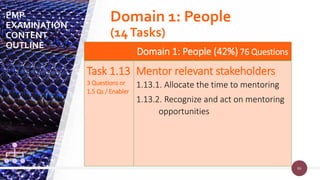
Domain 1: People (42%) 76 Questions
Task 1.13
3 Questions or
1.5 Qs / Enabler
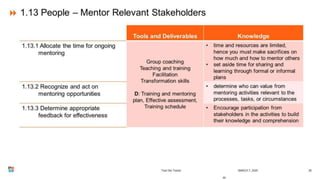
Mentor relevant stakeholders
1.13.1. Allocate the time to mentoring
1.13.2. Recognize and act on mentoring
opportunities
PMP
EXAMINATION
CONTENT
OUTLINE
Domain 1: People
(14Tasks)
87
Domain 1: People
(14Tasks)
87
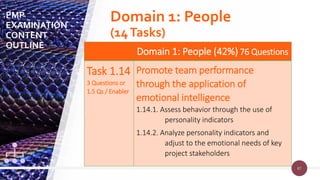
Domain 1: People (42%) 76 Questions
Task 1.14
3 Questions or
1.5 Qs / Enabler
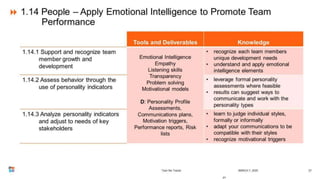
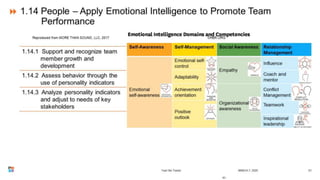
Promote team performance
through the application of
emotional intelligence
1.14.1. Assess behavior through the use of
personality indicators
1.14.2. Analyze personality indicators and
adjust to the emotional needs of key
project stakeholders
PMP
EXAMINATION
CONTENT
OUTLINE
88
88
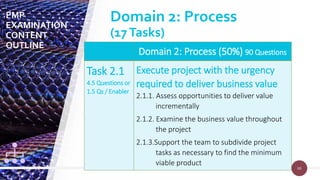
Domain 2: Process (50%) 90 Questions
Task 2.1
4.5 Questions or
1.5 Qs / Enabler
Execute project with the urgency
required to deliver business value
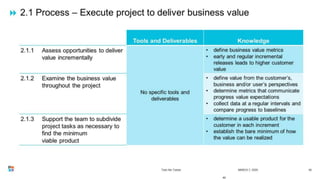
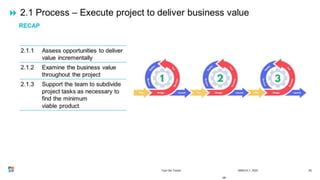
2.1.1. Assess opportunities to deliver value
incrementally
2.1.2. Examine the business value throughout
the project
2.1.3.Support the team to subdivide project
tasks as necessary to find the minimum
viable product
PMP
EXAMINATION
CONTENT
OUTLINE
Domain 2: Process
(17Tasks)
89
89
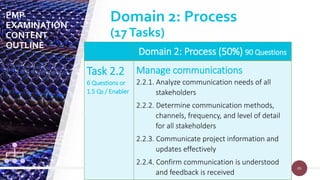
Domain 2: Process (50%) 90 Questions
Task 2.2
6 Questions or
1.5 Qs / Enabler
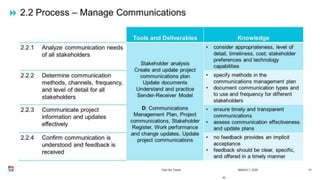
Manage communications
2.2.1. Analyze communication needs of all
stakeholders
2.2.2. Determine communication methods,
channels, frequency, and level of detail
for all stakeholders
2.2.3. Communicate project information and
updates effectively
2.2.4. Confirm communication is understood
and feedback is received
PMP
EXAMINATION
CONTENT
OUTLINE
Domain 2: Process
(17Tasks)
90
90
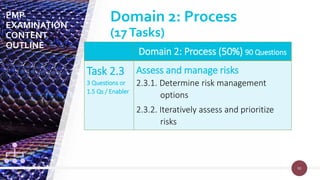
Domain 2: Process (50%) 90 Questions
Task 2.3
3 Questions or
1.5 Qs / Enabler
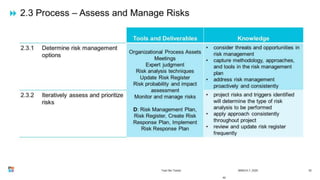
Assess and manage risks
2.3.1. Determine risk management
options
2.3.2. Iteratively assess and prioritize
risks
PMP
EXAMINATION
CONTENT
OUTLINE
Domain 2: Process
(17Tasks)
91
91
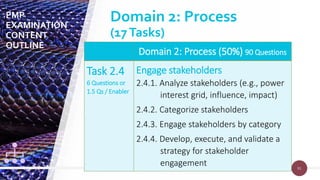
Domain 2: Process (50%) 90 Questions
Task 2.4
6 Questions or
1.5 Qs / Enabler
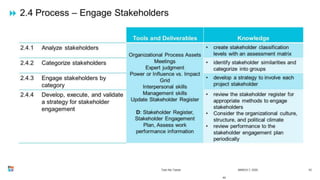
Engage stakeholders
2.4.1. Analyze stakeholders (e.g., power
interest grid, influence, impact)
2.4.2. Categorize stakeholders
2.4.3. Engage stakeholders by category
2.4.4. Develop, execute, and validate a
strategy for stakeholder
engagement
PMP
EXAMINATION
CONTENT
OUTLINE
Domain 2: Process
(17Tasks)
92
92
Domain 2: Process (50%) 90 Questions
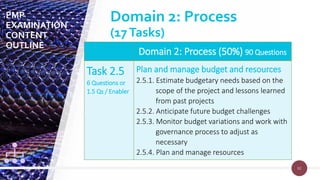
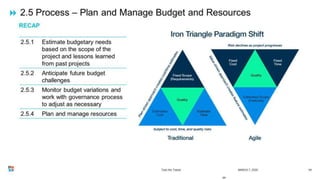
Task 2.5
6 Questions or
1.5 Qs / Enabler
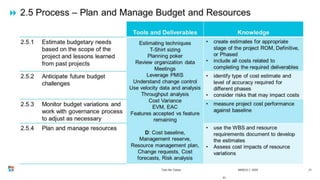
Plan and manage budget and resources
2.5.1. Estimate budgetary needs based on the
scope of the project and lessons learned
from past projects
2.5.2. Anticipate future budget challenges
2.5.3. Monitor budget variations and work with
governance process to adjust as
necessary
2.5.4. Plan and manage resources
PMP
EXAMINATION
CONTENT
OUTLINE
Domain 2: Process
(17Tasks)
93
93
Domain 2: Process (50%) 90 Questions
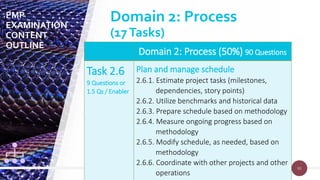
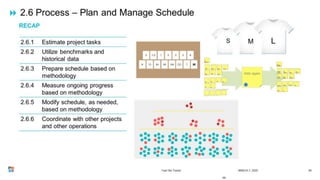
Task 2.6
9 Questions or
1.5 Qs / Enabler
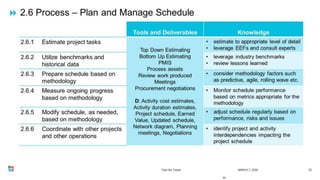
Plan and manage schedule
2.6.1. Estimate project tasks (milestones,
dependencies, story points)
2.6.2. Utilize benchmarks and historical data
2.6.3. Prepare schedule based on methodology
2.6.4. Measure ongoing progress based on
methodology
2.6.5. Modify schedule, as needed, based on
methodology
2.6.6. Coordinate with other projects and other
operations
PMP
EXAMINATION
CONTENT
OUTLINE
Domain 2: Process
(17Tasks)
94
94
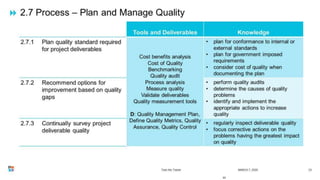
Domain 2: Process (50%) 90 Questions
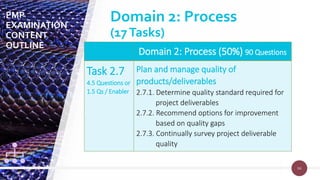
Task 2.7
4.5 Questions or
1.5 Qs / Enabler
Plan and manage quality of
products/deliverables
2.7.1. Determine quality standard required for
project deliverables
2.7.2. Recommend options for improvement
based on quality gaps
2.7.3. Continually survey project deliverable
quality
PMP
EXAMINATION
CONTENT
OUTLINE
Domain 2: Process
(17Tasks)
95
95
Domain 2: Process (50%) 90 Questions
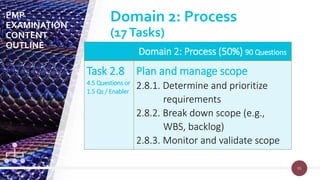
Task 2.8
4.5 Questions or
1.5 Qs / Enabler
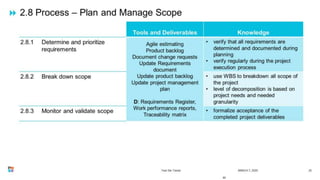
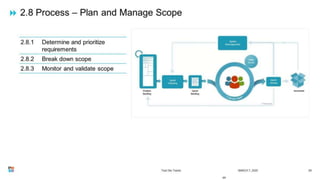
Plan and manage scope
2.8.1. Determine and prioritize
requirements
2.8.2. Break down scope (e.g.,
WBS, backlog)
2.8.3. Monitor and validate scope
PMP
EXAMINATION
CONTENT
OUTLINE
Domain 2: Process
(17Tasks)
96
96
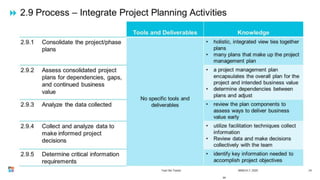
Domain 2: Process (50%) 90 Questions
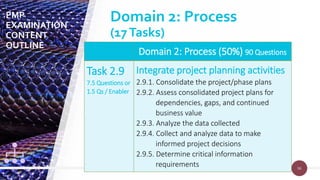
Task 2.9
7.5 Questions or
1.5 Qs / Enabler
Integrate project planning activities
2.9.1. Consolidate the project/phase plans
2.9.2. Assess consolidated project plans for
dependencies, gaps, and continued
business value
2.9.3. Analyze the data collected
2.9.4. Collect and analyze data to make
informed project decisions
2.9.5. Determine critical information
requirements
PMP
EXAMINATION
CONTENT
OUTLINE
Domain 2: Process
(17Tasks)
97
97
Domain 2: Process (50%) 90 Questions
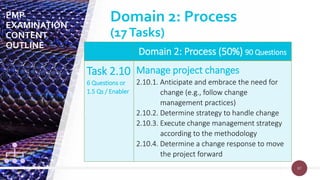
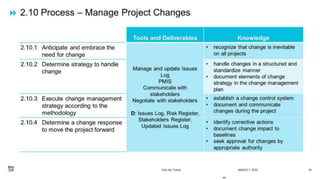
Task 2.10
6 Questions or
1.5 Qs / Enabler
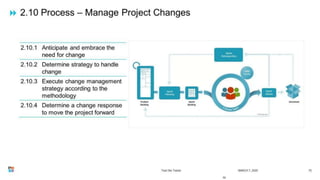
Manage project changes
2.10.1. Anticipate and embrace the need for
change (e.g., follow change
management practices)
2.10.2. Determine strategy to handle change
2.10.3. Execute change management strategy
according to the methodology
2.10.4. Determine a change response to move
the project forward
PMP
EXAMINATION
CONTENT
OUTLINE
Domain 2: Process
(17Tasks)
98
98
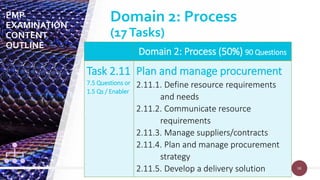
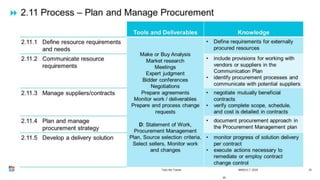
Domain 2: Process (50%) 90 Questions
Task 2.11
7.5 Questions or
1.5 Qs / Enabler
Plan and manage procurement
2.11.1. Define resource requirements
and needs
2.11.2. Communicate resource
requirements
2.11.3. Manage suppliers/contracts
2.11.4. Plan and manage procurement
strategy
2.11.5. Develop a delivery solution
PMP
EXAMINATION
CONTENT
OUTLINE
Domain 2: Process
(17Tasks)
99
99
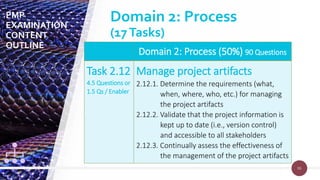
Domain 2: Process (50%) 90 Questions
Task 2.12
4.5 Questions or
1.5 Qs / Enabler
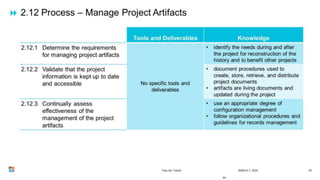
Manage project artifacts
2.12.1. Determine the requirements (what,
when, where, who, etc.) for managing
the project artifacts
2.12.2. Validate that the project information is
kept up to date (i.e., version control)
and accessible to all stakeholders
2.12.3. Continually assess the effectiveness of
the management of the project artifacts
PMP
EXAMINATION
CONTENT
OUTLINE
Domain 2: Process
(17Tasks)
100
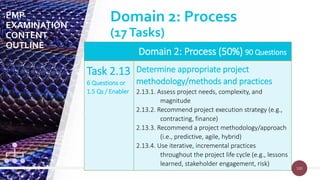
100
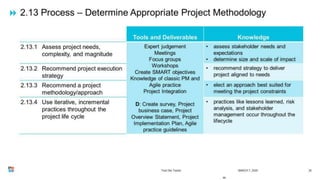
Domain 2: Process (50%) 90 Questions
Task 2.13
6 Questions or
1.5 Qs / Enabler
Determine appropriate project
methodology/methods and practices
2.13.1. Assess project needs, complexity, and
magnitude
2.13.2. Recommend project execution strategy (e.g.,
contracting, finance)
2.13.3. Recommend a project methodology/approach
(i.e., predictive, agile, hybrid)
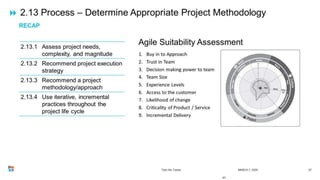
2.13.4. Use iterative, incremental practices
throughout the project life cycle (e.g., lessons
learned, stakeholder engagement, risk)
PMP
EXAMINATION
CONTENT
OUTLINE
Domain 2: Process
(17Tasks)
101
101
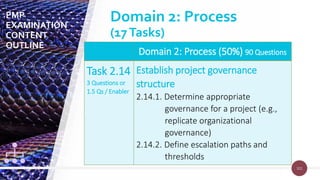
Domain 2: Process (50%) 90 Questions
Task 2.14
3 Questions or
1.5 Qs / Enabler
Establish project governance
structure
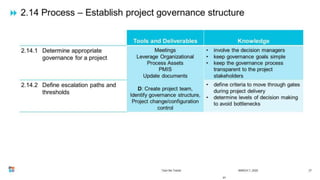
2.14.1. Determine appropriate
governance for a project (e.g.,
replicate organizational
governance)
2.14.2. Define escalation paths and
thresholds
PMP
EXAMINATION
CONTENT
OUTLINE
Domain 2: Process
(17Tasks)
102
102
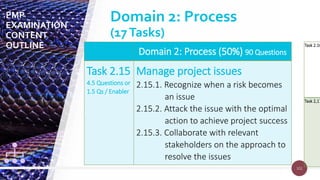
Domain 2: Process (50%) 90 Questions
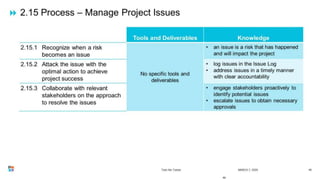
Task 2.15
4.5 Questions or
1.5 Qs / Enabler
Manage project issues
2.15.1. Recognize when a risk becomes
an issue
2.15.2. Attack the issue with the optimal
action to achieve project success
2.15.3. Collaborate with relevant
stakeholders on the approach to
resolve the issues
PMP
EXAMINATION
CONTENT
OUTLINE
Domain 2: Process
(17Tasks)
Task 2.16
Task 2,17
103
103
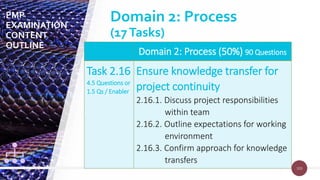
Domain 2: Process (50%) 90 Questions
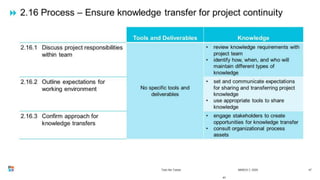
Task 2.16
4.5 Questions or
1.5 Qs / Enabler
Ensure knowledge transfer for
project continuity
2.16.1. Discuss project responsibilities
within team
2.16.2. Outline expectations for working
environment
2.16.3. Confirm approach for knowledge
transfers
PMP
EXAMINATION
CONTENT
OUTLINE
Domain 2: Process
(17Tasks)
104
104
Domain 2: Process (50%) 90 Questions
Task 2.17
4.5 Questions or
1.5 Qs / Enabler
Plan and manage project/phase
closure or transitions
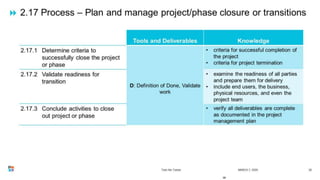
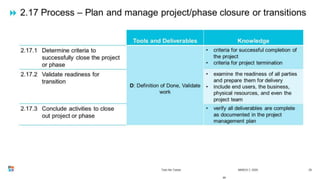
2.17.1. Determine criteria to successfully close
the project or phase
2.17.2. Validate readiness for transition (e.g., to
operations team or next phase)
2.17.3. Conclude activities to close out project
or phase (e.g., final lessons learned,
retrospective, procurement, financials,
resources)
PMP
EXAMINATION
CONTENT
OUTLINE
Domain 2: Process
(17Tasks)
105
105
Domain 2: Business (8%) 14 Questions
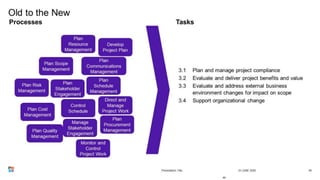
Task 3.1
4.5 Questions or
1.36 Qs / Enabler
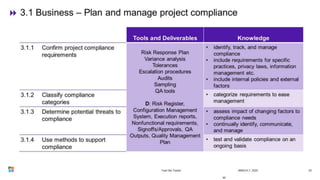
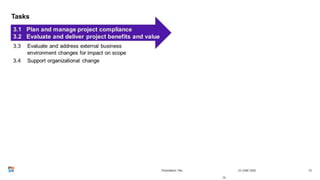
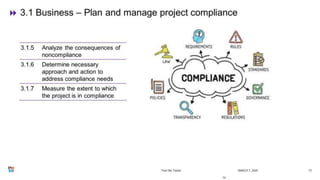
Plan and manage project compliance
3.1.1. Confirm project compliance requirements
(e.g., security, health and safety, regulatory
compliance)
3.1.2. Classify compliance categories
3.1.3. Determine potential threats to compliance
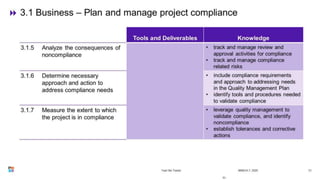
3.1.4. Use methods to support compliance
3.1.5. Analyze the consequences of noncompliance
3.1.6. Determine necessary approach and action to
address compliance needs (e.g., risk, legal)
3.1.7. Measure the extent to which the project is in
compliance
PMP
EXAMINATION
CONTENT
OUTLINE
Domain 3: Business
(4Tasks)
106
106
Domain 2: Business (8%) 14 Questions
Task 3.2
3.5 Questions or
1.36Qs / Enabler
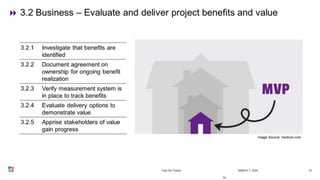
Evaluate and deliver project benefits and
value
3.2.1. Investigate that benefits are identified
3.2.2. Document agreement on ownership for
ongoing benefit realization
3.2.3. Verify measurement system is in place to
track benefits
3.2.4. Evaluate delivery options to demonstrate
value
3.2.5. Appraise stakeholders of value gain
progress
PMP
EXAMINATION
CONTENT
OUTLINE
Domain 3: Business
(4Tasks)
107
107
Domain 2: Business (8%) 14 Questions
Task 3.3
3 Questions or
1.36Qs / Enabler
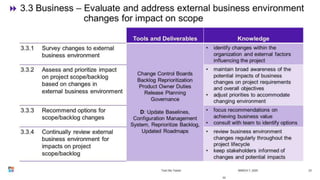
Evaluate Support organizational change
3.3.1. Survey changes to external business environment
(e.g., regulations, technology, geopolitical,
market)
3.3.2. Assess and prioritize impact on project
scope/backlog based on changes in external
business environment
3.3.3. Recommend options for scope/backlog changes
(e.g., schedule, cost changes)
3.3.4. Continually review external business environment
for impacts on project scope/backlog
PMP
EXAMINATION
CONTENT
OUTLINE
Domain 3: Business
(4Tasks)
108
108
Domain 2: Business (8%) 14 Questions
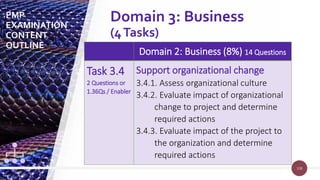
Task 3.4
2 Questions or
1.36Qs / Enabler
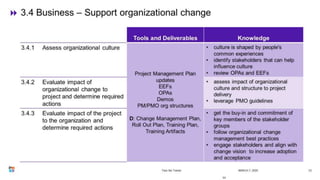
Support organizational change
3.4.1. Assess organizational culture
3.4.2. Evaluate impact of organizational
change to project and determine
required actions
3.4.3. Evaluate impact of the project to
the organization and determine
required actions
PMP
EXAMINATION
CONTENT
OUTLINE
Domain 3: Business
(4Tasks)
109
CAPM ECO
109
EXAMINATION
CONTENT
OUTLINE
110
110
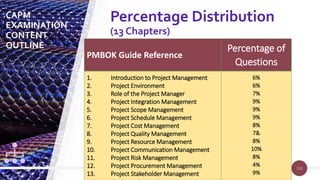
PMBOK Guide Reference
Percentage of
Questions
1. Introduction to Project Management
2. Project Environment
3. Role of the Project Manager
4. Project Integration Management
5. Project Scope Management
6. Project Schedule Management
7. Project Cost Management
8. Project Quality Management
9. Project Resource Management
10. Project Communication Management
11. Project Risk Management
12. Project Procurement Management
13. Project Stakeholder Management
6%
6%
7%
9%
9%
9%
8%
7&
8%
10%
8%
4%
9%
CAPM
EXAMINATION
CONTENT
OUTLINE
Percentage Distribution
(13 Chapters)
111
111
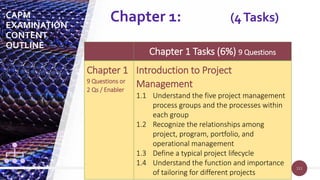
Chapter 1 Tasks (6%) 9 Questions
Chapter 1
9 Questions or
2 Qs / Enabler
Introduction to Project
Management
1.1 Understand the five project management
process groups and the processes within
each group
1.2 Recognize the relationships among
project, program, portfolio, and
operational management
1.3 Define a typical project lifecycle
1.4 Understand the function and importance
of tailoring for different projects
Chapter 1: (4Tasks)
CAPM
EXAMINATION
CONTENT
OUTLINE
112
112
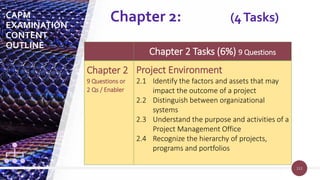
Chapter 2 Tasks (6%) 9 Questions
Chapter 2
9 Questions or
2 Qs / Enabler
Project Environment
2.1 Identify the factors and assets that may
impact the outcome of a project
2.2 Distinguish between organizational
systems
2.3 Understand the purpose and activities of a
Project Management Office
2.4 Recognize the hierarchy of projects,
programs and portfolios
Chapter 2: (4Tasks)
CAPM
EXAMINATION
CONTENT
OUTLINE
113
113
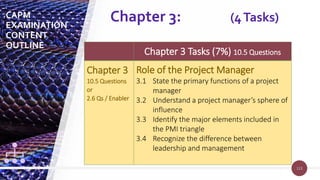
Chapter 3 Tasks (7%) 10.5 Questions
Chapter 3
10.5 Questions
or
2.6 Qs / Enabler
Role of the Project Manager
3.1 State the primary functions of a project
manager
3.2 Understand a project manager’s sphere of
influence
3.3 Identify the major elements included in
the PMI triangle
3.4 Recognize the difference between
leadership and management
Chapter 3: (4Tasks)
CAPM
EXAMINATION
CONTENT
OUTLINE
114
114
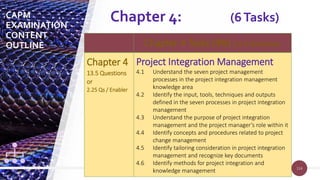
Chapter 4 Tasks (9%) 13.5 Questions
Chapter 4
13.5 Questions
or
2.25 Qs / Enabler
Project Integration Management
4.1 Understand the seven project management
processes in the project integration management
knowledge area
4.2 Identify the input, tools, techniques and outputs
defined in the seven processes in project integration
management
4.3 Understand the purpose of project integration
management and the project manager’s role within it
4.4 Identify concepts and procedures related to project
change management
4.5 Identify tailoring consideration in project integration
management and recognize key documents
4.6 Identify methods for project integration and
knowledge management
Chapter 4: (6Tasks)
CAPM
EXAMINATION
CONTENT
OUTLINE
115
115
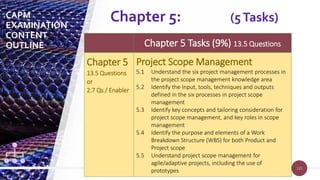
Chapter 5 Tasks (9%) 13.5 Questions
Chapter 5
13.5 Questions
or
2.7 Qs / Enabler
Project Scope Management
5.1 Understand the six project management processes in
the project scope management knowledge area
5.2 Identify the Input, tools, techniques and outputs
defined in the six processes in project scope
management
5.3 Identify key concepts and tailoring consideration for
project scope management, and key roles in scope
management
5.4 Identify the purpose and elements of a Work
Breakdown Structure (WBS) for both Product and
Project scope
5.5 Understand project scope management for
agile/adaptive projects, including the use of
prototypes
Chapter 5: (5Tasks)
CAPM
EXAMINATION
CONTENT
OUTLINE
116
116
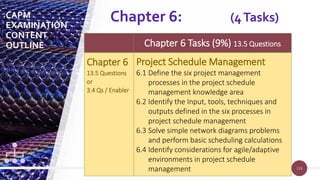
Chapter 6 Tasks (9%) 13.5 Questions
Chapter 6
13.5 Questions
or
3.4 Qs / Enabler
Project Schedule Management
6.1 Define the six project management
processes in the project schedule
management knowledge area
6.2 Identify the Input, tools, techniques and
outputs defined in the six processes in
project schedule management
6.3 Solve simple network diagrams problems
and perform basic scheduling calculations
6.4 Identify considerations for agile/adaptive
environments in project schedule
management
Chapter 6: (4Tasks)
CAPM
EXAMINATION
CONTENT
OUTLINE
117
117
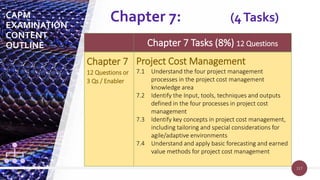
Chapter 7 Tasks (8%) 12 Questions
Chapter 7
12 Questions or
3 Qs / Enabler
Project Cost Management
7.1 Understand the four project management
processes in the project cost management
knowledge area
7.2 Identify the Input, tools, techniques and outputs
defined in the four processes in project cost
management
7.3 Identify key concepts in project cost management,
including tailoring and special considerations for
agile/adaptive environments
7.4 Understand and apply basic forecasting and earned
value methods for project cost management
Chapter 7: (4Tasks)
CAPM
EXAMINATION
CONTENT
OUTLINE
118
118
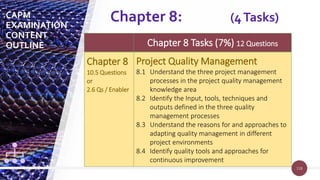
Chapter 8 Tasks (7%) 12 Questions
Chapter 8
10.5 Questions
or
2.6 Qs / Enabler
Project Quality Management
8.1 Understand the three project management
processes in the project quality management
knowledge area
8.2 Identify the Input, tools, techniques and
outputs defined in the three quality
management processes
8.3 Understand the reasons for and approaches to
adapting quality management in different
project environments
8.4 Identify quality tools and approaches for
continuous improvement
Chapter 8: (4Tasks)
CAPM
EXAMINATION
CONTENT
OUTLINE
119
119
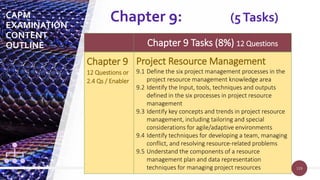
Chapter 9 Tasks (8%) 12 Questions
Chapter 9
12 Questions or
2.4 Qs / Enabler
Project Resource Management
9.1 Define the six project management processes in the
project resource management knowledge area
9.2 Identify the Input, tools, techniques and outputs
defined in the six processes in project resource
management
9.3 Identify key concepts and trends in project resource
management, including tailoring and special
considerations for agile/adaptive environments
9.4 Identify techniques for developing a team, managing
conflict, and resolving resource-related problems
9.5 Understand the components of a resource
management plan and data representation
techniques for managing project resources
Chapter 9: (5Tasks)
CAPM
EXAMINATION
CONTENT
OUTLINE
120
120
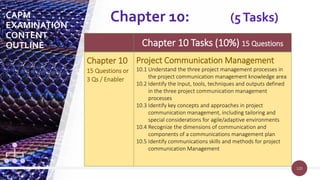
Chapter 10 Tasks (10%) 15 Questions
Chapter 10
15 Questions or
3 Qs / Enabler
Project Communication Management
10.1 Understand the three project management processes in
the project communication management knowledge area
10.2 Identify the Input, tools, techniques and outputs defined
in the three project communication management
processes
10.3 Identify key concepts and approaches in project
communication management, including tailoring and
special considerations for agile/adaptive environments
10.4 Recognize the dimensions of communication and
components of a communications management plan
10.5 Identify communications skills and methods for project
communication Management
Chapter 10: (5Tasks)
CAPM
EXAMINATION
CONTENT
OUTLINE
121
121
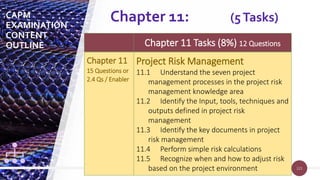
Chapter 11 Tasks (8%) 12 Questions
Chapter 11
15 Questions or
2.4 Qs / Enabler
Project Risk Management
11.1 Understand the seven project
management processes in the project risk
management knowledge area
11.2 Identify the Input, tools, techniques and
outputs defined in project risk
management
11.3 Identify the key documents in project
risk management
11.4 Perform simple risk calculations
11.5 Recognize when and how to adjust risk
based on the project environment
Chapter 11: (5Tasks)
CAPM
EXAMINATION
CONTENT
OUTLINE
122
122
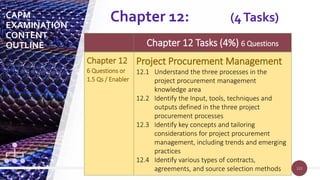
Chapter 12 Tasks (4%) 6 Questions
Chapter 12
6 Questions or
1.5 Qs / Enabler
Project Procurement Management
12.1 Understand the three processes in the
project procurement management
knowledge area
12.2 Identify the Input, tools, techniques and
outputs defined in the three project
procurement processes
12.3 Identify key concepts and tailoring
considerations for project procurement
management, including trends and emerging
practices
12.4 Identify various types of contracts,
agreements, and source selection methods
Chapter 12: (4Tasks)
CAPM
EXAMINATION
CONTENT
OUTLINE
123
123
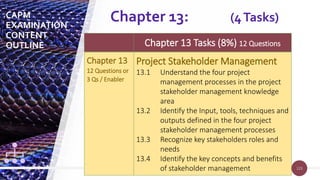
Chapter 13 Tasks (8%) 12 Questions
Chapter 13
12 Questions or
3 Qs / Enabler
Project Stakeholder Management
13.1 Understand the four project
management processes in the project
stakeholder management knowledge
area
13.2 Identify the Input, tools, techniques and
outputs defined in the four project
stakeholder management processes
13.3 Recognize key stakeholders roles and
needs
13.4 Identify the key concepts and benefits
of stakeholder management
Chapter 13: (4Tasks)
CAPM
EXAMINATION
CONTENT
OUTLINE
9
10
11
12
1.2
1.1
DAY 1
13
14
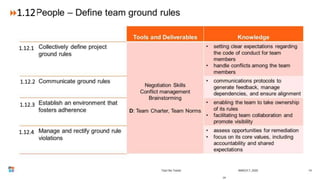
1.12.1
1.12
1.12.2
1.12.3
1.12.4
16
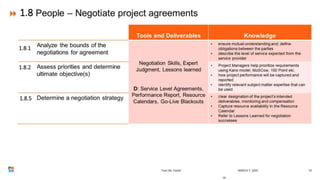
1.8.1
1.8
1.8.2
1.8.5
18
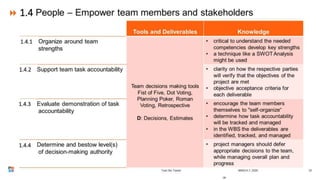
1.4.1
1.4
1.4.2
1.4.3
1.4.4
19
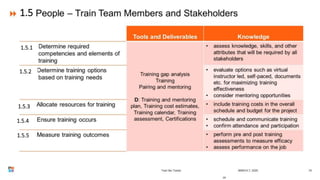
1.5.1
1.5
1.5.2
1.5.3
1.5.4
1.5.5
20
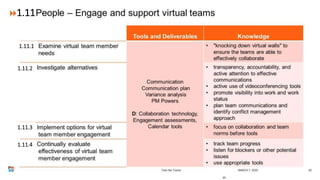
1.11.1
1.11
1.11.2
1.11.4
1.11.3
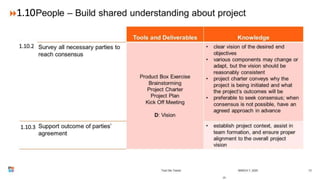
15
1.10.2
1.10
1.10.3
DAY 4
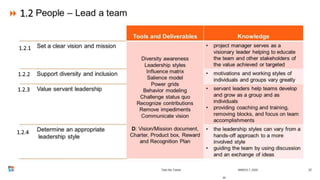
22
1.2.1
1.2
1.2.2
1.2.3
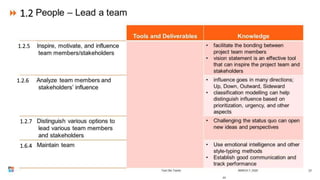
1.2.4
23
1.2.5
1.2
1.2.6
1.2.7
1.6.4
24
16
17
20
21
25
26
27
28
29
DAY 2
30
31
32
33
34
35
36
37
38
39
DAY 3
40
41
42
43
44
45
46
47
48
49
DAY 5
50
51
52
53
54
55
56
57
58
59
60
61
62
63
64
65
66
67
68
69
70
71
72
73
74
PMI AUTHORIZED
COURSEWARE
Changes in Mindset and new Outline
199
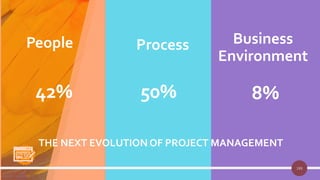
THE NEXT EVOLUTION OF PROJECT MANAGEMENT
199
42% 50% 8%
People Business
Environment
Process
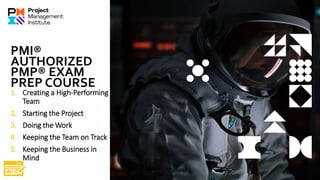
PMI®
AUTHORIZED
PMP® EXAM
PREP COURSE
1. Creating a High-Performing
Team
2. Starting the Project
3. Doing the Work
4. Keeping the Team on Track
5. Keeping the Business in
Mind
201
PMI AUTHORIZED
COURSEWARE
201
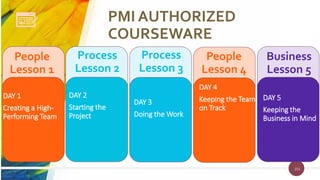
People
Lesson 1
People
Lesson 4
Process
Lesson 3
Business
Lesson 5
DAY 1
Creating a High-
Performing Team
DAY 4
Keeping the Team
on Track
DAY 3
Doing the Work
DAY 5
Keeping the
Business in Mind
Process
Lesson 2
DAY 2
Starting the
Project
202
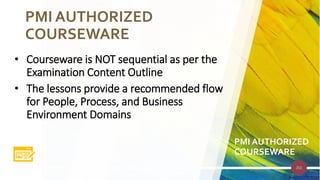
• Courseware is NOT sequential as per the
Examination Content Outline
• The lessons provide a recommended flow
for People, Process, and Business
Environment Domains
PMI AUTHORIZED
COURSEWARE
PMI AUTHORIZED
COURSEWARE
203
PMI AUTHORIZED
COURSEWARE
203
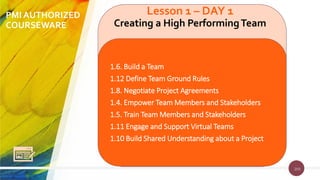
Lesson 1 – DAY 1
Creating a High PerformingTeam
1.6. Build a Team
1.12 Define Team Ground Rules
1.8. Negotiate Project Agreements
1.4. Empower Team Members and Stakeholders
1.5. Train Team Members and Stakeholders
1.11 Engage and Support Virtual Teams
1.10 Build Shared Understanding about a Project
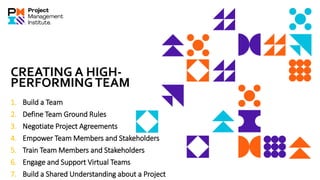
CREATING A HIGH-
PERFORMINGTEAM
1. Build a Team
2. Define Team Ground Rules
3. Negotiate Project Agreements
4. Empower Team Members and Stakeholders
5. Train Team Members and Stakeholders
6. Engage and Support Virtual Teams
7. Build a Shared Understanding about a Project
205
PMI AUTHORIZED
COURSEWARE
205
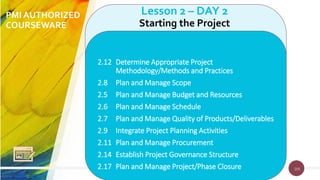
Lesson 2 – DAY 2
Starting the Project
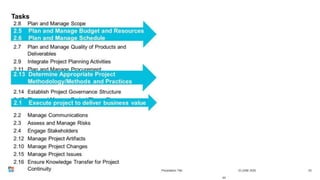
2.12 Determine Appropriate Project
Methodology/Methods and Practices
2.8 Plan and Manage Scope
2.5 Plan and Manage Budget and Resources
2.6 Plan and Manage Schedule
2.7 Plan and Manage Quality of Products/Deliverables
2.9 Integrate Project Planning Activities
2.11 Plan and Manage Procurement
2.14 Establish Project Governance Structure
2.17 Plan and Manage Project/Phase Closure
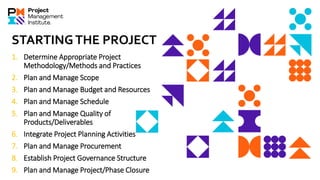
STARTINGTHE PROJECT
1. Determine Appropriate Project
Methodology/Methods and Practices
2. Plan and Manage Scope
3. Plan and Manage Budget and Resources
4. Plan and Manage Schedule
5. Plan and Manage Quality of
Products/Deliverables
6. Integrate Project Planning Activities
7. Plan and Manage Procurement
8. Establish Project Governance Structure
9. Plan and Manage Project/Phase Closure
207
PMI AUTHORIZED
COURSEWARE
207
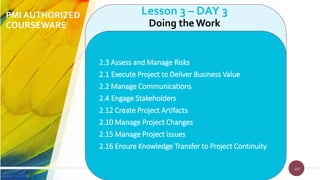
Lesson 3 – DAY 3
Doing theWork
2.3 Assess and Manage Risks
2.1 Execute Project to Deliver Business Value
2.2 Manage Communications
2.4 Engage Stakeholders
2.12 Create Project Artifacts
2.10 Manage Project Changes
2.15 Manage Project Issues
2.16 Ensure Knowledge Transfer to Project Continuity
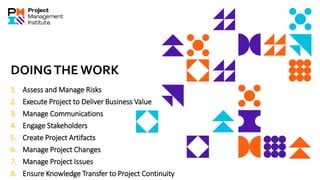
DOINGTHE WORK
1. Assess and Manage Risks
2. Execute Project to Deliver Business Value
3. Manage Communications
4. Engage Stakeholders
5. Create Project Artifacts
6. Manage Project Changes
7. Manage Project Issues
8. Ensure Knowledge Transfer to Project Continuity
209
PMI AUTHORIZED
COURSEWARE
209
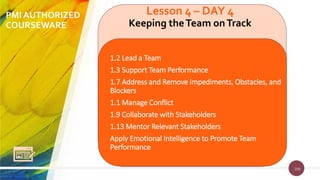
Lesson 4 – DAY 4
Keeping theTeam onTrack
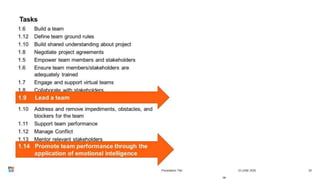
1.2 Lead a Team
1.3 Support Team Performance
1.7 Address and Remove Impediments, Obstacles, and
Blockers
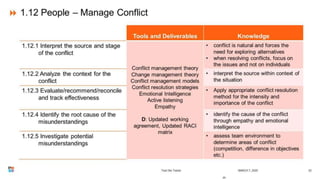
1.1 Manage Conflict
1.9 Collaborate with Stakeholders
1.13 Mentor Relevant Stakeholders
Apply Emotional Intelligence to Promote Team
Performance
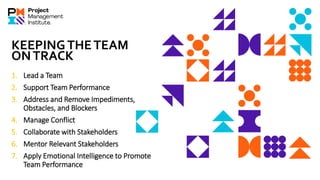
KEEPINGTHETEAM
ONTRACK
1. Lead a Team
2. Support Team Performance
3. Address and Remove Impediments,
Obstacles, and Blockers
4. Manage Conflict
5. Collaborate with Stakeholders
6. Mentor Relevant Stakeholders
7. Apply Emotional Intelligence to Promote
Team Performance
211
PMI AUTHORIZED
COURSEWARE
211
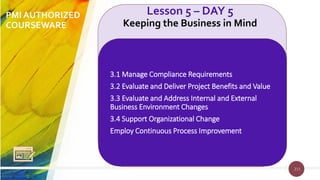
Lesson 5 – DAY 5
Keeping the Business in Mind
3.1 Manage Compliance Requirements
3.2 Evaluate and Deliver Project Benefits and Value
3.3 Evaluate and Address Internal and External
Business Environment Changes
3.4 Support Organizational Change
Employ Continuous Process Improvement
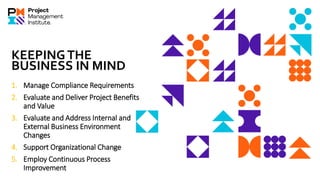
KEEPINGTHE
BUSINESS IN MIND
1. Manage Compliance Requirements
2. Evaluate and Deliver Project Benefits
and Value
3. Evaluate and Address Internal and
External Business Environment
Changes
4. Support Organizational Change
5. Employ Continuous Process
Improvement
3
213
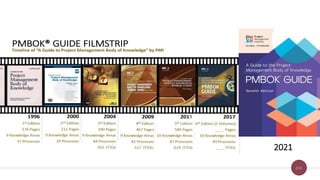
2021
214
216
PMI AUTHORIZED
COURSEWARE
216

ABOUT PMP NEW FORMAT 2021

  • 1.
    PMP EXAM PREPCOURSE ON NEW FORMAT EFFECTIVE 2 JAN 2021 AUTHORIZED PROJECT MANAGEMENT PROFESSIONAL EXAMINATION PREPARATION COURSE
  • 2.
    PMP EXAM PREPCOURSE ON NEW FORMAT EFFECTIVE 2 JAN 2021 AUTHORIZED PROJECT MANAGEMENT PROFESSIONAL EXAMINATION PREPARATION COURSE
  • 3.
    PMP EXAM PREPCOURSE ON NEW FORMAT EFFECTIVE 2 JAN 2021 AUTHORIZED PROJECT MANAGEMENT PROFESSIONAL EXAMINATION PREPARATION COURSE
  • 4.
  • 5.
    YOURTRAINER AND FACILITATOR PMIATP INSTRUCTOR SUHAIL IQBAL PE, PMP, PgMP, PfMP, PMI-PBA, PMI-RMP, PMI-SP, PMI-ACP, CAPM, SCT, SMC, SDC, SPOC, SAMC, ESMC, PRINCE2 Practitioner, MCT Alumni 5
  • 7.
  • 8.
    REFERENCES The Guides &Standards, Practice Guides & Standards, Maturity Models and Frameworks, Handbooks and Examination Content Outlines
  • 9.
  • 10.
  • 11.
  • 12.
  • 13.
  • 14.
  • 15.
  • 16.
  • 17.
  • 18.
  • 19.
  • 20.
  • 21.
  • 22.
  • 23.
  • 24.
  • 25.
  • 26.
  • 27.
  • 28.
  • 29.
  • 30.
  • 31.
    33 33 • Conducted every5-7 years • Third Party conducts the study • Discuss roles associated with credential • Tasks and responsibilities expected to be performed • Provides blueprint for the exam • Links the exam questions to the role PMP JobTask Analysis (JTA)
  • 32.
    34 34 The candidate forthe PMP credential will: • Perform their duties under general supervision and are responsible for all aspects of the project for the life of the project. • Lead and direct cross-functional teams to deliver projects within the constraints of schedule, budget and scope. • Demonstrate sufficient knowledge and experience to appropriately apply a methodology to projects that have reasonably well-defined requirements and deliverables. PMP JobTask Analysis (JTA)
  • 33.
  • 34.
  • 35.
  • 36.
  • 37.
  • 38.
    40 40 PMP examination questionsare developed in accordance with the ISO/IEC 17024 standard • are developed and independently validated by global work groups of PMP certification holders; • are referenced to current project management titles, which include but • are not limited to PMI’s global standards; • are monitored through psychometric analysis; and • satisfy the test specifications of the PMP Examination Content Outline. PMP Item Development
  • 39.
    41 41 • Many ofthe domains, tasks, knowledge, and skills outlined in PMP Examination Content Outline are covered by the PMBOK® Guide. • Some are unique to the PMP Examination Content Outline. • Current edition of PMBOK® Guide can certainly be included as one of the study references. • Also advised to study other current titles on project management, utilized in PMP examination development. PMP Item Development
  • 40.
    42 42 CAPM examination questions •developed and independently validated by global work groups of project management practitioners • Reference information in A Guide to the Project Management Body of Knowledge (PMBOK® Guide) – Sixth Edition • Are monitored through psychometric analysis CAPM Item Development
  • 41.
  • 42.
  • 43.
    45 45 Exam Scheduling • Theexam eligibility period is one year. • You may take the exam up to three times within this period, should you not pass on the first attempt. • PMI cannot guarantee or reserve seating at the testing centers or an available time for an online proctored test appointment. • Examination scheduling instructions will include:- • PMI Eligibility ID • The start and end dates for your eligibility period • The examination scheduling instructions. • Schedule exam within following time frames: • At least 6 weeks in advance of your preferred test date. • At least 3 months before the expiration of your eligibility period.
  • 44.
    46 46 Exam Scheduling atTest Center Ifyou selected Test Center during payment: 1. 1. When you are directed to your Pearson VUE account, the PMP exam will be available under Pre-approved Exams. Click the PMP exam link. 2. 2. On the next page, you will see the PMP exam and language you have selected. Please make sure to click “View Testing Policies”, then click “Schedule This Exam”. 3. 3. Next, search for a test center. Once you have located a test location with availability, select a date and time. 4. 4. After making your selection, review your appointment details and then click “Proceed to Checkout”. 5. 5. Follow the next steps to complete checkout, and then click “Submit Order”. 6. 6. Your appointment is confirmed and you will receive a confirmation email from Pearson VUE.
  • 45.
    47 47 Exam Scheduling ofOnline Proctored Exam If you selected Online Proctoring during payment: 1. When you are directed to your Pearson VUE account, the PMP exam will be available under Pre-approved Exams. Click the PMP exam link. 2. Read through and agree to the online proctoring policies and click “Next”. 3. The next page will display the PMP exam and language you have selected. Please make sure to click “View Testing Policies”, then click “Schedule This Exam”. 4. Choose the date and time you wish to take your exam. You do not need to select a location. You may schedule online at any time of day. Select the date you would like to take your exam and then the time. 5. After you make your selection, you will review your appointment details and then click “Proceed to Checkout”. 6. Follow the next steps to complete checkout and then click “Submit Order”. 7. Your appointment is confirmed and you will receive a confirmation email from Pearson VUE.
  • 46.
  • 47.
  • 48.
  • 49.
  • 50.
  • 51.
    53 53 CCR Requiremeents PDU Requirements GivingBack to the Profession PDUs (maximum limit enforced) Education PDUs (No maximum limit)
  • 52.
  • 53.
  • 54.
  • 55.
  • 56.
  • 57.
  • 58.
  • 59.
  • 60.
    62 Education PDUs 62 • Courseor Training - Instructor-led formal education courses or classes held in-person or online • Organization Meetings - Meetings, activities and local events related to the profession • Online or Digital Media - Self-paced learning conducted online or through varied forms of digital media • Read - Self-directed reading that is relevant to the certification you hold • Informal Learning - Educational opportunities focused on structured discussions • Work as a Practitioner - Working in your certified role • Create Content - Creating new knowledge resources for use by practitioners and the public at large • Give a Presentation - Presenting on topics relevant to the profession
  • 61.
    63 Giving Back tothe Profession 63 • Share Knowledge - Sharing your domain knowledge to help others learn and grow • Volunteer - Providing volunteer services to non-employer or non-client organizations
  • 62.
  • 63.
  • 64.
    66 THE NEXT EVOLUTIONOF PROJECT MANAGEMENT 66 42% 50% 8% People Business Environment Process
  • 65.
    67 CHANGING MINDSET Value Delivery Framework Business Environment People Process Business Environment People Process ProcessOriented and Sequential Initiate Plan Execute Close Monitor and Control Value Oriented VS
  • 66.
    68 PMP EXAMINATION CONTENT OUTLINE 68 Domains TasksEnablers Tools Deliverables 1. People 1.6. BuildTeam 1.6.1. Enablers X. X. X.
  • 67.
  • 68.
    70 70 Domain 1: People(42%) 76 Questions Task 1.1 4.5 Questions or 1.5 Qs / Enabler Manage conflict 1.1.1. Interpret the source and stage of the conflict 1.1.2. Analyze the context for the conflict 1.1.3. Evaluate/recommend/reconcile the appropriate conflict resolution solution PMP EXAMINATION CONTENT OUTLINE Domain 1: People (14Tasks)
  • 69.
    71 71 Domain 1: People(42%) 76 Questions Task 1.2 10.5 Questions or 1.5 Qs / Enabler Lead a Team 1.2.1. Set a clear vision and mission 1.2.2. Support diversity and inclusion (e.g., behavior types, thought process) 1.2.3. Value servant leadership (e.g., relate the tenets of servant leadership to the team) Task 1.2. “Lead a Team” Continued…… PMP EXAMINATION CONTENT OUTLINE Domain 1: People (14Tasks)
  • 70.
    72 72 Domain 1: People(42%) 76 Questions Task 1.2 10.5 Questions or 1.5 Qs / Enabler Lead a Team 1.2.4. Determine an appropriate leadership style (e.g., directive, collaborative) 1.2.5. Inspire, motivate, and influence team members/stakeholders (e.g., team contract, social contract, reward system) Task 1.2. “Lead a Team” Continued…… PMP EXAMINATION CONTENT OUTLINE Domain 1: People (14Tasks)
  • 71.
    73 73 Domain 1: People(42%) 76 Questions Task 1.2 10.5 Questions or 1.5 Qs / Enabler Lead a Team 1.2.6. Analyze team members and stakeholders’ influence 1.2.7. Distinguish various options to lead various team members and stakeholders PMP EXAMINATION CONTENT OUTLINE Domain 1: People (14Tasks)
  • 72.
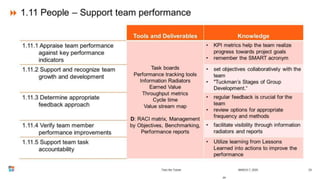
    74 74 Domain 1: People(42%) 76 Questions Task 1.3 6 Questions or 1.5 Qs / Enabler Support Team Performance 1.3.1. Appraise team member performance against key performance indicators 1.3.2. Support and recognize team member growth and development 1.3.3. Determine appropriate feedback approach 1.3.4. Verify performance improvements PMP EXAMINATION CONTENT OUTLINE Domain 1: People (14Tasks)
  • 73.
    75 75 Domain 1: People(42%) 76 Questions Task 1.4 6 Questions or 1.5 Qs / Enabler Empower team members and stakeholders 1.4.1. Organize around team strengths 1.4.2. Support team task accountability 1.4.3. Evaluate demonstration of task accountability 1.4.4. Determine and bestow level(s) of decision-making authority PMP EXAMINATION CONTENT OUTLINE Domain 1: People (14Tasks)
  • 74.
    76 76 Domain 1: People(42%) 76 Questions Task 1.5 6 Questions or 1.5 Qs / Enabler Ensure team members/stakeholders are adequately trained 1.5.1. Determine required competencies and elements of training 1.5.2. Determine training options based on training needs 1.5.3. Allocate resources for training 1.5.4. Ensure training occurs 1.5.5. Measure training outcomes PMP EXAMINATION CONTENT OUTLINE Domain 1: People (14Tasks)
  • 75.
    78 78 Domain 1: People(42%) 76 Questions Task 1.6 4.5 Questions or 1.5 Qs / Enabler Build a team 1.6.1. Appraise stakeholder skills 1.6.2. Deduce project resource requirements 1.6.3. Continuously assess and refresh team skills to meet project needs 1.6.4. Maintain team and knowledge transfer PMP EXAMINATION CONTENT OUTLINE Domain 1: People (14Tasks)
  • 76.
    79 79 Domain 1: People(42%) 76 Questions Task 1.7 6 Questions or 1.5 Qs / Enabler Address and remove impediments, obstacles, and blockers for the team 1.7.1. Determine critical impediments, obstacles, and blockers for the team 1.7.2. Prioritize critical impediments, obstacles, and blockers for the team 1.7.3. Use network to implement solutions to remove impediments, obstacles, and blockers for the team 1.7.4. Re-assess continually to ensure impediments, obstacles, and blockers for the team are being addressed PMP EXAMINATION CONTENT OUTLINE Domain 1: People (14Tasks)
  • 77.
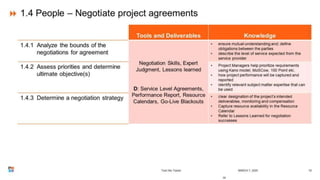
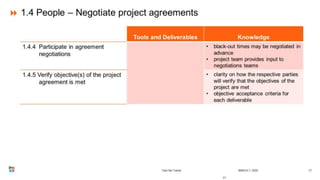
    80 80 Domain 1: People(42%) 76 Questions Task 1.8 7.5 Questions or 1.5 Qs / Enabler Negotiate project agreements 1.8.1. Analyze the bounds of the negotiations for agreement 1.8.2. Assess priorities and determine ultimate objective(s) 1.8.3. Verify objective(s) of the project agreement is met 1.8.4. Participate in agreement negotiations 1.8.5. Determine a negotiation strategy PMP EXAMINATION CONTENT OUTLINE Domain 1: People (14Tasks)
  • 78.
    81 81 Domain 1: People(42%) 76 Questions Task 1.9 4.5 Questions or 1.5 Qs / Enabler Collaborate with stakeholders 1.9.1. Evaluate engagement needs for stakeholders 1.9.2. Optimize alignment between stakeholder needs, expectations, and project objectives 1.9.3. Build trust and influence stakeholders to accomplish project objectives PMP EXAMINATION CONTENT OUTLINE Domain 1: People (14Tasks)
  • 79.
    82 82 Domain 1: People(42%) 76 Questions Task 1.10 6 Questions or 1.5 Qs / Enabler Build shared understanding 1.10.1. Break down situation to identify the root cause of a misunderstanding 1.10.2. Survey all necessary parties to reach consensus 1.10.3. Support outcome of parties’ agreement 1.10.4. Investigate potential misunderstandings PMP EXAMINATION CONTENT OUTLINE Domain 1: People (14Tasks)
  • 80.
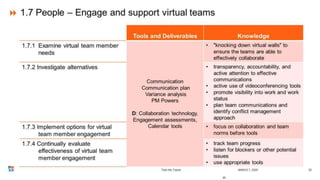
    83 83 Domain 1: People(42%) 76 Questions Task 1.11 6 Questions or 1.5 Qs / Enabler Engage and support virtual teams 1.11.1. Examine virtual team member needs (e.g., environment, geography, culture, global, etc.) 1.11.2. Investigate alternatives (e.g., communication tools, colocation) for virtual team member engagement 1.11.3. Implement options for virtual team member engagement 1.11.4. Continually evaluate effectiveness of virtual team member engagement PMP EXAMINATION CONTENT OUTLINE Domain 1: People (14Tasks)
  • 81.
    84 84 Domain 1: People(42%) 76 Questions Task 1.12 4.5 Questions or 1 Qs / Enabler Define team ground rules 1.12.1 Collectively define team ground rules 1,12,2, Communicate organizational principles with team and external stakeholders 1.12.3. Establish an environment that fosters adherence to the ground rules 1.12.4. Manage and rectify ground rule violations PMP EXAMINATION CONTENT OUTLINE Domain 1: People (14Tasks)
  • 82.
    86 86 Domain 1: People(42%) 76 Questions Task 1.13 3 Questions or 1.5 Qs / Enabler Mentor relevant stakeholders 1.13.1. Allocate the time to mentoring 1.13.2. Recognize and act on mentoring opportunities PMP EXAMINATION CONTENT OUTLINE Domain 1: People (14Tasks)
  • 83.
    87 Domain 1: People (14Tasks) 87 Domain1: People (42%) 76 Questions Task 1.14 3 Questions or 1.5 Qs / Enabler Promote team performance through the application of emotional intelligence 1.14.1. Assess behavior through the use of personality indicators 1.14.2. Analyze personality indicators and adjust to the emotional needs of key project stakeholders PMP EXAMINATION CONTENT OUTLINE
  • 84.
    88 88 Domain 2: Process(50%) 90 Questions Task 2.1 4.5 Questions or 1.5 Qs / Enabler Execute project with the urgency required to deliver business value 2.1.1. Assess opportunities to deliver value incrementally 2.1.2. Examine the business value throughout the project 2.1.3.Support the team to subdivide project tasks as necessary to find the minimum viable product PMP EXAMINATION CONTENT OUTLINE Domain 2: Process (17Tasks)
  • 85.
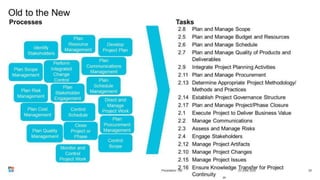
    89 89 Domain 2: Process(50%) 90 Questions Task 2.2 6 Questions or 1.5 Qs / Enabler Manage communications 2.2.1. Analyze communication needs of all stakeholders 2.2.2. Determine communication methods, channels, frequency, and level of detail for all stakeholders 2.2.3. Communicate project information and updates effectively 2.2.4. Confirm communication is understood and feedback is received PMP EXAMINATION CONTENT OUTLINE Domain 2: Process (17Tasks)
  • 86.
    90 90 Domain 2: Process(50%) 90 Questions Task 2.3 3 Questions or 1.5 Qs / Enabler Assess and manage risks 2.3.1. Determine risk management options 2.3.2. Iteratively assess and prioritize risks PMP EXAMINATION CONTENT OUTLINE Domain 2: Process (17Tasks)
  • 87.
    91 91 Domain 2: Process(50%) 90 Questions Task 2.4 6 Questions or 1.5 Qs / Enabler Engage stakeholders 2.4.1. Analyze stakeholders (e.g., power interest grid, influence, impact) 2.4.2. Categorize stakeholders 2.4.3. Engage stakeholders by category 2.4.4. Develop, execute, and validate a strategy for stakeholder engagement PMP EXAMINATION CONTENT OUTLINE Domain 2: Process (17Tasks)
  • 88.
    92 92 Domain 2: Process(50%) 90 Questions Task 2.5 6 Questions or 1.5 Qs / Enabler Plan and manage budget and resources 2.5.1. Estimate budgetary needs based on the scope of the project and lessons learned from past projects 2.5.2. Anticipate future budget challenges 2.5.3. Monitor budget variations and work with governance process to adjust as necessary 2.5.4. Plan and manage resources PMP EXAMINATION CONTENT OUTLINE Domain 2: Process (17Tasks)
  • 89.
    93 93 Domain 2: Process(50%) 90 Questions Task 2.6 9 Questions or 1.5 Qs / Enabler Plan and manage schedule 2.6.1. Estimate project tasks (milestones, dependencies, story points) 2.6.2. Utilize benchmarks and historical data 2.6.3. Prepare schedule based on methodology 2.6.4. Measure ongoing progress based on methodology 2.6.5. Modify schedule, as needed, based on methodology 2.6.6. Coordinate with other projects and other operations PMP EXAMINATION CONTENT OUTLINE Domain 2: Process (17Tasks)
  • 90.
    94 94 Domain 2: Process(50%) 90 Questions Task 2.7 4.5 Questions or 1.5 Qs / Enabler Plan and manage quality of products/deliverables 2.7.1. Determine quality standard required for project deliverables 2.7.2. Recommend options for improvement based on quality gaps 2.7.3. Continually survey project deliverable quality PMP EXAMINATION CONTENT OUTLINE Domain 2: Process (17Tasks)
  • 91.
    95 95 Domain 2: Process(50%) 90 Questions Task 2.8 4.5 Questions or 1.5 Qs / Enabler Plan and manage scope 2.8.1. Determine and prioritize requirements 2.8.2. Break down scope (e.g., WBS, backlog) 2.8.3. Monitor and validate scope PMP EXAMINATION CONTENT OUTLINE Domain 2: Process (17Tasks)
  • 92.
    96 96 Domain 2: Process(50%) 90 Questions Task 2.9 7.5 Questions or 1.5 Qs / Enabler Integrate project planning activities 2.9.1. Consolidate the project/phase plans 2.9.2. Assess consolidated project plans for dependencies, gaps, and continued business value 2.9.3. Analyze the data collected 2.9.4. Collect and analyze data to make informed project decisions 2.9.5. Determine critical information requirements PMP EXAMINATION CONTENT OUTLINE Domain 2: Process (17Tasks)
  • 93.
    97 97 Domain 2: Process(50%) 90 Questions Task 2.10 6 Questions or 1.5 Qs / Enabler Manage project changes 2.10.1. Anticipate and embrace the need for change (e.g., follow change management practices) 2.10.2. Determine strategy to handle change 2.10.3. Execute change management strategy according to the methodology 2.10.4. Determine a change response to move the project forward PMP EXAMINATION CONTENT OUTLINE Domain 2: Process (17Tasks)
  • 94.
    98 98 Domain 2: Process(50%) 90 Questions Task 2.11 7.5 Questions or 1.5 Qs / Enabler Plan and manage procurement 2.11.1. Define resource requirements and needs 2.11.2. Communicate resource requirements 2.11.3. Manage suppliers/contracts 2.11.4. Plan and manage procurement strategy 2.11.5. Develop a delivery solution PMP EXAMINATION CONTENT OUTLINE Domain 2: Process (17Tasks)
  • 95.
    99 99 Domain 2: Process(50%) 90 Questions Task 2.12 4.5 Questions or 1.5 Qs / Enabler Manage project artifacts 2.12.1. Determine the requirements (what, when, where, who, etc.) for managing the project artifacts 2.12.2. Validate that the project information is kept up to date (i.e., version control) and accessible to all stakeholders 2.12.3. Continually assess the effectiveness of the management of the project artifacts PMP EXAMINATION CONTENT OUTLINE Domain 2: Process (17Tasks)
  • 96.
    100 100 Domain 2: Process(50%) 90 Questions Task 2.13 6 Questions or 1.5 Qs / Enabler Determine appropriate project methodology/methods and practices 2.13.1. Assess project needs, complexity, and magnitude 2.13.2. Recommend project execution strategy (e.g., contracting, finance) 2.13.3. Recommend a project methodology/approach (i.e., predictive, agile, hybrid) 2.13.4. Use iterative, incremental practices throughout the project life cycle (e.g., lessons learned, stakeholder engagement, risk) PMP EXAMINATION CONTENT OUTLINE Domain 2: Process (17Tasks)
  • 97.
    101 101 Domain 2: Process(50%) 90 Questions Task 2.14 3 Questions or 1.5 Qs / Enabler Establish project governance structure 2.14.1. Determine appropriate governance for a project (e.g., replicate organizational governance) 2.14.2. Define escalation paths and thresholds PMP EXAMINATION CONTENT OUTLINE Domain 2: Process (17Tasks)
  • 98.
    102 102 Domain 2: Process(50%) 90 Questions Task 2.15 4.5 Questions or 1.5 Qs / Enabler Manage project issues 2.15.1. Recognize when a risk becomes an issue 2.15.2. Attack the issue with the optimal action to achieve project success 2.15.3. Collaborate with relevant stakeholders on the approach to resolve the issues PMP EXAMINATION CONTENT OUTLINE Domain 2: Process (17Tasks) Task 2.16 Task 2,17
  • 99.
    103 103 Domain 2: Process(50%) 90 Questions Task 2.16 4.5 Questions or 1.5 Qs / Enabler Ensure knowledge transfer for project continuity 2.16.1. Discuss project responsibilities within team 2.16.2. Outline expectations for working environment 2.16.3. Confirm approach for knowledge transfers PMP EXAMINATION CONTENT OUTLINE Domain 2: Process (17Tasks)
  • 100.
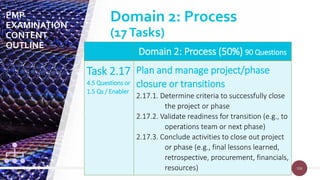
    104 104 Domain 2: Process(50%) 90 Questions Task 2.17 4.5 Questions or 1.5 Qs / Enabler Plan and manage project/phase closure or transitions 2.17.1. Determine criteria to successfully close the project or phase 2.17.2. Validate readiness for transition (e.g., to operations team or next phase) 2.17.3. Conclude activities to close out project or phase (e.g., final lessons learned, retrospective, procurement, financials, resources) PMP EXAMINATION CONTENT OUTLINE Domain 2: Process (17Tasks)
  • 101.
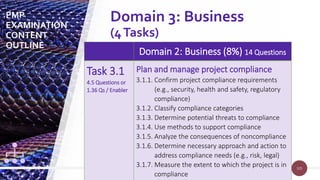
    105 105 Domain 2: Business(8%) 14 Questions Task 3.1 4.5 Questions or 1.36 Qs / Enabler Plan and manage project compliance 3.1.1. Confirm project compliance requirements (e.g., security, health and safety, regulatory compliance) 3.1.2. Classify compliance categories 3.1.3. Determine potential threats to compliance 3.1.4. Use methods to support compliance 3.1.5. Analyze the consequences of noncompliance 3.1.6. Determine necessary approach and action to address compliance needs (e.g., risk, legal) 3.1.7. Measure the extent to which the project is in compliance PMP EXAMINATION CONTENT OUTLINE Domain 3: Business (4Tasks)
  • 102.
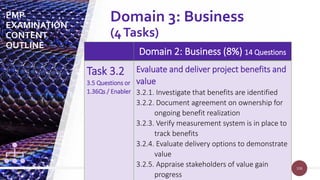
    106 106 Domain 2: Business(8%) 14 Questions Task 3.2 3.5 Questions or 1.36Qs / Enabler Evaluate and deliver project benefits and value 3.2.1. Investigate that benefits are identified 3.2.2. Document agreement on ownership for ongoing benefit realization 3.2.3. Verify measurement system is in place to track benefits 3.2.4. Evaluate delivery options to demonstrate value 3.2.5. Appraise stakeholders of value gain progress PMP EXAMINATION CONTENT OUTLINE Domain 3: Business (4Tasks)
  • 103.
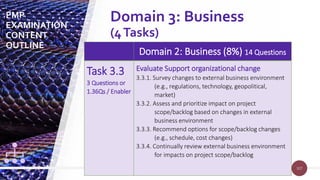
    107 107 Domain 2: Business(8%) 14 Questions Task 3.3 3 Questions or 1.36Qs / Enabler Evaluate Support organizational change 3.3.1. Survey changes to external business environment (e.g., regulations, technology, geopolitical, market) 3.3.2. Assess and prioritize impact on project scope/backlog based on changes in external business environment 3.3.3. Recommend options for scope/backlog changes (e.g., schedule, cost changes) 3.3.4. Continually review external business environment for impacts on project scope/backlog PMP EXAMINATION CONTENT OUTLINE Domain 3: Business (4Tasks)
  • 104.
    108 108 Domain 2: Business(8%) 14 Questions Task 3.4 2 Questions or 1.36Qs / Enabler Support organizational change 3.4.1. Assess organizational culture 3.4.2. Evaluate impact of organizational change to project and determine required actions 3.4.3. Evaluate impact of the project to the organization and determine required actions PMP EXAMINATION CONTENT OUTLINE Domain 3: Business (4Tasks)
  • 105.
  • 106.
    110 110 PMBOK Guide Reference Percentageof Questions 1. Introduction to Project Management 2. Project Environment 3. Role of the Project Manager 4. Project Integration Management 5. Project Scope Management 6. Project Schedule Management 7. Project Cost Management 8. Project Quality Management 9. Project Resource Management 10. Project Communication Management 11. Project Risk Management 12. Project Procurement Management 13. Project Stakeholder Management 6% 6% 7% 9% 9% 9% 8% 7& 8% 10% 8% 4% 9% CAPM EXAMINATION CONTENT OUTLINE Percentage Distribution (13 Chapters)
  • 107.
    111 111 Chapter 1 Tasks(6%) 9 Questions Chapter 1 9 Questions or 2 Qs / Enabler Introduction to Project Management 1.1 Understand the five project management process groups and the processes within each group 1.2 Recognize the relationships among project, program, portfolio, and operational management 1.3 Define a typical project lifecycle 1.4 Understand the function and importance of tailoring for different projects Chapter 1: (4Tasks) CAPM EXAMINATION CONTENT OUTLINE
  • 108.
    112 112 Chapter 2 Tasks(6%) 9 Questions Chapter 2 9 Questions or 2 Qs / Enabler Project Environment 2.1 Identify the factors and assets that may impact the outcome of a project 2.2 Distinguish between organizational systems 2.3 Understand the purpose and activities of a Project Management Office 2.4 Recognize the hierarchy of projects, programs and portfolios Chapter 2: (4Tasks) CAPM EXAMINATION CONTENT OUTLINE
  • 109.
    113 113 Chapter 3 Tasks(7%) 10.5 Questions Chapter 3 10.5 Questions or 2.6 Qs / Enabler Role of the Project Manager 3.1 State the primary functions of a project manager 3.2 Understand a project manager’s sphere of influence 3.3 Identify the major elements included in the PMI triangle 3.4 Recognize the difference between leadership and management Chapter 3: (4Tasks) CAPM EXAMINATION CONTENT OUTLINE
  • 110.
    114 114 Chapter 4 Tasks(9%) 13.5 Questions Chapter 4 13.5 Questions or 2.25 Qs / Enabler Project Integration Management 4.1 Understand the seven project management processes in the project integration management knowledge area 4.2 Identify the input, tools, techniques and outputs defined in the seven processes in project integration management 4.3 Understand the purpose of project integration management and the project manager’s role within it 4.4 Identify concepts and procedures related to project change management 4.5 Identify tailoring consideration in project integration management and recognize key documents 4.6 Identify methods for project integration and knowledge management Chapter 4: (6Tasks) CAPM EXAMINATION CONTENT OUTLINE
  • 111.
    115 115 Chapter 5 Tasks(9%) 13.5 Questions Chapter 5 13.5 Questions or 2.7 Qs / Enabler Project Scope Management 5.1 Understand the six project management processes in the project scope management knowledge area 5.2 Identify the Input, tools, techniques and outputs defined in the six processes in project scope management 5.3 Identify key concepts and tailoring consideration for project scope management, and key roles in scope management 5.4 Identify the purpose and elements of a Work Breakdown Structure (WBS) for both Product and Project scope 5.5 Understand project scope management for agile/adaptive projects, including the use of prototypes Chapter 5: (5Tasks) CAPM EXAMINATION CONTENT OUTLINE
  • 112.
    116 116 Chapter 6 Tasks(9%) 13.5 Questions Chapter 6 13.5 Questions or 3.4 Qs / Enabler Project Schedule Management 6.1 Define the six project management processes in the project schedule management knowledge area 6.2 Identify the Input, tools, techniques and outputs defined in the six processes in project schedule management 6.3 Solve simple network diagrams problems and perform basic scheduling calculations 6.4 Identify considerations for agile/adaptive environments in project schedule management Chapter 6: (4Tasks) CAPM EXAMINATION CONTENT OUTLINE
  • 113.
    117 117 Chapter 7 Tasks(8%) 12 Questions Chapter 7 12 Questions or 3 Qs / Enabler Project Cost Management 7.1 Understand the four project management processes in the project cost management knowledge area 7.2 Identify the Input, tools, techniques and outputs defined in the four processes in project cost management 7.3 Identify key concepts in project cost management, including tailoring and special considerations for agile/adaptive environments 7.4 Understand and apply basic forecasting and earned value methods for project cost management Chapter 7: (4Tasks) CAPM EXAMINATION CONTENT OUTLINE
  • 114.
    118 118 Chapter 8 Tasks(7%) 12 Questions Chapter 8 10.5 Questions or 2.6 Qs / Enabler Project Quality Management 8.1 Understand the three project management processes in the project quality management knowledge area 8.2 Identify the Input, tools, techniques and outputs defined in the three quality management processes 8.3 Understand the reasons for and approaches to adapting quality management in different project environments 8.4 Identify quality tools and approaches for continuous improvement Chapter 8: (4Tasks) CAPM EXAMINATION CONTENT OUTLINE
  • 115.
    119 119 Chapter 9 Tasks(8%) 12 Questions Chapter 9 12 Questions or 2.4 Qs / Enabler Project Resource Management 9.1 Define the six project management processes in the project resource management knowledge area 9.2 Identify the Input, tools, techniques and outputs defined in the six processes in project resource management 9.3 Identify key concepts and trends in project resource management, including tailoring and special considerations for agile/adaptive environments 9.4 Identify techniques for developing a team, managing conflict, and resolving resource-related problems 9.5 Understand the components of a resource management plan and data representation techniques for managing project resources Chapter 9: (5Tasks) CAPM EXAMINATION CONTENT OUTLINE
  • 116.
    120 120 Chapter 10 Tasks(10%) 15 Questions Chapter 10 15 Questions or 3 Qs / Enabler Project Communication Management 10.1 Understand the three project management processes in the project communication management knowledge area 10.2 Identify the Input, tools, techniques and outputs defined in the three project communication management processes 10.3 Identify key concepts and approaches in project communication management, including tailoring and special considerations for agile/adaptive environments 10.4 Recognize the dimensions of communication and components of a communications management plan 10.5 Identify communications skills and methods for project communication Management Chapter 10: (5Tasks) CAPM EXAMINATION CONTENT OUTLINE
  • 117.
    121 121 Chapter 11 Tasks(8%) 12 Questions Chapter 11 15 Questions or 2.4 Qs / Enabler Project Risk Management 11.1 Understand the seven project management processes in the project risk management knowledge area 11.2 Identify the Input, tools, techniques and outputs defined in project risk management 11.3 Identify the key documents in project risk management 11.4 Perform simple risk calculations 11.5 Recognize when and how to adjust risk based on the project environment Chapter 11: (5Tasks) CAPM EXAMINATION CONTENT OUTLINE
  • 118.
    122 122 Chapter 12 Tasks(4%) 6 Questions Chapter 12 6 Questions or 1.5 Qs / Enabler Project Procurement Management 12.1 Understand the three processes in the project procurement management knowledge area 12.2 Identify the Input, tools, techniques and outputs defined in the three project procurement processes 12.3 Identify key concepts and tailoring considerations for project procurement management, including trends and emerging practices 12.4 Identify various types of contracts, agreements, and source selection methods Chapter 12: (4Tasks) CAPM EXAMINATION CONTENT OUTLINE
  • 119.
    123 123 Chapter 13 Tasks(8%) 12 Questions Chapter 13 12 Questions or 3 Qs / Enabler Project Stakeholder Management 13.1 Understand the four project management processes in the project stakeholder management knowledge area 13.2 Identify the Input, tools, techniques and outputs defined in the four project stakeholder management processes 13.3 Recognize key stakeholders roles and needs 13.4 Identify the key concepts and benefits of stakeholder management Chapter 13: (4Tasks) CAPM EXAMINATION CONTENT OUTLINE
  • 120.
  • 121.
  • 122.
  • 123.
  • 124.
  • 125.
  • 126.
  • 127.
  • 128.
  • 129.
  • 130.
  • 131.
  • 132.
  • 133.
  • 134.
  • 135.
  • 137.
  • 138.
  • 139.
  • 140.
  • 141.
  • 142.
  • 143.
  • 144.
  • 145.
  • 146.
  • 147.
  • 148.
  • 149.
  • 150.
  • 151.
  • 152.
  • 153.
  • 154.
  • 155.
  • 156.
  • 157.
  • 158.
  • 159.
  • 160.
  • 161.
  • 162.
  • 163.
  • 164.
  • 165.
  • 166.
  • 167.
  • 168.
  • 169.
  • 170.
  • 171.
  • 172.
  • 173.
  • 174.
  • 175.
  • 176.
  • 177.
  • 178.
  • 179.
  • 180.
  • 181.
  • 182.
  • 183.
  • 184.
  • 185.
  • 186.
  • 187.
  • 188.
  • 189.
  • 190.
  • 191.
  • 192.
  • 193.
  • 194.
    PMI AUTHORIZED COURSEWARE Changes inMindset and new Outline
  • 195.
    199 THE NEXT EVOLUTIONOF PROJECT MANAGEMENT 199 42% 50% 8% People Business Environment Process
  • 196.
    PMI® AUTHORIZED PMP® EXAM PREP COURSE 1.Creating a High-Performing Team 2. Starting the Project 3. Doing the Work 4. Keeping the Team on Track 5. Keeping the Business in Mind
  • 197.
    201 PMI AUTHORIZED COURSEWARE 201 People Lesson 1 People Lesson4 Process Lesson 3 Business Lesson 5 DAY 1 Creating a High- Performing Team DAY 4 Keeping the Team on Track DAY 3 Doing the Work DAY 5 Keeping the Business in Mind Process Lesson 2 DAY 2 Starting the Project
  • 198.
    202 • Courseware isNOT sequential as per the Examination Content Outline • The lessons provide a recommended flow for People, Process, and Business Environment Domains PMI AUTHORIZED COURSEWARE PMI AUTHORIZED COURSEWARE
  • 199.
    203 PMI AUTHORIZED COURSEWARE 203 Lesson 1– DAY 1 Creating a High PerformingTeam 1.6. Build a Team 1.12 Define Team Ground Rules 1.8. Negotiate Project Agreements 1.4. Empower Team Members and Stakeholders 1.5. Train Team Members and Stakeholders 1.11 Engage and Support Virtual Teams 1.10 Build Shared Understanding about a Project
  • 200.
    CREATING A HIGH- PERFORMINGTEAM 1.Build a Team 2. Define Team Ground Rules 3. Negotiate Project Agreements 4. Empower Team Members and Stakeholders 5. Train Team Members and Stakeholders 6. Engage and Support Virtual Teams 7. Build a Shared Understanding about a Project
  • 201.
    205 PMI AUTHORIZED COURSEWARE 205 Lesson 2– DAY 2 Starting the Project 2.12 Determine Appropriate Project Methodology/Methods and Practices 2.8 Plan and Manage Scope 2.5 Plan and Manage Budget and Resources 2.6 Plan and Manage Schedule 2.7 Plan and Manage Quality of Products/Deliverables 2.9 Integrate Project Planning Activities 2.11 Plan and Manage Procurement 2.14 Establish Project Governance Structure 2.17 Plan and Manage Project/Phase Closure
  • 202.
    STARTINGTHE PROJECT 1. DetermineAppropriate Project Methodology/Methods and Practices 2. Plan and Manage Scope 3. Plan and Manage Budget and Resources 4. Plan and Manage Schedule 5. Plan and Manage Quality of Products/Deliverables 6. Integrate Project Planning Activities 7. Plan and Manage Procurement 8. Establish Project Governance Structure 9. Plan and Manage Project/Phase Closure
  • 203.
    207 PMI AUTHORIZED COURSEWARE 207 Lesson 3– DAY 3 Doing theWork 2.3 Assess and Manage Risks 2.1 Execute Project to Deliver Business Value 2.2 Manage Communications 2.4 Engage Stakeholders 2.12 Create Project Artifacts 2.10 Manage Project Changes 2.15 Manage Project Issues 2.16 Ensure Knowledge Transfer to Project Continuity
  • 204.
    DOINGTHE WORK 1. Assessand Manage Risks 2. Execute Project to Deliver Business Value 3. Manage Communications 4. Engage Stakeholders 5. Create Project Artifacts 6. Manage Project Changes 7. Manage Project Issues 8. Ensure Knowledge Transfer to Project Continuity
  • 205.
    209 PMI AUTHORIZED COURSEWARE 209 Lesson 4– DAY 4 Keeping theTeam onTrack 1.2 Lead a Team 1.3 Support Team Performance 1.7 Address and Remove Impediments, Obstacles, and Blockers 1.1 Manage Conflict 1.9 Collaborate with Stakeholders 1.13 Mentor Relevant Stakeholders Apply Emotional Intelligence to Promote Team Performance
  • 206.
    KEEPINGTHETEAM ONTRACK 1. Lead aTeam 2. Support Team Performance 3. Address and Remove Impediments, Obstacles, and Blockers 4. Manage Conflict 5. Collaborate with Stakeholders 6. Mentor Relevant Stakeholders 7. Apply Emotional Intelligence to Promote Team Performance
  • 207.
    211 PMI AUTHORIZED COURSEWARE 211 Lesson 5– DAY 5 Keeping the Business in Mind 3.1 Manage Compliance Requirements 3.2 Evaluate and Deliver Project Benefits and Value 3.3 Evaluate and Address Internal and External Business Environment Changes 3.4 Support Organizational Change Employ Continuous Process Improvement
  • 208.
    KEEPINGTHE BUSINESS IN MIND 1.Manage Compliance Requirements 2. Evaluate and Deliver Project Benefits and Value 3. Evaluate and Address Internal and External Business Environment Changes 4. Support Organizational Change 5. Employ Continuous Process Improvement
  • 209.
  • 210.
  • 212.