Operating Systems Kuldeep  yadav Class-X th B
INTRODUCTION Features of an Operating System Operating System abbreviated as OS. It is responsible for  Allocating system resources Processor times Disk space Managing peripheral devices It manages CPU, Input, Output, Network equipments. Microcomputer has a much simple OS than the Mainframe Contd. …
INTRODUCTION Examples of Microcomputer OS:-  Windows DOS OS/2 Examples of Minicomputer OS:- UNIX OS/400 etc. Examples of Mainframe computer OS:- MVS (Multiple Virtual Storage) VAX (Virtual Address eXtension) etc.
Functions of An Operating System Input / Output Device Management:- Accept data through input devices transfer to memory and sending to correct output devices. Data Management:- Manage data in the form of Directory and files in disk. Memory Management:- Allocate memory for each program even the OS also in its memory for concurrent running purpose. Backing Store Management:- OS sending data from disk to memory and vice versa. It stores the data in disk allocating space for the directory and file. Contd. …
Functions of An Operating System Job Management:- Set priority to the jobs and allocates memory to execute them. Resource Management and Scheduling:- It manages its all resources. It also runs several programs at once (known as programming). It does not do task as per given order. But it manages the sequence to run program and manages the memory space also. Network Management:- A user can enter into any network using user id and password for security purpose. OS allows to access the particular data or program to the authorized user in the server. Contd. …
Functions of An Operating System File Management:- The management of the file system is done by the file manager of Operating System. To save a file under a file name. The file manager holds the information of the files:  File type (folder file, sys file, hidden file, batch file, exe file or text file. Location of storage File size in bytes. Access rights (who and how can the file accessed i.e. read only, read-write, write only and delete permission. Date information (date of creation, date of modifiation, last modify date etc.) purge  Contd. …
Functions of An Operating System Interrupt Handling:- An interrupt is a signal to a processor. An event occurring on peripheral devices. A voluntary event occurring within process. An involuntary event occurring within a process. An event occurred by the action of operators. A timer interrupt.   Batch Processing:- It groups similar kind of jobs together and forms batch files. These files are later executed when a request is encountered. Program Execution:- It loads the application programs in the memory and executes them. Contd. …
Functions of An Operating System Virtual Storage:- It increases the capacity of the main memory without increasing the size. First it broken the task into pages and send them to execute in sequence page wise from secondary storage device. Error Handling:- It transforms the user about any error that occurs while the execution of a program. Security:- It deals with system security by monitoring the accessibility options provided to program and data. Contd. …
Functions of An Operating System On-line Processing:- It processes the data instantaneously in on-line processing. When a request is encountered, the software instantly answers it and sends back to the exact node where the request generated. Human Computer Interface (HCI):- It allows the computer to communicate with the user. Command driven:- This interface requires users to enter commands using the special words known as “keywords”. Menu Driven:- On-screen, text based menus that show all the options available. Graphical User Interface:- Most popular interface. It displays all the programs, files and connections through small illustrations called “icons”. Contd. …
Functions of An Operating System Multiprogramming:- It can manipulate more than one program in the memory at the same time. Multi-user:- It allows more than one user to work at the same time. MVS, VAX are the examples of the multi user OS. Multiprocessing:- It allows the utilization of multiple CPU in a single computer system (parallel processing). Multitasking:- It allows the execution of more than one program on the same CPU simultaneously.
Popular Operating Systems UNIX :- UNIX was developed at AT&T Bell Labs in early 1970s. Features:- Multitasking, Creation, synchronization and termination of processes. File Management system provides  i.  Directory control,  ii.  File naming,  iii.  Ability of control access files, shared access. Contd. …
Popular Operating Systems MS-DOS   (Microsoft Disk Operating System)  :- Originally developed for IBM Pc in 1981. Now it is being used by Intel based PCs. DOS commands are used for managing files and directories. It has limitation functionalities like management of peripheral devices and no multitasking. Contd. …
Popular Operating Systems MAC   (Macintosh)  :- Apple Incorporation released the original Macintosh operating system in 1984. It is a GUI based OS. It is easiest for beginning computer users. Contd. …
Popular Operating Systems Windows 95, 98 and 2000  :- GUI, developed by Microsoft for Intel microprocessors. It support multiprocessing, multitasking. It allows transfer of information between applications. It offers: better stability, improved internet connectivity, updated drivers for new peripherals including DVD-ROM disks etc. Contd. …
Popular Operating Systems Windows CE  :- GUI, mainly designed for the palmtops. It runs the applications like Office applications. It enables the user to work on them and transfer to Desktops for printing purpose. It includes scheduling calendar, address book, e-mail, web browsing etc. It also includes handwriting recognition and voice recording. Contd. …
Popular Operating Systems Windows NT   (New Technology) :- Specially designed for Client/Server systems. It is divided into two components Windows NT workstation and Windows NT Server. It is meant for Desktop computer. Windows NT Server supports high security level, directory services and web server. Contd. …
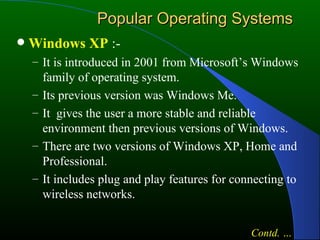
Popular Operating Systems Windows XP  :- It is introduced in 2001 from Microsoft’s Windows family of operating system. Its previous version was Windows Me. It  gives the user a more stable and reliable environment then previous versions of Windows. There are two versions of Windows XP, Home and Professional. It includes plug and play features for connecting to wireless networks. Contd. …
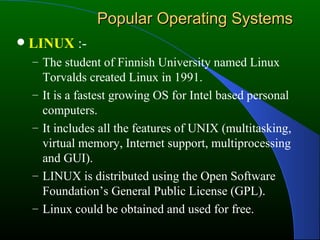
Popular Operating Systems LINUX  :- The student of Finnish University named Linux Torvalds created Linux in 1991. It is a fastest growing OS for Intel based personal computers. It includes all the features of UNIX (multitasking, virtual memory, Internet support, multiprocessing and GUI). LINUX is distributed using the Open Software Foundation’s General Public License (GPL). Linux could be obtained and used for free.
Thank You !!! sources- chinmay  raul

Operatingsystems

  • 1.
    Operating Systems Kuldeep yadav Class-X th B
  • 2.
    INTRODUCTION Features ofan Operating System Operating System abbreviated as OS. It is responsible for Allocating system resources Processor times Disk space Managing peripheral devices It manages CPU, Input, Output, Network equipments. Microcomputer has a much simple OS than the Mainframe Contd. …
  • 3.
    INTRODUCTION Examples ofMicrocomputer OS:- Windows DOS OS/2 Examples of Minicomputer OS:- UNIX OS/400 etc. Examples of Mainframe computer OS:- MVS (Multiple Virtual Storage) VAX (Virtual Address eXtension) etc.
  • 4.
    Functions of AnOperating System Input / Output Device Management:- Accept data through input devices transfer to memory and sending to correct output devices. Data Management:- Manage data in the form of Directory and files in disk. Memory Management:- Allocate memory for each program even the OS also in its memory for concurrent running purpose. Backing Store Management:- OS sending data from disk to memory and vice versa. It stores the data in disk allocating space for the directory and file. Contd. …
  • 5.
    Functions of AnOperating System Job Management:- Set priority to the jobs and allocates memory to execute them. Resource Management and Scheduling:- It manages its all resources. It also runs several programs at once (known as programming). It does not do task as per given order. But it manages the sequence to run program and manages the memory space also. Network Management:- A user can enter into any network using user id and password for security purpose. OS allows to access the particular data or program to the authorized user in the server. Contd. …
  • 6.
    Functions of AnOperating System File Management:- The management of the file system is done by the file manager of Operating System. To save a file under a file name. The file manager holds the information of the files: File type (folder file, sys file, hidden file, batch file, exe file or text file. Location of storage File size in bytes. Access rights (who and how can the file accessed i.e. read only, read-write, write only and delete permission. Date information (date of creation, date of modifiation, last modify date etc.) purge Contd. …
  • 7.
    Functions of AnOperating System Interrupt Handling:- An interrupt is a signal to a processor. An event occurring on peripheral devices. A voluntary event occurring within process. An involuntary event occurring within a process. An event occurred by the action of operators. A timer interrupt. Batch Processing:- It groups similar kind of jobs together and forms batch files. These files are later executed when a request is encountered. Program Execution:- It loads the application programs in the memory and executes them. Contd. …
  • 8.
    Functions of AnOperating System Virtual Storage:- It increases the capacity of the main memory without increasing the size. First it broken the task into pages and send them to execute in sequence page wise from secondary storage device. Error Handling:- It transforms the user about any error that occurs while the execution of a program. Security:- It deals with system security by monitoring the accessibility options provided to program and data. Contd. …
  • 9.
    Functions of AnOperating System On-line Processing:- It processes the data instantaneously in on-line processing. When a request is encountered, the software instantly answers it and sends back to the exact node where the request generated. Human Computer Interface (HCI):- It allows the computer to communicate with the user. Command driven:- This interface requires users to enter commands using the special words known as “keywords”. Menu Driven:- On-screen, text based menus that show all the options available. Graphical User Interface:- Most popular interface. It displays all the programs, files and connections through small illustrations called “icons”. Contd. …
  • 10.
    Functions of AnOperating System Multiprogramming:- It can manipulate more than one program in the memory at the same time. Multi-user:- It allows more than one user to work at the same time. MVS, VAX are the examples of the multi user OS. Multiprocessing:- It allows the utilization of multiple CPU in a single computer system (parallel processing). Multitasking:- It allows the execution of more than one program on the same CPU simultaneously.
  • 11.
    Popular Operating SystemsUNIX :- UNIX was developed at AT&T Bell Labs in early 1970s. Features:- Multitasking, Creation, synchronization and termination of processes. File Management system provides i. Directory control, ii. File naming, iii. Ability of control access files, shared access. Contd. …
  • 12.
    Popular Operating SystemsMS-DOS (Microsoft Disk Operating System) :- Originally developed for IBM Pc in 1981. Now it is being used by Intel based PCs. DOS commands are used for managing files and directories. It has limitation functionalities like management of peripheral devices and no multitasking. Contd. …
  • 13.
    Popular Operating SystemsMAC (Macintosh) :- Apple Incorporation released the original Macintosh operating system in 1984. It is a GUI based OS. It is easiest for beginning computer users. Contd. …
  • 14.
    Popular Operating SystemsWindows 95, 98 and 2000 :- GUI, developed by Microsoft for Intel microprocessors. It support multiprocessing, multitasking. It allows transfer of information between applications. It offers: better stability, improved internet connectivity, updated drivers for new peripherals including DVD-ROM disks etc. Contd. …
  • 15.
    Popular Operating SystemsWindows CE :- GUI, mainly designed for the palmtops. It runs the applications like Office applications. It enables the user to work on them and transfer to Desktops for printing purpose. It includes scheduling calendar, address book, e-mail, web browsing etc. It also includes handwriting recognition and voice recording. Contd. …
  • 16.
    Popular Operating SystemsWindows NT (New Technology) :- Specially designed for Client/Server systems. It is divided into two components Windows NT workstation and Windows NT Server. It is meant for Desktop computer. Windows NT Server supports high security level, directory services and web server. Contd. …
  • 17.
    Popular Operating SystemsWindows XP :- It is introduced in 2001 from Microsoft’s Windows family of operating system. Its previous version was Windows Me. It gives the user a more stable and reliable environment then previous versions of Windows. There are two versions of Windows XP, Home and Professional. It includes plug and play features for connecting to wireless networks. Contd. …
  • 18.
    Popular Operating SystemsLINUX :- The student of Finnish University named Linux Torvalds created Linux in 1991. It is a fastest growing OS for Intel based personal computers. It includes all the features of UNIX (multitasking, virtual memory, Internet support, multiprocessing and GUI). LINUX is distributed using the Open Software Foundation’s General Public License (GPL). Linux could be obtained and used for free.
  • 19.
    Thank You !!!sources- chinmay raul