Operating System
Esraa Zoghib
Operating System (OS)
• An operating system (OS) is system software that
manages computer hardware, software resources, and
provides common services for computer programs. Using
Awesome Backgrounds
• An operating system is a program that acts as an interface
between the computer user and computer hardware, and
controls the execution of programs.
Computer System can be divided
into four components
Operating System Types
• Batch Operating
System
• Time-Sharing Operating
Systems
• Distributed Operating
System
• Network Operating
System
• Real-Time Operating
System
Batch Operating System
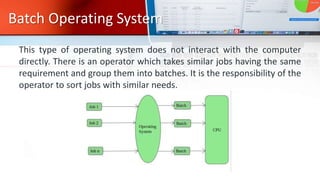
This type of operating system does not interact with the computer
directly. There is an operator which takes similar jobs having the same
requirement and group them into batches. It is the responsibility of the
operator to sort jobs with similar needs.
Batch Operating System
• Processors of the batch
systems know how long the
job would be when it is in
queue
• Multiple users can share the
batch systems
• The idle time for the batch
system is very less
• It is easy to manage large
work repeatedly in batch
systems.
• The computer operators
should be well known with
batch systems
• Batch systems are hard to
debug
• It is sometimes costly
• The other jobs will have to
wait for an unknown time if
any job fails
Disadvantages
Advantages
Time-Sharing Operating System
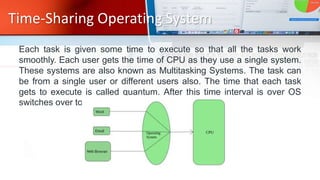
Each task is given some time to execute so that all the tasks work
smoothly. Each user gets the time of CPU as they use a single system.
These systems are also known as Multitasking Systems. The task can
be from a single user or different users also. The time that each task
gets to execute is called quantum. After this time interval is over OS
switches over to the next task.
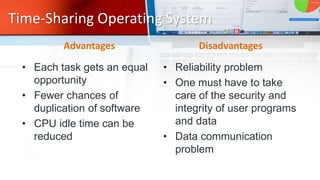
Time-Sharing Operating System
• Each task gets an equal
opportunity
• Fewer chances of
duplication of software
• CPU idle time can be
reduced
• Reliability problem
• One must have to take
care of the security and
integrity of user programs
and data
• Data communication
problem
Disadvantages
Advantages
Distributed Operating System
It is a recent advancement in the world of computer
technology .Various autonomous interconnected
computers communicate with each other using a
shared communication network. Independent systems
possess their own memory unit and CPU. These are
referred to as loosely coupled systems or distributed
systems. These system’s processors differ in size and
function. The major benefit of working with these types
of the operating system is that it is always possible that
one user can access the files or software which are not
actually present on his system but some other system
connected within this network i.e., remote access is
enabled within the devices connected in that network.
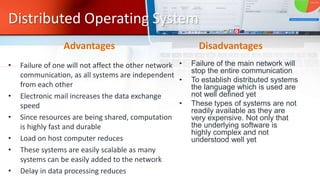
Distributed Operating System
• Failure of one will not affect the other network
communication, as all systems are independent
from each other
• Electronic mail increases the data exchange
speed
• Since resources are being shared, computation
is highly fast and durable
• Load on host computer reduces
• These systems are easily scalable as many
systems can be easily added to the network
• Delay in data processing reduces
• Failure of the main network will
stop the entire communication
• To establish distributed systems
the language which is used are
not well defined yet
• These types of systems are not
readily available as they are
very expensive. Not only that
the underlying software is
highly complex and not
understood well yet
Disadvantages
Advantages
Network Operating System
These systems run on a server and provide the
capability to manage data, users, groups,
security, applications, and other networking
functions. These types of operating systems
allow shared access of files, printers, security,
applications, and other networking functions
over a small private network. One more
important aspect of Network Operating Systems
is that all the users are well aware of the
underlying configuration, of all other users within
the network, their individual connections, etc.
and that’s why these computers are popularly
known as tightly coupled systems.
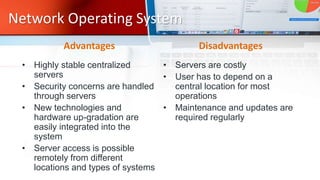
Network Operating System
• Highly stable centralized
servers
• Security concerns are handled
through servers
• New technologies and
hardware up-gradation are
easily integrated into the
system
• Server access is possible
remotely from different
locations and types of systems
• Servers are costly
• User has to depend on a
central location for most
operations
• Maintenance and updates are
required regularly
Disadvantages
Advantages
Real-Time Operating System
• These types of OSs serve real-time systems. The time
interval required to process and respond to inputs is very
small. This time interval is called response time.
• Real-time systems are used when there are time
requirements that are very strict like missile systems, air
traffic control systems, robots, etc.
Real-Time Operating System
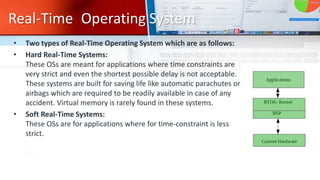
• Two types of Real-Time Operating System which are as follows:
• Hard Real-Time Systems:
These OSs are meant for applications where time constraints are
very strict and even the shortest possible delay is not acceptable.
These systems are built for saving life like automatic parachutes or
airbags which are required to be readily available in case of any
accident. Virtual memory is rarely found in these systems.
• Soft Real-Time Systems:
These OSs are for applications where for time-constraint is less
strict.
Real-Time Operating System
• Maximum Consumption
• Task Shifting
• Focus on Application
• Real-time operating
system
in the embedded
system
• Error Free
• Memory Allocation
• Limited Tasks
• Use heavy system
resources
• Complex Algorithms
• Device driver and
interrupt signals
• Thread Priority
Disadvantages
Advantages
Operating System

Operating System

  • 1.
  • 2.
    Operating System (OS) •An operating system (OS) is system software that manages computer hardware, software resources, and provides common services for computer programs. Using Awesome Backgrounds • An operating system is a program that acts as an interface between the computer user and computer hardware, and controls the execution of programs.
  • 3.
    Computer System canbe divided into four components
  • 4.
    Operating System Types •Batch Operating System • Time-Sharing Operating Systems • Distributed Operating System • Network Operating System • Real-Time Operating System
  • 5.
    Batch Operating System Thistype of operating system does not interact with the computer directly. There is an operator which takes similar jobs having the same requirement and group them into batches. It is the responsibility of the operator to sort jobs with similar needs.
  • 6.
    Batch Operating System •Processors of the batch systems know how long the job would be when it is in queue • Multiple users can share the batch systems • The idle time for the batch system is very less • It is easy to manage large work repeatedly in batch systems. • The computer operators should be well known with batch systems • Batch systems are hard to debug • It is sometimes costly • The other jobs will have to wait for an unknown time if any job fails Disadvantages Advantages
  • 7.
    Time-Sharing Operating System Eachtask is given some time to execute so that all the tasks work smoothly. Each user gets the time of CPU as they use a single system. These systems are also known as Multitasking Systems. The task can be from a single user or different users also. The time that each task gets to execute is called quantum. After this time interval is over OS switches over to the next task.
  • 8.
    Time-Sharing Operating System •Each task gets an equal opportunity • Fewer chances of duplication of software • CPU idle time can be reduced • Reliability problem • One must have to take care of the security and integrity of user programs and data • Data communication problem Disadvantages Advantages
  • 9.
    Distributed Operating System Itis a recent advancement in the world of computer technology .Various autonomous interconnected computers communicate with each other using a shared communication network. Independent systems possess their own memory unit and CPU. These are referred to as loosely coupled systems or distributed systems. These system’s processors differ in size and function. The major benefit of working with these types of the operating system is that it is always possible that one user can access the files or software which are not actually present on his system but some other system connected within this network i.e., remote access is enabled within the devices connected in that network.
  • 10.
    Distributed Operating System •Failure of one will not affect the other network communication, as all systems are independent from each other • Electronic mail increases the data exchange speed • Since resources are being shared, computation is highly fast and durable • Load on host computer reduces • These systems are easily scalable as many systems can be easily added to the network • Delay in data processing reduces • Failure of the main network will stop the entire communication • To establish distributed systems the language which is used are not well defined yet • These types of systems are not readily available as they are very expensive. Not only that the underlying software is highly complex and not understood well yet Disadvantages Advantages
  • 11.
    Network Operating System Thesesystems run on a server and provide the capability to manage data, users, groups, security, applications, and other networking functions. These types of operating systems allow shared access of files, printers, security, applications, and other networking functions over a small private network. One more important aspect of Network Operating Systems is that all the users are well aware of the underlying configuration, of all other users within the network, their individual connections, etc. and that’s why these computers are popularly known as tightly coupled systems.
  • 12.
    Network Operating System •Highly stable centralized servers • Security concerns are handled through servers • New technologies and hardware up-gradation are easily integrated into the system • Server access is possible remotely from different locations and types of systems • Servers are costly • User has to depend on a central location for most operations • Maintenance and updates are required regularly Disadvantages Advantages
  • 13.
    Real-Time Operating System •These types of OSs serve real-time systems. The time interval required to process and respond to inputs is very small. This time interval is called response time. • Real-time systems are used when there are time requirements that are very strict like missile systems, air traffic control systems, robots, etc.
  • 14.
    Real-Time Operating System •Two types of Real-Time Operating System which are as follows: • Hard Real-Time Systems: These OSs are meant for applications where time constraints are very strict and even the shortest possible delay is not acceptable. These systems are built for saving life like automatic parachutes or airbags which are required to be readily available in case of any accident. Virtual memory is rarely found in these systems. • Soft Real-Time Systems: These OSs are for applications where for time-constraint is less strict.
  • 15.
    Real-Time Operating System •Maximum Consumption • Task Shifting • Focus on Application • Real-time operating system in the embedded system • Error Free • Memory Allocation • Limited Tasks • Use heavy system resources • Complex Algorithms • Device driver and interrupt signals • Thread Priority Disadvantages Advantages