“Operating System”
1
Dr. M. M. Mohod
Assistant Professor, P. R. Pote Patil Educational Group,
Pote Patil Road, Amravati, (M.S.)
2
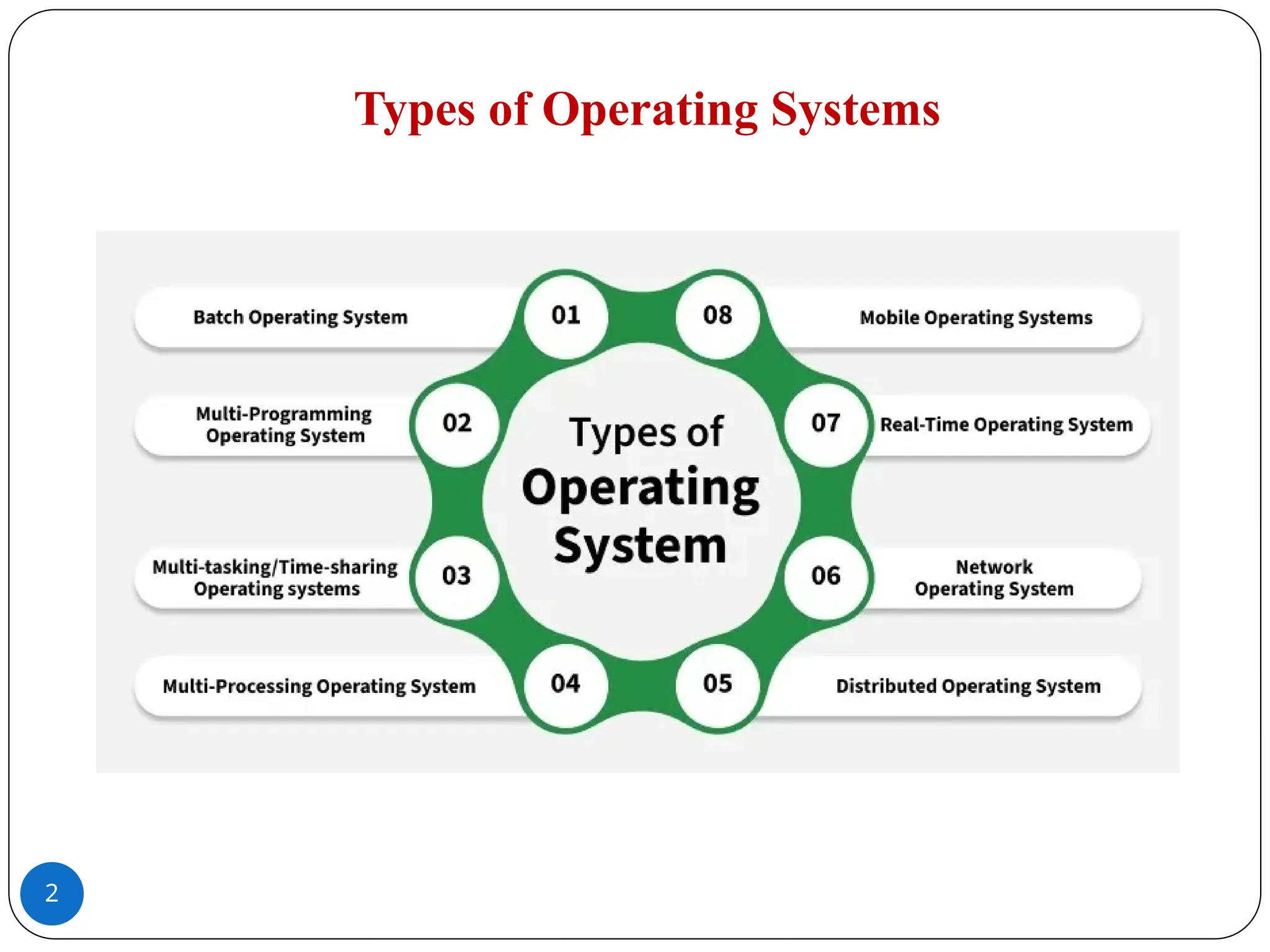
Types of Operating Systems
3
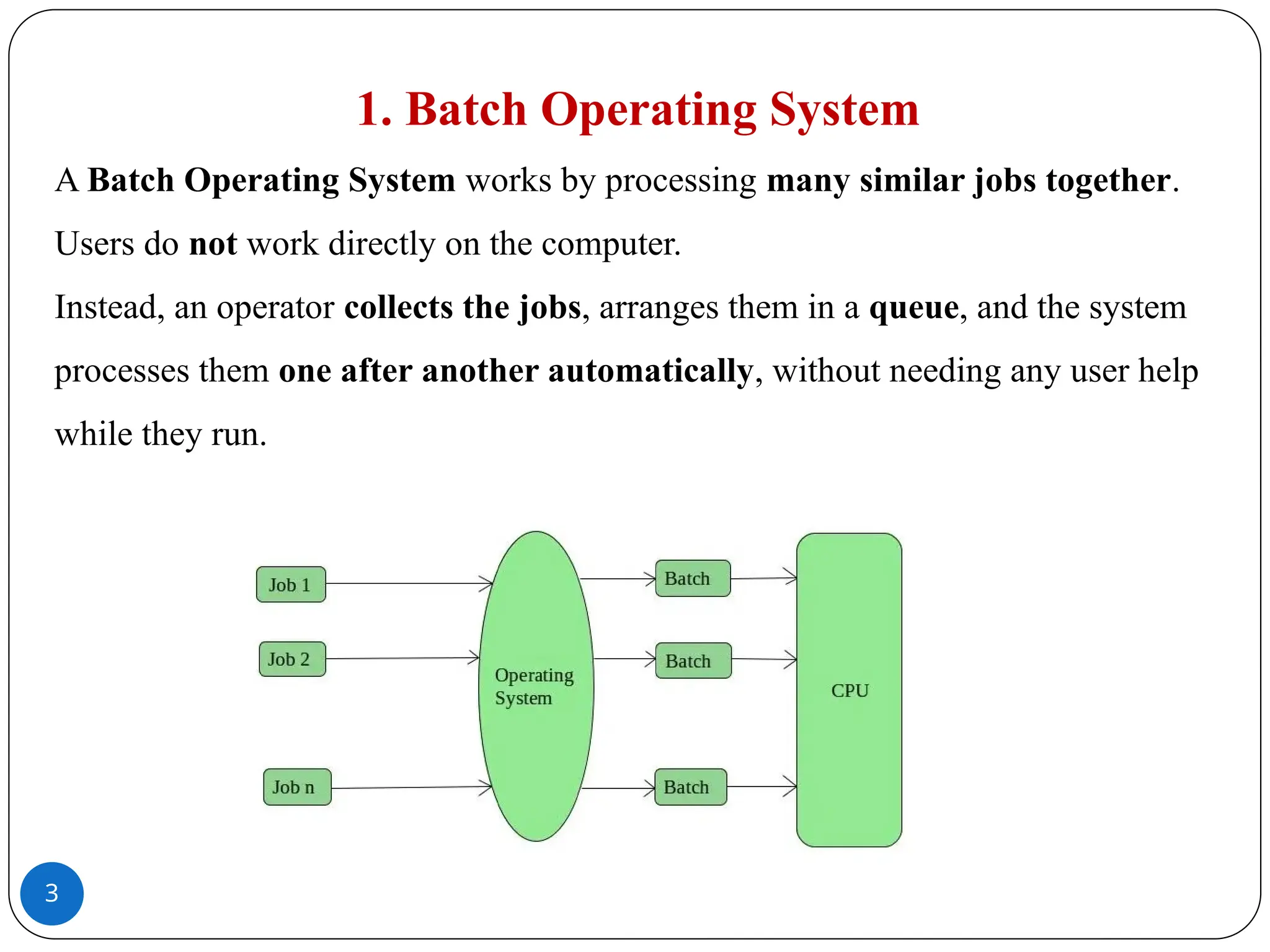
1. Batch Operating System
A Batch Operating System works by processing many similar jobs together.
Users do not work directly on the computer.
Instead, an operator collects the jobs, arranges them in a queue, and the system
processes them one after another automatically, without needing any user help
while they run.
4
Advantages of Batch Operating System
1. Minimal Idle Time
The computer keeps working on one job after another without waiting for a
person, so it rarely sits idle.
2. Good for Repetitive Tasks
It is very useful for work that needs to be done again and again—like preparing
salary slips or printing bills.
3. Improved Throughput
Many jobs are collected and processed in batches, so more work gets done
overall.
5
Disadvantages of Batch Operating System
1. Inefficient CPU Use
If one job waits for input or output, the CPU does nothing during that time.
2. Increased Response Time
It takes a long time to get results because jobs are handled one after another.
3. No Real-Time Interaction
Users cannot talk to or control the system while it is working. They must wait
until all jobs finish.
6
2. Multi-Programming Operating System
In a Multiprogramming Operating System, many programs are kept in memory
at the same time.
The CPU quickly switches from one program to another, so the computer is used
better and works faster.
7
Advantages of Multi-Programming Operating System
1. Better CPU Utilization
The CPU stays busy because when one job is waiting (for input/output), the CPU
switches to another job.
2. Improved Throughput
Many jobs run at the same time, so more work gets done in less time.
3. Efficient Resource Use
CPU, memory, and input/output devices are shared smartly among different
programs.
8
Disadvantages of Multi-Programming Operating System
1. Complex Design
It needs advanced methods for managing memory and scheduling tasks, which
makes it difficult to design.
2. Security Issues
Many programs stay in memory at the same time, increasing the chance of
unauthorized access or data leaks.
3. High Memory Requirement
It needs a large amount of RAM to run many programs together.
9
3. Multi-tasking/Time-sharing Operating systems
A Multitasking Operating System is a type of system that runs many programs
by giving each one a small amount of time, called a time slice or quantum.
When a program's time is over, the OS quickly switches to the next program.
This happens again and again in a round-robin way, so all tasks get a chance to
run.
Because of this, many tasks—whether from one user or many users—can run
smoothly on the same computer.
10
Advantages of Multi-tasking/Time-sharing Operating systems
1. Equal CPU Access
Every task gets a fair amount of CPU time, so no task is ignored.
2. Reduced Software Duplication
Many users can use the same software at the same time without needing
separate copies.
3. Low CPU Idle Time
The CPU is kept busy and used efficiently because tasks are scheduled well.
11
Disadvantages of Multi-tasking/Time-sharing Operating systems
1. Lower Reliability
If the system crashes, all users are affected.
2. Security Concerns
With many users, there is a higher chance of data theft or privacy issues.
3. Communication Issues
Sharing data between users can sometimes cause conflicts or errors.
12
4. Multi-Processing Operating System
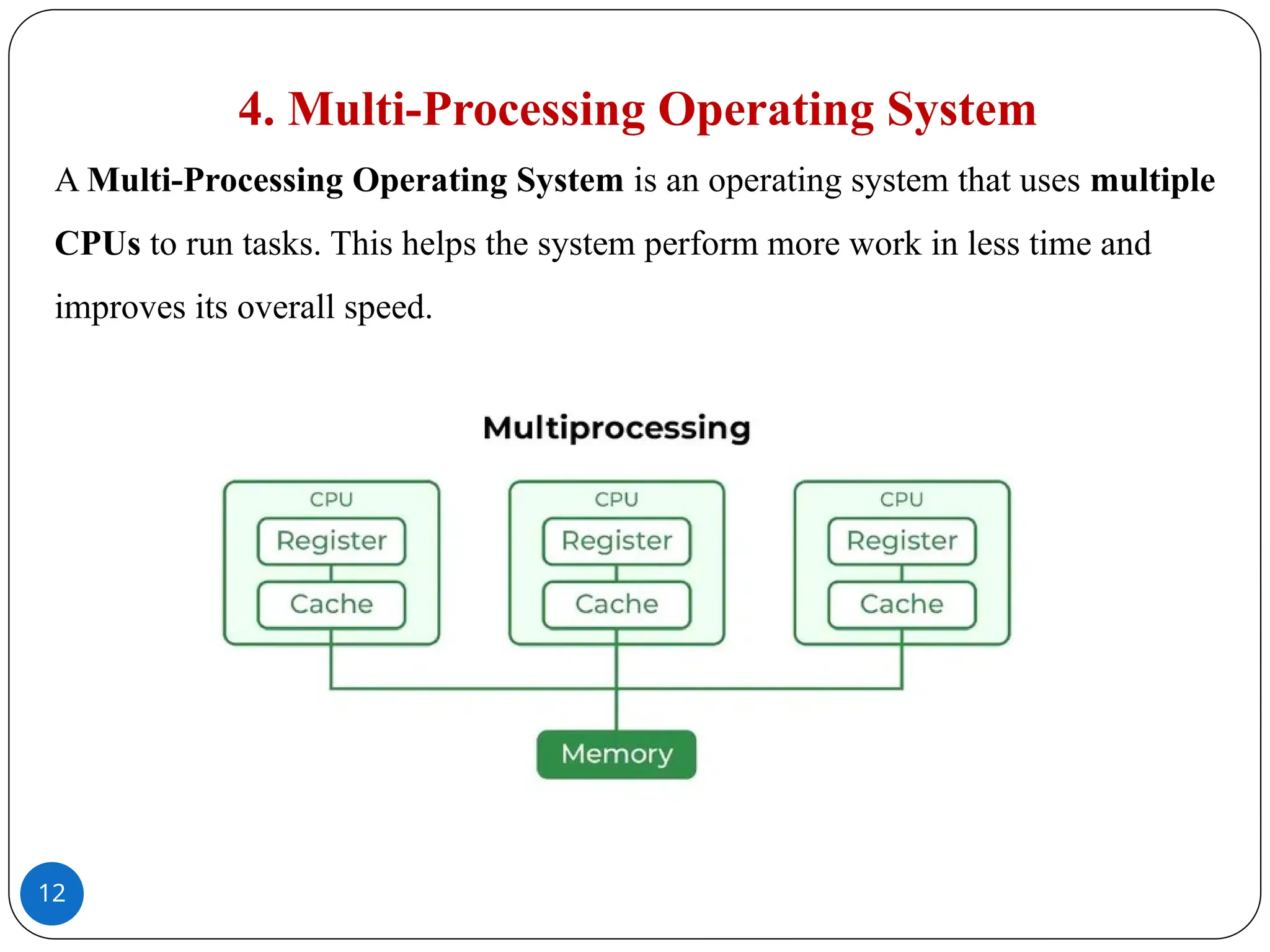
A Multi-Processing Operating System is an operating system that uses multiple
CPUs to run tasks. This helps the system perform more work in less time and
improves its overall speed.
13
Advantages of Multi-Processing Operating System
1. Faster Processing
Because many CPUs work at the same time, tasks are completed much faster.
2. High Reliability
If one CPU stops working, the others can continue doing the job.
3. Supports Heavy Tasks
It is very good for big and complex jobs like scientific research or industrial
work.
14
Disadvantages of Multi-Processing Operating System
1. High Cost
Having many processors and special hardware makes the system expensive.
2. Complex Design
The operating system must manage task sharing and communication, which is
hard to design.
3. Not Always Efficient
If the tasks are not divided properly, some processors may sit idle, wasting
resources.
15
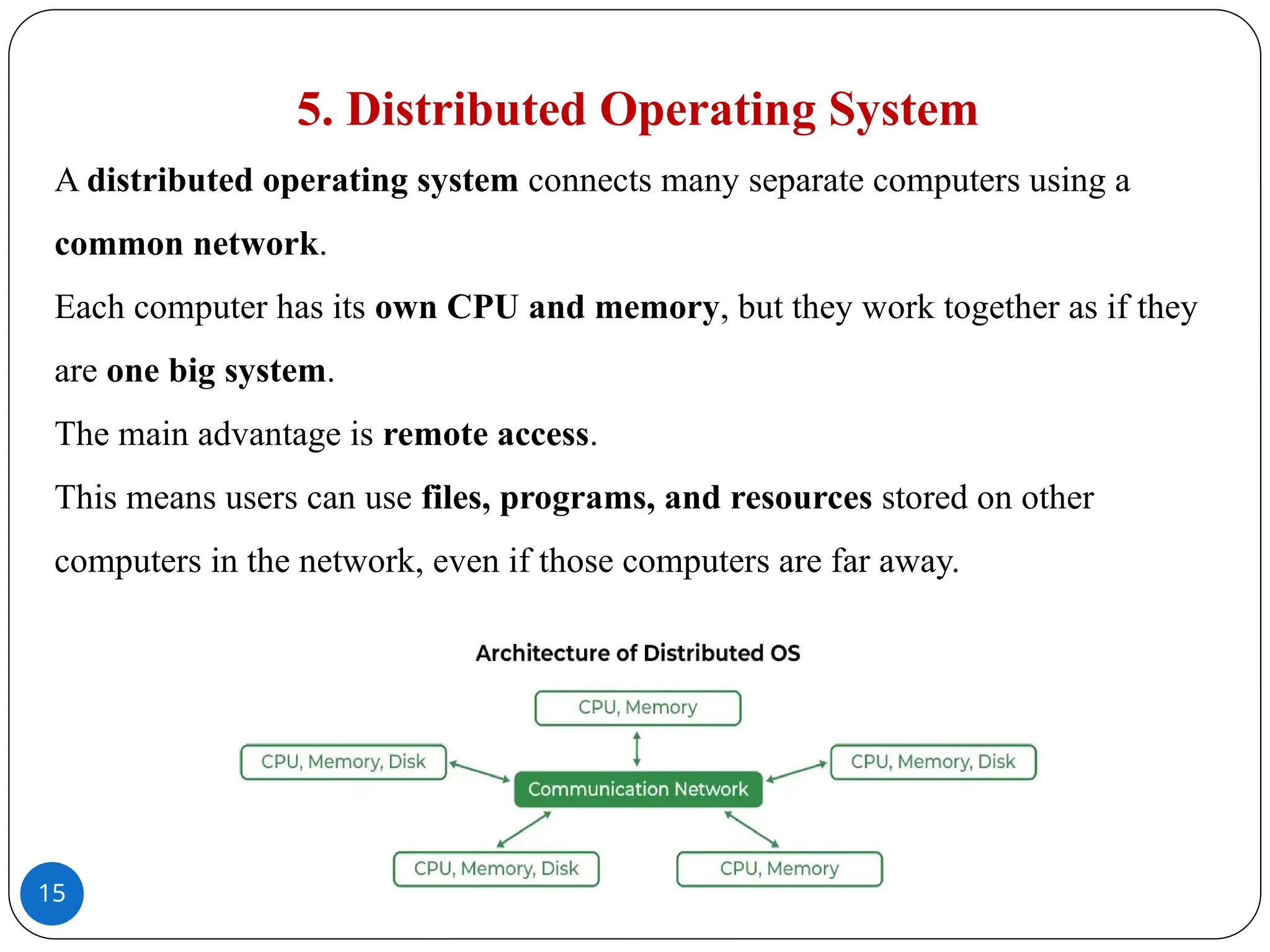
5. Distributed Operating System
A distributed operating system connects many separate computers using a
common network.
Each computer has its own CPU and memory, but they work together as if they
are one big system.
The main advantage is remote access.
This means users can use files, programs, and resources stored on other
computers in the network, even if those computers are far away.
16
Advantages of Distributed Operating System
1. Independent Systems
Each computer works on its own, so if one machine fails, the others keep
working.
2. Easily Scalable
You can add more computers to the network without much trouble.
3. Lower Processing Delays
Work is shared across many machines, so tasks get done faster.
17
Disadvantages of Distributed Operating System
1. Network Dependency
If the main network stops working, the computers cannot communicate.
2. Lack of Standardization
There is no common standard or language for building these systems.
3. High Cost & Complexity
The hardware required is expensive, and the system is difficult to design and
understand.
18
6. Network Operating System
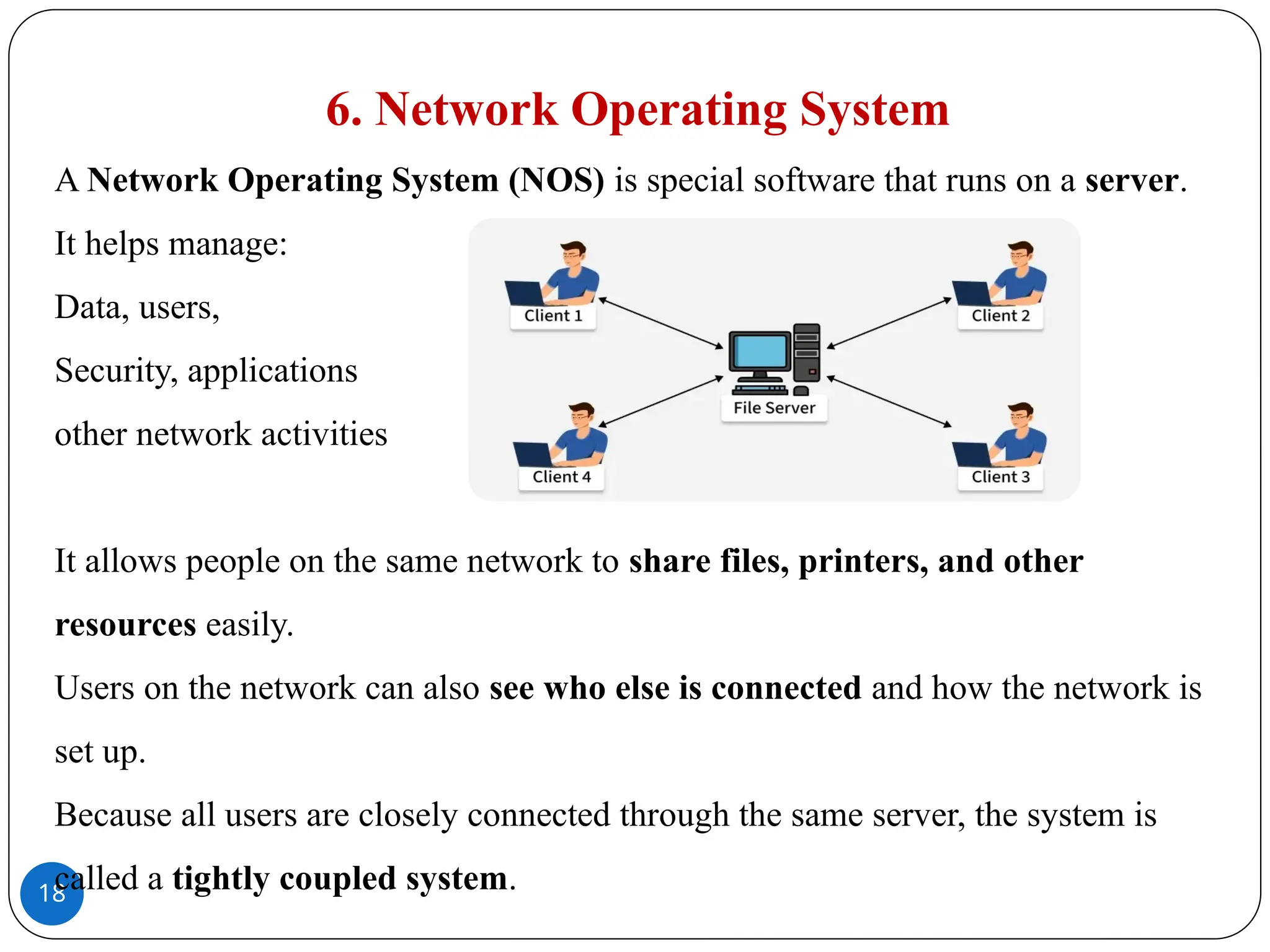
A Network Operating System (NOS) is special software that runs on a server.
It helps manage:
Data, users,
Security, applications
other network activities
It allows people on the same network to share files, printers, and other
resources easily.
Users on the network can also see who else is connected and how the network is
set up.
Because all users are closely connected through the same server, the system is
called a tightly coupled system.
19
Advantages of Network Operating System
1. Centralized and Stable Servers:
All resources (like files, printers, and applications) are managed from one main
server, which works reliably.
2. Easy Upgrades
New devices or technologies can be added without any major problems.
3. Remote Access
Users can connect to the server from different places and devices.
20
Disadvantages of Network Operating System
1. High Server Cost
Setting up and running a server is very expensive.
2. Dependency on Server
If the main server has a problem, the whole network may stop working.
3. Regular Maintenance Needed
The system needs frequent updates, monitoring, and technical support.
21
7. Real-Time Operating System
• These types of operating systems are used in real-time systems. They must
respond very quickly to any input.
• The small amount of time taken to respond is called response time.
• Real-time systems are used in situations where even a small delay can cause
big problems, such as in:
• Missile control systems
• Air traffic control
• Robots
22
Types of Real-Time Operating System
• Hard Real-Time Operating System:
These systems are used where timing must be perfect, and even a small delay is
not allowed. Examples: airbags, automatic parachutes.
They do not use virtual memory because it can slow down the system. They
must respond immediately to save lives or prevent damage.
• Soft Real-Time Operating System
These systems also need to respond quickly, but a small delay is acceptable.
They try to be fast and predictable, but perfect timing is not required.
Examples: video games, multimedia apps, video streaming, interactive apps.
23
Advantages of Real-Time Operating System
1. Maximum Consumption:
This means the system uses its devices and resources fully, so it gets more work
done and gives better output.
2. Error-Free
These systems are designed to work with very few or no mistakes.
3. Memory Allocation
These systems manage memory very well, giving the right amount of memory to
each task when needed.
24
Disadvantages of Real-Time Operating System
1. Limited Tasks:
• These systems run only a few tasks at the same time.
• They do this so they can focus better on each task and avoid mistakes.
2. Complex Algorithms:
• The rules and steps (algorithms) used in these systems are very complicated.
• This makes it difficult for designers or programmers to create them.
3. Thread Priority:
• Setting thread priority (deciding which task is more important) is not very
useful in these systems because they do not switch tasks often.
25
8. Mobile Operating Systems
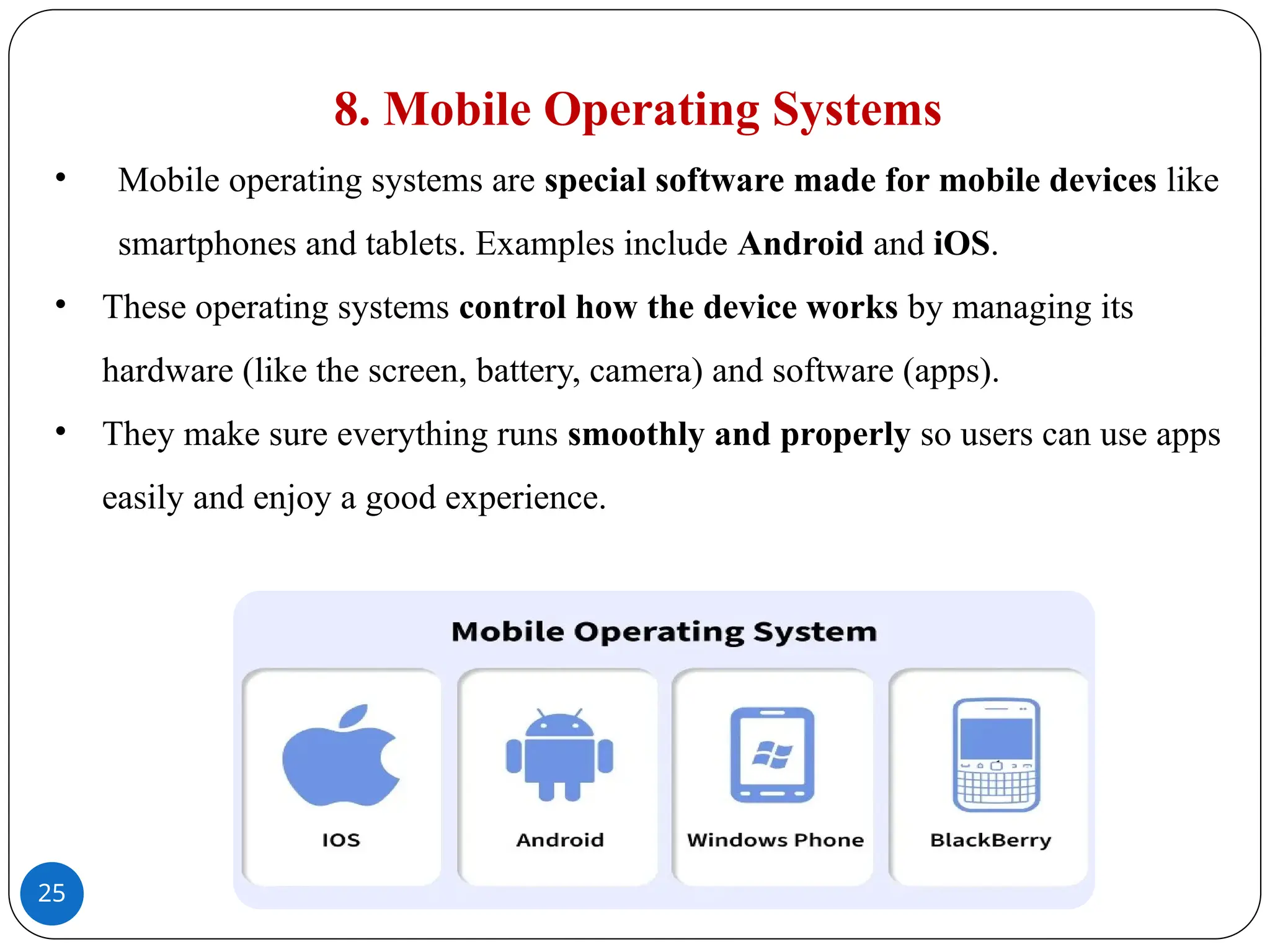
• Mobile operating systems are special software made for mobile devices like
smartphones and tablets. Examples include Android and iOS.
• These operating systems control how the device works by managing its
hardware (like the screen, battery, camera) and software (apps).
• They make sure everything runs smoothly and properly so users can use apps
easily and enjoy a good experience.
26
Advantages of Mobile Operating Systems
1. User-Friendly Interfaces:
• Mobile operating systems are made to be very easy to use.
• They have simple icons, menus, and touch gestures (like tapping or
swiping), so even beginners can understand them quickly.
2. Extensive App Ecosystems:
• There are thousands of apps available for mobile phones.
• Because of this, users can choose the apps they like and set up their phone
the way they want — for study, work, fitness, entertainment, etc.
3. Connectivity Options:
• Mobile operating systems allow devices to connect in many ways, like Wi-Fi,
mobile data, Bluetooth, and hotspot.
• This helps users stay online and connected wherever they go.
27
Disadvantages of Mobile Operating Systems
Battery Life Constraints:
• Even though mobile phones now have better battery-saving features, the
battery still runs out quickly, especially when we use the device a lot
(gaming, videos, internet, GPS, etc.).
Security Risks:
• Mobile devices can face security problems, like viruses, harmful apps, or
fake messages (phishing). These can steal or misuse personal information.
Fragmentation:
• Android is used on many different types of devices made by different
companies. Each device may have its own version or customization.
• Because of this, apps may not work the same on every device, and
developers find it hard to make their apps compatible with all.

There are eight types of Operating System

  • 1.
    “Operating System” 1 Dr. M.M. Mohod Assistant Professor, P. R. Pote Patil Educational Group, Pote Patil Road, Amravati, (M.S.)
  • 2.
  • 3.
    3 1. Batch OperatingSystem A Batch Operating System works by processing many similar jobs together. Users do not work directly on the computer. Instead, an operator collects the jobs, arranges them in a queue, and the system processes them one after another automatically, without needing any user help while they run.
  • 4.
    4 Advantages of BatchOperating System 1. Minimal Idle Time The computer keeps working on one job after another without waiting for a person, so it rarely sits idle. 2. Good for Repetitive Tasks It is very useful for work that needs to be done again and again—like preparing salary slips or printing bills. 3. Improved Throughput Many jobs are collected and processed in batches, so more work gets done overall.
  • 5.
    5 Disadvantages of BatchOperating System 1. Inefficient CPU Use If one job waits for input or output, the CPU does nothing during that time. 2. Increased Response Time It takes a long time to get results because jobs are handled one after another. 3. No Real-Time Interaction Users cannot talk to or control the system while it is working. They must wait until all jobs finish.
  • 6.
    6 2. Multi-Programming OperatingSystem In a Multiprogramming Operating System, many programs are kept in memory at the same time. The CPU quickly switches from one program to another, so the computer is used better and works faster.
  • 7.
    7 Advantages of Multi-ProgrammingOperating System 1. Better CPU Utilization The CPU stays busy because when one job is waiting (for input/output), the CPU switches to another job. 2. Improved Throughput Many jobs run at the same time, so more work gets done in less time. 3. Efficient Resource Use CPU, memory, and input/output devices are shared smartly among different programs.
  • 8.
    8 Disadvantages of Multi-ProgrammingOperating System 1. Complex Design It needs advanced methods for managing memory and scheduling tasks, which makes it difficult to design. 2. Security Issues Many programs stay in memory at the same time, increasing the chance of unauthorized access or data leaks. 3. High Memory Requirement It needs a large amount of RAM to run many programs together.
  • 9.
    9 3. Multi-tasking/Time-sharing Operatingsystems A Multitasking Operating System is a type of system that runs many programs by giving each one a small amount of time, called a time slice or quantum. When a program's time is over, the OS quickly switches to the next program. This happens again and again in a round-robin way, so all tasks get a chance to run. Because of this, many tasks—whether from one user or many users—can run smoothly on the same computer.
  • 10.
    10 Advantages of Multi-tasking/Time-sharingOperating systems 1. Equal CPU Access Every task gets a fair amount of CPU time, so no task is ignored. 2. Reduced Software Duplication Many users can use the same software at the same time without needing separate copies. 3. Low CPU Idle Time The CPU is kept busy and used efficiently because tasks are scheduled well.
  • 11.
    11 Disadvantages of Multi-tasking/Time-sharingOperating systems 1. Lower Reliability If the system crashes, all users are affected. 2. Security Concerns With many users, there is a higher chance of data theft or privacy issues. 3. Communication Issues Sharing data between users can sometimes cause conflicts or errors.
  • 12.
    12 4. Multi-Processing OperatingSystem A Multi-Processing Operating System is an operating system that uses multiple CPUs to run tasks. This helps the system perform more work in less time and improves its overall speed.
  • 13.
    13 Advantages of Multi-ProcessingOperating System 1. Faster Processing Because many CPUs work at the same time, tasks are completed much faster. 2. High Reliability If one CPU stops working, the others can continue doing the job. 3. Supports Heavy Tasks It is very good for big and complex jobs like scientific research or industrial work.
  • 14.
    14 Disadvantages of Multi-ProcessingOperating System 1. High Cost Having many processors and special hardware makes the system expensive. 2. Complex Design The operating system must manage task sharing and communication, which is hard to design. 3. Not Always Efficient If the tasks are not divided properly, some processors may sit idle, wasting resources.
  • 15.
    15 5. Distributed OperatingSystem A distributed operating system connects many separate computers using a common network. Each computer has its own CPU and memory, but they work together as if they are one big system. The main advantage is remote access. This means users can use files, programs, and resources stored on other computers in the network, even if those computers are far away.
  • 16.
    16 Advantages of DistributedOperating System 1. Independent Systems Each computer works on its own, so if one machine fails, the others keep working. 2. Easily Scalable You can add more computers to the network without much trouble. 3. Lower Processing Delays Work is shared across many machines, so tasks get done faster.
  • 17.
    17 Disadvantages of DistributedOperating System 1. Network Dependency If the main network stops working, the computers cannot communicate. 2. Lack of Standardization There is no common standard or language for building these systems. 3. High Cost & Complexity The hardware required is expensive, and the system is difficult to design and understand.
  • 18.
    18 6. Network OperatingSystem A Network Operating System (NOS) is special software that runs on a server. It helps manage: Data, users, Security, applications other network activities It allows people on the same network to share files, printers, and other resources easily. Users on the network can also see who else is connected and how the network is set up. Because all users are closely connected through the same server, the system is called a tightly coupled system.
  • 19.
    19 Advantages of NetworkOperating System 1. Centralized and Stable Servers: All resources (like files, printers, and applications) are managed from one main server, which works reliably. 2. Easy Upgrades New devices or technologies can be added without any major problems. 3. Remote Access Users can connect to the server from different places and devices.
  • 20.
    20 Disadvantages of NetworkOperating System 1. High Server Cost Setting up and running a server is very expensive. 2. Dependency on Server If the main server has a problem, the whole network may stop working. 3. Regular Maintenance Needed The system needs frequent updates, monitoring, and technical support.
  • 21.
    21 7. Real-Time OperatingSystem • These types of operating systems are used in real-time systems. They must respond very quickly to any input. • The small amount of time taken to respond is called response time. • Real-time systems are used in situations where even a small delay can cause big problems, such as in: • Missile control systems • Air traffic control • Robots
  • 22.
    22 Types of Real-TimeOperating System • Hard Real-Time Operating System: These systems are used where timing must be perfect, and even a small delay is not allowed. Examples: airbags, automatic parachutes. They do not use virtual memory because it can slow down the system. They must respond immediately to save lives or prevent damage. • Soft Real-Time Operating System These systems also need to respond quickly, but a small delay is acceptable. They try to be fast and predictable, but perfect timing is not required. Examples: video games, multimedia apps, video streaming, interactive apps.
  • 23.
    23 Advantages of Real-TimeOperating System 1. Maximum Consumption: This means the system uses its devices and resources fully, so it gets more work done and gives better output. 2. Error-Free These systems are designed to work with very few or no mistakes. 3. Memory Allocation These systems manage memory very well, giving the right amount of memory to each task when needed.
  • 24.
    24 Disadvantages of Real-TimeOperating System 1. Limited Tasks: • These systems run only a few tasks at the same time. • They do this so they can focus better on each task and avoid mistakes. 2. Complex Algorithms: • The rules and steps (algorithms) used in these systems are very complicated. • This makes it difficult for designers or programmers to create them. 3. Thread Priority: • Setting thread priority (deciding which task is more important) is not very useful in these systems because they do not switch tasks often.
  • 25.
    25 8. Mobile OperatingSystems • Mobile operating systems are special software made for mobile devices like smartphones and tablets. Examples include Android and iOS. • These operating systems control how the device works by managing its hardware (like the screen, battery, camera) and software (apps). • They make sure everything runs smoothly and properly so users can use apps easily and enjoy a good experience.
  • 26.
    26 Advantages of MobileOperating Systems 1. User-Friendly Interfaces: • Mobile operating systems are made to be very easy to use. • They have simple icons, menus, and touch gestures (like tapping or swiping), so even beginners can understand them quickly. 2. Extensive App Ecosystems: • There are thousands of apps available for mobile phones. • Because of this, users can choose the apps they like and set up their phone the way they want — for study, work, fitness, entertainment, etc. 3. Connectivity Options: • Mobile operating systems allow devices to connect in many ways, like Wi-Fi, mobile data, Bluetooth, and hotspot. • This helps users stay online and connected wherever they go.
  • 27.
    27 Disadvantages of MobileOperating Systems Battery Life Constraints: • Even though mobile phones now have better battery-saving features, the battery still runs out quickly, especially when we use the device a lot (gaming, videos, internet, GPS, etc.). Security Risks: • Mobile devices can face security problems, like viruses, harmful apps, or fake messages (phishing). These can steal or misuse personal information. Fragmentation: • Android is used on many different types of devices made by different companies. Each device may have its own version or customization. • Because of this, apps may not work the same on every device, and developers find it hard to make their apps compatible with all.