operating system Evolution understanding the basics
1.
EVOLUTION OF OPERATINGSYSTEMS
• CS 311: operating systems
•Name of the Student: Ahmed Hamdan alhamdan
• Academic Number: 391100925
• Professor: Dr. Khaled Nazim abdul sattar.
• Department of Computer Science & Information,
College of Science , Al Zulfi, Majmaah
University, KSA
2.
•Content:
•Introduction
•What is theGeneration of Operating Systems
•First Generation(1945 - 1955 )
•Second Generation(1955-1965 )
•Third Generation(1965 -1980 )
•Fourth Generation ( 1980 - Present )
•The future of operating systems
•Summary
•References
2
3.
•Introduction:
•What is operatingsystem?
An operating system acts as an
intermediary between the user
of a computer and computer
hardware. The purpose of an
operating system is to provide
an environment in which a user
can execute programs in a
convenient and efficient manner.
3
4.
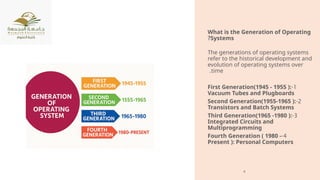
What is theGeneration of Operating
Systems
?
The generations of operating systems
refer to the historical development and
evolution of operating systems over
time
.
1
-
First Generation(1945 - 1955 ):
Vacuum Tubes and Plugboards
2
-
Second Generation(1955-1965 ):
Transistors and Batch Systems
3
-
Third Generation(1965 -1980 ):
Integrated Circuits and
Multiprogramming
4
-
Fourth Generation ( 1980 -
Present ): Personal Computers
4
5.
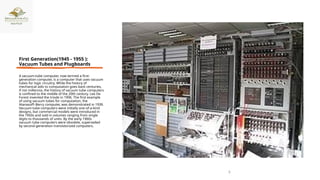
First Generation(1945 -1955 ):
Vacuum Tubes and Plugboards
A vacuum-tube computer, now termed a first-
generation computer, is a computer that uses vacuum
tubes for logic circuitry. While the history of
mechanical aids to computation goes back centuries,
if not millennia, the history of vacuum tube computers
is confined to the middle of the 20th century. Lee De
Forest invented the triode in 1906. The first example
of using vacuum tubes for computation, the
Atanasoff–Berry computer, was demonstrated in 1939.
Vacuum-tube computers were initially one-of-a-kind
designs, but commercial models were introduced in
the 1950s and sold in volumes ranging from single
digits to thousands of units. By the early 1960s
vacuum tube computers were obsolete, superseded
by second-generation transistorized computers.
5
6.
2
-
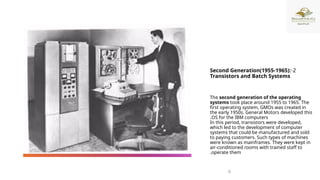
Second Generation(1955-1965):
Transistors andBatch Systems
The second generation of the operating
systems took place around 1955 to 1965. The
first operating system, GMOs was created in
the early 1950s. General Motors developed this
OS for the IBM computers
.
In this period, transistors were developed,
which led to the development of computer
systems that could be manufactured and sold
to paying customers. Such types of machines
were known as mainframes. They were kept in
air-conditioned rooms with trained staff to
operate them
.
6
7.
3
-
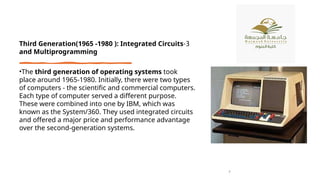
Third Generation(1965 -1980): Integrated Circuits
and Multiprogramming
•The third generation of operating systems took
place around 1965-1980. Initially, there were two types
of computers - the scientific and commercial computers.
Each type of computer served a different purpose.
These were combined into one by IBM, which was
known as the System/360. They used integrated circuits
and offered a major price and performance advantage
over the second-generation systems.
7
8.
4
-
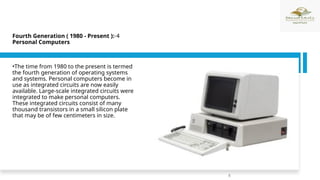
Fourth Generation (1980 - Present ):
Personal Computers
•The time from 1980 to the present is termed
the fourth generation of operating systems
and systems. Personal computers become in
use as integrated circuits are now easily
available. Large-scale integrated circuits were
integrated to make personal computers.
These integrated circuits consist of many
thousand transistors in a small silicon plate
that may be of few centimeters in size.
8
9.
The future ofoperating
systems
:
1. Increased Integration of AI
•Smart Assistants: Operating systems may integrate
more advanced AI capabilities, providing users with
personalized experiences and automating routine tasks.
•Predictive Functionality: AI could enable OSes to
predict user needs and optimize performance based on
usage patterns.
2. Cloud-Based Operating Systems
•Remote Access: With the rise of cloud computing,
more OS functionalities may shift to the cloud, allowing
users to access their systems from any device.
•Resource Management: Cloud-based OSes can
leverage powerful remote servers, reducing the
hardware requirements for local devices.
3. Security Enhancements
•Zero Trust Architectures: Future OSes may adopt
more robust security models that assume threats are
always present, implementing stricter access controls.
•Built-In Encryption: Enhanced encryption techniques
will likely be standard, ensuring data security across all
applications.
9
10.
•Summary of theevolution of operating
systems
• From simple commands typed by hand on punch cards, to intelligent
systems that control our phones, watches, and even our cars!
• Operating systems have been and still are the beating heart of every
digital device we use.
• Their evolution has not been merely a technical improvement; it's an
ongoing journey toward intelligence, speed, and security.
• Today, we live in a world where operating systems operate behind the
scenes with incredible intelligence, serving us at every moment... even
without our awareness!
• The future? We may not need screens at all! The system could be in
glasses, or even implanted in our brains (who knows?).
• The bottom line:
• Operating systems have evolved with humans... and they will continue to
evolve to become closer to them and smarter to serve them
everywhere.
10