Week 8
Topics discussed:
SystemModel
Deadlock Characterization
Methods for Handling Deadlocks
Deadlock Prevention
Deadlock Avoidance
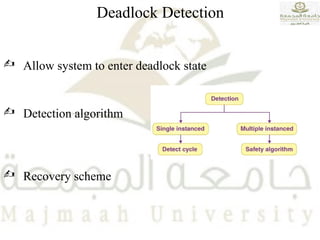
Deadlock Detection
Recovery from Deadlock
3.
Objectives
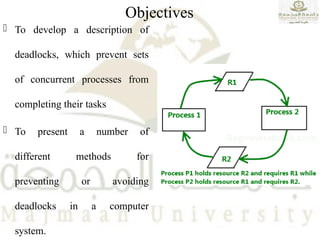
To developa description of
deadlocks, which prevent sets
of concurrent processes from
completing their tasks
To present a number of
different methods for
preventing or avoiding
deadlocks in a computer
system.
4.
System Model
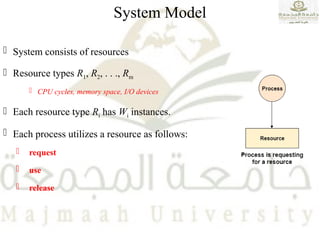
Systemconsists of resources
Resource types R1, R2, . . ., Rm
CPU cycles, memory space, I/O devices
Each resource type Ri has Wi instances.
Each process utilizes a resource as follows:
request
use
release
5.
Deadlock Characterization
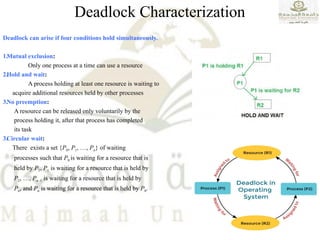
Deadlock canarise if four conditions hold simultaneously.
1.Mutual exclusion:
Only one process at a time can use a resource
2.Hold and wait:
A process holding at least one resource is waiting to
acquire additional resources held by other processes
3.No preemption:
A resource can be released only voluntarily by the
process holding it, after that process has completed
its task
3.Circular wait:
There exists a set {P0, P1, …, Pn} of waiting
processes such that P0 is waiting for a resource that is
held by P1, P1 is waiting for a resource that is held by
P2, …, Pn–1 is waiting for a resource that is held by
Pn, and Pn is waiting for a resource that is held by P0.
6.
Deadlock with MutexLocks
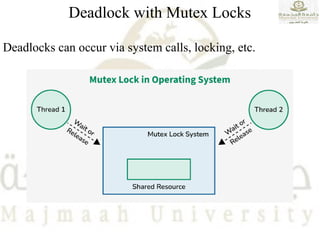
Deadlocks can occur via system calls, locking, etc.
7.
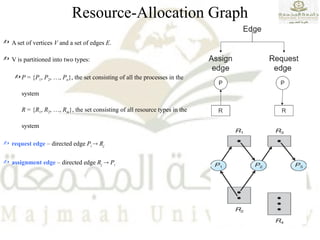
Resource-Allocation Graph
Aset of vertices V and a set of edges E.
V is partitioned into two types:
P = {P1, P2, …, Pn}, the set consisting of all the processes in the
system
R = {R1, R2, …, Rm}, the set consisting of all resource types in the
system
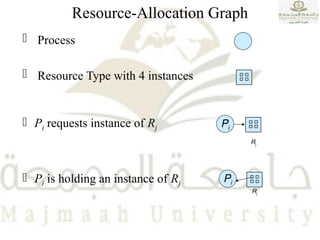
request edge – directed edge Pi Rj
assignment edge – directed edge Rj Pi
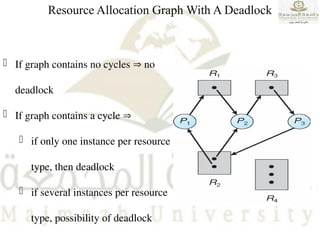
Resource Allocation GraphWith A Deadlock
If graph contains no cycles no
deadlock
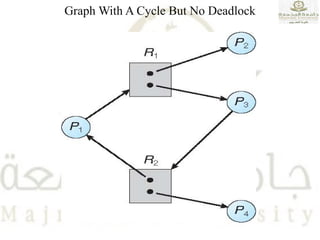
If graph contains a cycle
if only one instance per resource
type, then deadlock
if several instances per resource
type, possibility of deadlock
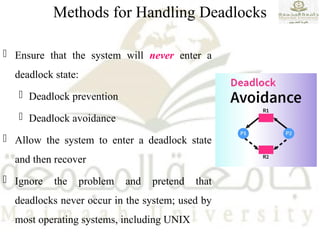
Methods for HandlingDeadlocks
Ensure that the system will never enter a
deadlock state:
Deadlock prevention
Deadlock avoidance
Allow the system to enter a deadlock state
and then recover
Ignore the problem and pretend that
deadlocks never occur in the system; used by
most operating systems, including UNIX
12.
Deadlock Prevention
Restrain theways request can be made
Mutual Exclusion:
Not required for sharable resources (e.g., read-only files); must hold for non-sharable resources
Hold and Wait:
1.Must guarantee that whenever a process requests a resource, it does not hold any other
resources
2.Require process to request and be allocated all its resources before it begins execution, or allow
process to request resources only when the process has none allocated to it.
3.Low resource utilization; starvation possible
No Preemption:
1.If a process that is holding some resources requests another resource that cannot be
immediately allocated to it, then all resources currently being held are released
2.Preempted resources are added to the list of resources for which the process is waiting
3.Process will be restarted only when it can regain its old resources, as well as the new ones that
it is requesting
Circular Wait:
Impose a total ordering of all resource types, and require that each process requests resources in
an increasing order of enumeration
13.
Deadlock Avoidance
Requires thatthe system has some additional a priori information available
Simplest and most useful model requires that each process declare the
maximum number of resources of each type that it may need
The deadlock-avoidance algorithm dynamically examines the resource-
allocation state to ensure that there can never be a circular-wait condition
Resource-allocation state is defined by the number of available and allocated
resources, and the maximum demands of the processes
14.
Safe State
Whena process requests an available resource, system must decide if immediate allocation leaves
the system in a safe state
System is in safe state if there exists a sequence <P1, P2, …, Pn> of ALL the processes in the
systems such that for each Pi, the resources that Pi can still request can be satisfied by currently
available resources + resources held by all the Pj, with j < I
That is:
If Pi resource needs are not immediately available, then Pi can wait until all Pj have finished
When Pj is finished, Pi can obtain needed resources, execute, return allocated resources, and
terminate
When Pi terminates, Pi +1 can obtain its needed resources, and so on
15.
Safe, Unsafe, DeadlockState
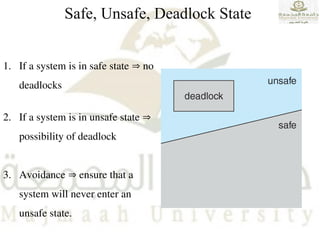
1. If a system is in safe state no
deadlocks
2. If a system is in unsafe state
possibility of deadlock
3. Avoidance ensure that a
system will never enter an
unsafe state.
16.
Avoidance Algorithms
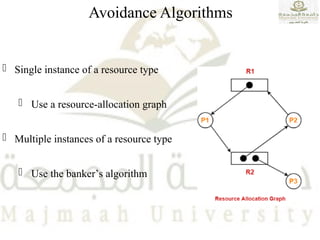
Singleinstance of a resource type
Use a resource-allocation graph
Multiple instances of a resource type
Use the banker’s algorithm
17.
Resource-Allocation Graph Scheme
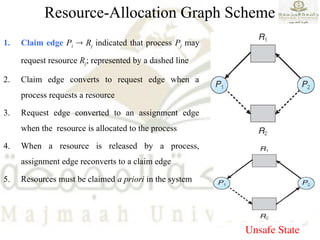
1.Claim edge Pi Rj indicated that process Pj may
request resource Rj; represented by a dashed line
2. Claim edge converts to request edge when a
process requests a resource
3. Request edge converted to an assignment edge
when the resource is allocated to the process
4. When a resource is released by a process,
assignment edge reconverts to a claim edge
5. Resources must be claimed a priori in the system
Unsafe State
18.
Resource-Allocation Graph Algorithm
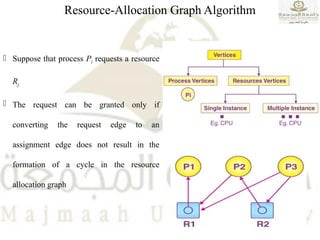
Suppose that process Pi requests a resource
Rj
The request can be granted only if
converting the request edge to an
assignment edge does not result in the
formation of a cycle in the resource
allocation graph
19.
Banker’s Algorithm
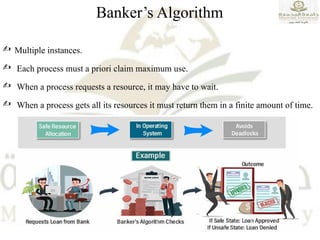
Multipleinstances.
Each process must a priori claim maximum use.
When a process requests a resource, it may have to wait.
When a process gets all its resources it must return them in a finite amount of time.
20.
Data Structures forthe Banker’s Algorithm
Available:
Vector of length m. If available [j] = k, there are k instances of
resource type Rj available
Max:
n x m matrix. If Max [i,j] = k, then process Pi may request at
most k instances of resource type Rj
Allocation:
n x m matrix. If Allocation[i,j] = k then Pi is currently allocated k
instances of Rj
Need:
n x m matrix. If Need[i,j] = k, then Pi may need k more instances of
Rj to complete its task
Need [i,j] = Max[i,j] – Allocation [i,j]
21.
Safety Algorithm
1. LetWork and Finish be vectors of length m and n, respectively. Initialize:
Work = Available
Finish [i] = false for i = 0, 1, …, n- 1
2. Find an i such that both:
(a) Finish [i] = false
(b) Needi Work
If no such i exists, go to step 4
3. Work = Work + Allocationi
Finish[i] = true
go to step 2
4. If Finish [i] == true for all i, then the system is in a safe state
22.
Resource-Request Algorithm forProcess Pi
Requesti = request vector for process Pi. If Requesti [j] = k then process Pi wants k instances of resource type Rj
1. If Requesti Needi go to step 2. Otherwise, raise error condition, since process has exceeded its maximum
claim
2. If Requesti Available, go to step 3. Otherwise Pi must wait, since resources are not available
3. Pretend to allocate requested resources to Pi by modifying the state as follows:
Available = Available – Requesti;
Allocationi = Allocationi + Requesti;
Needi = Needi – Requesti;
If safe the resources are allocated to Pi
If unsafe Pi must wait, and the old resource-allocation state is restored
23.
Example of Banker’sAlgorithm
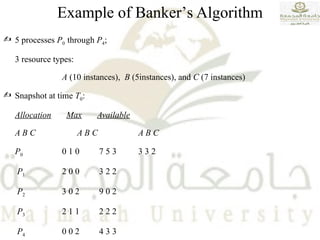
5 processes P0 through P4;
3 resource types:
A (10 instances), B (5instances), and C (7 instances)
Snapshot at time T0:
Allocation Max Available
A B C A B C A B C
P0 0 1 0 7 5 3 3 3 2
P1 2 0 0 3 2 2
P2 3 0 2 9 0 2
P3 2 1 1 2 2 2
P4 0 0 2 4 3 3
24.
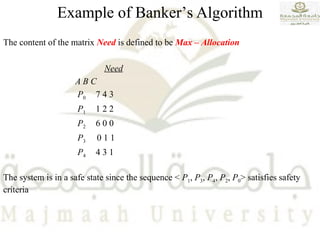
The content ofthe matrix Need is defined to be Max – Allocation
Need
A B C
P0 7 4 3
P1 1 2 2
P2 6 0 0
P3 0 1 1
P4 4 3 1
The system is in a safe state since the sequence < P1, P3, P4, P2, P0> satisfies safety
criteria
Example of Banker’s Algorithm
25.
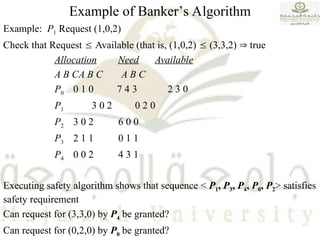
Example: P1 Request(1,0,2)
Check that Request Available (that is, (1,0,2) (3,3,2) true
Allocation Need Available
A B CA B C A B C
P0 0 1 0 7 4 3 2 3 0
P1 3 0 2 0 2 0
P2 3 0 2 6 0 0
P3 2 1 1 0 1 1
P4 0 0 2 4 3 1
Executing safety algorithm shows that sequence < P1, P3, P4, P0, P2> satisfies
safety requirement
Can request for (3,3,0) by P4 be granted?
Can request for (0,2,0) by P0 be granted?
Example of Banker’s Algorithm
Single Instance ofEach Resource Type
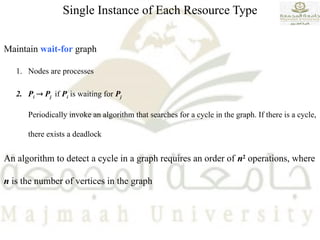
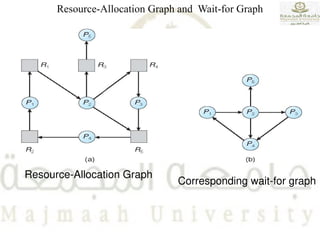
Maintain wait-for graph
1. Nodes are processes
2. Pi Pj if Pi is waiting for Pj
Periodically invoke an algorithm that searches for a cycle in the graph. If there is a cycle,
there exists a deadlock
An algorithm to detect a cycle in a graph requires an order of n2
operations, where
n is the number of vertices in the graph
Several Instances ofa Resource Type
1. Available:
A vector of length m indicates the number of available resources of
each type
2. Allocation:
An n x m matrix defines the number of resources of each type currently allocated to each process
2. Request:
An n x m matrix indicates the current request of each process. If Request [i][j] = k, then process
Pi is requesting k more instances of
resource type Rj.
30.
Detection Algorithm
Algorithm requiresan order of O(m x n2
) operations to detect whether the system is in deadlocked state
1. Let Work and Finish be vectors of length m and n, respectively
Initialize:
(a) Work = Available
(b) For i = 1,2, …, n, if Allocationi 0, then
Finish[i] = false; otherwise, Finish[i] = true
2. Find an index i such that both:
(a) Finish[i] == false
(b) Requesti Work
If no such i exists, go to step 4
Work = Work + Allocationi
Finish[i] = true
go to step 2
4. If Finish[i] == false, for some i, 1 i n, then the system is in deadlock state. Moreover, if Finish[i] ==
false, then Pi is deadlocked
31.
Example of DetectionAlgorithm
Five processes P0 through P4;three resource types
A (7 instances), B (2 instances), and C (6 instances)
Snapshot at time T0:
Allocation Request Available
A B C A B C A B C
P0 0 1 0 0 0 0 0 0 0
P1 2 0 0 2 0 2
P2 3 0 3 0 0 0
P3 2 1 1 1 0 0
P4 0 0 2 0 0 2
Sequence <P0, P2, P3, P1, P4> will result in Finish[i] = true for all i
32.
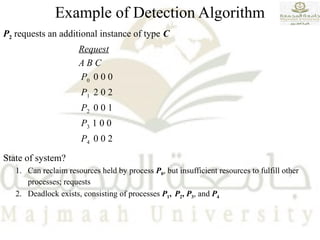
P2 requests anadditional instance of type C
Request
A B C
P0 0 0 0
P1 2 0 2
P2 0 0 1
P3 1 0 0
P4 0 0 2
State of system?
1. Can reclaim resources held by process P0, but insufficient resources to fulfill other
processes; requests
2. Deadlock exists, consisting of processes P1, P2, P3, and P4
Example of Detection Algorithm
33.
Detection-Algorithm Usage
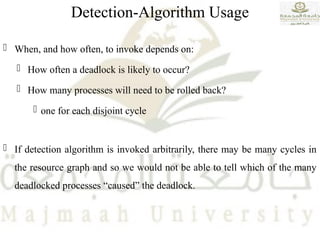
When,and how often, to invoke depends on:
How often a deadlock is likely to occur?
How many processes will need to be rolled back?
one for each disjoint cycle
If detection algorithm is invoked arbitrarily, there may be many cycles in
the resource graph and so we would not be able to tell which of the many
deadlocked processes “caused” the deadlock.
34.
Recovery from Deadlock:Process Termination
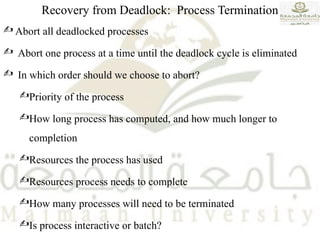
Abort all deadlocked processes
Abort one process at a time until the deadlock cycle is eliminated
In which order should we choose to abort?
Priority of the process
How long process has computed, and how much longer to
completion
Resources the process has used
Resources process needs to complete
How many processes will need to be terminated
Is process interactive or batch?
35.
Selecting avictim:
minimize cost
Rollback:
return to some safe state, restart process for that state
Starvation:
same process may always be picked as victim, include
number of rollback in cost factor
Recovery from Deadlock: Resource Preemption
36.
Summary
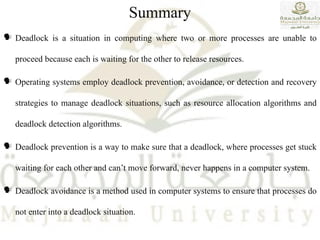
Deadlock isa situation in computing where two or more processes are unable to
proceed because each is waiting for the other to release resources.
Operating systems employ deadlock prevention, avoidance, or detection and recovery
strategies to manage deadlock situations, such as resource allocation algorithms and
deadlock detection algorithms.
Deadlock prevention is a way to make sure that a deadlock, where processes get stuck
waiting for each other and can’t move forward, never happens in a computer system.
Deadlock avoidance is a method used in computer systems to ensure that processes do
not enter into a deadlock situation.
![© Dr. Khalid Nazim S.A. B.E., M. Tech, MBA[IT], PhD, LMISTE, LMCSI, MIE
Associate Professor,
Department of Computer Science & Information,
Majmaah University, Az- Zulfi Campus, KSA.
CS 311: Operating Systems](https://image.slidesharecdn.com/week8deadlocks-250318072100-33c248d8/85/Deadlock-principles-in-operating-systems-1-320.jpg)
![© Dr. Khalid Nazim S.A. B.E., M. Tech, MBA[IT], PhD, LMISTE, LMCSI, MIE
Associate Professor,
Department of Computer Science & Information,
Majmaah University, Az- Zulfi Campus, KSA.
CS 311: Operating Systems](https://image.slidesharecdn.com/week8deadlocks-250318072100-33c248d8/75/Deadlock-principles-in-operating-systems-1-2048.jpg)

![Data Structures for the Banker’s Algorithm
Available:
Vector of length m. If available [j] = k, there are k instances of
resource type Rj available
Max:
n x m matrix. If Max [i,j] = k, then process Pi may request at
most k instances of resource type Rj
Allocation:
n x m matrix. If Allocation[i,j] = k then Pi is currently allocated k
instances of Rj
Need:
n x m matrix. If Need[i,j] = k, then Pi may need k more instances of
Rj to complete its task
Need [i,j] = Max[i,j] – Allocation [i,j]](https://image.slidesharecdn.com/week8deadlocks-250318072100-33c248d8/85/Deadlock-principles-in-operating-systems-20-320.jpg)
![Safety Algorithm
1. Let Work and Finish be vectors of length m and n, respectively. Initialize:
Work = Available
Finish [i] = false for i = 0, 1, …, n- 1
2. Find an i such that both:
(a) Finish [i] = false
(b) Needi Work
If no such i exists, go to step 4
3. Work = Work + Allocationi
Finish[i] = true
go to step 2
4. If Finish [i] == true for all i, then the system is in a safe state](https://image.slidesharecdn.com/week8deadlocks-250318072100-33c248d8/85/Deadlock-principles-in-operating-systems-21-320.jpg)
![Resource-Request Algorithm for Process Pi
Requesti = request vector for process Pi. If Requesti [j] = k then process Pi wants k instances of resource type Rj
1. If Requesti Needi go to step 2. Otherwise, raise error condition, since process has exceeded its maximum
claim
2. If Requesti Available, go to step 3. Otherwise Pi must wait, since resources are not available
3. Pretend to allocate requested resources to Pi by modifying the state as follows:
Available = Available – Requesti;
Allocationi = Allocationi + Requesti;
Needi = Needi – Requesti;
If safe the resources are allocated to Pi
If unsafe Pi must wait, and the old resource-allocation state is restored](https://image.slidesharecdn.com/week8deadlocks-250318072100-33c248d8/85/Deadlock-principles-in-operating-systems-22-320.jpg)
![Several Instances of a Resource Type
1. Available:
A vector of length m indicates the number of available resources of
each type
2. Allocation:
An n x m matrix defines the number of resources of each type currently allocated to each process
2. Request:
An n x m matrix indicates the current request of each process. If Request [i][j] = k, then process
Pi is requesting k more instances of
resource type Rj.](https://image.slidesharecdn.com/week8deadlocks-250318072100-33c248d8/85/Deadlock-principles-in-operating-systems-29-320.jpg)
![Detection Algorithm
Algorithm requires an order of O(m x n2
) operations to detect whether the system is in deadlocked state
1. Let Work and Finish be vectors of length m and n, respectively
Initialize:
(a) Work = Available
(b) For i = 1,2, …, n, if Allocationi 0, then
Finish[i] = false; otherwise, Finish[i] = true
2. Find an index i such that both:
(a) Finish[i] == false
(b) Requesti Work
If no such i exists, go to step 4
Work = Work + Allocationi
Finish[i] = true
go to step 2
4. If Finish[i] == false, for some i, 1 i n, then the system is in deadlock state. Moreover, if Finish[i] ==
false, then Pi is deadlocked](https://image.slidesharecdn.com/week8deadlocks-250318072100-33c248d8/85/Deadlock-principles-in-operating-systems-30-320.jpg)
![Example of Detection Algorithm
Five processes P0 through P4;three resource types
A (7 instances), B (2 instances), and C (6 instances)
Snapshot at time T0:
Allocation Request Available
A B C A B C A B C
P0 0 1 0 0 0 0 0 0 0
P1 2 0 0 2 0 2
P2 3 0 3 0 0 0
P3 2 1 1 1 0 0
P4 0 0 2 0 0 2
Sequence <P0, P2, P3, P1, P4> will result in Finish[i] = true for all i](https://image.slidesharecdn.com/week8deadlocks-250318072100-33c248d8/85/Deadlock-principles-in-operating-systems-31-320.jpg)