Programming Languages
Dr. khalid nazim abdul sattar
S.N : Muhammad alshammari
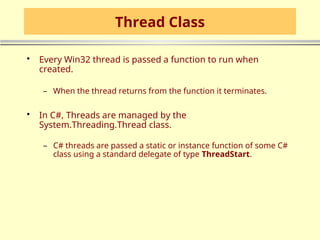
Thread Class
 Every Win32 thread is passed a function to run when
created.
– When the thread returns from the function it terminates.
 In C#, Threads are managed by the
System.Threading.Thread class.
– C# threads are passed a static or instance function of some C#
class using a standard delegate of type ThreadStart.
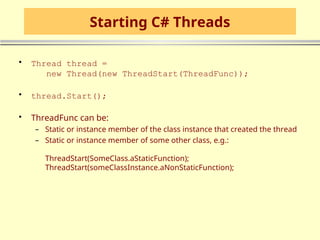
Starting C# Threads
 Thread thread =
new Thread(new ThreadStart(ThreadFunc));
 thread.Start();
 ThreadFunc can be:
– Static or instance member of the class instance that created the thread
– Static or instance member of some other class, e.g.:
ThreadStart(SomeClass.aStaticFunction);
ThreadStart(someClassInstance.aNonStaticFunction);
Thread States
 A thread that has been started, but not yet terminated can
be in one of the following states:
– Running
– Waiting to run
– Suspended
– Blocked
Thread Properties
 IsBackground – get, set
– Process does not end until all Foreground threads have ended.
– Background threads are terminated when application ends.
 CurrentThread – get, static
– Returns thread reference to calling thread
 IsAlive – get
– Has thread started but not terminated?
 Priority – get, set
– Highest, AboveNormal, Normal, BelowNormal, Lowest
 ThreadState – get
– Unstarted, Running, Suspended, Stopped, WaitSleepJoin, ..
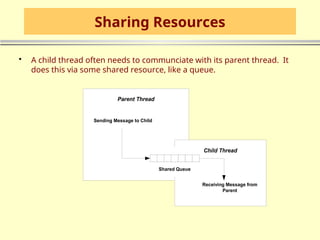
Sharing Resources
 A child thread often needs to communciate with its parent thread. It
does this via some shared resource, like a queue.
Parent Thread
Child Thread
Sending Message to Child
Receiving Message from
Parent
Shared Queue
Synchronization
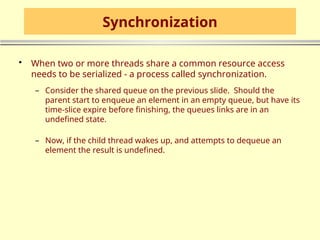
 When two or more threads share a common resource access
needs to be serialized - a process called synchronization.
– Consider the shared queue on the previous slide. Should the
parent start to enqueue an element in an empty queue, but have its
time-slice expire before finishing, the queues links are in an
undefined state.
– Now, if the child thread wakes up, and attempts to dequeue an
element the result is undefined.
Synchronization with C# Lock
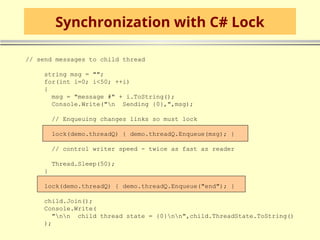
// send messages to child thread
string msg = "";
for(int i=0; i<50; ++i)
{
msg = "message #" + i.ToString();
Console.Write("n Sending {0},",msg);
// Enqueuing changes links so must lock
lock(demo.threadQ) { demo.threadQ.Enqueue(msg); }
// control writer speed - twice as fast as reader
Thread.Sleep(50);
}
lock(demo.threadQ) { demo.threadQ.Enqueue("end"); }
child.Join();
Console.Write(
"nn child thread state = {0}nn",child.ThreadState.ToString()
);
Demonstration Program
 QueuedMessages folder
– Illustrates communication between parent and child threads
using a queue.
– Also illustrates use of C# lock operation.
Other Locking Mechanisms
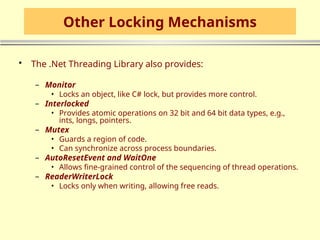
 The .Net Threading Library also provides:
– Monitor
• Locks an object, like C# lock, but provides more control.
– Interlocked
• Provides atomic operations on 32 bit and 64 bit data types, e.g.,
ints, longs, pointers.
– Mutex
• Guards a region of code.
• Can synchronize across process boundaries.
– AutoResetEvent and WaitOne
• Allows fine-grained control of the sequencing of thread operations.
– ReaderWriterLock
• Locks only when writing, allowing free reads.
Concepts of programming languages in computers.ppt

  • 1.
    Programming Languages Dr. khalidnazim abdul sattar S.N : Muhammad alshammari
  • 2.
    Thread Class  EveryWin32 thread is passed a function to run when created. – When the thread returns from the function it terminates.  In C#, Threads are managed by the System.Threading.Thread class. – C# threads are passed a static or instance function of some C# class using a standard delegate of type ThreadStart.
  • 3.
    Starting C# Threads Thread thread = new Thread(new ThreadStart(ThreadFunc));  thread.Start();  ThreadFunc can be: – Static or instance member of the class instance that created the thread – Static or instance member of some other class, e.g.: ThreadStart(SomeClass.aStaticFunction); ThreadStart(someClassInstance.aNonStaticFunction);
  • 4.
    Thread States  Athread that has been started, but not yet terminated can be in one of the following states: – Running – Waiting to run – Suspended – Blocked
  • 5.
    Thread Properties  IsBackground– get, set – Process does not end until all Foreground threads have ended. – Background threads are terminated when application ends.  CurrentThread – get, static – Returns thread reference to calling thread  IsAlive – get – Has thread started but not terminated?  Priority – get, set – Highest, AboveNormal, Normal, BelowNormal, Lowest  ThreadState – get – Unstarted, Running, Suspended, Stopped, WaitSleepJoin, ..
  • 6.
    Sharing Resources  Achild thread often needs to communciate with its parent thread. It does this via some shared resource, like a queue. Parent Thread Child Thread Sending Message to Child Receiving Message from Parent Shared Queue
  • 7.
    Synchronization  When twoor more threads share a common resource access needs to be serialized - a process called synchronization. – Consider the shared queue on the previous slide. Should the parent start to enqueue an element in an empty queue, but have its time-slice expire before finishing, the queues links are in an undefined state. – Now, if the child thread wakes up, and attempts to dequeue an element the result is undefined.
  • 8.
    Synchronization with C#Lock // send messages to child thread string msg = ""; for(int i=0; i<50; ++i) { msg = "message #" + i.ToString(); Console.Write("n Sending {0},",msg); // Enqueuing changes links so must lock lock(demo.threadQ) { demo.threadQ.Enqueue(msg); } // control writer speed - twice as fast as reader Thread.Sleep(50); } lock(demo.threadQ) { demo.threadQ.Enqueue("end"); } child.Join(); Console.Write( "nn child thread state = {0}nn",child.ThreadState.ToString() );
  • 9.
    Demonstration Program  QueuedMessagesfolder – Illustrates communication between parent and child threads using a queue. – Also illustrates use of C# lock operation.
  • 10.
    Other Locking Mechanisms The .Net Threading Library also provides: – Monitor • Locks an object, like C# lock, but provides more control. – Interlocked • Provides atomic operations on 32 bit and 64 bit data types, e.g., ints, longs, pointers. – Mutex • Guards a region of code. • Can synchronize across process boundaries. – AutoResetEvent and WaitOne • Allows fine-grained control of the sequencing of thread operations. – ReaderWriterLock • Locks only when writing, allowing free reads.