© 2015 VMware Inc. All rights reserved.
OpenStack Congress & Datalog
2nd Tokyo OpenStack Meetup at Vmware K.K.
Motonori Shindo (@motonori_shindo)
CTO Ambassador /
Technical Leader
VMware
Self Introduction
•  Motonori Shindo
•  Bio
–  Tokyo Electric Power Co (TEPCO), School of Computer Science
at Carnegie Mellon University, Ascend Communications,
CoSine Communications, Proxim, Fivefront, Nicira, VMware
2
What is OpenStack Congress ?
•  One of the projects in OpenStack to provide “Policy as a Service”.
•  Why called “Congress” ?
–  Because that’s where policy is defined J
3
Why does Congress live in OpenStack?
•  Congress is a generic policy engine so it works as standalone (i.e. without OpenStack)
•  That said, in order to define a meaningful / useful policy, some sort of information (“data
source”) upon which policy can be defined is needed.
•  OpenStack has a rich set of data sources that can be consumed by Congress, so it is a great
place for Congress to live!
4
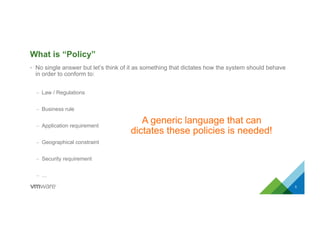
What is “Policy”
•  No single answer but let’s think of it as something that dictates how the system should behave
in order to conform to:
–  Law / Regulations
–  Business rule
–  Application requirement
–  Geographical constraint
–  Security requirement
–  …
5
A generic language that can
dictates these policies is needed!
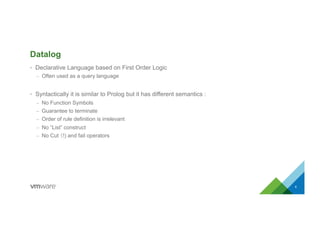
Datalog
•  Declarative Language based on First Order Logic
–  Often used as a query language
•  Syntactically it is similar to Prolog but it has different semantics :
–  No Function Symbols
–  Guarantee to terminate
–  Order of rule definition is irrelevant
–  No “List” construct
–  No Cut (!) and fail operators
6
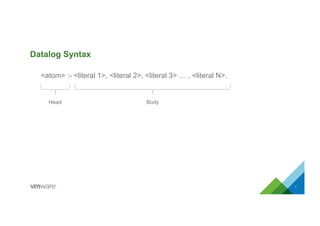
Datalog Syntax
7
<atom> :- <literal 1>, <literal 2>, <literal 3> … , <literal N>.
Head Body
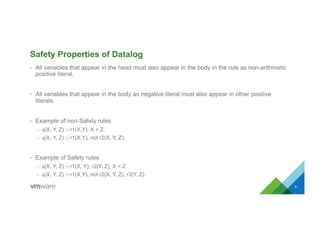
Safety Properties of Datalog
•  All variables that appear in the head must also appear in the body in the rule as non-arithmetic
positive literal.
•  All variables that appear in the body as negative literal must also appear in other positive
literals.
•  Example of non-Safety rules
–  q(X, Y, Z) :- r1(X,Y), X < Z.
–  q(X, Y, Z) :- r1(X,Y), not r2(X, Y, Z).
•  Example of Safety rules
–  q(X, Y, Z) :- r1(X, Y), r2(Y, Z), X < Z.
–  q(X, Y, Z) :- r1(X,Y), not r2(X, Y, Z), r3(Y, Z).
8
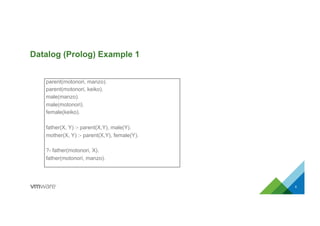
Datalog (Prolog) Example 1
9
parent(motonori, manzo).
parent(motonori, keiko).
male(manzo).
male(motonori).
female(keiko).
father(X, Y) :- parent(X,Y), male(Y).
mother(X, Y) :- parent(X,Y), female(Y).
?- father(motonori, X).
father(motonori, manzo).
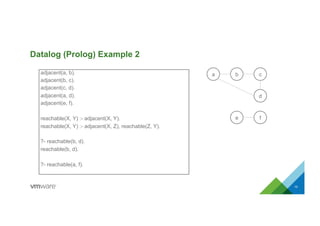
Datalog (Prolog) Example 2
10
adjacent(a, b).
adjacent(b, c).
adjacent(c, d).
adjacent(a, d).
adjacent(e, f).
reachable(X, Y) :- adjacent(X, Y).
reachable(X, Y) :- adjacent(X, Z), reachable(Z, Y).
?- reachable(b, d).
reachable(b, d).
?- reachable(a, f).
a b
d
f
c
e
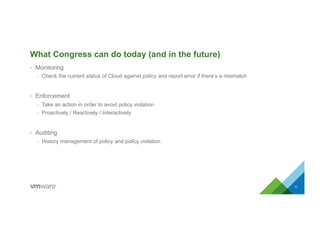
What Congress can do today (and in the future)
•  Monitoring
–  Check the current status of Cloud against policy and report error if there’s a mismatch
•  Enforcement
–  Take an action in order to avoid policy violation
–  Proactively / Reactively / Interactively
•  Auditing
–  History management of policy and policy violation
11
Datalog in Congress
•  Syntax
•  Restrictions
–  Recursion is not supported (at least for the time being)
12
<policy> ::= <rule>*
<rule> ::= <head> COLONMINUS <literal> (COMMA <literal>)*
<head> ::= <atom>
<head> ::= EXECUTE[<atom>]
<literal> ::= <atom>
<literal> ::= NOT <atom>
<atom> ::= TABLENAME LPAREN <arg> (COMMA <arg>)* RPAREN
<arg> ::= <term>
<arg> ::= COLUMNNAME=<term>
<term> ::= INTEGER | FLOAT | STRING | VARIABLE
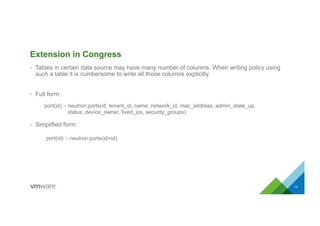
Extension in Congress
•  Tables in certain data source may have many number of columns. When writing policy using
such a table it is cumbersome to write all those columns explicitly.
•  Full form:
•  Simplified form:
13
port(id) :- neutron:ports(id, tenant_id, name, network_id, mac_address, admin_state_up,
       status, device_owner, fixed_ips, security_groups).
port(id) :- neutron:ports(id=id).
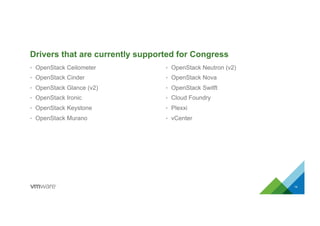
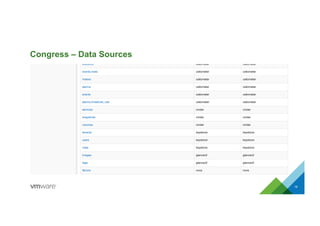
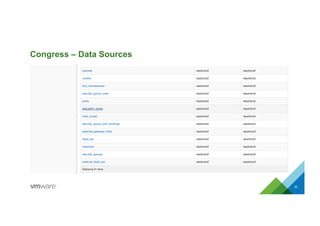
Drivers that are currently supported for Congress
•  OpenStack Ceilometer
•  OpenStack Cinder
•  OpenStack Glance (v2)
•  OpenStack Ironic
•  OpenStack Keystone
•  OpenStack Murano
•  OpenStack Neutron (v2)
•  OpenStack Nova
•  OpenStack Switft
•  Cloud Foundry
•  Plexxi
•  vCenter
14
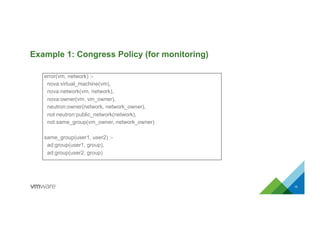
Example 1: Congress Policy (for monitoring)
15
error(vm, network) :-
nova:virtual_machine(vm),
nova:network(vm, network),
nova:owner(vm, vm_owner),
neutron:owner(network, network_owner),
not neutron:public_network(network),
not same_group(vm_owner, network_owner)
same_group(user1, user2) :-
ad:group(user1, group),
ad:group(user2, group)
Example 2: Congress Policy (for enforcement)
16
Execute[neutron:disconnectNetwork(vm, network)] :-
error(vm, network)
Execute[nova:pause(x)] :-
nova:servers(id=x, status=“ACTIVE”)
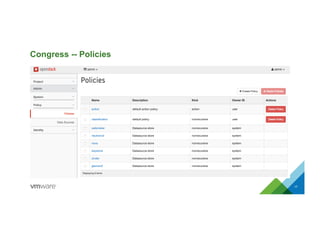
Congress -- Policies
17
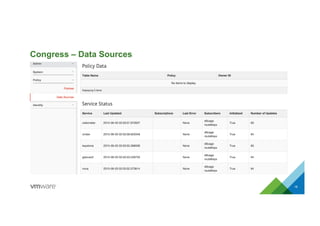
Congress – Data Sources
18
Congress – Data Sources
19
Congress – Data Sources
20
Live Demo
21
Goal : Detect a policy violation when a VM is
spun up with a flavor lager than or equal to
4GB of memory
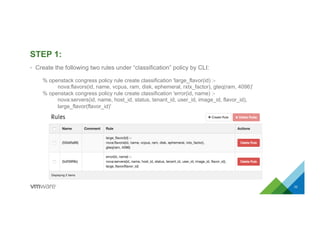
STEP 1:
•  Create the following two rules under “classification” policy by CLI:
22
% openstack congress policy rule create classification 'large_flavor(id) :-
nova:flavors(id, name, vcpus, ram, disk, ephemeral, rxtx_factor), gteq(ram, 4096)'
% openstack congress policy rule create classification 'error(id, name) :-
nova:servers(id, name, host_id, status, tenant_id, user_id, image_id, flavor_id),
large_flavor(flavor_id)'
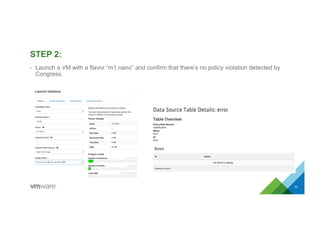
STEP 2:
•  Launch a VM with a flavor “m1.nano” and confirm that there’s no policy violation detected by
Congress.
23
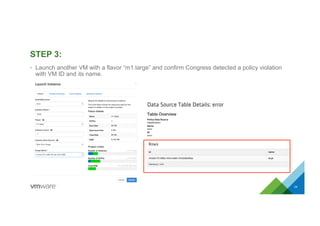
STEP 3:
24
•  Launch another VM with a flavor “m1.large” and confirm Congress detected a policy violation
with VM ID and its name.
Questions

OpenStack Congress and Datalog (English)

  • 1.
    © 2015 VMwareInc. All rights reserved. OpenStack Congress & Datalog 2nd Tokyo OpenStack Meetup at Vmware K.K. Motonori Shindo (@motonori_shindo) CTO Ambassador / Technical Leader VMware
  • 2.
    Self Introduction •  MotonoriShindo •  Bio –  Tokyo Electric Power Co (TEPCO), School of Computer Science at Carnegie Mellon University, Ascend Communications, CoSine Communications, Proxim, Fivefront, Nicira, VMware 2
  • 3.
    What is OpenStackCongress ? •  One of the projects in OpenStack to provide “Policy as a Service”. •  Why called “Congress” ? –  Because that’s where policy is defined J 3
  • 4.
    Why does Congresslive in OpenStack? •  Congress is a generic policy engine so it works as standalone (i.e. without OpenStack) •  That said, in order to define a meaningful / useful policy, some sort of information (“data source”) upon which policy can be defined is needed. •  OpenStack has a rich set of data sources that can be consumed by Congress, so it is a great place for Congress to live! 4
  • 5.
    What is “Policy” • No single answer but let’s think of it as something that dictates how the system should behave in order to conform to: –  Law / Regulations –  Business rule –  Application requirement –  Geographical constraint –  Security requirement –  … 5 A generic language that can dictates these policies is needed!
  • 6.
    Datalog •  Declarative Languagebased on First Order Logic –  Often used as a query language •  Syntactically it is similar to Prolog but it has different semantics : –  No Function Symbols –  Guarantee to terminate –  Order of rule definition is irrelevant –  No “List” construct –  No Cut (!) and fail operators 6
  • 7.
    Datalog Syntax 7 <atom> :-<literal 1>, <literal 2>, <literal 3> … , <literal N>. Head Body
  • 8.
    Safety Properties ofDatalog •  All variables that appear in the head must also appear in the body in the rule as non-arithmetic positive literal. •  All variables that appear in the body as negative literal must also appear in other positive literals. •  Example of non-Safety rules –  q(X, Y, Z) :- r1(X,Y), X < Z. –  q(X, Y, Z) :- r1(X,Y), not r2(X, Y, Z). •  Example of Safety rules –  q(X, Y, Z) :- r1(X, Y), r2(Y, Z), X < Z. –  q(X, Y, Z) :- r1(X,Y), not r2(X, Y, Z), r3(Y, Z). 8
  • 9.
    Datalog (Prolog) Example1 9 parent(motonori, manzo). parent(motonori, keiko). male(manzo). male(motonori). female(keiko). father(X, Y) :- parent(X,Y), male(Y). mother(X, Y) :- parent(X,Y), female(Y). ?- father(motonori, X). father(motonori, manzo).
  • 10.
    Datalog (Prolog) Example2 10 adjacent(a, b). adjacent(b, c). adjacent(c, d). adjacent(a, d). adjacent(e, f). reachable(X, Y) :- adjacent(X, Y). reachable(X, Y) :- adjacent(X, Z), reachable(Z, Y). ?- reachable(b, d). reachable(b, d). ?- reachable(a, f). a b d f c e
  • 11.
    What Congress cando today (and in the future) •  Monitoring –  Check the current status of Cloud against policy and report error if there’s a mismatch •  Enforcement –  Take an action in order to avoid policy violation –  Proactively / Reactively / Interactively •  Auditing –  History management of policy and policy violation 11
  • 12.
    Datalog in Congress • Syntax •  Restrictions –  Recursion is not supported (at least for the time being) 12 <policy> ::= <rule>* <rule> ::= <head> COLONMINUS <literal> (COMMA <literal>)* <head> ::= <atom> <head> ::= EXECUTE[<atom>] <literal> ::= <atom> <literal> ::= NOT <atom> <atom> ::= TABLENAME LPAREN <arg> (COMMA <arg>)* RPAREN <arg> ::= <term> <arg> ::= COLUMNNAME=<term> <term> ::= INTEGER | FLOAT | STRING | VARIABLE
  • 13.
    Extension in Congress • Tables in certain data source may have many number of columns. When writing policy using such a table it is cumbersome to write all those columns explicitly. •  Full form: •  Simplified form: 13 port(id) :- neutron:ports(id, tenant_id, name, network_id, mac_address, admin_state_up,        status, device_owner, fixed_ips, security_groups). port(id) :- neutron:ports(id=id).
  • 14.
    Drivers that arecurrently supported for Congress •  OpenStack Ceilometer •  OpenStack Cinder •  OpenStack Glance (v2) •  OpenStack Ironic •  OpenStack Keystone •  OpenStack Murano •  OpenStack Neutron (v2) •  OpenStack Nova •  OpenStack Switft •  Cloud Foundry •  Plexxi •  vCenter 14
  • 15.
    Example 1: CongressPolicy (for monitoring) 15 error(vm, network) :- nova:virtual_machine(vm), nova:network(vm, network), nova:owner(vm, vm_owner), neutron:owner(network, network_owner), not neutron:public_network(network), not same_group(vm_owner, network_owner) same_group(user1, user2) :- ad:group(user1, group), ad:group(user2, group)
  • 16.
    Example 2: CongressPolicy (for enforcement) 16 Execute[neutron:disconnectNetwork(vm, network)] :- error(vm, network) Execute[nova:pause(x)] :- nova:servers(id=x, status=“ACTIVE”)
  • 17.
  • 18.
  • 19.
  • 20.
  • 21.
    Live Demo 21 Goal :Detect a policy violation when a VM is spun up with a flavor lager than or equal to 4GB of memory
  • 22.
    STEP 1: •  Createthe following two rules under “classification” policy by CLI: 22 % openstack congress policy rule create classification 'large_flavor(id) :- nova:flavors(id, name, vcpus, ram, disk, ephemeral, rxtx_factor), gteq(ram, 4096)' % openstack congress policy rule create classification 'error(id, name) :- nova:servers(id, name, host_id, status, tenant_id, user_id, image_id, flavor_id), large_flavor(flavor_id)'
  • 23.
    STEP 2: •  Launcha VM with a flavor “m1.nano” and confirm that there’s no policy violation detected by Congress. 23
  • 24.
    STEP 3: 24 •  Launchanother VM with a flavor “m1.large” and confirm Congress detected a policy violation with VM ID and its name.
  • 25.