30 November, 2015 1
Openness in Education:Openness in Education:
Teacher Perspectives throughTeacher Perspectives through
Concept MappingConcept Mapping
Shironica P. Karunanayaka, Som Naidu,
Sashikala Kugamoorthy, Anoma Ariyaratne,
L. R. Gonsalkorala & T.D.T.L. Dhanapala
Faculty of Education,Faculty of Education,
The Open University of Sri LankaThe Open University of Sri Lanka
AAOU-2015; Kuala Lumpur, Malaysia
30 November-02 December, 2015
30 November, 2015 22
Background to the StudyBackground to the Study
ROER4D Project:
Impact of integrating OER in Teacher Education at OUSL
A Design-based Research (DBR) Approach - Design and
implementation of a professional development intervention
program in several stages for teachers on the integration of
OER in teaching and learning.
Stage 1 – Pre-Intervention Survey
An investigation to discover the initial perspectives of
teachers on “Openness in education” as captured by
their concept maps.
30 November, 2015 33
Openness in Education through OEROpenness in Education through OER
OER contributes to the teaching-learning processes by,
providing free and open access to teaching, learning and
research materials
promoting a more open, participatory, collaborative,
creative and sharing culture among individuals.
Such ‘Openness’ in education through OER will depend on
‘changing’ the pedagogical perceptions and practices of
educators.
Supporting teachers to understand and reflect on their
changing perspectives in relation to ‘openness in education’
will enable them to move towards more ‘open educational
practices’ (Ehlers, 2011).
30 November, 2015 4
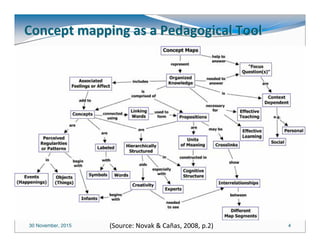
Concept mapping as a Pedagogical ToolConcept mapping as a Pedagogical Tool
(Source: Novak & Cañas, 2008, p.2)
30 November, 2015 55
Research QuestionsResearch Questions
How do the knowledge structures of concept
maps reveal teacher perspectives on
“openness in education”?
What are the teacher perspectives on
“openness in education” as illustrated by their
concept maps?
How can concept mapping be used to support
teachers to reflect on their changing
perspectives on “openness in education”?
30 November, 2015 66
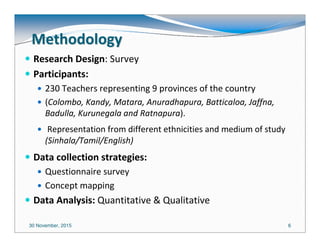
MethodologyMethodology
Research Design: Survey
Participants:
230 Teachers representing 9 provinces of the country
(Colombo, Kandy, Matara, Anuradhapura, Batticaloa, Jaffna,
Badulla, Kurunegala and Ratnapura).
Representation from different ethnicities and medium of study
(Sinhala/Tamil/English)
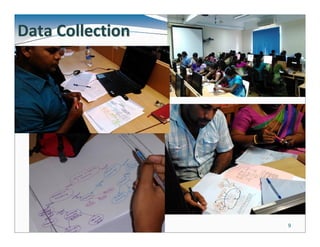
Data collection strategies:
Questionnaire survey
Concept mapping
Data Analysis: Quantitative & Qualitative
30 November, 2015 7
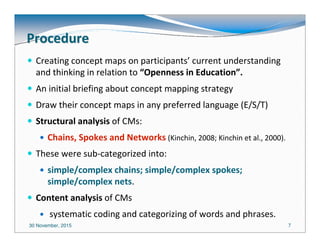
ProcedureProcedure
Creating concept maps on participants’ current understanding
and thinking in relation to “Openness in Education”.
An initial briefing about concept mapping strategy
Draw their concept maps in any preferred language (E/S/T)
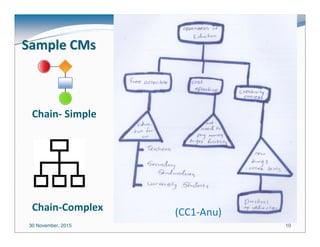
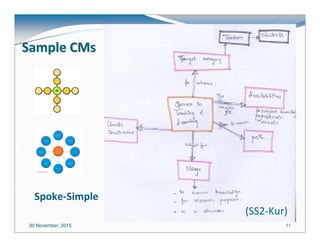
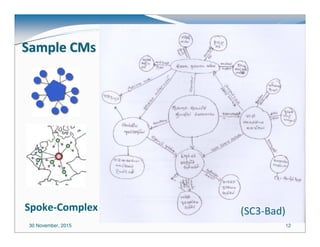
Structural analysis of CMs:
Chains, Spokes and Networks (Kinchin, 2008; Kinchin et al., 2000).
These were sub-categorized into:
simple/complex chains; simple/complex spokes;
simple/complex nets.
Content analysis of CMs
systematic coding and categorizing of words and phrases.
30 November, 2015 8
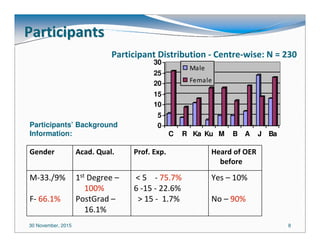
Participant Distribution - Centre-wise: N = 230
0
5
10
15
20
25
30
C R Ka Ku M B A J Ba
Male
Female
ParticipantsParticipants
Gender Acad. Qual. Prof. Exp. Heard of OER
before
M-33./9%
F- 66.1%
1st Degree –
100%
PostGrad –
16.1%
< 5 - 75.7%
6 -15 - 22.6%
> 15 - 1.7%
Yes – 10%
No – 90%
Participants’ Background
Information:
30 November, 2015 9
Data CollectionData Collection
30 November, 2015 10
Sample CMsSample CMs
Chain-Complex
Chain- Simple
(CC1-Anu)
30 November, 2015 11
Sample CMsSample CMs
Spoke-Simple
(SS2-Kur)
30 November, 2015 12
Sample CMsSample CMs
Spoke-Complex (SC3-Bad)
30 November, 2015 13
Sample CMsSample CMs
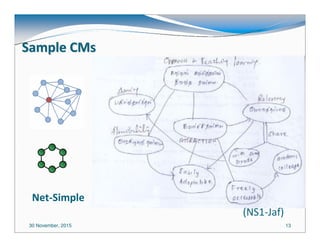
Net-Simple
(NS1-Jaf)
30 November, 2015 14
Sample CMsSample CMs
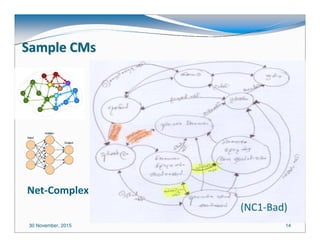
Net-Complex
(NC1-Bad)
30 November, 2015 15
Results & DiscussionResults & Discussion
–– Structural Analysis of CMsStructural Analysis of CMs
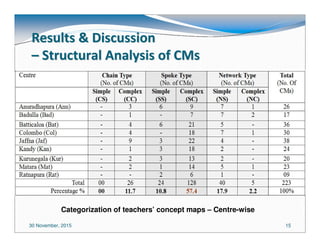
Categorization of teachers’ concept maps – Centre-wise
30 November, 2015 16
Findings – Structural Analysis
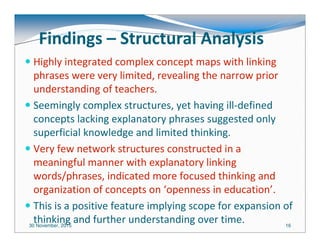
Highly integrated complex concept maps with linking
phrases were very limited, revealing the narrow prior
understanding of teachers.
Seemingly complex structures, yet having ill-defined
concepts lacking explanatory phrases suggested only
superficial knowledge and limited thinking.
Very few network structures constructed in a
meaningful manner with explanatory linking
words/phrases, indicated more focused thinking and
organization of concepts on ‘openness in education’.
This is a positive feature implying scope for expansion of
thinking and further understanding over time.
30 November, 2015 17
Results &Results &
DiscussionDiscussion ––
ContentContent
Analysis ofAnalysis of
CMsCMs
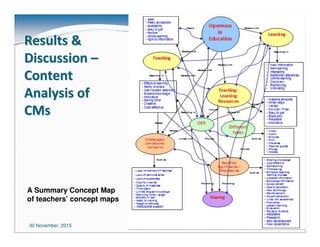
A Summary Concept Map
of teachers’ concept maps
30 November, 2015 18
Findings – Content Analysis
Even though the concept of OER was novel to the
teachers, their perspectives on ‘sharing’ and
‘openness’ in education and its relevance to
teaching and learning were quite optimistic.
Despite the fact that a majority of concept maps
lacked explanatory phrases and focus of thinking,
this revelation is indicative of an overall positive
perspective of the teachers.
30 November, 2015 19
Conclusions & Implications
The concept mapping exercise was a useful strategy to visualize
teachers’ understandings around “openness in education”.
As a ‘graphical tool for organizing and representing knowledge’
(Novak and Caňas , 2008), and as a ‘relational device’ that outline
relationships between different ideas (Davies, 2010), it helped
teachers organize thinking and reflect on their understandings.
Since a concept map is never finished (Novak and Cañas, 2006)
teachers are able to update their maps with the addition of new
concepts, as their understandings expand and deepen.
The comparison of different versions of concept maps will reveal
incremental developments in their understandings over time.
Concept mapping strategy can be thus used to support teachers
to reflect on their changing perspectives and practices.
30 November, 2015 2020
AcknowledgementsAcknowledgements
This work was carried out with the aid of a grant from the
International Development Research Centre (IDRC),
Ottawa, Canada, through the Wawasan Open University
(WOU) of Penang, Malaysia, as part of the Research on
Open Educational Resources for Development (ROER4D)
programme.
The active participation of the student teachers of PGDE
Programme at OUSL and contributions of the research
assistants of Faculty of Education in data collection, is
much appreciated.

Openness in Education: Teacher perspectives through Concept Mapping

  • 1.
    30 November, 20151 Openness in Education:Openness in Education: Teacher Perspectives throughTeacher Perspectives through Concept MappingConcept Mapping Shironica P. Karunanayaka, Som Naidu, Sashikala Kugamoorthy, Anoma Ariyaratne, L. R. Gonsalkorala & T.D.T.L. Dhanapala Faculty of Education,Faculty of Education, The Open University of Sri LankaThe Open University of Sri Lanka AAOU-2015; Kuala Lumpur, Malaysia 30 November-02 December, 2015
  • 2.
    30 November, 201522 Background to the StudyBackground to the Study ROER4D Project: Impact of integrating OER in Teacher Education at OUSL A Design-based Research (DBR) Approach - Design and implementation of a professional development intervention program in several stages for teachers on the integration of OER in teaching and learning. Stage 1 – Pre-Intervention Survey An investigation to discover the initial perspectives of teachers on “Openness in education” as captured by their concept maps.
  • 3.
    30 November, 201533 Openness in Education through OEROpenness in Education through OER OER contributes to the teaching-learning processes by, providing free and open access to teaching, learning and research materials promoting a more open, participatory, collaborative, creative and sharing culture among individuals. Such ‘Openness’ in education through OER will depend on ‘changing’ the pedagogical perceptions and practices of educators. Supporting teachers to understand and reflect on their changing perspectives in relation to ‘openness in education’ will enable them to move towards more ‘open educational practices’ (Ehlers, 2011).
  • 4.
    30 November, 20154 Concept mapping as a Pedagogical ToolConcept mapping as a Pedagogical Tool (Source: Novak & Cañas, 2008, p.2)
  • 5.
    30 November, 201555 Research QuestionsResearch Questions How do the knowledge structures of concept maps reveal teacher perspectives on “openness in education”? What are the teacher perspectives on “openness in education” as illustrated by their concept maps? How can concept mapping be used to support teachers to reflect on their changing perspectives on “openness in education”?
  • 6.
    30 November, 201566 MethodologyMethodology Research Design: Survey Participants: 230 Teachers representing 9 provinces of the country (Colombo, Kandy, Matara, Anuradhapura, Batticaloa, Jaffna, Badulla, Kurunegala and Ratnapura). Representation from different ethnicities and medium of study (Sinhala/Tamil/English) Data collection strategies: Questionnaire survey Concept mapping Data Analysis: Quantitative & Qualitative
  • 7.
    30 November, 20157 ProcedureProcedure Creating concept maps on participants’ current understanding and thinking in relation to “Openness in Education”. An initial briefing about concept mapping strategy Draw their concept maps in any preferred language (E/S/T) Structural analysis of CMs: Chains, Spokes and Networks (Kinchin, 2008; Kinchin et al., 2000). These were sub-categorized into: simple/complex chains; simple/complex spokes; simple/complex nets. Content analysis of CMs systematic coding and categorizing of words and phrases.
  • 8.
    30 November, 20158 Participant Distribution - Centre-wise: N = 230 0 5 10 15 20 25 30 C R Ka Ku M B A J Ba Male Female ParticipantsParticipants Gender Acad. Qual. Prof. Exp. Heard of OER before M-33./9% F- 66.1% 1st Degree – 100% PostGrad – 16.1% < 5 - 75.7% 6 -15 - 22.6% > 15 - 1.7% Yes – 10% No – 90% Participants’ Background Information:
  • 9.
    30 November, 20159 Data CollectionData Collection
  • 10.
    30 November, 201510 Sample CMsSample CMs Chain-Complex Chain- Simple (CC1-Anu)
  • 11.
    30 November, 201511 Sample CMsSample CMs Spoke-Simple (SS2-Kur)
  • 12.
    30 November, 201512 Sample CMsSample CMs Spoke-Complex (SC3-Bad)
  • 13.
    30 November, 201513 Sample CMsSample CMs Net-Simple (NS1-Jaf)
  • 14.
    30 November, 201514 Sample CMsSample CMs Net-Complex (NC1-Bad)
  • 15.
    30 November, 201515 Results & DiscussionResults & Discussion –– Structural Analysis of CMsStructural Analysis of CMs Categorization of teachers’ concept maps – Centre-wise
  • 16.
    30 November, 201516 Findings – Structural Analysis Highly integrated complex concept maps with linking phrases were very limited, revealing the narrow prior understanding of teachers. Seemingly complex structures, yet having ill-defined concepts lacking explanatory phrases suggested only superficial knowledge and limited thinking. Very few network structures constructed in a meaningful manner with explanatory linking words/phrases, indicated more focused thinking and organization of concepts on ‘openness in education’. This is a positive feature implying scope for expansion of thinking and further understanding over time.
  • 17.
    30 November, 201517 Results &Results & DiscussionDiscussion –– ContentContent Analysis ofAnalysis of CMsCMs A Summary Concept Map of teachers’ concept maps
  • 18.
    30 November, 201518 Findings – Content Analysis Even though the concept of OER was novel to the teachers, their perspectives on ‘sharing’ and ‘openness’ in education and its relevance to teaching and learning were quite optimistic. Despite the fact that a majority of concept maps lacked explanatory phrases and focus of thinking, this revelation is indicative of an overall positive perspective of the teachers.
  • 19.
    30 November, 201519 Conclusions & Implications The concept mapping exercise was a useful strategy to visualize teachers’ understandings around “openness in education”. As a ‘graphical tool for organizing and representing knowledge’ (Novak and Caňas , 2008), and as a ‘relational device’ that outline relationships between different ideas (Davies, 2010), it helped teachers organize thinking and reflect on their understandings. Since a concept map is never finished (Novak and Cañas, 2006) teachers are able to update their maps with the addition of new concepts, as their understandings expand and deepen. The comparison of different versions of concept maps will reveal incremental developments in their understandings over time. Concept mapping strategy can be thus used to support teachers to reflect on their changing perspectives and practices.
  • 20.
    30 November, 20152020 AcknowledgementsAcknowledgements This work was carried out with the aid of a grant from the International Development Research Centre (IDRC), Ottawa, Canada, through the Wawasan Open University (WOU) of Penang, Malaysia, as part of the Research on Open Educational Resources for Development (ROER4D) programme. The active participation of the student teachers of PGDE Programme at OUSL and contributions of the research assistants of Faculty of Education in data collection, is much appreciated.