How the Centre for Innovation in
Higher Education drives and
enhances multi-disciplinary
pedagogic innovation
Dr Simon Pratt-Adams
Acting Director, Centre for Innovation in Higher Education
About CIHE
Advancing the intersection between innovative educational research
and pedagogic practice
Showcasing Anglia Ruskin’s strengths and distinctiveness in learning, teaching and
assessment
Supporting ARU academics in conducting applied pedagogic research and
producing high-quality research outputs
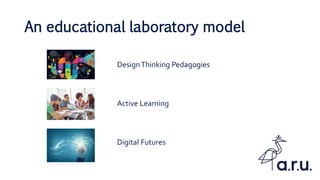
An educational laboratory model
DesignThinking Pedagogies
Active Learning
Digital Futures
Advice and collaboration
Designing pedagogic research studies
Qualitative methods and ethics of educational research
Grant funding applications
Academic writing collaborations
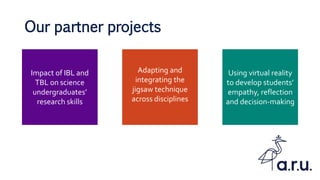
Our partner projects
Impact of IBL and
TBL on science
undergraduates’
research skills
Adapting and
integrating the
jigsaw technique
across disciplines
Using virtual reality
to develop students’
empathy, reflection
and decision-making
Tweet us your questions
@CIHE_ALT
#TLConf19
‘Inspire to aspire’: the impact of inquiry-based learning (IBL)
and team-based learning (TBL) strategies in developing
undergraduate science students’ research skills.
Dr Paul Dyer
@CIHE_ALT
#TLConf19
ProjectAims
• To develop a module that instils in the student an enthusiasm for
Science, providing the skills to inquire, synthesise and critically
analyse scientific information.
• To provide a sound foundation in research skills that enables
students to excel in their final year project
• To enable to students to evidence the skills to future / prospective
employers supporting the students’ career ambitions
Team Based Learning
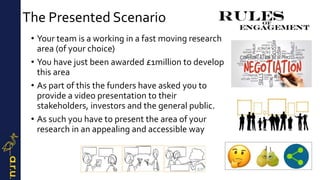
The Presented Scenario
• Your team is a working in a fast moving research
area (of your choice)
• You have just been awarded £1million to develop
this area
• As part of this the funders have asked you to
provide a video presentation to their
stakeholders, investors and the general public.
• As such you have to present the area of your
research in an appealing and accessible way
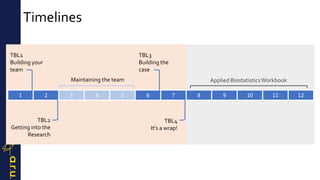
Timelines
1 2 3 4 5 6 7 8 9 10 11 12
TBL1
Building your
team
TBL2
Getting into the
Research
Maintaining the team
TBL3
Building the
case
TBL4
It’s a wrap!
Applied BiostatisticsWorkbook
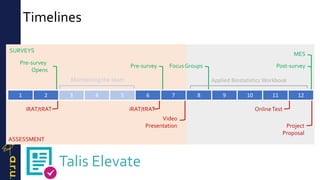
Timelines
1 2 3 4 5 6 7 8 9 10 11 12
iRAT/tRAT
Maintaining the team
iRAT/tRAT
Video
Presentation
Applied Biostatistics Workbook
OnlineTest
Pre-survey
Opens
Project
Proposal
Post-surveyPre-survey Focus Groups
MES
ASSESSMENT
SURVEYS
Talis Elevate
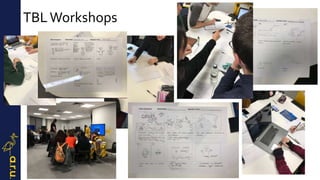
TBLWorkshops
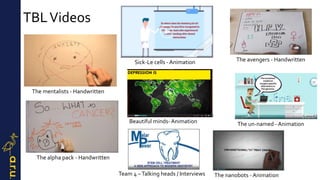
TBLVideos
The mentalists - Handwritten
The alpha pack - Handwritten
Team 4 –Talking heads / Interviews
Sick-Le cells - Animation
Beautiful minds-Animation
The avengers - Handwritten
The un-named - Animation
The nanobots - Animation
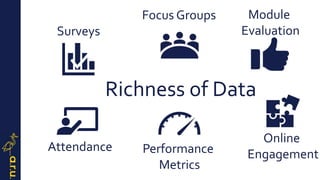
Richness of Data
Surveys
Focus Groups Module
Evaluation
Performance
Metrics
Attendance
Online
Engagement
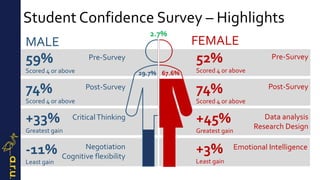
Student Confidence Survey – Highlights
MALE FEMALE
59%
Scored 4 or above
2.7%
67.6%
52%
Scored 4 or above
74%
Scored 4 or above
74%
Scored 4 or above
29.7%
Pre-Survey
Post-Survey
+33%
Greatest gain
+45%
Greatest gain
Data analysis
Research Design
Pre-Survey
Post-Survey
CriticalThinking
-11%
Least gain
Negotiation
Cognitive flexibility
+3%
Least gain
Emotional Intelligence
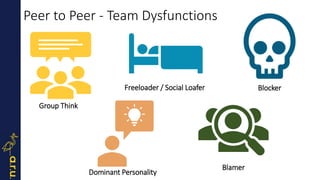
Group Think
Dominant Personality
Freeloader / Social Loafer
Blamer
Blocker
Peer to Peer - Team Dysfunctions
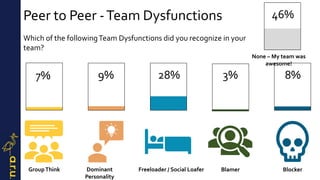
Peer to Peer -Team Dysfunctions
Which of the followingTeam Dysfunctions did you recognize in your
team?
GroupThink Dominant
Personality
Freeloader / Social Loafer Blamer Blocker
46%
None – My team was
awesome!
7% 9% 28% 3% 8%
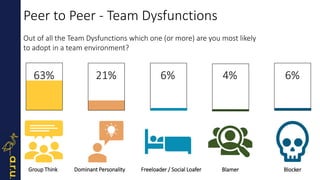
6%4%21%
Peer to Peer - Team Dysfunctions
Out of all the Team Dysfunctions which one (or more) are you most likely
to adopt in a team environment?
Group Think Dominant Personality Freeloader / Social Loafer Blamer Blocker
6%63%
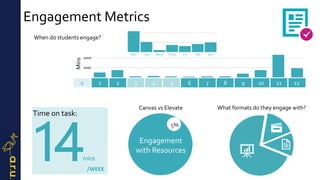
Engagement Metrics
Engagement
with Resources
5%
Canvas vs Elevate
1 2 3 4 5 6 7 8 9 10 11 120
Mins
1000
2000
When do students engage?
Mon Tues Weds Thurs Fri Sat Sun
What formats do they engage with?
14mins
Time on task:
/WEEK
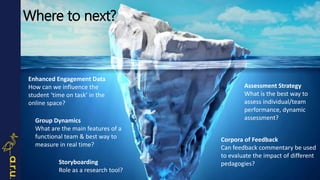
Where to next?
Corpora of Feedback
Can feedback commentary be used
to evaluate the impact of different
pedagogies?
Enhanced Engagement Data
How can we influence the
student ‘time on task’ in the
online space?
Group Dynamics
What are the main features of a
functional team & best way to
measure in real time?
Assessment Strategy
What is the best way to
assess individual/team
performance, dynamic
assessment?
Storyboarding
Role as a research tool?
Advance HE Conference Presentation, 3rd July 2019
David Jay, Sarah Etchells, Stephanie Dimond-Bayir
Piecing it together:
Evaluating the Jigsaw Technique
1. Background and project method
2. Student-facing findings
3. Findings for staff participants & Conclusions
Objectives
What is the Jigsaw Technique?
Pioneered in 1970s US school system (Aronson, 2017) to
enhance engagement through inclusivity
1. Students form groups; each allocated different area of
input, e.g. text, data set, case study
2. Each group focuses on own area (expert groups)
3. Jigsaw regrouping to share expertise
(mixed or Jigsaw groups)
Views of Jigsaw within HE
• Widely adopted as an Active Learning method by HEIs in North
America, e.g. Harvard (Ablconnect, 2019) in various disciplines
• Investigated in terms of achievement in relation to student
proactivity (García-Almeida and Cabrera-Nuez, 2018) Included in
operative learning ‘structures’, already investigated for student
engagement (Herrmann, 2017)
Pedagogic Literacies
• ARU Active Curriculum Framework (2018)
• Students ‘develop insights into pedagogic practices,
pedagogical research and principles as well as gaining
insights into their own learning strategies and preferred
learning styles’
• Staff ‘build effective alignments between module
outcomes and the pedagogies they employ’, c.f. Maclellan
(2018)
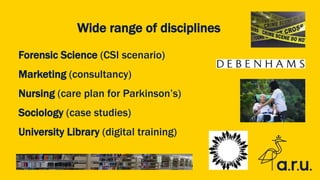
Wide range of disciplines
Forensic Science (CSI scenario)
Marketing (consultancy)
Nursing (care plan for Parkinson’s)
Sociology (case studies)
University Library (digital training)
Student participants (n = 83)
• Likert scales + free comments
• Responses categorised (Herrmann, 2017) into pedagogic
advantages and disadvantages
Staff participants (n = 5)
• Initial interviews + follow-up questionnaires
• Observation notes
Data collection and Analysis
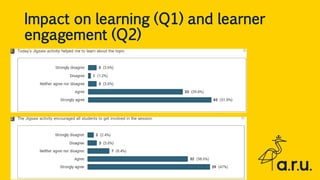
Impact on learning (Q1) and learner
engagement (Q2)
Very positive response to technique, esp. to
Q1 (91.6% ‘Agree’ or ‘Strongly Agree’); Q2
(85.6%).
Q1
• Benefits for time management
• Application of theory to practice
• Retention of information
• Engaging learners with SEN (dyslexia)
Q2
• Enhanced participation and involvement
• Working with new people but starting with friends
in the first expert group
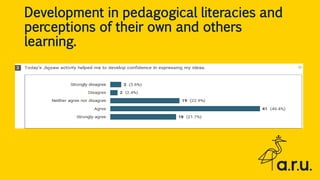
Development in pedagogical literacies and
perceptions of their own and others
learning.
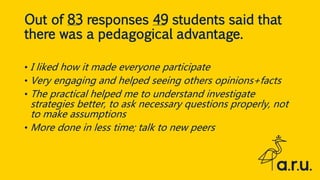
Out of 83 responses 49 students said that
there was a pedagogical advantage.
• I liked how it made everyone participate
• Very engaging and helped seeing others opinions+facts
• The practical helped me to understand investigate
strategies better, to ask necessary questions properly, not
to make assumptions
• More done in less time; talk to new peers
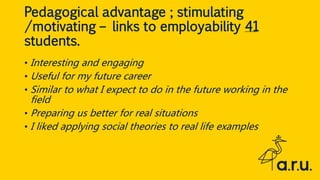
Pedagogical advantage ; stimulating
/motivating – links to employability 41
students.
• Interesting and engaging
• Useful for my future career
• Similar to what I expect to do in the future working in the
field
• Preparing us better for real situations
• I liked applying social theories to real life examples
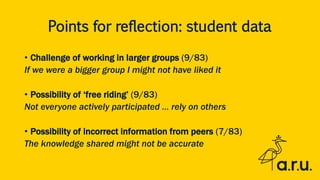
Points for reflection: student data
• Challenge of working in larger groups (9/83)
If we were a bigger group I might not have liked it
• Possibility of ‘free riding’ (9/83)
Not everyone actively participated … rely on others
• Possibility of incorrect information from peers (7/83)
The knowledge shared might not be accurate
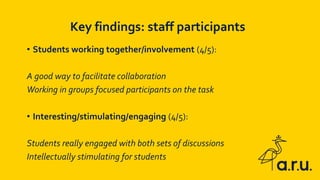
• Students working together/involvement (4/5):
A good way to facilitate collaboration
Working in groups focused participants on the task
• Interesting/stimulating/engaging (4/5):
Students really engaged with both sets of discussions
Intellectually stimulating for students
Key findings: staff participants
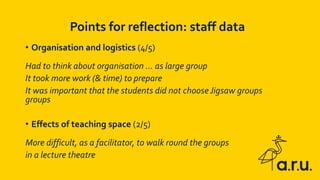
• Organisation and logistics (4/5)
Had to think about organisation … as large group
It took more work (& time) to prepare
It was important that the students did not choose Jigsaw groups
groups
• Effects of teaching space (2/5)
More difficult, as a facilitator, to walk round the groups
in a lecture theatre
Points for reflection: staff data
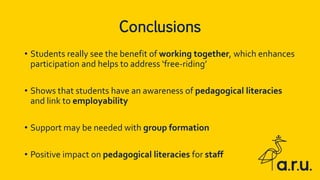
• Students really see the benefit of working together, which enhances
participation and helps to address ‘free-riding’
• Shows that students have an awareness of pedagogical literacies
and link to employability
• Support may be needed with group formation
• Positive impact on pedagogical literacies for staff
Conclusions
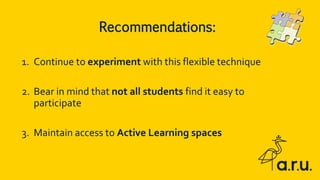
1. Continue to experiment with this flexible technique
2. Bear in mind that not all students find it easy to
participate
3. Maintain access to Active Learning spaces
Recommendations:
ABLConnect, 2019. Jigsaw. [online] Available at: https://ablconnect.harvard.edu/jigsaw-description Accessed 2nd
June 2019.
ARU Students’ Union, 2018. Active Curriculum. [online] Available at
https://www.angliastudent.com/represent/activecurriculum/ Accessed 2nd June 2019.
Coghlan, D. and Brannick, T., 2010. Doing Action Research InYour Own Organization. 3rd ed. London: Sage.
García-Almeida, D. J, and M.T. Cabrera-Nuez., 2018.The influence of recipients’ proactivity on knowledge
construction in cooperative learning experiences. Active Learning in Higher Education, 1-14.
Herrmann, K., 2013.The impact of cooperative learning on student engagement: Results from an intervention.
Active Learning in Higher Education, 14 (3), 175-187.
Maclellan, E., 2008. Pedagogical Literacy: What it means and what it allows. Teaching andTeacher Education, 24,
1986-1992.
SPN (Social Psychology Network, 2019. The Jigsaw Classroom. [online] Available at:
https://www.jigsaw.org/#overview.Accessed 3rd June 2019
References
Advance he combined_presentation july 2019

Advance he combined_presentation july 2019

  • 1.
    How the Centrefor Innovation in Higher Education drives and enhances multi-disciplinary pedagogic innovation Dr Simon Pratt-Adams Acting Director, Centre for Innovation in Higher Education
  • 2.
    About CIHE Advancing theintersection between innovative educational research and pedagogic practice Showcasing Anglia Ruskin’s strengths and distinctiveness in learning, teaching and assessment Supporting ARU academics in conducting applied pedagogic research and producing high-quality research outputs
  • 3.
    An educational laboratorymodel DesignThinking Pedagogies Active Learning Digital Futures
  • 4.
    Advice and collaboration Designingpedagogic research studies Qualitative methods and ethics of educational research Grant funding applications Academic writing collaborations
  • 5.
    Our partner projects Impactof IBL and TBL on science undergraduates’ research skills Adapting and integrating the jigsaw technique across disciplines Using virtual reality to develop students’ empathy, reflection and decision-making
  • 6.
    Tweet us yourquestions @CIHE_ALT #TLConf19
  • 8.
    ‘Inspire to aspire’:the impact of inquiry-based learning (IBL) and team-based learning (TBL) strategies in developing undergraduate science students’ research skills. Dr Paul Dyer @CIHE_ALT #TLConf19
  • 9.
    ProjectAims • To developa module that instils in the student an enthusiasm for Science, providing the skills to inquire, synthesise and critically analyse scientific information. • To provide a sound foundation in research skills that enables students to excel in their final year project • To enable to students to evidence the skills to future / prospective employers supporting the students’ career ambitions Team Based Learning
  • 10.
    The Presented Scenario •Your team is a working in a fast moving research area (of your choice) • You have just been awarded £1million to develop this area • As part of this the funders have asked you to provide a video presentation to their stakeholders, investors and the general public. • As such you have to present the area of your research in an appealing and accessible way
  • 11.
    Timelines 1 2 34 5 6 7 8 9 10 11 12 TBL1 Building your team TBL2 Getting into the Research Maintaining the team TBL3 Building the case TBL4 It’s a wrap! Applied BiostatisticsWorkbook
  • 12.
    Timelines 1 2 34 5 6 7 8 9 10 11 12 iRAT/tRAT Maintaining the team iRAT/tRAT Video Presentation Applied Biostatistics Workbook OnlineTest Pre-survey Opens Project Proposal Post-surveyPre-survey Focus Groups MES ASSESSMENT SURVEYS Talis Elevate
  • 13.
  • 14.
    TBLVideos The mentalists -Handwritten The alpha pack - Handwritten Team 4 –Talking heads / Interviews Sick-Le cells - Animation Beautiful minds-Animation The avengers - Handwritten The un-named - Animation The nanobots - Animation
  • 15.
    Richness of Data Surveys FocusGroups Module Evaluation Performance Metrics Attendance Online Engagement
  • 16.
    Student Confidence Survey– Highlights MALE FEMALE 59% Scored 4 or above 2.7% 67.6% 52% Scored 4 or above 74% Scored 4 or above 74% Scored 4 or above 29.7% Pre-Survey Post-Survey +33% Greatest gain +45% Greatest gain Data analysis Research Design Pre-Survey Post-Survey CriticalThinking -11% Least gain Negotiation Cognitive flexibility +3% Least gain Emotional Intelligence
  • 17.
    Group Think Dominant Personality Freeloader/ Social Loafer Blamer Blocker Peer to Peer - Team Dysfunctions
  • 18.
    Peer to Peer-Team Dysfunctions Which of the followingTeam Dysfunctions did you recognize in your team? GroupThink Dominant Personality Freeloader / Social Loafer Blamer Blocker 46% None – My team was awesome! 7% 9% 28% 3% 8%
  • 19.
    6%4%21% Peer to Peer- Team Dysfunctions Out of all the Team Dysfunctions which one (or more) are you most likely to adopt in a team environment? Group Think Dominant Personality Freeloader / Social Loafer Blamer Blocker 6%63%
  • 20.
    Engagement Metrics Engagement with Resources 5% Canvasvs Elevate 1 2 3 4 5 6 7 8 9 10 11 120 Mins 1000 2000 When do students engage? Mon Tues Weds Thurs Fri Sat Sun What formats do they engage with? 14mins Time on task: /WEEK
  • 21.
    Where to next? Corporaof Feedback Can feedback commentary be used to evaluate the impact of different pedagogies? Enhanced Engagement Data How can we influence the student ‘time on task’ in the online space? Group Dynamics What are the main features of a functional team & best way to measure in real time? Assessment Strategy What is the best way to assess individual/team performance, dynamic assessment? Storyboarding Role as a research tool?
  • 23.
    Advance HE ConferencePresentation, 3rd July 2019 David Jay, Sarah Etchells, Stephanie Dimond-Bayir Piecing it together: Evaluating the Jigsaw Technique
  • 24.
    1. Background andproject method 2. Student-facing findings 3. Findings for staff participants & Conclusions Objectives
  • 25.
    What is theJigsaw Technique? Pioneered in 1970s US school system (Aronson, 2017) to enhance engagement through inclusivity 1. Students form groups; each allocated different area of input, e.g. text, data set, case study 2. Each group focuses on own area (expert groups) 3. Jigsaw regrouping to share expertise (mixed or Jigsaw groups)
  • 26.
    Views of Jigsawwithin HE • Widely adopted as an Active Learning method by HEIs in North America, e.g. Harvard (Ablconnect, 2019) in various disciplines • Investigated in terms of achievement in relation to student proactivity (García-Almeida and Cabrera-Nuez, 2018) Included in operative learning ‘structures’, already investigated for student engagement (Herrmann, 2017)
  • 27.
    Pedagogic Literacies • ARUActive Curriculum Framework (2018) • Students ‘develop insights into pedagogic practices, pedagogical research and principles as well as gaining insights into their own learning strategies and preferred learning styles’ • Staff ‘build effective alignments between module outcomes and the pedagogies they employ’, c.f. Maclellan (2018)
  • 28.
    Wide range ofdisciplines Forensic Science (CSI scenario) Marketing (consultancy) Nursing (care plan for Parkinson’s) Sociology (case studies) University Library (digital training)
  • 29.
    Student participants (n= 83) • Likert scales + free comments • Responses categorised (Herrmann, 2017) into pedagogic advantages and disadvantages Staff participants (n = 5) • Initial interviews + follow-up questionnaires • Observation notes Data collection and Analysis
  • 30.
    Impact on learning(Q1) and learner engagement (Q2)
  • 31.
    Very positive responseto technique, esp. to Q1 (91.6% ‘Agree’ or ‘Strongly Agree’); Q2 (85.6%). Q1 • Benefits for time management • Application of theory to practice • Retention of information • Engaging learners with SEN (dyslexia) Q2 • Enhanced participation and involvement • Working with new people but starting with friends in the first expert group
  • 32.
    Development in pedagogicalliteracies and perceptions of their own and others learning.
  • 33.
    Out of 83responses 49 students said that there was a pedagogical advantage. • I liked how it made everyone participate • Very engaging and helped seeing others opinions+facts • The practical helped me to understand investigate strategies better, to ask necessary questions properly, not to make assumptions • More done in less time; talk to new peers
  • 34.
    Pedagogical advantage ;stimulating /motivating – links to employability 41 students. • Interesting and engaging • Useful for my future career • Similar to what I expect to do in the future working in the field • Preparing us better for real situations • I liked applying social theories to real life examples
  • 35.
    Points for reflection:student data • Challenge of working in larger groups (9/83) If we were a bigger group I might not have liked it • Possibility of ‘free riding’ (9/83) Not everyone actively participated … rely on others • Possibility of incorrect information from peers (7/83) The knowledge shared might not be accurate
  • 36.
    • Students workingtogether/involvement (4/5): A good way to facilitate collaboration Working in groups focused participants on the task • Interesting/stimulating/engaging (4/5): Students really engaged with both sets of discussions Intellectually stimulating for students Key findings: staff participants
  • 37.
    • Organisation andlogistics (4/5) Had to think about organisation … as large group It took more work (& time) to prepare It was important that the students did not choose Jigsaw groups groups • Effects of teaching space (2/5) More difficult, as a facilitator, to walk round the groups in a lecture theatre Points for reflection: staff data
  • 38.
    • Students reallysee the benefit of working together, which enhances participation and helps to address ‘free-riding’ • Shows that students have an awareness of pedagogical literacies and link to employability • Support may be needed with group formation • Positive impact on pedagogical literacies for staff Conclusions
  • 39.
    1. Continue toexperiment with this flexible technique 2. Bear in mind that not all students find it easy to participate 3. Maintain access to Active Learning spaces Recommendations:
  • 40.
    ABLConnect, 2019. Jigsaw.[online] Available at: https://ablconnect.harvard.edu/jigsaw-description Accessed 2nd June 2019. ARU Students’ Union, 2018. Active Curriculum. [online] Available at https://www.angliastudent.com/represent/activecurriculum/ Accessed 2nd June 2019. Coghlan, D. and Brannick, T., 2010. Doing Action Research InYour Own Organization. 3rd ed. London: Sage. García-Almeida, D. J, and M.T. Cabrera-Nuez., 2018.The influence of recipients’ proactivity on knowledge construction in cooperative learning experiences. Active Learning in Higher Education, 1-14. Herrmann, K., 2013.The impact of cooperative learning on student engagement: Results from an intervention. Active Learning in Higher Education, 14 (3), 175-187. Maclellan, E., 2008. Pedagogical Literacy: What it means and what it allows. Teaching andTeacher Education, 24, 1986-1992. SPN (Social Psychology Network, 2019. The Jigsaw Classroom. [online] Available at: https://www.jigsaw.org/#overview.Accessed 3rd June 2019 References

Editor's Notes

  • #2 Simon – introduction
  • #3 CIHE’s mission
  • #4 Our three key areas of focus for pedagogic innovation
  • #5 CIHE’s mission
  • #6 Today we are showcasing just three of our collaborative projects – we’re currently working with over twice that number of colleagues to explore innovative pedagogic research
  • #7 How this symposium will work: Panel-style presentation Questions for all speakers at end You can also tweet us questions and Emma will put them to the panel during the Q&A slot
  • #10 Talk through aims Why TBL? Develop a collaborative peer-assited learning environment Talk about mechanics – random allocation
  • #12 Challenges – attendance!!
  • #18 Explain each feature of Team dysfunctions – is there a citation / reference for this?
  • #21 Time / week - SD Slides content