Thomas King, Cheryl Hodgkinson-Williams, Michelle Willmers, Sukaina Walji
University of Cape Town
OE Global Conference 2016, 14-16 April, Krakow, Poland
Contact presenter: Sukaina.Walji@uct.ac.za
Dimensions of open research: critical reflections on
openness in the ROER4D project
www.slideshare.net/ROER4D
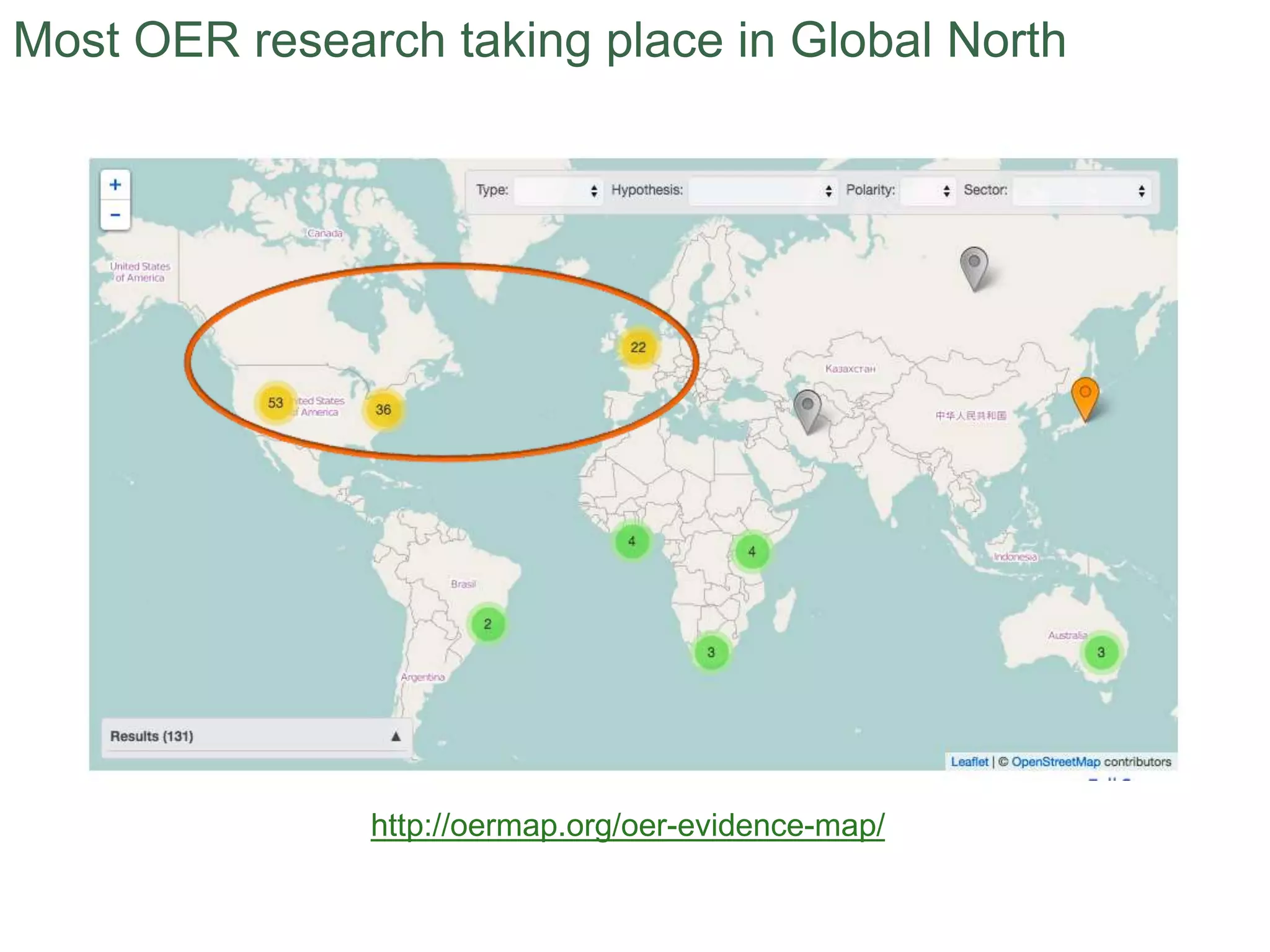
http://oermap.org/oer-evidence-map/
Most OER research taking place in Global North
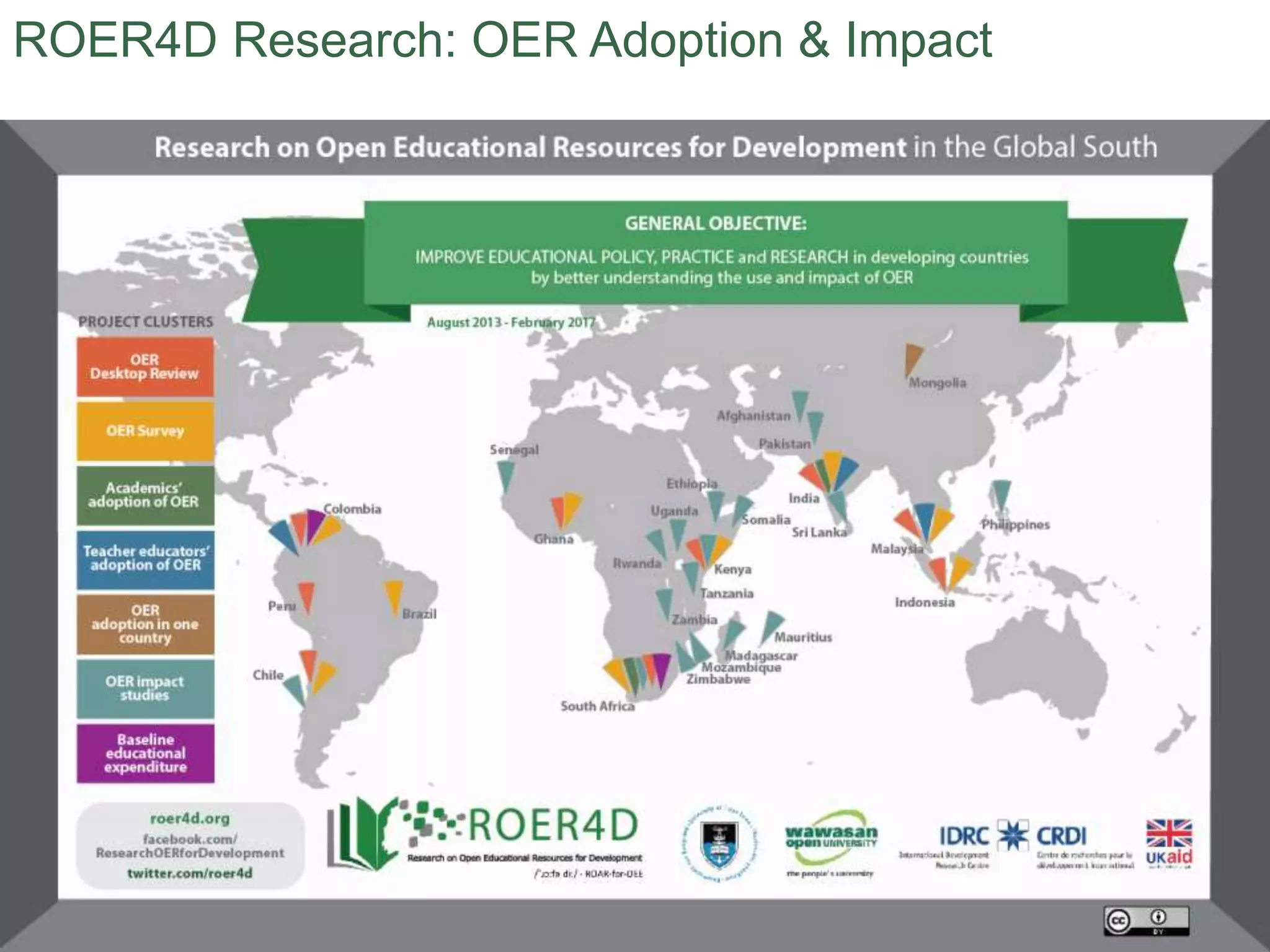
ROER4D Research: OER Adoption & Impact
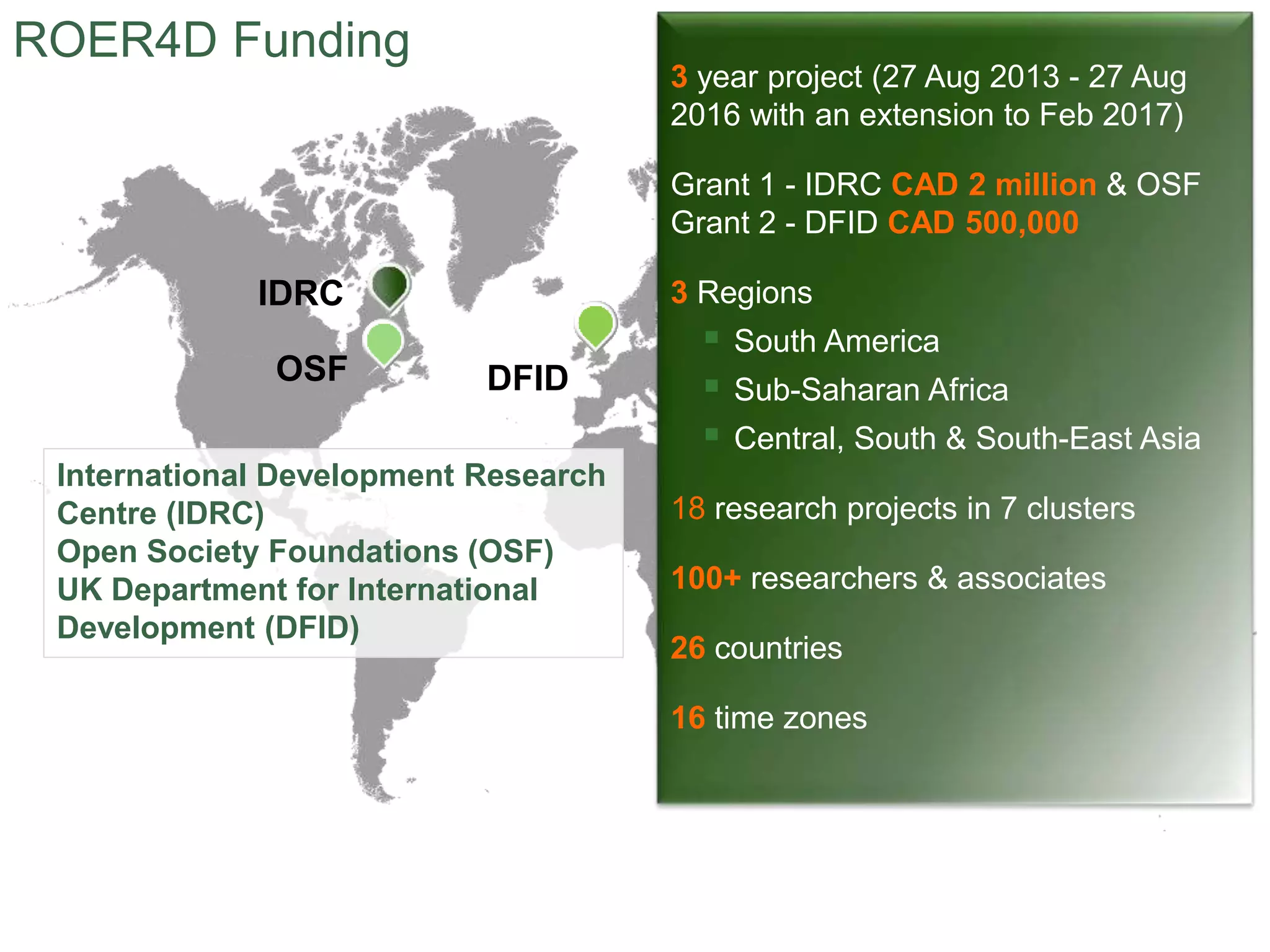
International Development Research
Centre (IDRC)
Open Society Foundations (OSF)
UK Department for International
Development (DFID)
3 year project (27 Aug 2013 - 27 Aug
2016 with an extension to Feb 2017)
Grant 1 - IDRC CAD 2 million & OSF
Grant 2 - DFID CAD 500,000
3 Regions
 South America
 Sub-Saharan Africa
 Central, South & South-East Asia
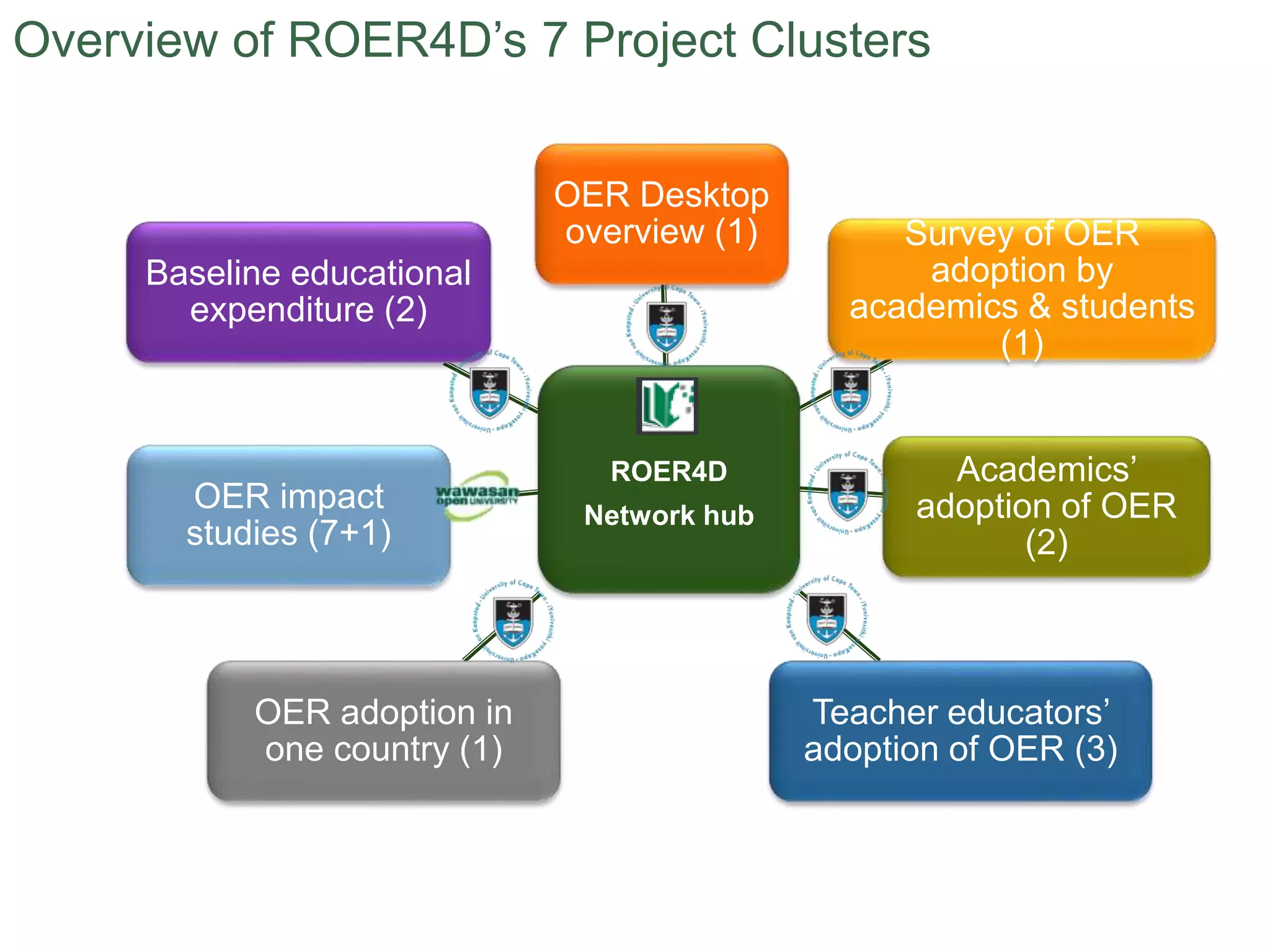
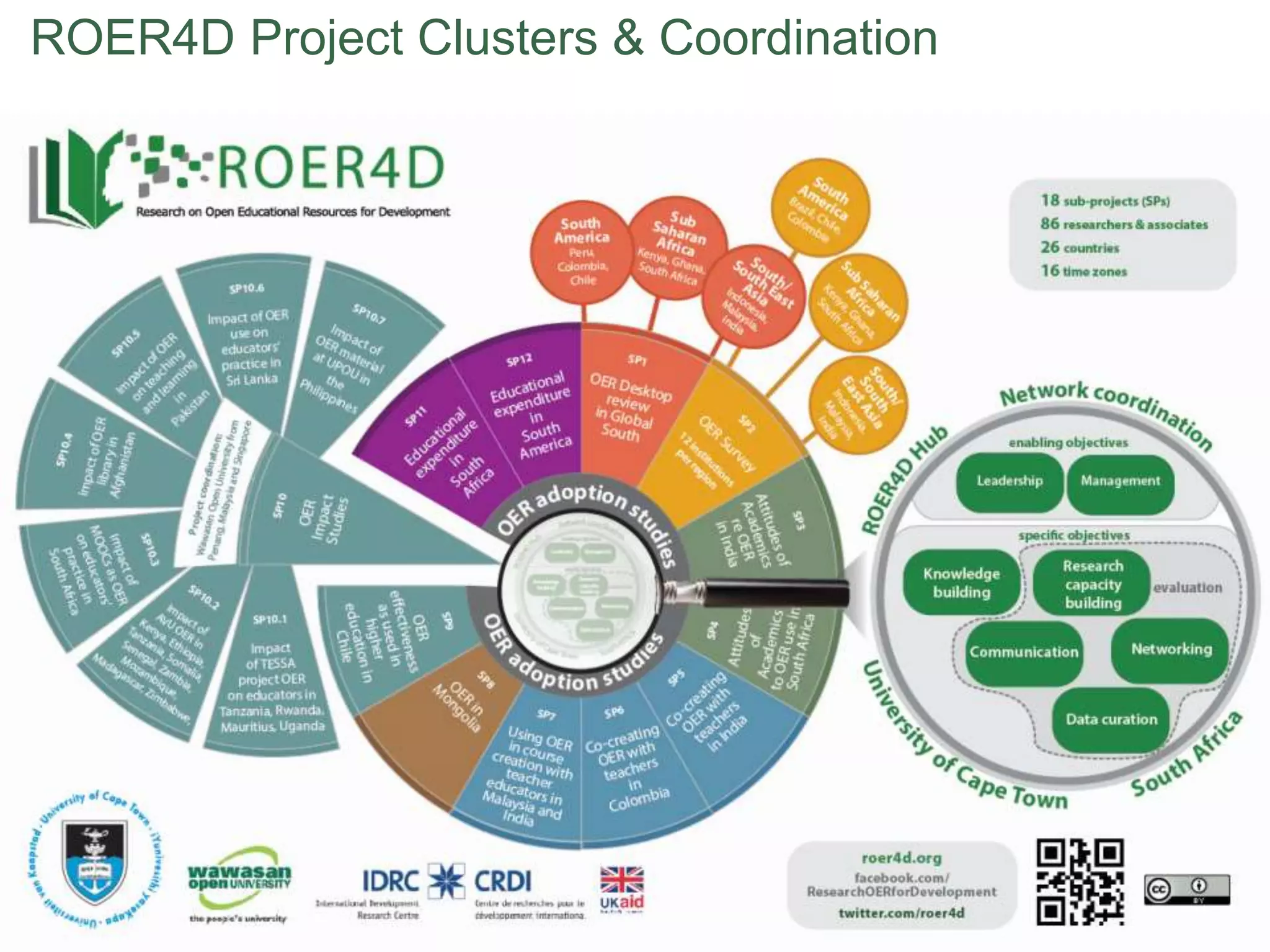
18 research projects in 7 clusters
100+ researchers & associates
26 countries
16 time zones
IDRC
OSF DFID
ROER4D Funding
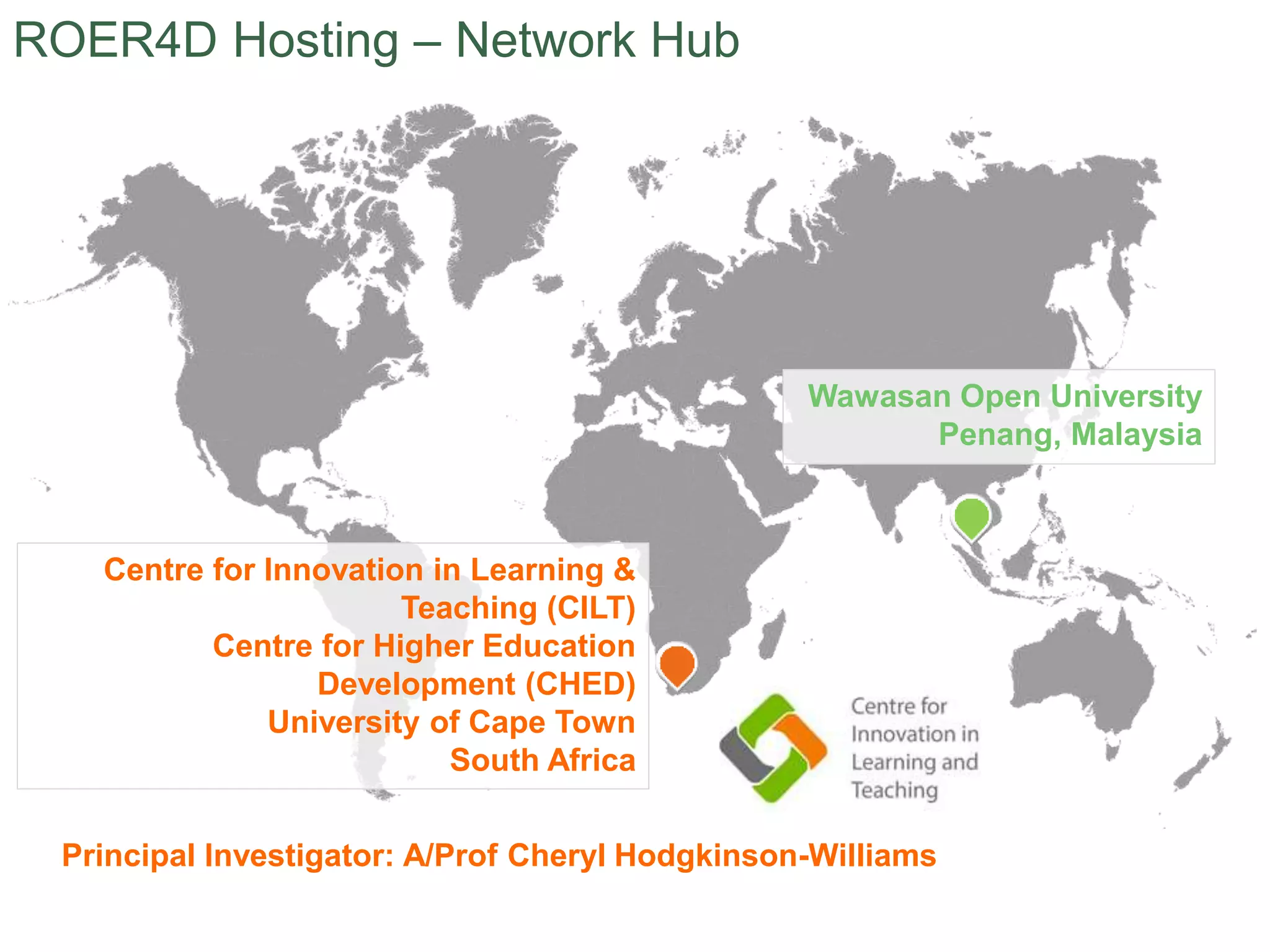
Wawasan Open University
Penang, Malaysia
Centre for Innovation in Learning &
Teaching (CILT)
Centre for Higher Education
Development (CHED)
University of Cape Town
South Africa
ROER4D Hosting – Network Hub
Principal Investigator: A/Prof Cheryl Hodgkinson-Williams
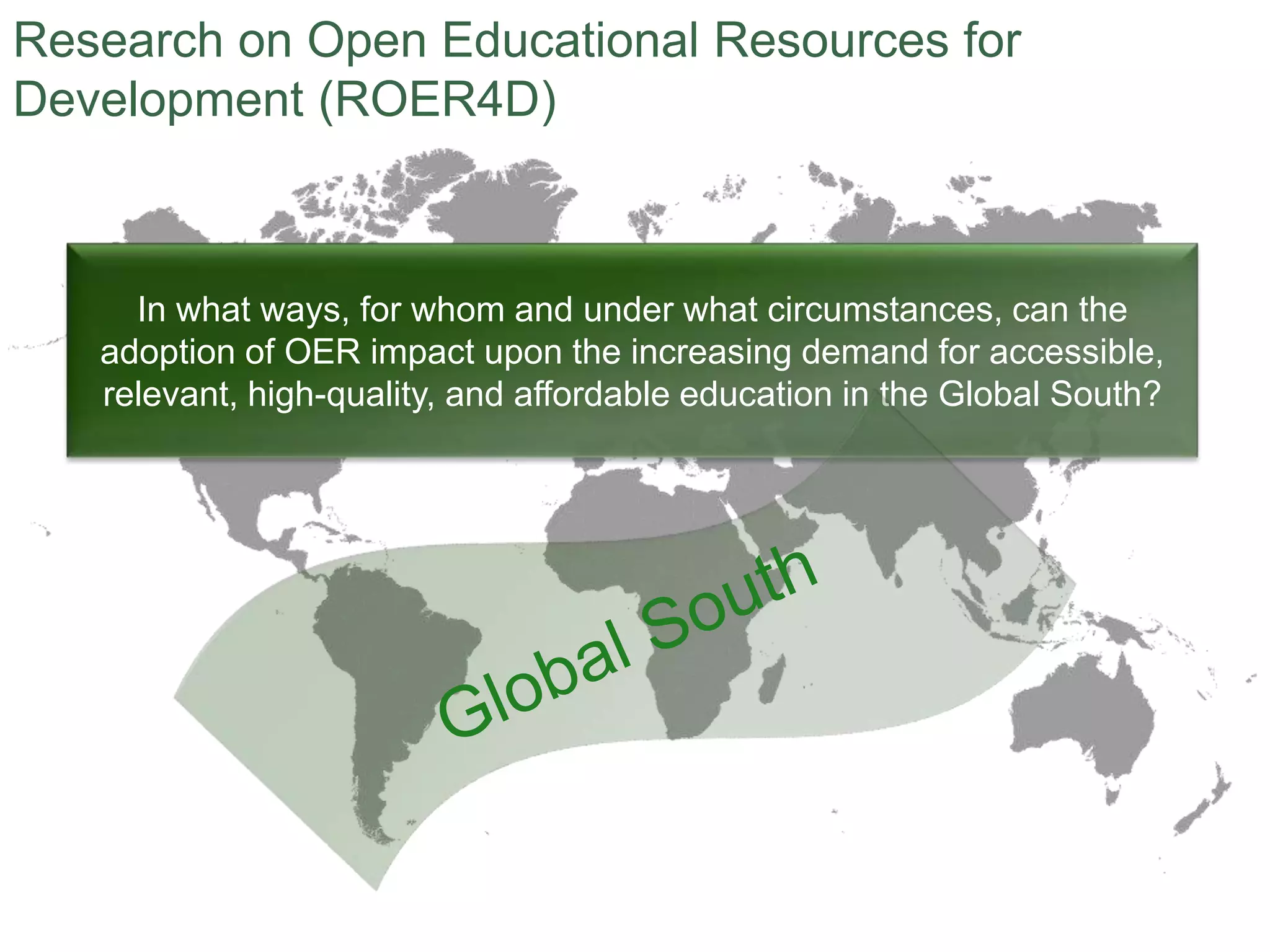
In what ways, for whom and under what circumstances, can the
adoption of OER impact upon the increasing demand for accessible,
relevant, high-quality, and affordable education in the Global South?
Research on Open Educational Resources for
Development (ROER4D)
ROER4D
Network hub
OER Desktop
overview (1) Survey of OER
adoption by
academics & students
(1)
Academics’
adoption of OER
(2)
Teacher educators’
adoption of OER (3)
OER adoption in
one country (1)
OER impact
studies (7+1)
Baseline educational
expenditure (2)
Overview of ROER4D’s 7 Project Clusters
ROER4D Project Clusters & Coordination
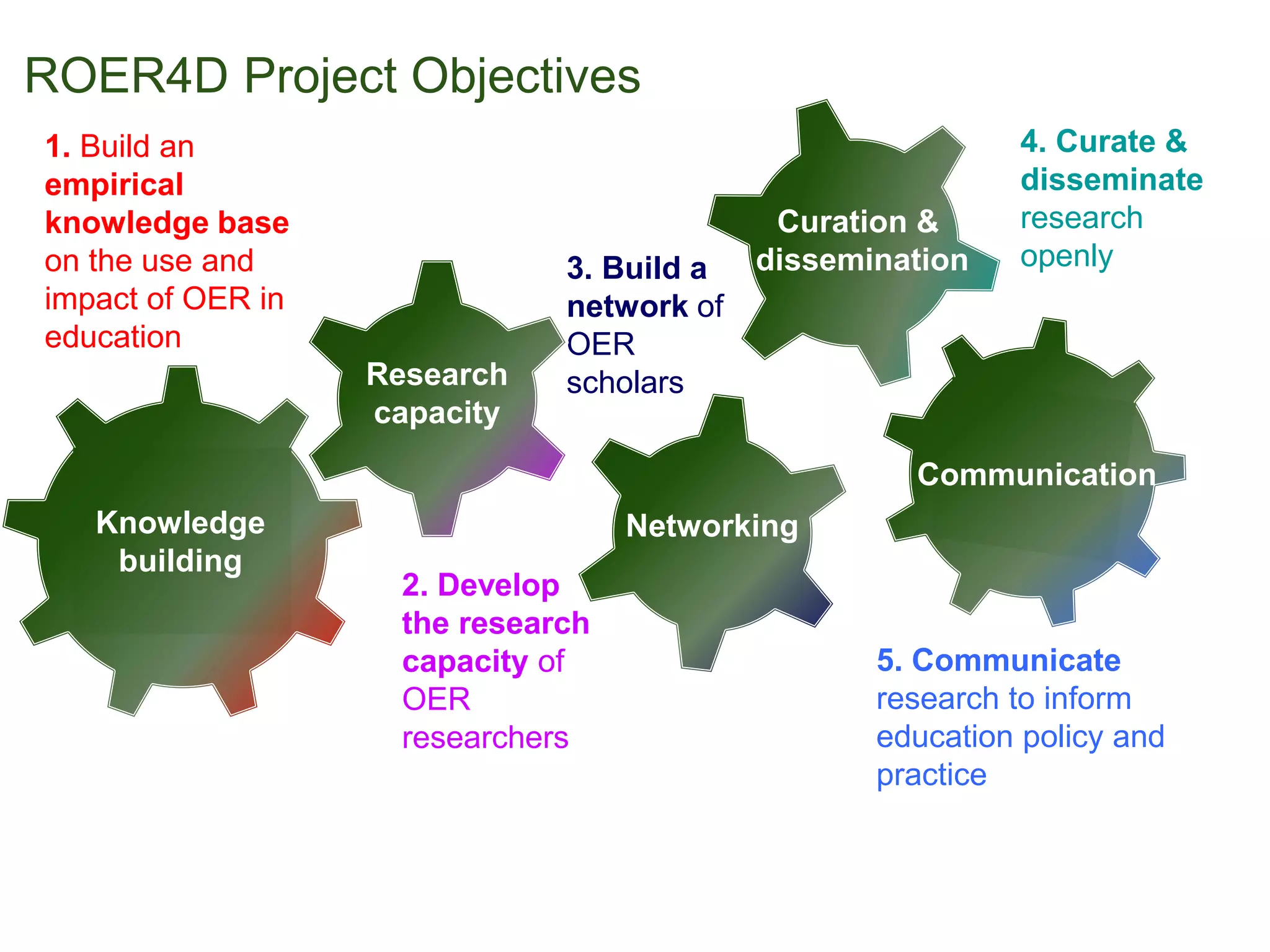
Knowledge
building
Research
capacity
Networking
1. Build an
empirical
knowledge base
on the use and
impact of OER in
education
2. Develop
the research
capacity of
OER
researchers
3. Build a
network of
OER
scholars
5. Communicate
research to inform
education policy and
practice
4. Curate &
disseminate
research
openly
Curation &
dissemination
Research
capacity
Communication
ROER4D Project Objectives
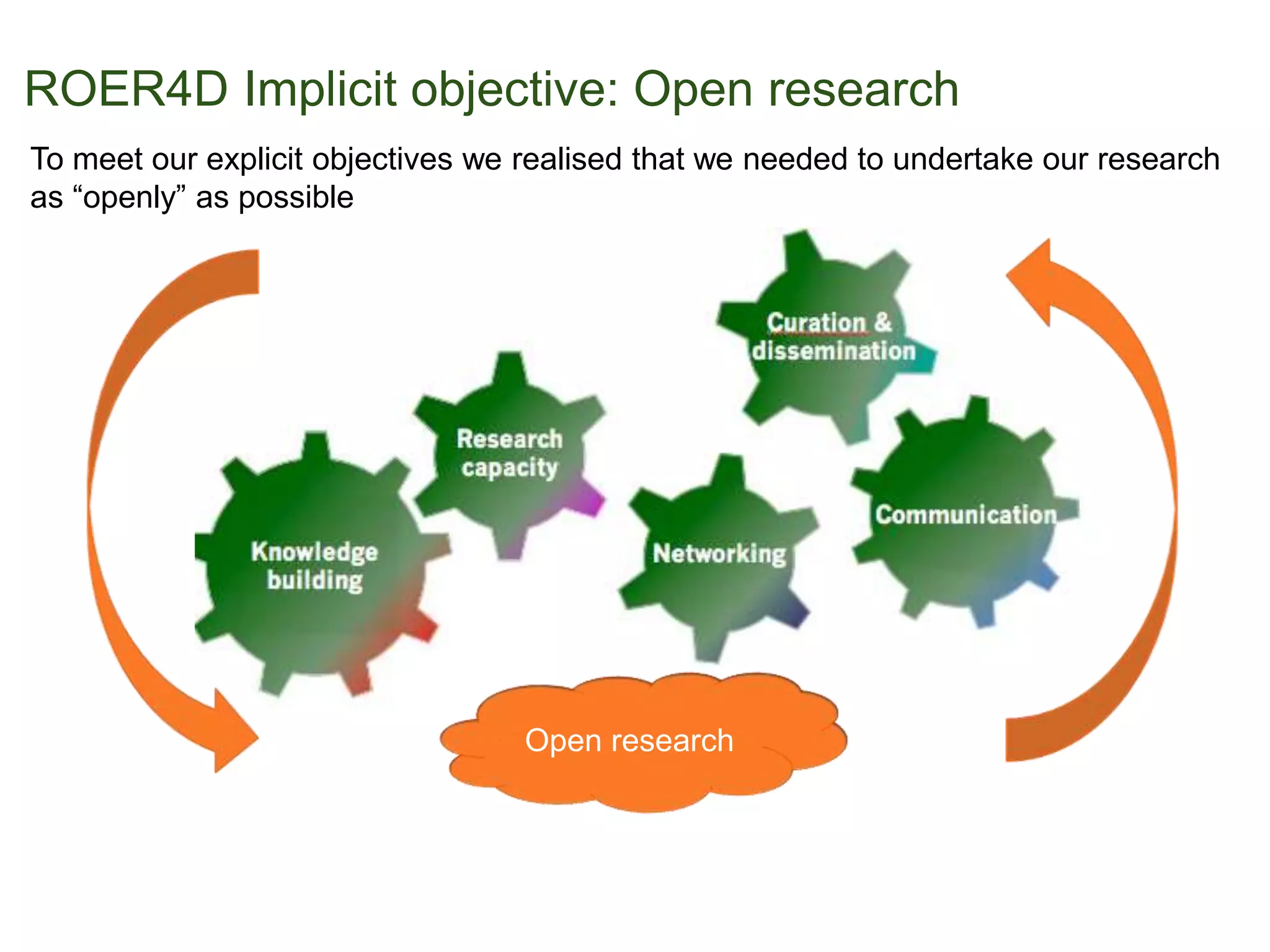
To meet our explicit objectives we realised that we needed to undertake our research
as “openly” as possible
Open research
ROER4D Implicit objective: Open research
Defining Open Research
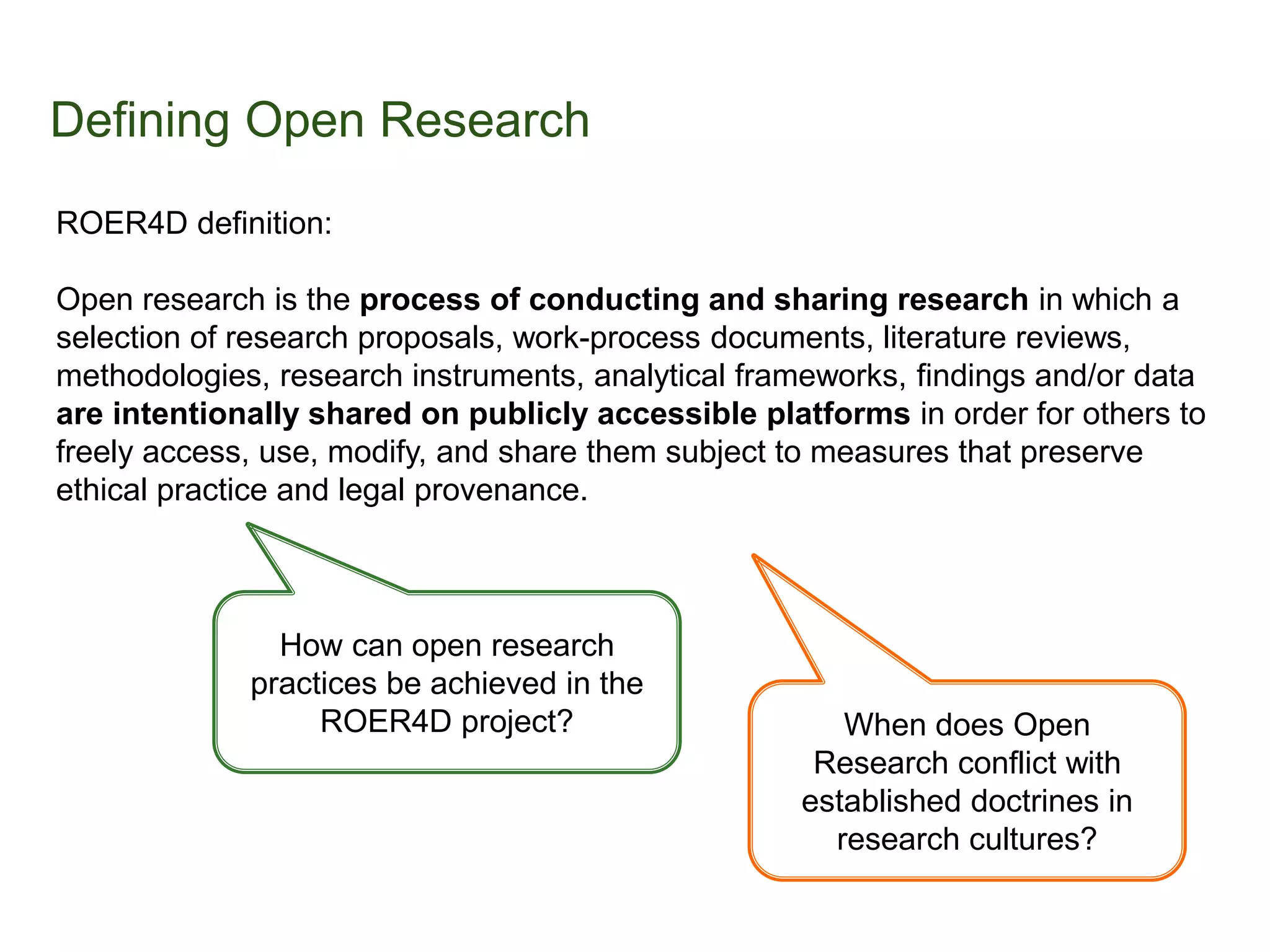
ROER4D definition:
Open research is the process of conducting and sharing research in which a
selection of research proposals, work-process documents, literature reviews,
methodologies, research instruments, analytical frameworks, findings and/or data
are intentionally shared on publicly accessible platforms in order for others to
freely access, use, modify, and share them subject to measures that preserve
ethical practice and legal provenance.
How can open research
practices be achieved in the
ROER4D project? When does Open
Research conflict with
established doctrines in
research cultures?
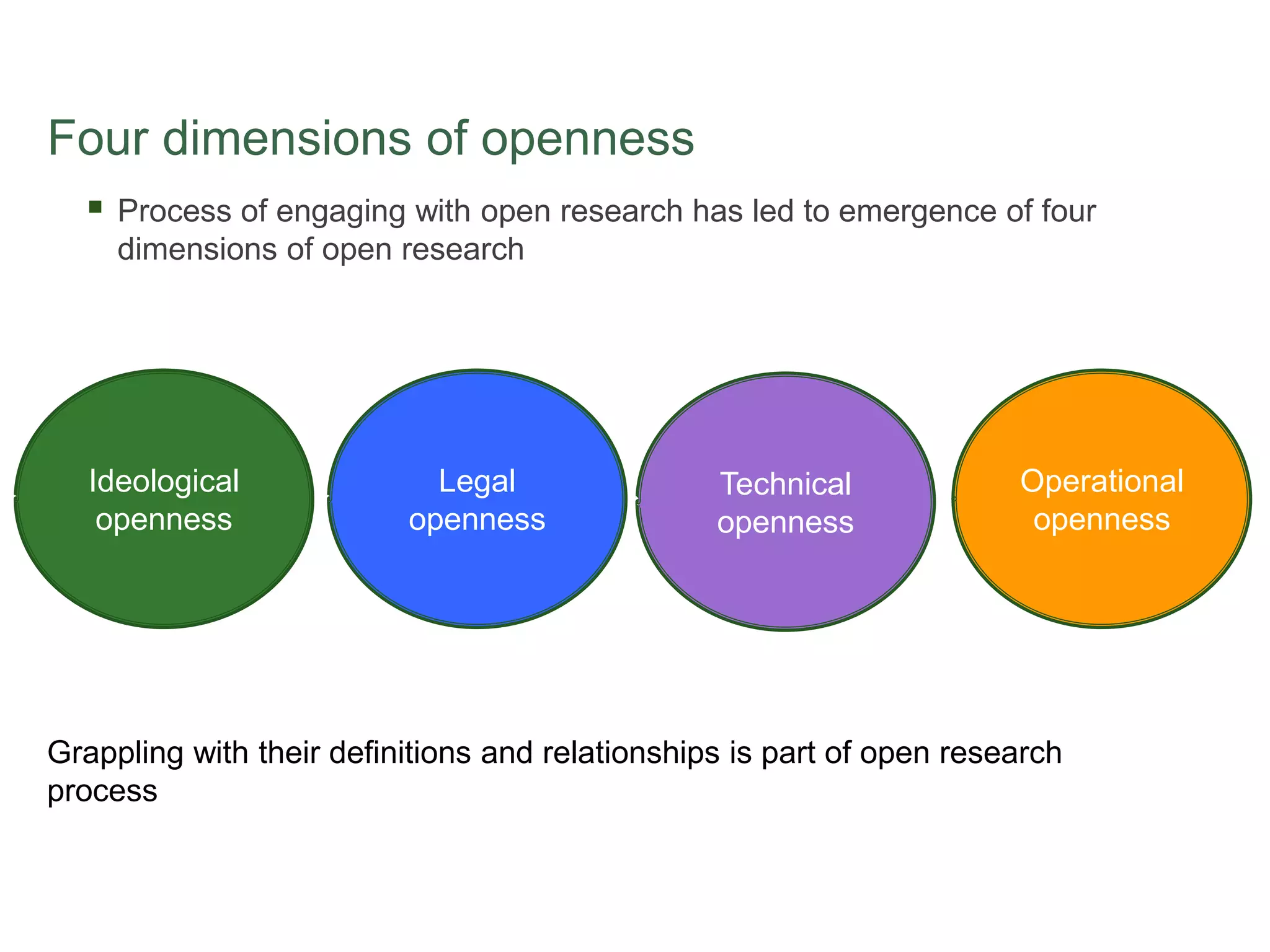
Ideological
openness
Legal
openness
Technical
openness
Operational
openness
Four dimensions of openness
 Process of engaging with open research has led to emergence of four
dimensions of open research
Grappling with their definitions and relationships is part of open research
process
Defining ideological openness
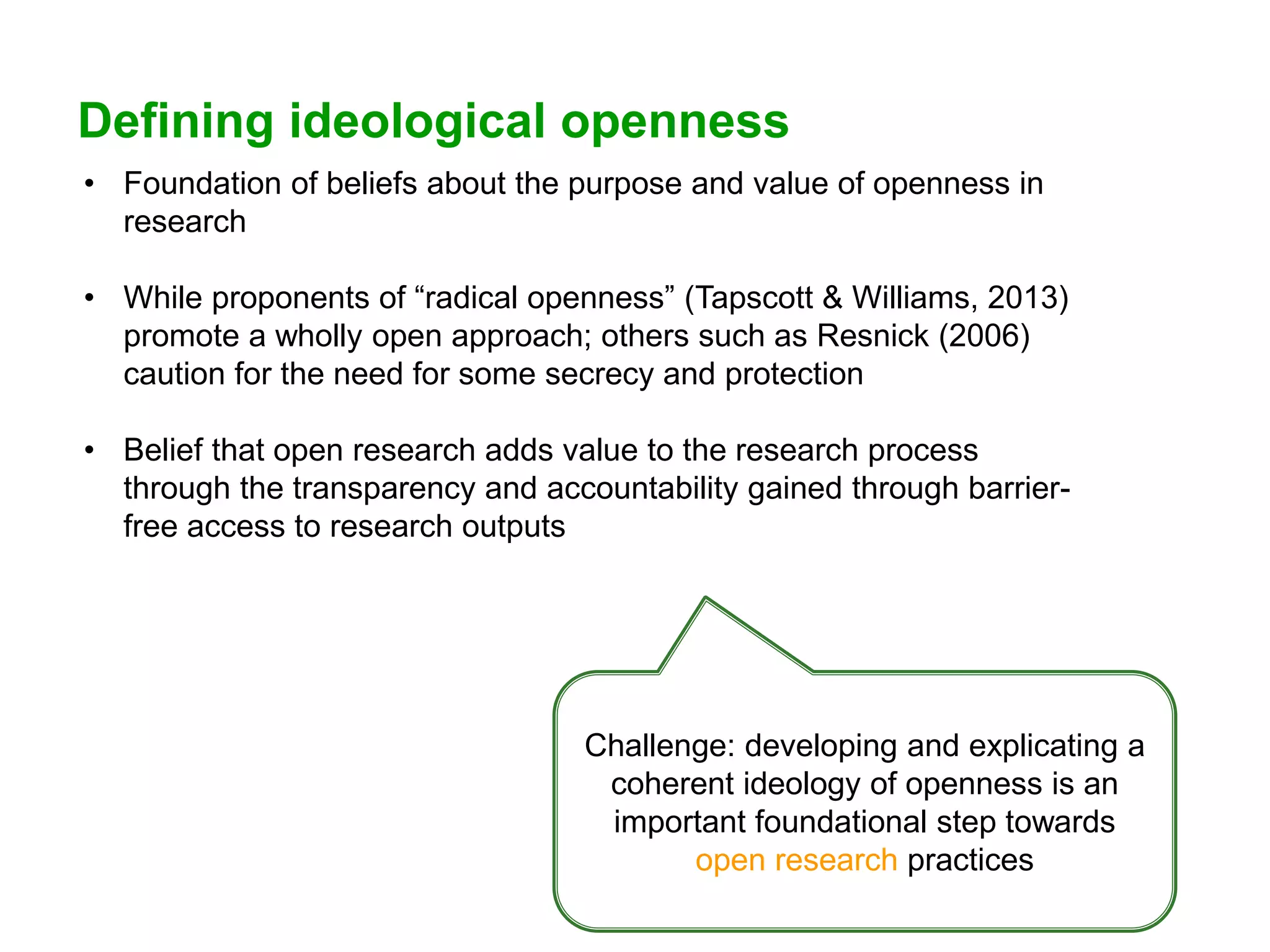
• Foundation of beliefs about the purpose and value of openness in
research
• While proponents of “radical openness” (Tapscott & Williams, 2013)
promote a wholly open approach; others such as Resnick (2006)
caution for the need for some secrecy and protection
• Belief that open research adds value to the research process
through the transparency and accountability gained through barrier-
free access to research outputs
Challenge: developing and explicating a
coherent ideology of openness is an
important foundational step towards
open research practices
Towards ideological openness
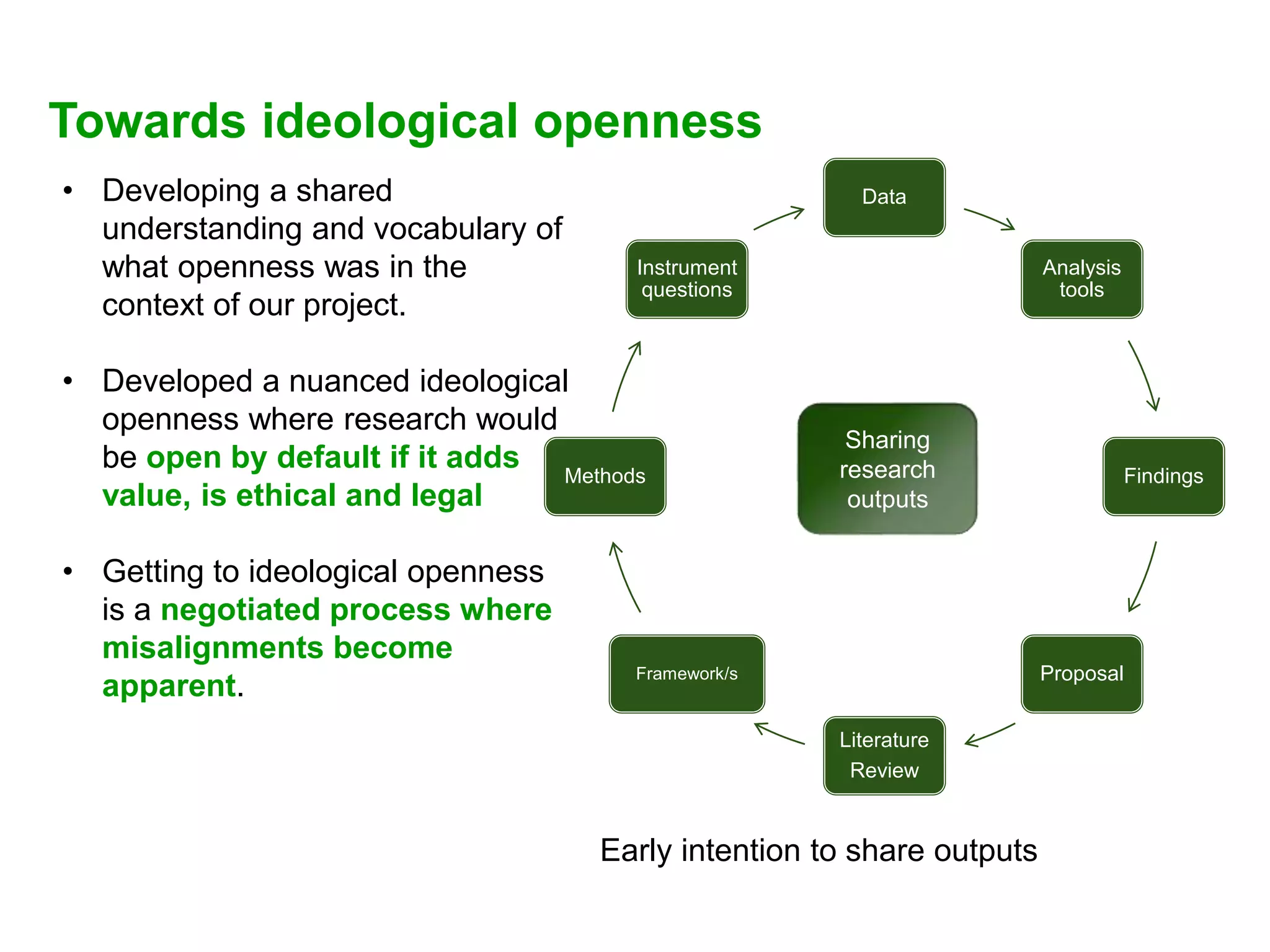
• Developing a shared
understanding and vocabulary of
what openness was in the
context of our project.
• Developed a nuanced ideological
openness where research would
be open by default if it adds
value, is ethical and legal
• Getting to ideological openness
is a negotiated process where
misalignments become
apparent.
Data
Analysis
tools
Findings
Proposal
Literature
Review
Framework/s
Methods
Instrument
questions
Sharing
research
outputs
Early intention to share outputs
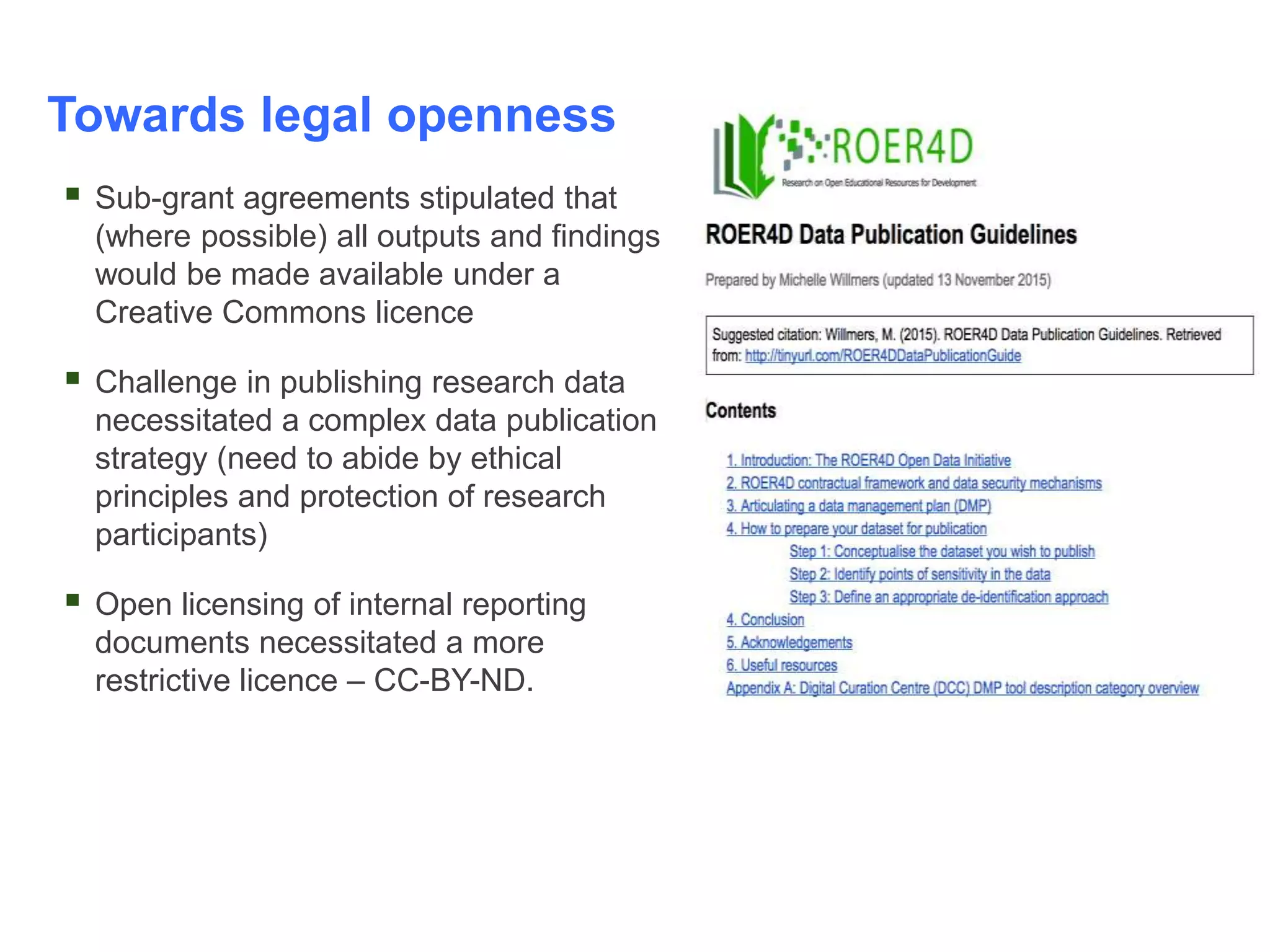
Defining legal openness
Legal openness refers to the use of appropriate alternative licensing
mechanisms such as Creative Commons, as well as the knowledge and
resources required to apply and/or negotiate open licensing, copyright
clearance, and the related intellectual property considerations that accompany the
decision to make outputs and data legally open and reusable.
Challenge: which legal permissions
would be feasible given subject matter,
what is valuable for users and
producers and what was practical?
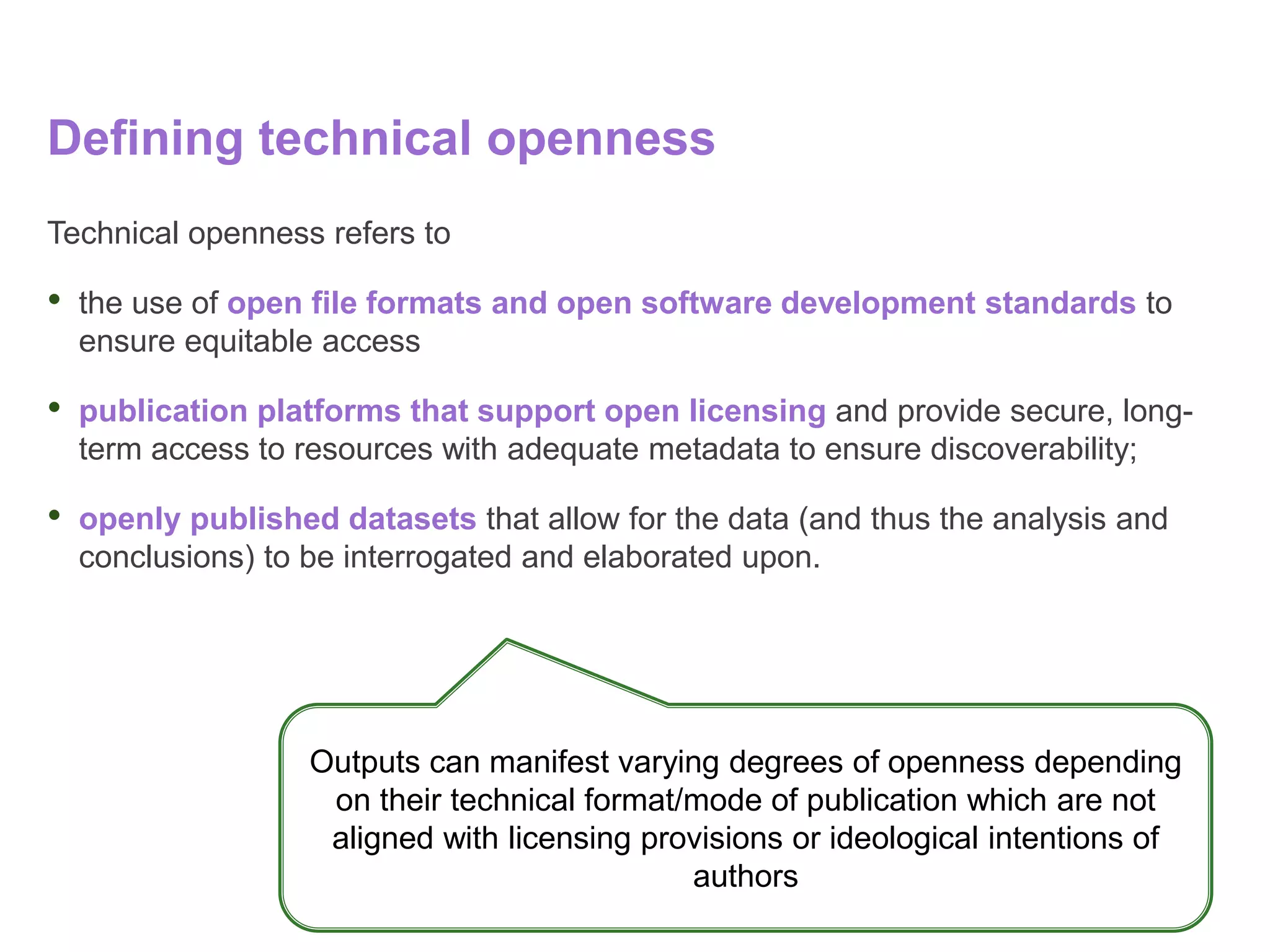
Towards legal openness
 Sub-grant agreements stipulated that
(where possible) all outputs and findings
would be made available under a
Creative Commons licence
 Challenge in publishing research data
necessitated a complex data publication
strategy (need to abide by ethical
principles and protection of research
participants)
 Open licensing of internal reporting
documents necessitated a more
restrictive licence – CC-BY-ND.
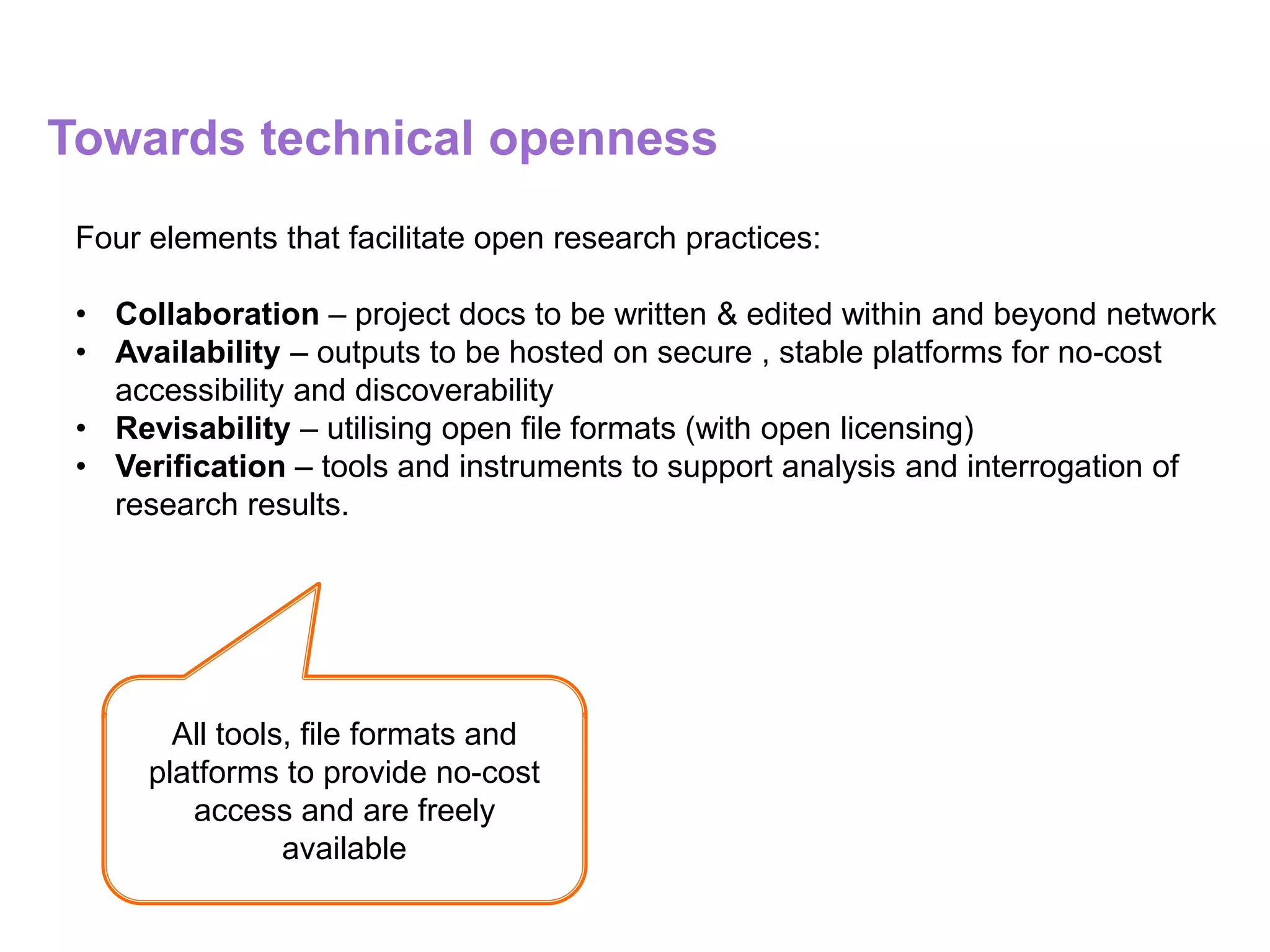
Defining technical openness
Technical openness refers to
• the use of open file formats and open software development standards to
ensure equitable access
• publication platforms that support open licensing and provide secure, long-
term access to resources with adequate metadata to ensure discoverability;
• openly published datasets that allow for the data (and thus the analysis and
conclusions) to be interrogated and elaborated upon.
Outputs can manifest varying degrees of openness depending
on their technical format/mode of publication which are not
aligned with licensing provisions or ideological intentions of
authors
Towards technical openness
Four elements that facilitate open research practices:
• Collaboration – project docs to be written & edited within and beyond network
• Availability – outputs to be hosted on secure , stable platforms for no-cost
accessibility and discoverability
• Revisability – utilising open file formats (with open licensing)
• Verification – tools and instruments to support analysis and interrogation of
research results.
All tools, file formats and
platforms to provide no-cost
access and are freely
available
Towards technical openness - collaboration
 An intention of Open Research is to
enable collaboration between
researchers
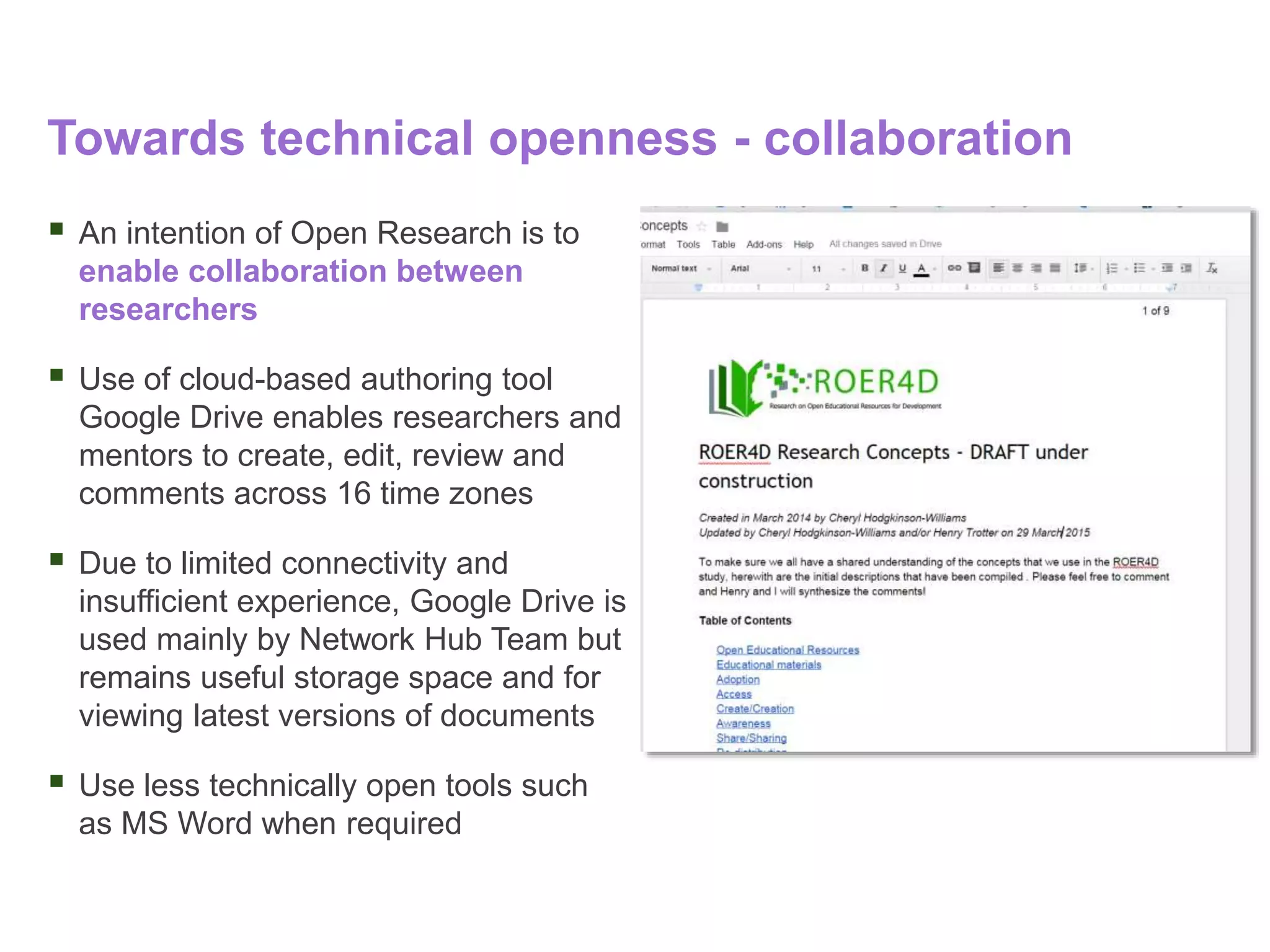
 Use of cloud-based authoring tool
Google Drive enables researchers and
mentors to create, edit, review and
comments across 16 time zones
 Due to limited connectivity and
insufficient experience, Google Drive is
used mainly by Network Hub Team but
remains useful storage space and for
viewing latest versions of documents
 Use less technically open tools such
as MS Word when required
Towards technical openness - discoverability
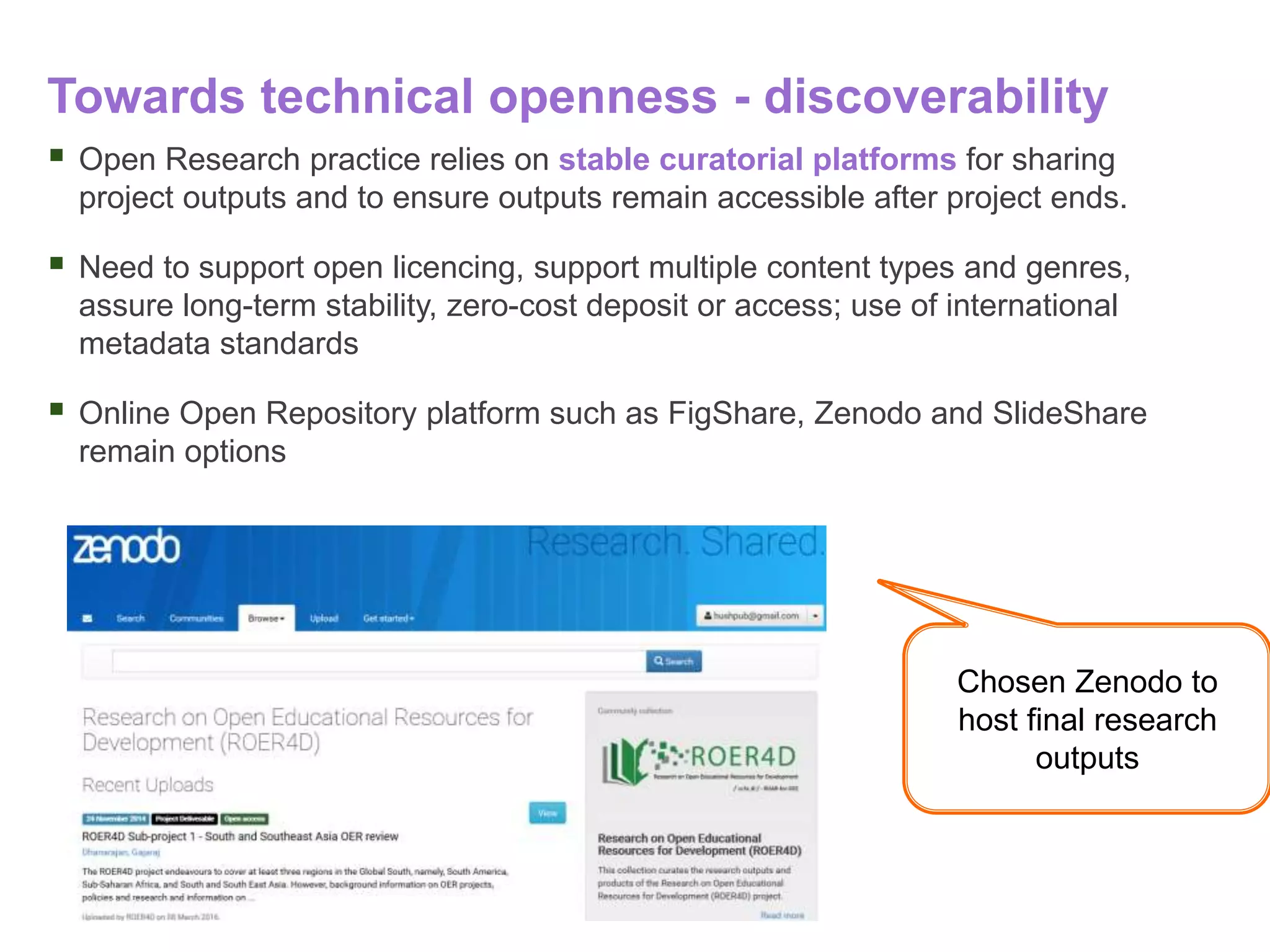
 Open Research practice relies on stable curatorial platforms for sharing
project outputs and to ensure outputs remain accessible after project ends.
 Need to support open licencing, support multiple content types and genres,
assure long-term stability, zero-cost deposit or access; use of international
metadata standards
 Online Open Repository platform such as FigShare, Zenodo and SlideShare
remain options
Chosen Zenodo to
host final research
outputs
Towards technical openness - revisability
 File formats exist on a spectrum of technical openness: impacts on their
accessibility, revisability and remixability
 More ‘closed’ formats can be viewed with free software (PDF/EPUB) but are
less revisable without proprietary software.
 More ‘open formats’ such as ODT, ODS, HTML, XML allow for remixing of
constituent elements using open source software
 Other formats such as MS Word facilitate reuse and revision and would be a
popular choice but requires proprietary software
Aware of tensions between our
choice of formats and user
preferences and kinds of reuse we
wanted (e.g. use of PDF)
Committed to releasing final
outputs under a range of
formats
Towards technical openness - verification
 Open Research practice implies a value-added component to the research
process – interrogation of open data contributes to verifying the research
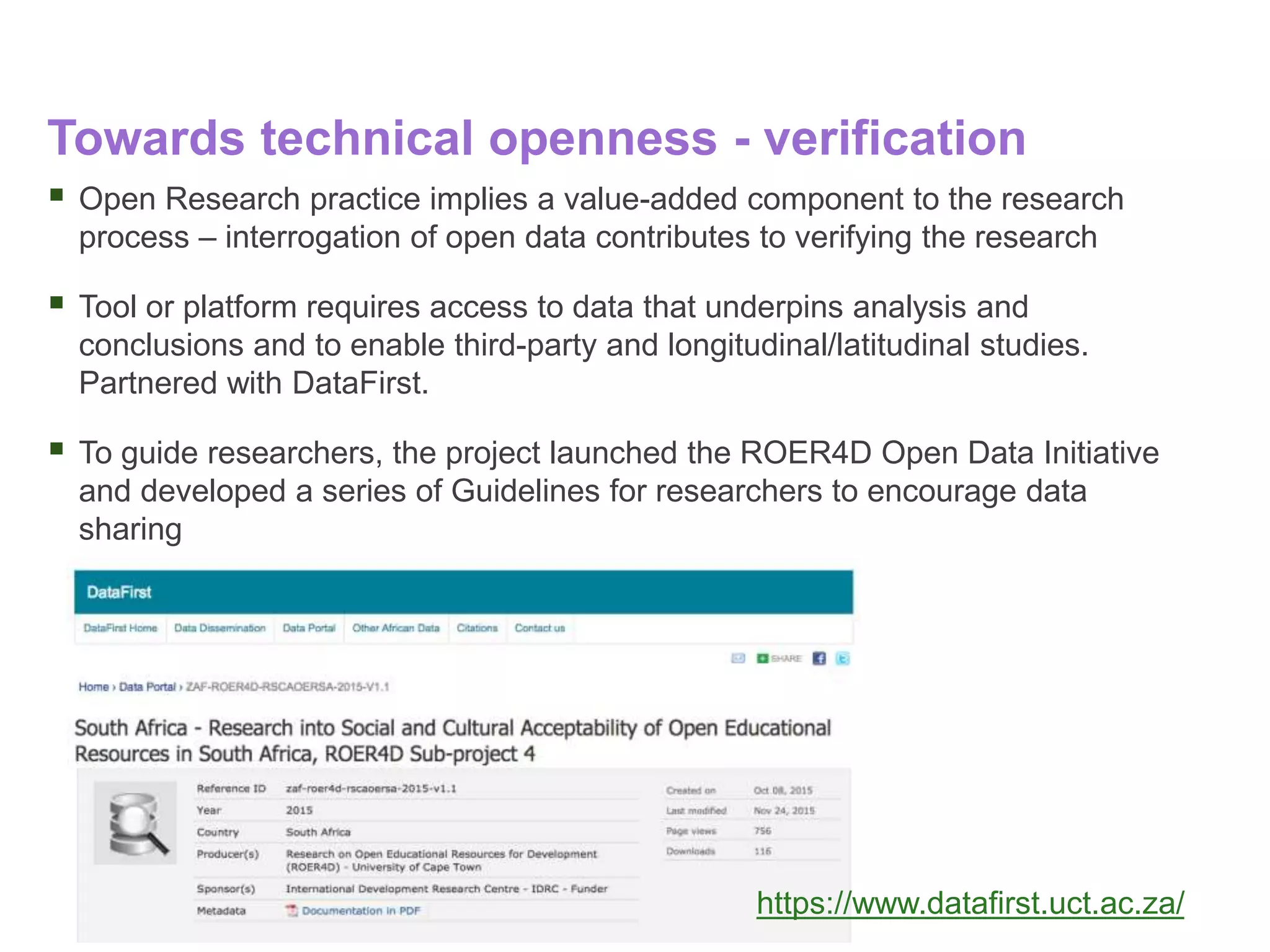
 Tool or platform requires access to data that underpins analysis and
conclusions and to enable third-party and longitudinal/latitudinal studies.
Partnered with DataFirst.
 To guide researchers, the project launched the ROER4D Open Data Initiative
and developed a series of Guidelines for researchers to encourage data
sharing
https://www.datafirst.uct.ac.za/
Defining operational openness
The enactment of ideological, legal and technical principles in the course of
conducting research:
 Practices that emerge as a result of critical reflection on where to be more or
less open as specific context dictates
 “if it adds value” has been a touchstone when grappling/choosing between
commitment to ideological openness and when a more nuanced approach is
required
 An agile and strategic approach to support research management process
Towards operational openness
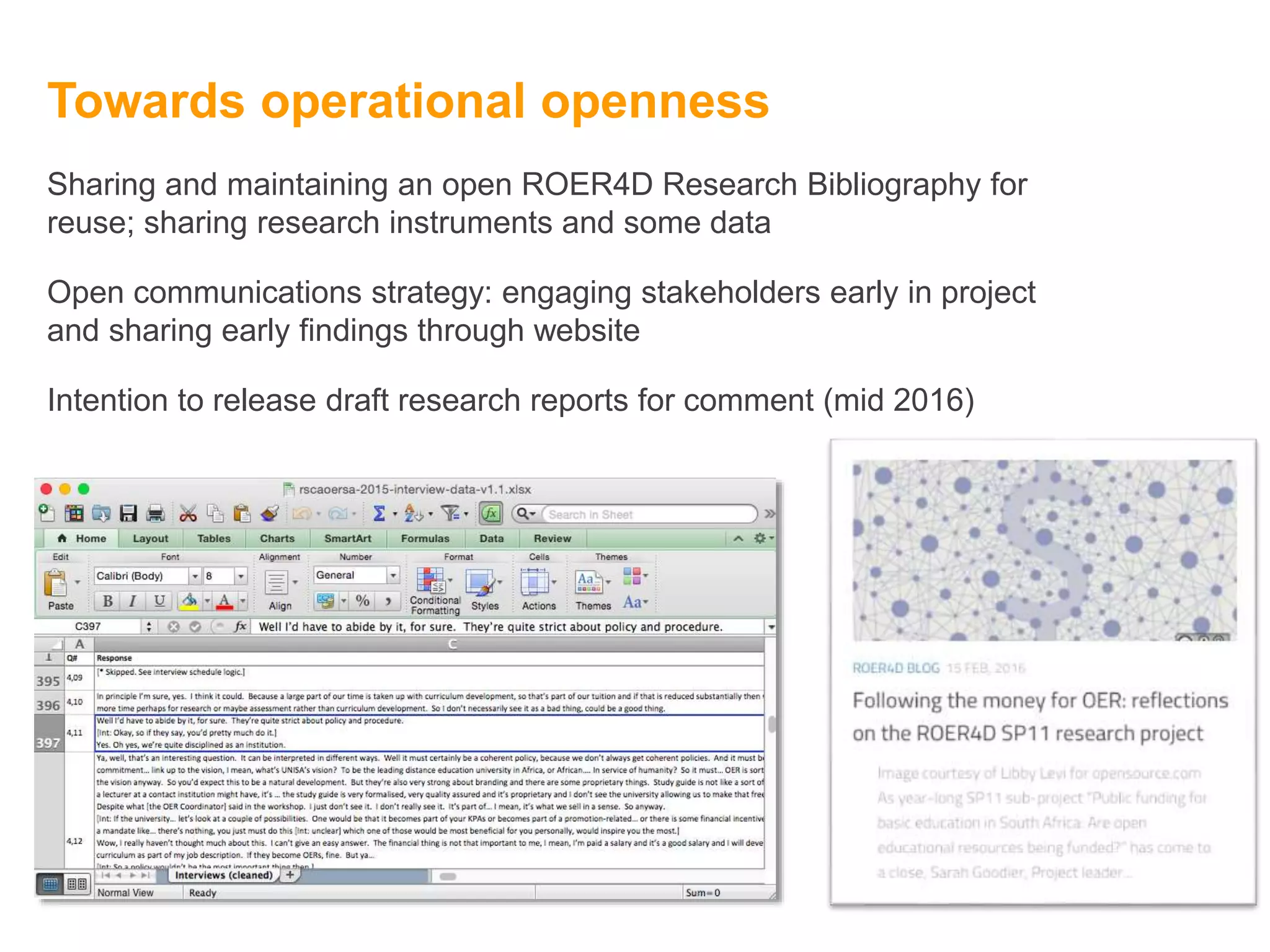
Sharing and maintaining an open ROER4D Research Bibliography for
reuse; sharing research instruments and some data
Open communications strategy: engaging stakeholders early in project
and sharing early findings through website
Intention to release draft research reports for comment (mid 2016)
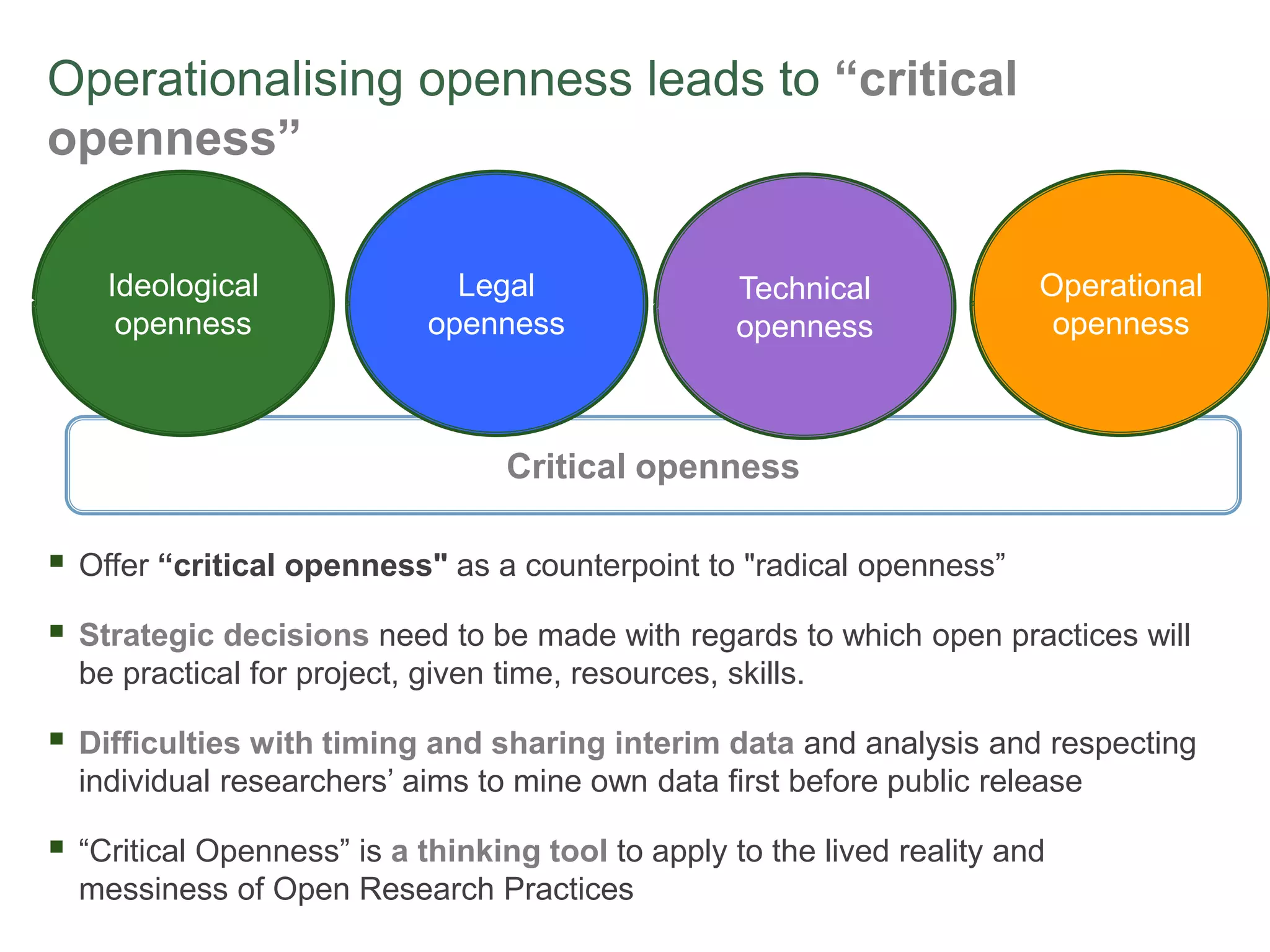
Operationalising openness leads to “critical
openness”
Critical openness
 Offer “critical openness" as a counterpoint to "radical openness”
 Strategic decisions need to be made with regards to which open practices will
be practical for project, given time, resources, skills.
 Difficulties with timing and sharing interim data and analysis and respecting
individual researchers’ aims to mine own data first before public release
 “Critical Openness” is a thinking tool to apply to the lived reality and
messiness of Open Research Practices
Ideological
openness
Legal
openness
Technical
openness
Operational
openness
Thank you!
Questions?
Comments?
Full paper:
King, T., Hodgkinson-Williams, C. A., Willmers, M. & Walji, S. (2016). Dimensions
of open research: Reflections on ‘critical openness’ in the ROER4D project.
Open Praxis, [in press]
Links
Website: www.roer4d.org
Contact Principal Invesigator:
cheryl.hodgkinson-williams@uct.ac.za
Follow us: http://twitter.com/roer4D
Presentations: www.slideshare.com/roer4D
Acknowledgments & Attribution
This work is licensed under a Creative Commons Attribution
4.0 International License.
Written by Sukaina Walji
Acknowledgements to
Cheryl Hodgkinson-Williams, Thomas King
& Michelle Willmers
Contact:
Sukaina.walji@uct.ac.za
Graphics by Rondine Carstens
rondine.carstens@uct.ac.za

Dimensions of open research: critical reflections on openness in the ROER4D project

  • 1.
    Thomas King, CherylHodgkinson-Williams, Michelle Willmers, Sukaina Walji University of Cape Town OE Global Conference 2016, 14-16 April, Krakow, Poland Contact presenter: Sukaina.Walji@uct.ac.za Dimensions of open research: critical reflections on openness in the ROER4D project www.slideshare.net/ROER4D
  • 2.
  • 3.
    ROER4D Research: OERAdoption & Impact
  • 4.
    International Development Research Centre(IDRC) Open Society Foundations (OSF) UK Department for International Development (DFID) 3 year project (27 Aug 2013 - 27 Aug 2016 with an extension to Feb 2017) Grant 1 - IDRC CAD 2 million & OSF Grant 2 - DFID CAD 500,000 3 Regions  South America  Sub-Saharan Africa  Central, South & South-East Asia 18 research projects in 7 clusters 100+ researchers & associates 26 countries 16 time zones IDRC OSF DFID ROER4D Funding
  • 5.
    Wawasan Open University Penang,Malaysia Centre for Innovation in Learning & Teaching (CILT) Centre for Higher Education Development (CHED) University of Cape Town South Africa ROER4D Hosting – Network Hub Principal Investigator: A/Prof Cheryl Hodgkinson-Williams
  • 6.
    In what ways,for whom and under what circumstances, can the adoption of OER impact upon the increasing demand for accessible, relevant, high-quality, and affordable education in the Global South? Research on Open Educational Resources for Development (ROER4D)
  • 7.
    ROER4D Network hub OER Desktop overview(1) Survey of OER adoption by academics & students (1) Academics’ adoption of OER (2) Teacher educators’ adoption of OER (3) OER adoption in one country (1) OER impact studies (7+1) Baseline educational expenditure (2) Overview of ROER4D’s 7 Project Clusters
  • 8.
  • 9.
    Knowledge building Research capacity Networking 1. Build an empirical knowledgebase on the use and impact of OER in education 2. Develop the research capacity of OER researchers 3. Build a network of OER scholars 5. Communicate research to inform education policy and practice 4. Curate & disseminate research openly Curation & dissemination Research capacity Communication ROER4D Project Objectives
  • 10.
    To meet ourexplicit objectives we realised that we needed to undertake our research as “openly” as possible Open research ROER4D Implicit objective: Open research
  • 11.
    Defining Open Research ROER4Ddefinition: Open research is the process of conducting and sharing research in which a selection of research proposals, work-process documents, literature reviews, methodologies, research instruments, analytical frameworks, findings and/or data are intentionally shared on publicly accessible platforms in order for others to freely access, use, modify, and share them subject to measures that preserve ethical practice and legal provenance. How can open research practices be achieved in the ROER4D project? When does Open Research conflict with established doctrines in research cultures?
  • 12.
    Ideological openness Legal openness Technical openness Operational openness Four dimensions ofopenness  Process of engaging with open research has led to emergence of four dimensions of open research Grappling with their definitions and relationships is part of open research process
  • 13.
    Defining ideological openness •Foundation of beliefs about the purpose and value of openness in research • While proponents of “radical openness” (Tapscott & Williams, 2013) promote a wholly open approach; others such as Resnick (2006) caution for the need for some secrecy and protection • Belief that open research adds value to the research process through the transparency and accountability gained through barrier- free access to research outputs Challenge: developing and explicating a coherent ideology of openness is an important foundational step towards open research practices
  • 14.
    Towards ideological openness •Developing a shared understanding and vocabulary of what openness was in the context of our project. • Developed a nuanced ideological openness where research would be open by default if it adds value, is ethical and legal • Getting to ideological openness is a negotiated process where misalignments become apparent. Data Analysis tools Findings Proposal Literature Review Framework/s Methods Instrument questions Sharing research outputs Early intention to share outputs
  • 15.
    Defining legal openness Legalopenness refers to the use of appropriate alternative licensing mechanisms such as Creative Commons, as well as the knowledge and resources required to apply and/or negotiate open licensing, copyright clearance, and the related intellectual property considerations that accompany the decision to make outputs and data legally open and reusable. Challenge: which legal permissions would be feasible given subject matter, what is valuable for users and producers and what was practical?
  • 16.
    Towards legal openness Sub-grant agreements stipulated that (where possible) all outputs and findings would be made available under a Creative Commons licence  Challenge in publishing research data necessitated a complex data publication strategy (need to abide by ethical principles and protection of research participants)  Open licensing of internal reporting documents necessitated a more restrictive licence – CC-BY-ND.
  • 17.
    Defining technical openness Technicalopenness refers to • the use of open file formats and open software development standards to ensure equitable access • publication platforms that support open licensing and provide secure, long- term access to resources with adequate metadata to ensure discoverability; • openly published datasets that allow for the data (and thus the analysis and conclusions) to be interrogated and elaborated upon. Outputs can manifest varying degrees of openness depending on their technical format/mode of publication which are not aligned with licensing provisions or ideological intentions of authors
  • 18.
    Towards technical openness Fourelements that facilitate open research practices: • Collaboration – project docs to be written & edited within and beyond network • Availability – outputs to be hosted on secure , stable platforms for no-cost accessibility and discoverability • Revisability – utilising open file formats (with open licensing) • Verification – tools and instruments to support analysis and interrogation of research results. All tools, file formats and platforms to provide no-cost access and are freely available
  • 19.
    Towards technical openness- collaboration  An intention of Open Research is to enable collaboration between researchers  Use of cloud-based authoring tool Google Drive enables researchers and mentors to create, edit, review and comments across 16 time zones  Due to limited connectivity and insufficient experience, Google Drive is used mainly by Network Hub Team but remains useful storage space and for viewing latest versions of documents  Use less technically open tools such as MS Word when required
  • 20.
    Towards technical openness- discoverability  Open Research practice relies on stable curatorial platforms for sharing project outputs and to ensure outputs remain accessible after project ends.  Need to support open licencing, support multiple content types and genres, assure long-term stability, zero-cost deposit or access; use of international metadata standards  Online Open Repository platform such as FigShare, Zenodo and SlideShare remain options Chosen Zenodo to host final research outputs
  • 21.
    Towards technical openness- revisability  File formats exist on a spectrum of technical openness: impacts on their accessibility, revisability and remixability  More ‘closed’ formats can be viewed with free software (PDF/EPUB) but are less revisable without proprietary software.  More ‘open formats’ such as ODT, ODS, HTML, XML allow for remixing of constituent elements using open source software  Other formats such as MS Word facilitate reuse and revision and would be a popular choice but requires proprietary software Aware of tensions between our choice of formats and user preferences and kinds of reuse we wanted (e.g. use of PDF) Committed to releasing final outputs under a range of formats
  • 22.
    Towards technical openness- verification  Open Research practice implies a value-added component to the research process – interrogation of open data contributes to verifying the research  Tool or platform requires access to data that underpins analysis and conclusions and to enable third-party and longitudinal/latitudinal studies. Partnered with DataFirst.  To guide researchers, the project launched the ROER4D Open Data Initiative and developed a series of Guidelines for researchers to encourage data sharing https://www.datafirst.uct.ac.za/
  • 23.
    Defining operational openness Theenactment of ideological, legal and technical principles in the course of conducting research:  Practices that emerge as a result of critical reflection on where to be more or less open as specific context dictates  “if it adds value” has been a touchstone when grappling/choosing between commitment to ideological openness and when a more nuanced approach is required  An agile and strategic approach to support research management process
  • 24.
    Towards operational openness Sharingand maintaining an open ROER4D Research Bibliography for reuse; sharing research instruments and some data Open communications strategy: engaging stakeholders early in project and sharing early findings through website Intention to release draft research reports for comment (mid 2016)
  • 25.
    Operationalising openness leadsto “critical openness” Critical openness  Offer “critical openness" as a counterpoint to "radical openness”  Strategic decisions need to be made with regards to which open practices will be practical for project, given time, resources, skills.  Difficulties with timing and sharing interim data and analysis and respecting individual researchers’ aims to mine own data first before public release  “Critical Openness” is a thinking tool to apply to the lived reality and messiness of Open Research Practices Ideological openness Legal openness Technical openness Operational openness
  • 26.
    Thank you! Questions? Comments? Full paper: King,T., Hodgkinson-Williams, C. A., Willmers, M. & Walji, S. (2016). Dimensions of open research: Reflections on ‘critical openness’ in the ROER4D project. Open Praxis, [in press]
  • 27.
    Links Website: www.roer4d.org Contact PrincipalInvesigator: cheryl.hodgkinson-williams@uct.ac.za Follow us: http://twitter.com/roer4D Presentations: www.slideshare.com/roer4D
  • 28.
    Acknowledgments & Attribution Thiswork is licensed under a Creative Commons Attribution 4.0 International License. Written by Sukaina Walji Acknowledgements to Cheryl Hodgkinson-Williams, Thomas King & Michelle Willmers Contact: Sukaina.walji@uct.ac.za Graphics by Rondine Carstens rondine.carstens@uct.ac.za

Editor's Notes

  • #3 http://oermap.org/oer-evidence-map/
  • #4 the difference the ROER4D project is potentially making to the OER research space
  • #5 3 year project funded by IDRC with contributions from DFID and OSF
  • #8 We have 18 sub-projects who are grantees A number of studies looking at different thematic aspects of OER activity – both adoption and impact
  • #10 The project has 5 objectives In addition to the core objective of Knowledge Building we have four specific objectives and team members hold specific portfolios:
  • #11 The project objectives guide the activities and due to their nature they guide the way research is conducted We also realised that in order to meet these objectives – for example to build a network of open scholars – we needed to conduct our research as openly as possibly.
  • #12 Hodgkinson-Williams & King, 2015 p.5
  • #14 we needed to develop a shared understanding and vocabulary of what openness was in the context of our project. In multilingual and cross-regional projects, the development of a shared vocabulary or understanding can be difficult to negotiate.
  • #15 Negotiating ideological openness has been an iterative process, and one in which understanding power relations between and the need for capacity development amongst research participants is particularly important. This is especially important in network-based or geographically dispersed projects where researchers pursue their own objectives, partly or largely in isolation from their project peers. While we argue that a strategic approach to openness is advisable, researchers will need to revise the overall strategy as their research progresses, particularly when engaging at-risk or vulnerable groups who may be uneasy about the release of interim research outputs or open data.
  • #16 Misalignments happen when notions or understandings of open research butt up against other factors. This may be established research practices or rules, or when there are misalignments between the other domains of openness.
  • #19 Collaboration: ensuring that, where appropriate, project documents can be written, edited and commented upon collaboratively within and beyond the ROER4D network. Availability: ensuring that outputs are hosted on stable, secure platforms that facilitate open licensing and provide adequate metadata according to recognised international standards, thereby maximising their discoverability and no-cost accessibility. Revisability/remixability: utilising open file formats (supported by open licensing) to facilitate access in a non-proprietary software context, allowing users to make changes, extract text or images, or otherwise alter the content. Verification: the tools and instruments that support the analysis are freely available and facilitate interrogation of the research results.
  • #21 the ROER4D Network Hub has chosen to use Zenodo as the public curatorial space for its outputs, due to its stability, comprehensive licensing and metadata features, and capacity to accommodate a wide range of outputs from a cross-institutional group of researchers (institutional repositories such as OpenUCT only accept outputs from UCT-affiliated authors). As the ROER4D project is a grant-funded (and therefore time-bound) initiative, we needed to pursue options that enable long-term, free access to the materials under open licensing provisions without interrupted access.
  • #24 Enactment of ideological, legal and technical principles
  • #26 We offer critical openness as a counterpoint to notions of radical openness. Seemingly more modest aspiration for open research but given the context: -allows for strategic and agile decisions to be made -allows for consideration of all dimensions of openness and the negotiations that happen to be made explicit. This work is very much experimental thinking. We continue to reflect on whether and how this makes sense to us as we conduct research.